Renewable Energy Resources


      By : Pradeep Choudhary
   Completed from:suzlon energy ltd.
               jaisalmer
Wind Energy Technology


                  Pradeep choudhary
Department of Electronics & communication Engineering,
                      Gits,udaipur
Wind Power Potential

              The      wind     power
              potential on a national
              level,    base     data
              collected    from    10
              states considering only
              1% of land availability,
              is around 46,092 MW.


                   Wind Speed: 6.0 m/s

                   Wind Speed: 6.4 m/s
                   Wind Speed: 7.0 m/s

                   Wind Speed: 7.5 m/s

                   Wind Speed: 8.0m/s
Energy growth in india
Turbine Evolution

             Used for
                   • Pumping water
                   • Grinding grain


Mainly used for
      • Generating Electricity
Over 3,000 years ago, the ancient
  Egyptians used wind power to
sail their ships on the Nile River.
 Later, people built windmills to
         grind their grain.
In 1891, the first electrical output
  wind machine was developed
 incorporating the aerodynamic
         design principles.
Energy Cost Trend

 1979: 20 INR/kWh


                 2000: 3 INR/kWh


 Increased
  Turbine Size
 Manufacturing
  Improvements                2012: 1.5 INR/kWh
TYPES OF WIND TURBINES
 1. Onshore:
 Onshore wind turbines are placed in
hilly and mountainous places and
are at least three kilometers away
from the nearest shore.


                                                           2. Near-shore
                                         Near-shore wind turbines are installed
                                              within three kilometers from the
                                              nearest shore or on water within
                                                      ten kilometers from land.


 3.Offshore
 Offshore wind turbines’ developement
zones are at least ten kilometers away from land.
Why Wind Energy?
Wind, for now, is the renewable energy resource/technology of choice
“Free” resource
A “clean” resource due to:
      Replacement of a “dirty” energy source (coal) and,
      No emissions associated with its use
Can be utilized on underutilized land or on lands currently in commodity
crop production (“harvest” on the surface and “harvest” above the
surface)
Wind Energy Benefits

   No air emissions
   No fuel to mine, transport, or
   store
   No cooling water
   No water pollution
   No wastes
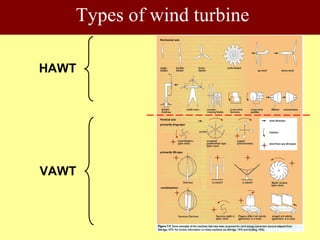
Types of wind turbine

HAWT


VAWT
Vertical Axis Wind Turbine (VAWT)

 1920 :Invented by G. M. Darrieus
  (French Engineer): Darrieus Rotor
 500 kW, 34m long was undertaken in
  1980 by Sandia national Lab, USA
  but leaving the business in 1997
Common HAWT Construction


  Rotor


• Blades are connected to a hub, which is connected to a shaft
• Rotational speed will depend on blade geometry, number of blades, and wind
  speed (40 to 400 revolutions per minute typical speed range)
• Gear box needed to increase speed to 1200-1800 RPM for generator
Wind Turbine
Blade Design
3D View of 1.5 mw turbine
Number of Blades – One

 Rotor must move more
  rapidly to capture same
  amount of wind
   – Gearbox ratio reduced
   – Added weight of
     counterbalance negates some
     benefits of lighter design
   – Higher speed means more
     noise, visual, and wildlife
     impacts
 Blades easier to install
  because entire rotor can be
  assembled on ground
 Captures 10% less energy
  than two blade design
 Ultimately provide no cost
  savings
Number of Blades - Two
 Advantages &
  disadvantages
  similar to one
  blade
 Need teetering hub
  and or shock
  absorbers because
  of gyroscopic
  imbalances
 Capture 5% less
  energy than three
  blade designs
Number of Blades - Three


 Balance of
  gyroscopic forces
 Slower rotation
  – increases gearbox &
    transmission costs
  – More aesthetic, less
    noise, fewer bird
    strikes
Blade Composition Metal


 Steel
  – Heavy & expensive
 Aluminum
  – Lighter-weight and easy
    to work with turbine
  – Expensive
  – Subject to metal fatigue
Features of major Components & Systems

                Tubular Tower for better load carrying capacity
Tower           Designed stiffness to eliminate critical natural
                frequencies
                Designed to reduce the dynamic stresses to
                minimum
                Load Separation plate inserted inside
                foundation for better stability and better load
                distribution.
                Ergonomically designed tower internals with
                necessary safety equipment, like fall arrester
                Superior cable management systems with
                specific designed clamp for less wear and tear
                while twisting
                Epoxy coating
                Ultrasonic and Radiography tests
                Less maintenance as compared to lattice
Technical specification
 Tower       Nominal Power -1500 kW
                           Rotor diameter - 82 m
                         Hub height- 78.5m
                        Rotor cone angle- 4.3°
                        Swept area -5281 m2
              Rotor speed (at rated power) -16.30 rpm
                  Rotational speed 15.6 -18.4 rpm
                Tip speed (at rated power)- 70 m/s
                         Blade length -40 m
                  Generator Stator Voltage -690 V
              Speed at rated power and shortcut rotor-
                             1,511 rpm
                          Start wind 4 m/s
                          Stop wind 20 m/s
Turbines: Different Sizes and Applications

         Small (≤10 kW)
         • Homes (Grid-connected)                    Intermediate
         • Farms
         • Remote Applications                        (10-500 kW)
                                                     • Village Power
          (e.g. battery changing, water
         pumping, telecom sites)                     • Hybrid Systems
                                                     • Distributed
                                                     Power

                                     Large (500 kW – 5 MW)
                                     • Central Station Wind Farms
                                     • Distributed Power
                                     • Offshore Wind
Wind Turbine Size-Power Comparison
Nacelle for 1.65-MW turbine
Wind Turbine Perspective for 1.5mw
                  Workers              Blade
                                      112’ long


                                   Nacelle
                                    56 tons


                                Tower
                               3 sections
Wind Turbine Technology
                        2
              2.0

                       1.8

                       1.6

                       1.4

                       1.2
     MW


          Pt
               i        1

                       0.8

                       0.6

                       0.4

                       0.2

                   0    0
                             0   5   10             15   20   25
                             0             vw                 25
                                                i
                                     Wind Speed (m/s)

          Power curve for a 1.5 MW variable-speed, pitch-
             40

          controlled wind turbine. Note “flatness” of output
             35
          for wind speeds at or above rated value
                       30

          Source: AWEA
                       25
 W


     P    v
Wind farms


Source: http://news.medill.northwestern.edu/chicago/news.aspx?   Source: http://www.sharonpavey.org/luppitt-looking-forward-to-a-sustainable-
id=100757&print=1                                                future/


   Most wind turbines are rather small in generating capacity (e.g., 50 to 500 kW. There are
   some very large units to about 1 MW. At these power levels, many turbines are needed to
   obtain desirable power levels – typically well above 100 MW. The many turbines are often
   organized into ‘wind farms’ as shown here.                                           27
ADVANTAGES OF WIND POWER:


1. The wind is free and with modern technology it can be
captured                        efficiently.
2. Once the wind turbine is built the energy it produces does not
cause    green    house     gases    or    other    pollutants.
3. Although wind turbines can be very tall each takes up only a
small plot of land. This means that the land below can still be
used. This is especially the case in agricultural areas as farming
can                 still                continue.
4. Many people find wind farms an interesting feature of the
landscape.
5. Remote areas that are not connected to the electricity power
grid can use wind turbines to produce their own supply.
6. Wind turbines have a role to play in both the developed and
third                            world.
7. Wind turbines are available in a range of sizes which means a
vast range of people and businesses can use them. Single
DISADVANTAGES OF WIND POWER :

1. The strength of the wind is not constant and it varies from zero to
storm force. This means that wind turbines do not produce the same
amount of electricity all the time. There will be times when they
produce           no          electricity         at         all.
2. Many people feel that the countryside should be left untouched,
without these large structures being built. The landscape should left in
its     natural      form       for      everyone      to     enjoy.
3. Wind turbines are noisy. Each one can generate the same level of
noise    as     a    family    car     travelling   at    70      mph.
4. Many people see large wind turbines as unsightly structures and not
pleasant or interesting to look at. They disfigure the countryside and
are                   generally                   ugly.
5. When wind turbines are being manufactured some pollution is
produced. Therefore wind power does produce some pollution.
6. Large wind farms are needed to provide entire communities with
enough electricity. For example, the largest single turbine available
today can only provide enough electricity for 475 homes, when running
at full capacity. How many would be needed for a town of 100 000
people?
 wind energy Seminar

wind energy Seminar

  • 1.
    Renewable Energy Resources By : Pradeep Choudhary Completed from:suzlon energy ltd. jaisalmer
  • 2.
    Wind Energy Technology Pradeep choudhary Department of Electronics & communication Engineering, Gits,udaipur
  • 3.
    Wind Power Potential The wind power potential on a national level, base data collected from 10 states considering only 1% of land availability, is around 46,092 MW. Wind Speed: 6.0 m/s Wind Speed: 6.4 m/s Wind Speed: 7.0 m/s Wind Speed: 7.5 m/s Wind Speed: 8.0m/s
  • 4.
  • 5.
    Turbine Evolution Used for • Pumping water • Grinding grain Mainly used for • Generating Electricity
  • 6.
    Over 3,000 yearsago, the ancient Egyptians used wind power to sail their ships on the Nile River. Later, people built windmills to grind their grain. In 1891, the first electrical output wind machine was developed incorporating the aerodynamic design principles.
  • 7.
    Energy Cost Trend 1979: 20 INR/kWh 2000: 3 INR/kWh  Increased Turbine Size  Manufacturing Improvements 2012: 1.5 INR/kWh
  • 8.
    TYPES OF WINDTURBINES  1. Onshore:  Onshore wind turbines are placed in hilly and mountainous places and are at least three kilometers away from the nearest shore.  2. Near-shore Near-shore wind turbines are installed within three kilometers from the nearest shore or on water within ten kilometers from land.  3.Offshore  Offshore wind turbines’ developement zones are at least ten kilometers away from land.
  • 9.
    Why Wind Energy? Wind,for now, is the renewable energy resource/technology of choice “Free” resource A “clean” resource due to:  Replacement of a “dirty” energy source (coal) and,  No emissions associated with its use Can be utilized on underutilized land or on lands currently in commodity crop production (“harvest” on the surface and “harvest” above the surface)
  • 10.
    Wind Energy Benefits No air emissions No fuel to mine, transport, or store No cooling water No water pollution No wastes
  • 11.
    Types of windturbine HAWT VAWT
  • 12.
    Vertical Axis WindTurbine (VAWT)  1920 :Invented by G. M. Darrieus (French Engineer): Darrieus Rotor  500 kW, 34m long was undertaken in 1980 by Sandia national Lab, USA but leaving the business in 1997
  • 13.
    Common HAWT Construction Rotor • Blades are connected to a hub, which is connected to a shaft • Rotational speed will depend on blade geometry, number of blades, and wind speed (40 to 400 revolutions per minute typical speed range) • Gear box needed to increase speed to 1200-1800 RPM for generator
  • 14.
  • 15.
    3D View of1.5 mw turbine
  • 16.
    Number of Blades– One  Rotor must move more rapidly to capture same amount of wind – Gearbox ratio reduced – Added weight of counterbalance negates some benefits of lighter design – Higher speed means more noise, visual, and wildlife impacts  Blades easier to install because entire rotor can be assembled on ground  Captures 10% less energy than two blade design  Ultimately provide no cost savings
  • 17.
    Number of Blades- Two  Advantages & disadvantages similar to one blade  Need teetering hub and or shock absorbers because of gyroscopic imbalances  Capture 5% less energy than three blade designs
  • 18.
    Number of Blades- Three  Balance of gyroscopic forces  Slower rotation – increases gearbox & transmission costs – More aesthetic, less noise, fewer bird strikes
  • 19.
    Blade Composition Metal Steel – Heavy & expensive  Aluminum – Lighter-weight and easy to work with turbine – Expensive – Subject to metal fatigue
  • 20.
    Features of majorComponents & Systems  Tubular Tower for better load carrying capacity Tower  Designed stiffness to eliminate critical natural  frequencies  Designed to reduce the dynamic stresses to  minimum  Load Separation plate inserted inside  foundation for better stability and better load  distribution.  Ergonomically designed tower internals with  necessary safety equipment, like fall arrester  Superior cable management systems with  specific designed clamp for less wear and tear  while twisting  Epoxy coating  Ultrasonic and Radiography tests  Less maintenance as compared to lattice
  • 21.
    Technical specification  Tower Nominal Power -1500 kW Rotor diameter - 82 m Hub height- 78.5m Rotor cone angle- 4.3° Swept area -5281 m2 Rotor speed (at rated power) -16.30 rpm Rotational speed 15.6 -18.4 rpm Tip speed (at rated power)- 70 m/s Blade length -40 m Generator Stator Voltage -690 V Speed at rated power and shortcut rotor- 1,511 rpm Start wind 4 m/s Stop wind 20 m/s
  • 22.
    Turbines: Different Sizesand Applications Small (≤10 kW) • Homes (Grid-connected) Intermediate • Farms • Remote Applications (10-500 kW) • Village Power (e.g. battery changing, water pumping, telecom sites) • Hybrid Systems • Distributed Power Large (500 kW – 5 MW) • Central Station Wind Farms • Distributed Power • Offshore Wind
  • 23.
  • 24.
  • 25.
    Wind Turbine Perspectivefor 1.5mw Workers Blade 112’ long Nacelle 56 tons Tower 3 sections
  • 26.
    Wind Turbine Technology 2 2.0 1.8 1.6 1.4 1.2 MW Pt i 1 0.8 0.6 0.4 0.2 0 0 0 5 10 15 20 25 0 vw 25 i Wind Speed (m/s) Power curve for a 1.5 MW variable-speed, pitch- 40 controlled wind turbine. Note “flatness” of output 35 for wind speeds at or above rated value 30 Source: AWEA 25 W P v
  • 27.
    Wind farms Source: http://news.medill.northwestern.edu/chicago/news.aspx? Source: http://www.sharonpavey.org/luppitt-looking-forward-to-a-sustainable- id=100757&print=1 future/ Most wind turbines are rather small in generating capacity (e.g., 50 to 500 kW. There are some very large units to about 1 MW. At these power levels, many turbines are needed to obtain desirable power levels – typically well above 100 MW. The many turbines are often organized into ‘wind farms’ as shown here. 27
  • 28.
    ADVANTAGES OF WINDPOWER: 1. The wind is free and with modern technology it can be captured efficiently. 2. Once the wind turbine is built the energy it produces does not cause green house gases or other pollutants. 3. Although wind turbines can be very tall each takes up only a small plot of land. This means that the land below can still be used. This is especially the case in agricultural areas as farming can still continue. 4. Many people find wind farms an interesting feature of the landscape. 5. Remote areas that are not connected to the electricity power grid can use wind turbines to produce their own supply. 6. Wind turbines have a role to play in both the developed and third world. 7. Wind turbines are available in a range of sizes which means a vast range of people and businesses can use them. Single
  • 29.
    DISADVANTAGES OF WINDPOWER : 1. The strength of the wind is not constant and it varies from zero to storm force. This means that wind turbines do not produce the same amount of electricity all the time. There will be times when they produce no electricity at all. 2. Many people feel that the countryside should be left untouched, without these large structures being built. The landscape should left in its natural form for everyone to enjoy. 3. Wind turbines are noisy. Each one can generate the same level of noise as a family car travelling at 70 mph. 4. Many people see large wind turbines as unsightly structures and not pleasant or interesting to look at. They disfigure the countryside and are generally ugly. 5. When wind turbines are being manufactured some pollution is produced. Therefore wind power does produce some pollution. 6. Large wind farms are needed to provide entire communities with enough electricity. For example, the largest single turbine available today can only provide enough electricity for 475 homes, when running at full capacity. How many would be needed for a town of 100 000 people?