Module 4. Wind Energy
i. Wind is caused by the uneven heating of the atmosphere by the sun, variations in the earth's surface, and rotation
of the earth. Thus the wind energy is a form of solar energy
ii. Wind is the moving air and is caused by the differences in air pressure in our atmosphere.
iii. Wind energy (or wind power) describes the process by which wind is used to generate electricity
iv. Wind turbines convert the kinetic energy in the wind into mechanical power by rotating propeller like blades.
PROPERTIES OF WIND
• Wind is non-conventional energy source
• Wind is due to differences in air pressure in the atmosphere
• Wind at high pressure tends to move to areas at low air pressure, greater the pressure difference faster will be the flow of
air
• The wind is also a critical means of transportation for seeds, insects, and birds, which can travel on wind currents for
thousands of miles.
• Wind is characterized by two parameters. They are wind speed and wind direction.
Wind speed indicates the speed of air movement from one point to another measured through a device called
“anemometer” and
wind direction indicated the direction at which air is moving measured through a device “wind vane” attached to a
direction indicator.
AVAILABILITY OF WIND ENERGY IN INDIA
• Wind power generation capacity in India has significantly increased in recent years. As of 31
January 2023, the total installed wind power capacity was 41.983 gigawatts (GW).
• The fourth largest installed wind power capacity in the world. Wind power capacity is mainly
spread across the southern, western, and northwestern states.
• Wind in India are influenced by the strong south-west summer monsoon, which starts in May-June,
when cool, humid air moves towards the land; further, the weak north-east winter monsoon, which
starts in October, when cool, dry air moves towards the ocean.
• During March- August, the winds are uniformly strong over the whole Indian Peninsula, except the
eastern peninsular coast. Wind speeds during November-March are relatively weak, although high
winds are available during a part of the period on the Tamil Nadu coastline.
WIND VELOCITY
Wind velocity is the measure of speed of wind in horizontal direction
It is a measure of air ventilation which has a direct effect on outdoor thermal comfort
WIND POWER
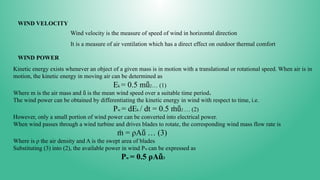
Kinetic energy exists whenever an object of a given mass is in motion with a translational or rotational speed. When air is in
motion, the kinetic energy in moving air can be determined as
Ek = 0.5 mṻ2… (1)
Where m is the air mass and is the mean wind speed over a suitable time period
ṻ .
The wind power can be obtained by differentiating the kinetic energy in wind with respect to time, i.e.
Pw = dEk / dt = 0.5 ṁṻ2 … (2)
However, only a small portion of wind power can be converted into electrical power.
When wind passes through a wind turbine and drives blades to rotate, the corresponding wind mass flow rate is
=
ṁ ρA … (3)
ṻ
Where is ρ the air density and A is the swept area of blades
Substituting (3) into (2), the available power in wind Pw can be expressed as
Pw = 0.5 ρAṻ3
MAJOR PROBLEMS ASSOCIATED WITH WIND POWER
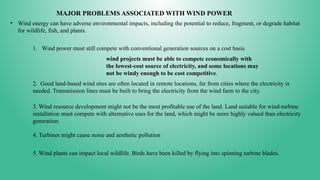
• Wind energy can have adverse environmental impacts, including the potential to reduce, fragment, or degrade habitat
for wildlife, fish, and plants.
1. Wind power must still compete with conventional generation sources on a cost basis
wind projects must be able to compete economically with
the lowest-cost source of electricity, and some locations may
not be windy enough to be cost competitive.
2. Good land-based wind sites are often located in remote locations, far from cities where the electricity is
needed. Transmission lines must be built to bring the electricity from the wind farm to the city.
3. Wind resource development might not be the most profitable use of the land. Land suitable for wind-turbine
installation must compete with alternative uses for the land, which might be more highly valued than electricity
generation.
4. Turbines might cause noise and aesthetic pollution
5. Wind plants can impact local wildlife. Birds have been killed by flying into spinning turbine blades.
WIND MACHINES
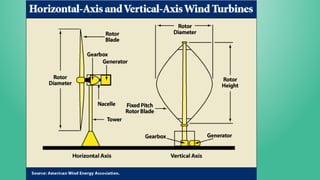
Wind machines or wind turbines or wind energy converter, are the devices that converts the wind's kinetic energy
into electrical energy. Wind turbines are manufactured in a wide range of sizes, with either horizontal or vertical
axes.
Types of wind machines
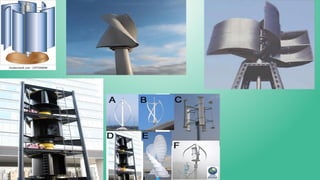
• Vertical-axis wind turbines (VAWT)
• Darrieus (which uses lift forces generated by aerofoil)
• Savonius (which uses drag forces)
• Horizontal-axis wind turbines (HAWT)
• Dutch windmills
• Multi-blade water-pumping windmills
• High-speed propeller-type wind machines
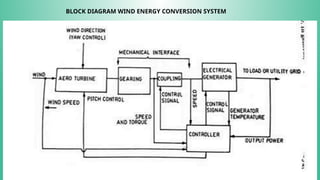
BLOCK DIAGRAM WIND ENERGY CONVERSION SYSTEM
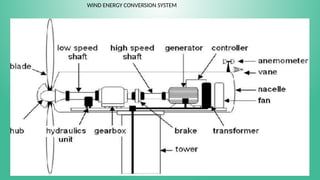
WIND ENERGY CONVERSION SYSTEM
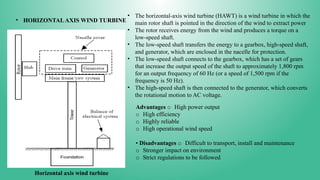
• HORIZONTALAXIS WIND TURBINE
Horizontal axis wind turbine
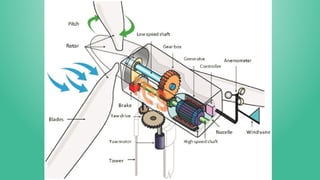
• The horizontal-axis wind turbine (HAWT) is a wind turbine in which the
main rotor shaft is pointed in the direction of the wind to extract power
• The rotor receives energy from the wind and produces a torque on a
low-speed shaft.
• The low-speed shaft transfers the energy to a gearbox, high-speed shaft,
and generator, which are enclosed in the nacelle for protection.
• The low-speed shaft connects to the gearbox, which has a set of gears
that increase the output speed of the shaft to approximately 1,800 rpm
for an output frequency of 60 Hz (or a speed of 1,500 rpm if the
frequency is 50 Hz).
• The high-speed shaft is then connected to the generator, which converts
the rotational motion to AC voltage.
Advantages o High power output
o High efficiency
o Highly reliable
o High operational wind speed
• Disadvantages o Difficult to transport, install and maintenance
o Stronger impact on environment
o Strict regulations to be followed
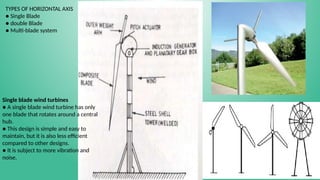
TYPES OF HORIZONTAL AXIS
● Single Blade
● double Blade
● Multi-blade system
Single blade wind turbines
● A single blade wind turbine has only
one blade that rotates around a central
hub.
● This design is simple and easy to
maintain, but it is also less efficient
compared to other designs.
● It is subject to more vibration and
noise.
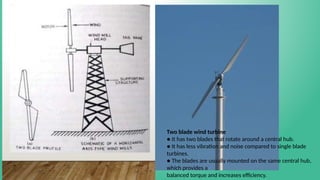
Two blade wind turbine
● It has two blades that rotate around a central hub.
● It has less vibration and noise compared to single blade
turbines.
● The blades are usually mounted on the same central hub,
which provides a
balanced torque and increases efficiency.
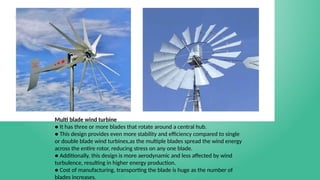
Multi blade wind turbine
● It has three or more blades that rotate around a central hub.
● This design provides even more stability and efficiency compared to single
or double blade wind turbines,as the multiple blades spread the wind energy
across the entire rotor, reducing stress on any one blade.
● Additionally, this design is more aerodynamic and less affected by wind
turbulence, resulting in higher energy production.
● Cost of manufacturing, transporting the blade is huge as the number of
blades increases.
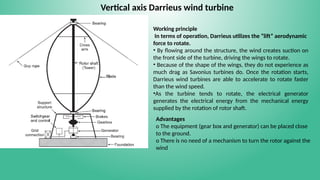
Vertical axis Darrieus wind turbine
Working principle
In terms of operation, Darrieus utilizes the “lift” aerodynamic
force to rotate.
• By flowing around the structure, the wind creates suction on
the front side of the turbine, driving the wings to rotate.
• Because of the shape of the wings, they do not experience as
much drag as Savonius turbines do. Once the rotation starts,
Darrieus wind turbines are able to accelerate to rotate faster
than the wind speed.
•As the turbine tends to rotate, the electrical generator
generates the electrical energy from the mechanical energy
supplied by the rotation of rotor shaft.
Advantages
o The equipment (gear box and generator) can be placed close
to the ground.
o There is no need of a mechanism to turn the rotor against the
wind
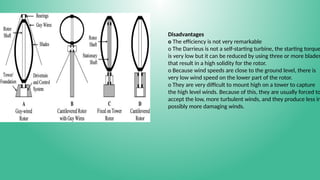
Disadvantages
o The efficiency is not very remarkable
o The Darrieus is not a self-starting turbine, the starting torque
is very low but it can be reduced by using three or more blades
that result in a high solidity for the rotor.
o Because wind speeds are close to the ground level, there is
very low wind speed on the lower part of the rotor.
o They are very difficult to mount high on a tower to capture
the high level winds. Because of this, they are usually forced to
accept the low, more turbulent winds, and they produce less in
possibly more damaging winds.
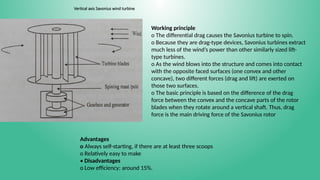
Vertical axis Savonius wind turbine
Working principle
o The differential drag causes the Savonius turbine to spin.
o Because they are drag-type devices, Savonius turbines extract
much less of the wind’s power than other similarly sized lift-
type turbines.
o As the wind blows into the structure and comes into contact
with the opposite faced surfaces (one convex and other
concave), two different forces (drag and lift) are exerted on
those two surfaces.
o The basic principle is based on the difference of the drag
force between the convex and the concave parts of the rotor
blades when they rotate around a vertical shaft. Thus, drag
force is the main driving force of the Savonius rotor
Advantages
o Always self-starting, if there are at least three scoops
o Relatively easy to make
• Disadvantages
o Low efficiency: around 15%.
ELEMENTARY DESIGN PRINCIPLES
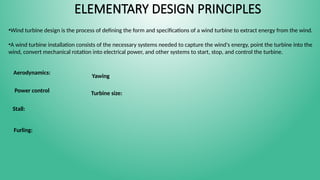
•Wind turbine design is the process of defining the form and specifications of a wind turbine to extract energy from the wind.
•A wind turbine installation consists of the necessary systems needed to capture the wind's energy, point the turbine into the
wind, convert mechanical rotation into electrical power, and other systems to start, stop, and control the turbine.
Aerodynamics:
Power control
Stall:
Furling:
Yawing
Turbine size:
Aerodynamics: The shape and dimensions of the blades of the
wind turbine are determined by the aerodynamic performance
required to efficiently extract energy from the wind, and by the
strength required to resist the forces on the blade.
Power control: The centrifugal force on the spinning blades
increases as the square of the rotation speed, which makes this
structure sensitive to over speed. A wind turbine is designed to
produce power over a range of wind speeds.
Stall: A stall on an airfoil occurs when air passes over it in such
a way that the generation of lift rapidly decreases. Usually this
is due to a high angle of attack (AOA), but can also result from
dynamic effects. The blades of a wind turbine with fixed pitch
can be aerodynamically designed to stall in high wind speeds,
causing slower rotation.
Furling: Furling works by decreasing the angle of attack, which
reduces the induced drag from the lift of the rotor, as well as
the cross-section. A fully furled turbine blade, when stopped,
has the edge of the blade facing into the wind.
Yawing: Modern large wind turbines are typically actively
controlled to face the wind direction measured by a wind vane
situated on the back of the nacelle. By minimizing the yaw
angle (the misalignment between wind and turbine pointing
direction), the power output is maximized and non-symmetrical
loads minimized
Turbine size: For a given survivable wind speed, the mass of a
turbine is approximately proportional to the cube of its blade-
length. Wind power intercepted by the turbine is proportional
to the square of its blade-length. The maximum blade-length of
a turbine is limited by both the strength, the stiffness of its
material, and transportation considerations
AERODYNAMIC CONSIDERATIONS IN WIND MILL DESIGN
There are two primary physical principles by which energy
can be extracted from the wind. These are through the
creation of either lift or drag force
Air flow over a stationary airfoil produces two forces, a lift
force perpendicular to the air flow and a drag force in the
direction of air flow
The existence of the lift force depends upon laminar flow
over the airfoil, which means that the air flows smoothly
over both sides of the airfoil. If turbulent flow exists rather
than laminar flow, there will be little or no lift force.
Lift Force: The lift force (FL) arises in a direction that is
perpendicular to the airstream caused by Bernoulli’s effect
that lowers the pressure on the top of the airfoil when
compared with the pressure on its bottom. The curvature on
the top leads to a higher stream velocity than at the bottom
and hence a lower pressure.
Let (FL) is the lift force in Newton, (SL) is the cross-
sectional area of airfoil in m2, ρ is the air density in
kg/m2, and V is the wind speed in m/s2. Then, lift
coefficient (CL) is
defined as follows
CL = [FL/SL} / [(1/2) ρV2]
Drag force (FD): It is described as follows, Where CD = drag coefficient and SD = Effective area of airfoil
in the direction of drag force.
CD = [FD/SD] / [(1/2) ρV2]
TIDAL ENERGY
Tidal energy is produced by the surge of ocean waters during the rise and fall of tides
Tidal energy is a renewable source of energy harnessed by converting energy from tides into useful forms of power,
mainly electricity
TIDES AND WAVES AS ENERGY SUPPLIERS AND THEIR MECHANICS
•Tidal power is taken from the Earth's oceanic tides. Tidal forces are periodic variations in gravitational attraction exerted by
celestial bodies. These forces create corresponding motions or currents in the world's oceans.
• Due to the strong attraction to the oceans, a bulge in the water level is created, causing a temporary increase in sea level.
• As the Earth rotates, this bulge of ocean water meets the shallow water adjacent to the shoreline and creates a tide. This
occurrence takes place in an unfailing manner, due to the consistent pattern of the moon's orbit around the earth.
• The magnitude and character of this motion reflects the changing positions of the Moon and Sun relative to the Earth, the
effects of Earth's rotation, and local geography of the seafloor and coastlines.
• The rise of seawater is called high tide and fall in seawater is called low tide and this process of rising and receding of water
waves happen twice a day and cause enormous movement of water. Thus, enormous rising and falling movement of water is
called tidal energy, which is a large source of energy and can be harnessed in many coastal areas of the world.
FUNDAMENTAL CHARACTERISTICS OF TIDAL POWER
•Tidal power or tidal energy is a form of hydropower that converts the energy obtained from tides into useful forms of power,
mainly electricity.
• Although not yet widely used, tidal energy has potential for future electricity generation.
• Tidal power is the only technology that draws on energy inherent in the orbital characteristics of the Earth–Moon system,
and to a lesser extent in the Earth–Sun system.
• Greater tidal variation and higher tidal current velocities can dramatically increase the potential of a site for tidal electricity
generation.
• Tidal power is also relatively prosperous at low speeds, in contrast to wind power. Water has one thousand times higher
density than air and tidal turbines can generate electricity at speeds as low as 1m/s, or 2.2mph.
•Tidal energy is clean, renewable, and sustainable form of energy resource. It has no impact on climate because it does not
produce any greenhouse gases.
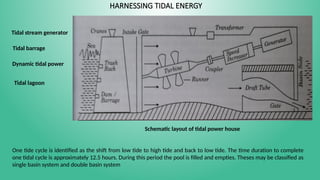
HARNESSING TIDAL ENERGY
Tidal stream generator
Tidal barrage
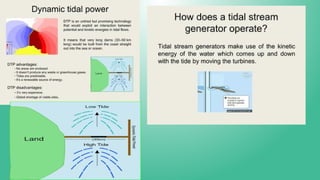
Dynamic tidal power
Tidal lagoon
Schematic layout of tidal power house
One tide cycle is identified as the shift from low tide to high tide and back to low tide. The time duration to complete
one tidal cycle is approximately 12.5 hours. During this period the pool is filled and empties. Theses may be classified as
single basin system and double basin system
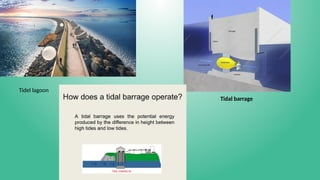
Tidel lagoon
Tidal barrage
LIMITATIONS
•Economic recovery of energy from tides is feasible only at those sites where energy is concentrated in the form
of tidal range of about 5 m or more and geography provide favorable site for economic construction of a tidal
plant, thus it is site specific
• Due to mismatch of lunar driven period of 12.5 hours and human (solar) period of 24 hours, the optimum
tidal power generation is not in phase with demand
• Changing tidal range in two weeks period produces changing power
• The turbines are required to operate at variable heads
• Requirement of large water volume flow at low head necessitates parallel operation of many turbines
• Tidal plant disrupts marine life at the location and can cause potential harm to ecology
• It requires very large capital cost at most potential installations
• The location of sites may be distant from the demand centers
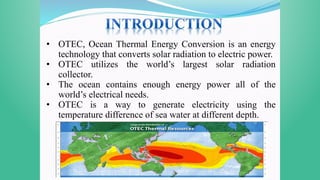
OCEAN THERMAL ENERGY
About 70% of earth’s surface is covered by ocean which is continuously heated by solar heat. Solar heat is stored as
uneven distribution of heat between warm surface water and cold deep ocean water (called gradient) from where it is
harnessed as ocean thermal energy
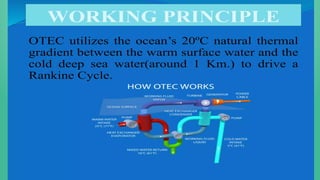
PRINCIPLE OF WORKING
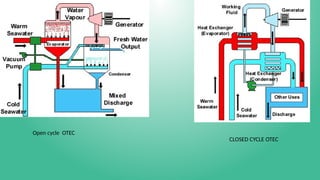
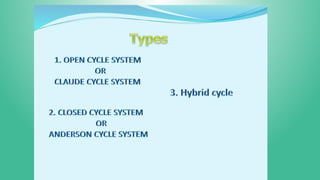
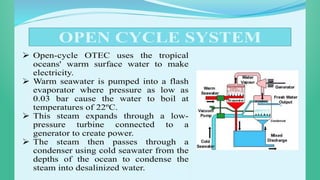
Open cycle OTEC
• If ocean surface water is high, enough propane or similar
material is used as working fluid; otherwise, for low-
temperature surface water, fluid such as ammonia with low
boiling point is used.
• In an open-cycle OETC, warm ocean surface water is pumped
into a low-pressure boiler to boil and produce steam.
• Then, the steam is used in steam turbine to drive an electrical
generator for producing electrical power. The cold deep sea
water is used in condenser to condense steam.
• Some fractions of electrical power generated by OTEC plants
are used for operating and controlling equipment involved in
power plants, and high electrical power is used for feeding to
several other energy consumers.
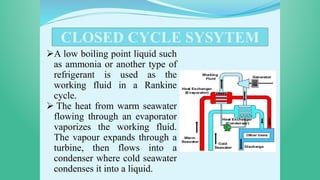
Closed cycle OTEC
• The warm water from the ocean surface is collected and
pumped through the heat exchanger to heat and vaporize
a working fluid, and it develops pressure in a secondary
cycle.
• Then, the vaporized working fluid expands through a
heat engine (similar to a turbine) coupled to an electric
generator that generates electrical power.
• Working fluid vapor coming out of heat engine is
condensed back into liquid by a condenser.
• Cold deep ocean water is pumped through condenser
where the vapor is cooled and returns to liquid state.
• The liquid (working fluid) is pumped again through heat
exchanger and cycle repeats. It is known as closed-cycle
OTEC.
Open cycle OTEC
CLOSED CYCLE OTEC
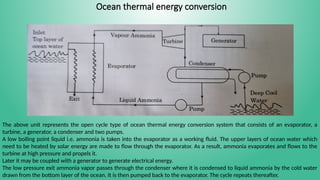
Ocean thermal energy conversion
The above unit represents the open cycle type of ocean thermal energy conversion system that consists of an evaporator, a
turbine, a generator, a condenser and two pumps.
A low boiling point liquid i.e. ammonia is taken into the evaporator as a working fluid. The upper layers of ocean water which
need to be heated by solar energy are made to flow through the evaporator. As a result, ammonia evaporates and flows to the
turbine at high pressure and propels it.
Later it may be coupled with a generator to generate electrical energy.
The low pressure exit ammonia vapor passes through the condenser where it is condensed to liquid ammonia by the cold water
drawn from the bottom layer of the ocean. It is then pumped back to the evaporator. The cycle repeats thereafter.
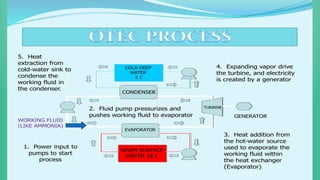
RANKINE CYCLE
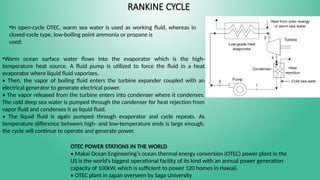
•In open-cycle OTEC, warm sea water is used as working fluid, whereas in
closed-cycle type, low-boiling point ammonia or propane is
used.
•Warm ocean surface water flows into the evaporator which is the high-
temperature heat source. A fluid pump is utilized to force the fluid in a heat
evaporator where liquid fluid vaporizes.
• Then, the vapor of boiling fluid enters the turbine expander coupled with an
electrical generator to generate electrical power.
• The vapor released from the turbine enters into condenser where it condenses.
The cold deep sea water is pumped through the condenser for heat rejection from
vapor fluid and condenses it as liquid fluid.
• The liquid fluid is again pumped through evaporator and cycle repeats. As
temperature difference between high- and low-temperature ends is large enough,
the cycle will continue to operate and generate power.
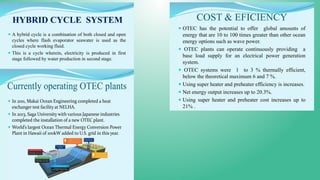
OTEC POWER STATIONS IN THE WORLD
• Makai Ocean Engineering’s ocean thermal energy conversion (OTEC) power plant in the
US is the world’s biggest operational facility of its kind with an annual power generation
capacity of 100kW, which is sufficient to power 120 homes in Hawaii.
• OTEC plant in Japan overseen by Saga University
PROBLEMS ASSOCIATED WITH OTEC
• High cost: Electricity generated by OTEC plants is more expensive than electricity produced by chemical and
nuclear fuels.
• Complexity: OTEC plants must be located where a difference of about 20°C occurs year round. Ocean
depths must be available fairly close to shore-based facilities for economic operation. Floating plant ships
could provide more flexibility.
• Acceptability: For the large-scale production of electricity and other products, OTEC plants are poorly
acceptable due to their high costs.
• Ecosystem damage: It is obvious by setting OTEC plants.
• Lower efficiency: A higher temperature difference between ocean surface warm water and cold deep ocean
water is required for highly efficient operation of plant.
4TH MODULE NCES  -  Read-Oaeryrhtrshnly.pptx

4TH MODULE NCES - Read-Oaeryrhtrshnly.pptx

  • 1.
    Module 4. WindEnergy i. Wind is caused by the uneven heating of the atmosphere by the sun, variations in the earth's surface, and rotation of the earth. Thus the wind energy is a form of solar energy ii. Wind is the moving air and is caused by the differences in air pressure in our atmosphere. iii. Wind energy (or wind power) describes the process by which wind is used to generate electricity iv. Wind turbines convert the kinetic energy in the wind into mechanical power by rotating propeller like blades. PROPERTIES OF WIND • Wind is non-conventional energy source • Wind is due to differences in air pressure in the atmosphere • Wind at high pressure tends to move to areas at low air pressure, greater the pressure difference faster will be the flow of air • The wind is also a critical means of transportation for seeds, insects, and birds, which can travel on wind currents for thousands of miles. • Wind is characterized by two parameters. They are wind speed and wind direction. Wind speed indicates the speed of air movement from one point to another measured through a device called “anemometer” and wind direction indicated the direction at which air is moving measured through a device “wind vane” attached to a direction indicator.
  • 2.
    AVAILABILITY OF WINDENERGY IN INDIA • Wind power generation capacity in India has significantly increased in recent years. As of 31 January 2023, the total installed wind power capacity was 41.983 gigawatts (GW). • The fourth largest installed wind power capacity in the world. Wind power capacity is mainly spread across the southern, western, and northwestern states. • Wind in India are influenced by the strong south-west summer monsoon, which starts in May-June, when cool, humid air moves towards the land; further, the weak north-east winter monsoon, which starts in October, when cool, dry air moves towards the ocean. • During March- August, the winds are uniformly strong over the whole Indian Peninsula, except the eastern peninsular coast. Wind speeds during November-March are relatively weak, although high winds are available during a part of the period on the Tamil Nadu coastline.
  • 3.
    WIND VELOCITY Wind velocityis the measure of speed of wind in horizontal direction It is a measure of air ventilation which has a direct effect on outdoor thermal comfort WIND POWER Kinetic energy exists whenever an object of a given mass is in motion with a translational or rotational speed. When air is in motion, the kinetic energy in moving air can be determined as Ek = 0.5 mṻ2… (1) Where m is the air mass and is the mean wind speed over a suitable time period ṻ . The wind power can be obtained by differentiating the kinetic energy in wind with respect to time, i.e. Pw = dEk / dt = 0.5 ṁṻ2 … (2) However, only a small portion of wind power can be converted into electrical power. When wind passes through a wind turbine and drives blades to rotate, the corresponding wind mass flow rate is = ṁ ρA … (3) ṻ Where is ρ the air density and A is the swept area of blades Substituting (3) into (2), the available power in wind Pw can be expressed as Pw = 0.5 ρAṻ3
  • 4.
    MAJOR PROBLEMS ASSOCIATEDWITH WIND POWER • Wind energy can have adverse environmental impacts, including the potential to reduce, fragment, or degrade habitat for wildlife, fish, and plants. 1. Wind power must still compete with conventional generation sources on a cost basis wind projects must be able to compete economically with the lowest-cost source of electricity, and some locations may not be windy enough to be cost competitive. 2. Good land-based wind sites are often located in remote locations, far from cities where the electricity is needed. Transmission lines must be built to bring the electricity from the wind farm to the city. 3. Wind resource development might not be the most profitable use of the land. Land suitable for wind-turbine installation must compete with alternative uses for the land, which might be more highly valued than electricity generation. 4. Turbines might cause noise and aesthetic pollution 5. Wind plants can impact local wildlife. Birds have been killed by flying into spinning turbine blades.
  • 5.
    WIND MACHINES Wind machinesor wind turbines or wind energy converter, are the devices that converts the wind's kinetic energy into electrical energy. Wind turbines are manufactured in a wide range of sizes, with either horizontal or vertical axes. Types of wind machines • Vertical-axis wind turbines (VAWT) • Darrieus (which uses lift forces generated by aerofoil) • Savonius (which uses drag forces) • Horizontal-axis wind turbines (HAWT) • Dutch windmills • Multi-blade water-pumping windmills • High-speed propeller-type wind machines
  • 6.
    BLOCK DIAGRAM WINDENERGY CONVERSION SYSTEM
  • 7.
  • 8.
    • HORIZONTALAXIS WINDTURBINE Horizontal axis wind turbine • The horizontal-axis wind turbine (HAWT) is a wind turbine in which the main rotor shaft is pointed in the direction of the wind to extract power • The rotor receives energy from the wind and produces a torque on a low-speed shaft. • The low-speed shaft transfers the energy to a gearbox, high-speed shaft, and generator, which are enclosed in the nacelle for protection. • The low-speed shaft connects to the gearbox, which has a set of gears that increase the output speed of the shaft to approximately 1,800 rpm for an output frequency of 60 Hz (or a speed of 1,500 rpm if the frequency is 50 Hz). • The high-speed shaft is then connected to the generator, which converts the rotational motion to AC voltage. Advantages o High power output o High efficiency o Highly reliable o High operational wind speed • Disadvantages o Difficult to transport, install and maintenance o Stronger impact on environment o Strict regulations to be followed
  • 10.
    TYPES OF HORIZONTALAXIS ● Single Blade ● double Blade ● Multi-blade system Single blade wind turbines ● A single blade wind turbine has only one blade that rotates around a central hub. ● This design is simple and easy to maintain, but it is also less efficient compared to other designs. ● It is subject to more vibration and noise.
  • 11.
    Two blade windturbine ● It has two blades that rotate around a central hub. ● It has less vibration and noise compared to single blade turbines. ● The blades are usually mounted on the same central hub, which provides a balanced torque and increases efficiency.
  • 12.
    Multi blade windturbine ● It has three or more blades that rotate around a central hub. ● This design provides even more stability and efficiency compared to single or double blade wind turbines,as the multiple blades spread the wind energy across the entire rotor, reducing stress on any one blade. ● Additionally, this design is more aerodynamic and less affected by wind turbulence, resulting in higher energy production. ● Cost of manufacturing, transporting the blade is huge as the number of blades increases.
  • 13.
    Vertical axis Darrieuswind turbine Working principle In terms of operation, Darrieus utilizes the “lift” aerodynamic force to rotate. • By flowing around the structure, the wind creates suction on the front side of the turbine, driving the wings to rotate. • Because of the shape of the wings, they do not experience as much drag as Savonius turbines do. Once the rotation starts, Darrieus wind turbines are able to accelerate to rotate faster than the wind speed. •As the turbine tends to rotate, the electrical generator generates the electrical energy from the mechanical energy supplied by the rotation of rotor shaft. Advantages o The equipment (gear box and generator) can be placed close to the ground. o There is no need of a mechanism to turn the rotor against the wind
  • 14.
    Disadvantages o The efficiencyis not very remarkable o The Darrieus is not a self-starting turbine, the starting torque is very low but it can be reduced by using three or more blades that result in a high solidity for the rotor. o Because wind speeds are close to the ground level, there is very low wind speed on the lower part of the rotor. o They are very difficult to mount high on a tower to capture the high level winds. Because of this, they are usually forced to accept the low, more turbulent winds, and they produce less in possibly more damaging winds.
  • 15.
    Vertical axis Savoniuswind turbine Working principle o The differential drag causes the Savonius turbine to spin. o Because they are drag-type devices, Savonius turbines extract much less of the wind’s power than other similarly sized lift- type turbines. o As the wind blows into the structure and comes into contact with the opposite faced surfaces (one convex and other concave), two different forces (drag and lift) are exerted on those two surfaces. o The basic principle is based on the difference of the drag force between the convex and the concave parts of the rotor blades when they rotate around a vertical shaft. Thus, drag force is the main driving force of the Savonius rotor Advantages o Always self-starting, if there are at least three scoops o Relatively easy to make • Disadvantages o Low efficiency: around 15%.
  • 18.
    ELEMENTARY DESIGN PRINCIPLES •Windturbine design is the process of defining the form and specifications of a wind turbine to extract energy from the wind. •A wind turbine installation consists of the necessary systems needed to capture the wind's energy, point the turbine into the wind, convert mechanical rotation into electrical power, and other systems to start, stop, and control the turbine. Aerodynamics: Power control Stall: Furling: Yawing Turbine size:
  • 19.
    Aerodynamics: The shapeand dimensions of the blades of the wind turbine are determined by the aerodynamic performance required to efficiently extract energy from the wind, and by the strength required to resist the forces on the blade. Power control: The centrifugal force on the spinning blades increases as the square of the rotation speed, which makes this structure sensitive to over speed. A wind turbine is designed to produce power over a range of wind speeds. Stall: A stall on an airfoil occurs when air passes over it in such a way that the generation of lift rapidly decreases. Usually this is due to a high angle of attack (AOA), but can also result from dynamic effects. The blades of a wind turbine with fixed pitch can be aerodynamically designed to stall in high wind speeds, causing slower rotation. Furling: Furling works by decreasing the angle of attack, which reduces the induced drag from the lift of the rotor, as well as the cross-section. A fully furled turbine blade, when stopped, has the edge of the blade facing into the wind. Yawing: Modern large wind turbines are typically actively controlled to face the wind direction measured by a wind vane situated on the back of the nacelle. By minimizing the yaw angle (the misalignment between wind and turbine pointing direction), the power output is maximized and non-symmetrical loads minimized Turbine size: For a given survivable wind speed, the mass of a turbine is approximately proportional to the cube of its blade- length. Wind power intercepted by the turbine is proportional to the square of its blade-length. The maximum blade-length of a turbine is limited by both the strength, the stiffness of its material, and transportation considerations
  • 20.
    AERODYNAMIC CONSIDERATIONS INWIND MILL DESIGN There are two primary physical principles by which energy can be extracted from the wind. These are through the creation of either lift or drag force Air flow over a stationary airfoil produces two forces, a lift force perpendicular to the air flow and a drag force in the direction of air flow The existence of the lift force depends upon laminar flow over the airfoil, which means that the air flows smoothly over both sides of the airfoil. If turbulent flow exists rather than laminar flow, there will be little or no lift force. Lift Force: The lift force (FL) arises in a direction that is perpendicular to the airstream caused by Bernoulli’s effect that lowers the pressure on the top of the airfoil when compared with the pressure on its bottom. The curvature on the top leads to a higher stream velocity than at the bottom and hence a lower pressure. Let (FL) is the lift force in Newton, (SL) is the cross- sectional area of airfoil in m2, ρ is the air density in kg/m2, and V is the wind speed in m/s2. Then, lift coefficient (CL) is defined as follows CL = [FL/SL} / [(1/2) ρV2]
  • 21.
    Drag force (FD):It is described as follows, Where CD = drag coefficient and SD = Effective area of airfoil in the direction of drag force. CD = [FD/SD] / [(1/2) ρV2]
  • 22.
    TIDAL ENERGY Tidal energyis produced by the surge of ocean waters during the rise and fall of tides Tidal energy is a renewable source of energy harnessed by converting energy from tides into useful forms of power, mainly electricity TIDES AND WAVES AS ENERGY SUPPLIERS AND THEIR MECHANICS •Tidal power is taken from the Earth's oceanic tides. Tidal forces are periodic variations in gravitational attraction exerted by celestial bodies. These forces create corresponding motions or currents in the world's oceans. • Due to the strong attraction to the oceans, a bulge in the water level is created, causing a temporary increase in sea level. • As the Earth rotates, this bulge of ocean water meets the shallow water adjacent to the shoreline and creates a tide. This occurrence takes place in an unfailing manner, due to the consistent pattern of the moon's orbit around the earth. • The magnitude and character of this motion reflects the changing positions of the Moon and Sun relative to the Earth, the effects of Earth's rotation, and local geography of the seafloor and coastlines. • The rise of seawater is called high tide and fall in seawater is called low tide and this process of rising and receding of water waves happen twice a day and cause enormous movement of water. Thus, enormous rising and falling movement of water is called tidal energy, which is a large source of energy and can be harnessed in many coastal areas of the world.
  • 23.
    FUNDAMENTAL CHARACTERISTICS OFTIDAL POWER •Tidal power or tidal energy is a form of hydropower that converts the energy obtained from tides into useful forms of power, mainly electricity. • Although not yet widely used, tidal energy has potential for future electricity generation. • Tidal power is the only technology that draws on energy inherent in the orbital characteristics of the Earth–Moon system, and to a lesser extent in the Earth–Sun system. • Greater tidal variation and higher tidal current velocities can dramatically increase the potential of a site for tidal electricity generation. • Tidal power is also relatively prosperous at low speeds, in contrast to wind power. Water has one thousand times higher density than air and tidal turbines can generate electricity at speeds as low as 1m/s, or 2.2mph. •Tidal energy is clean, renewable, and sustainable form of energy resource. It has no impact on climate because it does not produce any greenhouse gases.
  • 24.
    HARNESSING TIDAL ENERGY Tidalstream generator Tidal barrage Dynamic tidal power Tidal lagoon Schematic layout of tidal power house One tide cycle is identified as the shift from low tide to high tide and back to low tide. The time duration to complete one tidal cycle is approximately 12.5 hours. During this period the pool is filled and empties. Theses may be classified as single basin system and double basin system
  • 26.
  • 27.
    LIMITATIONS •Economic recovery ofenergy from tides is feasible only at those sites where energy is concentrated in the form of tidal range of about 5 m or more and geography provide favorable site for economic construction of a tidal plant, thus it is site specific • Due to mismatch of lunar driven period of 12.5 hours and human (solar) period of 24 hours, the optimum tidal power generation is not in phase with demand • Changing tidal range in two weeks period produces changing power • The turbines are required to operate at variable heads • Requirement of large water volume flow at low head necessitates parallel operation of many turbines • Tidal plant disrupts marine life at the location and can cause potential harm to ecology • It requires very large capital cost at most potential installations • The location of sites may be distant from the demand centers
  • 28.
    OCEAN THERMAL ENERGY About70% of earth’s surface is covered by ocean which is continuously heated by solar heat. Solar heat is stored as uneven distribution of heat between warm surface water and cold deep ocean water (called gradient) from where it is harnessed as ocean thermal energy PRINCIPLE OF WORKING Open cycle OTEC • If ocean surface water is high, enough propane or similar material is used as working fluid; otherwise, for low- temperature surface water, fluid such as ammonia with low boiling point is used. • In an open-cycle OETC, warm ocean surface water is pumped into a low-pressure boiler to boil and produce steam. • Then, the steam is used in steam turbine to drive an electrical generator for producing electrical power. The cold deep sea water is used in condenser to condense steam. • Some fractions of electrical power generated by OTEC plants are used for operating and controlling equipment involved in power plants, and high electrical power is used for feeding to several other energy consumers. Closed cycle OTEC • The warm water from the ocean surface is collected and pumped through the heat exchanger to heat and vaporize a working fluid, and it develops pressure in a secondary cycle. • Then, the vaporized working fluid expands through a heat engine (similar to a turbine) coupled to an electric generator that generates electrical power. • Working fluid vapor coming out of heat engine is condensed back into liquid by a condenser. • Cold deep ocean water is pumped through condenser where the vapor is cooled and returns to liquid state. • The liquid (working fluid) is pumped again through heat exchanger and cycle repeats. It is known as closed-cycle OTEC.
  • 29.
  • 30.
    Ocean thermal energyconversion The above unit represents the open cycle type of ocean thermal energy conversion system that consists of an evaporator, a turbine, a generator, a condenser and two pumps. A low boiling point liquid i.e. ammonia is taken into the evaporator as a working fluid. The upper layers of ocean water which need to be heated by solar energy are made to flow through the evaporator. As a result, ammonia evaporates and flows to the turbine at high pressure and propels it. Later it may be coupled with a generator to generate electrical energy. The low pressure exit ammonia vapor passes through the condenser where it is condensed to liquid ammonia by the cold water drawn from the bottom layer of the ocean. It is then pumped back to the evaporator. The cycle repeats thereafter.
  • 31.
    RANKINE CYCLE •In open-cycleOTEC, warm sea water is used as working fluid, whereas in closed-cycle type, low-boiling point ammonia or propane is used. •Warm ocean surface water flows into the evaporator which is the high- temperature heat source. A fluid pump is utilized to force the fluid in a heat evaporator where liquid fluid vaporizes. • Then, the vapor of boiling fluid enters the turbine expander coupled with an electrical generator to generate electrical power. • The vapor released from the turbine enters into condenser where it condenses. The cold deep sea water is pumped through the condenser for heat rejection from vapor fluid and condenses it as liquid fluid. • The liquid fluid is again pumped through evaporator and cycle repeats. As temperature difference between high- and low-temperature ends is large enough, the cycle will continue to operate and generate power. OTEC POWER STATIONS IN THE WORLD • Makai Ocean Engineering’s ocean thermal energy conversion (OTEC) power plant in the US is the world’s biggest operational facility of its kind with an annual power generation capacity of 100kW, which is sufficient to power 120 homes in Hawaii. • OTEC plant in Japan overseen by Saga University
  • 32.
    PROBLEMS ASSOCIATED WITHOTEC • High cost: Electricity generated by OTEC plants is more expensive than electricity produced by chemical and nuclear fuels. • Complexity: OTEC plants must be located where a difference of about 20°C occurs year round. Ocean depths must be available fairly close to shore-based facilities for economic operation. Floating plant ships could provide more flexibility. • Acceptability: For the large-scale production of electricity and other products, OTEC plants are poorly acceptable due to their high costs. • Ecosystem damage: It is obvious by setting OTEC plants. • Lower efficiency: A higher temperature difference between ocean surface warm water and cold deep ocean water is required for highly efficient operation of plant.