Department of EnergyEngineering
2
Agenda
1. Why Wind Energy?
2. History of Wind Energy.
3. Introduction.
4. Working and Design Considerations
5. Dutch Wind Mills
Department of EnergyEngineering
5
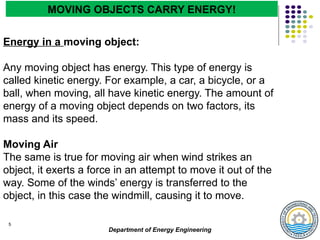
Energy in a moving object:
Any moving object has energy. This type of energy is
called kinetic energy. For example, a car, a bicycle, or a
ball, when moving, all have kinetic energy. The amount of
energy of a moving object depends on two factors, its
mass and its speed.
Moving Air
The same is true for moving air when wind strikes an
object, it exerts a force in an attempt to move it out of the
way. Some of the winds’ energy is transferred to the
object, in this case the windmill, causing it to move.
MOVING OBJECTS CARRY ENERGY!
6.
Department of EnergyEngineering
6
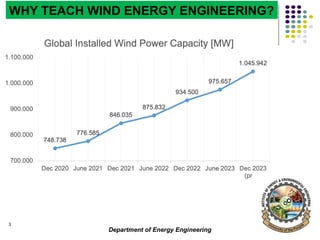
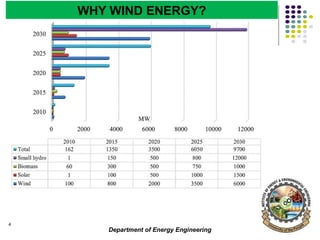
WHY WIND ENERGY?
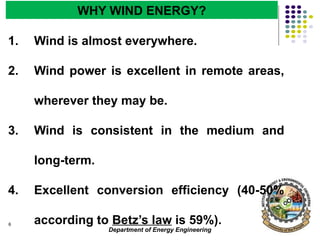
1. Wind is almost everywhere.
2. Wind power is excellent in remote areas,
wherever they may be.
3. Wind is consistent in the medium and
long-term.
4. Excellent conversion efficiency (40-50%
according to Betz’s law is 59%).
7.
Department of EnergyEngineering
7
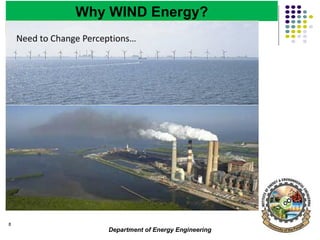
WHY WIND ENERGY?
1. Wind power occupies very little land.
2. The environmental impact is minimal.
3. A green source that is truly economical.
4. Maintenance is simple and only
occasionally necessary.
5. Excellent circularity in the end-of-life
phase.
Department of EnergyEngineering
9
CHALLENGES OF WIND POWER?
1. Wind power must compete with other low-
cost energy sources.
2. Ideal wind sites are often in remote
locations.
3. Turbines produce noise and alter visual
aesthetics.
4. Wind plants can impact local wildlife.
10.
Department of EnergyEngineering
10
HISTORY
1. Its use dates back to 5,000 years ago
(Righter, 2006, p. 35) •
2. Use decrease with invention of water and
fossil energies •
3. More developments in 19th and 20th
century
11.
Department of EnergyEngineering
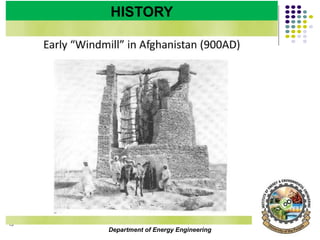
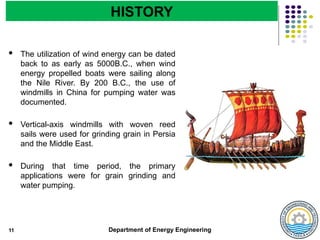
The utilization of wind energy can be dated
back to as early as 5000B.C., when wind
energy propelled boats were sailing along
the Nile River. By 200 B.C., the use of
windmills in China for pumping water was
documented.
Vertical-axis windmills with woven reed
sails were used for grinding grain in Persia
and the Middle East.
During that time period, the primary
applications were for grain grinding and
water pumping.
11
HISTORY
12.
Department of EnergyEngineering
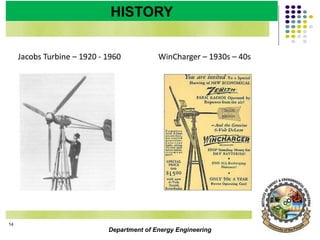
Between 1850 and 1970, over six million,
mostly small (one horsepower or less) [746
W] wind mills were installed in the U.S.
alone for conversion of the wind energy to
the mechanical energy.
The primary use was water-pumping for
stock watering and meeting the water
needs of farms and homes.
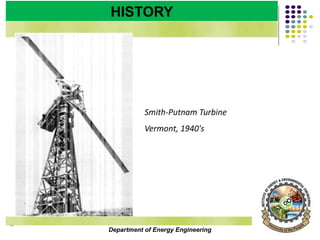
Very large windmills, with rotors up to 18 m
in diameter, were used to pump water for
the steam railroad trains that provided the
primary source of commercial
transportation in areas where there were no
navigable rivers.
12
HISTORY
Department of EnergyEngineering
INTRODUCTION
Wind is a form of Solar energy.
Wind is caused by the uneven heating of the earth’s surface
and rotation of the Earth Wind Turbines convert the kinetic
energy in the wind to mechanical power.
A generator can convert the mechanical power into
electricity.
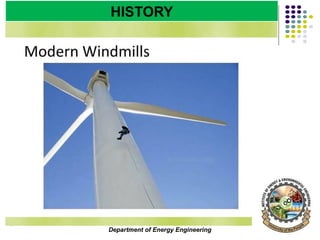
The kinetic energy of wind is harvested using wind turbines
to generate electricity.
17
18.
Department of EnergyEngineering
Among various renewable energy sources, wind
energy is the second most technologically advanced
renewable energy source; hydropower is the first.
Although there is a significant potential for
converting wind energy to electricity, a number of
issues must be addressed before it can be used to
its full potential.
18
INTRODUCTION
19.
Department of EnergyEngineering
19
WORKING OF WIND MILLS
Wind turbines operate on a simple principle. The
energy in the wind turns two or three propeller-like
blades around a rotor. The rotor is connected to the
main shaft, which spins a generator to create
electricity.
Wind turbines are mounted on a tower to capture
the most energy. At 100 feet (30 meters) or more
above ground.
20.
Department of EnergyEngineering
20
WORKING OF WIND MILLS
Wind turbines can be used to produce electricity for
a single home or building, or they can be connected
to an electricity grid for more widespread electricity
distribution.
21.
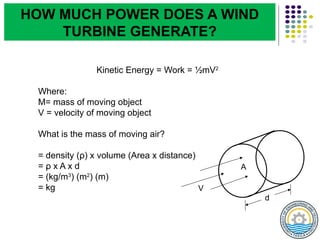
Kinetic Energy =Work = ½mV2
Where:
M= mass of moving object
V = velocity of moving object
What is the mass of moving air?
= density (ρ) x volume (Area x distance)
= ρ x A x d
= (kg/m3
) (m2
) (m)
= kg V
A
d
HOW MUCH POWER DOES A WIND
TURBINE GENERATE?
22.
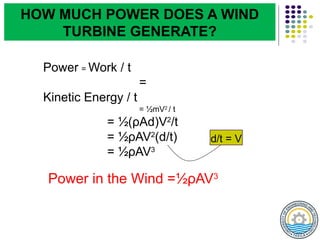
Power = Work/ t
=
Kinetic Energy / t
= ½mV2
/ t
= ½(ρAd)V2
/t
= ½ρAV2
(d/t)
= ½ρAV3
Power in the Wind =½ρAV3
d/t = V
HOW MUCH POWER DOES A WIND
TURBINE GENERATE?
23.
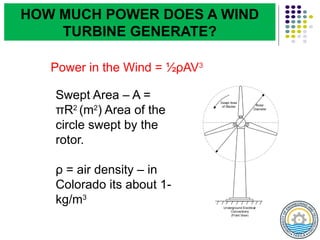
Power in theWind = ½ρAV3
Swept Area – A =
πR2
(m2
) Area of the
circle swept by the
rotor.
ρ = air density – in
Colorado its about 1-
kg/m3
HOW MUCH POWER DOES A WIND
TURBINE GENERATE?
24.
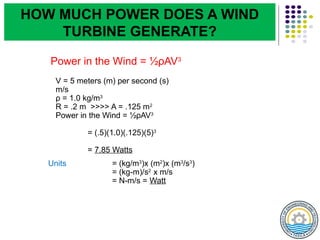
Power in theWind = ½ρAV3
V = 5 meters (m) per second (s)
m/s
ρ = 1.0 kg/m3
R = .2 m >>>> A = .125 m2
Power in the Wind = ½ρAV3
= (.5)(1.0)(.125)(5)3
= 7.85 Watts
Units = (kg/m3
)x (m2
)x (m3
/s3
)
= (kg-m)/s2
x m/s
= N-m/s = Watt
HOW MUCH POWER DOES A WIND
TURBINE GENERATE?
25.
Department of EnergyEngineering
A Windmill captures wind energy and then uses a
generator to convert it to electrical energy.
The design of a windmill is an integral part of how
efficient it will be.
When designing a windmill, one must decide on the
size of the turbine, and the size of the generator.
25
WIND MILL DESIGN
26.
Department of EnergyEngineering
WIND TURBINES LARGE TURBINES:
Able to deliver electricity at lower cost than smaller
turbines, because foundation costs, planning costs,
etc. are independent of size.
Well-suited for offshore wind plants.
In areas where it is difficult to find sites, one large
turbine on a tall tower uses the wind extremely
efficiently.
26
WIND MILL DESIGN
27.
Department of EnergyEngineering
SMALL TURBINES:
Local electrical grids may not be able to handle the
large electrical output from a large turbine, so
smaller turbines may be more suitable.
High costs for foundations for large turbines may not
be economical in some areas.
Landscape considerations
27
WIND MILL DESIGN
28.
Department of EnergyEngineering
Wind Turbines: Number of Blades
Most common design is the three-bladed turbine.
The most important reason is the stability of the
turbine. A rotor with an odd number of rotor blades
(and at least three blades) can be considered.
28
WIND MILL DESIGN
29.
Department of EnergyEngineering
A rotor with an even number of blades will give
stability problems for a machine with a stiff
structure. The reason is that at the very moment
when the uppermost blade bends backwards,
because it gets the maximum power from the wind,
the lowermost blade passes into the wind shade in
front of the tower.
29
WIND MILL DESIGN
30.
Department of EnergyEngineering
WIND TURBINE GENERATORS
Wind power generators convert wind energy
(mechanical energy) to electrical energy.
The generator is attached at one end to the wind
turbine, which provides the mechanical energy.
At the other end, the generator is connected to the
electrical grid.
30
WIND MILL DESIGN
31.
Department of EnergyEngineering
SMALL GENERATORS:
Require less force to turn than a larger ones, but give
much lower power output.
Less efficient
i.e.. If you fit a large wind turbine rotor with a small
generator it will be producing electricity during many
hours of the year, but it will capture only a small part of
the energy content of the wind at high wind speeds.
31
WIND MILL DESIGN
32.
Department of EnergyEngineering
LARGE GENERATORS:
Very efficient at high wind speeds, but unable to turn
at low wind speeds.
i.e.. If the generator has larger coils, and/or a
stronger internal magnet, it will require more force
(mechanical) to start in motion.
32
WIND MILL DESIGN
33.
Department of EnergyEngineering
Installation costs are typically $125,000.
Therefore, the total costs will be about $575,000.
The average price for large, modern wind farms is
around $1,000 per kilowatt electrical power
installed.
Modern wind turbines are designed to work for
some 120,000 hours of operation throughout their
design lifetime of 20 years. ( 13.7 years non-stop)
33
COST CALCULATIONS A TYPICAL 600 KW
TURBINE COSTS ABOUT $450,000.
34.
Department of EnergyEngineering
Maintenance costs are about percent of the original
cost, per year
34
COST CALCULATIONS A TYPICAL 600 KW
TURBINE COSTS ABOUT $450,000.
35.
Department of EnergyEngineering
The oldest windmill probably originates from China
and was built somewhere between the years 25 and
220. But this was a very different mill than the Dutch
windmills. The Dutch windmills originate from the
11th century.
The Netherlands used to have 10.000 windmills,
nowadays over a 1.000 are still standing and most
of them still work. Some of them are clustered
together, this is called a ‘molengang
35
DUTCH WIND MILL
36.
Department of EnergyEngineering
Dutch windmills have a lot of different functions. The
most important one in the Netherlands was pumping
water out of the lowlands and back into the rivers
beyond the dikes. By doing this, the mills made the
land ready for farming.
Most of the Kinderdijk windmills were built for this
drainage purpose. Dutch windmills of this type were
usually owned by a Dutch water board because
there was no direct profit for the miller.
36
DUTCH WIND MILL
37.
Department of EnergyEngineering
Dutch windmills were also used for industrial
purposes. These windmills were usually owned by
the miller because of the direct profit. The windmills
at the Zaanse Schans, for instance, were used for
making mustard, hemp, grain, paint and to saw.
37
DUTCH WIND MILL
![Department of Energy Engineering
Between 1850 and 1970, over six million,
mostly small (one horsepower or less) [746
W] wind mills were installed in the U.S.
alone for conversion of the wind energy to
the mechanical energy.
The primary use was water-pumping for
stock watering and meeting the water
needs of farms and homes.
Very large windmills, with rotors up to 18 m
in diameter, were used to pump water for
the steam railroad trains that provided the
primary source of commercial
transportation in areas where there were no
navigable rivers.
12
HISTORY](https://image.slidesharecdn.com/windenergyengineering08-1-2024-250923100014-5a2aadac/85/Wind-Energy-EngineeringDVBfd-b-V-XC-C-XC-xc-12-320.jpg)