Differentiated InstructionTeaching in a Mixed Ability ClassroomBarb LukensMAED 5040
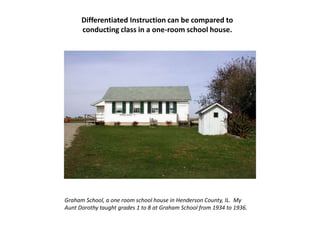
Differentiated Instruction can be compared to conducting class in a one-room school house.Graham School, a one room school house in Henderson County, IL.  My Aunt Dorothy taught grades 1 to 8 at Graham School from 1934 to 1936.
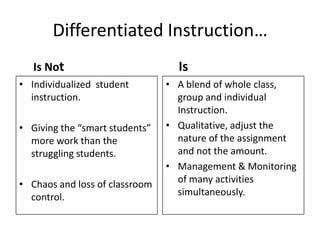
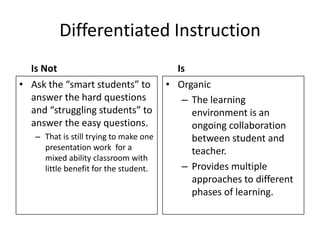
Differentiated Instruction…     Is NotIndividualized  student instruction.Giving the “smart students” more work than the struggling students.Chaos and loss of classroom control.    IsA blend of whole class, group and individual  Instruction.Qualitative, adjust the nature of the assignment and not the amount.Management & Monitoring of many activities simultaneously.
Differentiated Instruction     Is NotAsk the “smart students” to answer the hard questions and “struggling students” to answer the easy questions. That is still trying to make one  presentation work  for a mixed ability classroom with little benefit for the student.     IsOrganicThe learning environment is an ongoing collaboration between student and teacher.Provides multiple approaches to different phases of learning.
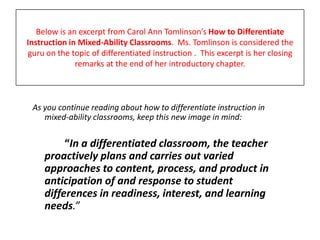
Below is an excerpt from Carol Ann Tomlinson’s How to Differentiate Instruction in Mixed-Ability Classrooms.  Ms. Tomlinson is considered the guru on the topic of differentiated instruction .  This excerpt is her closing remarks at the end of her introductory chapter.As you continue reading about how to differentiate instruction in mixed-ability classrooms, keep this new image in mind:  “In a differentiated classroom, the teacher proactively plans and carries out varied approaches to content, process, and product in anticipation of and response to student differences in readiness, interest, and learning needs.”
My  initial reaction: What a mouthful of words!!!The reader “needs to keep in mind” a statement containing 19 words that scored a Flesch Reading Ease of 15.7 and a Flesch Kincaid Grade Level Determination of 19.0.   I got lost in all the words and was unable to visualize “a mental image”  to keep in mind as I continued reading her book.  Therefore, I reread the paragraph and...
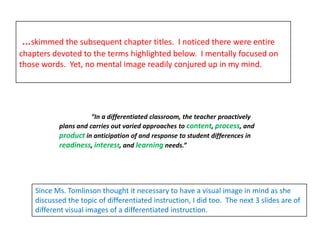
…skimmed the subsequent chapter titles.  I noticed there were entire chapters devoted to the terms highlighted below.  I mentally focused on those words.  Yet, no mental image readily conjured up in my mind. 	“In a differentiated classroom, the teacher proactively plans and carries out varied approaches to content, process, and product in anticipation of and response to student differences in readiness, interest, and learningneeds.”Since Ms. Tomlinson thought it necessary to have a visual image in mind as she discussed the topic of differentiated instruction, I did too.  The next 3 slides are of different visual images of a differentiated instruction.
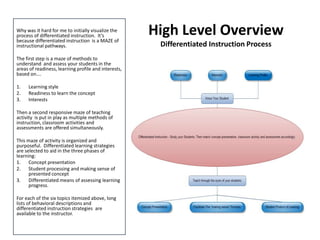
High Level Overview Differentiated Instruction ProcessWhy was it hard for me to initially visualize the process of differentiated instruction.  It’s because differentiated instruction  is a MAZE of instructional pathways.  The first step is a maze of methods to understand  and assess your students in the areas of readiness, learning profile and interests, based on….Learning styleReadiness to learn the conceptInterestsThen a second responsive maze of teaching activity  is put in play as multiple methods of instruction, classroom activities and assessments are offered simultaneously.This maze of activity is organized and purposeful.  Differentiated learning strategies are selected to aid in the three phases of learning:Concept presentationStudent processing and making sense of presented conceptDifferentiated means of assessing learning progress.  For each of the six topics itemized above, long lists of behavioral descriptions and differentiated instruction strategies  are available to the instructor.
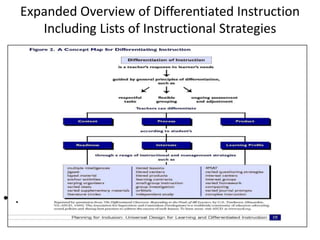
Expanded Overview of Differentiated Instruction Including Lists of Instructional Strategies.
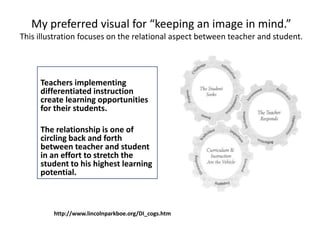
My preferred visual for “keeping an image in mind.” This illustration focuses on the relational aspect between teacher and student. Teachers implementing differentiated instruction create learning opportunities for their students.  The relationship is one of circling back and forth between teacher and student in an effort to stretch the student to his highest learning potential.http://www.lincolnparkboe.org/DI_cogs.htm
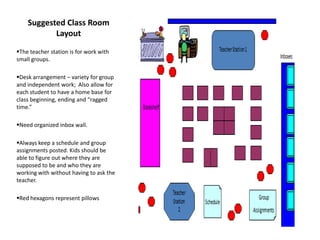
Suggested Class Room LayoutThe teacher station is for work with small groups.
Desk arrangement – variety for group and independent work;  Also allow for each student to have a home base for class beginning, ending and “ragged time.”
Need organized inbox wall.
Always keep a schedule and group assignments posted. Kids should be able to figure out where they are supposed to be and who they are working with without having to ask the teacher.
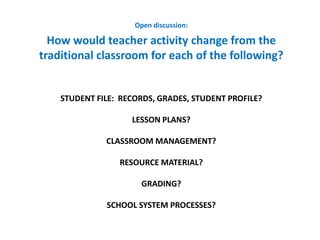
Red hexagons represent pillowsOpen discussion:How would teacher activity change from the traditional classroom for each of the following?student File:  Records, Grades, Student profile?Lesson Plans?Classroom management?Resource Material?Grading?School system processes?
What’s a realistic goal for a first year teacher in the area of differentiated instruction?
Start differentiated instruction on an easy level.  Focus on only one differentiated activity .   Differentiated instruction classrooms are built over time and draws on teacher experience.  A full fledge differentiated instructional classroom may not be a realistic goal for the new teacher. The key point is to begin doing something toward building a differentiated instructional classroom.
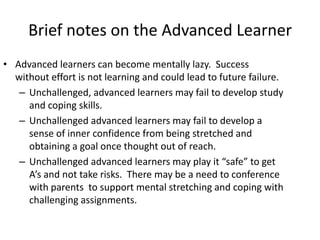
Brief notes on the struggling learnerAlways teach “up”.  A struggling learning needs to build the inner confidence of reaching goals once thought unattainable as well as the advance learner.Prioritize the focus of their learning on the big picture.Make school relevant for today and the struggling learner will want to stay in school tomorrow.Build on what “works” for the struggling learner.  Learn their strengths.

Differentiated instruction presentation

  • 1.
    Differentiated InstructionTeaching ina Mixed Ability ClassroomBarb LukensMAED 5040
  • 2.
    Differentiated Instruction canbe compared to conducting class in a one-room school house.Graham School, a one room school house in Henderson County, IL. My Aunt Dorothy taught grades 1 to 8 at Graham School from 1934 to 1936.
  • 3.
    Differentiated Instruction… Is NotIndividualized student instruction.Giving the “smart students” more work than the struggling students.Chaos and loss of classroom control. IsA blend of whole class, group and individual Instruction.Qualitative, adjust the nature of the assignment and not the amount.Management & Monitoring of many activities simultaneously.
  • 4.
    Differentiated Instruction Is NotAsk the “smart students” to answer the hard questions and “struggling students” to answer the easy questions. That is still trying to make one presentation work for a mixed ability classroom with little benefit for the student. IsOrganicThe learning environment is an ongoing collaboration between student and teacher.Provides multiple approaches to different phases of learning.
  • 5.
    Below is anexcerpt from Carol Ann Tomlinson’s How to Differentiate Instruction in Mixed-Ability Classrooms. Ms. Tomlinson is considered the guru on the topic of differentiated instruction . This excerpt is her closing remarks at the end of her introductory chapter.As you continue reading about how to differentiate instruction in mixed-ability classrooms, keep this new image in mind: “In a differentiated classroom, the teacher proactively plans and carries out varied approaches to content, process, and product in anticipation of and response to student differences in readiness, interest, and learning needs.”
  • 6.
    My initialreaction: What a mouthful of words!!!The reader “needs to keep in mind” a statement containing 19 words that scored a Flesch Reading Ease of 15.7 and a Flesch Kincaid Grade Level Determination of 19.0. I got lost in all the words and was unable to visualize “a mental image” to keep in mind as I continued reading her book. Therefore, I reread the paragraph and...
  • 7.
    …skimmed the subsequentchapter titles. I noticed there were entire chapters devoted to the terms highlighted below. I mentally focused on those words. Yet, no mental image readily conjured up in my mind. “In a differentiated classroom, the teacher proactively plans and carries out varied approaches to content, process, and product in anticipation of and response to student differences in readiness, interest, and learningneeds.”Since Ms. Tomlinson thought it necessary to have a visual image in mind as she discussed the topic of differentiated instruction, I did too. The next 3 slides are of different visual images of a differentiated instruction.
  • 8.
    High Level OverviewDifferentiated Instruction ProcessWhy was it hard for me to initially visualize the process of differentiated instruction. It’s because differentiated instruction is a MAZE of instructional pathways. The first step is a maze of methods to understand and assess your students in the areas of readiness, learning profile and interests, based on….Learning styleReadiness to learn the conceptInterestsThen a second responsive maze of teaching activity is put in play as multiple methods of instruction, classroom activities and assessments are offered simultaneously.This maze of activity is organized and purposeful. Differentiated learning strategies are selected to aid in the three phases of learning:Concept presentationStudent processing and making sense of presented conceptDifferentiated means of assessing learning progress. For each of the six topics itemized above, long lists of behavioral descriptions and differentiated instruction strategies are available to the instructor.
  • 9.
    Expanded Overview ofDifferentiated Instruction Including Lists of Instructional Strategies.
  • 10.
    My preferred visualfor “keeping an image in mind.” This illustration focuses on the relational aspect between teacher and student. Teachers implementing differentiated instruction create learning opportunities for their students. The relationship is one of circling back and forth between teacher and student in an effort to stretch the student to his highest learning potential.http://www.lincolnparkboe.org/DI_cogs.htm
  • 11.
    Suggested Class RoomLayoutThe teacher station is for work with small groups.
  • 12.
    Desk arrangement –variety for group and independent work; Also allow for each student to have a home base for class beginning, ending and “ragged time.”
  • 13.
  • 14.
    Always keep aschedule and group assignments posted. Kids should be able to figure out where they are supposed to be and who they are working with without having to ask the teacher.
  • 15.
    Red hexagons representpillowsOpen discussion:How would teacher activity change from the traditional classroom for each of the following?student File: Records, Grades, Student profile?Lesson Plans?Classroom management?Resource Material?Grading?School system processes?
  • 16.
    What’s a realisticgoal for a first year teacher in the area of differentiated instruction?
  • 17.
    Start differentiated instructionon an easy level. Focus on only one differentiated activity . Differentiated instruction classrooms are built over time and draws on teacher experience. A full fledge differentiated instructional classroom may not be a realistic goal for the new teacher. The key point is to begin doing something toward building a differentiated instructional classroom.
  • 18.
    Brief notes onthe struggling learnerAlways teach “up”. A struggling learning needs to build the inner confidence of reaching goals once thought unattainable as well as the advance learner.Prioritize the focus of their learning on the big picture.Make school relevant for today and the struggling learner will want to stay in school tomorrow.Build on what “works” for the struggling learner. Learn their strengths.