
PRESENTED BY :
VIKRAM SINGH 8th SEM / 4rd YEAR
ELECTRICAL DEPARMENT
MITS JADAN,PALI
GUIDE BY :
Mr. HITESH JAIN (Asst.
Professor)
ELECTRICAL DEPARMENT
MITS JADAN,PALI
 Need of starter
 TYPES OFSTARTER
 Stator resistance starter
 Auto transformer starter
 Star-delta starter
 Rotor resistance starter
 Direct on line (DOL) starter
 Variable Frequency Drive (VFD)
 A motor starter is essential for starting an induction motor.
 It is because of its low rotor impedance.
 The rotor impedance depends on the slip of the motor
which is the relative speed between the rotor & stator.
 The impedance varies inversely with the slip.
 The high inrush current magnetizes the air gap between the
rotor & stator that induces an EMF in the rotor winding.
 Stator resistance starter
 Auto transformer starter
 Star-delta starter
 Rotor resistance starter
 Direct on line (DOL) starter
 Variable Frequency Drive (VFD)
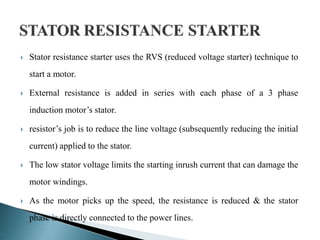
 Stator resistance starter uses the RVS (reduced voltage starter) technique to
start a motor.
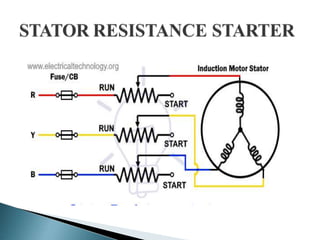
 External resistance is added in series with each phase of a 3 phase
induction motor’s stator.
 resistor’s job is to reduce the line voltage (subsequently reducing the initial
current) applied to the stator.
 The low stator voltage limits the starting inrush current that can damage the
motor windings.
 As the motor picks up the speed, the resistance is reduced & the stator
phase is directly connected to the power lines.
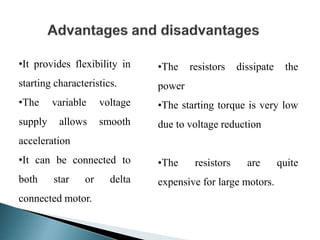
•It provides flexibility in
starting characteristics.
•The variable voltage
supply allows smooth
acceleration
•It can be connected to
both star or delta
connected motor.
•The resistors dissipate the
power
•The starting torque is very low
due to voltage reduction
•The resistors are quite
expensive for large motors.
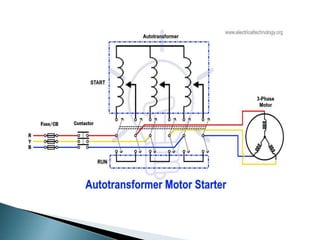
. AUTO-TRANSFORMER STARTER
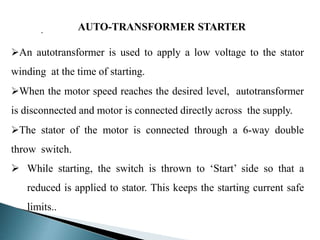
An autotransformer is used to apply a low voltage to the stator
winding at the time of starting.
When the motor speed reaches the desired level, autotransformer
is disconnected and motor is connected directly across the supply.
The stator of the motor is connected through a 6-way double
throw switch.
 While starting, the switch is thrown to ‘Start’ side so that a
reduced is applied to stator. This keeps the starting current safe
limits..
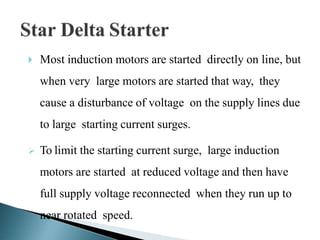
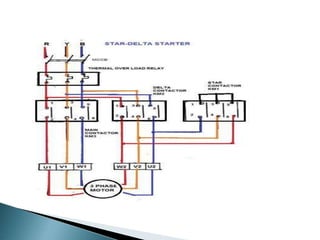
 Most induction motors are started directly on line, but
when very large motors are started that way, they
cause a disturbance of voltage on the supply lines due
to large starting current surges.
 To limit the starting current surge, large induction
motors are started at reduced voltage and then have
full supply voltage reconnected when they run up to
near rotated speed.
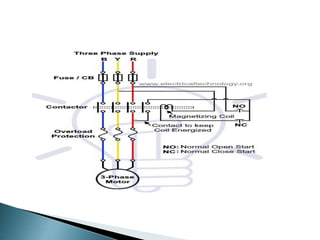
 It is the simplest form of motor starter that connects the motor
directly to the power supply.
 It consists of a magnetic contactor that connects the motor
with a supply line & an overload relay for protection against
over current.
 There is no voltage reduction for safe starting a motor.
 Therefore the motor used with such starters has below 5 hp
rating. It has two simple push buttons that start & stop the
motor.
 Pressing the start button energizes the coil that pulls the
contactors together to close the circuit. And pressing the stop
button de-energizes the contactor’s coil & pushes its contacts
apart thus breaking the circuit.
 VFD can vary the voltage as well as the frequency of the supplying current.
 It is mainly used for controlling the speed of the induction motor as it
depends on the supply frequency.
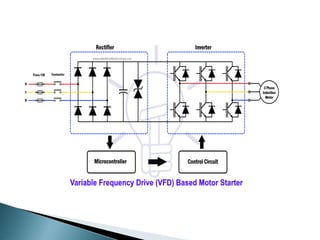
 The AC from the supply line is converted into DC using rectifiers.
 The pure DC is converted into AC with adjustable frequency & voltage
using pulse width modulation technique through power transistor like
IGBTs.It provides full control over the motor speed from 0 to rated speed.
The speed adjust option with the variable voltage provides a better starting
current & acceleration
 It provides a better and smooth acceleration for large
motor
 It offers full speed control with smooth acceleration &
deceleration.
 It increases the life span due to the absence of electrical
& mechanical stress
 It offers forward & reverse operation of a motor
 It is relatively expensive unless speed control is
necessary
 There is heat dissipation
 VFDs create harmonics in the electric lines which can
affect electronic equipment & power factor.
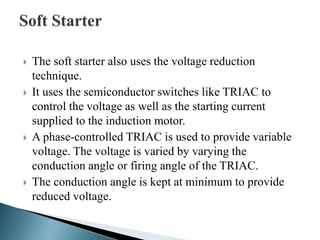
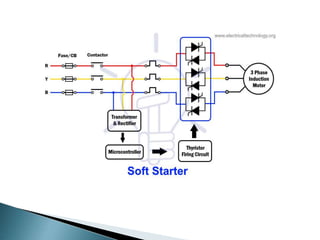
 The soft starter also uses the voltage reduction
technique.
 It uses the semiconductor switches like TRIAC to
control the voltage as well as the starting current
supplied to the induction motor.
 A phase-controlled TRIAC is used to provide variable
voltage. The voltage is varied by varying the
conduction angle or firing angle of the TRIAC.
 The conduction angle is kept at minimum to provide
reduced voltage.
 It provides better control over starting current &
voltage
 It offers smooth acceleration, thus no jerks.
 It reduces the power surges in the system.
 Extends the life span of the system
 Provide better efficiency & lack the need for
maintenance
 Its size is small
 It is relatively expensive
 There is energy dissipation in the form of heat
MOTOR STARTER

MOTOR STARTER

  • 1.
    PRESENTED BY : VIKRAMSINGH 8th SEM / 4rd YEAR ELECTRICAL DEPARMENT MITS JADAN,PALI GUIDE BY : Mr. HITESH JAIN (Asst. Professor) ELECTRICAL DEPARMENT MITS JADAN,PALI
  • 2.
     Need ofstarter  TYPES OFSTARTER  Stator resistance starter  Auto transformer starter  Star-delta starter  Rotor resistance starter  Direct on line (DOL) starter  Variable Frequency Drive (VFD)
  • 3.
     A motorstarter is essential for starting an induction motor.  It is because of its low rotor impedance.  The rotor impedance depends on the slip of the motor which is the relative speed between the rotor & stator.  The impedance varies inversely with the slip.  The high inrush current magnetizes the air gap between the rotor & stator that induces an EMF in the rotor winding.
  • 4.
     Stator resistancestarter  Auto transformer starter  Star-delta starter  Rotor resistance starter  Direct on line (DOL) starter  Variable Frequency Drive (VFD)
  • 5.
     Stator resistancestarter uses the RVS (reduced voltage starter) technique to start a motor.  External resistance is added in series with each phase of a 3 phase induction motor’s stator.  resistor’s job is to reduce the line voltage (subsequently reducing the initial current) applied to the stator.  The low stator voltage limits the starting inrush current that can damage the motor windings.  As the motor picks up the speed, the resistance is reduced & the stator phase is directly connected to the power lines.
  • 7.
    •It provides flexibilityin starting characteristics. •The variable voltage supply allows smooth acceleration •It can be connected to both star or delta connected motor. •The resistors dissipate the power •The starting torque is very low due to voltage reduction •The resistors are quite expensive for large motors.
  • 8.
    . AUTO-TRANSFORMER STARTER Anautotransformer is used to apply a low voltage to the stator winding at the time of starting. When the motor speed reaches the desired level, autotransformer is disconnected and motor is connected directly across the supply. The stator of the motor is connected through a 6-way double throw switch.  While starting, the switch is thrown to ‘Start’ side so that a reduced is applied to stator. This keeps the starting current safe limits..
  • 10.
     Most inductionmotors are started directly on line, but when very large motors are started that way, they cause a disturbance of voltage on the supply lines due to large starting current surges.  To limit the starting current surge, large induction motors are started at reduced voltage and then have full supply voltage reconnected when they run up to near rotated speed.
  • 12.
     It isthe simplest form of motor starter that connects the motor directly to the power supply.  It consists of a magnetic contactor that connects the motor with a supply line & an overload relay for protection against over current.  There is no voltage reduction for safe starting a motor.  Therefore the motor used with such starters has below 5 hp rating. It has two simple push buttons that start & stop the motor.  Pressing the start button energizes the coil that pulls the contactors together to close the circuit. And pressing the stop button de-energizes the contactor’s coil & pushes its contacts apart thus breaking the circuit.
  • 14.
     VFD canvary the voltage as well as the frequency of the supplying current.  It is mainly used for controlling the speed of the induction motor as it depends on the supply frequency.  The AC from the supply line is converted into DC using rectifiers.  The pure DC is converted into AC with adjustable frequency & voltage using pulse width modulation technique through power transistor like IGBTs.It provides full control over the motor speed from 0 to rated speed. The speed adjust option with the variable voltage provides a better starting current & acceleration
  • 16.
     It providesa better and smooth acceleration for large motor  It offers full speed control with smooth acceleration & deceleration.  It increases the life span due to the absence of electrical & mechanical stress  It offers forward & reverse operation of a motor
  • 17.
     It isrelatively expensive unless speed control is necessary  There is heat dissipation  VFDs create harmonics in the electric lines which can affect electronic equipment & power factor.
  • 18.
     The softstarter also uses the voltage reduction technique.  It uses the semiconductor switches like TRIAC to control the voltage as well as the starting current supplied to the induction motor.  A phase-controlled TRIAC is used to provide variable voltage. The voltage is varied by varying the conduction angle or firing angle of the TRIAC.  The conduction angle is kept at minimum to provide reduced voltage.
  • 20.
     It providesbetter control over starting current & voltage  It offers smooth acceleration, thus no jerks.  It reduces the power surges in the system.  Extends the life span of the system  Provide better efficiency & lack the need for maintenance  Its size is small
  • 21.
     It isrelatively expensive  There is energy dissipation in the form of heat