Testing of DC Machines

By,
Rohini Haridas
Assistant Professor,
Dept of Electrical Engineering,
SSGM College of Engineering,Shegaon
Objectives of Testing
When m/c is manufactured in industry as per
particular design, it is necessary that it should undergo
testing
Testing is required to determine whether the
performance of m/c is as per the designed data or not?
If not how much variations are there in the actual
values and calculated values, the difference is so
recorded are within the permissible limits or not?
Continued
.

If the variations in the results such as regulation, iron
losses, copper losses, no load current, no load speed
etc. are not within the permissible limits, the reasons
for either higher values or lower values should be
investigated and manufacturing process modify
accordingly.
From testing we can also determine the quality of
materials used.
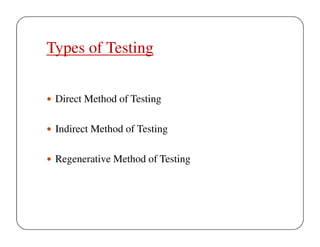
Types of Testing
Direct Method of Testing
Indirect Method of Testing
Regenerative Method of Testing
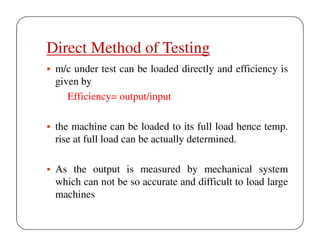
Direct Method of Testing
m/c under test can be loaded directly and efficiency is
given by
Efficiency= output/input
the machine can be loaded to its full load hence temp.
rise at full load can be actually determined.
As the output is measured by mechanical system
which can not be so accurate and difficult to load large
machines
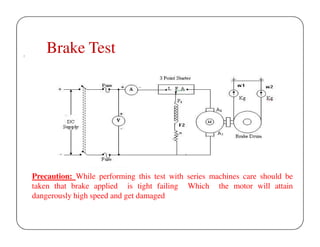
Brake Test

Precaution: While performing this test with series machines care should be
taken that brake applied is tight failing Which the motor will attain
dangerously high speed and get damaged
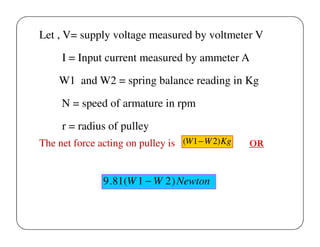
Let , V= supply voltage measured by voltmeter V
I = Input current measured by ammeter A
W1 and W2 = spring balance reading in Kg
N = speed of armature in rpm
r = radius of pulley
The net force acting on pulley is (W1 − W 2) Kg

9 .81(W 1 − W 2 ) Newton

OR
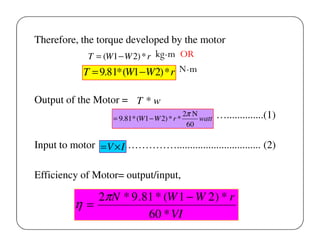
Therefore, the torque developed by the motor
T = (W1 − W 2) * r kg-m OR
T = 9.81* (W1 −W 2) * r N-m
Output of the Motor = T * w
= 9.81* (W1 − W 2) * r *

2π N
watt
60


..............(1)

Input to motor = V × I


................................ (2)
Efficiency of Motor= output/input,

2πN * 9 .81 * (W 1 − W 2 ) * r
η=
60 * VI
Numerical
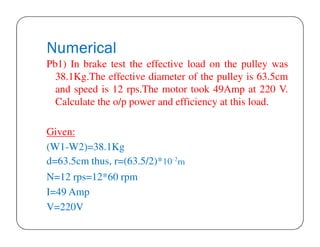
Pb1) In brake test the effective load on the pulley was
38.1Kg.The effective diameter of the pulley is 63.5cm
and speed is 12 rps.The motor took 49Amp at 220 V.
Calculate the o/p power and efficiency at this load.
Given:
(W1-W2)=38.1Kg
d=63.5cm thus, r=(63.5/2)*10-2m
N=12 rps=12*60 rpm
I=49 Amp
V=220V
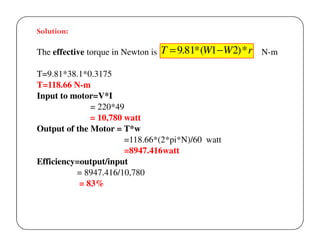
Solution:

The effective torque in Newton is

T = 9.81* (W1 −W 2) * r N-m

T=9.81*38.1*0.3175
T=118.66 N-m
Input to motor=V*I
= 220*49
= 10,780 watt
Output of the Motor = T*w
=118.66*(2*pi*N)/60 watt
=8947.416watt
Efficiency=output/input
= 8947.416/10,780
= 83%
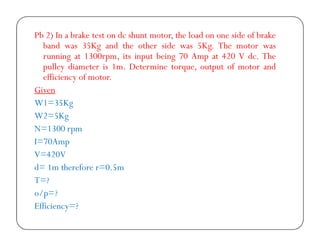
Pb 2) In a brake test on dc shunt motor, the load on one side of brake
band was 35Kg and the other side was 5Kg. The motor was
running at 1300rpm, its input being 70 Amp at 420 V dc. The
pulley diameter is 1m. Determine torque, output of motor and
efficiency of motor.
Given
W1=35Kg
W2=5Kg
N=1300 rpm
I=70Amp
V=420V
d= 1m therefore r=0.5m
T=?
o/p=?
Efficiency=?
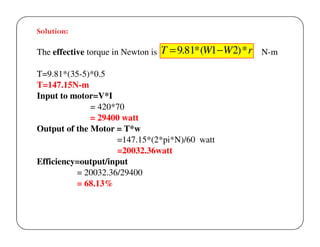
Solution:

The effective torque in Newton is

T = 9.81* (W1 −W 2) * r N-m

T=9.81*(35-5)*0.5
T=147.15N-m
Input to motor=V*I
= 420*70
= 29400 watt
Output of the Motor = T*w
=147.15*(2*pi*N)/60 watt
=20032.36watt
Efficiency=output/input
= 20032.36/29400
= 68.13%
Indirect method of Testing
In this method , the m/c under test is not directly
loaded for determining its efficiency but its
performance characteristics is determined by using the
data obtained in no load test performed on the m/c.
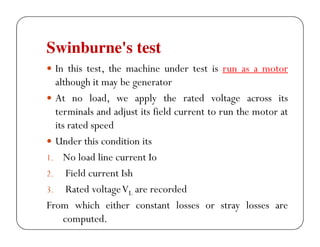
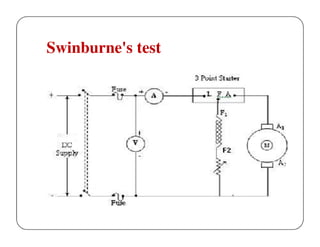
Swinburne's test
In this test, the machine under test is run as a motor
although it may be generator
At no load, we apply the rated voltage across its
terminals and adjust its field current to run the motor at
its rated speed
Under this condition its
1. No load line current Io
2. Field current Ish
3. Rated voltage VL are recorded
From which either constant losses or stray losses are
computed.
Swinburne's test
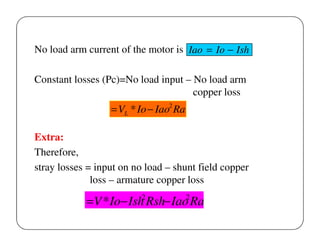
No load arm current of the motor is Iao = Io − Ish
Constant losses (Pc)=No load input – No load arm
copper loss

= VL * Io − Iao2 Ra
Extra:
Therefore,
stray losses = input on no load – shunt field copper
loss – armature copper loss
2

2

=V * Io− Ish Rsh− Iao Ra
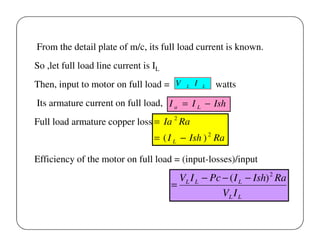
From the detail plate of m/c, its full load current is known.
So ,let full load line current is IL
Then, input to motor on full load = V

L

I

L

watts

Its armature current on full load, I a = I L − Ish
Full load armature copper loss = Ia 2 Ra

= ( I L − Ish ) 2 Ra
Efficiency of the motor on full load = (input-losses)/input

VL I L − Pc − ( I L − Ish) 2 Ra
=
VL I L
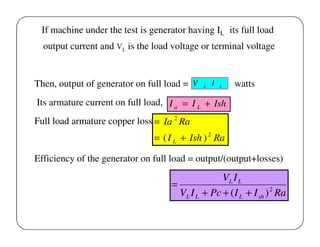
If machine under the test is generator having IL its full load
output current and VL is the load voltage or terminal voltage

Then, output of generator on full load = V

L

I

L

watts

Its armature current on full load, I a = I L + Ish
Full load armature copper loss = Ia 2 Ra

= ( I L + Ish ) 2 Ra
Efficiency of the generator on full load = output/(output+losses)

VL I L
=
VL I L + Pc + ( I L + I sh ) 2 Ra

Testing of dc machines_I

  • 1.
    Testing of DCMachines By, Rohini Haridas Assistant Professor, Dept of Electrical Engineering, SSGM College of Engineering,Shegaon
  • 2.
    Objectives of Testing Whenm/c is manufactured in industry as per particular design, it is necessary that it should undergo testing Testing is required to determine whether the performance of m/c is as per the designed data or not? If not how much variations are there in the actual values and calculated values, the difference is so recorded are within the permissible limits or not?
  • 3.
    Continued
. If the variationsin the results such as regulation, iron losses, copper losses, no load current, no load speed etc. are not within the permissible limits, the reasons for either higher values or lower values should be investigated and manufacturing process modify accordingly. From testing we can also determine the quality of materials used.
  • 4.
    Types of Testing DirectMethod of Testing Indirect Method of Testing Regenerative Method of Testing
  • 5.
    Direct Method ofTesting m/c under test can be loaded directly and efficiency is given by Efficiency= output/input the machine can be loaded to its full load hence temp. rise at full load can be actually determined. As the output is measured by mechanical system which can not be so accurate and difficult to load large machines
  • 6.
    Brake Test Precaution: Whileperforming this test with series machines care should be taken that brake applied is tight failing Which the motor will attain dangerously high speed and get damaged
  • 7.
    Let , V=supply voltage measured by voltmeter V I = Input current measured by ammeter A W1 and W2 = spring balance reading in Kg N = speed of armature in rpm r = radius of pulley The net force acting on pulley is (W1 − W 2) Kg 9 .81(W 1 − W 2 ) Newton OR
  • 8.
    Therefore, the torquedeveloped by the motor T = (W1 − W 2) * r kg-m OR T = 9.81* (W1 −W 2) * r N-m Output of the Motor = T * w = 9.81* (W1 − W 2) * r * 2π N watt 60 
..............(1) Input to motor = V × I


................................ (2) Efficiency of Motor= output/input, 2πN * 9 .81 * (W 1 − W 2 ) * r η= 60 * VI
  • 9.
    Numerical Pb1) In braketest the effective load on the pulley was 38.1Kg.The effective diameter of the pulley is 63.5cm and speed is 12 rps.The motor took 49Amp at 220 V. Calculate the o/p power and efficiency at this load. Given: (W1-W2)=38.1Kg d=63.5cm thus, r=(63.5/2)*10-2m N=12 rps=12*60 rpm I=49 Amp V=220V
  • 10.
    Solution: The effective torquein Newton is T = 9.81* (W1 −W 2) * r N-m T=9.81*38.1*0.3175 T=118.66 N-m Input to motor=V*I = 220*49 = 10,780 watt Output of the Motor = T*w =118.66*(2*pi*N)/60 watt =8947.416watt Efficiency=output/input = 8947.416/10,780 = 83%
  • 11.
    Pb 2) Ina brake test on dc shunt motor, the load on one side of brake band was 35Kg and the other side was 5Kg. The motor was running at 1300rpm, its input being 70 Amp at 420 V dc. The pulley diameter is 1m. Determine torque, output of motor and efficiency of motor. Given W1=35Kg W2=5Kg N=1300 rpm I=70Amp V=420V d= 1m therefore r=0.5m T=? o/p=? Efficiency=?
  • 12.
    Solution: The effective torquein Newton is T = 9.81* (W1 −W 2) * r N-m T=9.81*(35-5)*0.5 T=147.15N-m Input to motor=V*I = 420*70 = 29400 watt Output of the Motor = T*w =147.15*(2*pi*N)/60 watt =20032.36watt Efficiency=output/input = 20032.36/29400 = 68.13%
  • 13.
    Indirect method ofTesting In this method , the m/c under test is not directly loaded for determining its efficiency but its performance characteristics is determined by using the data obtained in no load test performed on the m/c.
  • 14.
    Swinburne's test In thistest, the machine under test is run as a motor although it may be generator At no load, we apply the rated voltage across its terminals and adjust its field current to run the motor at its rated speed Under this condition its 1. No load line current Io 2. Field current Ish 3. Rated voltage VL are recorded From which either constant losses or stray losses are computed.
  • 15.
  • 16.
    No load armcurrent of the motor is Iao = Io − Ish Constant losses (Pc)=No load input – No load arm copper loss = VL * Io − Iao2 Ra Extra: Therefore, stray losses = input on no load – shunt field copper loss – armature copper loss 2 2 =V * Io− Ish Rsh− Iao Ra
  • 17.
    From the detailplate of m/c, its full load current is known. So ,let full load line current is IL Then, input to motor on full load = V L I L watts Its armature current on full load, I a = I L − Ish Full load armature copper loss = Ia 2 Ra = ( I L − Ish ) 2 Ra Efficiency of the motor on full load = (input-losses)/input VL I L − Pc − ( I L − Ish) 2 Ra = VL I L
  • 18.
    If machine underthe test is generator having IL its full load output current and VL is the load voltage or terminal voltage Then, output of generator on full load = V L I L watts Its armature current on full load, I a = I L + Ish Full load armature copper loss = Ia 2 Ra = ( I L + Ish ) 2 Ra Efficiency of the generator on full load = output/(output+losses) VL I L = VL I L + Pc + ( I L + I sh ) 2 Ra