LOSSES IN A DC MACHINES and
efficiency
Following are the losses in the DC
machines
•Electrical or copper loss ( I²R Losses)
•Core losses or Iron losses
•Brush Losses
•Mechanical losses
•Stray load losses
07/28/14
Professor MD Dutt HOD EX Department
SRCT Bhopal
1
ELECTRICAL LOSSES
• Windings having resistance consumes certain
losses, these are termed as copper losses
because mostly windings are made of copper.
• Armature copper loss Ia²Ra ( Ia is armature
current)
• Shunt field copper loss Ish²Rsh
• Copper loss in the series field Ise²Rse
07/28/14
Professor MD Dutt HOD EX Department
SRCT Bhopal
2
ELECTRICAL LOSSES
• Copper loss in the interpole winding which are
in series with armature Ia²Ri
• Compound machines both series field and
shunt field copper losses are also there
• Copper losses are there in the compensating
winding
07/28/14
Professor MD Dutt HOD EX Department
SRCT Bhopal
3
CORE LOSSES
• The core losses are the hysteresis losses and
Eddy current losses. Since the machine usually
operates at constant flux density and speed,
these losses are almost constant. These losses
are about 20% of Full load losses.
07/28/14
Professor MD Dutt HOD EX Department
SRCT Bhopal
4
BRUSH LOSSES
• There is a power loss at the brush contact
with commutator and the carbon brushes.
This loss can me measured by the voltage
drop at the brush contact and armature
current.
• Pbd = Vbd Ia
• The voltage drop is more or less remains
constant over a wide range of Ia and it is
assumed 2V ( approx)
07/28/14
Professor MD Dutt HOD EX Department
SRCT Bhopal
5
MECHANICAL LOSSES
• The losses associated with mechanical effect
are called mechanical losses. These consists of
friction losses at bearing and windage losses
( fan losses) . the fans are used to take away
the heat produced due to I²R losses and iron
losses inside the machine.
07/28/14
Professor MD Dutt HOD EX Department
SRCT Bhopal
6
STRAY LOAD LOSSES
• These are miscellaneous losses which are due
to the following reasons:-
• Distortion of flux due to armature reaction
• Short circuit currents in the coils due to
commutation.
• These losses are difficult to find out, However
they are taken as 1 % of full load power
output.
07/28/14
Professor MD Dutt HOD EX Department
SRCT Bhopal
7
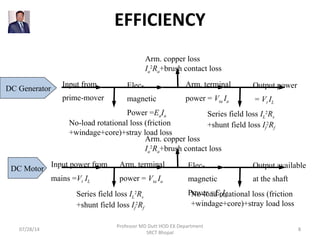
EFFICIENCY
07/28/14
Professor MD Dutt HOD EX Department
SRCT Bhopal
8
Input from
prime-mover
Elec-
magnetic
Power =EaIa
Arm. terminal
power = Vta Ia
Output power
= Vt IL
No-load rotational loss (friction
+windage+core)+stray load loss
Arm. copper loss
Ia
2
Ra+brush contact loss
Series field loss IL
2
Rs
+shunt field loss If
2
Rf
Input power from
mains =Vt IL
Elec-
magnetic
Power =EaIa
Arm. terminal
power = Vta Ia
Output available
at the shaft
No-load rotational loss (friction
+windage+core)+stray load loss
Arm. copper loss
Ia
2
Ra+brush contact loss
Series field loss IL
2
Rs
+shunt field loss If
2
Rf
DC Motor
DC Generator
EFFICIENCY
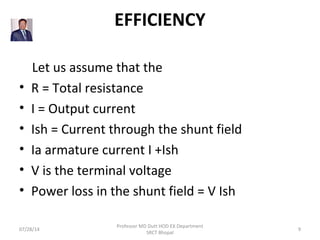
    Let us assume that the
• R = Total resistance
• I = Output current
• Ish = Current through the shunt field
• Ia armature current I +Ish
• V is the terminal voltage
• Power loss in the shunt field = V Ish
07/28/14
Professor MD Dutt HOD EX Department
SRCT Bhopal
9
EFFICIENCY
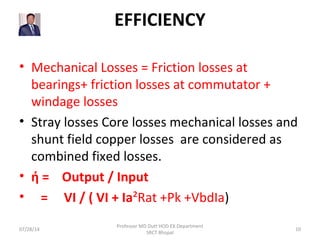
• Mechanical Losses = Friction losses at
bearings+ friction losses at commutator +
windage losses
• Stray losses Core losses mechanical losses and
shunt field copper losses are considered as
combined fixed losses.
• ή = Output / Input
• = VI / ( VI + Ia²Rat +Pk +VbdIa)
07/28/14
Professor MD Dutt HOD EX Department
SRCT Bhopal
10
EFFICIENCY
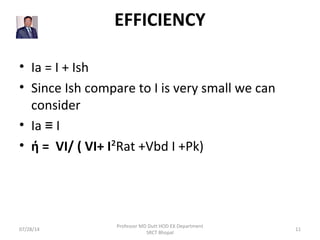
• Ia = I + Ish
• Since Ish compare to I is very small we can
consider
• Ia I≡
• ή = VI/ ( VI+ I²Rat +Vbd I +Pk)
07/28/14
Professor MD Dutt HOD EX Department
SRCT Bhopal
11
EFFICIENCY
• LOAD for Maximum efficiency
• Ifl = Full load current at maximum efficiency
• Im = current at maximum efficiency
• Im ² Rat = Pk
• Im ² = Pk/ Rat
• Current at Maximum ή =
F.L Current X( Pk/F.L Copper loss)
²
07/28/14
Professor MD Dutt HOD EX Department
SRCT Bhopal
12

Losses dc machines

  • 1.
    LOSSES IN ADC MACHINES and efficiency Following are the losses in the DC machines •Electrical or copper loss ( I²R Losses) •Core losses or Iron losses •Brush Losses •Mechanical losses •Stray load losses 07/28/14 Professor MD Dutt HOD EX Department SRCT Bhopal 1
  • 2.
    ELECTRICAL LOSSES • Windingshaving resistance consumes certain losses, these are termed as copper losses because mostly windings are made of copper. • Armature copper loss Ia²Ra ( Ia is armature current) • Shunt field copper loss Ish²Rsh • Copper loss in the series field Ise²Rse 07/28/14 Professor MD Dutt HOD EX Department SRCT Bhopal 2
  • 3.
    ELECTRICAL LOSSES • Copperloss in the interpole winding which are in series with armature Ia²Ri • Compound machines both series field and shunt field copper losses are also there • Copper losses are there in the compensating winding 07/28/14 Professor MD Dutt HOD EX Department SRCT Bhopal 3
  • 4.
    CORE LOSSES • Thecore losses are the hysteresis losses and Eddy current losses. Since the machine usually operates at constant flux density and speed, these losses are almost constant. These losses are about 20% of Full load losses. 07/28/14 Professor MD Dutt HOD EX Department SRCT Bhopal 4
  • 5.
    BRUSH LOSSES • Thereis a power loss at the brush contact with commutator and the carbon brushes. This loss can me measured by the voltage drop at the brush contact and armature current. • Pbd = Vbd Ia • The voltage drop is more or less remains constant over a wide range of Ia and it is assumed 2V ( approx) 07/28/14 Professor MD Dutt HOD EX Department SRCT Bhopal 5
  • 6.
    MECHANICAL LOSSES • Thelosses associated with mechanical effect are called mechanical losses. These consists of friction losses at bearing and windage losses ( fan losses) . the fans are used to take away the heat produced due to I²R losses and iron losses inside the machine. 07/28/14 Professor MD Dutt HOD EX Department SRCT Bhopal 6
  • 7.
    STRAY LOAD LOSSES •These are miscellaneous losses which are due to the following reasons:- • Distortion of flux due to armature reaction • Short circuit currents in the coils due to commutation. • These losses are difficult to find out, However they are taken as 1 % of full load power output. 07/28/14 Professor MD Dutt HOD EX Department SRCT Bhopal 7
  • 8.
    EFFICIENCY 07/28/14 Professor MD DuttHOD EX Department SRCT Bhopal 8 Input from prime-mover Elec- magnetic Power =EaIa Arm. terminal power = Vta Ia Output power = Vt IL No-load rotational loss (friction +windage+core)+stray load loss Arm. copper loss Ia 2 Ra+brush contact loss Series field loss IL 2 Rs +shunt field loss If 2 Rf Input power from mains =Vt IL Elec- magnetic Power =EaIa Arm. terminal power = Vta Ia Output available at the shaft No-load rotational loss (friction +windage+core)+stray load loss Arm. copper loss Ia 2 Ra+brush contact loss Series field loss IL 2 Rs +shunt field loss If 2 Rf DC Motor DC Generator
  • 9.
    EFFICIENCY     Let usassume that the • R = Total resistance • I = Output current • Ish = Current through the shunt field • Ia armature current I +Ish • V is the terminal voltage • Power loss in the shunt field = V Ish 07/28/14 Professor MD Dutt HOD EX Department SRCT Bhopal 9
  • 10.
    EFFICIENCY • Mechanical Losses= Friction losses at bearings+ friction losses at commutator + windage losses • Stray losses Core losses mechanical losses and shunt field copper losses are considered as combined fixed losses. • ή = Output / Input • = VI / ( VI + Ia²Rat +Pk +VbdIa) 07/28/14 Professor MD Dutt HOD EX Department SRCT Bhopal 10
  • 11.
    EFFICIENCY • Ia =I + Ish • Since Ish compare to I is very small we can consider • Ia I≡ • ή = VI/ ( VI+ I²Rat +Vbd I +Pk) 07/28/14 Professor MD Dutt HOD EX Department SRCT Bhopal 11
  • 12.
    EFFICIENCY • LOAD forMaximum efficiency • Ifl = Full load current at maximum efficiency • Im = current at maximum efficiency • Im ² Rat = Pk • Im ² = Pk/ Rat • Current at Maximum ή = F.L Current X( Pk/F.L Copper loss) ² 07/28/14 Professor MD Dutt HOD EX Department SRCT Bhopal 12