DEPARTMENT OF ELECTRICAL & ELECTRONICS
ENGINEERING
ANNAMACHARYA INSTITUTE OF
TECHNOLOGY & SCIENCES (AUTONOMOUS)
RAJAMPET.
1
2
 To know different parts of robot
 Types of robots
 Basic 3 laws
3
 HISTORY
 ROBOTICS-ROBOT
 LAWS OF ROBOT
 TYPES
 PARTS
 ADVANTAGES & DISADVANTAGES
 CONCLUSIONS
 REFERENCE
4
 The term "robot" was first used in
1920 in a play called "R.U.R." Or “
Rossum 's universal robots" by the
Czech writer KarelCapek.
 The word “Robot ”come s from the
word “ Robota ”,meaning ,in Czech”,
forced labour, drudgery.
5
- Mechanical device that performs human
tasks, either automatically or by remote control.
A re-programmable, multifunctional, automatic
industrial machine designed to replace human in hazardous
work. for the performance of a variety of Tasks
 Robotics - Study and application of robot technology.
 Telerobotics - Robot that is operated remotely.
6
 Asimov proposed three “Laws of Robotics”
 Law 1: A robot may not injure a human being or
through inaction, allow a human being to come to
harm.
 Law 2: A robot must obey orders given to it by
human beings, except where such orders would
conflict with the first law.
 Law 3: A robot must protect its own existence as
long as such protection does not conflict with the first
law.
7
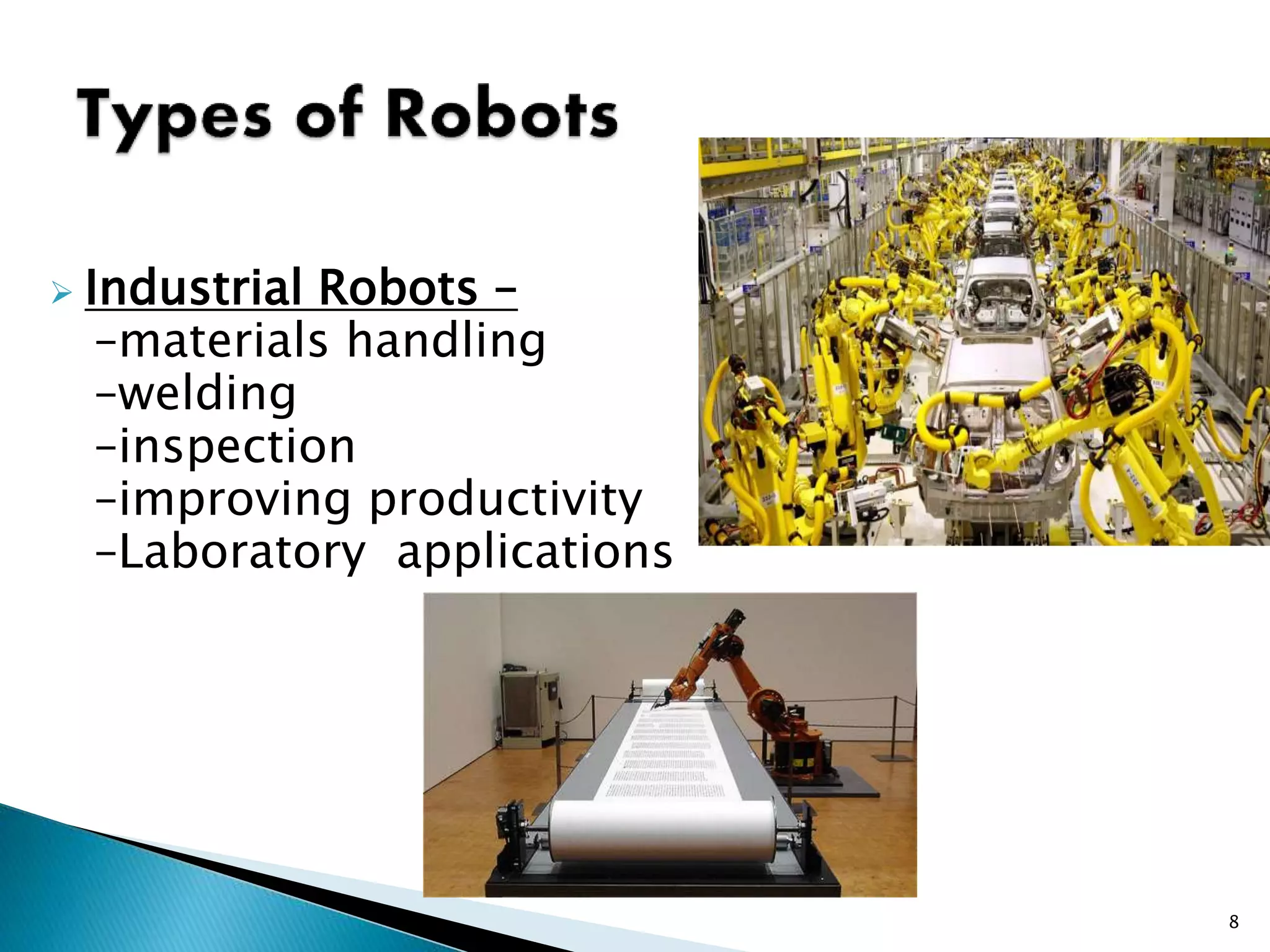
 Industrial Robots –
–materials handling
–welding
–inspection
–improving productivity
–Laboratory applications
8
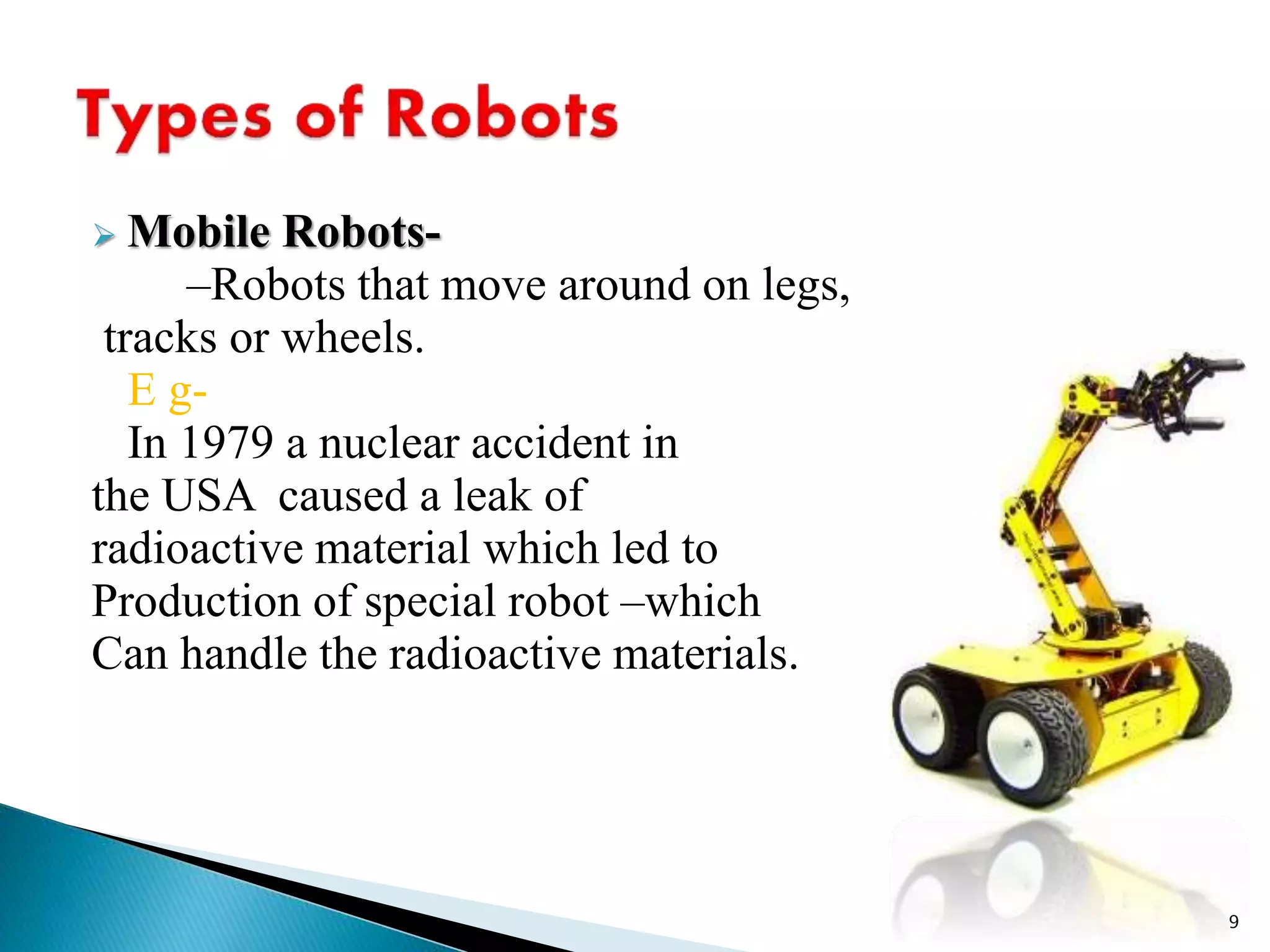
 Mobile Robots-
–Robots that move around on legs,
tracks or wheels.
E g-
In 1979 a nuclear accident in
the USA caused a leak of
radioactive material which led to
Production of special robot –which
Can handle the radioactive materials.
9
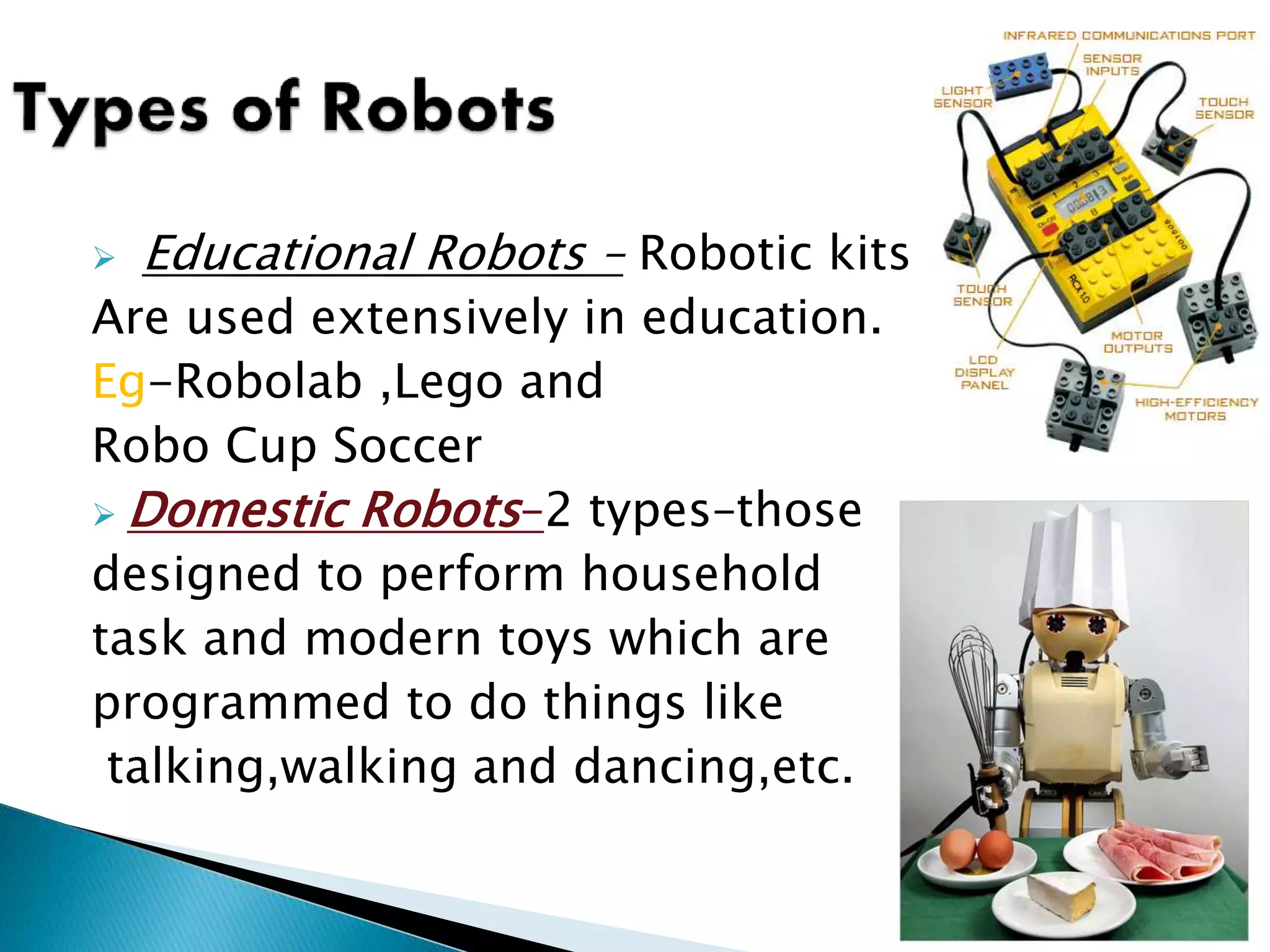
 Educational Robots – Robotic kits
Are used extensively in education.
Eg-Robolab ,Lego and
Robo Cup Soccer
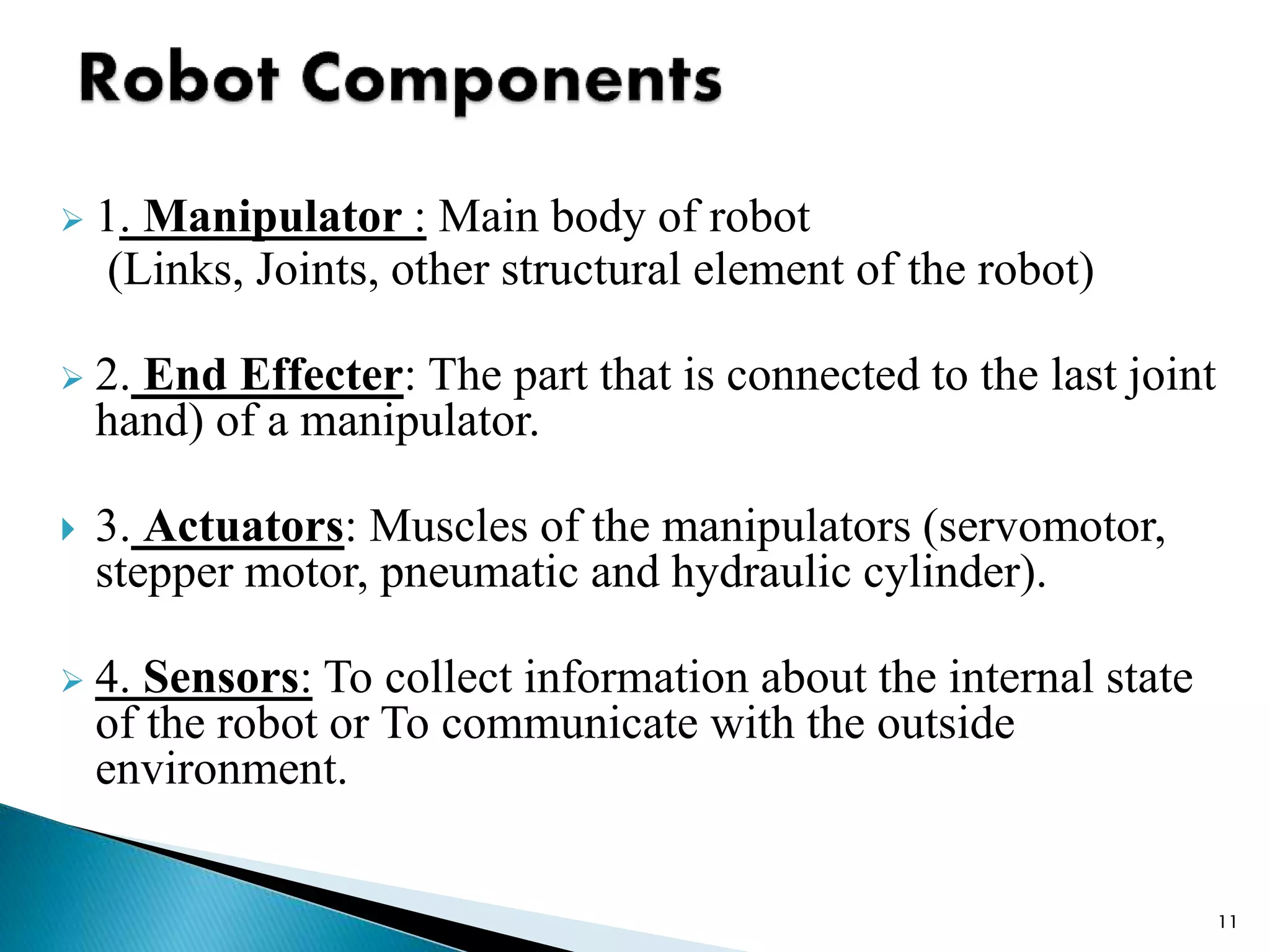
 Domestic Robots–2 types–those
designed to perform household
task and modern toys which are
programmed to do things like
talking,walking and dancing,etc.
10
 1. Manipulator : Main body of robot
(Links, Joints, other structural element of the robot)
 2. End Effecter: The part that is connected to the last joint
hand) of a manipulator.
 3. Actuators: Muscles of the manipulators (servomotor,
stepper motor, pneumatic and hydraulic cylinder).
 4. Sensors: To collect information about the internal state
of the robot or To communicate with the outside
environment.
11
 5. Controller: Similar to cerebellum. It controls and
coordinates the motion of the actuators
 6. Processor: The brain of the robot. It calculates the
motions and the velocity of the robot’s joints, etc
 7. Software: Operating system, robotic software and the
collection of routines.
12
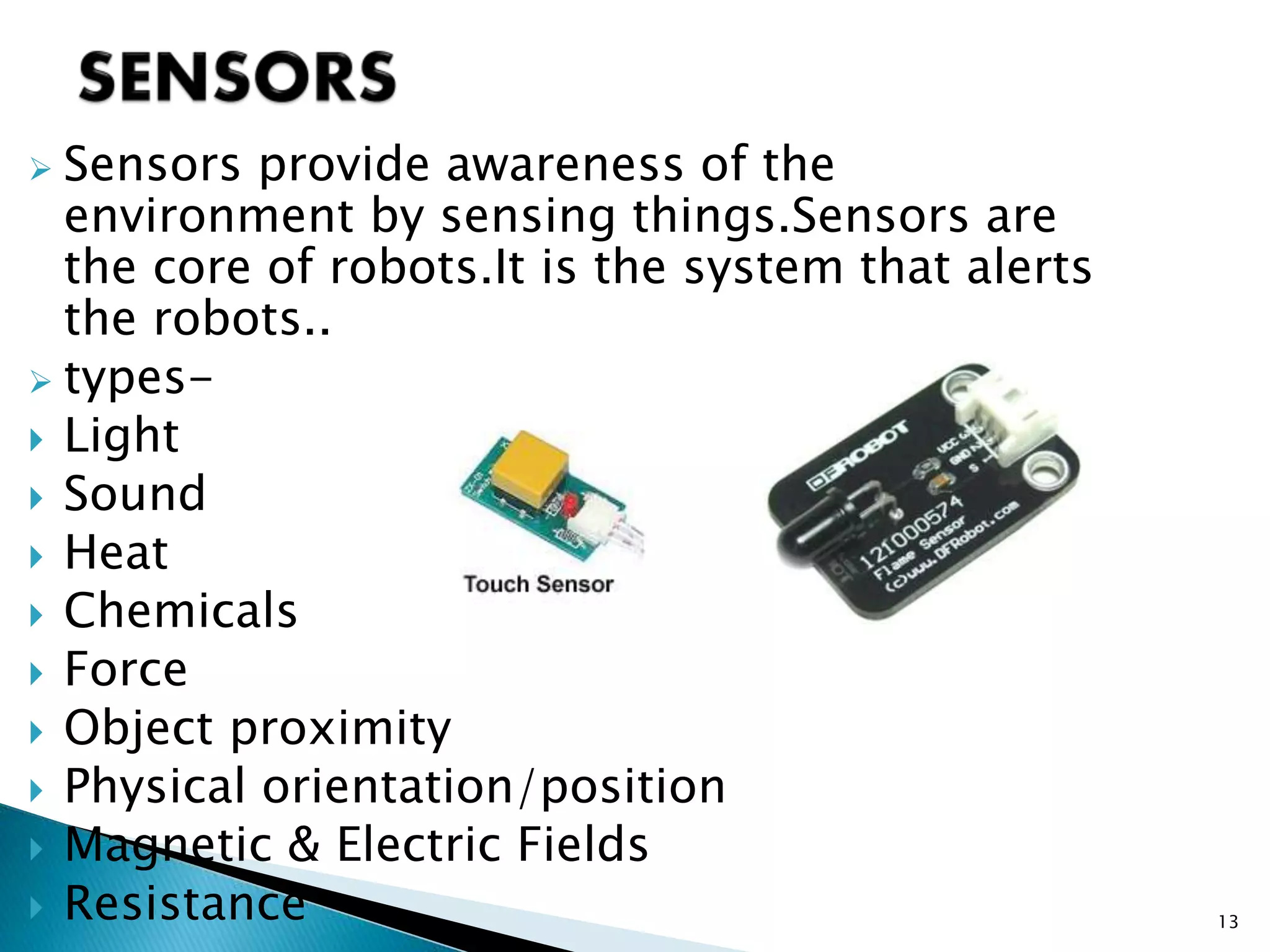
 Sensors provide awareness of the
environment by sensing things.Sensors are
the core of robots.It is the system that alerts
the robots..
 types-
 Light
 Sound
 Heat
 Chemicals
 Force
 Object proximity
 Physical orientation/position
 Magnetic & Electric Fields
 Resistance 13
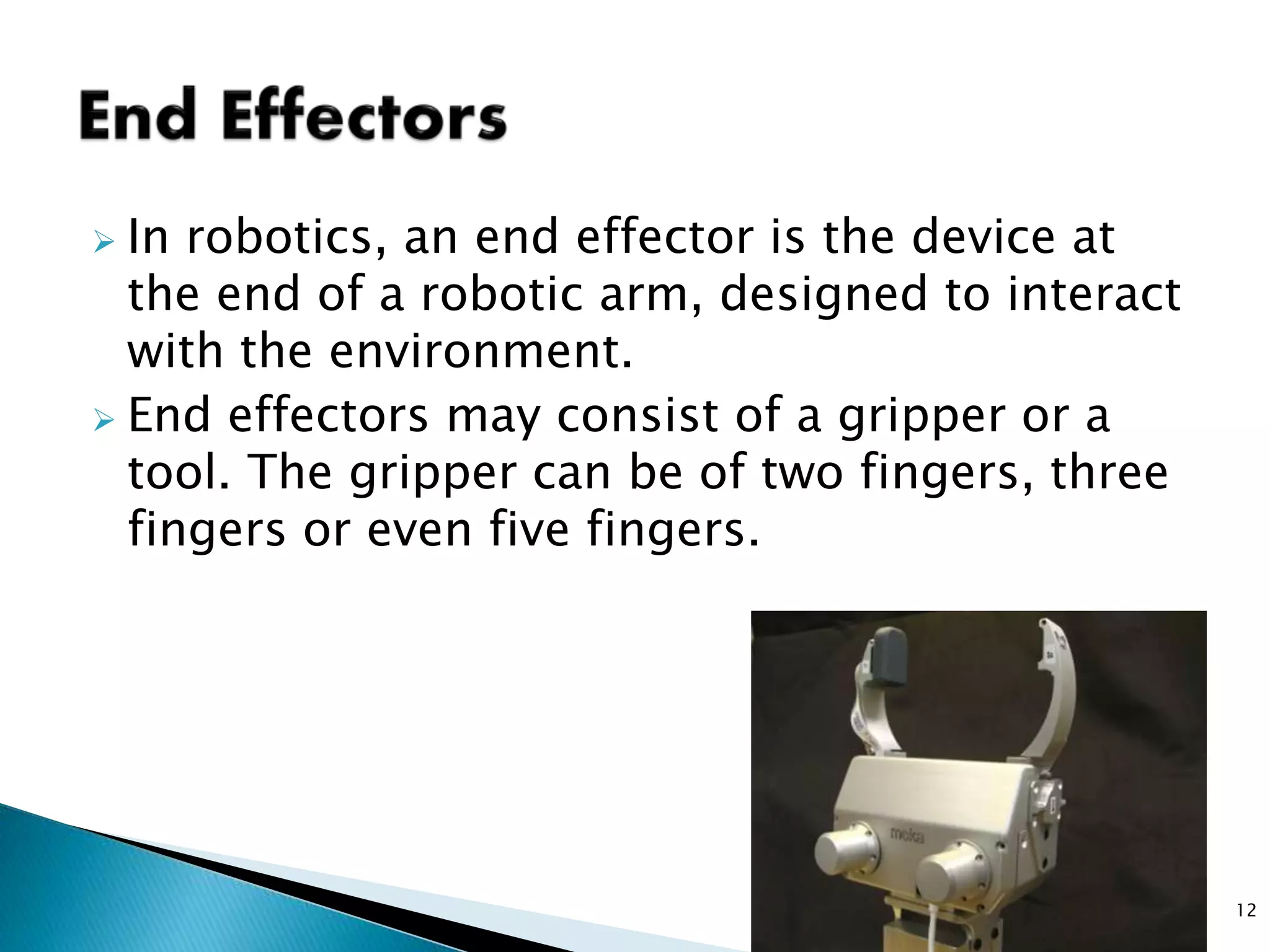
 In robotics, an end effector is the device at
the end of a robotic arm, designed to interact
with the environment.
 End effectors may consist of a gripper or a
tool. The gripper can be of two fingers, three
fingers or even five fingers.
12
 Locomotion
 Manipulation
15
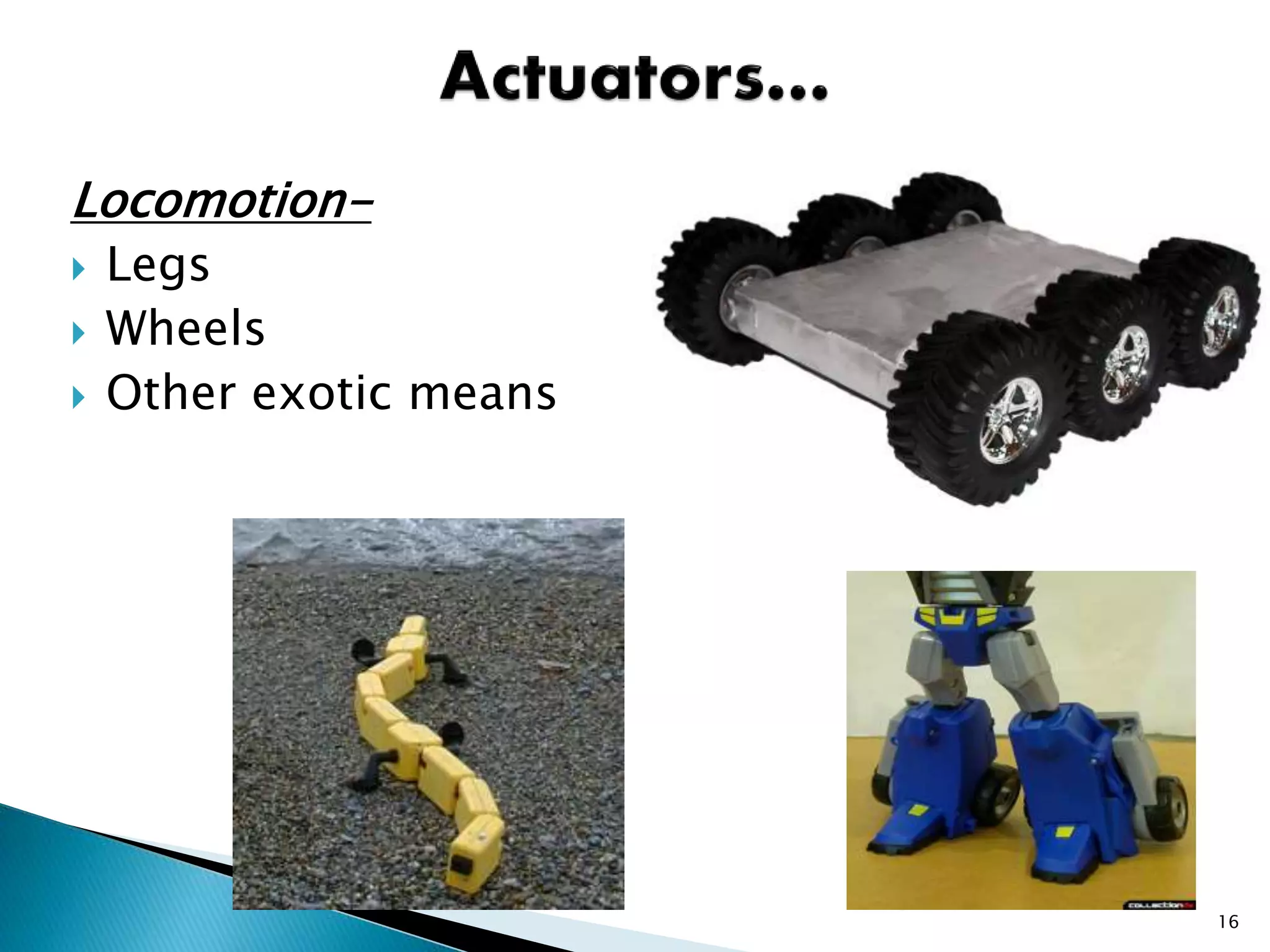
Locomotion-
 Legs
 Wheels
 Other exotic means
16
Manipulations-
 Degrees of freedom
◦ independently controllable components of motion
 Arms:
◦ convenient method to allow full movement in 3D
◦ more often used in fixed robots due to power & weight
◦ even more difficult to control!
 due to extra degrees of freedom
 Grippers:
◦ may be very simple (two rigid arms) to pick up objects
◦ may be complex device with fingers on end of an arm
◦ probably need feedback to control grip force
17
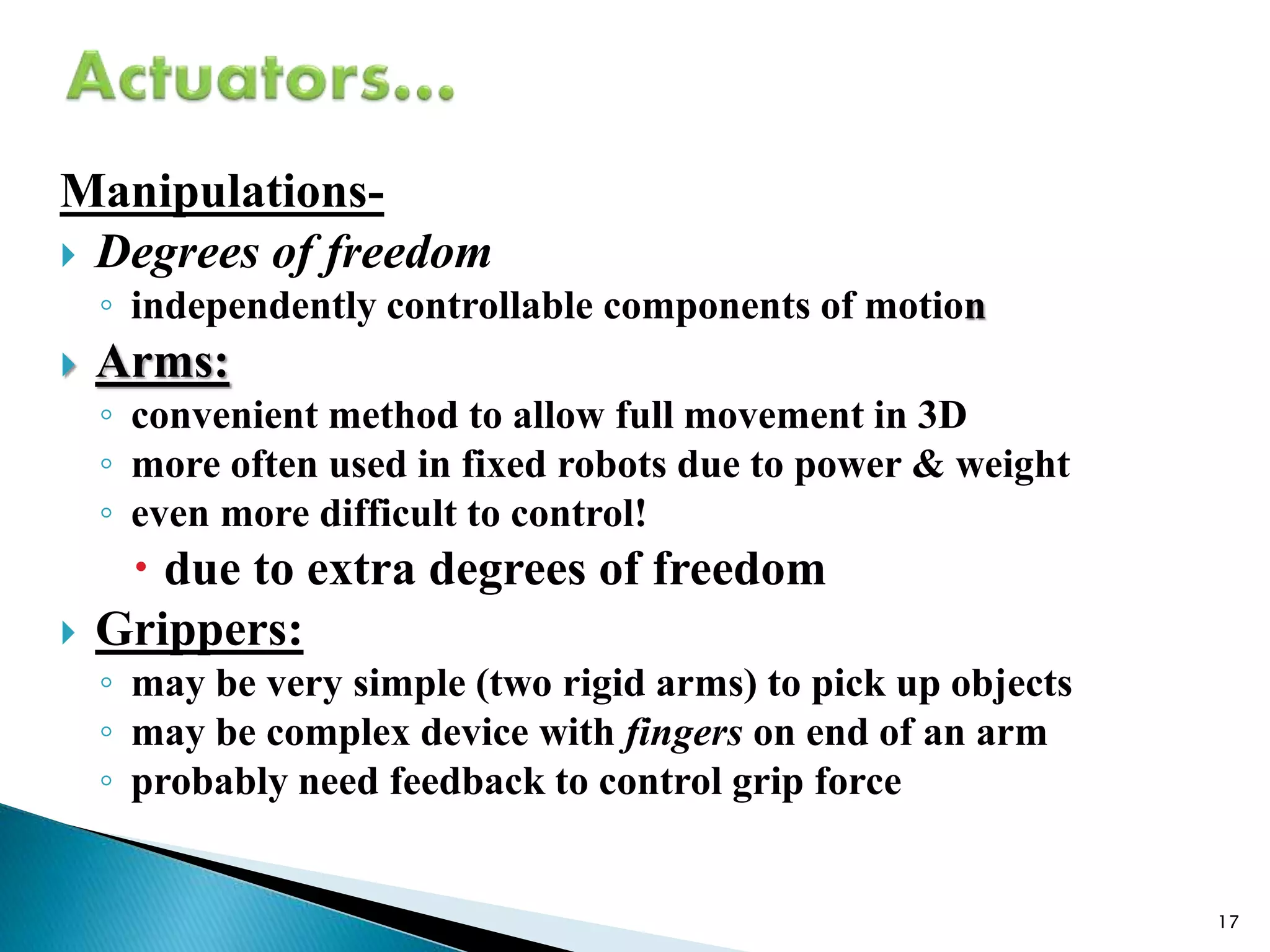
 EXPLORATION-
– Space Missions
– Robots in the Antarctic
– Exploring Volcanoes
– Underwater Exploration
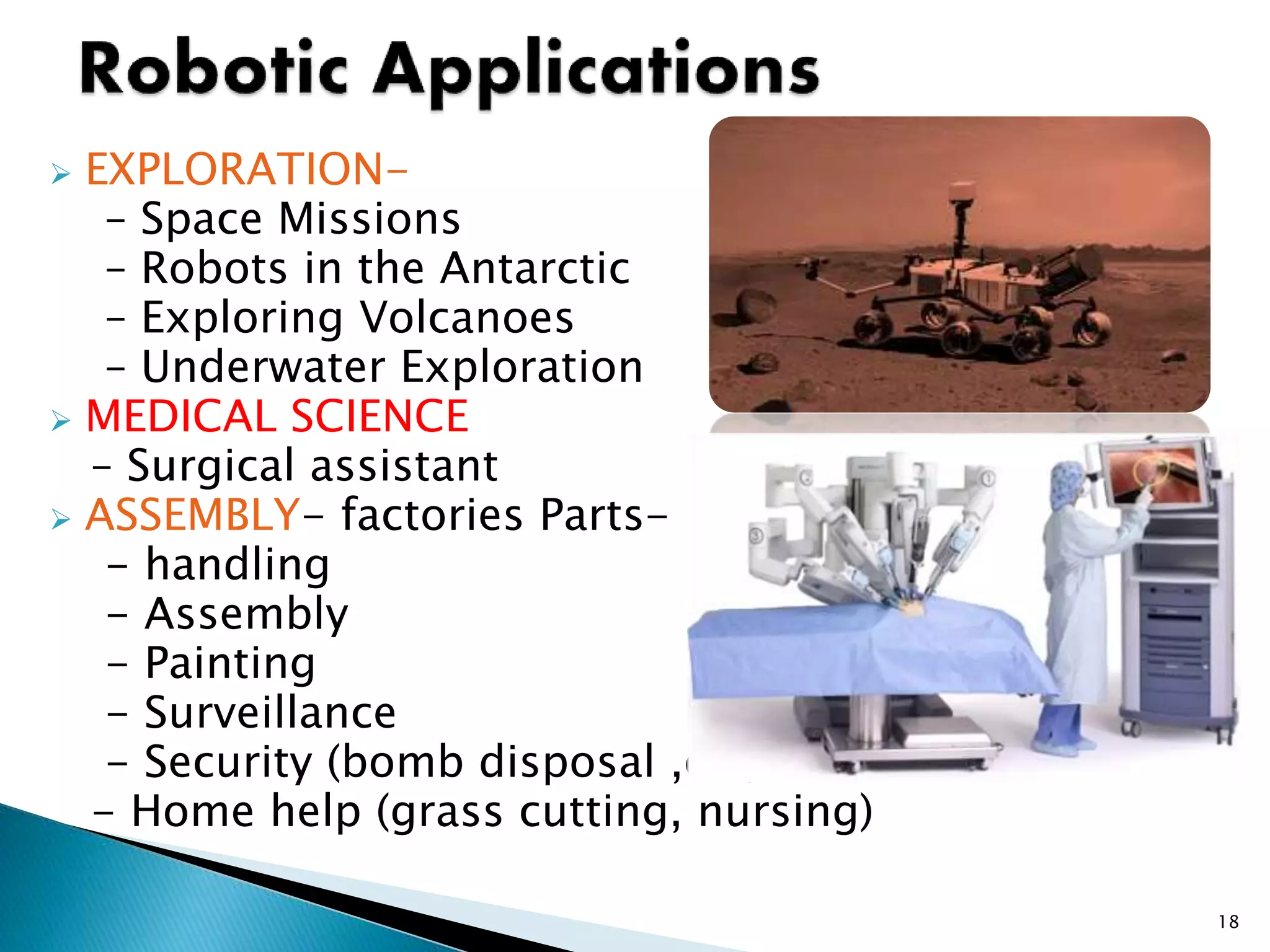
 MEDICAL SCIENCE
– Surgical assistant
 ASSEMBLY- factories Parts-
- handling
- Assembly
- Painting
- Surveillance
- Security (bomb disposal ,etc)
- Home help (grass cutting, nursing)
18
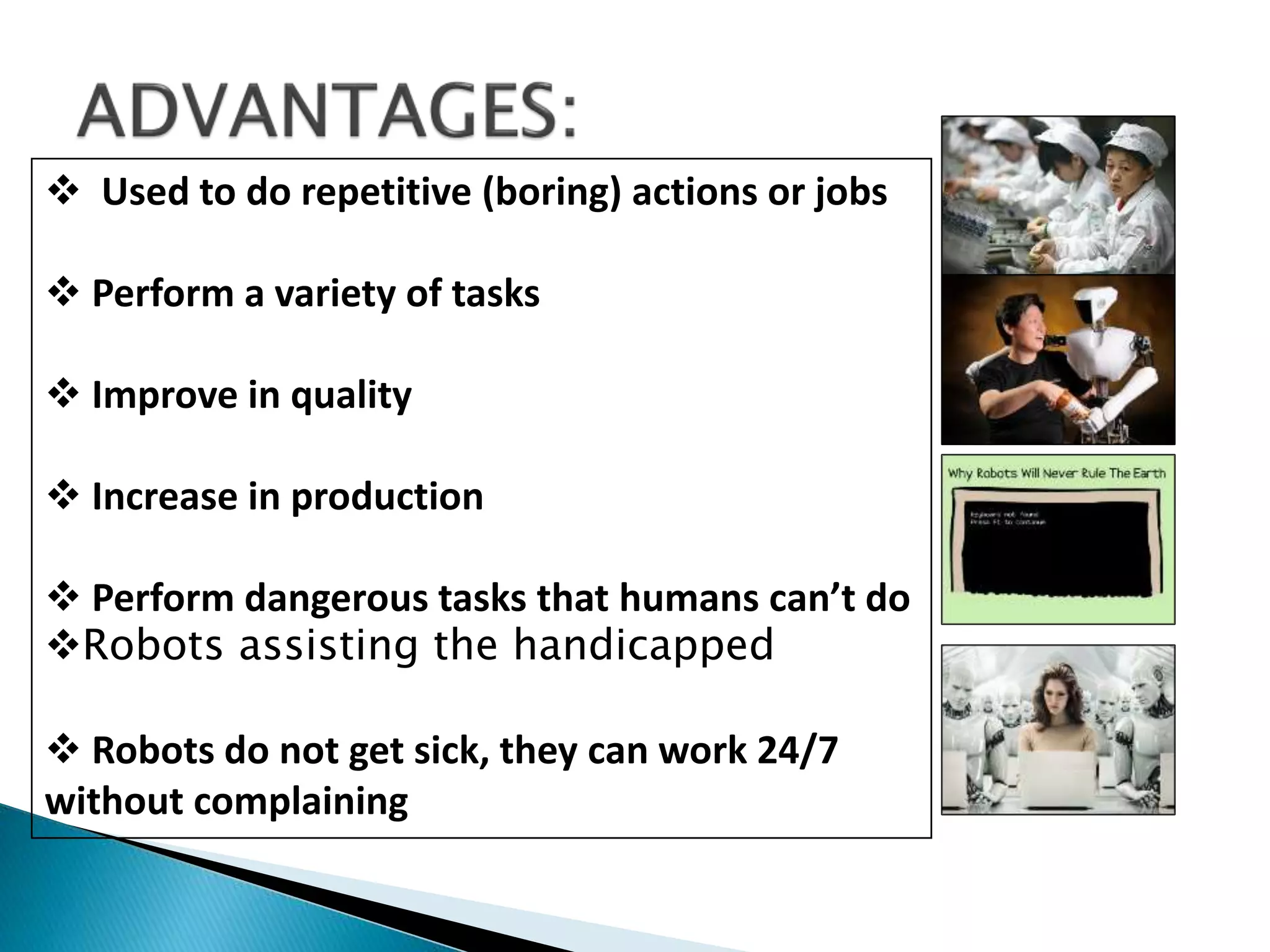
 Used to do repetitive (boring) actions or jobs
 Perform a variety of tasks
 Improve in quality
 Increase in production
 Perform dangerous tasks that humans can’t do
Robots assisting the handicapped
 Robots do not get sick, they can work 24/7
without complaining
 UNEMPLOYEMENT
 MORE COST
 UNEDUCATED PERSON CAN’T HANDLE EASIAY
20
 Today we find most robots working for
people in industries, factories, warehouses,
and laboratories. Robots are useful in many
ways. Therefore, having robots helps
business owners to be competitive, because
robots can do jobs better and faster than
humans can.
21
 http://www.robotix.in/
 http://www.techfest.org/
 http://www.kurukshetra.org
 http://www.robofest.org.my/
 http://www.pragyan.org
22
THANK YOU
24

Robotics ppt

  • 1.
    DEPARTMENT OF ELECTRICAL& ELECTRONICS ENGINEERING ANNAMACHARYA INSTITUTE OF TECHNOLOGY & SCIENCES (AUTONOMOUS) RAJAMPET. 1
  • 2.
  • 3.
     To knowdifferent parts of robot  Types of robots  Basic 3 laws 3
  • 4.
     HISTORY  ROBOTICS-ROBOT LAWS OF ROBOT  TYPES  PARTS  ADVANTAGES & DISADVANTAGES  CONCLUSIONS  REFERENCE 4
  • 5.
     The term"robot" was first used in 1920 in a play called "R.U.R." Or “ Rossum 's universal robots" by the Czech writer KarelCapek.  The word “Robot ”come s from the word “ Robota ”,meaning ,in Czech”, forced labour, drudgery. 5
  • 6.
    - Mechanical devicethat performs human tasks, either automatically or by remote control. A re-programmable, multifunctional, automatic industrial machine designed to replace human in hazardous work. for the performance of a variety of Tasks  Robotics - Study and application of robot technology.  Telerobotics - Robot that is operated remotely. 6
  • 7.
     Asimov proposedthree “Laws of Robotics”  Law 1: A robot may not injure a human being or through inaction, allow a human being to come to harm.  Law 2: A robot must obey orders given to it by human beings, except where such orders would conflict with the first law.  Law 3: A robot must protect its own existence as long as such protection does not conflict with the first law. 7
  • 8.
     Industrial Robots– –materials handling –welding –inspection –improving productivity –Laboratory applications 8
  • 9.
     Mobile Robots- –Robotsthat move around on legs, tracks or wheels. E g- In 1979 a nuclear accident in the USA caused a leak of radioactive material which led to Production of special robot –which Can handle the radioactive materials. 9
  • 10.
     Educational Robots– Robotic kits Are used extensively in education. Eg-Robolab ,Lego and Robo Cup Soccer  Domestic Robots–2 types–those designed to perform household task and modern toys which are programmed to do things like talking,walking and dancing,etc. 10
  • 11.
     1. Manipulator: Main body of robot (Links, Joints, other structural element of the robot)  2. End Effecter: The part that is connected to the last joint hand) of a manipulator.  3. Actuators: Muscles of the manipulators (servomotor, stepper motor, pneumatic and hydraulic cylinder).  4. Sensors: To collect information about the internal state of the robot or To communicate with the outside environment. 11
  • 12.
     5. Controller:Similar to cerebellum. It controls and coordinates the motion of the actuators  6. Processor: The brain of the robot. It calculates the motions and the velocity of the robot’s joints, etc  7. Software: Operating system, robotic software and the collection of routines. 12
  • 13.
     Sensors provideawareness of the environment by sensing things.Sensors are the core of robots.It is the system that alerts the robots..  types-  Light  Sound  Heat  Chemicals  Force  Object proximity  Physical orientation/position  Magnetic & Electric Fields  Resistance 13
  • 14.
     In robotics,an end effector is the device at the end of a robotic arm, designed to interact with the environment.  End effectors may consist of a gripper or a tool. The gripper can be of two fingers, three fingers or even five fingers. 12
  • 15.
  • 16.
  • 17.
    Manipulations-  Degrees offreedom ◦ independently controllable components of motion  Arms: ◦ convenient method to allow full movement in 3D ◦ more often used in fixed robots due to power & weight ◦ even more difficult to control!  due to extra degrees of freedom  Grippers: ◦ may be very simple (two rigid arms) to pick up objects ◦ may be complex device with fingers on end of an arm ◦ probably need feedback to control grip force 17
  • 18.
     EXPLORATION- – SpaceMissions – Robots in the Antarctic – Exploring Volcanoes – Underwater Exploration  MEDICAL SCIENCE – Surgical assistant  ASSEMBLY- factories Parts- - handling - Assembly - Painting - Surveillance - Security (bomb disposal ,etc) - Home help (grass cutting, nursing) 18
  • 19.
     Used todo repetitive (boring) actions or jobs  Perform a variety of tasks  Improve in quality  Increase in production  Perform dangerous tasks that humans can’t do Robots assisting the handicapped  Robots do not get sick, they can work 24/7 without complaining
  • 20.
     UNEMPLOYEMENT  MORECOST  UNEDUCATED PERSON CAN’T HANDLE EASIAY 20
  • 21.
     Today wefind most robots working for people in industries, factories, warehouses, and laboratories. Robots are useful in many ways. Therefore, having robots helps business owners to be competitive, because robots can do jobs better and faster than humans can. 21
  • 22.
     http://www.robotix.in/  http://www.techfest.org/ http://www.kurukshetra.org  http://www.robofest.org.my/  http://www.pragyan.org 22
  • 23.
  • 24.

Editor's Notes