
ME-181
INTRODUCTION TO
MECHANICAL ENGINEERING
LEVEL-1, TERM-I
Adib Bin Rashid
Capt
Instructor Class C
Mechanical Engineering Department
A D I B B I N R A S H I D
C A P T
I N S T R U C T O R C L A S S C
M E C H A N I C A L E N G I N E E R I N G
D E P A R T M E N T
Robotics
Robot
 A robot is a mechanical or virtual artificial agent, usually an electro-
mechanical machine that is guided by a computer program or electronic
circuitry.
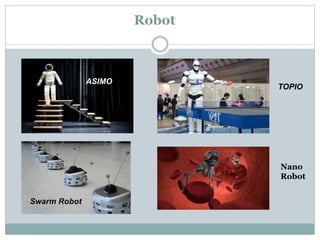
 Robots can be autonomous or semi-autonomous and range from
humanoids such as Honda's Advanced Step in Innovative
Mobility (ASIMO) and TOSY's TOSY Ping Pong Playing Robot (TOPIO)
to industrial robots, medical operating robots, patient assist robots, dog
therapy robots, collectively programmed swarm robots, UAV drones
such as General Atomics MQ-1 Predator, and even microscopic nano
robots.
 By mimicking a lifelike appearance or automating movements, a robot
may convey a sense of intelligence or thought of its own
Robot
Swarm Robot
ASIMO
Nano
Robot
TOPIO
Robot
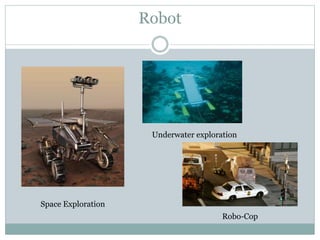
Space Exploration
Underwater exploration
Robo-Cop
Robot_History
 The word 'robot' was first used to denote a fictional humanoid in a 1921
play R.U.R. by the Czech writer, Karel Čapek.
 Electronics evolved into the driving force of development with the
advent of the first electronic autonomous robots created by William
Grey Walter in Bristol, England in 1948.
 The first digital and programmable robot was invented by George
Devol in 1954 and was named the Unimate. It was sold to General
Motors in 1961 where it was used to lift pieces of hot metal from die
casting machines at the Inland Fisher Guide Plant in the West
Trenton section of Ewing Township, New Jerse.
Robotics
 Robotics is the branch of mechanical
engineering, electrical engineering, electronic
engineering and computer science that deals with the
design, construction, operation, and application
of robots, as well as computer systems for their
control, sensory feedback, and information processing.
 These technologies deal with automated machines
that can take the place of humans in dangerous
environments or manufacturing processes, or
resemble humans in appearance, behavior, and or
cognition. Many of today's robots are inspired by
nature contributing to the field of bio-inspired robotics.
Laws of Robotics
 Laws of Robotics are a set of laws, rules, or principles,
which are intended as a fundamental framework to
underpin the behavior of robots designed to have a degree
of autonomy.
 Robots of this degree of complexity do not yet exist, but
they have been widely anticipated in science
fiction, films and are a topic of active research and
development in the fields of robotics and artificial
intelligence.
The Three Laws of Robotics
 The Three Laws of Robotics (often shortened to The
Three Laws or Three Laws, also known as Asimov's
Laws) are a set of rules devised by the science fiction
author Isaac Asimov.
 The rules were introduced in his 1942 short story
"Runaround", although they had been foreshadowed in a
few earlier stories.
 The Three Laws, quoted as being from the "Handbook of
Robotics, 56th Edition, 2058 A.D.", are:
The Three Laws of Robotics
1. A robot may not injure a human being or, through in
action, allow a human being to come to harm.
2. A robot must obey the orders given it by human
beings except where such orders would conflict
with the First Law.
3. A robot must protect its own existence as long as
such protection does not conflict with the First or
Second Laws.
The original laws have been altered and elaborated on by Asimov
and other authors. Asimov himself made slight modifications to
the first three in various books and short stories to further
develop how robots would interact with humans and each other.
In later fiction where robots had taken responsibility for
government of whole planets and human civilizations, Asimov
also added a fourth, or , to precede the others:
The Three Laws, and the zeroth, have pervaded science fiction
and are referred to in many books, films, and other media.
Example of Robot
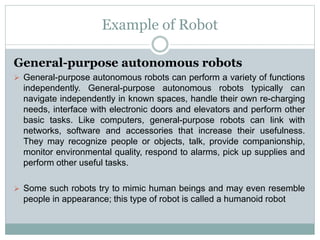
General-purpose autonomous robots
 General-purpose autonomous robots can perform a variety of functions
independently. General-purpose autonomous robots typically can
navigate independently in known spaces, handle their own re-charging
needs, interface with electronic doors and elevators and perform other
basic tasks. Like computers, general-purpose robots can link with
networks, software and accessories that increase their usefulness.
They may recognize people or objects, talk, provide companionship,
monitor environmental quality, respond to alarms, pick up supplies and
perform other useful tasks.
 Some such robots try to mimic human beings and may even resemble
people in appearance; this type of robot is called a humanoid robot
Example of Robot
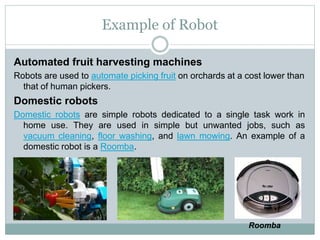
Automated fruit harvesting machines
Robots are used to automate picking fruit on orchards at a cost lower than
that of human pickers.
Domestic robots
Domestic robots are simple robots dedicated to a single task work in
home use. They are used in simple but unwanted jobs, such as
vacuum cleaning, floor washing, and lawn mowing. An example of a
domestic robot is a Roomba.
Roomba
Example of Robot
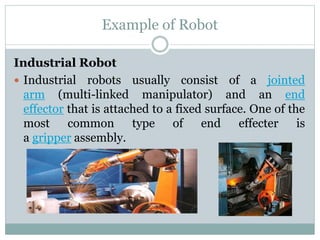
Industrial Robot
 Industrial robots usually consist of a jointed
arm (multi-linked manipulator) and an end
effector that is attached to a fixed surface. One of the
most common type of end effecter is
a gripper assembly.
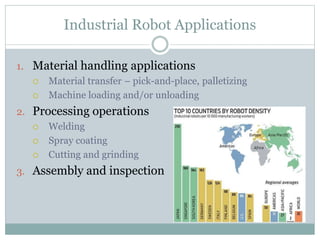
Industrial Robot Applications
1. Material handling applications
 Material transfer – pick-and-place, palletizing
 Machine loading and/or unloading
2. Processing operations
 Welding
 Spray coating
 Cutting and grinding
3. Assembly and inspection
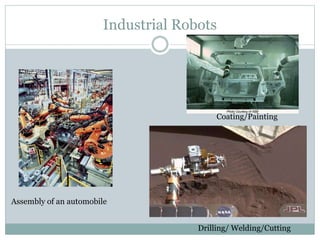
Industrial Robots
Assembly of an automobile
Drilling/ Welding/Cutting
Coating/Painting
Example of Robot
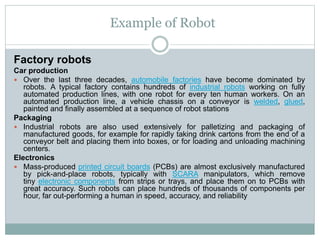
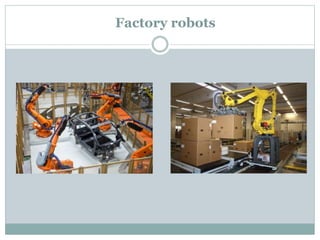
Factory robots
Car production
 Over the last three decades, automobile factories have become dominated by
robots. A typical factory contains hundreds of industrial robots working on fully
automated production lines, with one robot for every ten human workers. On an
automated production line, a vehicle chassis on a conveyor is welded, glued,
painted and finally assembled at a sequence of robot stations
Packaging
 Industrial robots are also used extensively for palletizing and packaging of
manufactured goods, for example for rapidly taking drink cartons from the end of a
conveyor belt and placing them into boxes, or for loading and unloading machining
centers.
Electronics
 Mass-produced printed circuit boards (PCBs) are almost exclusively manufactured
by pick-and-place robots, typically with SCARA manipulators, which remove
tiny electronic components from strips or trays, and place them on to PCBs with
great accuracy. Such robots can place hundreds of thousands of components per
hour, far out-performing a human in speed, accuracy, and reliability
Factory robots
Example of Robot
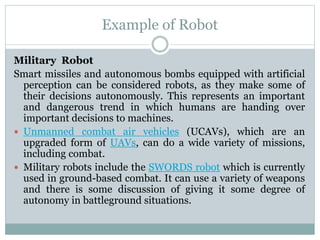
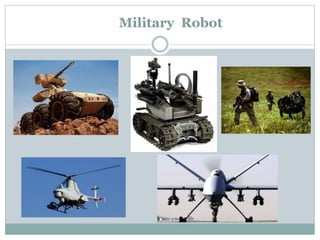
Military Robot
Smart missiles and autonomous bombs equipped with artificial
perception can be considered robots, as they make some of
their decisions autonomously. This represents an important
and dangerous trend in which humans are handing over
important decisions to machines.
 Unmanned combat air vehicles (UCAVs), which are an
upgraded form of UAVs, can do a wide variety of missions,
including combat.
 Military robots include the SWORDS robot which is currently
used in ground-based combat. It can use a variety of weapons
and there is some discussion of giving it some degree of
autonomy in battleground situations.
Military Robot
Example of Robot
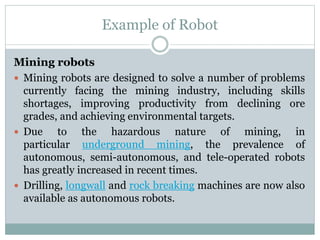
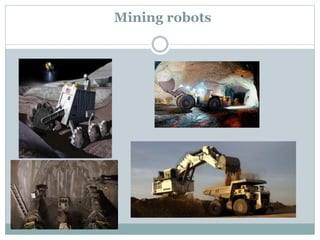
Mining robots
 Mining robots are designed to solve a number of problems
currently facing the mining industry, including skills
shortages, improving productivity from declining ore
grades, and achieving environmental targets.
 Due to the hazardous nature of mining, in
particular underground mining, the prevalence of
autonomous, semi-autonomous, and tele-operated robots
has greatly increased in recent times.
 Drilling, longwall and rock breaking machines are now also
available as autonomous robots.
Mining robots
Example of Robot
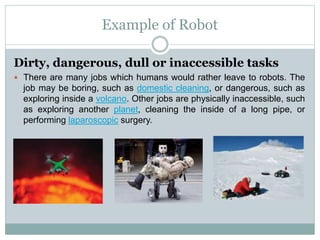
Dirty, dangerous, dull or inaccessible tasks
 There are many jobs which humans would rather leave to robots. The
job may be boring, such as domestic cleaning, or dangerous, such as
exploring inside a volcano. Other jobs are physically inaccessible, such
as exploring another planet, cleaning the inside of a long pipe, or
performing laparoscopic surgery.
Example of Robot
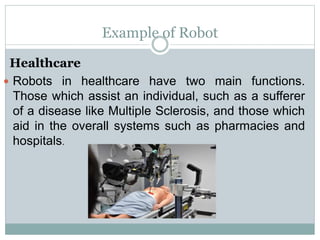
Healthcare
 Robots in healthcare have two main functions.
Those which assist an individual, such as a sufferer
of a disease like Multiple Sclerosis, and those which
aid in the overall systems such as pharmacies and
hospitals.
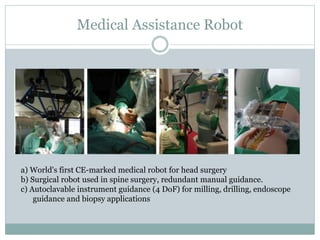
Medical Assistance Robot
a) World's first CE-marked medical robot for head surgery
b) Surgical robot used in spine surgery, redundant manual guidance.
c) Autoclavable instrument guidance (4 DoF) for milling, drilling, endoscope
guidance and biopsy applications
Healthcare
Home automation for the elderly
and disabled
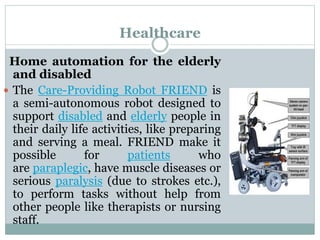
 The Care-Providing Robot FRIEND is
a semi-autonomous robot designed to
support disabled and elderly people in
their daily life activities, like preparing
and serving a meal. FRIEND make it
possible for patients who
are paraplegic, have muscle diseases or
serious paralysis (due to strokes etc.),
to perform tasks without help from
other people like therapists or nursing
staff.
Example of Robot
Pharmacies
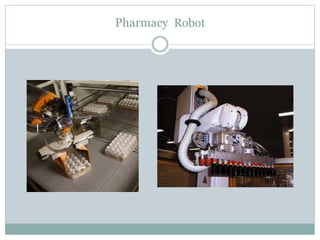
 Script Pro manufactures a robot designed to help pharmacies fill
prescriptions that consist of oral solids or medications in pill form.
The pharmacist or pharmacy technician enters the prescription
information into its information system. The system, upon
determining whether or not the drug is in the robot, will send the
information to the robot for filling.
 The pharmacist or technician then checks the contents of the vial to
ensure it’s the correct drug for the correct patient and then seals
the vials and sends it out front to be picked up. The robot is a very
time efficient device that the pharmacy depends on to fill
prescriptions.
Pharmacy Robot
Example of Robot
Nano Robots
 Nanorobotics is the emerging technology field of creating machines
or robots whose components are at or close to the microscopic
scale of a nanometer (10−9 meters). Also known as "nanobots" or
"nanites", they would be constructed from molecular machines. So
far, researchers have mostly produced only parts of these complex
systems, such as bearings, sensors, and synthetic molecular
motors, but functioning robots have also been made such as the
entrants to the Nanobot Robocup contest.
 Researchers also hope to be able to create entire robots as small
as viruses or bacteria, which could perform tasks on a tiny scale.
 Possible applications include micro surgery (on the level of
individual cells), utility fog, manufacturing, weaponry and cleaning.
Nano Robot
1. introduction to robot

1. introduction to robot

  • 1.
    ME-181 INTRODUCTION TO MECHANICAL ENGINEERING LEVEL-1,TERM-I Adib Bin Rashid Capt Instructor Class C Mechanical Engineering Department
  • 2.
    A D IB B I N R A S H I D C A P T I N S T R U C T O R C L A S S C M E C H A N I C A L E N G I N E E R I N G D E P A R T M E N T Robotics
  • 3.
    Robot  A robotis a mechanical or virtual artificial agent, usually an electro- mechanical machine that is guided by a computer program or electronic circuitry.  Robots can be autonomous or semi-autonomous and range from humanoids such as Honda's Advanced Step in Innovative Mobility (ASIMO) and TOSY's TOSY Ping Pong Playing Robot (TOPIO) to industrial robots, medical operating robots, patient assist robots, dog therapy robots, collectively programmed swarm robots, UAV drones such as General Atomics MQ-1 Predator, and even microscopic nano robots.  By mimicking a lifelike appearance or automating movements, a robot may convey a sense of intelligence or thought of its own
  • 4.
  • 5.
  • 6.
    Robot_History  The word'robot' was first used to denote a fictional humanoid in a 1921 play R.U.R. by the Czech writer, Karel Čapek.  Electronics evolved into the driving force of development with the advent of the first electronic autonomous robots created by William Grey Walter in Bristol, England in 1948.  The first digital and programmable robot was invented by George Devol in 1954 and was named the Unimate. It was sold to General Motors in 1961 where it was used to lift pieces of hot metal from die casting machines at the Inland Fisher Guide Plant in the West Trenton section of Ewing Township, New Jerse.
  • 7.
    Robotics  Robotics isthe branch of mechanical engineering, electrical engineering, electronic engineering and computer science that deals with the design, construction, operation, and application of robots, as well as computer systems for their control, sensory feedback, and information processing.  These technologies deal with automated machines that can take the place of humans in dangerous environments or manufacturing processes, or resemble humans in appearance, behavior, and or cognition. Many of today's robots are inspired by nature contributing to the field of bio-inspired robotics.
  • 8.
    Laws of Robotics Laws of Robotics are a set of laws, rules, or principles, which are intended as a fundamental framework to underpin the behavior of robots designed to have a degree of autonomy.  Robots of this degree of complexity do not yet exist, but they have been widely anticipated in science fiction, films and are a topic of active research and development in the fields of robotics and artificial intelligence.
  • 9.
    The Three Lawsof Robotics  The Three Laws of Robotics (often shortened to The Three Laws or Three Laws, also known as Asimov's Laws) are a set of rules devised by the science fiction author Isaac Asimov.  The rules were introduced in his 1942 short story "Runaround", although they had been foreshadowed in a few earlier stories.  The Three Laws, quoted as being from the "Handbook of Robotics, 56th Edition, 2058 A.D.", are:
  • 10.
    The Three Lawsof Robotics 1. A robot may not injure a human being or, through in action, allow a human being to come to harm. 2. A robot must obey the orders given it by human beings except where such orders would conflict with the First Law. 3. A robot must protect its own existence as long as such protection does not conflict with the First or Second Laws.
  • 11.
    The original lawshave been altered and elaborated on by Asimov and other authors. Asimov himself made slight modifications to the first three in various books and short stories to further develop how robots would interact with humans and each other. In later fiction where robots had taken responsibility for government of whole planets and human civilizations, Asimov also added a fourth, or , to precede the others: The Three Laws, and the zeroth, have pervaded science fiction and are referred to in many books, films, and other media.
  • 12.
    Example of Robot General-purposeautonomous robots  General-purpose autonomous robots can perform a variety of functions independently. General-purpose autonomous robots typically can navigate independently in known spaces, handle their own re-charging needs, interface with electronic doors and elevators and perform other basic tasks. Like computers, general-purpose robots can link with networks, software and accessories that increase their usefulness. They may recognize people or objects, talk, provide companionship, monitor environmental quality, respond to alarms, pick up supplies and perform other useful tasks.  Some such robots try to mimic human beings and may even resemble people in appearance; this type of robot is called a humanoid robot
  • 13.
    Example of Robot Automatedfruit harvesting machines Robots are used to automate picking fruit on orchards at a cost lower than that of human pickers. Domestic robots Domestic robots are simple robots dedicated to a single task work in home use. They are used in simple but unwanted jobs, such as vacuum cleaning, floor washing, and lawn mowing. An example of a domestic robot is a Roomba. Roomba
  • 14.
    Example of Robot IndustrialRobot  Industrial robots usually consist of a jointed arm (multi-linked manipulator) and an end effector that is attached to a fixed surface. One of the most common type of end effecter is a gripper assembly.
  • 15.
    Industrial Robot Applications 1.Material handling applications  Material transfer – pick-and-place, palletizing  Machine loading and/or unloading 2. Processing operations  Welding  Spray coating  Cutting and grinding 3. Assembly and inspection
  • 16.
    Industrial Robots Assembly ofan automobile Drilling/ Welding/Cutting Coating/Painting
  • 17.
    Example of Robot Factoryrobots Car production  Over the last three decades, automobile factories have become dominated by robots. A typical factory contains hundreds of industrial robots working on fully automated production lines, with one robot for every ten human workers. On an automated production line, a vehicle chassis on a conveyor is welded, glued, painted and finally assembled at a sequence of robot stations Packaging  Industrial robots are also used extensively for palletizing and packaging of manufactured goods, for example for rapidly taking drink cartons from the end of a conveyor belt and placing them into boxes, or for loading and unloading machining centers. Electronics  Mass-produced printed circuit boards (PCBs) are almost exclusively manufactured by pick-and-place robots, typically with SCARA manipulators, which remove tiny electronic components from strips or trays, and place them on to PCBs with great accuracy. Such robots can place hundreds of thousands of components per hour, far out-performing a human in speed, accuracy, and reliability
  • 18.
  • 19.
    Example of Robot MilitaryRobot Smart missiles and autonomous bombs equipped with artificial perception can be considered robots, as they make some of their decisions autonomously. This represents an important and dangerous trend in which humans are handing over important decisions to machines.  Unmanned combat air vehicles (UCAVs), which are an upgraded form of UAVs, can do a wide variety of missions, including combat.  Military robots include the SWORDS robot which is currently used in ground-based combat. It can use a variety of weapons and there is some discussion of giving it some degree of autonomy in battleground situations.
  • 20.
  • 21.
    Example of Robot Miningrobots  Mining robots are designed to solve a number of problems currently facing the mining industry, including skills shortages, improving productivity from declining ore grades, and achieving environmental targets.  Due to the hazardous nature of mining, in particular underground mining, the prevalence of autonomous, semi-autonomous, and tele-operated robots has greatly increased in recent times.  Drilling, longwall and rock breaking machines are now also available as autonomous robots.
  • 22.
  • 23.
    Example of Robot Dirty,dangerous, dull or inaccessible tasks  There are many jobs which humans would rather leave to robots. The job may be boring, such as domestic cleaning, or dangerous, such as exploring inside a volcano. Other jobs are physically inaccessible, such as exploring another planet, cleaning the inside of a long pipe, or performing laparoscopic surgery.
  • 24.
    Example of Robot Healthcare Robots in healthcare have two main functions. Those which assist an individual, such as a sufferer of a disease like Multiple Sclerosis, and those which aid in the overall systems such as pharmacies and hospitals.
  • 25.
    Medical Assistance Robot a)World's first CE-marked medical robot for head surgery b) Surgical robot used in spine surgery, redundant manual guidance. c) Autoclavable instrument guidance (4 DoF) for milling, drilling, endoscope guidance and biopsy applications
  • 26.
    Healthcare Home automation forthe elderly and disabled  The Care-Providing Robot FRIEND is a semi-autonomous robot designed to support disabled and elderly people in their daily life activities, like preparing and serving a meal. FRIEND make it possible for patients who are paraplegic, have muscle diseases or serious paralysis (due to strokes etc.), to perform tasks without help from other people like therapists or nursing staff.
  • 27.
    Example of Robot Pharmacies Script Pro manufactures a robot designed to help pharmacies fill prescriptions that consist of oral solids or medications in pill form. The pharmacist or pharmacy technician enters the prescription information into its information system. The system, upon determining whether or not the drug is in the robot, will send the information to the robot for filling.  The pharmacist or technician then checks the contents of the vial to ensure it’s the correct drug for the correct patient and then seals the vials and sends it out front to be picked up. The robot is a very time efficient device that the pharmacy depends on to fill prescriptions.
  • 28.
  • 29.
    Example of Robot NanoRobots  Nanorobotics is the emerging technology field of creating machines or robots whose components are at or close to the microscopic scale of a nanometer (10−9 meters). Also known as "nanobots" or "nanites", they would be constructed from molecular machines. So far, researchers have mostly produced only parts of these complex systems, such as bearings, sensors, and synthetic molecular motors, but functioning robots have also been made such as the entrants to the Nanobot Robocup contest.  Researchers also hope to be able to create entire robots as small as viruses or bacteria, which could perform tasks on a tiny scale.  Possible applications include micro surgery (on the level of individual cells), utility fog, manufacturing, weaponry and cleaning.
  • 30.