




Tittle: robotic Workspace Safety Optimization
Group Members:-
1.Zaid Kh. Saadon (GS 40746)
2.Ghassan Maan Salim (GS 42930)
3.Omotoso Oladiran Aremu (GS 41284)
1. Introduction
2. Problem statement
3. Objective
4. Safety factors
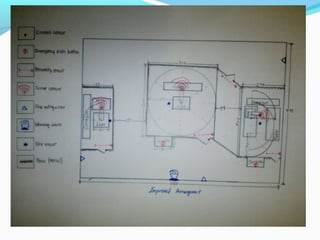
5. Proposal design of robot workcell/robot safety
6. Function for each safety devices/equipments
7. Cost for implementing the robot workcell/ robot safety for every
device/ equipment
8. Recommendation
9. Summary
INTRODUCTION
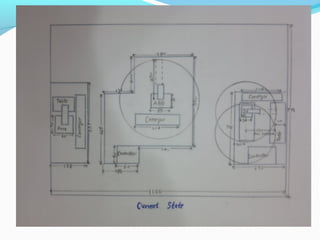
 Two types of robots used in the robotic laboratory, which are ABB robot and
FARA robot, basically there are two ABB robots and one FARA. Thus, based on the
provided robot safety in our robotic laboratory currently, the safety factors are not
satisfactory.
 The students are required to design a proper robot workcell for the three robots
in the laboratory. The factors must follow the standardized safety guideline used in
any robotic laboratory.
 Robot workcell is a complete system that includes the robot, controller and other
peripherals such as a part positioner and safety environment. It is sometimes
referred to as robot cell.
 While safety is a method and techniques used for avoiding accidents. It is important
to apply the robot safety and to follow the safety guideline while in the robot
laboratory. Protecting robots with a proper workcells from damage is important so
they will remain online, and functioning effectively requires protective equipment.
•Robots in robotics lab is FARA and ABB
•Lacks security to prevent mishaps from happening
because the only security measure is a fencing perimetre
only.
•With that being said, is it not enough should a personnel
happens to intrude without authorisation
•Absence of emergency button will aggravate situation
even further because robot would still be running in an
accident
•Overlapping workspace will cause collision with robots.
 
1. To design a proper robot safety work cell.
2. To be familiarized with robots, workcells, and robot safety.
3. To be familiarized with robotics before entering the real
industry.
Safety Factors
Robots removes the need for humans to perform
certain dangerous and harmful operations
Robots themselves can also create dangerous
conditions and threaten human safety
Essential that robot users and manufacturers
recognize the potential hazards and implement
safeguards to eliminate them.
Safety factors are taken to reduce the problem. Here are
the safety factors being taken:
1. To use protective cover to prevent workers from being in contact with the
robots in operation or working area. And another commonly used safety
measures in a work cell layout is constructing a physical barrier around
the robot. Most importantly, the barrier must cover the full reach of robot
end effector. It must also allow the robot to handle any equipment within
the work cell, while performing an operation. The main purpose for
building a barrier is to avoid the human operators from entering the
surrounding area of a robot, while it is performing. The barrier has
a gate attached to it in which the workers use to access the work cell.
2. Robots should be equipped with safety precautions like alarms, flashes
and shields. This is to remain the robot area is safe and in control.
3. Power systems - To understand the tensile strength of the robot and avoid
overloading. The disrupted and undesired actions to the power systems can
produce a release of energy, creating a hazardous environment for an
operator.
4. Control errors - The error in the controls software or the hardware can
lead to hazards within a robotic work cell. Thus, take measures to avoid
bug or failure of the software, for instance, robots equipped with several
processors, auto disconnection when computer cannot be connected with
the robots for a long time, and two computers working simultaneously to
check the data.
5. Always test and maintain to avoid the malfunction of robots. For instance,
addition of sensors to test and track information of voltage, pressure,
temperature, velocity and acceleration. Backup hardware should be
added to prevent malfunction, for instance, when carrying load, more
operating machines should be used, so as to avoid accidents when one of
them fails to function properly and drops the heavy load. Thus, the
industrial engineer is in charge with the installation to avoid an improper
installation to occur.
6. Use multi-safety design during the design to ensure the robots can stop
when malfunction, such as an emergency brake and automatic halt during
prolonged use.
7. Unfamiliar operator can lead to fatal. Training should be given to
operators to ensure they have adequate knowledge to handle sudden
changes or accidents caused by the robots.
FUNCTION FOR EACH SAFETY
DEVICES
Warning alarm
Contact sensor
Proximity sensor
Metal fence
Emergency push button
Sonar sensor
Fire extinguisher
Smoke sensors
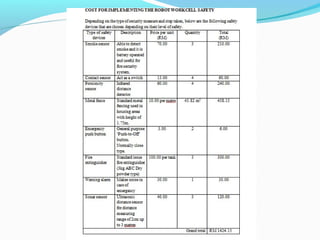
Cost of Implementing
Cost of safety devices are kept at a minimum by utilising numerous
resources.
Prices are checked by referring to respective websites that sells the
intended equipment.
By calculating how much safety devices needed, costs of buying the
parts are kept at a low level.
Design have been optimised so that less equipment is used but at the
same time maximising safety purposes.
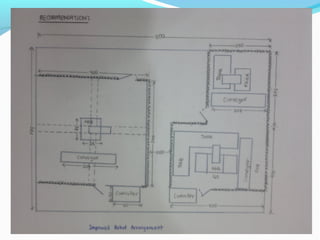
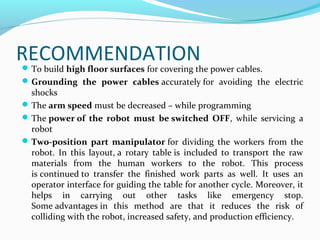
RECOMMENDATIONTo build high floor surfaces for covering the power cables.
Grounding the power cables accurately for avoiding the electric
shocks
The arm speed must be decreased – while programming
The power of the robot must be switched OFF, while servicing a
robot
Two-position part manipulator for dividing the workers from the
robot. In this layout, a rotary table is included to transport the raw
materials from the human workers to the robot. This process
is continued to transfer the finished work parts as well. It uses an
operator interface for guiding the table for another cycle. Moreover, it
helps in carrying out other tasks like emergency stop.
Some advantages in this method are that it reduces the risk of
colliding with the robot, increased safety, and production efficiency.
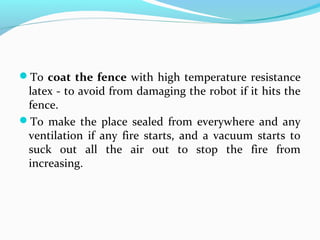
To coat the fence with high temperature resistance
latex - to avoid from damaging the robot if it hits the
fence.
To make the place sealed from everywhere and any
ventilation if any fire starts, and a vacuum starts to
suck out all the air out to stop the fire from
increasing.
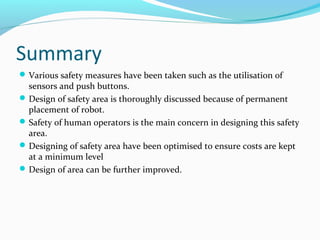
Summary
Various safety measures have been taken such as the utilisation of
sensors and push buttons.
Design of safety area is thoroughly discussed because of permanent
placement of robot.
Safety of human operators is the main concern in designing this safety
area.
Designing of safety area have been optimised to ensure costs are kept
at a minimum level
Design of area can be further improved.

Robot Safety Workcell

  • 1.
    Tittle: robotic WorkspaceSafety Optimization Group Members:- 1.Zaid Kh. Saadon (GS 40746) 2.Ghassan Maan Salim (GS 42930) 3.Omotoso Oladiran Aremu (GS 41284)
  • 2.
    1. Introduction 2. Problemstatement 3. Objective 4. Safety factors 5. Proposal design of robot workcell/robot safety 6. Function for each safety devices/equipments 7. Cost for implementing the robot workcell/ robot safety for every device/ equipment 8. Recommendation 9. Summary
  • 5.
    INTRODUCTION  Two typesof robots used in the robotic laboratory, which are ABB robot and FARA robot, basically there are two ABB robots and one FARA. Thus, based on the provided robot safety in our robotic laboratory currently, the safety factors are not satisfactory.  The students are required to design a proper robot workcell for the three robots in the laboratory. The factors must follow the standardized safety guideline used in any robotic laboratory.  Robot workcell is a complete system that includes the robot, controller and other peripherals such as a part positioner and safety environment. It is sometimes referred to as robot cell.  While safety is a method and techniques used for avoiding accidents. It is important to apply the robot safety and to follow the safety guideline while in the robot laboratory. Protecting robots with a proper workcells from damage is important so they will remain online, and functioning effectively requires protective equipment.
  • 6.
    •Robots in roboticslab is FARA and ABB •Lacks security to prevent mishaps from happening because the only security measure is a fencing perimetre only. •With that being said, is it not enough should a personnel happens to intrude without authorisation •Absence of emergency button will aggravate situation even further because robot would still be running in an accident •Overlapping workspace will cause collision with robots.
  • 7.
      1. To designa proper robot safety work cell. 2. To be familiarized with robots, workcells, and robot safety. 3. To be familiarized with robotics before entering the real industry.
  • 9.
    Safety Factors Robots removesthe need for humans to perform certain dangerous and harmful operations Robots themselves can also create dangerous conditions and threaten human safety Essential that robot users and manufacturers recognize the potential hazards and implement safeguards to eliminate them.
  • 10.
    Safety factors aretaken to reduce the problem. Here are the safety factors being taken: 1. To use protective cover to prevent workers from being in contact with the robots in operation or working area. And another commonly used safety measures in a work cell layout is constructing a physical barrier around the robot. Most importantly, the barrier must cover the full reach of robot end effector. It must also allow the robot to handle any equipment within the work cell, while performing an operation. The main purpose for building a barrier is to avoid the human operators from entering the surrounding area of a robot, while it is performing. The barrier has a gate attached to it in which the workers use to access the work cell. 2. Robots should be equipped with safety precautions like alarms, flashes and shields. This is to remain the robot area is safe and in control. 3. Power systems - To understand the tensile strength of the robot and avoid overloading. The disrupted and undesired actions to the power systems can produce a release of energy, creating a hazardous environment for an operator.
  • 11.
    4. Control errors- The error in the controls software or the hardware can lead to hazards within a robotic work cell. Thus, take measures to avoid bug or failure of the software, for instance, robots equipped with several processors, auto disconnection when computer cannot be connected with the robots for a long time, and two computers working simultaneously to check the data. 5. Always test and maintain to avoid the malfunction of robots. For instance, addition of sensors to test and track information of voltage, pressure, temperature, velocity and acceleration. Backup hardware should be added to prevent malfunction, for instance, when carrying load, more operating machines should be used, so as to avoid accidents when one of them fails to function properly and drops the heavy load. Thus, the industrial engineer is in charge with the installation to avoid an improper installation to occur. 6. Use multi-safety design during the design to ensure the robots can stop when malfunction, such as an emergency brake and automatic halt during prolonged use. 7. Unfamiliar operator can lead to fatal. Training should be given to operators to ensure they have adequate knowledge to handle sudden changes or accidents caused by the robots.
  • 17.
    FUNCTION FOR EACHSAFETY DEVICES Warning alarm Contact sensor Proximity sensor Metal fence Emergency push button Sonar sensor Fire extinguisher Smoke sensors
  • 19.
    Cost of Implementing Costof safety devices are kept at a minimum by utilising numerous resources. Prices are checked by referring to respective websites that sells the intended equipment. By calculating how much safety devices needed, costs of buying the parts are kept at a low level. Design have been optimised so that less equipment is used but at the same time maximising safety purposes.
  • 22.
    RECOMMENDATIONTo build highfloor surfaces for covering the power cables. Grounding the power cables accurately for avoiding the electric shocks The arm speed must be decreased – while programming The power of the robot must be switched OFF, while servicing a robot Two-position part manipulator for dividing the workers from the robot. In this layout, a rotary table is included to transport the raw materials from the human workers to the robot. This process is continued to transfer the finished work parts as well. It uses an operator interface for guiding the table for another cycle. Moreover, it helps in carrying out other tasks like emergency stop. Some advantages in this method are that it reduces the risk of colliding with the robot, increased safety, and production efficiency.
  • 23.
    To coat thefence with high temperature resistance latex - to avoid from damaging the robot if it hits the fence. To make the place sealed from everywhere and any ventilation if any fire starts, and a vacuum starts to suck out all the air out to stop the fire from increasing.
  • 25.
    Summary Various safety measureshave been taken such as the utilisation of sensors and push buttons. Design of safety area is thoroughly discussed because of permanent placement of robot. Safety of human operators is the main concern in designing this safety area. Designing of safety area have been optimised to ensure costs are kept at a minimum level Design of area can be further improved.