Robot Safety
Industrial Robots
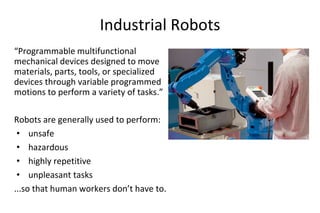
“Programmable multifunctional
mechanical devices designed to move
materials, parts, tools, or specialized
devices through variable programmed
motions to perform a variety of tasks.”
Robots are generally used to perform:
• unsafe
• hazardous
• highly repetitive
• unpleasant tasks
...so that human workers don’t have to.
Robot Accidents
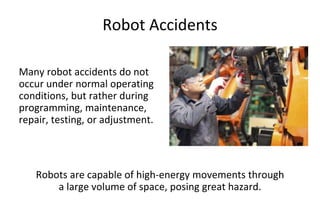
Many robot accidents do not
occur under normal operating
conditions, but rather during
programming, maintenance,
repair, testing, or adjustment.
Robots are capable of high-energy movements through
a large volume of space, posing great hazard.
Robot Accidents
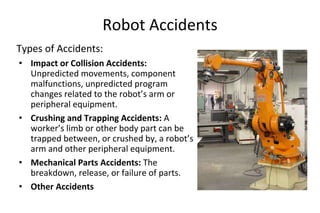
Types of Accidents:
• Impact or Collision Accidents:
Unpredicted movements, component
malfunctions, unpredicted program
changes related to the robot’s arm or
peripheral equipment.
• Crushing and Trapping Accidents: A
worker’s limb or other body part can be
trapped between, or crushed by, a robot’s
arm and other peripheral equipment.
• Mechanical Parts Accidents: The
breakdown, release, or failure of parts.
• Other Accidents
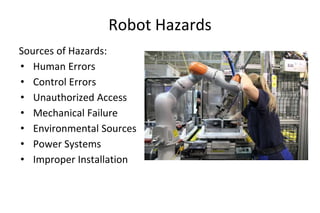
Robot Hazards
Sources of Hazards:
• Human Errors
• Control Errors
• Unauthorized Access
• Mechanical Failure
• Environmental Sources
• Power Systems
• Improper Installation
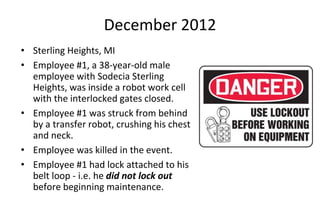
December 2012
• Sterling Heights, MI
• Employee #1, a 38-year-old male
employee with Sodecia Sterling
Heights, was inside a robot work cell
with the interlocked gates closed.
• Employee #1 was struck from behind
by a transfer robot, crushing his chest
and neck.
• Employee was killed in the event.
• Employee #1 had lock attached to his
belt loop - i.e. he did not lock out
before beginning maintenance.
July 2015
• Grand Rapids MI
• Grandmother Wanda Holbrook, 57, was
crushed to death by robotic arm at work
• Wanda was working on the production
line when a robotic arm took her by
surprise by entering the section in which
she was stationed.
• The arm hit and crushed her head
against a hitch assembly it was working
on, the lawsuit states.
• It also stated a failure of one or more of
the safety systems or devices had
caused Wanda's death. (per lawsuit)
• William Holbrook has filed a wrongful
death complaint against five robotic
firms responsible for installing and
testing the machinery that killed his
wife.
• $7000 Lockout – Later Dismissed
May 2007
• Waverly, NE
• Employee #1 was troubleshooting a
robotic arm used to remove CD
jewel cases from an injection
molding machine, when the arm
cycled and struck the employee.
• He suffered blunt force trauma to
his head and ribs.
• He was transported to the hospital,
where he died two weeks later.
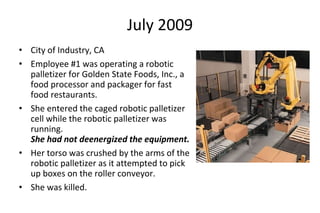
July 2009
• City of Industry, CA
• Employee #1 was operating a robotic
palletizer for Golden State Foods, Inc., a
food processor and packager for fast
food restaurants.
• She entered the caged robotic palletizer
cell while the robotic palletizer was
running.
She had not deenergized the equipment.
• Her torso was crushed by the arms of the
robotic palletizer as it attempted to pick
up boxes on the roller conveyor.
• She was killed.
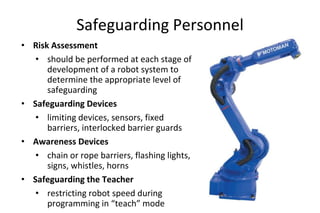
Safeguarding Personnel
• Risk Assessment
• should be performed at each stage of
development of a robot system to
determine the appropriate level of
safeguarding
• Safeguarding Devices
• limiting devices, sensors, fixed
barriers, interlocked barrier guards
• Awareness Devices
• chain or rope barriers, flashing lights,
signs, whistles, horns
• Safeguarding the Teacher
• restricting robot speed during
programming in “teach” mode
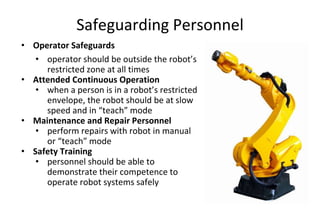
Safeguarding Personnel
• Operator Safeguards
• operator should be outside the robot’s
restricted zone at all times
• Attended Continuous Operation
• when a person is in a robot’s restricted
envelope, the robot should be at slow
speed and in “teach” mode
• Maintenance and Repair Personnel
• perform repairs with robot in manual
or “teach” mode
• Safety Training
• personnel should be able to
demonstrate their competence to
operate robot systems safely

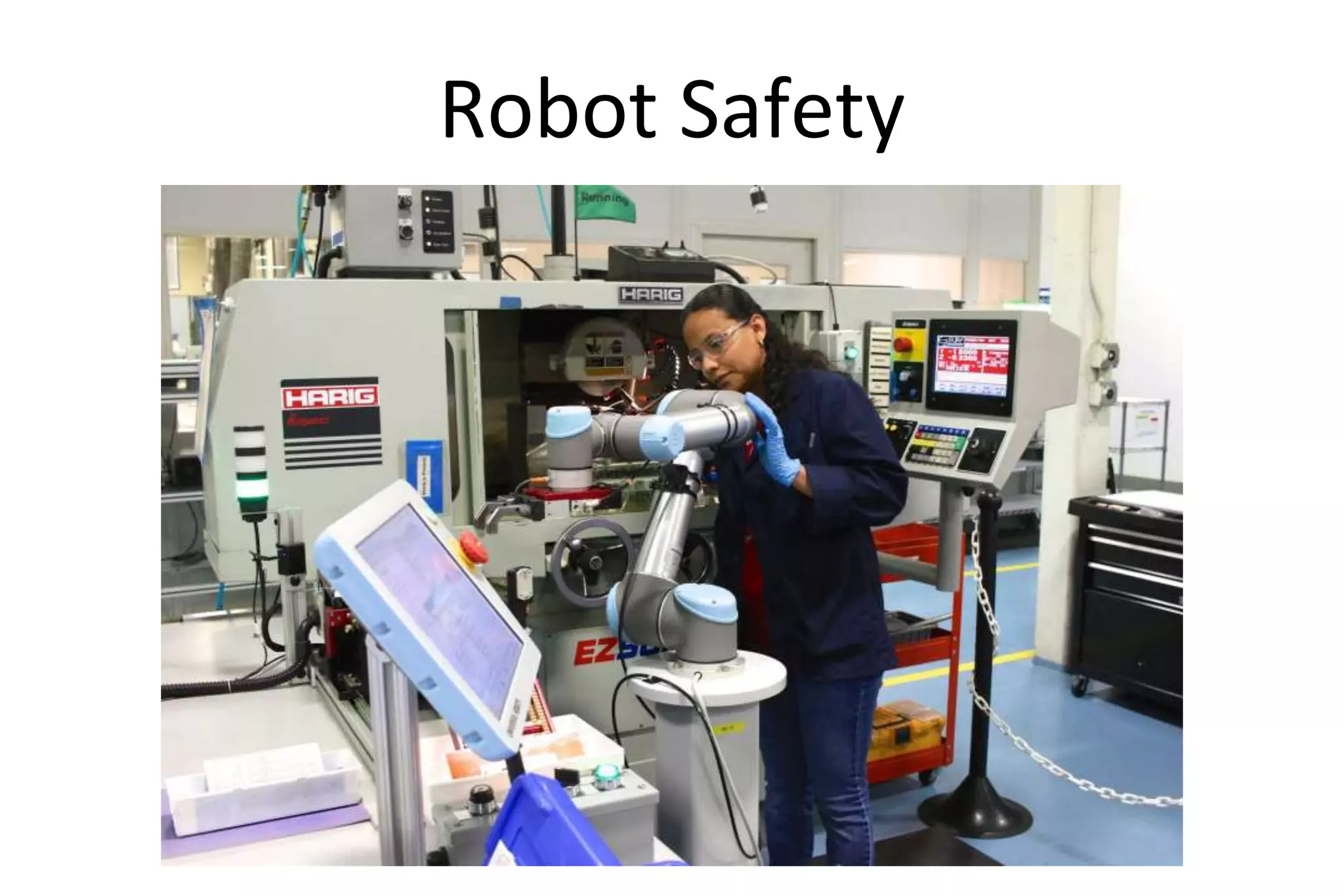
Robot Safety

  • 1.
  • 2.
    Industrial Robots “Programmable multifunctional mechanicaldevices designed to move materials, parts, tools, or specialized devices through variable programmed motions to perform a variety of tasks.” Robots are generally used to perform: • unsafe • hazardous • highly repetitive • unpleasant tasks ...so that human workers don’t have to.
  • 3.
    Robot Accidents Many robotaccidents do not occur under normal operating conditions, but rather during programming, maintenance, repair, testing, or adjustment. Robots are capable of high-energy movements through a large volume of space, posing great hazard.
  • 4.
    Robot Accidents Types ofAccidents: • Impact or Collision Accidents: Unpredicted movements, component malfunctions, unpredicted program changes related to the robot’s arm or peripheral equipment. • Crushing and Trapping Accidents: A worker’s limb or other body part can be trapped between, or crushed by, a robot’s arm and other peripheral equipment. • Mechanical Parts Accidents: The breakdown, release, or failure of parts. • Other Accidents
  • 5.
    Robot Hazards Sources ofHazards: • Human Errors • Control Errors • Unauthorized Access • Mechanical Failure • Environmental Sources • Power Systems • Improper Installation
  • 6.
    December 2012 • SterlingHeights, MI • Employee #1, a 38-year-old male employee with Sodecia Sterling Heights, was inside a robot work cell with the interlocked gates closed. • Employee #1 was struck from behind by a transfer robot, crushing his chest and neck. • Employee was killed in the event. • Employee #1 had lock attached to his belt loop - i.e. he did not lock out before beginning maintenance.
  • 7.
    July 2015 • GrandRapids MI • Grandmother Wanda Holbrook, 57, was crushed to death by robotic arm at work • Wanda was working on the production line when a robotic arm took her by surprise by entering the section in which she was stationed. • The arm hit and crushed her head against a hitch assembly it was working on, the lawsuit states. • It also stated a failure of one or more of the safety systems or devices had caused Wanda's death. (per lawsuit) • William Holbrook has filed a wrongful death complaint against five robotic firms responsible for installing and testing the machinery that killed his wife. • $7000 Lockout – Later Dismissed
  • 8.
    May 2007 • Waverly,NE • Employee #1 was troubleshooting a robotic arm used to remove CD jewel cases from an injection molding machine, when the arm cycled and struck the employee. • He suffered blunt force trauma to his head and ribs. • He was transported to the hospital, where he died two weeks later.
  • 9.
    July 2009 • Cityof Industry, CA • Employee #1 was operating a robotic palletizer for Golden State Foods, Inc., a food processor and packager for fast food restaurants. • She entered the caged robotic palletizer cell while the robotic palletizer was running. She had not deenergized the equipment. • Her torso was crushed by the arms of the robotic palletizer as it attempted to pick up boxes on the roller conveyor. • She was killed.
  • 10.
    Safeguarding Personnel • RiskAssessment • should be performed at each stage of development of a robot system to determine the appropriate level of safeguarding • Safeguarding Devices • limiting devices, sensors, fixed barriers, interlocked barrier guards • Awareness Devices • chain or rope barriers, flashing lights, signs, whistles, horns • Safeguarding the Teacher • restricting robot speed during programming in “teach” mode
  • 11.
    Safeguarding Personnel • OperatorSafeguards • operator should be outside the robot’s restricted zone at all times • Attended Continuous Operation • when a person is in a robot’s restricted envelope, the robot should be at slow speed and in “teach” mode • Maintenance and Repair Personnel • perform repairs with robot in manual or “teach” mode • Safety Training • personnel should be able to demonstrate their competence to operate robot systems safely

Editor's Notes