Introduction of
Industrial
Robotics
Rajesh papatla
Assistant professor
Department of mechanical engineering
Ramachandra college of Engineering., Eluru.
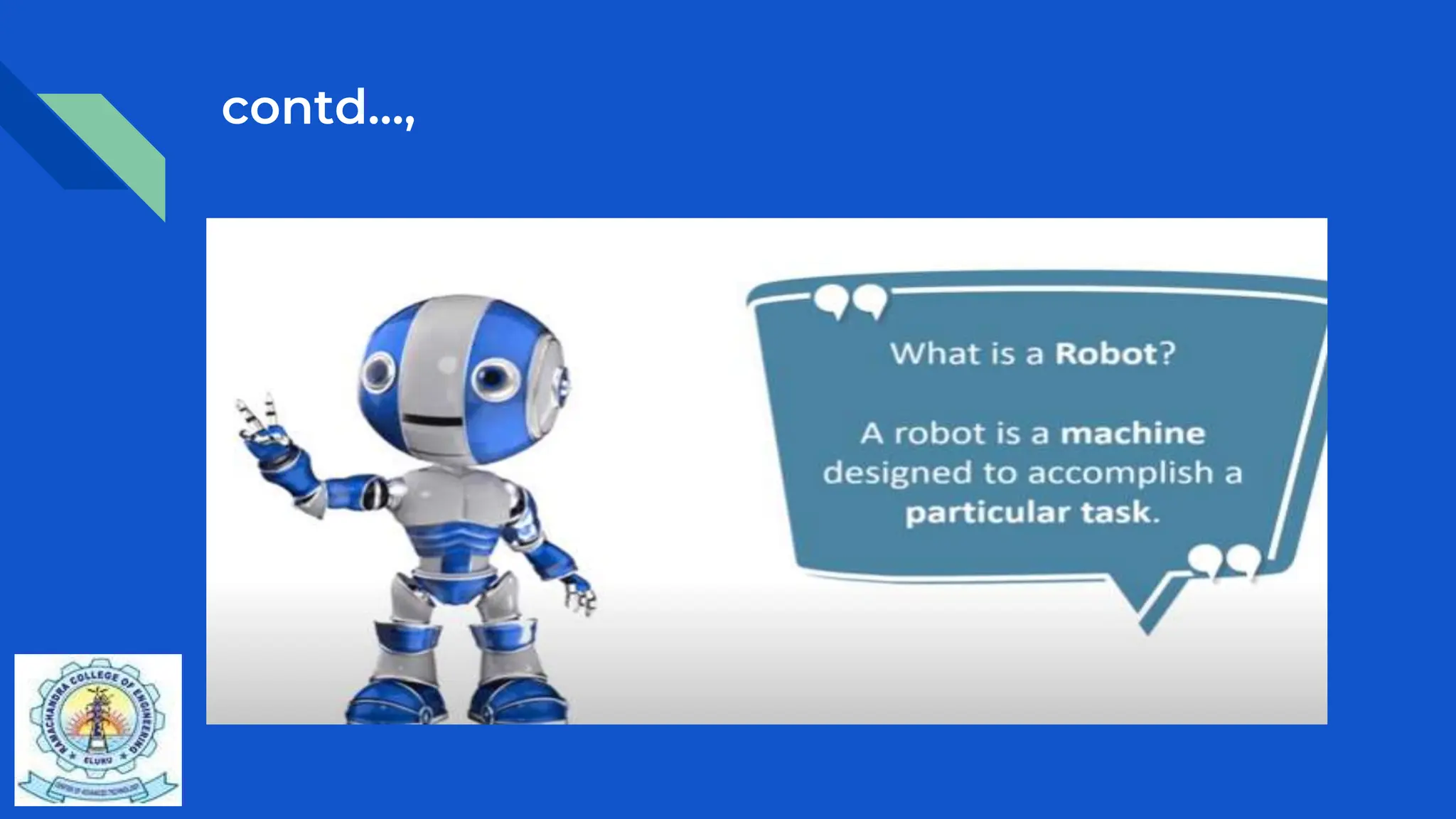
contd…,
What is industrial Robot
According to Robotic Institute of America (RIA)
“A robot is a reprogrammable, multi functional manipulator
designed to move materials, parts, tools or specialized
devices through variable programmed motions for the
performance of the variety of the tasks”
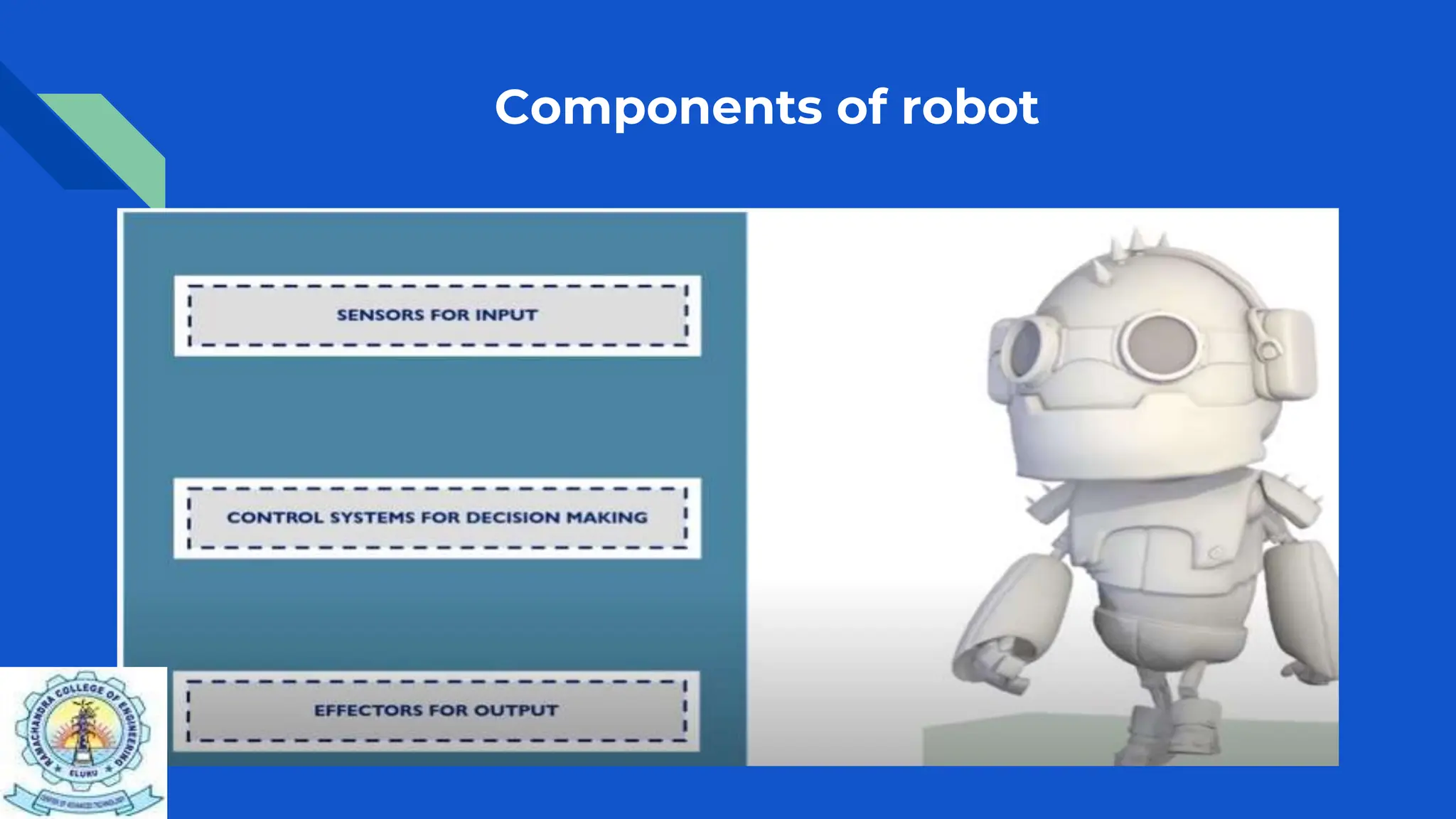
Components of robot
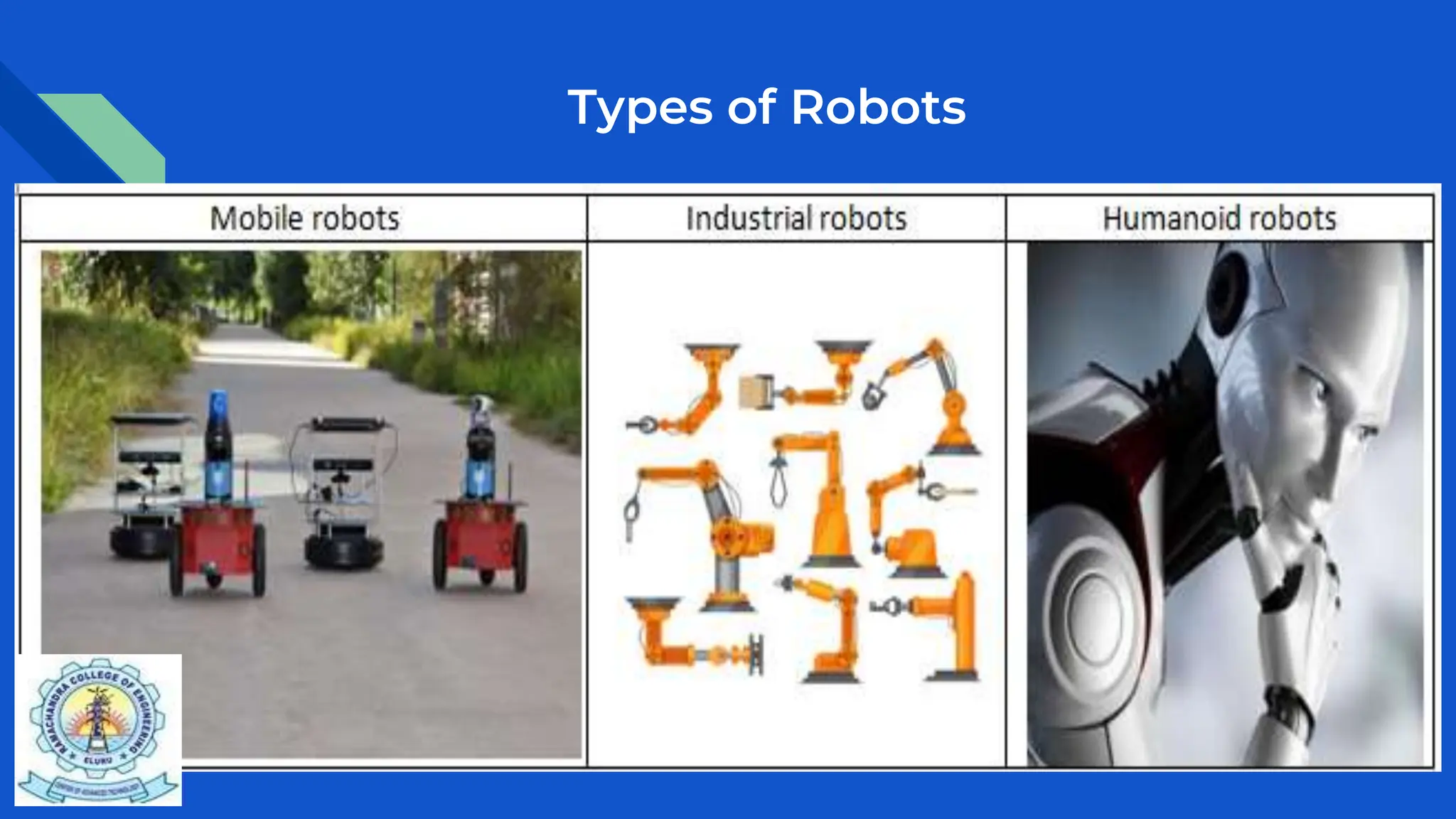
Types of Robots
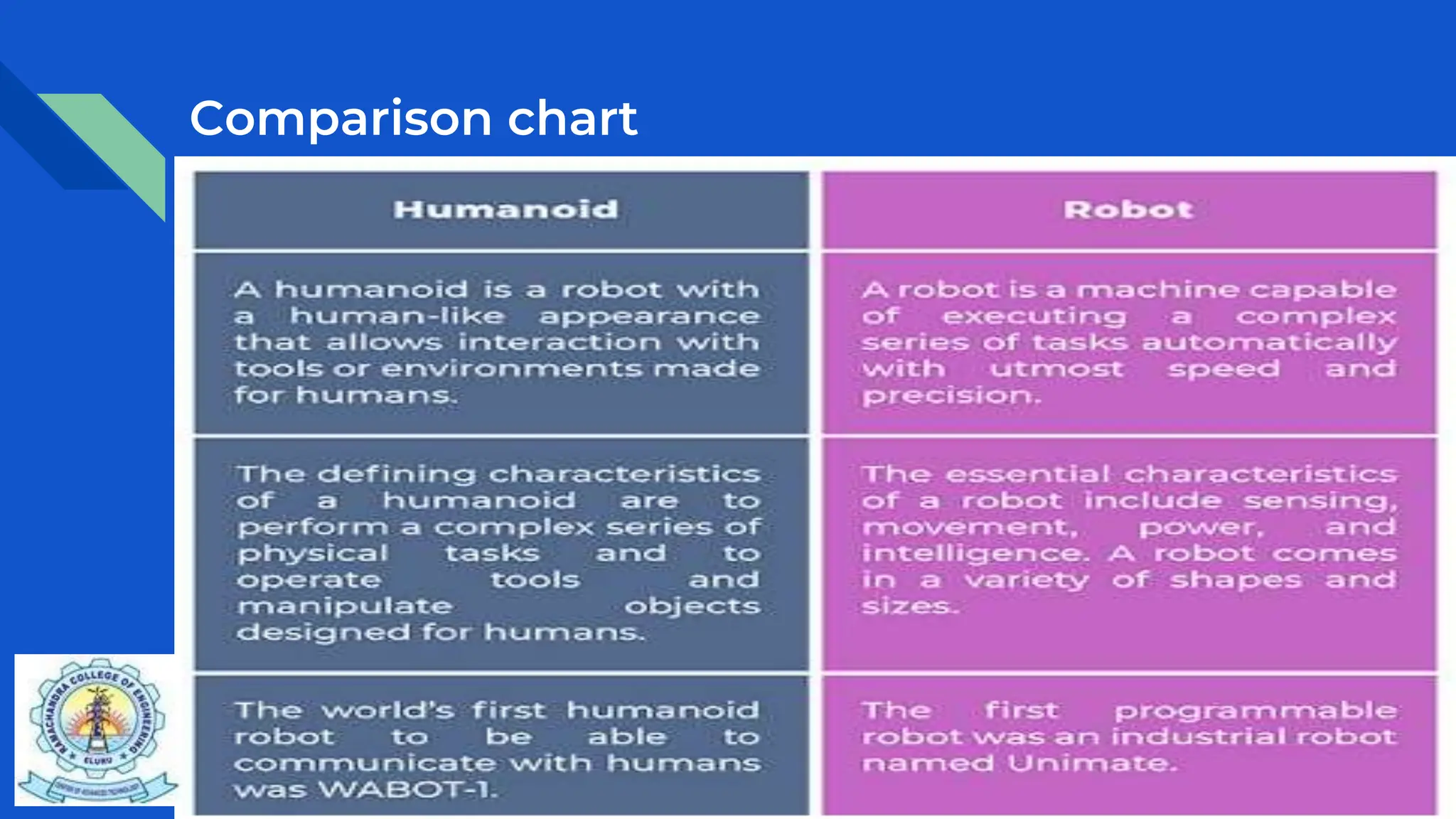
Comparison chart
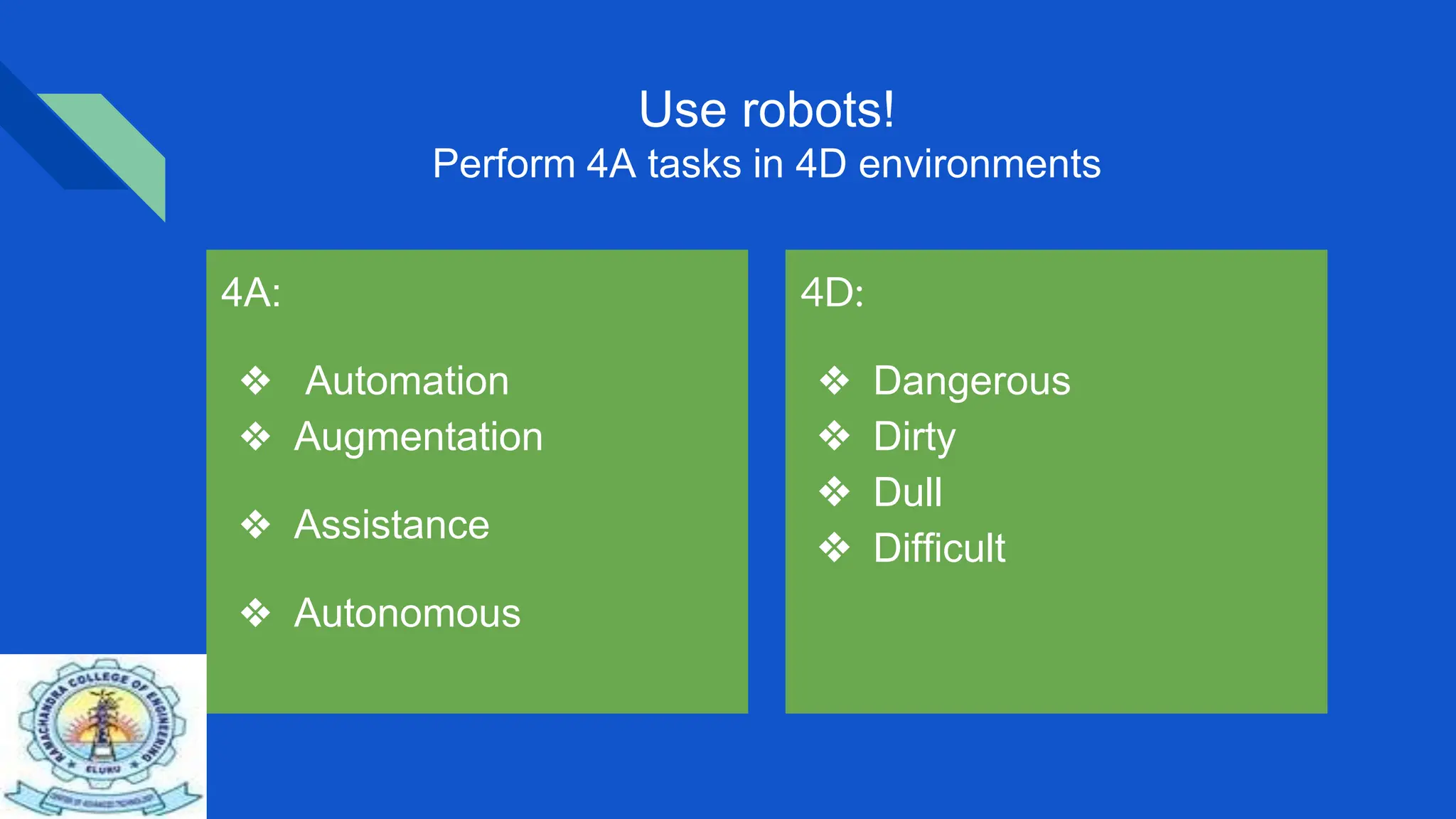
Use robots!
Perform 4A tasks in 4D environments
4A:
❖ Automation
❖ Augmentation
❖ Assistance
❖ Autonomous
4D:
❖ Dangerous
❖ Dirty
❖ Dull
❖ Difficult
How to select a robot
❖ Degrees of Freedom and Workspace
❖ Power source
❖ Based on controlled system
❖ based on arm configuration
❖ Minimum to maximum distance moved
❖ Accuracy & repeatability
❖ Based on wrist configuration
❖ Type of material to be handled
❖ Torque of the joints
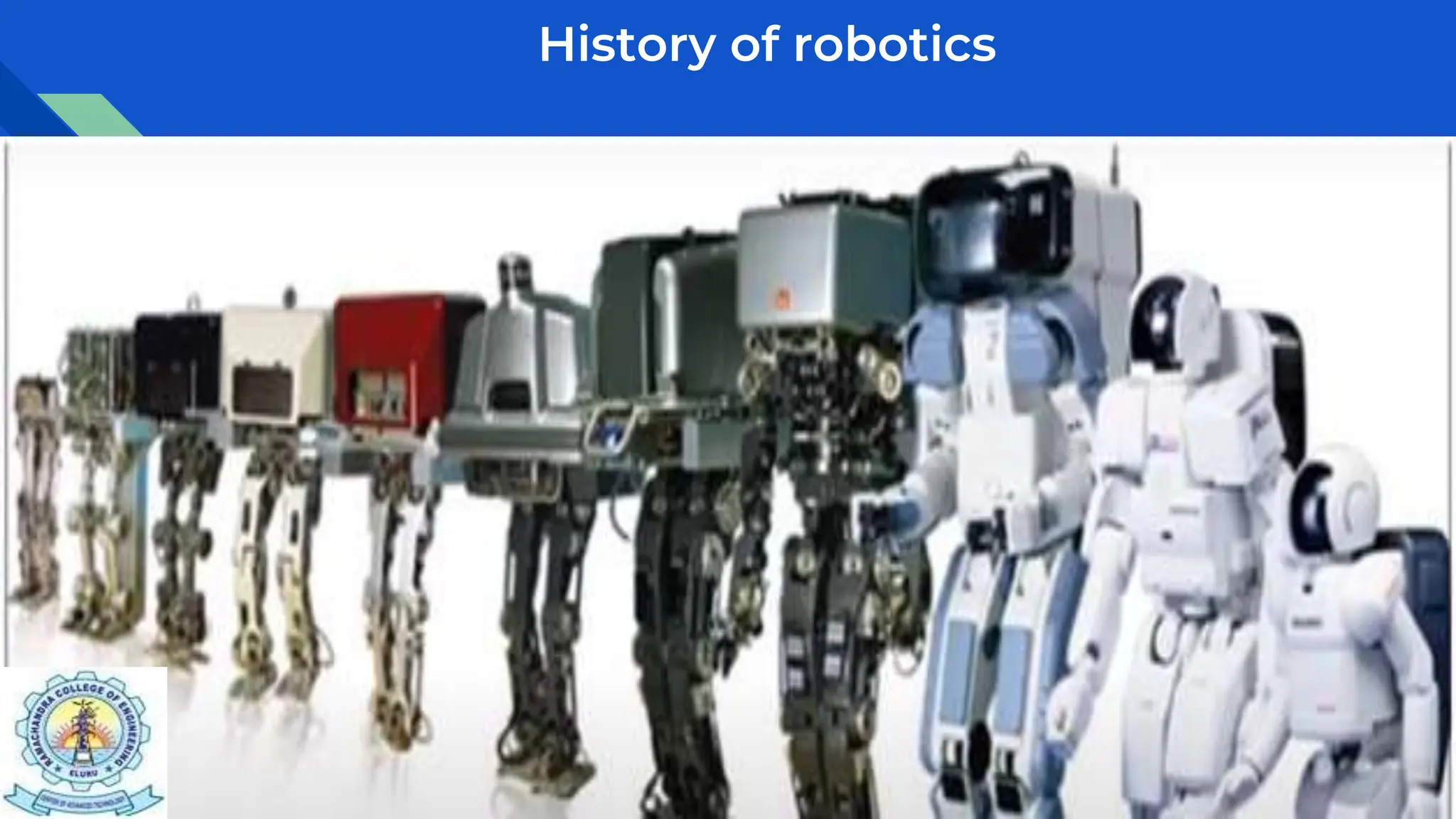
History of robotics
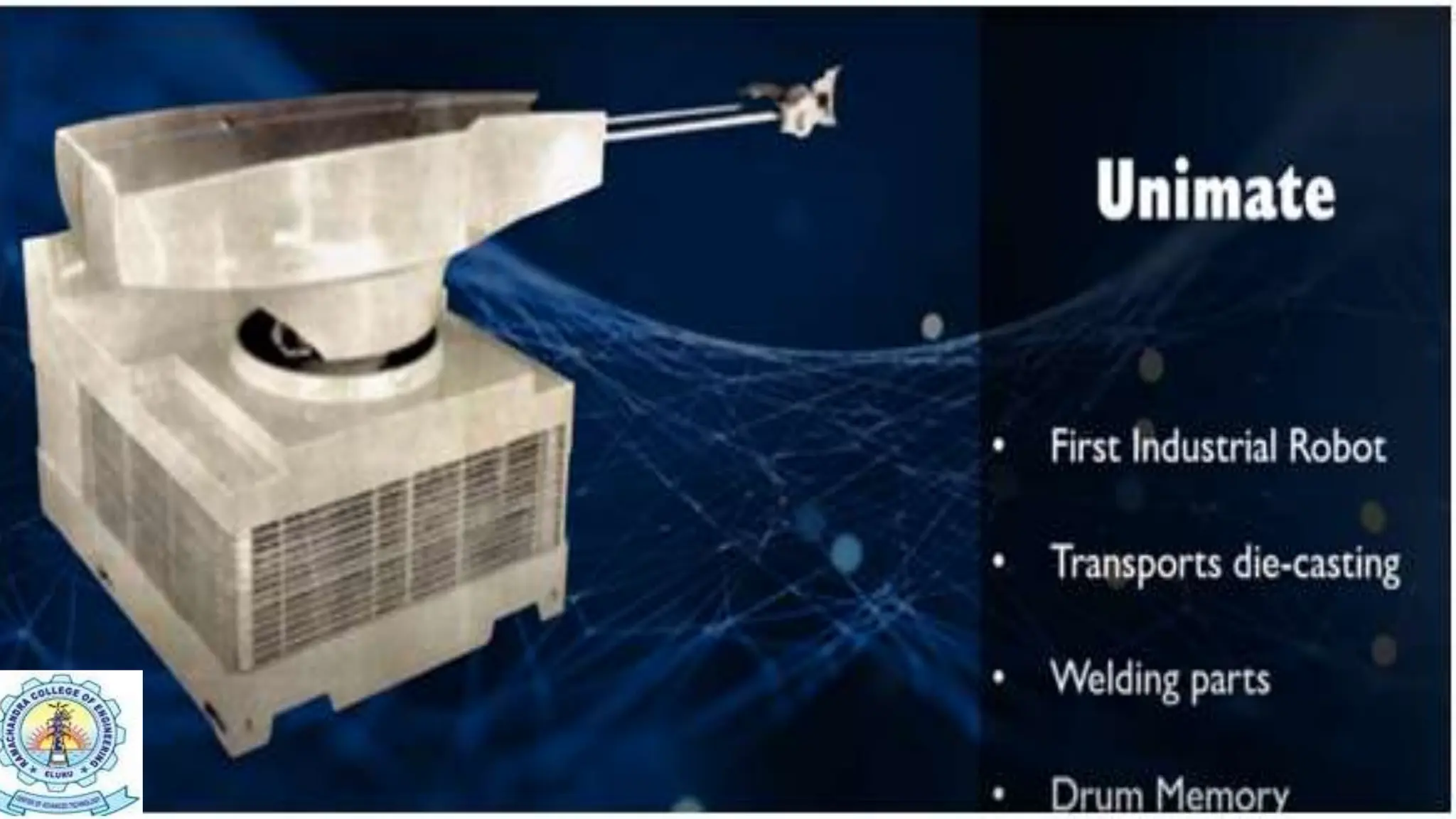
Unimate
Revolutionizing manufacturing the world over, the Unimate was the very
first industrial robot. Conceived from a design for a mechanical arm
patented in 1954 (granted in 1961) by American inventor George Devol, the
Unimate was developed as a result of the foresight and business acumen of
Joseph Engelberger - the Father of Robotics.
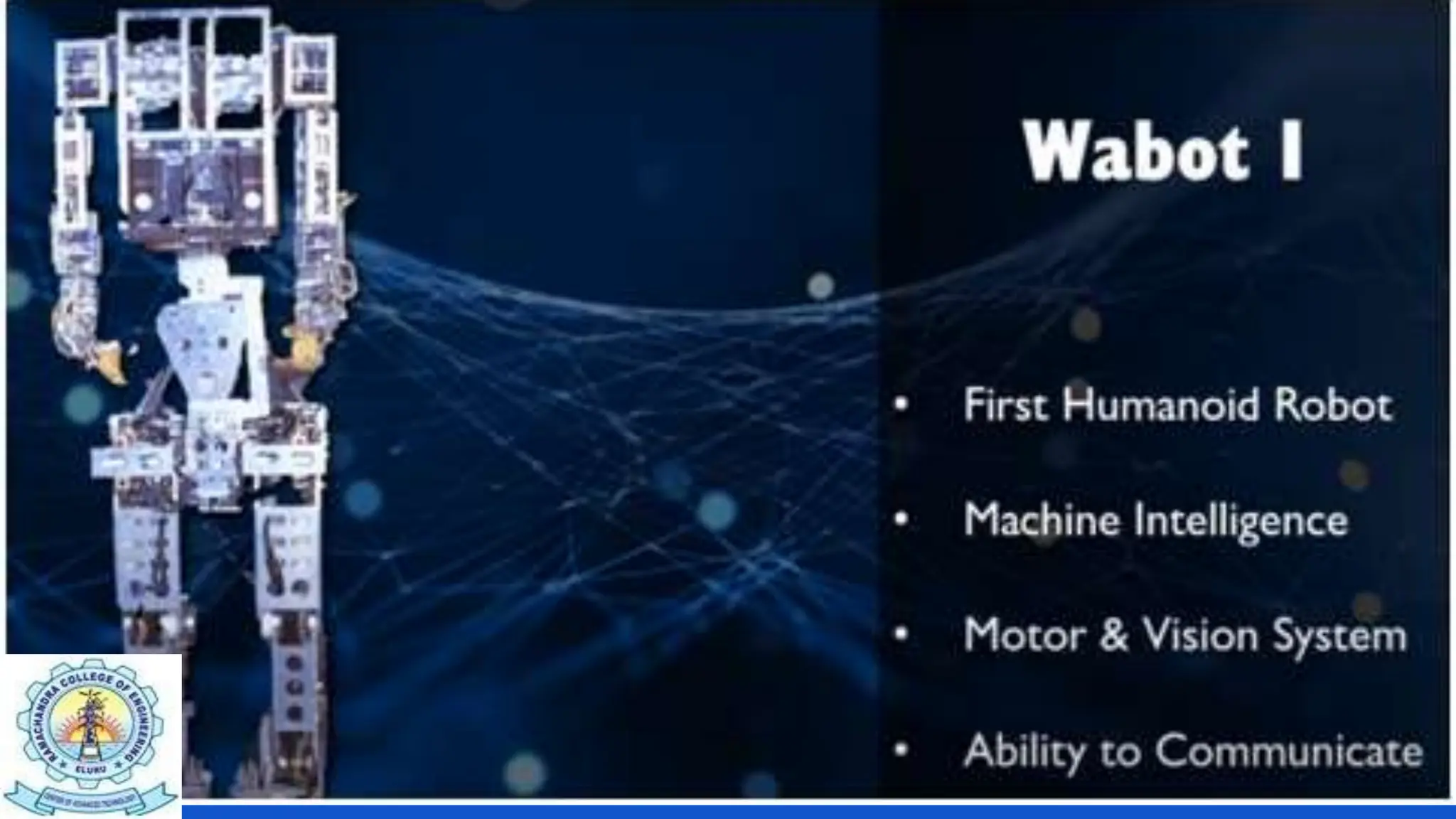
WABOT-1 (1970~1973)
The WABOT-1 was the first fun-scale anthropomorphic robot developed
in the world. It consisted of a limb-control system, a vision system and a

conversation system. The WABOT-1 was able to communicate-with a
person in Japanese and to measure distances and directions to the
objects using external receptors, artificial ears and eyes, and an artificial
mouth. The WABOT-1 walked with his lower limbs and was able to grip
and transport objects with hands that used tactile-sensors.
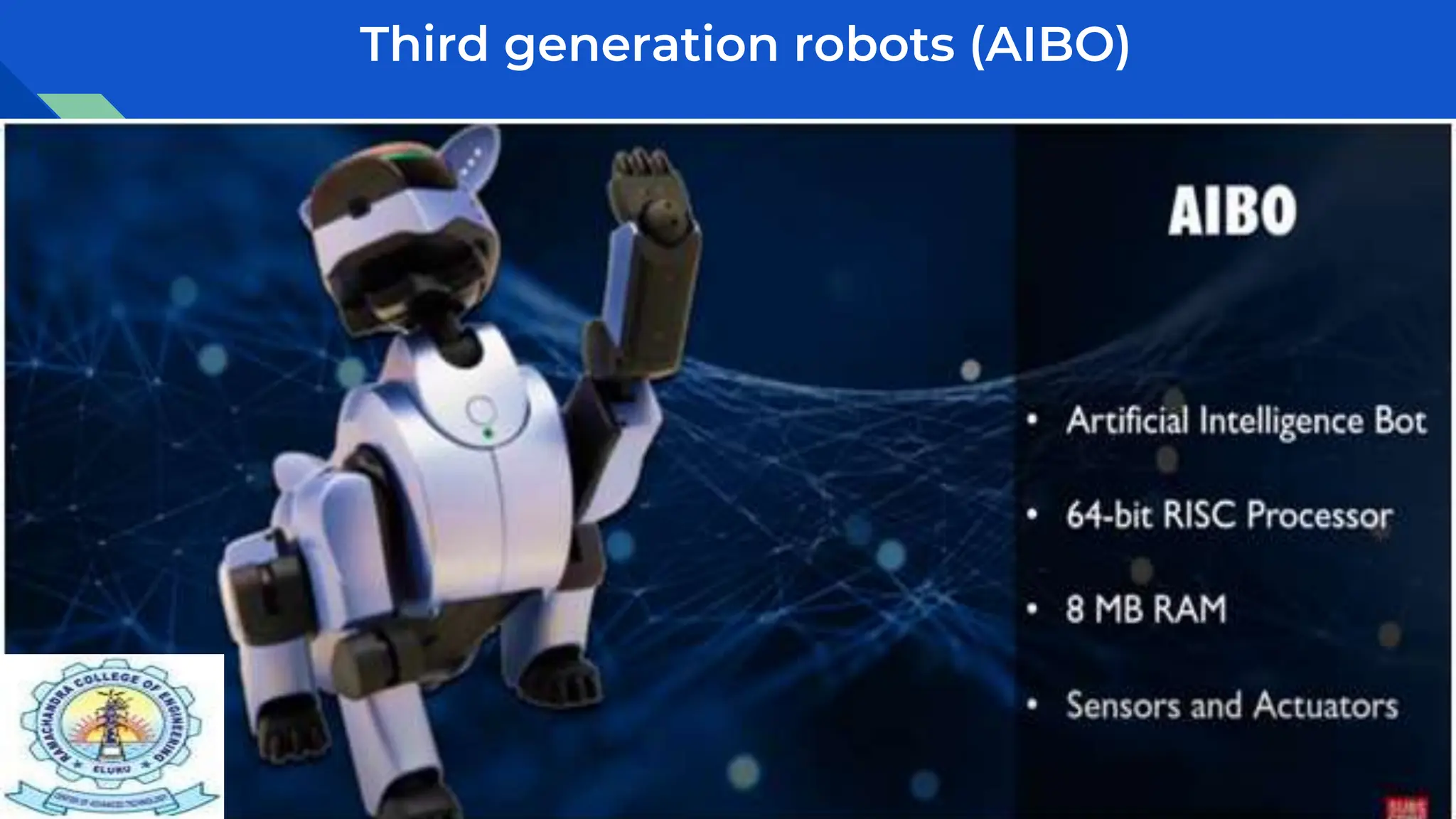
Third generation robots (AIBO)
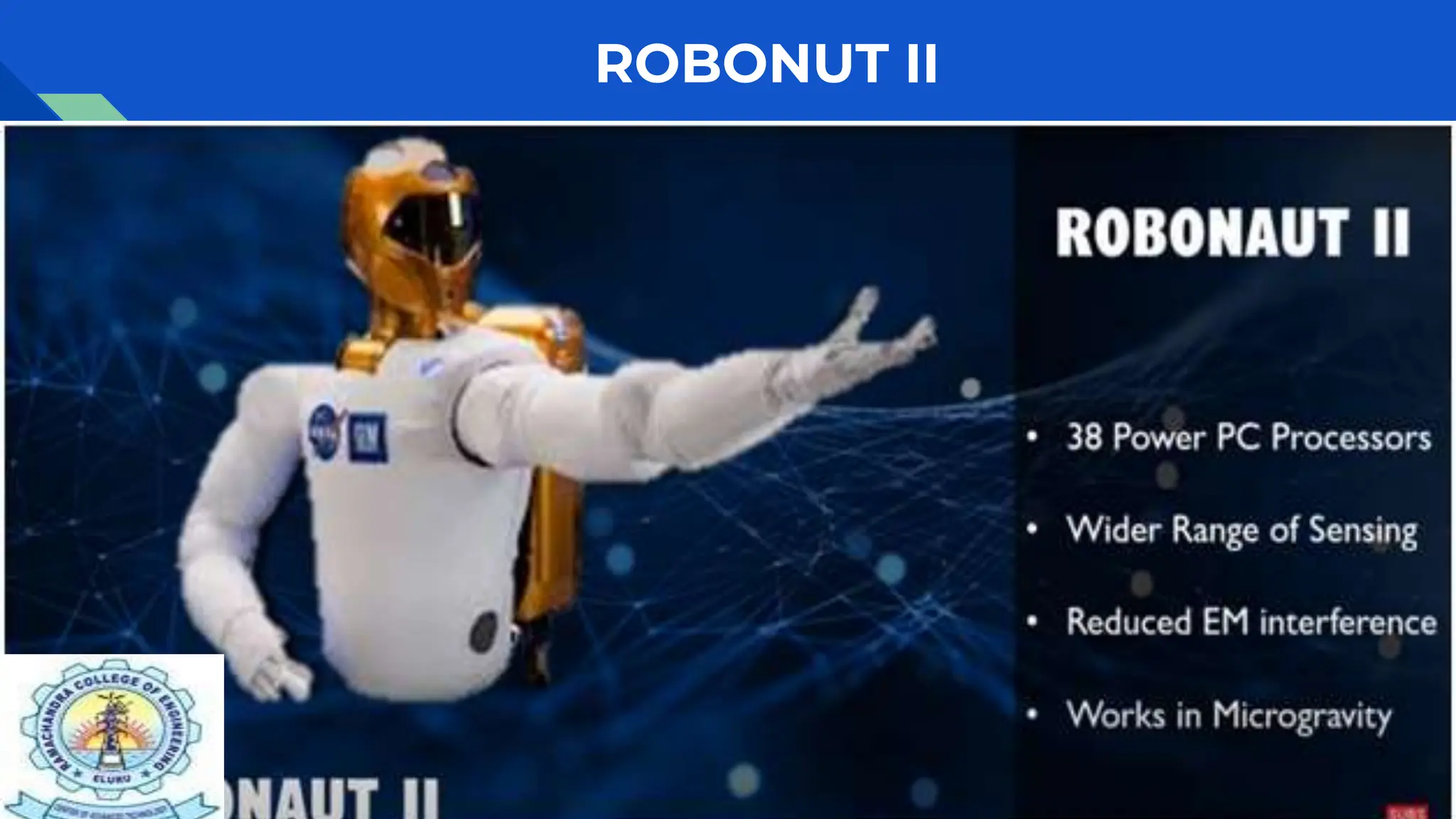
ROBONUT II
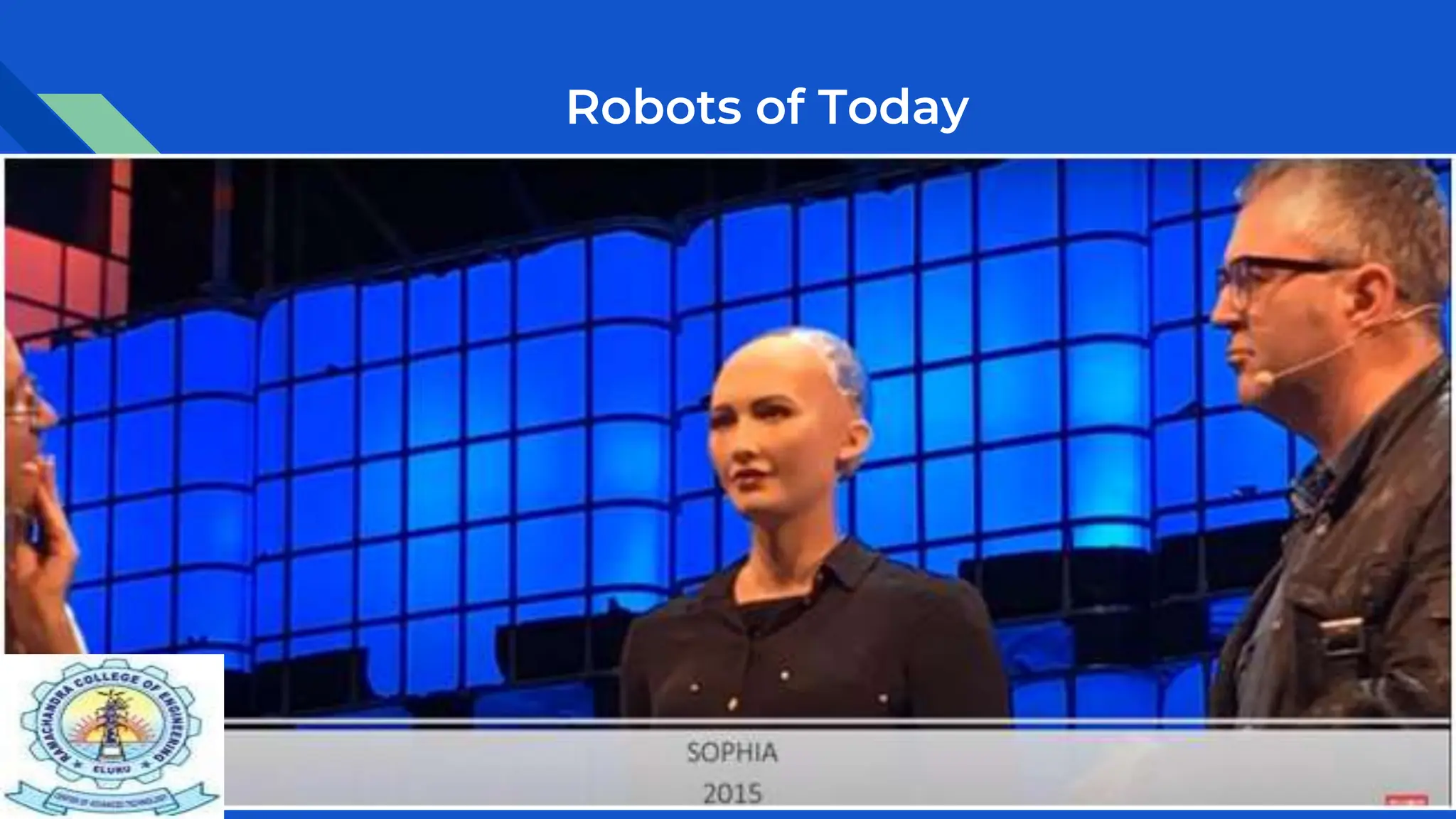
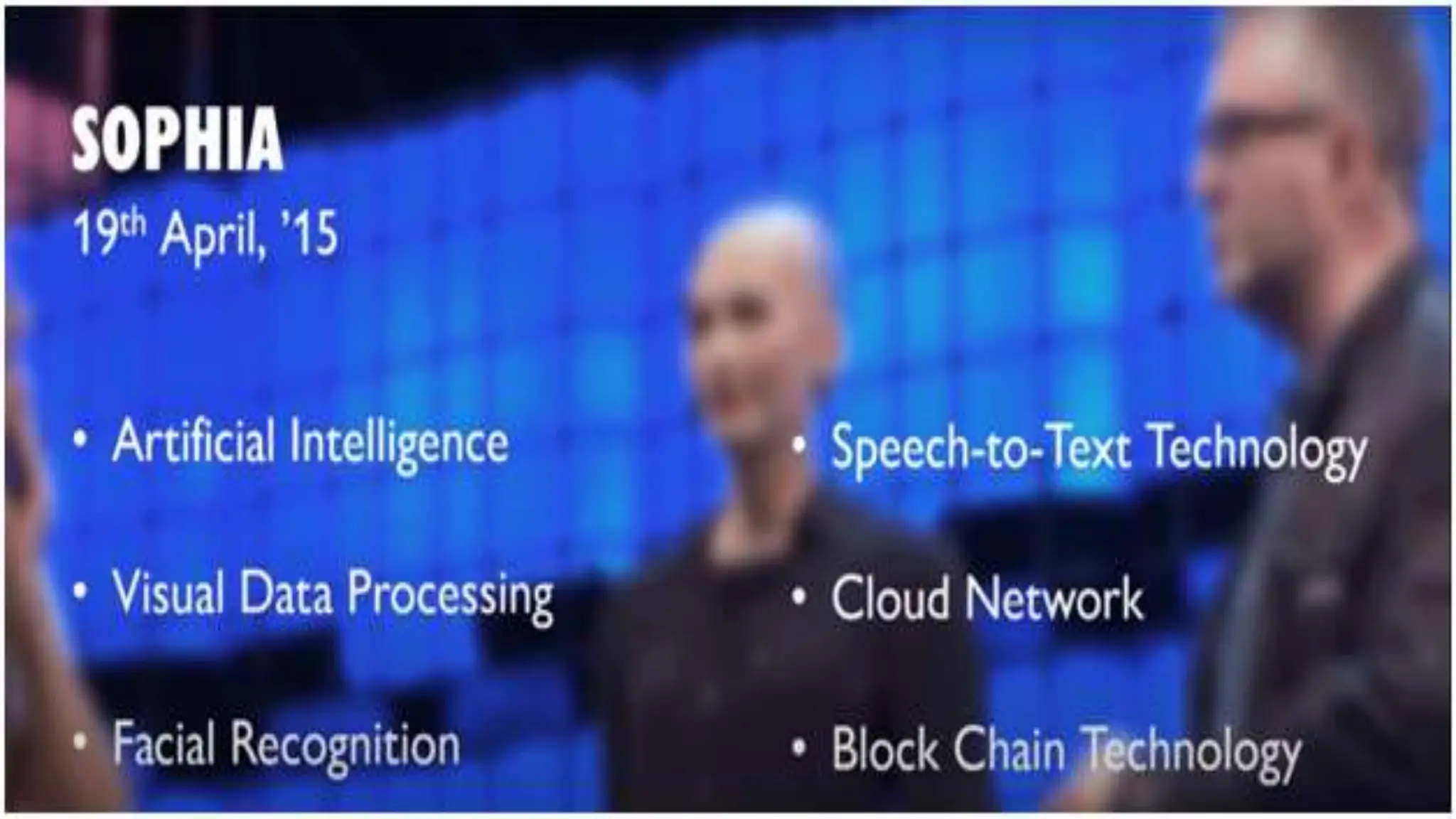
Robots of Today
Laws of robotics
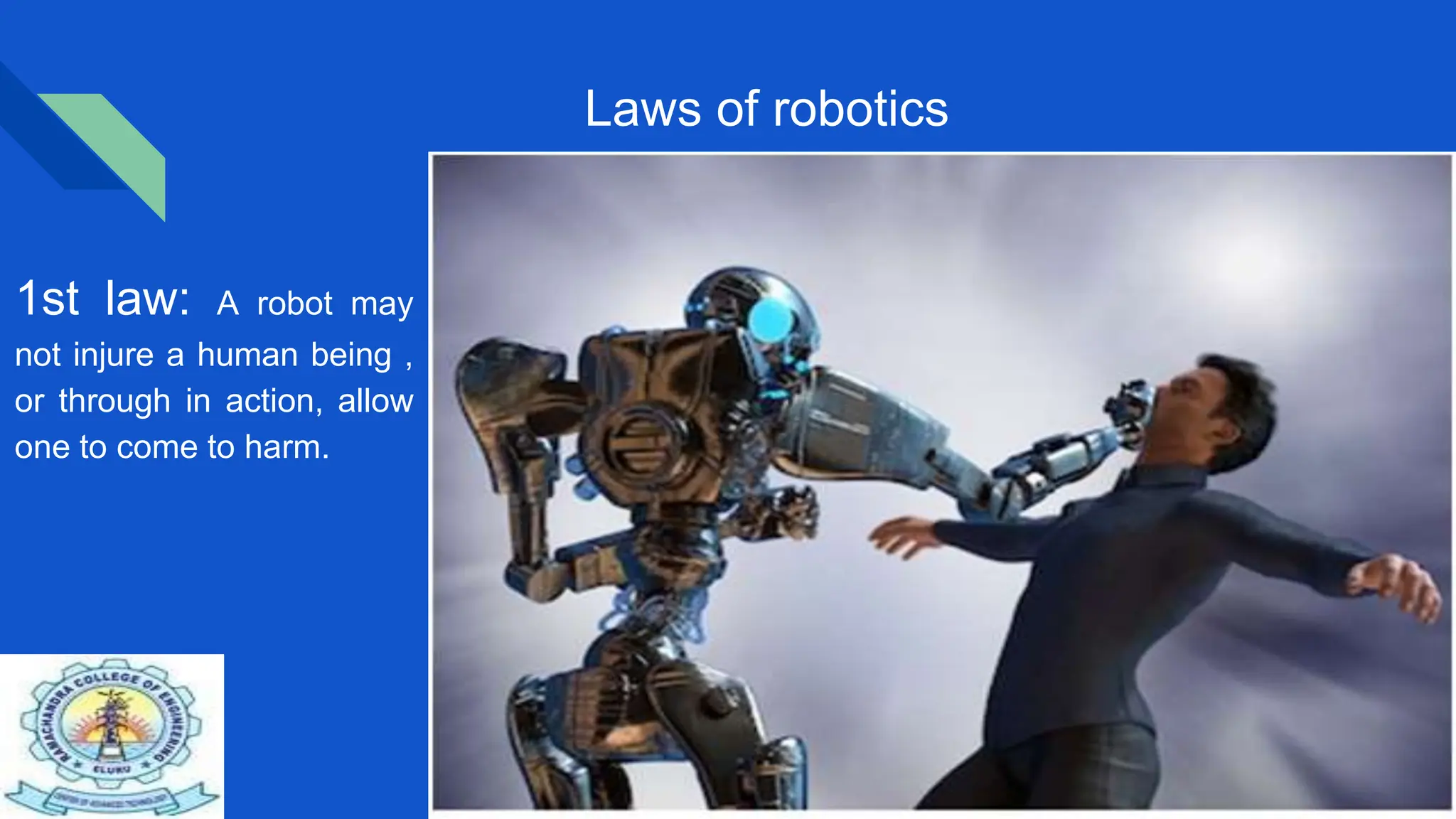
1st law: A robot may
not injure a human being ,
or through in action, allow
one to come to harm.
contd..,
2nd law : robot must
obey the orders given to it
by the human beings except
where such orders would
conflict with the 1st law.
contd…,
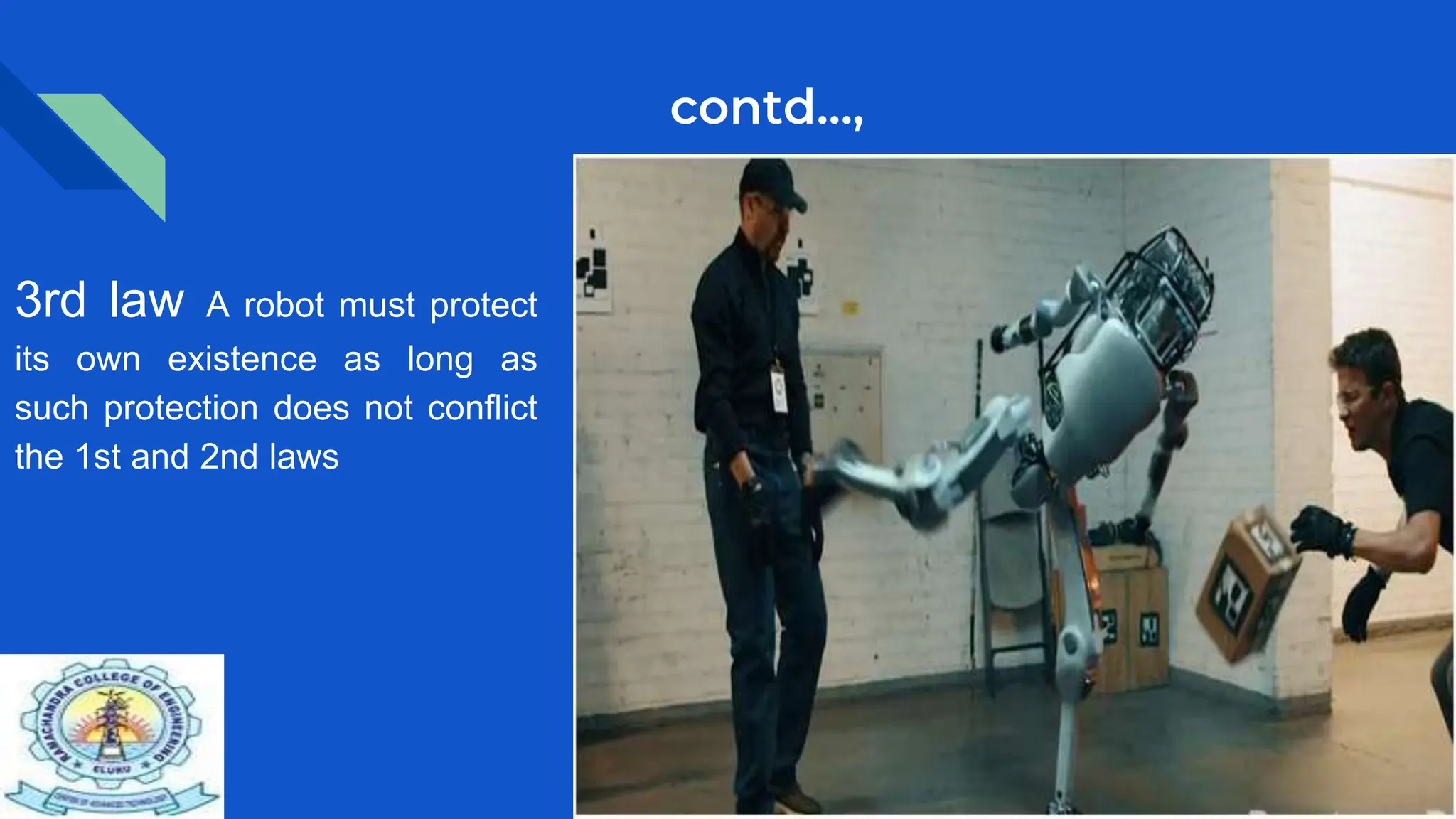
3rd law A robot must protect
its own existence as long as
such protection does not conflict
the 1st and 2nd laws
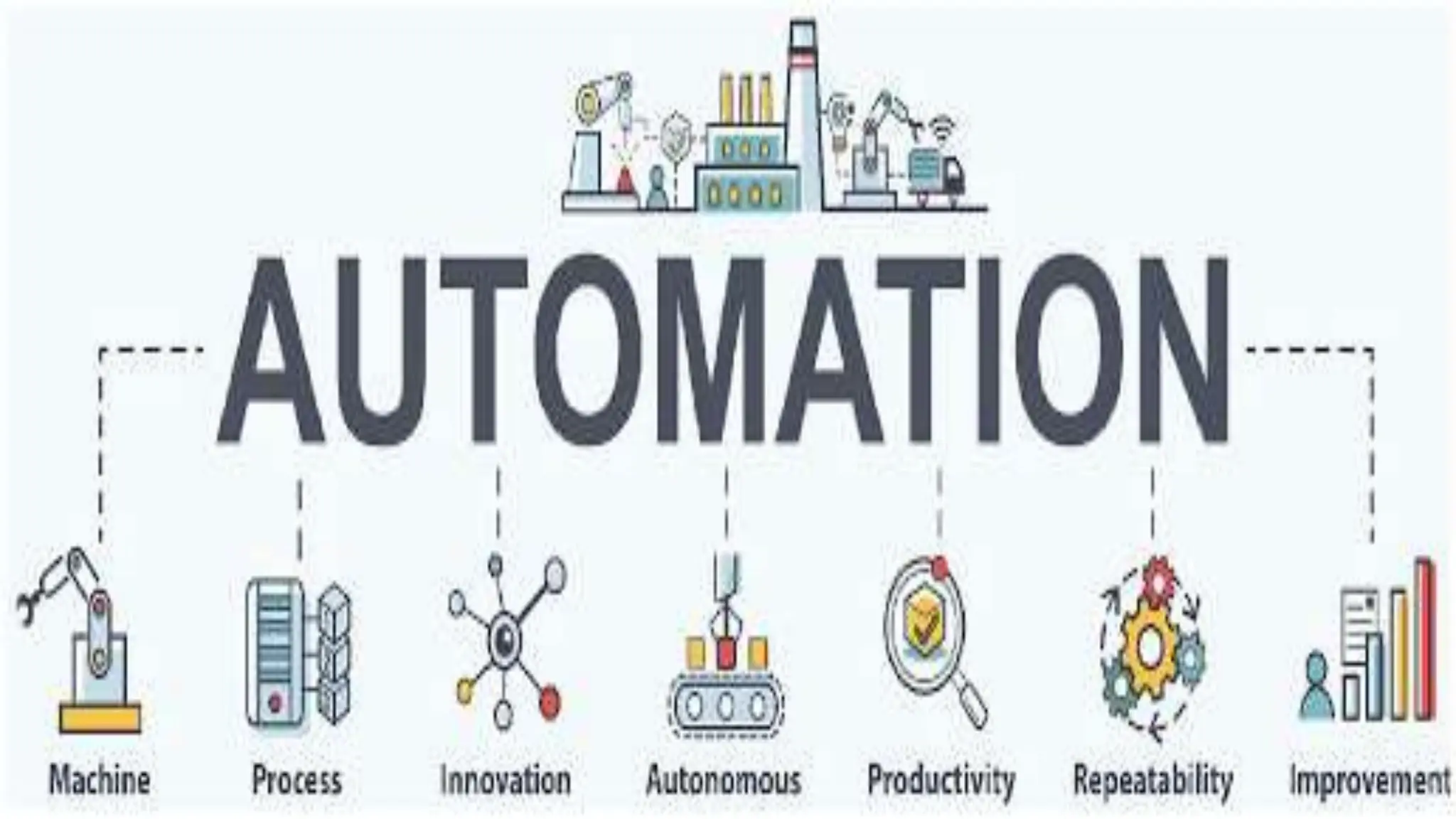
Automation
Technology that is concerned with the use of mechanical,
electronic and computer based systems in the operation and
control of production
It usually refers a combination of 1. Computerization of
information processing in manufacturing 2. Automation of
manufacturing systems in the factory.
contd…,
Ex:1. Automatic machine tools to process the parts
2. Automatic Assembly machines
3. Industrial robots
4. Automatic material handling and storage system
5. Automatic inspection system
6. Process control system etc.,
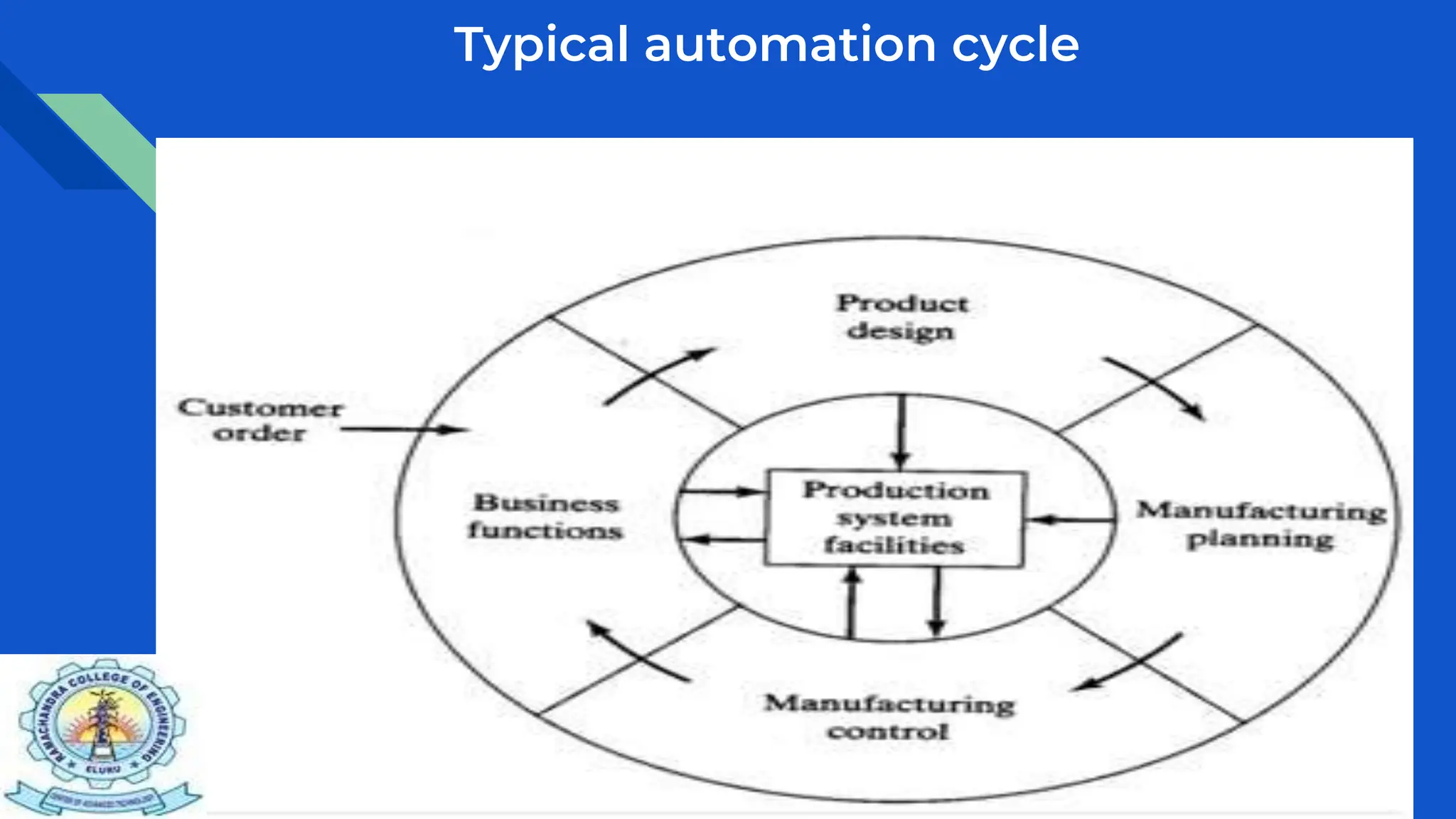
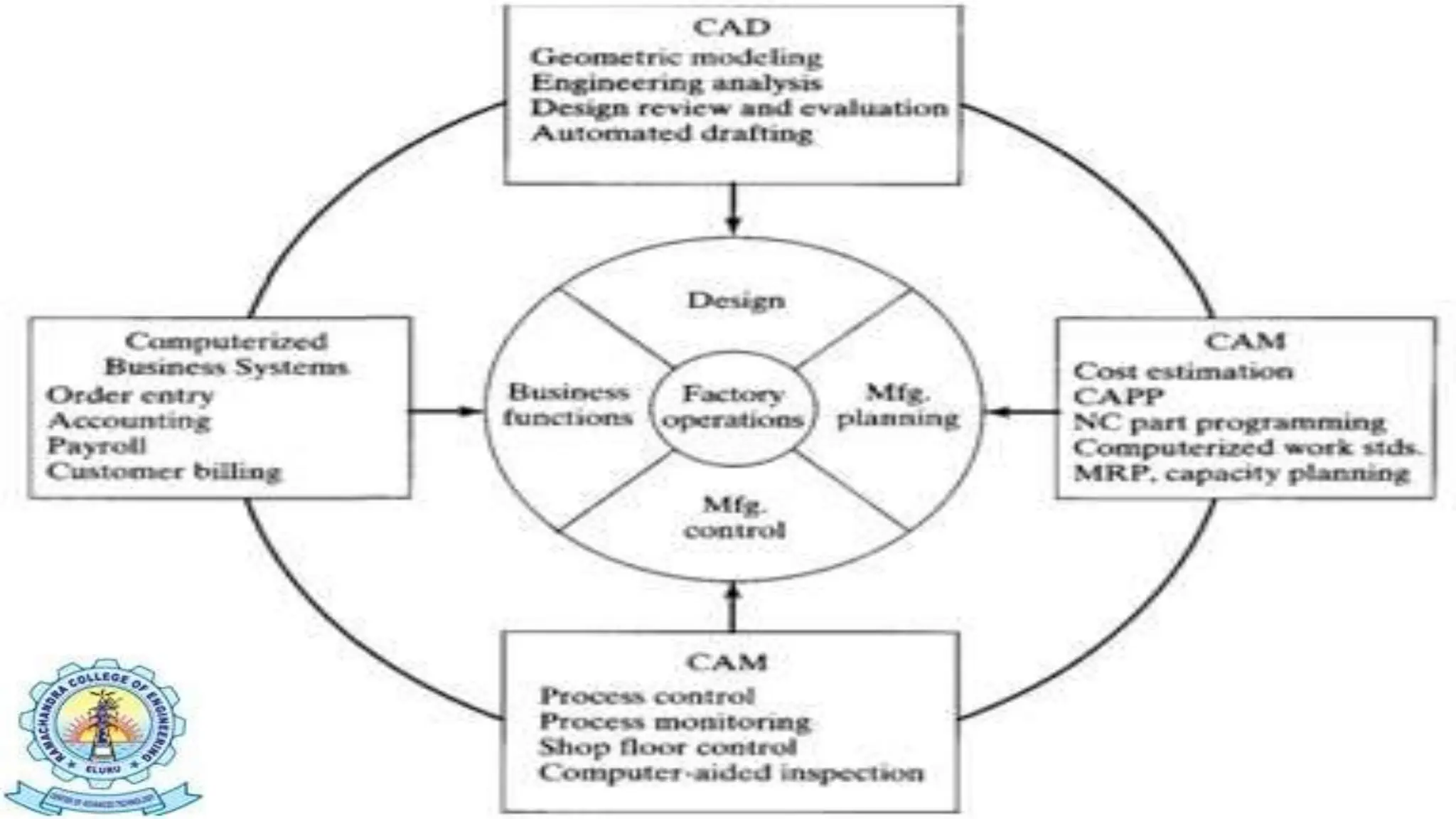
Typical automation cycle
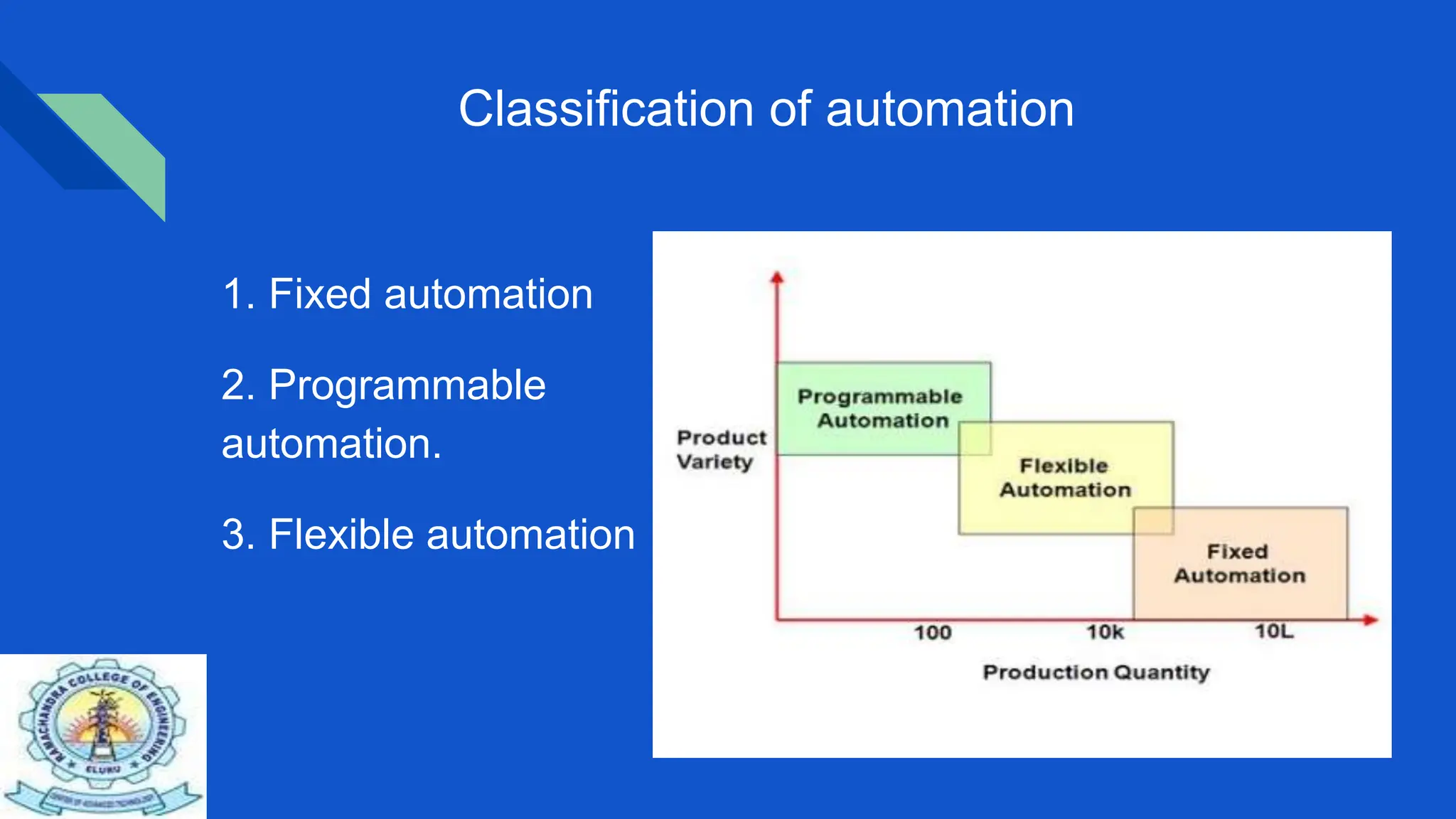
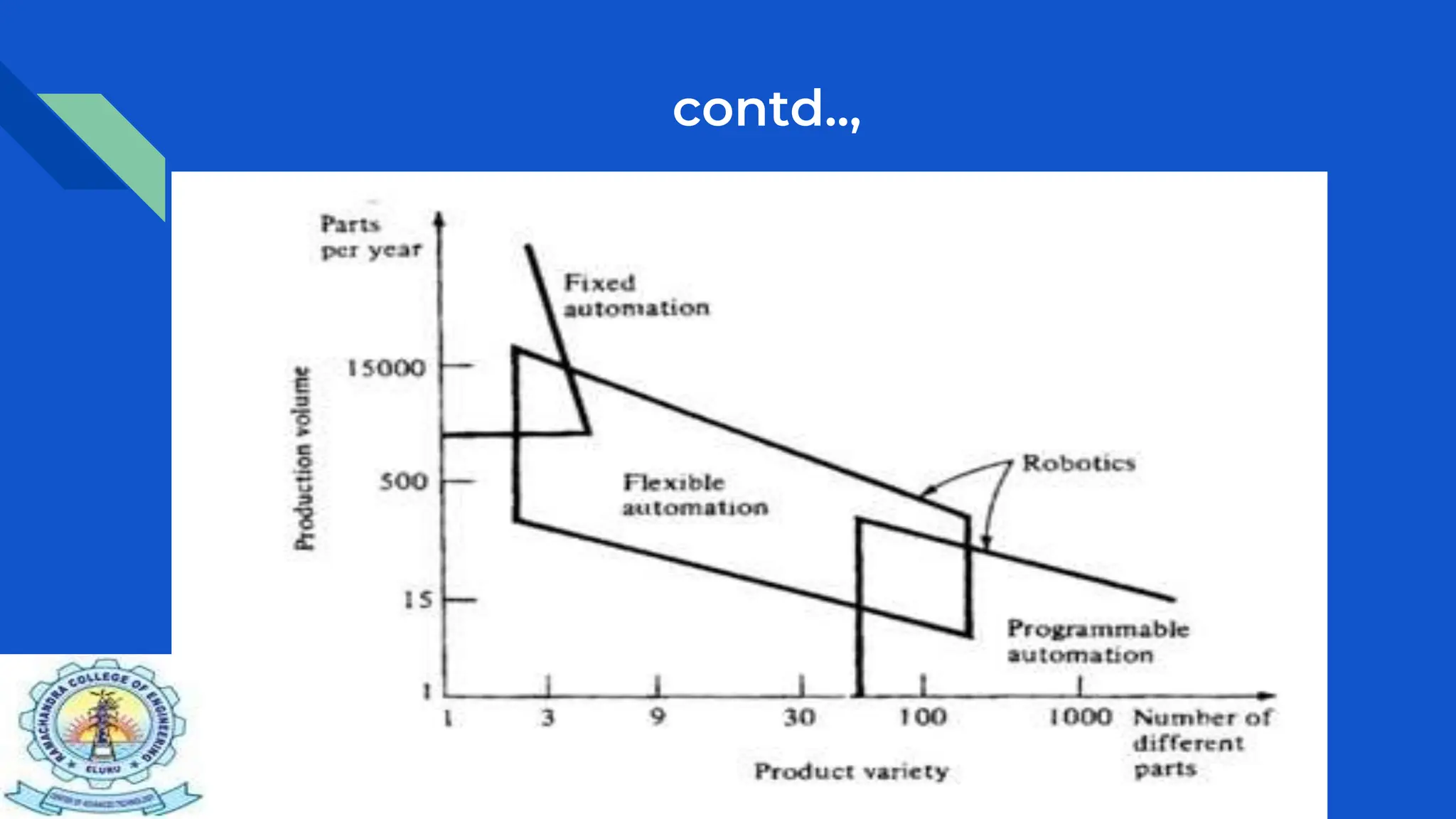
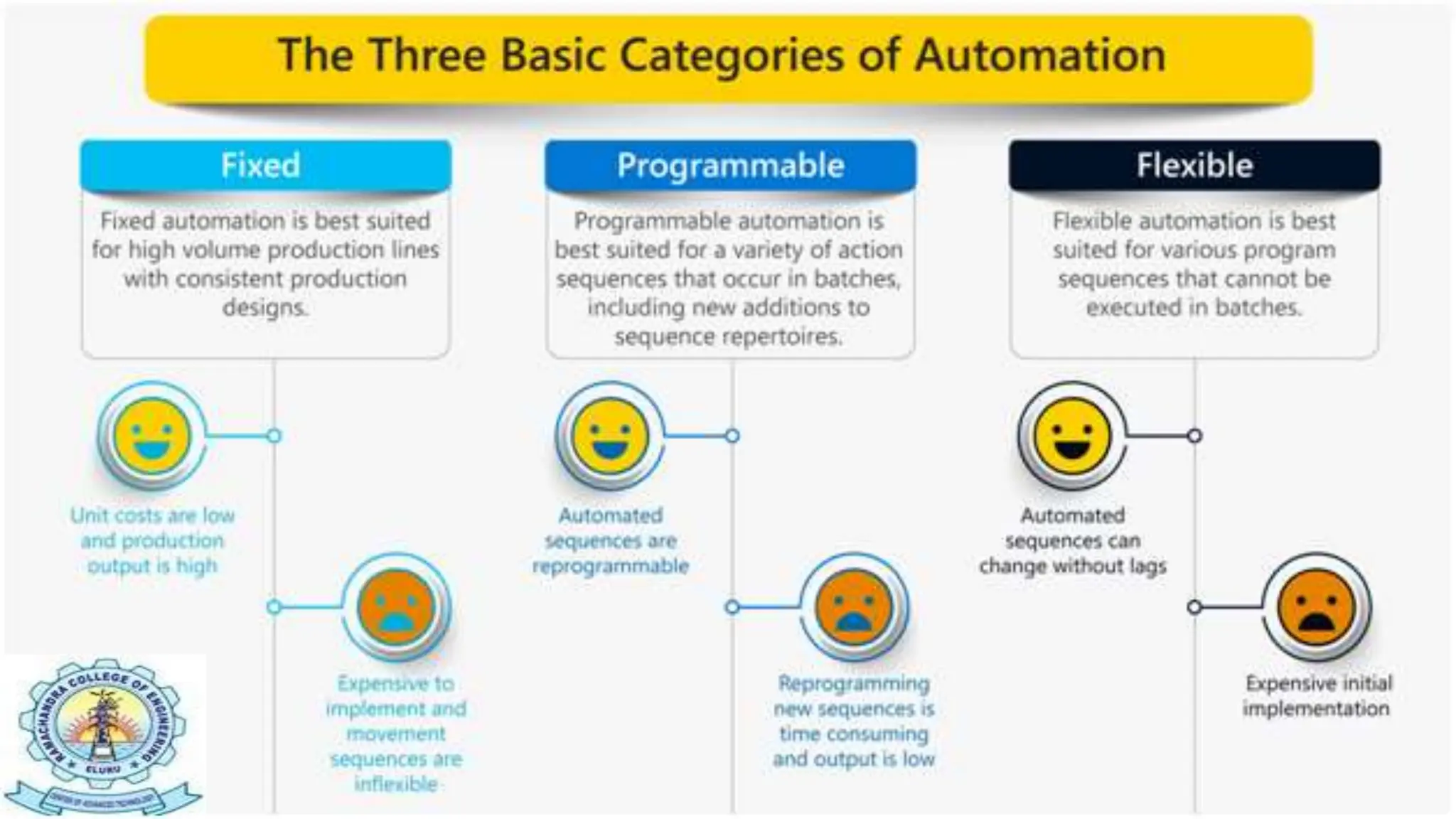
Classification of automation
1. Fixed automation
2. Programmable
automation.
3. Flexible automation
contd..,
Basic elements of automation system
Consist of three basic elements :
1) The actuator ( which does work) controlled by the
controller
The actuator is a automated process may in fact be
several actuators , each of which provides an output that
drives another in the series of actuators .
contd…,
2. The controller ( which ‘tells’ to the actuator to do the work )
❖ A controlled system either may be a simple digital system or an
analog system .
❖ Digital and analog controllers are available “of the shelf”so that
system can be constructed inexpensive and with little
specialized knowledge is required
contd…,
3. Sensor ( which provides to feed back to the controller so that it
knows the actuators are doing the work
❖ Obviously , controlled automation requires devices to sense
system output .
❖ Sensor also can be used so that a controller can detect and
responded to changing conditions in its working environment
Reasons for automation
❖ To increase labour productivity
❖ To reduce labour cost
❖ To improve worker safety
❖ To improve product quality
❖ To migrate the effect of labour shortages
❖ To reduced MFG Lead time
❖ To accomplish process that cannot be done
manually
Classification of Robots
JIRA (Japanese Industrial Robot Association)
Class1: Manual-Handling Device
Class2: Fixed Sequence Robot
Class3: Variable Sequence Robot
Class4: Playback Robot
Class5: Numerical Control Robot
Class6: Intelligent Robot
Present and future applications
Current robotics applications
❖ Welding
❖ Spray painting
❖ Grinding
❖ Other applications involving a rotary tool i.e. drilling
holes, polishing etc.
❖ Parts handling/transfer Assembly operations Parts
sorting Parts inspection
Future robotics applications
Hazardous and inaccessible non manufacturing
environments
❖ Construction trades
❖ Underground coal mining
❖ Military applications
❖ fire fighting
❖ Undersea robots
❖ Robots in space
Service industry and similar applications
❖ Teaching robots
❖ Retail robots Fast food restaurants Bank tallers
❖ Garbage collections and waste disposal operations
❖ Cargo handling, Loading, and Distribution
Operations
❖ Security guards
❖ Medical care and hospital duties
❖ Agricultural robots
❖ Household robot
Thank you
for your attention
Any queries ????
prajeshbabu@rcee.ac.in
8985230119

INTRODUCTION OF INDUSTRIAL ROBOTICS .ppt

  • 1.
    Introduction of Industrial Robotics Rajesh papatla Assistantprofessor Department of mechanical engineering Ramachandra college of Engineering., Eluru.
  • 2.
  • 3.
    What is industrialRobot According to Robotic Institute of America (RIA) “A robot is a reprogrammable, multi functional manipulator designed to move materials, parts, tools or specialized devices through variable programmed motions for the performance of the variety of the tasks”
  • 4.
  • 5.
  • 6.
  • 7.
    Use robots! Perform 4Atasks in 4D environments 4A: ❖ Automation ❖ Augmentation ❖ Assistance ❖ Autonomous 4D: ❖ Dangerous ❖ Dirty ❖ Dull ❖ Difficult
  • 8.
    How to selecta robot ❖ Degrees of Freedom and Workspace ❖ Power source ❖ Based on controlled system ❖ based on arm configuration ❖ Minimum to maximum distance moved ❖ Accuracy & repeatability ❖ Based on wrist configuration ❖ Type of material to be handled ❖ Torque of the joints
  • 9.
  • 11.
    Unimate Revolutionizing manufacturing theworld over, the Unimate was the very first industrial robot. Conceived from a design for a mechanical arm patented in 1954 (granted in 1961) by American inventor George Devol, the Unimate was developed as a result of the foresight and business acumen of Joseph Engelberger - the Father of Robotics.
  • 13.
    WABOT-1 (1970~1973) The WABOT-1was the first fun-scale anthropomorphic robot developed in the world. It consisted of a limb-control system, a vision system and a conversation system. The WABOT-1 was able to communicate-with a person in Japanese and to measure distances and directions to the objects using external receptors, artificial ears and eyes, and an artificial mouth. The WABOT-1 walked with his lower limbs and was able to grip and transport objects with hands that used tactile-sensors.
  • 14.
  • 15.
  • 16.
  • 18.
    Laws of robotics 1stlaw: A robot may not injure a human being , or through in action, allow one to come to harm.
  • 19.
    contd.., 2nd law :robot must obey the orders given to it by the human beings except where such orders would conflict with the 1st law.
  • 20.
    contd…, 3rd law Arobot must protect its own existence as long as such protection does not conflict the 1st and 2nd laws
  • 22.
    Automation Technology that isconcerned with the use of mechanical, electronic and computer based systems in the operation and control of production It usually refers a combination of 1. Computerization of information processing in manufacturing 2. Automation of manufacturing systems in the factory.
  • 23.
    contd…, Ex:1. Automatic machinetools to process the parts 2. Automatic Assembly machines 3. Industrial robots 4. Automatic material handling and storage system 5. Automatic inspection system 6. Process control system etc.,
  • 24.
  • 26.
    Classification of automation 1.Fixed automation 2. Programmable automation. 3. Flexible automation
  • 27.
  • 31.
    Basic elements ofautomation system Consist of three basic elements : 1) The actuator ( which does work) controlled by the controller The actuator is a automated process may in fact be several actuators , each of which provides an output that drives another in the series of actuators .
  • 32.
    contd…, 2. The controller( which ‘tells’ to the actuator to do the work ) ❖ A controlled system either may be a simple digital system or an analog system . ❖ Digital and analog controllers are available “of the shelf”so that system can be constructed inexpensive and with little specialized knowledge is required
  • 33.
    contd…, 3. Sensor (which provides to feed back to the controller so that it knows the actuators are doing the work ❖ Obviously , controlled automation requires devices to sense system output . ❖ Sensor also can be used so that a controller can detect and responded to changing conditions in its working environment
  • 34.
    Reasons for automation ❖To increase labour productivity ❖ To reduce labour cost ❖ To improve worker safety ❖ To improve product quality ❖ To migrate the effect of labour shortages ❖ To reduced MFG Lead time ❖ To accomplish process that cannot be done manually
  • 35.
    Classification of Robots JIRA(Japanese Industrial Robot Association) Class1: Manual-Handling Device Class2: Fixed Sequence Robot Class3: Variable Sequence Robot Class4: Playback Robot Class5: Numerical Control Robot Class6: Intelligent Robot
  • 36.
    Present and futureapplications Current robotics applications ❖ Welding ❖ Spray painting ❖ Grinding ❖ Other applications involving a rotary tool i.e. drilling holes, polishing etc. ❖ Parts handling/transfer Assembly operations Parts sorting Parts inspection
  • 37.
    Future robotics applications Hazardousand inaccessible non manufacturing environments ❖ Construction trades ❖ Underground coal mining ❖ Military applications ❖ fire fighting ❖ Undersea robots ❖ Robots in space
  • 38.
    Service industry andsimilar applications ❖ Teaching robots ❖ Retail robots Fast food restaurants Bank tallers ❖ Garbage collections and waste disposal operations ❖ Cargo handling, Loading, and Distribution Operations ❖ Security guards ❖ Medical care and hospital duties ❖ Agricultural robots ❖ Household robot
  • 40.
    Thank you for yourattention Any queries ???? prajeshbabu@rcee.ac.in 8985230119