Robotics Technology
Contents
 Introduction of Robot its Technology.
Types of robot.
Components of robot.
Robot Configuration
Which Language are used in robotics technology.
Application of robotics technology.
Advantage and Disadvantage of robotics
technology.
Future of robotics technology.
Conclusion.
Introduction
 A machine capable of carrying out a complex
series of actions automatically, especially one
programmable by a computer.
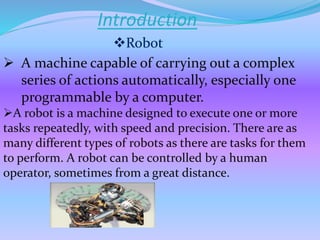
A robot is a machine designed to execute one or more
tasks repeatedly, with speed and precision. There are as
many different types of robots as there are tasks for them
to perform. A robot can be controlled by a human
operator, sometimes from a great distance.
Robot
 Robotics Technology
Robotics is the branch of mechanical
engineering, electrical engineering
and computer science that deals with
the design, construction, operation,
and application of robots, as well as
computer systems for their control,
sensory feedback, and information
processing.
First Developed
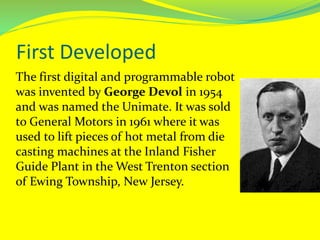
The first digital and programmable robot
was invented by George Devol in 1954
and was named the Unimate. It was sold
to General Motors in 1961 where it was
used to lift pieces of hot metal from die
casting machines at the Inland Fisher
Guide Plant in the West Trenton section
of Ewing Township, New Jersey.
Types of robots by General Concept
1. Pick and place
2. Continuous path
control
3. Sensory
Pick and Place
Moves items from one point to
another
Does not need to follow a
specific path between points
Uses include loading and
unloading machines, placing
components on circuit boards,
and moving parts off conveyor
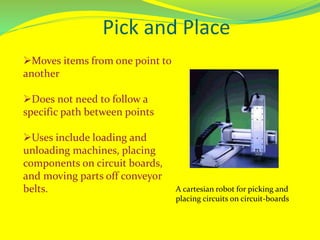
belts. A cartesian robot for picking and
placing circuits on circuit-boards
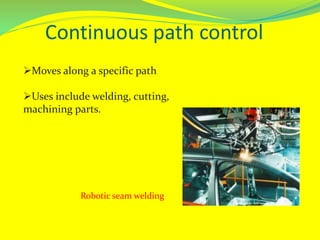
Continuous path control
Moves along a specific path
Uses include welding, cutting,
machining parts.
Robotic seam welding
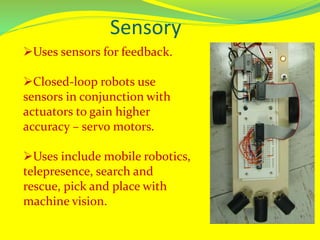
Sensory
Uses sensors for feedback.
Closed-loop robots use
sensors in conjunction with
actuators to gain higher
accuracy – servo motors.
Uses include mobile robotics,
telepresence, search and
rescue, pick and place with
machine vision.
Types of robots by application
Industrial robots
Domestic or household robots
Medical robots
Service robots
Military robots
Entertainment robots
Space robots
Hobby and competition robots
Types of robots by Locomotion and
Kinematics
Stationary Robots(including robotic arms with a
global axis of movement)
Cartesian/Gantry robots
Cylindrical robots
Spherical robots
Articulated robots
Parallel robots'
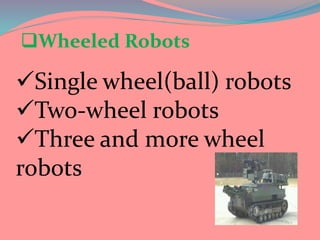
Wheeled Robots
Single wheel(ball) robots
Two-wheel robots
Three and more wheel
robots
Legged Robots
Bipedal robots(humanoid
robots)
Tropical robots
Quadruped robots
Hexapod robots
Other number of legs
Swimming Robots
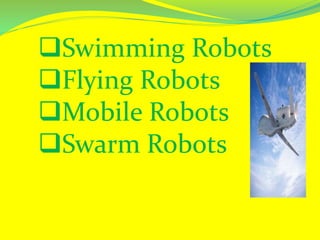
Flying Robots
Mobile Robots
Swarm Robots
Components of robot
A Robot is a system, consists of the following elements, which
are integrated to form a whole:
Manipulator / Rover : This is the
main body of the Robot and consists of links,
joints and structural elements of the Robot.
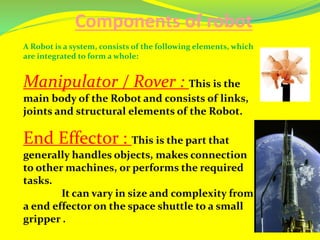
End Effector : This is the part that
generally handles objects, makes connection
to other machines, or performs the required
tasks.
It can vary in size and complexity from
a end effector on the space shuttle to a small
gripper .
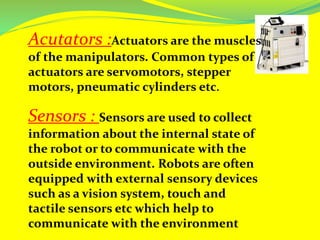
Acutators :Actuators are the muscles
of the manipulators. Common types of
actuators are servomotors, stepper
motors, pneumatic cylinders etc.
Sensors : Sensors are used to collect
information about the internal state of
the robot or to communicate with the
outside environment. Robots are often
equipped with external sensory devices
such as a vision system, touch and
tactile sensors etc which help to
communicate with the environment
Controller : The controller receives data
from the computer, controls the motions of
the actuator and coordinates these motions
with the sensory feedback information.
Robot Configurations
Some of the commonly used configurations in
Robotics are
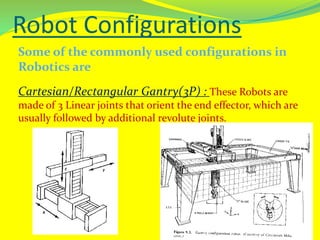
Cartesian/Rectangular Gantry(3P) : These Robots are
made of 3 Linear joints that orient the end effector, which are
usually followed by additional revolute joints.
Programming Languages
Motivation
need to interface robot control system to external
sensors, to provide “real time” changes based on sensory
equipment
computing based on geometry of environment
ability to interface with CAD/CAM systems
meaningful task descriptions
off-line programming capability
Large number of robot languages
available
AML, VAL, AL, RAIL, RobotStudio,
etc. (200+)
Each robot manufacturer has their
own robot programming language
No standards exist
Portability of programs virtually non-
existent
Application of Robotics Technology
Nowadays the uses the many
fields.
In Industries
•Welding
•Packing
•Painting
•Assembling
•Material Handling
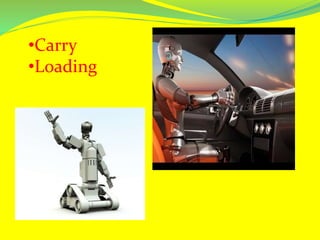
•Carry
•Loading
Domestic or household
•Sweeper
•Washing
•Gutter Cleaner
•Pool Cleaner
•Vacuum Cleaner
•Security guard
•Delivery
•Cleaning
•Mowing
Service Robots
Medical Purpose
Military
Entertainment
In Space
Hobby and competition
Defuse Bum
Advantage
1) Going to far away planets
2) Spying on people in ways people
can't move and from views humans
can't reach
3) Going far down into the unknown
waters where humans would be
crushed
4) Giving us information that
humans can't get
5) Working at places 24/7 without
any salary and food. Plus they don't
get bored
6) They can perform tasks faster
than humans and much more
consistently and accurately
7) They can capture moments just too
fast for the human eye to get, for
example the Atlas detector in the LHC
project can capture ~ 600000 frames
per second while we can see at about
60
8) Most of them are automatic so
they can go around by
themselves without any human
interference
9) They can entertain us and
help us in certain tasks
Disadvantage
1) People can lose jobs in
factories
2) It needs a supply of power
3) It needs maintenance to
keep it running
4) It costs money to make or
buy a robot
Future of robotics technology
Bottle filling Plant.
 Construction works.
Rescue Robots
Robotic Competitions
Robotic Insects
Robotic Prosthetics
Robot Caregivers
Conclusions
Robots are an important
component in Intelligent
Environments
•Automate devices
•Provide physical services
Robot Systems in these
environments need
particular capabilities
•Autonomous control systems
•Simple and natural human-robot
interface
•Adaptive and learning
capabilities
•Robots have to maintain safety
during operation
While a number of techniques
to address these requirements
exist, no functional, satisfactory
solutions have yet been
developed
•Only very simple robots for single
tasks in intelligent environments
exist
Robotic technology

Robotic technology

  • 1.
  • 2.
    Contents  Introduction ofRobot its Technology. Types of robot. Components of robot. Robot Configuration Which Language are used in robotics technology. Application of robotics technology. Advantage and Disadvantage of robotics technology. Future of robotics technology. Conclusion.
  • 3.
    Introduction  A machinecapable of carrying out a complex series of actions automatically, especially one programmable by a computer. A robot is a machine designed to execute one or more tasks repeatedly, with speed and precision. There are as many different types of robots as there are tasks for them to perform. A robot can be controlled by a human operator, sometimes from a great distance. Robot
  • 4.
     Robotics Technology Roboticsis the branch of mechanical engineering, electrical engineering and computer science that deals with the design, construction, operation, and application of robots, as well as computer systems for their control, sensory feedback, and information processing.
  • 5.
    First Developed The firstdigital and programmable robot was invented by George Devol in 1954 and was named the Unimate. It was sold to General Motors in 1961 where it was used to lift pieces of hot metal from die casting machines at the Inland Fisher Guide Plant in the West Trenton section of Ewing Township, New Jersey.
  • 6.
    Types of robotsby General Concept 1. Pick and place 2. Continuous path control 3. Sensory
  • 7.
    Pick and Place Movesitems from one point to another Does not need to follow a specific path between points Uses include loading and unloading machines, placing components on circuit boards, and moving parts off conveyor belts. A cartesian robot for picking and placing circuits on circuit-boards
  • 8.
    Continuous path control Movesalong a specific path Uses include welding, cutting, machining parts. Robotic seam welding
  • 9.
    Sensory Uses sensors forfeedback. Closed-loop robots use sensors in conjunction with actuators to gain higher accuracy – servo motors. Uses include mobile robotics, telepresence, search and rescue, pick and place with machine vision.
  • 10.
    Types of robotsby application Industrial robots Domestic or household robots Medical robots Service robots Military robots Entertainment robots Space robots Hobby and competition robots
  • 11.
    Types of robotsby Locomotion and Kinematics Stationary Robots(including robotic arms with a global axis of movement) Cartesian/Gantry robots Cylindrical robots Spherical robots Articulated robots Parallel robots'
  • 12.
    Wheeled Robots Single wheel(ball)robots Two-wheel robots Three and more wheel robots
  • 13.
    Legged Robots Bipedal robots(humanoid robots) Tropicalrobots Quadruped robots Hexapod robots Other number of legs
  • 14.
  • 15.
    Components of robot ARobot is a system, consists of the following elements, which are integrated to form a whole: Manipulator / Rover : This is the main body of the Robot and consists of links, joints and structural elements of the Robot. End Effector : This is the part that generally handles objects, makes connection to other machines, or performs the required tasks. It can vary in size and complexity from a end effector on the space shuttle to a small gripper .
  • 16.
    Acutators :Actuators arethe muscles of the manipulators. Common types of actuators are servomotors, stepper motors, pneumatic cylinders etc. Sensors : Sensors are used to collect information about the internal state of the robot or to communicate with the outside environment. Robots are often equipped with external sensory devices such as a vision system, touch and tactile sensors etc which help to communicate with the environment
  • 17.
    Controller : Thecontroller receives data from the computer, controls the motions of the actuator and coordinates these motions with the sensory feedback information.
  • 18.
    Robot Configurations Some ofthe commonly used configurations in Robotics are Cartesian/Rectangular Gantry(3P) : These Robots are made of 3 Linear joints that orient the end effector, which are usually followed by additional revolute joints.
  • 19.
    Programming Languages Motivation need tointerface robot control system to external sensors, to provide “real time” changes based on sensory equipment computing based on geometry of environment ability to interface with CAD/CAM systems meaningful task descriptions off-line programming capability
  • 20.
    Large number ofrobot languages available AML, VAL, AL, RAIL, RobotStudio, etc. (200+) Each robot manufacturer has their own robot programming language No standards exist Portability of programs virtually non- existent
  • 21.
    Application of RoboticsTechnology Nowadays the uses the many fields. In Industries •Welding •Packing •Painting •Assembling •Material Handling
  • 22.
  • 23.
    Domestic or household •Sweeper •Washing •GutterCleaner •Pool Cleaner •Vacuum Cleaner
  • 24.
  • 25.
  • 26.
    Advantage 1) Going tofar away planets 2) Spying on people in ways people can't move and from views humans can't reach 3) Going far down into the unknown waters where humans would be crushed 4) Giving us information that humans can't get
  • 27.
    5) Working atplaces 24/7 without any salary and food. Plus they don't get bored 6) They can perform tasks faster than humans and much more consistently and accurately
  • 28.
    7) They cancapture moments just too fast for the human eye to get, for example the Atlas detector in the LHC project can capture ~ 600000 frames per second while we can see at about 60
  • 29.
    8) Most ofthem are automatic so they can go around by themselves without any human interference 9) They can entertain us and help us in certain tasks
  • 30.
    Disadvantage 1) People canlose jobs in factories 2) It needs a supply of power 3) It needs maintenance to keep it running 4) It costs money to make or buy a robot
  • 31.
    Future of roboticstechnology Bottle filling Plant.  Construction works. Rescue Robots Robotic Competitions Robotic Insects Robotic Prosthetics Robot Caregivers
  • 32.
    Conclusions Robots are animportant component in Intelligent Environments •Automate devices •Provide physical services
  • 33.
    Robot Systems inthese environments need particular capabilities •Autonomous control systems •Simple and natural human-robot interface •Adaptive and learning capabilities •Robots have to maintain safety during operation
  • 34.
    While a numberof techniques to address these requirements exist, no functional, satisfactory solutions have yet been developed •Only very simple robots for single tasks in intelligent environments exist