Necessities in Robotic Safety Systems
Don’t integrate without it
By KC Robotics
www.kcrobotics.com
April 2013
We hear you. There are so many rules
that if you implemented them all, you
wouldn’t be able to run your robots.
We hear you. There are so many rules
that if you implemented them all, you
wouldn’t be able to run your robots.
BUT…
We hear you. There are so many rules
that if you implemented them all, you
wouldn’t be able to run your robots.
Kenji Urada was killed by a robot on a production line when another
employee turned the robot on while Urada was doing maintenance.
Robert Williams died in 1979 when a robot arm hit him in the
head after he climbed into a part bin to retrieve some parts.
We hear you. There are so many rules
that if you implemented them all, you
wouldn’t be able to run your robots.
Kenji Urada was killed by a robot on a production line when another
employee turned the robot on while Urada was doing maintenance.
Robert Williams died in 1979 when a robot arm hit him in the
head after he climbed into a part bin to retrieve some parts.
You can’t run your assembly line without people.
FACT: A robot’s arm will win in an arm wrestling
contest with you.
FACT: A robot’s arm will win in an arm wrestling
contest with you.
FACT : A robot can and will pin and/or crush you
against other objects.
FACT: A robot’s arm will win in an arm wrestling
contest with you.
FACT : A robot can and will pin and/or crush you
against other objects.
FACT : Hazards boil down to human error,
equipment failure, and environmental conditions.
Studies have shown that accidents
involving industrial robotics do not usually
occur during normal working hours, rather
during times of installation, maintenance,
programming, and servicing.
http://www.osha.gov/SLTC/robotics/
Here’s a short guide as to how you can
keep your employees from
experiencing the same fates
as Kenji and Robert.
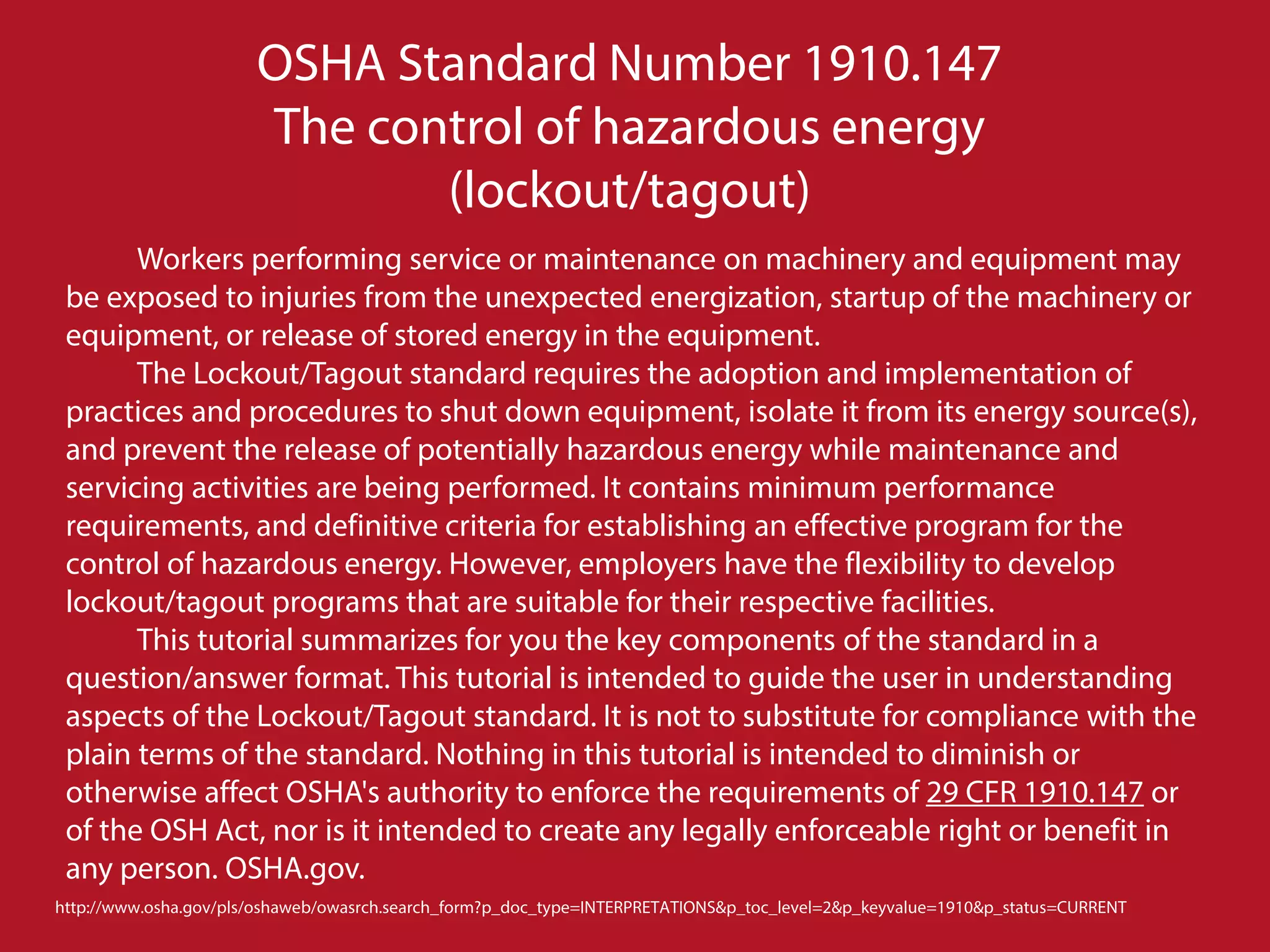
Workers performing service or maintenance on machinery and equipment may
be exposed to injuries from the unexpected energization, startup of the machinery or
equipment, or release of stored energy in the equipment.
The Lockout/Tagout standard requires the adoption and implementation of
practices and procedures to shut down equipment, isolate it from its energy source(s),
and prevent the release of potentially hazardous energy while maintenance and
servicing activities are being performed. It contains minimum performance
requirements, and definitive criteria for establishing an effective program for the
control of hazardous energy. However, employers have the flexibility to develop
lockout/tagout programs that are suitable for their respective facilities.
This tutorial summarizes for you the key components of the standard in a
question/answer format. This tutorial is intended to guide the user in understanding
aspects of the Lockout/Tagout standard. It is not to substitute for compliance with the
plain terms of the standard. Nothing in this tutorial is intended to diminish or
otherwise affect OSHA's authority to enforce the requirements of 29 CFR 1910.147 or
of the OSH Act, nor is it intended to create any legally enforceable right or benefit in
any person. OSHA.gov.
OSHA Standard Number 1910.147
The control of hazardous energy
(lockout/tagout)
http://www.osha.gov/pls/oshaweb/owasrch.search_form?p_doc_type=INTERPRETATIONS&p_toc_level=2&p_keyvalue=1910&p_status=CURRENT
That’s a lot of words.
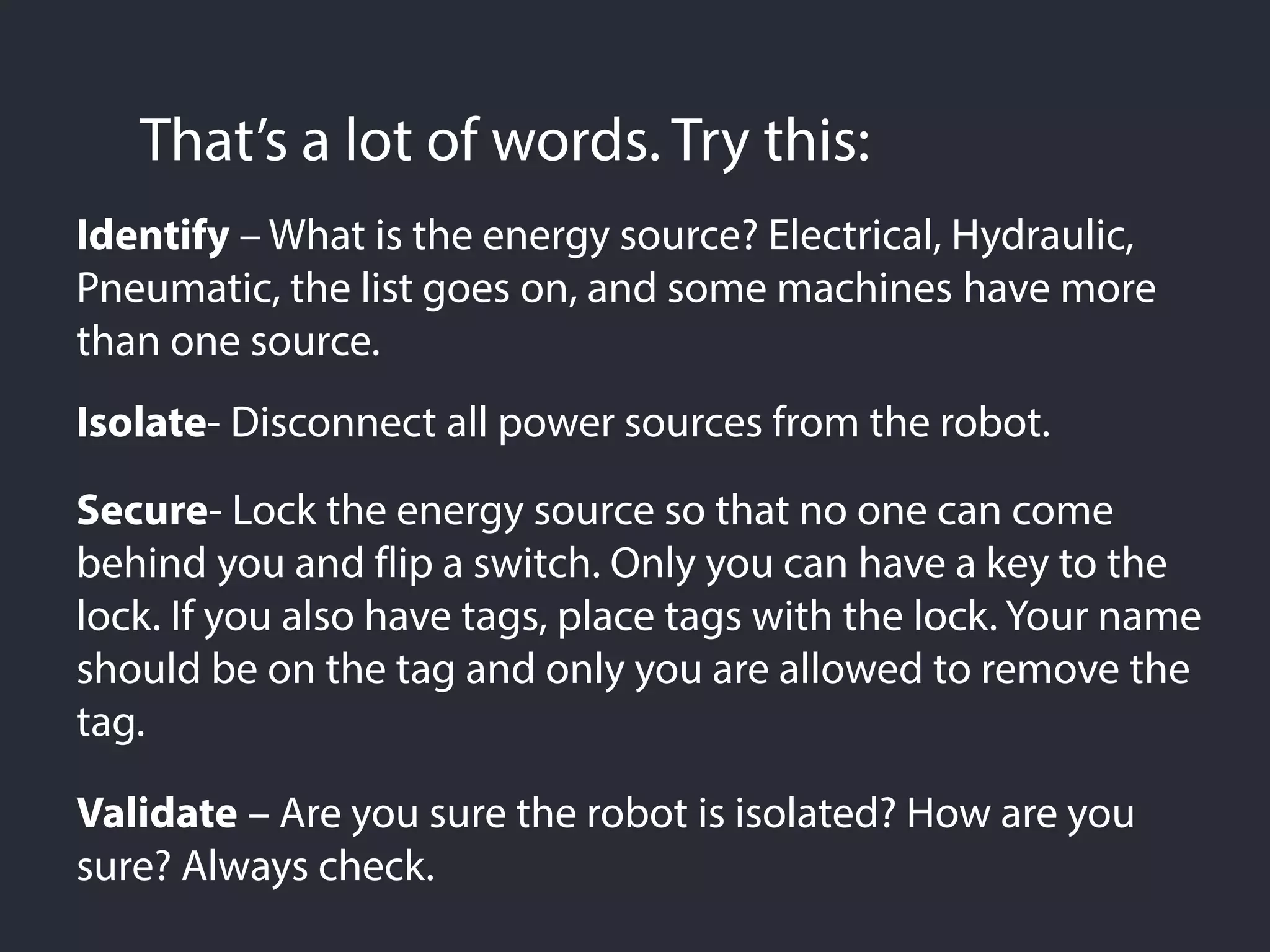
That’s a lot of words. Try this:
Identify – What is the energy source? Electrical, Hydraulic,
Pneumatic, the list goes on, and some machines have more
than one source.
Isolate- Disconnect all power sources from the robot.
Secure- Lock the energy source so that no one can come
behind you and flip a switch. Only you can have a key to the
lock. If you also have tags, place tags with the lock. Your name
should be on the tag and only you are allowed to remove the
tag.
Validate – Are you sure the robot is isolated? How are you
sure? Always check.
Four words. Much Better.
Identify. Isolate. Secure. Validate.
Four words. Much Better.
Identify. Isolate. Secure. Validate.
Why is this integral to any system?
If you cut off the power supplies of the
robot, there is no chance for the robot to
inadvertently move due to human error or
machine malfunction.
Also, power supplies many times contain
enough voltage to kill a person in seconds,
if the power source is removed from the
robot before maintenance, the chances of
injury directly from the power supply are
eliminated.
Interlocked Doors
Interlocked doors are seen on safety fencing that is typically
installed around the predetermined work envelope of a
robotic system.
The electromechanical switch is normally found on hinges or
on the doors themselves. When the interlock is tripped, the
robot will cease function.
The interlock can be disabled with a key when the robot is
safely disengaged.
Light Curtains
Mostly used around robotic systems that need frequent accessibility by
the operator, light curtains are extremely reliable for detecting
unplanned movement within predetermined spaces near a robot. In a
nutshell it’s an invisible wall of light that, when broken, will stop the
robot in motion.
How it works:
- A transmitter located on metal posts around the robotic system
outputs a synchronized pattern of infrared light beams to a receiver
on an opposing post, hence, curtain of light.
- The receiver is only programmed to acknowledge these beams
preventing an external, unintended light source from interfering.
- When a beam is broken, the work cell is shut down, the robot’s brakes
are enabled and the work cell cannot move again until restarted.
http://www.lightcurtain.com/light_curtain-operation.html
Warning Lights
Warning lights are exactly what they say they are. They
are lights, usually mounted on the top of the safety
fencing or the PLC and indicate to those working
around the robot if the system is operating safely.
The colors of the lights are usually
red, yellow, and green.
Cable Management
Cable management is a common issue amongst assembly lines. From atop the
robot to the cables running on the floor, torn, cut, or damaged cables
can cause hazardous situations for everyone on the assembly line.
www.hoffmanonline.com
www.igus.com
Cable Management
Cable management is a common issue amongst assembly lines. From atop the
robot to the cables running on the floor, torn, cut, or damaged cables
can cause hazardous situations for everyone on the assembly line.
www.hoffmanonline.com
www.igus.com
Some tips on how to make cables last a lifetime:
- Make sure the cables being installed fit the application, many cables
are not fit for welding applications and can wear quicker
- Cables on the robot can easily be contained by a sleeve or cable
management system. Companies like igus offer retractable and
flexible cables for the robot and Hoffman offer cable management
throughout the system.
- A common reason for replaced cables? Fork Lifts and foot traffic over
the cables. Protect your cables from plug to plug.
Remote E-Stops
Vary from manufacturer to integrator, make sure the technician installing
them teaches you and your operators how to engage them.
Found on the teach pendant, around the robotic system and anywhere it
is presumed an operator may need to go to operate the robot.
Usually are big red buttons placed in obvious places around the robotic
system.
Not the equivalent of a lockout/tagout (ie: Hazardous Energy Control
Procedure). They are considered more of a preventive measure.
To restart after pulling E-Stop, operator must apply a“power ON”or
“RESET”button on the robotic system.
Smoke Hoods/Fume Extractors
While what you can see is dangerous, what you can’t see can be just as
hazardous to your health. When arc welding, fumes are created that can
cause a lot of health problems if inhaled. To protect against these fumes,
companies involved with robotic AND manual arc welding should invest
in a fume extraction system.
Fumes are created during the welding process when some of the welded
metal particles are released into the air.
Fume extractors can be portable or stationary and some can be installed
indoors as well as outdoors.
http://www.asse.org/practicespecialties/articles/weldingfumes.php
Welding fumes can have
long and short-term effects on the:
- Lungs
- Brain cells
- Nervous system
http://www.asse.org/practicespecialties/articles/weldingfumes.php
Welding fumes can have
long and short-term effects on the:
- Lungs
- Brain cells
- Nervous system
Problems that have been documented include:
- Encephalopathy
- Fatigue
- Mental confusion
- Metal fume fever
- Paralysis
Software
Most OEMs carry their own branded software now that adds
safety mechanisms to their robots.
KUKA Robotics, for example, offers KUKA.,SafeOperation
software to maximize safety when the robot is in use.
The software allows an integrator to configure a safe zone for
the robot by defining the cell area, the envelope that the
robot will be working in, the product area and the product ,
and the robot itself.
The software is intended to limit the area in which the robot
can move reducing the distance an employee may need to
be from the robot. This especially benefits manual loading
stations.
www.kuka-robotics.com/usa/en/products/software/hub_technologies/start.htm

Necessities in Robotic Safety Systems

  • 1.
    Necessities in RoboticSafety Systems Don’t integrate without it By KC Robotics www.kcrobotics.com April 2013
  • 2.
    We hear you.There are so many rules that if you implemented them all, you wouldn’t be able to run your robots.
  • 3.
    We hear you.There are so many rules that if you implemented them all, you wouldn’t be able to run your robots. BUT…
  • 4.
    We hear you.There are so many rules that if you implemented them all, you wouldn’t be able to run your robots. Kenji Urada was killed by a robot on a production line when another employee turned the robot on while Urada was doing maintenance. Robert Williams died in 1979 when a robot arm hit him in the head after he climbed into a part bin to retrieve some parts.
  • 5.
    We hear you.There are so many rules that if you implemented them all, you wouldn’t be able to run your robots. Kenji Urada was killed by a robot on a production line when another employee turned the robot on while Urada was doing maintenance. Robert Williams died in 1979 when a robot arm hit him in the head after he climbed into a part bin to retrieve some parts. You can’t run your assembly line without people.
  • 6.
    FACT: A robot’sarm will win in an arm wrestling contest with you.
  • 7.
    FACT: A robot’sarm will win in an arm wrestling contest with you. FACT : A robot can and will pin and/or crush you against other objects.
  • 8.
    FACT: A robot’sarm will win in an arm wrestling contest with you. FACT : A robot can and will pin and/or crush you against other objects. FACT : Hazards boil down to human error, equipment failure, and environmental conditions.
  • 9.
    Studies have shownthat accidents involving industrial robotics do not usually occur during normal working hours, rather during times of installation, maintenance, programming, and servicing. http://www.osha.gov/SLTC/robotics/
  • 10.
    Here’s a shortguide as to how you can keep your employees from experiencing the same fates as Kenji and Robert.
  • 11.
    Workers performing serviceor maintenance on machinery and equipment may be exposed to injuries from the unexpected energization, startup of the machinery or equipment, or release of stored energy in the equipment. The Lockout/Tagout standard requires the adoption and implementation of practices and procedures to shut down equipment, isolate it from its energy source(s), and prevent the release of potentially hazardous energy while maintenance and servicing activities are being performed. It contains minimum performance requirements, and definitive criteria for establishing an effective program for the control of hazardous energy. However, employers have the flexibility to develop lockout/tagout programs that are suitable for their respective facilities. This tutorial summarizes for you the key components of the standard in a question/answer format. This tutorial is intended to guide the user in understanding aspects of the Lockout/Tagout standard. It is not to substitute for compliance with the plain terms of the standard. Nothing in this tutorial is intended to diminish or otherwise affect OSHA's authority to enforce the requirements of 29 CFR 1910.147 or of the OSH Act, nor is it intended to create any legally enforceable right or benefit in any person. OSHA.gov. OSHA Standard Number 1910.147 The control of hazardous energy (lockout/tagout) http://www.osha.gov/pls/oshaweb/owasrch.search_form?p_doc_type=INTERPRETATIONS&p_toc_level=2&p_keyvalue=1910&p_status=CURRENT
  • 12.
    That’s a lotof words.
  • 13.
    That’s a lotof words. Try this: Identify – What is the energy source? Electrical, Hydraulic, Pneumatic, the list goes on, and some machines have more than one source. Isolate- Disconnect all power sources from the robot. Secure- Lock the energy source so that no one can come behind you and flip a switch. Only you can have a key to the lock. If you also have tags, place tags with the lock. Your name should be on the tag and only you are allowed to remove the tag. Validate – Are you sure the robot is isolated? How are you sure? Always check.
  • 14.
    Four words. MuchBetter. Identify. Isolate. Secure. Validate.
  • 15.
    Four words. MuchBetter. Identify. Isolate. Secure. Validate. Why is this integral to any system?
  • 16.
    If you cutoff the power supplies of the robot, there is no chance for the robot to inadvertently move due to human error or machine malfunction. Also, power supplies many times contain enough voltage to kill a person in seconds, if the power source is removed from the robot before maintenance, the chances of injury directly from the power supply are eliminated.
  • 17.
    Interlocked Doors Interlocked doorsare seen on safety fencing that is typically installed around the predetermined work envelope of a robotic system. The electromechanical switch is normally found on hinges or on the doors themselves. When the interlock is tripped, the robot will cease function. The interlock can be disabled with a key when the robot is safely disengaged.
  • 18.
    Light Curtains Mostly usedaround robotic systems that need frequent accessibility by the operator, light curtains are extremely reliable for detecting unplanned movement within predetermined spaces near a robot. In a nutshell it’s an invisible wall of light that, when broken, will stop the robot in motion. How it works: - A transmitter located on metal posts around the robotic system outputs a synchronized pattern of infrared light beams to a receiver on an opposing post, hence, curtain of light. - The receiver is only programmed to acknowledge these beams preventing an external, unintended light source from interfering. - When a beam is broken, the work cell is shut down, the robot’s brakes are enabled and the work cell cannot move again until restarted. http://www.lightcurtain.com/light_curtain-operation.html
  • 19.
    Warning Lights Warning lightsare exactly what they say they are. They are lights, usually mounted on the top of the safety fencing or the PLC and indicate to those working around the robot if the system is operating safely. The colors of the lights are usually red, yellow, and green.
  • 20.
    Cable Management Cable managementis a common issue amongst assembly lines. From atop the robot to the cables running on the floor, torn, cut, or damaged cables can cause hazardous situations for everyone on the assembly line. www.hoffmanonline.com www.igus.com
  • 21.
    Cable Management Cable managementis a common issue amongst assembly lines. From atop the robot to the cables running on the floor, torn, cut, or damaged cables can cause hazardous situations for everyone on the assembly line. www.hoffmanonline.com www.igus.com Some tips on how to make cables last a lifetime: - Make sure the cables being installed fit the application, many cables are not fit for welding applications and can wear quicker - Cables on the robot can easily be contained by a sleeve or cable management system. Companies like igus offer retractable and flexible cables for the robot and Hoffman offer cable management throughout the system. - A common reason for replaced cables? Fork Lifts and foot traffic over the cables. Protect your cables from plug to plug.
  • 22.
    Remote E-Stops Vary frommanufacturer to integrator, make sure the technician installing them teaches you and your operators how to engage them. Found on the teach pendant, around the robotic system and anywhere it is presumed an operator may need to go to operate the robot. Usually are big red buttons placed in obvious places around the robotic system. Not the equivalent of a lockout/tagout (ie: Hazardous Energy Control Procedure). They are considered more of a preventive measure. To restart after pulling E-Stop, operator must apply a“power ON”or “RESET”button on the robotic system.
  • 23.
    Smoke Hoods/Fume Extractors Whilewhat you can see is dangerous, what you can’t see can be just as hazardous to your health. When arc welding, fumes are created that can cause a lot of health problems if inhaled. To protect against these fumes, companies involved with robotic AND manual arc welding should invest in a fume extraction system. Fumes are created during the welding process when some of the welded metal particles are released into the air. Fume extractors can be portable or stationary and some can be installed indoors as well as outdoors. http://www.asse.org/practicespecialties/articles/weldingfumes.php
  • 24.
    http://www.asse.org/practicespecialties/articles/weldingfumes.php Welding fumes canhave long and short-term effects on the: - Lungs - Brain cells - Nervous system
  • 25.
    http://www.asse.org/practicespecialties/articles/weldingfumes.php Welding fumes canhave long and short-term effects on the: - Lungs - Brain cells - Nervous system Problems that have been documented include: - Encephalopathy - Fatigue - Mental confusion - Metal fume fever - Paralysis
  • 26.
    Software Most OEMs carrytheir own branded software now that adds safety mechanisms to their robots. KUKA Robotics, for example, offers KUKA.,SafeOperation software to maximize safety when the robot is in use. The software allows an integrator to configure a safe zone for the robot by defining the cell area, the envelope that the robot will be working in, the product area and the product , and the robot itself. The software is intended to limit the area in which the robot can move reducing the distance an employee may need to be from the robot. This especially benefits manual loading stations. www.kuka-robotics.com/usa/en/products/software/hub_technologies/start.htm