Introduction to Robotics
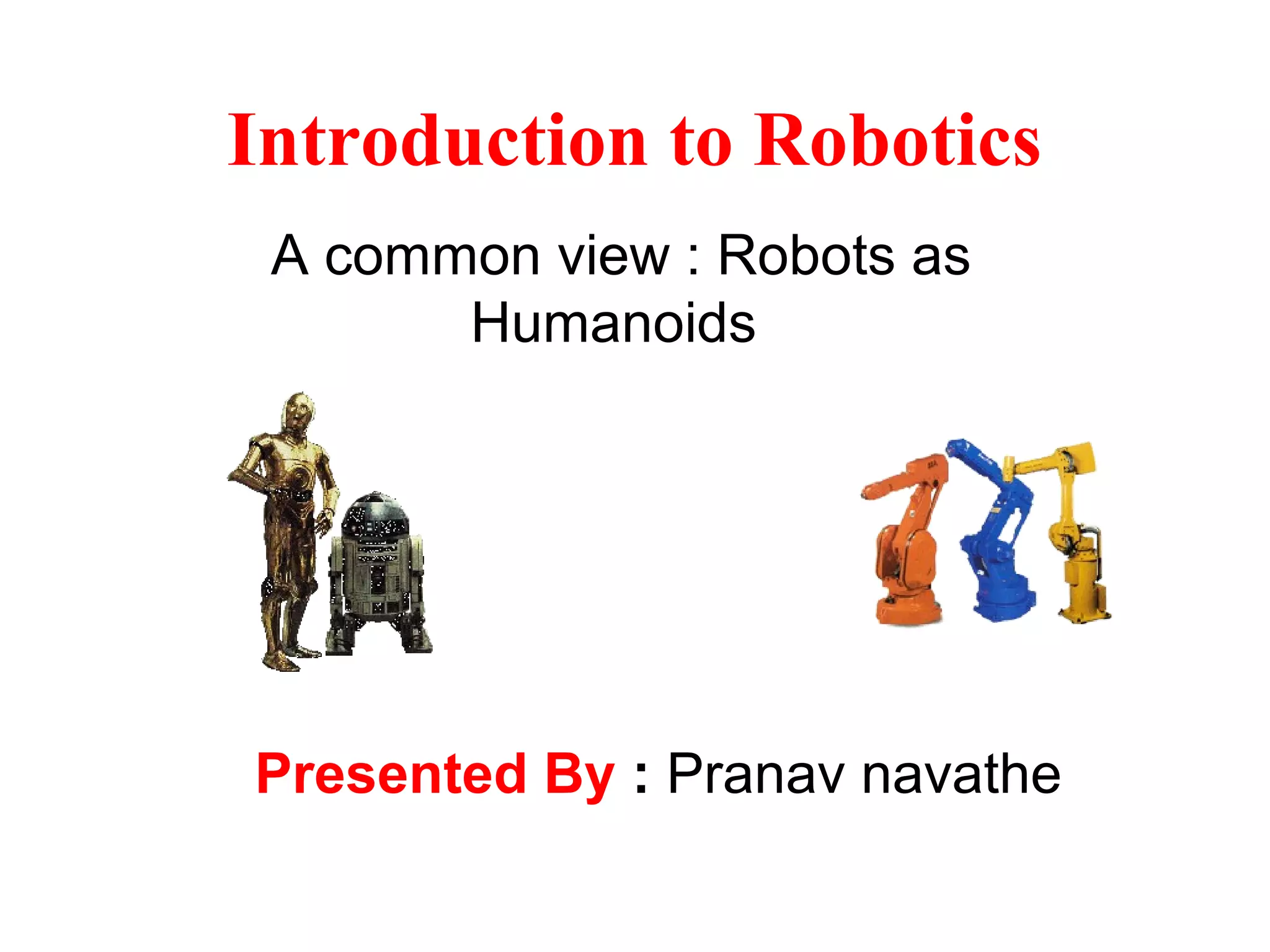
A common view : Robots as
Humanoids
Presented By : Pranav navathe
Agenda
• Introduction to Robotics
• Classification of Robots
• Robot accessories
• Robot coordinate
• Reference Frames
• Control methods
• Robot Programming
Robotics Timeline
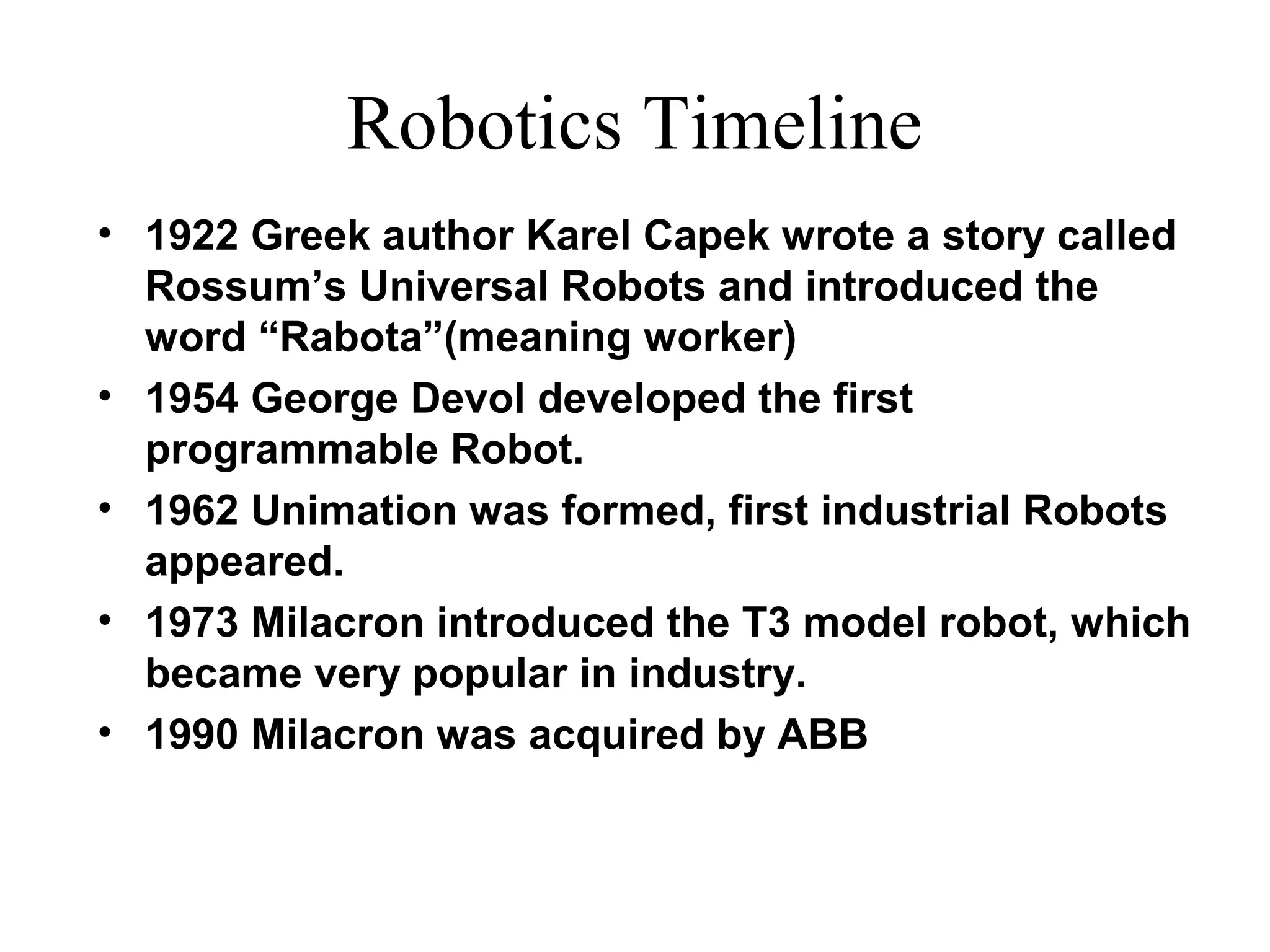
• 1922 Greek author Karel Capek wrote a story called
Rossum’s Universal Robots and introduced the
word “Rabota”(meaning worker)
• 1954 George Devol developed the first
programmable Robot.
• 1962 Unimation was formed, first industrial Robots
appeared.
• 1973 Milacron introduced the T3 model robot, which
became very popular in industry.
• 1990 Milacron was acquired by ABB
Robot Classification
The following is the classification of Robots according to the
Robotics Institute of America
• Variable-Sequence Robot : A device that performs the
successive stages of a task according to a predetermined
method easy to modify
• Playback Robot :A human operator performs the task
manually by leading the Robot
• Numerical Control Robot : The operator supplies the
movement program rather than teaching it the task
manually.
• Intelligent Robot : A robot with the means to understand its
environment and the ability to successfully complete a task
despite changes to the environment.
Robot Accessories
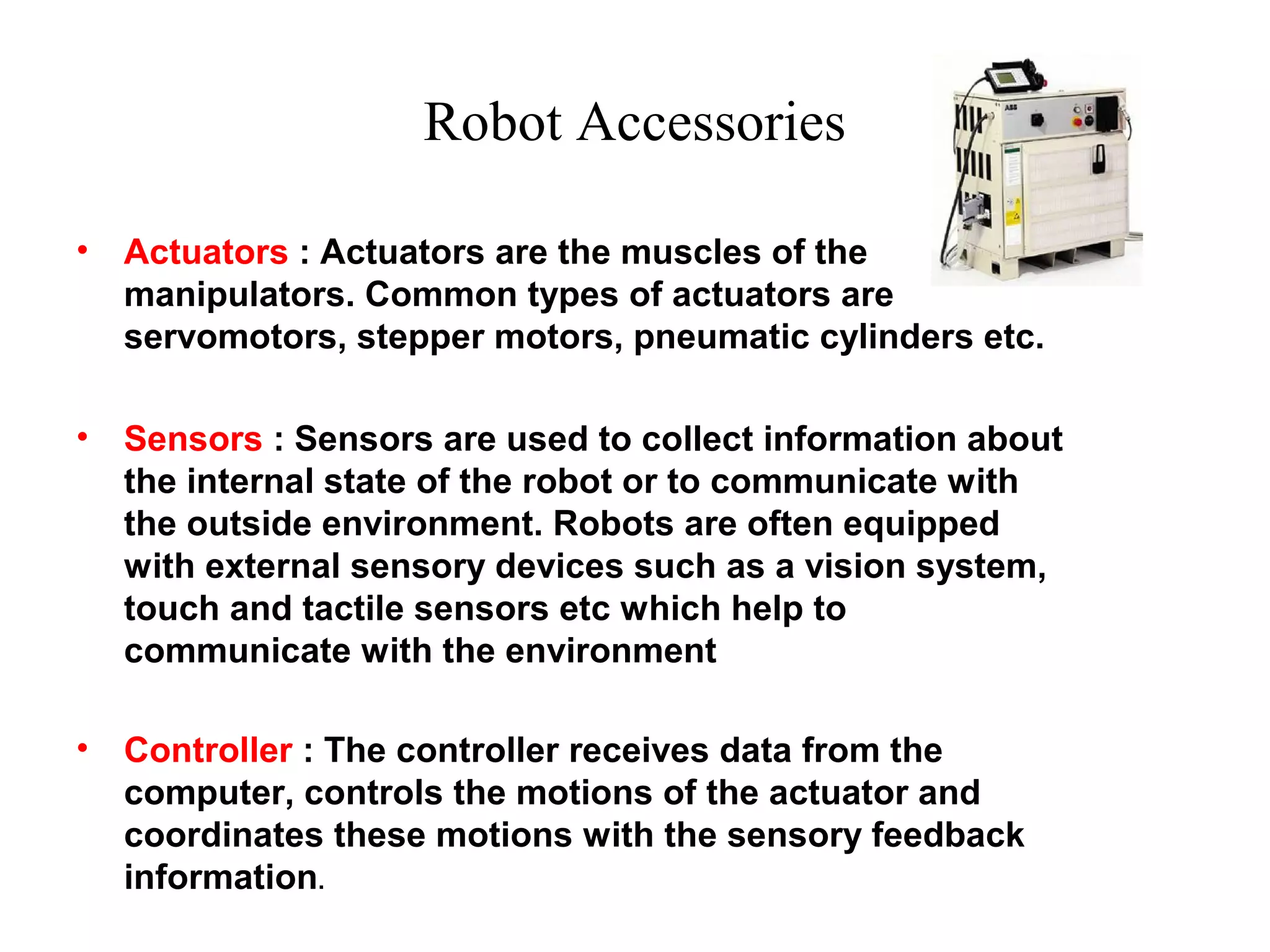
• Actuators : Actuators are the muscles of the
manipulators. Common types of actuators are
servomotors, stepper motors, pneumatic cylinders etc.
• Sensors : Sensors are used to collect information about
the internal state of the robot or to communicate with
the outside environment. Robots are often equipped
with external sensory devices such as a vision system,
touch and tactile sensors etc which help to
communicate with the environment
• Controller : The controller receives data from the
computer, controls the motions of the actuator and
coordinates these motions with the sensory feedback
information.
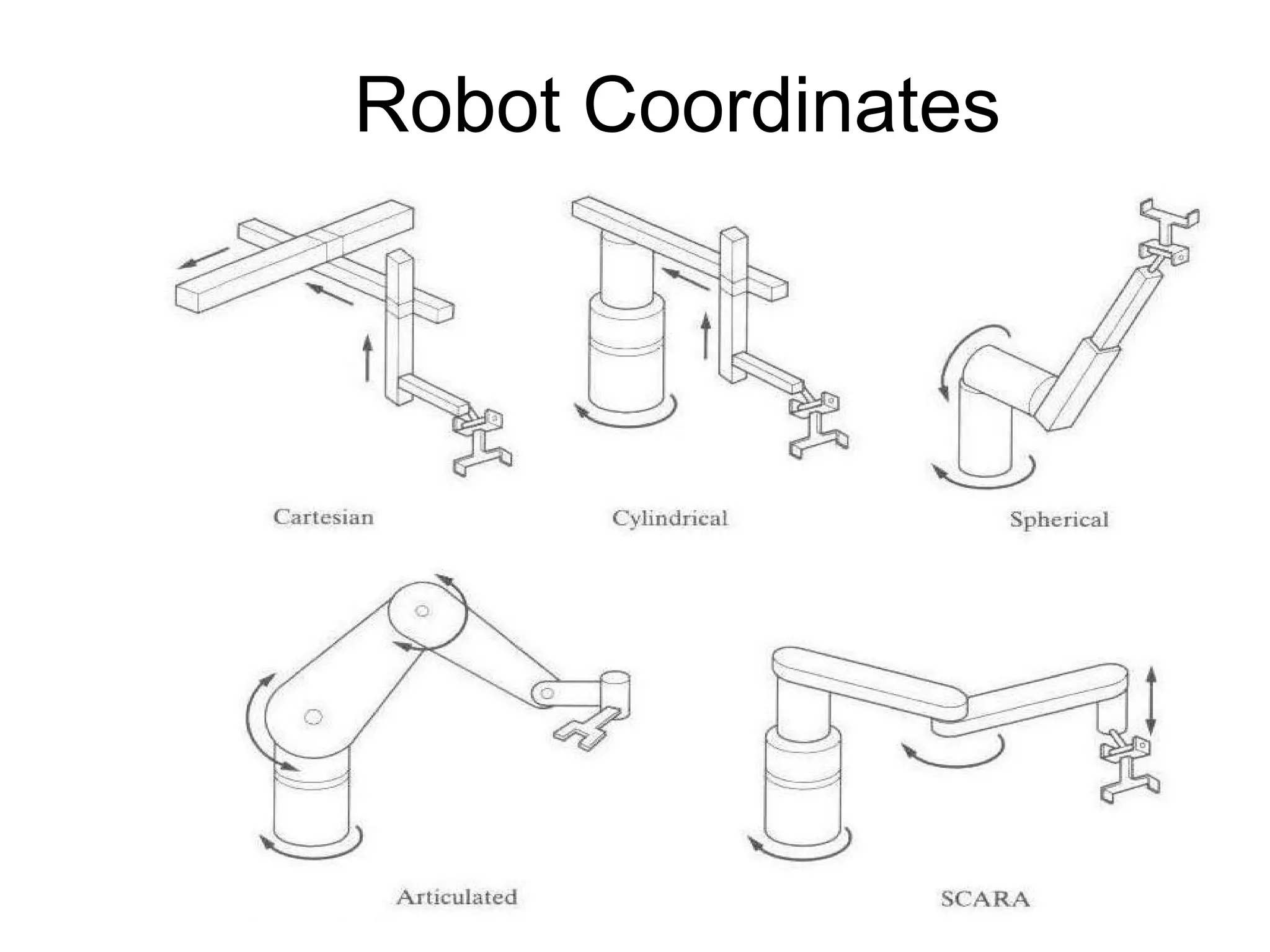
Robot Coordinates
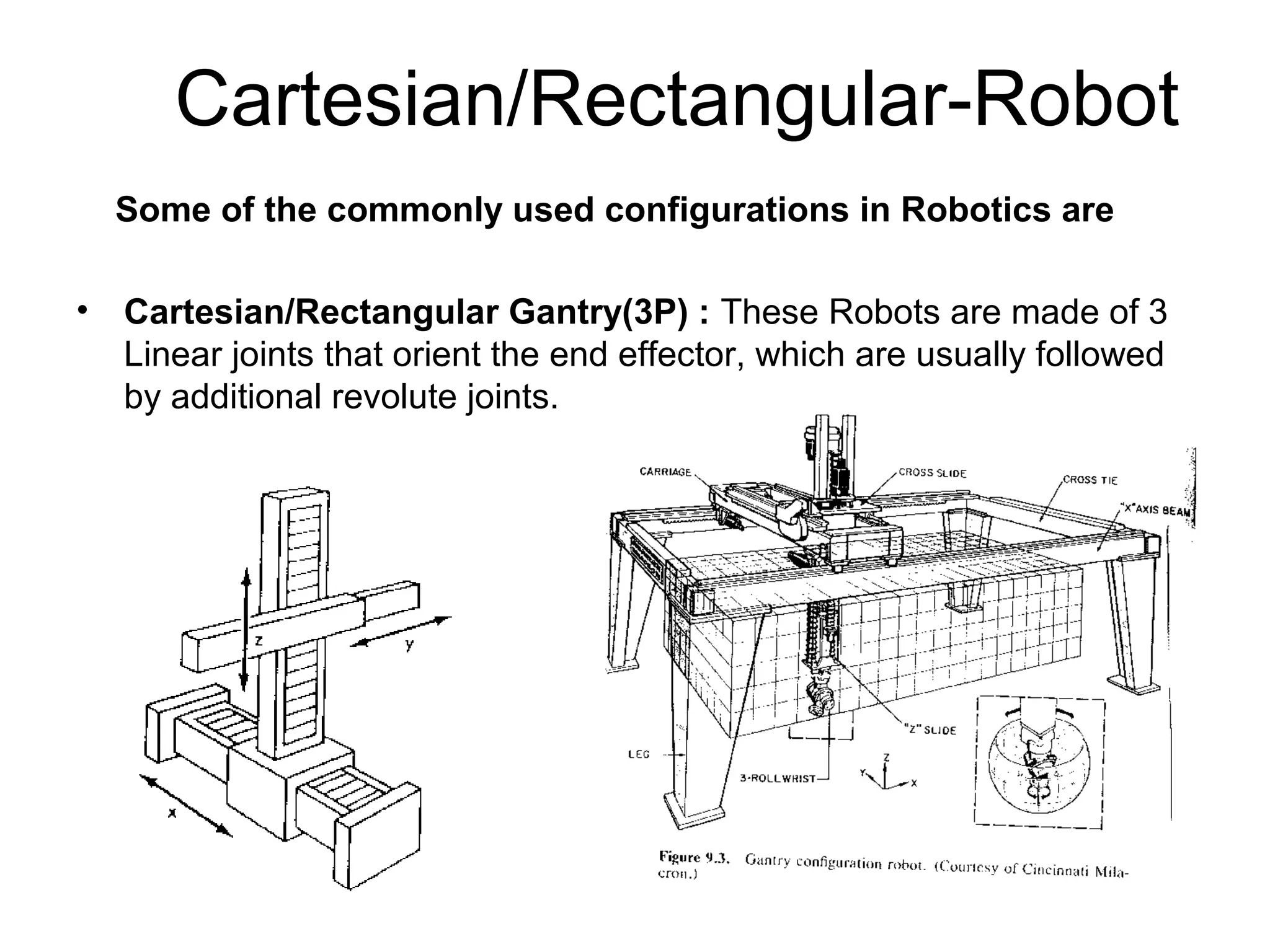
Cartesian/Rectangular-Robot
Some of the commonly used configurations in Robotics are
• Cartesian/Rectangular Gantry(3P) : These Robots are made of 3
Linear joints that orient the end effector, which are usually followed
by additional revolute joints.
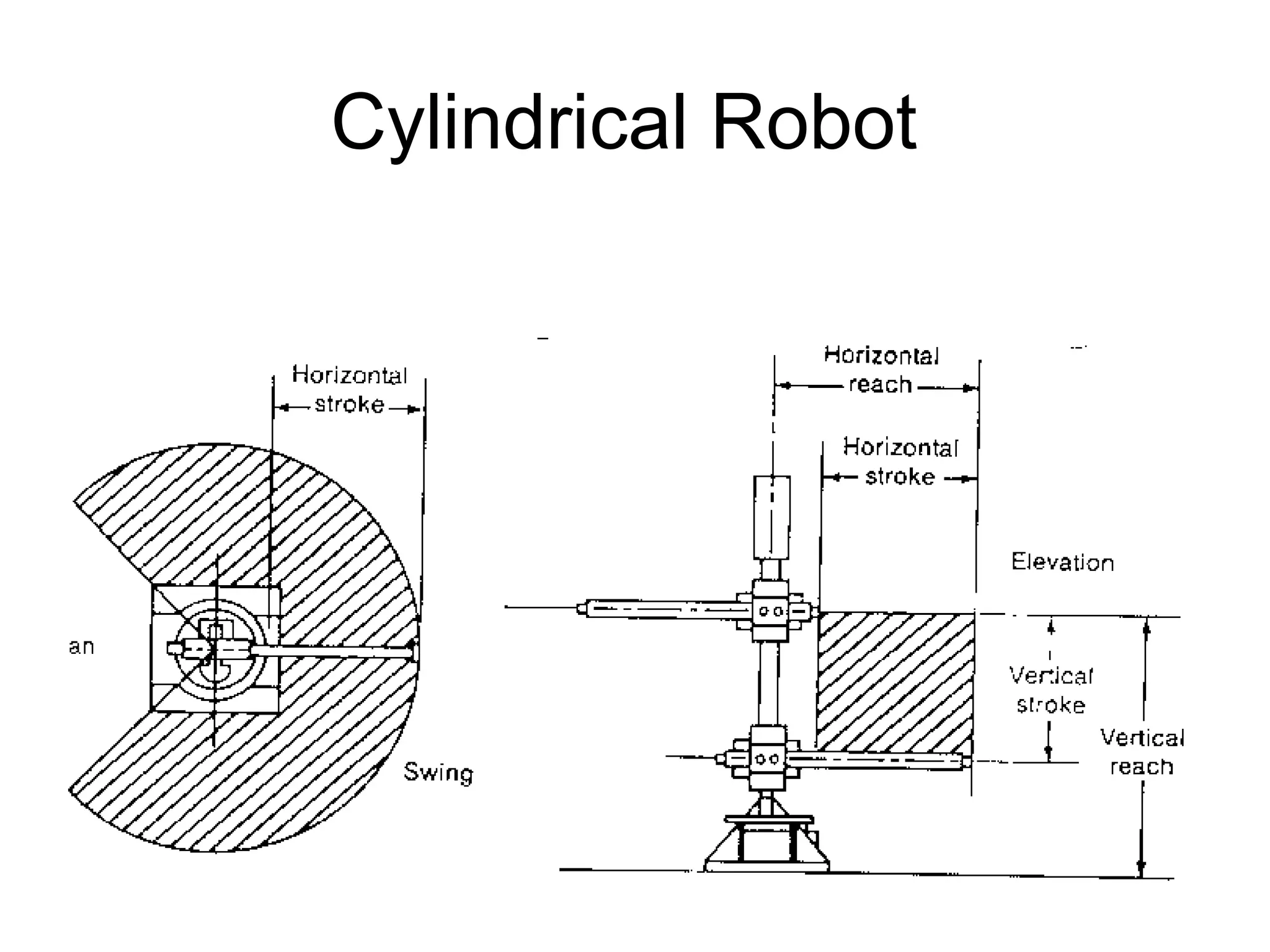
Cylindrical Robot
Spherical joint Robot
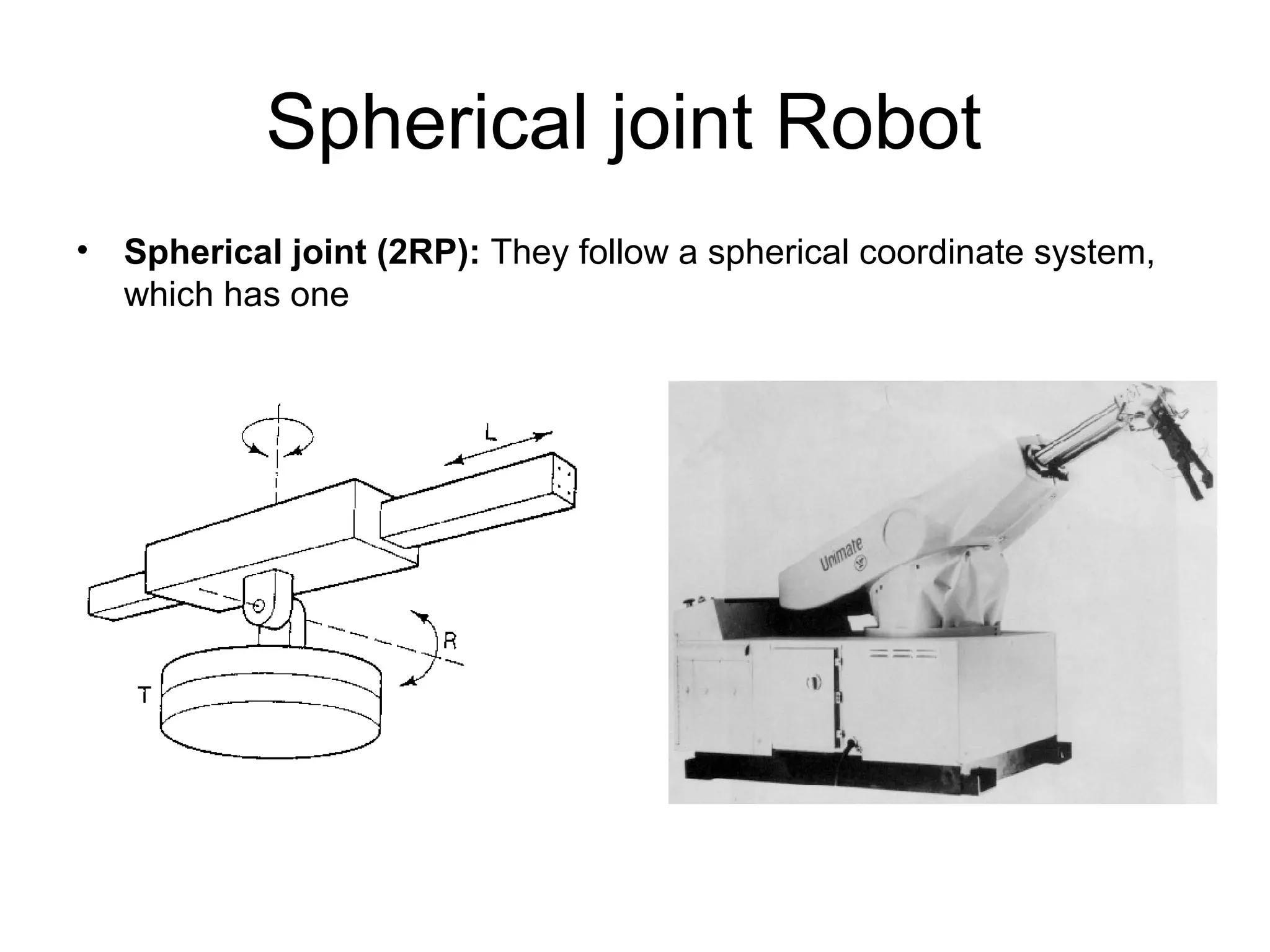
• Spherical joint (2RP): They follow a spherical coordinate system,
which has one
Articulated Robot
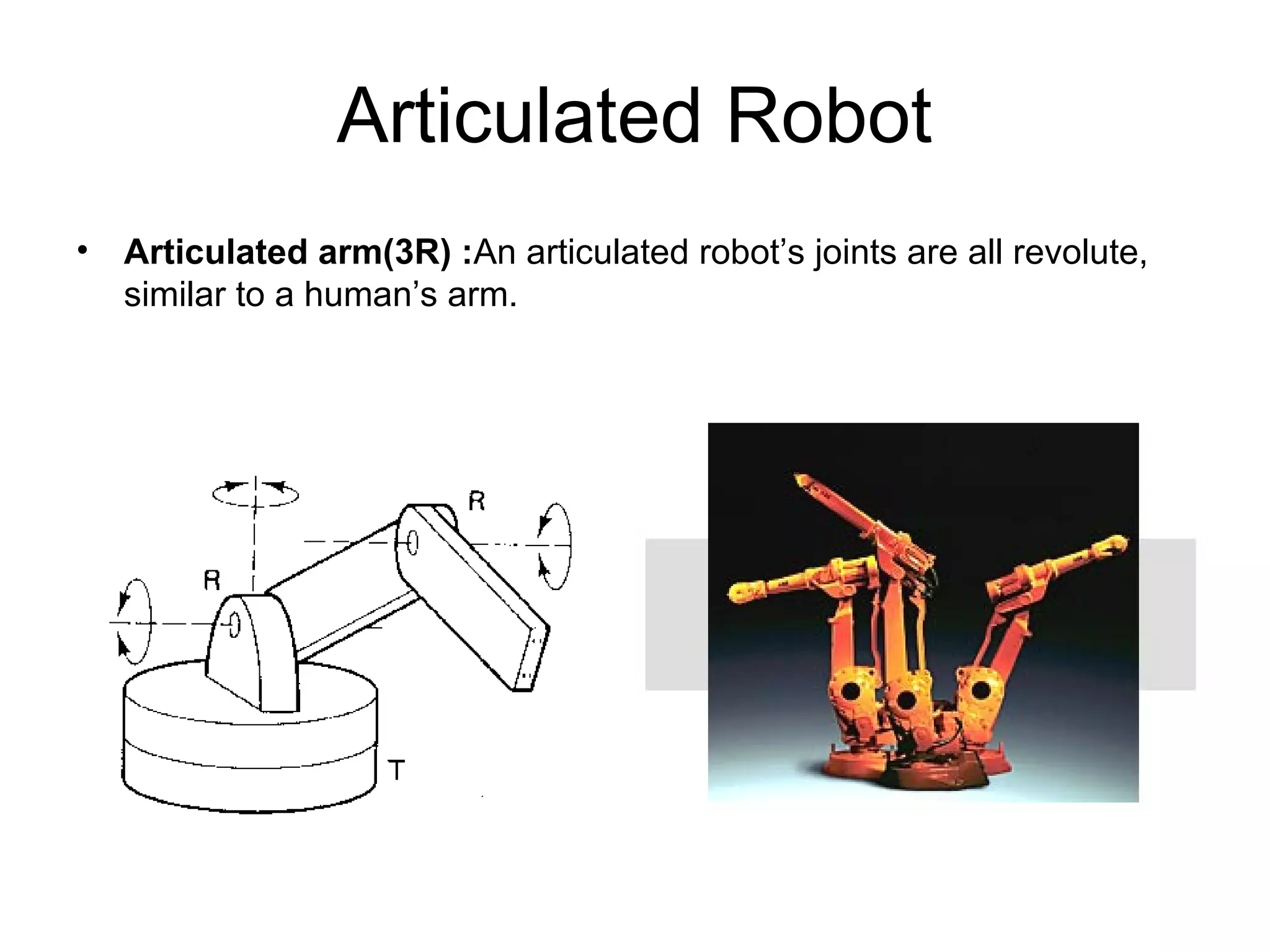
• Articulated arm(3R) :An articulated robot’s joints are all revolute,
similar to a human’s arm.
Selective Compliance Assembly
Robot Arm
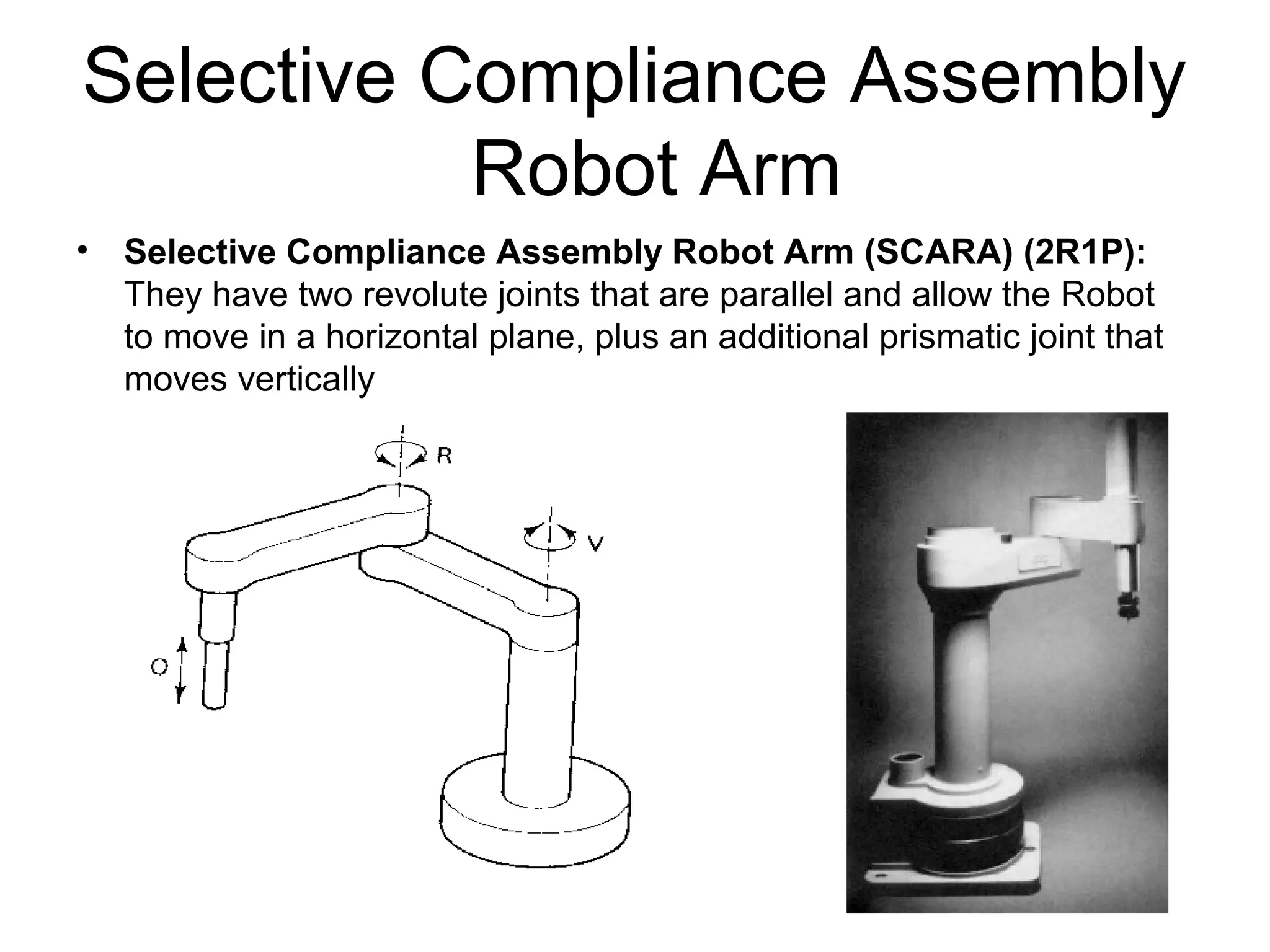
• Selective Compliance Assembly Robot Arm (SCARA) (2R1P):
They have two revolute joints that are parallel and allow the Robot
to move in a horizontal plane, plus an additional prismatic joint that
moves vertically
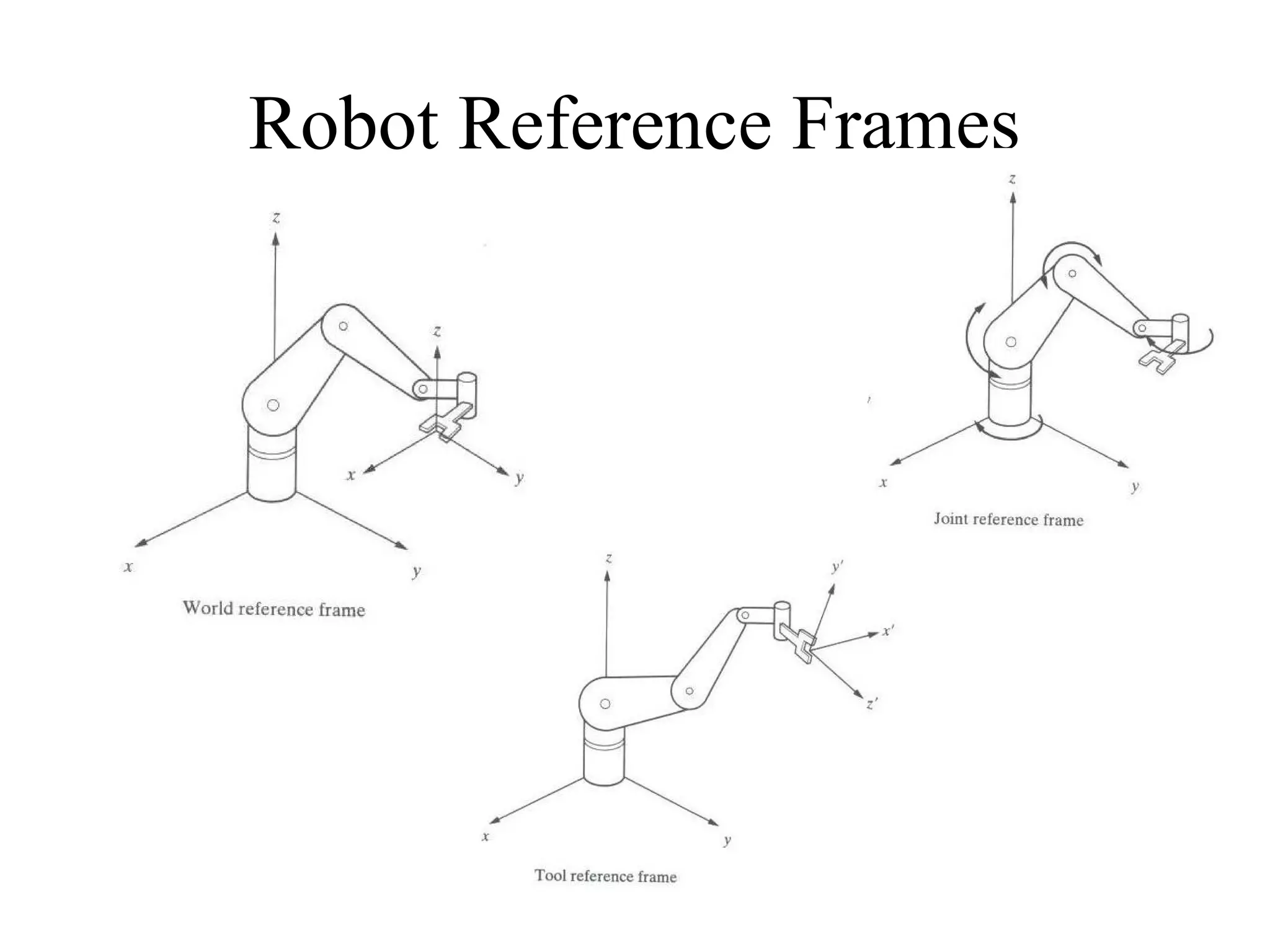
Robot Reference Frames
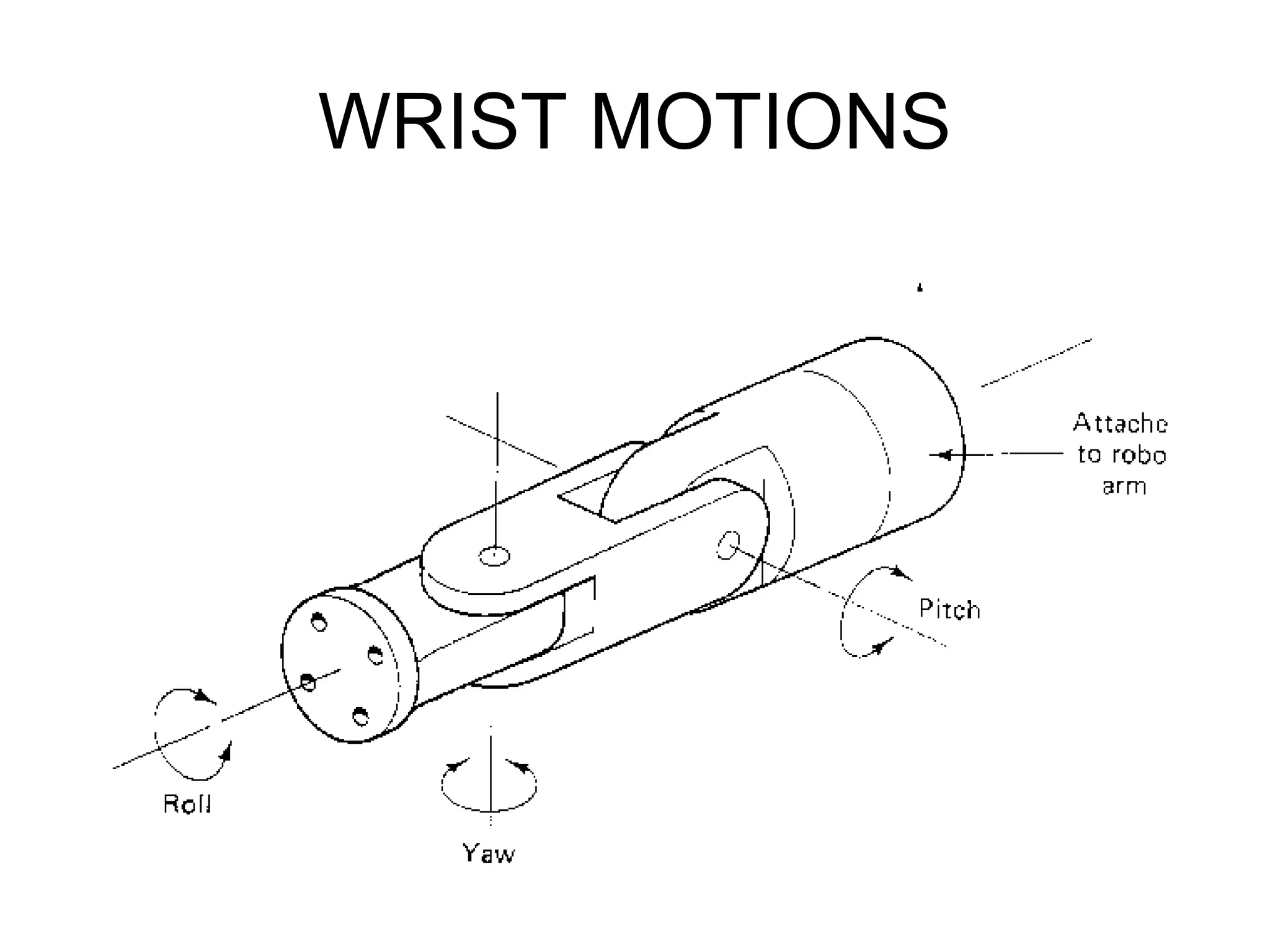
WRIST
• typically has 3 degrees of freedom
– Roll involves rotating the wrist about the arm
axis
– Pitch up-down rotation of the wrist
– Yaw left-right rotation of the wrist
• End effector is mounted on the wrist
WRIST MOTIONS
CONTROL METHODS
There are two types of control methods
 Non servo control
 Servo control
• Point to point control
• Continuous Path Controlled
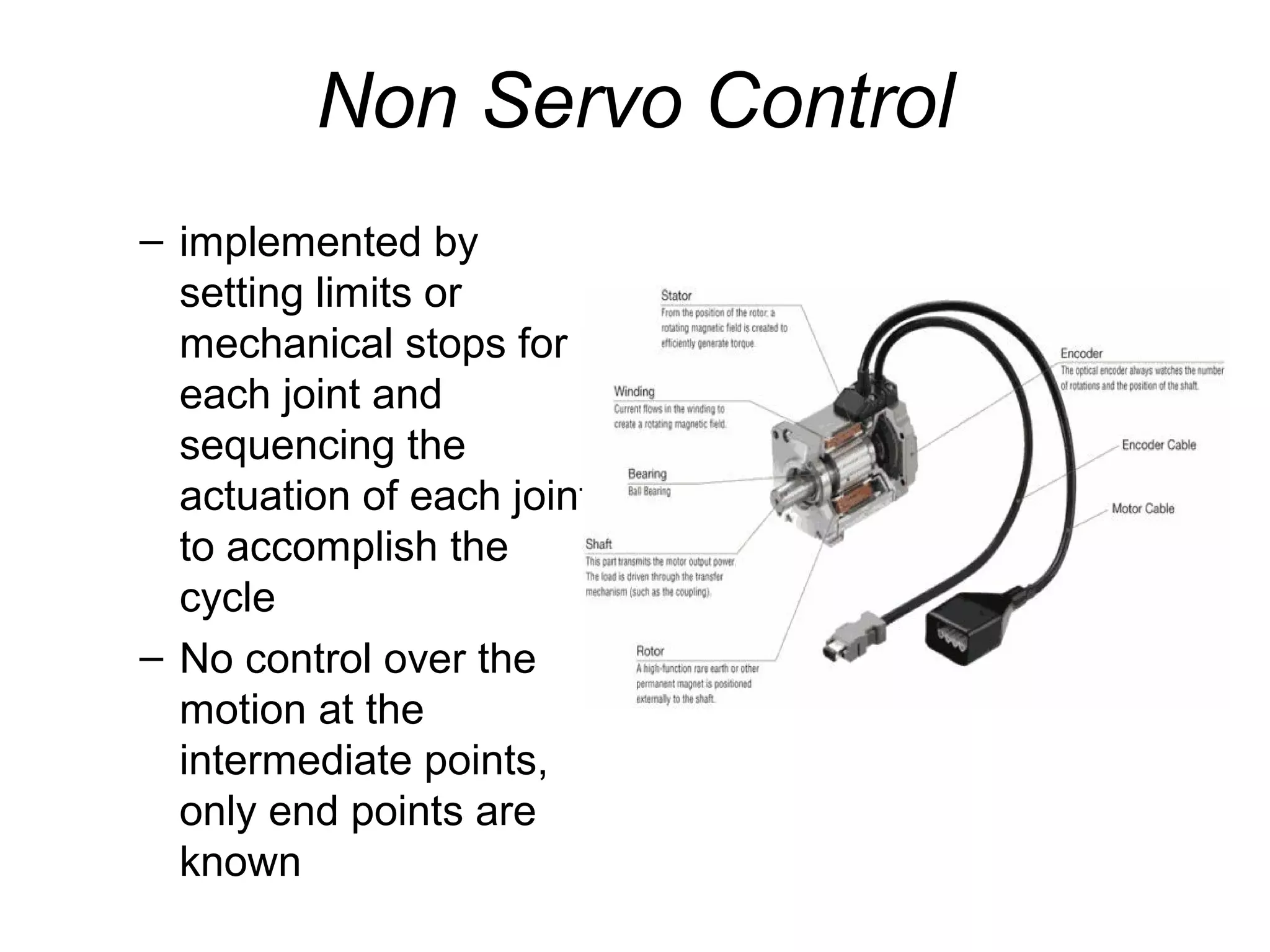
Non Servo Control
– implemented by
setting limits or
mechanical stops for
each joint and
sequencing the
actuation of each joint
to accomplish the
cycle
– No control over the
motion at the
intermediate points,
only end points are
known
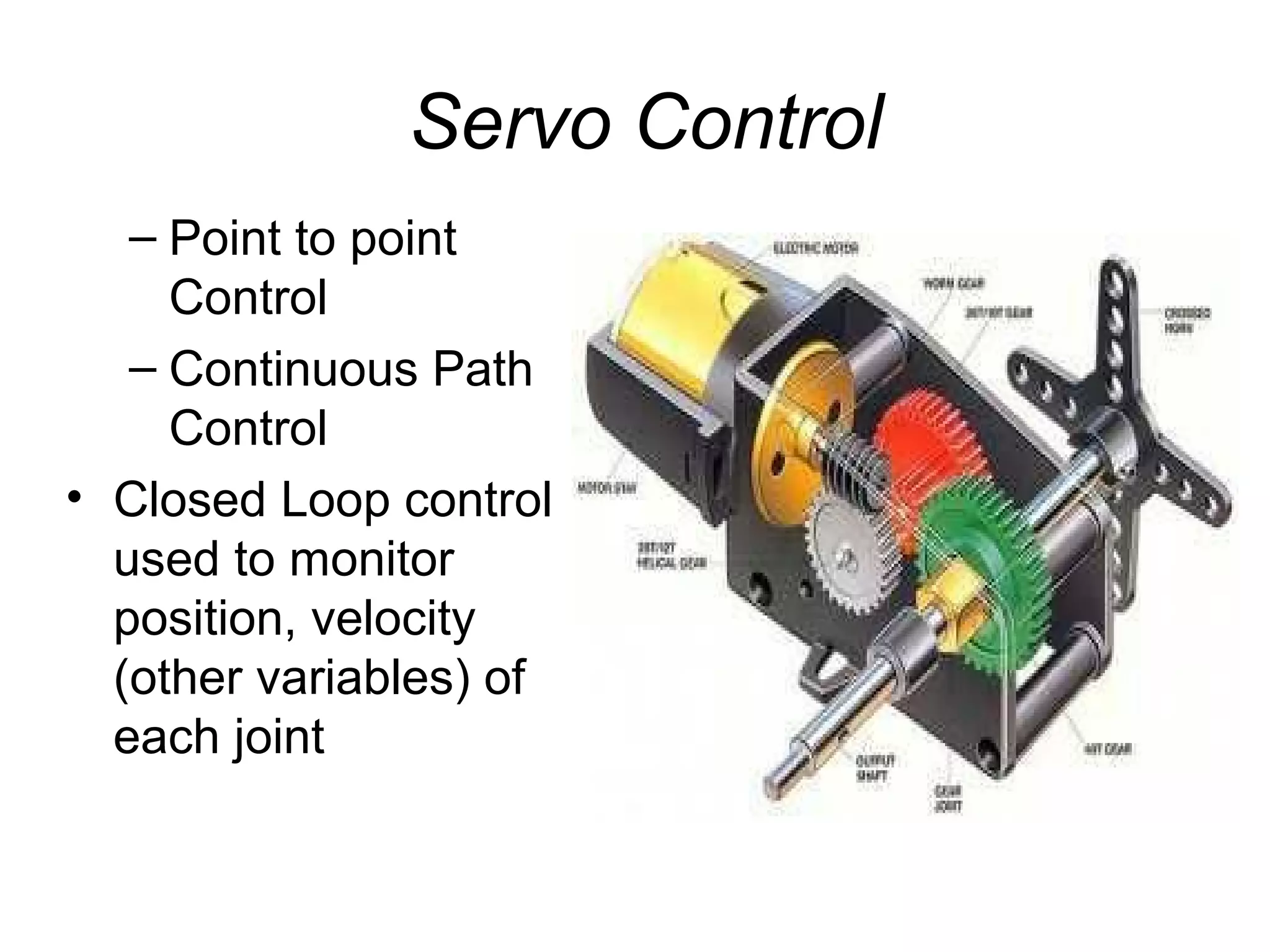
Servo Control
– Point to point
Control
– Continuous Path
Control
• Closed Loop control
used to monitor
position, velocity
(other variables) of
each joint
ROBOT PROGRAMMING
• Typically performed using one of the
following
– On line
• teach pendant
• lead through programming
– Off line
• robot programming languages
• task level programming
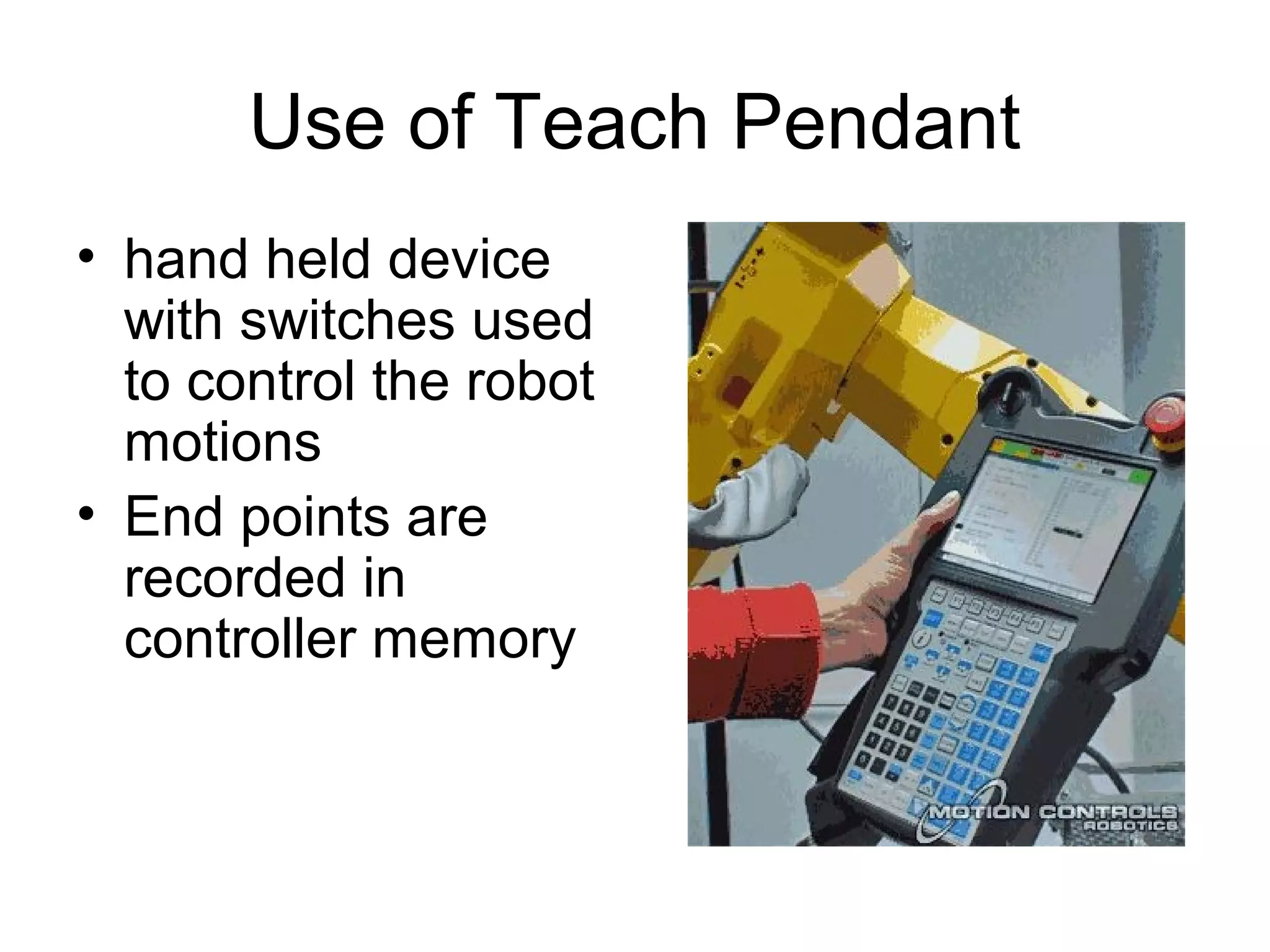
Use of Teach Pendant
• hand held device
with switches used
to control the robot
motions
• End points are
recorded in
controller memory
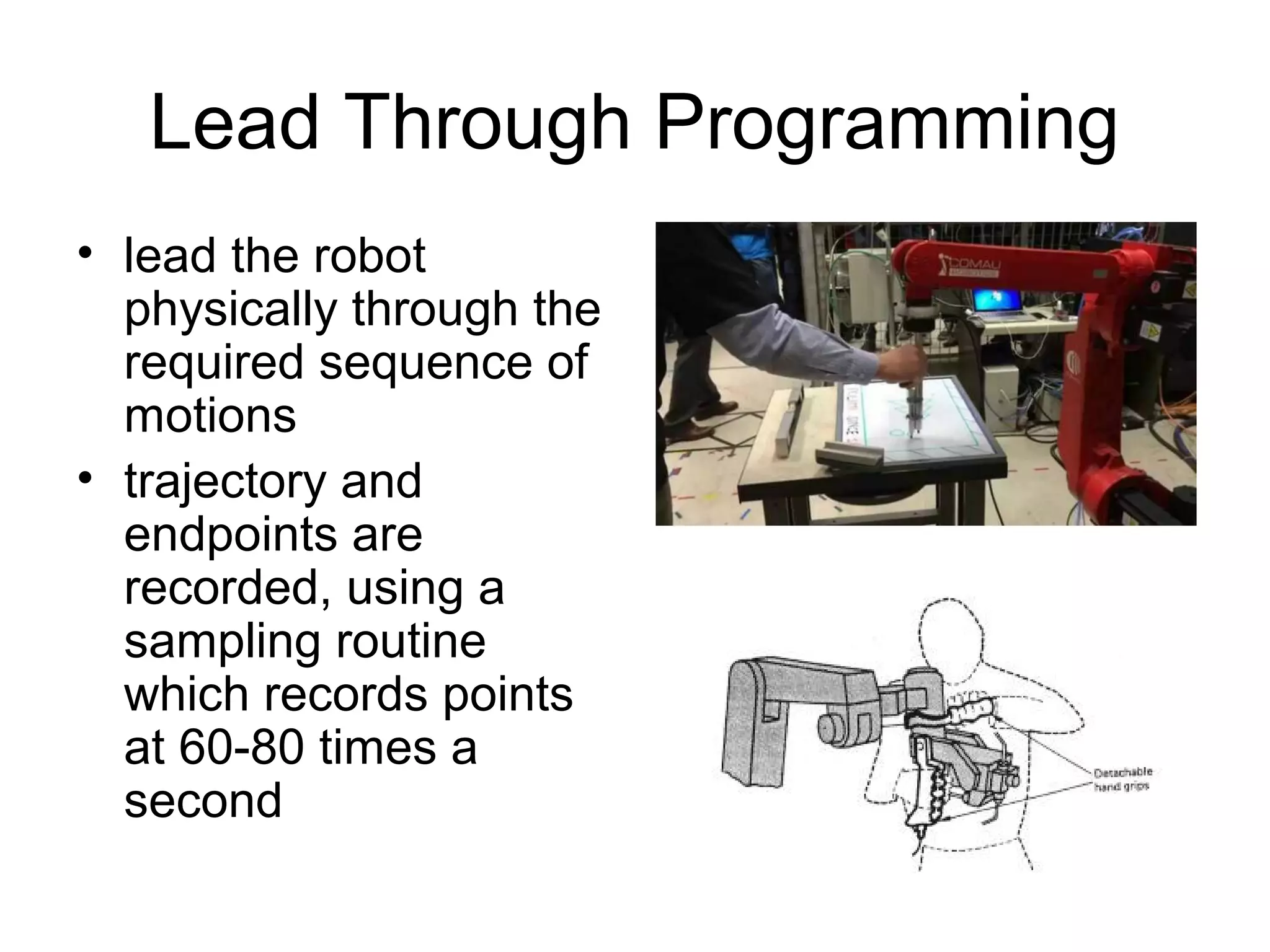
Lead Through Programming
• lead the robot
physically through the
required sequence of
motions
• trajectory and
endpoints are
recorded, using a
sampling routine
which records points
at 60-80 times a
second
Programming Languages
• Large number of robot languages
available
– AML, VAL, AL, RAIL, Robot Studio, etc.(200+)
• Each robot manufacturer has their own
robot programming language
• No standards exist
• Portability of programs virtually non-
existent
THANK YOU

Robotics introduction by Pranav navathe

  • 1.
    Introduction to Robotics Acommon view : Robots as Humanoids Presented By : Pranav navathe
  • 2.
    Agenda • Introduction toRobotics • Classification of Robots • Robot accessories • Robot coordinate • Reference Frames • Control methods • Robot Programming
  • 3.
    Robotics Timeline • 1922Greek author Karel Capek wrote a story called Rossum’s Universal Robots and introduced the word “Rabota”(meaning worker) • 1954 George Devol developed the first programmable Robot. • 1962 Unimation was formed, first industrial Robots appeared. • 1973 Milacron introduced the T3 model robot, which became very popular in industry. • 1990 Milacron was acquired by ABB
  • 4.
    Robot Classification The followingis the classification of Robots according to the Robotics Institute of America • Variable-Sequence Robot : A device that performs the successive stages of a task according to a predetermined method easy to modify • Playback Robot :A human operator performs the task manually by leading the Robot • Numerical Control Robot : The operator supplies the movement program rather than teaching it the task manually. • Intelligent Robot : A robot with the means to understand its environment and the ability to successfully complete a task despite changes to the environment.
  • 5.
    Robot Accessories • Actuators: Actuators are the muscles of the manipulators. Common types of actuators are servomotors, stepper motors, pneumatic cylinders etc. • Sensors : Sensors are used to collect information about the internal state of the robot or to communicate with the outside environment. Robots are often equipped with external sensory devices such as a vision system, touch and tactile sensors etc which help to communicate with the environment • Controller : The controller receives data from the computer, controls the motions of the actuator and coordinates these motions with the sensory feedback information.
  • 6.
  • 7.
    Cartesian/Rectangular-Robot Some of thecommonly used configurations in Robotics are • Cartesian/Rectangular Gantry(3P) : These Robots are made of 3 Linear joints that orient the end effector, which are usually followed by additional revolute joints.
  • 8.
  • 9.
    Spherical joint Robot •Spherical joint (2RP): They follow a spherical coordinate system, which has one
  • 10.
    Articulated Robot • Articulatedarm(3R) :An articulated robot’s joints are all revolute, similar to a human’s arm.
  • 11.
    Selective Compliance Assembly RobotArm • Selective Compliance Assembly Robot Arm (SCARA) (2R1P): They have two revolute joints that are parallel and allow the Robot to move in a horizontal plane, plus an additional prismatic joint that moves vertically
  • 12.
  • 13.
    WRIST • typically has3 degrees of freedom – Roll involves rotating the wrist about the arm axis – Pitch up-down rotation of the wrist – Yaw left-right rotation of the wrist • End effector is mounted on the wrist
  • 14.
  • 15.
    CONTROL METHODS There aretwo types of control methods  Non servo control  Servo control • Point to point control • Continuous Path Controlled
  • 16.
    Non Servo Control –implemented by setting limits or mechanical stops for each joint and sequencing the actuation of each joint to accomplish the cycle – No control over the motion at the intermediate points, only end points are known
  • 17.
    Servo Control – Pointto point Control – Continuous Path Control • Closed Loop control used to monitor position, velocity (other variables) of each joint
  • 18.
    ROBOT PROGRAMMING • Typicallyperformed using one of the following – On line • teach pendant • lead through programming – Off line • robot programming languages • task level programming
  • 19.
    Use of TeachPendant • hand held device with switches used to control the robot motions • End points are recorded in controller memory
  • 20.
    Lead Through Programming •lead the robot physically through the required sequence of motions • trajectory and endpoints are recorded, using a sampling routine which records points at 60-80 times a second
  • 21.
    Programming Languages • Largenumber of robot languages available – AML, VAL, AL, RAIL, Robot Studio, etc.(200+) • Each robot manufacturer has their own robot programming language • No standards exist • Portability of programs virtually non- existent
  • 22.