RNA POLYMERASE
TRANSCRIPTION FACTORS IN EUKARYOTES”
By
KAUSHAL KUMAR SAHU
Assistant Professor (Ad Hoc)
Department of Biotechnology
Govt. Digvijay Autonomous P. G. College
Raj-Nandgaon ( C. G. )
•INTRODUCTION
•WHAT IS TRANSCRIPTION ?
•STEPS INVOLVE IN TRANSCRIPTION.
•RNA POLYMERASES.
•HISTORY OF RNA POLYMERASES.
•STRUCTURE OF RNA POLYMERASES.
•SUB UNITS OF RNA POLYMERASES.
•TYPES OF RNA POLYMERASES.
•FUNCTION OF RNA POLYMERASES.
•TRANSCRIPTION FACTORS INVOLVE IN
EUKARYOTIC TRANSCRIPTION.
•CONCLUSION.
•REFERENCES.
C
O
N
T
E
N
T
“RNA POLYMERASE AND TRANSCRIPTION
FACTOR IN EUKARYOTES”
WHAT IS TRANSCRIPTION?
I
N
T
R
O
D
U
C
T
I
O
N
“ Process By which nucleotide sequence information
is transferred from DNA to RNA is known as
Transcription.”
I
N
T
R
O
D
U
C
T
I
O
N
The ENZYME use in transcription is DNA Dependent
RNA Polymerase.
Transcription is very similar to DNA replication but
there are some important differences:
1. RNA is made of ribonucleotides
2. RNA polymerase catalyzes the reaction
3. The synthesized RNA does not remain base-paired
to the template DNA strand
4. Less accurate (error rate: 10-4)
Eukaryotic transcription is more complex
than prokaryotic transcription.
T
R
N
S
C
R
I
P
T
I
O
N
S
T
E
P
S
Transcription by RNA polymerase
proceeds in a series of steps:
1. • Initiation
2.
• Elongation
3.
• Termination
R
N
A
P
O
L
Y
M
E
R
A
S
E
RNA polymerase (RNAP or RNApol), also
known as DNA-dependent RNA polymerase, is
an enzyme that produces RNA.
In cells, RNAP is necessary for constructing RNA
chains using DNA genes as templates, a process
called transcription.
RNA polymerase enzymes are essential to life and
are found in all organisms and many viruses. In
chemical terms, RNAP is a nucleotidyl transferase
that polymerizes ribonucleotides at the 3' end of an
RNA transcript.
RNA polymerase
R
N
A
P
O
L
Y
M
E
R
A
S
E
HISTORY-
•RNAP was discovered independently by Charles Loe,
Audrey Stevens, and Jerard Hurwitz in 1960.
• By this time, one half of the 1959 Nobel Prize in
Medicine had been awarded to Severo Ochoa for the
discovery of what was believed to be RNAP, but instead
turned out to be polynucleotide phosphorylase
•The 2006 Nobel Prize in Chemistry was awarded
to Roger D. Kornberg for creating detailed molecular
images of RNA polymerase during various stages of the
transcription process.
R
N
A
P
O
L
Y
M
E
R
A
S
E
STRUCTURE-
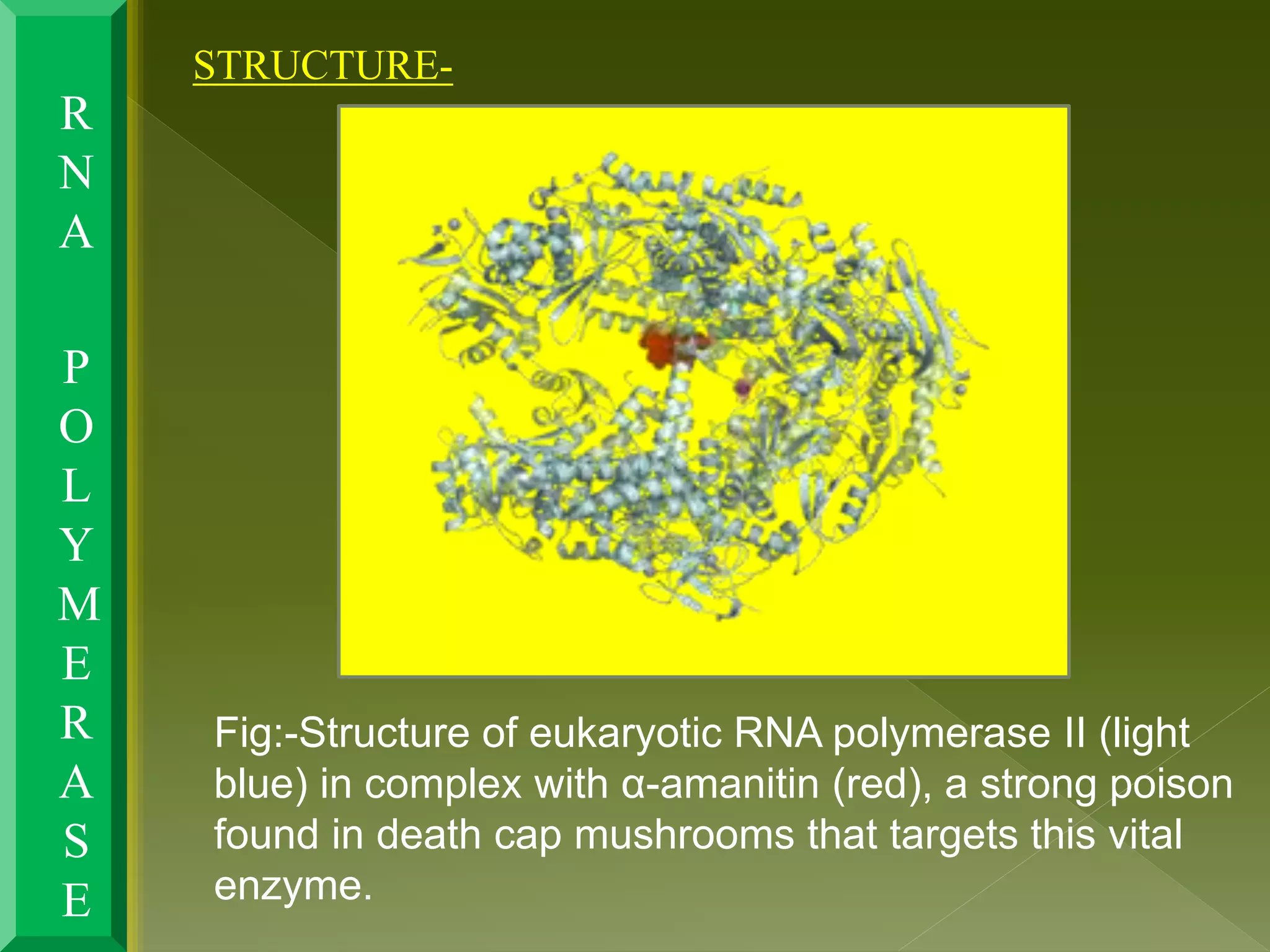
Fig:-Structure of eukaryotic RNA polymerase II (light
blue) in complex with α-amanitin (red), a strong poison
found in death cap mushrooms that targets this vital
enzyme.
R
N
A
P
O
L
Y
M
E
R
A
S
E
SUB UNITS-
R
N
A
P
O
L
Y
M
E
R
A
S
E
TYPES OF RNA POLYMERASES-
•RNA polymerase I synthesizes a pre-rRNA 45S (35S in yeast),
which matures into 28S, 18S and 5.8S rRNAs which will form the
major RNA sections of the ribosome.
•RNA polymerase II synthesizes precursors of mRNAs. This is
the most studied type, and, due to the high level of control
required over transcription, a range of transcription factors are
required for its binding to promoters.
•RNA polymerase III synthesizes tRNAs, rRNA 5S and
other small RNAs found in the nucleus and cytosol.
•RNA polymerase IV synthesizes RNA in plants.
R
N
A
P
O
L
Y
M
E
R
A
S
E
TYPES OF RNA POLYMERASES-
•Eukaryotic chloroplasts contain an RNAP very
highly structurally and mechanistically similar to
bacterial RNAP ("plastid-encoded polymerase").
•Eukaryotic chloroplasts also contain a second,
structurally and mechanistically unrelated, RNAP
("nucleus-encoded polymerase"; member of the
"single-subunit RNAP" protein family).
•Eukaryotic mitochondria contain a structurally and
mechanistically unrelated RNAP (member of the
"single-subunit RNAP" protein family).
RNA polymerase is a complex enzyme that plays
multiple roles in the process of transcription:
1. It searches DNA for initiation sites, that is, promoter
sites.
2. It unwinds a short stretch of double-helical DNA to
produce a single-stranded DNA template from which it
takes instructions.
3. It selects the correct ribonucleoside
triphosphate and catalyzes the reaction in which the
ribonucleotides are added to the 3' –OH end of RNA.
R
N
A
P
O
L
Y
M
E
R
A
S
E
FUNCTION-
These proteins play a role in virtually every aspect of
the transcription process, from the binding of the
polymerase to the DNA template, to the initiation of
transcription, to its elongation and termination.
TR
A
N
S
C
RI
P
TI
O
N
F
A
C
T
O
R
S
A major distinction between transcription in
prokaryotes and eukaryotes is the requirement in
eukaryotes for a large variety of accessory proteins,
called transcription factors.
TRANSCRIPTION FACTORS-
TR
A
N
S
C
RI
P
TI
O
N
F
A
C
T
O
R
S
GENERAL TRANSCRIPTION FACTORS-
•All eukaryotic mRNA precursors are synthesized by RNA
polymerase II, an enzyme composed of a dozen different subunits
that is remarkably conserved from yeast to mammals.
•RNA polymerase II binds the promoter with the cooperation of a
number of general transcription factors (GTFs) to form a
preinitiation complex (PIC).
•The first step in assembly of the preinitiation complex is binding of a
protein, called TATA-binding protein (TBP), that recognizes the TATA
box of these promoters.
•TBP is present as a subunit of a much larger protein complex called
TFIID (transcription factor for polymerase II, fraction D).
TR
A
N
S
C
RI
P
TI
O
N
F
A
C
T
O
R
S
The TATA box binding protein (TBP)
T
R
A
N
S
C
R
I
P
T
I
O
N
F
A
C
T
O
R
Preinitiation complex contains:
Polymerase II
 6 general transcription factors:
TFIIA
TFIIB
TFIID
TFIIE
TFIIH
The transcription factors (TF) and polymerase
bind the preinitiation complex in a specific
order
PREINITIATION COPLEX (PIC).
Preinitiation complex (PIC).
T
R
A
N
S
C
R
I
P
T
I
O
N
F
A
C
T
O
R
SOME IMPORTANT FACTORS-
1. TFIID
2. TFIIB
3. TFIIF
4. TFIIE
5. TFIIH
6. TFIIA
7. THE TBP ASSOCIATED FACTORS
T
R
A
N
S
C
R
I
P
T
I
O
N
F
A
C
T
O
R
Structure and Function of TFIID
TFIID contains several subunits
TATA-box binding protein (TBP)
•Binds to the minor groove of the TATA box
Saddle-shaped TBP lines up with DNA
Underside of the saddle forces open the
minor groove
The TATA box is bent into 80° curve
8 to 10 copies of TBP-associated factors (TAFIIs)
specific for class II
T
R
A
N
S
C
R
I
P
T
I
O
N
F
A
C
T
O
R
TFIID
Structure and Function of TFIIB
T
R
A
N
S
C
R
I
P
T
I
O
N
F
A
C
T
O
R
The gene for human TFIIB has been cloned and
expressed by Reinberg et al.
TFIIB binds to
TBP at the TATA box via its C-terminal domain
Polymerase II via its N-terminal domain
T
R
A
N
S
C
R
I
P
T
I
O
N
F
A
C
T
O
R
TFIIF
Functions:
- Recruitment of Pol II to the existing DNA-TFIID-B
complex,
- Positioning Pol II over the start site
- Binding to the non-template DNA strand.
- TFIIF also reduces non-specific binding of RNA pol II
to DNA.
T
R
A
N
S
C
R
I
P
T
I
O
N
F
A
C
T
O
R
TFIIE is a heterotetrameric
protein
Functions:
- TFIIE appears to create the
docking site for next transcription
factor, TFIIH.
- TFIIE also modulates TFIIH
enzymatic activities
- In addition TFIIE enhances
promoter melting.
TFIIE
TFIIH -
T
R
A
N
S
C
R
I
P
T
I
O
N
F
A
C
T
O
R
TFIIH is the last general transcription
factor to join the preinitiation complex
Functions:
- TFIIH has a helicase activity, which
unwinds the DNA duplex at a start site,
allowing Pol II to bind to the template
strand.
- TFIIH also has a kinase ativity, it
phosphorylates PolII in the begining of
elongation
TFIIH is a multimeric protein,
composed of 9 subunits, some of them
with distinct enzymatic activities
For transcription in vivo, another factor TFIIA is
required.
 The function of TFIIA is somewhat unclear, but it
might help the other factors to bind.
TFIIA has also shown to have some anti-repressor
functions.
TFIIA is not required for transcription in vitro.
T
R
A
N
S
C
R
I
P
T
I
O
N
F
A
C
T
O
R
TFIIA
The TBP-Associated Factors
T
R
A
N
S
C
R
I
P
T
I
O
N
F
A
C
T
O
R
These are also called TAF
8 different proteins are designated
Most are evolutionarily conserved in eukaryotes
Several functions discovered:
Interaction with the core promoter elements
Interaction with gene-specific transcription
factors
When attached to TBP extend the binding of
TFIID beyond the TATA box
S.No. BOOK EDITION AUTHOR
NAME
PAGE NO.
1. Molecular biology
of gene
5th edition Watson
and
Baker
391-405
2. Molecular cell
biology
5th edition Lodish 442-525
3. Cell and Molecular
biology
6th edition Gerald
Karp
422-497
R
E
F
E
R
E
N
C
E
s
Referances:

RNA polymerase and transcription factor

  • 1.
    RNA POLYMERASE TRANSCRIPTION FACTORSIN EUKARYOTES” By KAUSHAL KUMAR SAHU Assistant Professor (Ad Hoc) Department of Biotechnology Govt. Digvijay Autonomous P. G. College Raj-Nandgaon ( C. G. )
  • 2.
    •INTRODUCTION •WHAT IS TRANSCRIPTION? •STEPS INVOLVE IN TRANSCRIPTION. •RNA POLYMERASES. •HISTORY OF RNA POLYMERASES. •STRUCTURE OF RNA POLYMERASES. •SUB UNITS OF RNA POLYMERASES. •TYPES OF RNA POLYMERASES. •FUNCTION OF RNA POLYMERASES. •TRANSCRIPTION FACTORS INVOLVE IN EUKARYOTIC TRANSCRIPTION. •CONCLUSION. •REFERENCES. C O N T E N T “RNA POLYMERASE AND TRANSCRIPTION FACTOR IN EUKARYOTES”
  • 3.
    WHAT IS TRANSCRIPTION? I N T R O D U C T I O N “Process By which nucleotide sequence information is transferred from DNA to RNA is known as Transcription.”
  • 4.
    I N T R O D U C T I O N The ENZYME usein transcription is DNA Dependent RNA Polymerase. Transcription is very similar to DNA replication but there are some important differences: 1. RNA is made of ribonucleotides 2. RNA polymerase catalyzes the reaction 3. The synthesized RNA does not remain base-paired to the template DNA strand 4. Less accurate (error rate: 10-4) Eukaryotic transcription is more complex than prokaryotic transcription.
  • 5.
    T R N S C R I P T I O N S T E P S Transcription by RNApolymerase proceeds in a series of steps: 1. • Initiation 2. • Elongation 3. • Termination
  • 6.
    R N A P O L Y M E R A S E RNA polymerase (RNAPor RNApol), also known as DNA-dependent RNA polymerase, is an enzyme that produces RNA. In cells, RNAP is necessary for constructing RNA chains using DNA genes as templates, a process called transcription. RNA polymerase enzymes are essential to life and are found in all organisms and many viruses. In chemical terms, RNAP is a nucleotidyl transferase that polymerizes ribonucleotides at the 3' end of an RNA transcript. RNA polymerase
  • 7.
    R N A P O L Y M E R A S E HISTORY- •RNAP was discoveredindependently by Charles Loe, Audrey Stevens, and Jerard Hurwitz in 1960. • By this time, one half of the 1959 Nobel Prize in Medicine had been awarded to Severo Ochoa for the discovery of what was believed to be RNAP, but instead turned out to be polynucleotide phosphorylase •The 2006 Nobel Prize in Chemistry was awarded to Roger D. Kornberg for creating detailed molecular images of RNA polymerase during various stages of the transcription process.
  • 8.
    R N A P O L Y M E R A S E STRUCTURE- Fig:-Structure of eukaryoticRNA polymerase II (light blue) in complex with α-amanitin (red), a strong poison found in death cap mushrooms that targets this vital enzyme.
  • 9.
  • 10.
    R N A P O L Y M E R A S E TYPES OF RNAPOLYMERASES- •RNA polymerase I synthesizes a pre-rRNA 45S (35S in yeast), which matures into 28S, 18S and 5.8S rRNAs which will form the major RNA sections of the ribosome. •RNA polymerase II synthesizes precursors of mRNAs. This is the most studied type, and, due to the high level of control required over transcription, a range of transcription factors are required for its binding to promoters. •RNA polymerase III synthesizes tRNAs, rRNA 5S and other small RNAs found in the nucleus and cytosol. •RNA polymerase IV synthesizes RNA in plants.
  • 11.
    R N A P O L Y M E R A S E TYPES OF RNAPOLYMERASES- •Eukaryotic chloroplasts contain an RNAP very highly structurally and mechanistically similar to bacterial RNAP ("plastid-encoded polymerase"). •Eukaryotic chloroplasts also contain a second, structurally and mechanistically unrelated, RNAP ("nucleus-encoded polymerase"; member of the "single-subunit RNAP" protein family). •Eukaryotic mitochondria contain a structurally and mechanistically unrelated RNAP (member of the "single-subunit RNAP" protein family).
  • 12.
    RNA polymerase isa complex enzyme that plays multiple roles in the process of transcription: 1. It searches DNA for initiation sites, that is, promoter sites. 2. It unwinds a short stretch of double-helical DNA to produce a single-stranded DNA template from which it takes instructions. 3. It selects the correct ribonucleoside triphosphate and catalyzes the reaction in which the ribonucleotides are added to the 3' –OH end of RNA. R N A P O L Y M E R A S E FUNCTION-
  • 13.
    These proteins playa role in virtually every aspect of the transcription process, from the binding of the polymerase to the DNA template, to the initiation of transcription, to its elongation and termination. TR A N S C RI P TI O N F A C T O R S A major distinction between transcription in prokaryotes and eukaryotes is the requirement in eukaryotes for a large variety of accessory proteins, called transcription factors. TRANSCRIPTION FACTORS-
  • 14.
    TR A N S C RI P TI O N F A C T O R S GENERAL TRANSCRIPTION FACTORS- •Alleukaryotic mRNA precursors are synthesized by RNA polymerase II, an enzyme composed of a dozen different subunits that is remarkably conserved from yeast to mammals. •RNA polymerase II binds the promoter with the cooperation of a number of general transcription factors (GTFs) to form a preinitiation complex (PIC). •The first step in assembly of the preinitiation complex is binding of a protein, called TATA-binding protein (TBP), that recognizes the TATA box of these promoters. •TBP is present as a subunit of a much larger protein complex called TFIID (transcription factor for polymerase II, fraction D).
  • 15.
  • 16.
    T R A N S C R I P T I O N F A C T O R Preinitiation complex contains: PolymeraseII  6 general transcription factors: TFIIA TFIIB TFIID TFIIE TFIIH The transcription factors (TF) and polymerase bind the preinitiation complex in a specific order PREINITIATION COPLEX (PIC).
  • 17.
  • 18.
    T R A N S C R I P T I O N F A C T O R SOME IMPORTANT FACTORS- 1.TFIID 2. TFIIB 3. TFIIF 4. TFIIE 5. TFIIH 6. TFIIA 7. THE TBP ASSOCIATED FACTORS
  • 19.
    T R A N S C R I P T I O N F A C T O R Structure and Functionof TFIID TFIID contains several subunits TATA-box binding protein (TBP) •Binds to the minor groove of the TATA box Saddle-shaped TBP lines up with DNA Underside of the saddle forces open the minor groove The TATA box is bent into 80° curve 8 to 10 copies of TBP-associated factors (TAFIIs) specific for class II
  • 20.
  • 21.
    Structure and Functionof TFIIB T R A N S C R I P T I O N F A C T O R The gene for human TFIIB has been cloned and expressed by Reinberg et al. TFIIB binds to TBP at the TATA box via its C-terminal domain Polymerase II via its N-terminal domain
  • 22.
    T R A N S C R I P T I O N F A C T O R TFIIF Functions: - Recruitment ofPol II to the existing DNA-TFIID-B complex, - Positioning Pol II over the start site - Binding to the non-template DNA strand. - TFIIF also reduces non-specific binding of RNA pol II to DNA.
  • 23.
    T R A N S C R I P T I O N F A C T O R TFIIE is aheterotetrameric protein Functions: - TFIIE appears to create the docking site for next transcription factor, TFIIH. - TFIIE also modulates TFIIH enzymatic activities - In addition TFIIE enhances promoter melting. TFIIE
  • 24.
    TFIIH - T R A N S C R I P T I O N F A C T O R TFIIH isthe last general transcription factor to join the preinitiation complex Functions: - TFIIH has a helicase activity, which unwinds the DNA duplex at a start site, allowing Pol II to bind to the template strand. - TFIIH also has a kinase ativity, it phosphorylates PolII in the begining of elongation TFIIH is a multimeric protein, composed of 9 subunits, some of them with distinct enzymatic activities
  • 25.
    For transcription invivo, another factor TFIIA is required.  The function of TFIIA is somewhat unclear, but it might help the other factors to bind. TFIIA has also shown to have some anti-repressor functions. TFIIA is not required for transcription in vitro. T R A N S C R I P T I O N F A C T O R TFIIA
  • 26.
    The TBP-Associated Factors T R A N S C R I P T I O N F A C T O R Theseare also called TAF 8 different proteins are designated Most are evolutionarily conserved in eukaryotes Several functions discovered: Interaction with the core promoter elements Interaction with gene-specific transcription factors When attached to TBP extend the binding of TFIID beyond the TATA box
  • 27.
    S.No. BOOK EDITIONAUTHOR NAME PAGE NO. 1. Molecular biology of gene 5th edition Watson and Baker 391-405 2. Molecular cell biology 5th edition Lodish 442-525 3. Cell and Molecular biology 6th edition Gerald Karp 422-497 R E F E R E N C E s Referances: