Transcription
By Dr Sajid Ali
Assistant Professor
Dept of Biotech, AWKUM
The synthesis of RNA molecules using
DNA strands as the templates so that
the genetic information can be
transferred from DNA to RNA.
Transcription
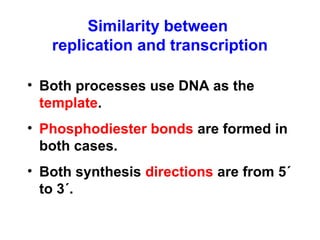
• Both processes use DNA as the
template.
• Phosphodiester bonds are formed in
both cases.
• Both synthesis directions are from 5´
to 3´.
Similarity between
replication and transcription
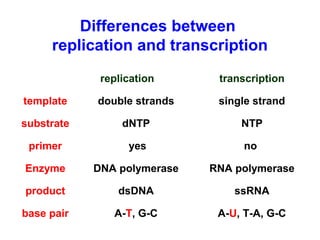
replication transcription
template double strands single strand
substrate dNTP NTP
primer yes no
Enzyme DNA polymerase RNA polymerase
product dsDNA ssRNA
base pair A-T, G-C A-U, T-A, G-C
Differences between
replication and transcription
Section 1
Template and Enzymes
• The whole genome of DNA needs to
be replicated, but only small portion
of genome is transcribed in response
to the development requirement,
physiological need and
environmental changes.
• DNA regions that can be transcribed
into RNA are called structural genes.
§1.1 Template
The template strand is the strand
from which the RNA is actually
transcribed. It is also termed as
antisense strand.
The coding strand is the strand
whose base sequence specifies the
amino acid sequence of the encoded
protein. Therefore, it is also called as
sense strand.
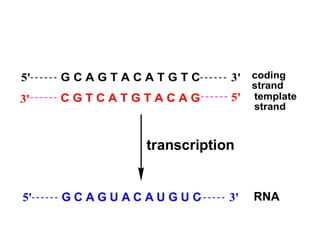
G C A G T A C A T G T C5' 3'
3' C G T C A T G T A C A G 5' template
strand
coding
strand
transcription
RNAG C A G U A C A U G U C5' 3'
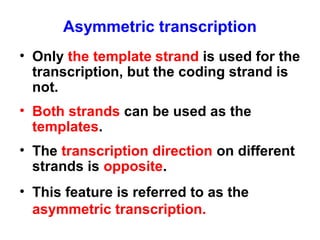
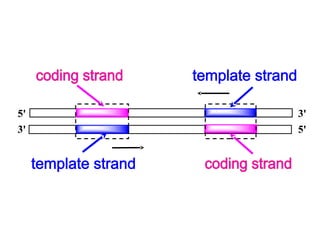
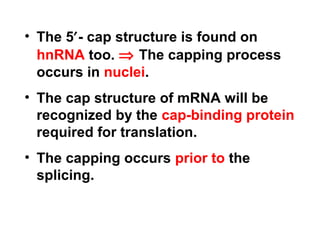
• Only the template strand is used for the
transcription, but the coding strand is
not.
• Both strands can be used as the
templates.
• The transcription direction on different
strands is opposite.
• This feature is referred to as the
asymmetric transcription.
Asymmetric transcription
5'
3'
3'
5'
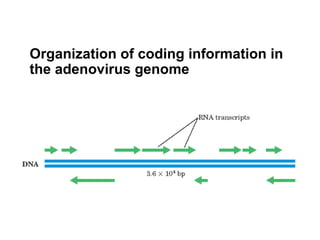
Organization of coding information in
the adenovirus genome
§1.2 RNA Polymerase
• The enzyme responsible for the RNA
synthesis is DNA-dependent RNA
polymerase.
– The prokaryotic RNA polymerase is a
multiple-subunit protein of ~480kD.
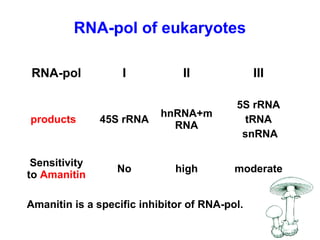
– Eukaryotic systems have three kinds of
RNA polymerases, each of which is a
multiple-subunit protein and responsible
for transcription of different RNAs.
core enzymeholoenzyme
Holoenzyme
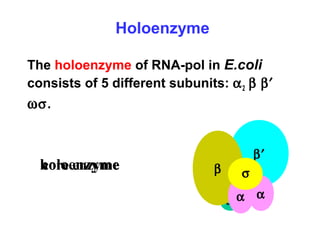
The holoenzyme of RNA-pol in E.coli
consists of 5 different subunits: α2 β β′
ωσ.
ω
β′
β
αα
σ
subunit MW function
α 36512
Determine the DNA to be
transcribed
β 150618 Catalyze polymerization
β′ 155613 Bind & open DNA template
σ 70263
Recognize the promoter
for synthesis initiation
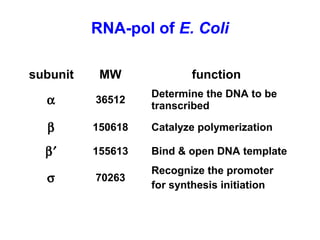
RNA-pol of E. Coli
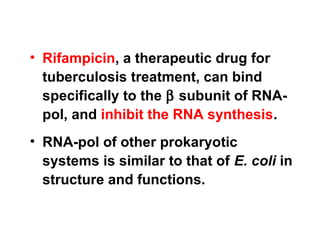
• Rifampicin, a therapeutic drug for
tuberculosis treatment, can bind
specifically to the β subunit of RNA-
pol, and inhibit the RNA synthesis.
• RNA-pol of other prokaryotic
systems is similar to that of E. coli in
structure and functions.
RNA-pol I II III
products 45S rRNA
hnRNA+m
RNA
5S rRNA
tRNA
snRNA
Sensitivity
to Amanitin
No high moderate
RNA-pol of eukaryotes
Amanitin is a specific inhibitor of RNA-pol.
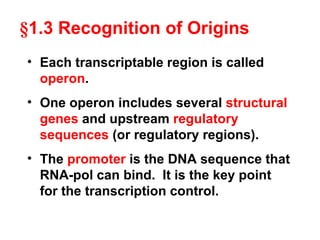
• Each transcriptable region is called
operon.
• One operon includes several structural
genes and upstream regulatory
sequences (or regulatory regions).
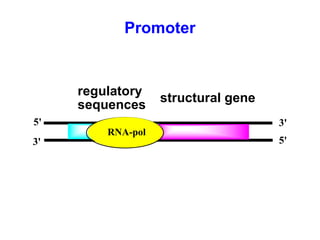
• The promoter is the DNA sequence that
RNA-pol can bind. It is the key point
for the transcription control.
§1.3 Recognition of Origins
5'
3'
3'
5'
regulatory
sequences
structural gene
promotorRNA-pol
Promoter
5'
3'
3'
5'
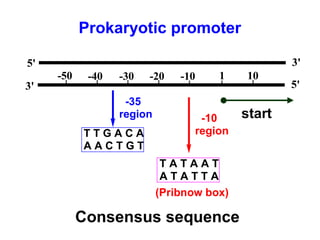
-50 -40 -30 -20 -10 1 10
start-10
region
T A T A A T
A T A T T A
(Pribnow box)
-35
region
T T G A C A
A A C T G T
Prokaryotic promoter
Consensus sequence
• The -35 region of TTGACA sequence
is the recognition site and the
binding site of RNA-pol.
• The -10 region of TATAAT is the
region at which a stable complex of
DNA and RNA-pol is formed.
Section 2
Transcription Process
General concepts
• Three phases: initiation, elongation,
and termination.
• The prokaryotic RNA-pol can bind to
the DNA template directly in the
transcription process.
• The eukaryotic RNA-pol requires co-
factors to bind to the DNA template
together in the transcription process.
§2.1 Transcription of Prokaryotes
• Initiation phase: RNA-pol recognizes
the promoter and starts the
transcription.
• Elongation phase: the RNA strand is
continuously growing.
• Termination phase: the RNA-pol stops
synthesis and the nascent RNA is
separated from the DNA template.
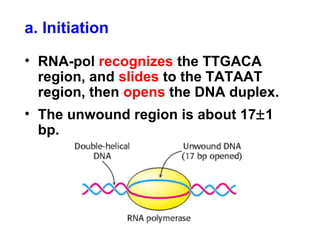
a. Initiation
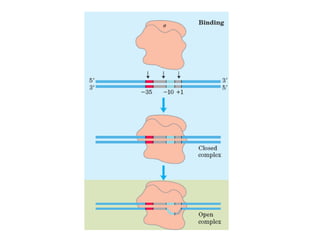
• RNA-pol recognizes the TTGACA
region, and slides to the TATAAT
region, then opens the DNA duplex.
• The unwound region is about 17±1
bp.
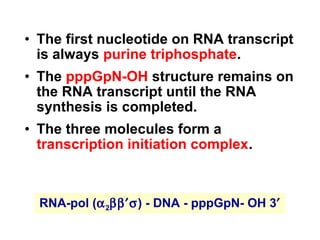
• The first nucleotide on RNA transcript
is always purine triphosphate.
• The pppGpN-OH structure remains on
the RNA transcript until the RNA
synthesis is completed.
• The three molecules form a
transcription initiation complex.
RNA-pol (α2ββ′σ) - DNA - pppGpN- OH 3′
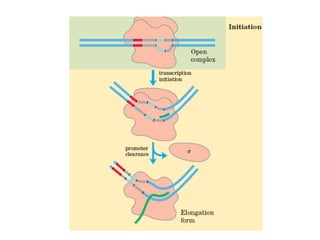
• No primer is needed for RNA
synthesis.
• The σ subunit falls off from the RNA-
pol once the first 3′,5′ phosphodiester
bond is formed.
• The core enzyme moves along the
DNA template to enter the elongation
phase.
b. Elongation
• The release of the σ subunit causes
the conformational change of the
core enzyme. The core enzyme
slides on the DNA template toward
the 3′ end.
• Free NTPs are added sequentially to
the 3′ -OH of the nascent RNA strand.
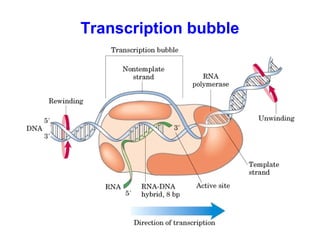
• RNA-pol, DNA segment of ~40nt and
the nascent RNA form a complex
called the transcription bubble.
• The 3′ segment of the nascent RNA
hybridizes with the DNA template,
and its 5′ end extends out the
transcription bubble as the synthesis
is processing.
Transcription bubble
c. Termination
• The RNA-pol stops moving on the
DNA template. The RNA transcript
falls off from the transcription
complex.
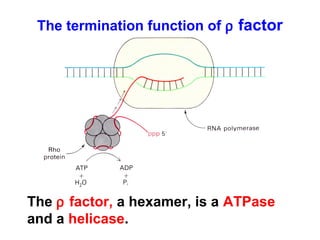
• The termination occurs in either ρ
-dependent or ρ -independent
manner.
The termination function of ρ factor
The ρ factor, a hexamer, is a ATPase
and a helicase.
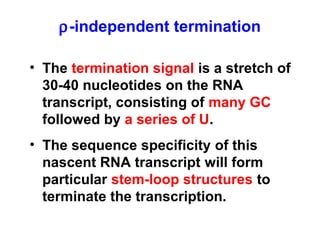
ρ-independent termination
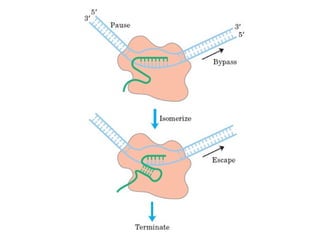
• The termination signal is a stretch of
30-40 nucleotides on the RNA
transcript, consisting of many GC
followed by a series of U.
• The sequence specificity of this
nascent RNA transcript will form
particular stem-loop structures to
terminate the transcription.
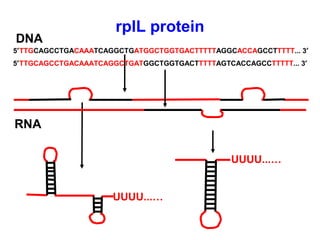
RNA
5′TTGCAGCCTGACAAATCAGGCTGATGGCTGGTGACTTTTTAGGCACCAGCCTTTTT... 3′
DNA
UUUU...…
rplL protein
UUUU...…
5′TTGCAGCCTGACAAATCAGGCTGATGGCTGGTGACTTTTTAGTCACCAGCCTTTTT... 3′
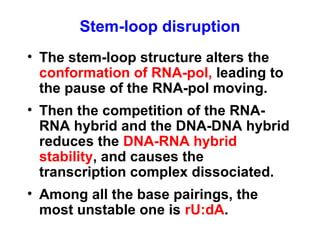
• The stem-loop structure alters the
conformation of RNA-pol, leading to
the pause of the RNA-pol moving.
• Then the competition of the RNA-
RNA hybrid and the DNA-DNA hybrid
reduces the DNA-RNA hybrid
stability, and causes the
transcription complex dissociated.
• Among all the base pairings, the
most unstable one is rU:dA.
Stem-loop disruption
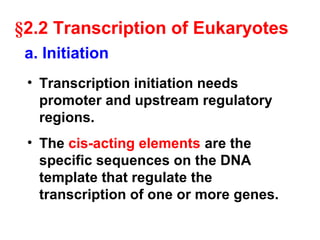
§2.2 Transcription of Eukaryotes
• Transcription initiation needs
promoter and upstream regulatory
regions.
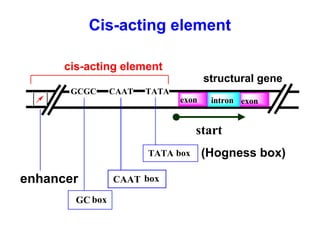
• The cis-acting elements are the
specific sequences on the DNA
template that regulate the
transcription of one or more genes.
a. Initiation
structural gene
GCGC CAAT TATA
intronexon exon
start
CAAT box
GC box
enhancer
cis-acting element
TATA box (Hogness box)
Cis-acting element
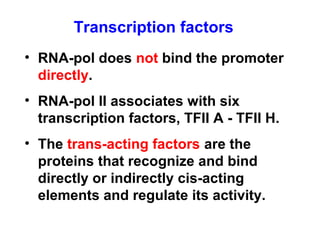
• RNA-pol does not bind the promoter
directly.
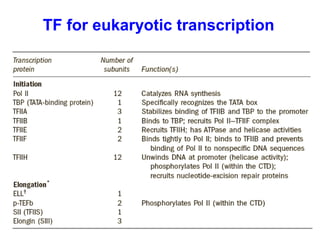
• RNA-pol II associates with six
transcription factors, TFII A - TFII H.
• The trans-acting factors are the
proteins that recognize and bind
directly or indirectly cis-acting
elements and regulate its activity.
Transcription factors
TF for eukaryotic transcription
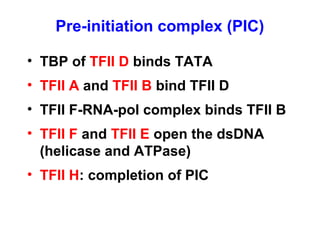
• TBP of TFII D binds TATA
• TFII A and TFII B bind TFII D
• TFII F-RNA-pol complex binds TFII B
• TFII F and TFII E open the dsDNA
(helicase and ATPase)
• TFII H: completion of PIC
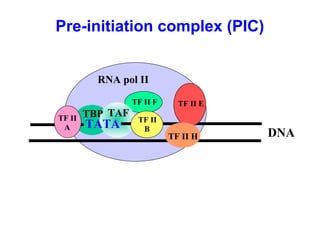
Pre-initiation complex (PIC)
RNA pol II
TF II F
TBP TAF
TATA
DNA
TF II
A
TF II
B
TF II E
TF II H
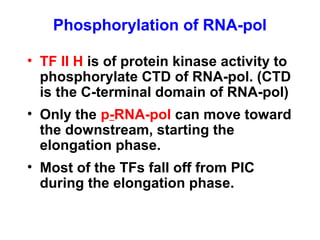
• TF II H is of protein kinase activity to
phosphorylate CTD of RNA-pol. (CTD
is the C-terminal domain of RNA-pol)
• Only the p-RNA-pol can move toward
the downstream, starting the
elongation phase.
• Most of the TFs fall off from PIC
during the elongation phase.
Phosphorylation of RNA-pol
• The elongation is similar to that of
prokaryotes.
• The transcription and translation do
not take place simultaneously since
they are separated by nuclear
membrane.
b. Elongation
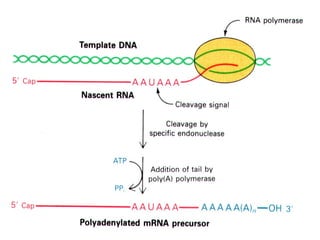
• The termination sequence is
AATAAA followed by GT repeats.
• The termination is closely related to
the post-transcriptional modification.
c. Termination
Section 3
Post-Transcriptional
Modification
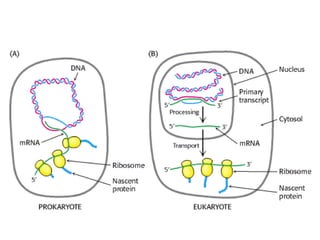
• The nascent RNA, also known as
primary transcript, needs to be
modified to become functional
tRNAs, rRNAs, and mRNAs.
• The modification is critical to
eukaryotic systems.
• Primary transcripts of mRNA are called as
heteronuclear RNA (hnRNA).
• hnRNA are larger than matured mRNA by
many folds.
• Modification includes
– Capping at the 5′- end
– Tailing at the 3′- end
– mRNA splicing
– RNA edition
§3.1 Modification of hnRNA
CH3
O
O OH
CH2
PO
O
O
N
NH
N
N
O
NH2
AAAAA-OH
O
Pi
5'
3'
O
OHOH
H2C
N
HN
N
N
O
H2N O P
O
O
O P
O
O
O P
O
O
5'
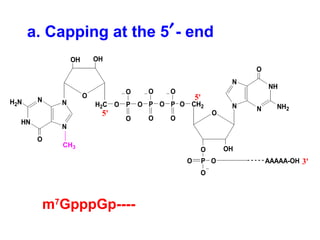
a. Capping at the 5′- end
m7
GpppGp----
• The 5′- cap structure is found on
hnRNA too. ⇒ The capping process
occurs in nuclei.
• The cap structure of mRNA will be
recognized by the cap-binding protein
required for translation.
• The capping occurs prior to the
splicing.
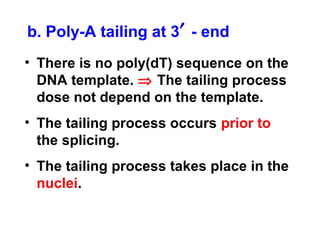
b. Poly-A tailing at 3′ - end
• There is no poly(dT) sequence on the
DNA template. ⇒ The tailing process
dose not depend on the template.
• The tailing process occurs prior to
the splicing.
• The tailing process takes place in the
nuclei.
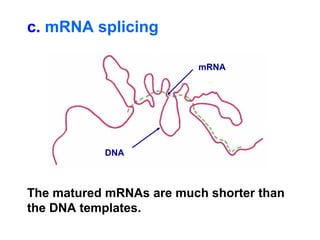
The matured mRNAs are much shorter than
the DNA templates.
DNA
mRNA
c. mRNA splicing
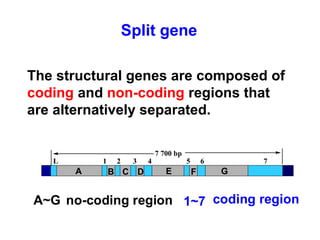
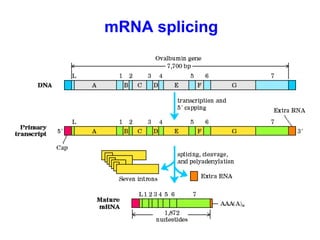
A~G no-coding region 1~7 coding region
L 1 2 3 4 5 6 7
7 700 bp
The structural genes are composed of
coding and non-coding regions that
are alternatively separated.
Split gene
EA B C D F G
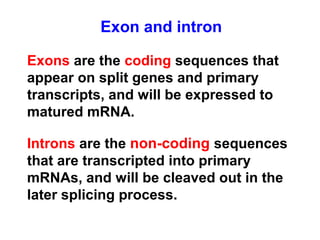
Exon and intron
Exons are the coding sequences that
appear on split genes and primary
transcripts, and will be expressed to
matured mRNA.
Introns are the non-coding sequences
that are transcripted into primary
mRNAs, and will be cleaved out in the
later splicing process.
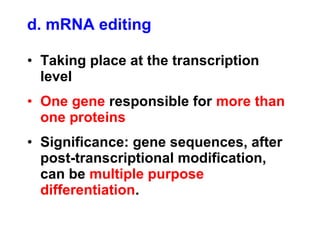
mRNA splicing
• Taking place at the transcription
level
• One gene responsible for more than
one proteins
• Significance: gene sequences, after
post-transcriptional modification,
can be multiple purpose
differentiation.
d. mRNA editing
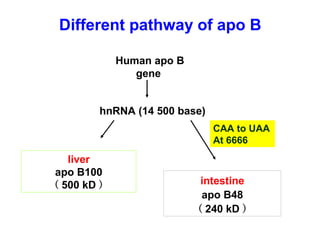
Different pathway of apo B
Human apo B
gene
hnRNA (14 500 base)
liver
apo B100
( 500 kD ) intestine
apo B48
( 240 kD )
CAA to UAA
At 6666

Transcription

  • 1.
    Transcription By Dr SajidAli Assistant Professor Dept of Biotech, AWKUM
  • 2.
    The synthesis ofRNA molecules using DNA strands as the templates so that the genetic information can be transferred from DNA to RNA. Transcription
  • 3.
    • Both processesuse DNA as the template. • Phosphodiester bonds are formed in both cases. • Both synthesis directions are from 5´ to 3´. Similarity between replication and transcription
  • 4.
    replication transcription template doublestrands single strand substrate dNTP NTP primer yes no Enzyme DNA polymerase RNA polymerase product dsDNA ssRNA base pair A-T, G-C A-U, T-A, G-C Differences between replication and transcription
  • 5.
  • 6.
    • The wholegenome of DNA needs to be replicated, but only small portion of genome is transcribed in response to the development requirement, physiological need and environmental changes. • DNA regions that can be transcribed into RNA are called structural genes.
  • 7.
    §1.1 Template The templatestrand is the strand from which the RNA is actually transcribed. It is also termed as antisense strand. The coding strand is the strand whose base sequence specifies the amino acid sequence of the encoded protein. Therefore, it is also called as sense strand.
  • 8.
    G C AG T A C A T G T C5' 3' 3' C G T C A T G T A C A G 5' template strand coding strand transcription RNAG C A G U A C A U G U C5' 3'
  • 9.
    • Only thetemplate strand is used for the transcription, but the coding strand is not. • Both strands can be used as the templates. • The transcription direction on different strands is opposite. • This feature is referred to as the asymmetric transcription. Asymmetric transcription
  • 10.
  • 11.
    Organization of codinginformation in the adenovirus genome
  • 12.
    §1.2 RNA Polymerase •The enzyme responsible for the RNA synthesis is DNA-dependent RNA polymerase. – The prokaryotic RNA polymerase is a multiple-subunit protein of ~480kD. – Eukaryotic systems have three kinds of RNA polymerases, each of which is a multiple-subunit protein and responsible for transcription of different RNAs.
  • 13.
    core enzymeholoenzyme Holoenzyme The holoenzymeof RNA-pol in E.coli consists of 5 different subunits: α2 β β′ ωσ. ω β′ β αα σ
  • 14.
    subunit MW function α36512 Determine the DNA to be transcribed β 150618 Catalyze polymerization β′ 155613 Bind & open DNA template σ 70263 Recognize the promoter for synthesis initiation RNA-pol of E. Coli
  • 15.
    • Rifampicin, atherapeutic drug for tuberculosis treatment, can bind specifically to the β subunit of RNA- pol, and inhibit the RNA synthesis. • RNA-pol of other prokaryotic systems is similar to that of E. coli in structure and functions.
  • 16.
    RNA-pol I IIIII products 45S rRNA hnRNA+m RNA 5S rRNA tRNA snRNA Sensitivity to Amanitin No high moderate RNA-pol of eukaryotes Amanitin is a specific inhibitor of RNA-pol.
  • 17.
    • Each transcriptableregion is called operon. • One operon includes several structural genes and upstream regulatory sequences (or regulatory regions). • The promoter is the DNA sequence that RNA-pol can bind. It is the key point for the transcription control. §1.3 Recognition of Origins
  • 18.
  • 19.
    5' 3' 3' 5' -50 -40 -30-20 -10 1 10 start-10 region T A T A A T A T A T T A (Pribnow box) -35 region T T G A C A A A C T G T Prokaryotic promoter Consensus sequence
  • 20.
    • The -35region of TTGACA sequence is the recognition site and the binding site of RNA-pol. • The -10 region of TATAAT is the region at which a stable complex of DNA and RNA-pol is formed.
  • 21.
  • 22.
    General concepts • Threephases: initiation, elongation, and termination. • The prokaryotic RNA-pol can bind to the DNA template directly in the transcription process. • The eukaryotic RNA-pol requires co- factors to bind to the DNA template together in the transcription process.
  • 23.
    §2.1 Transcription ofProkaryotes • Initiation phase: RNA-pol recognizes the promoter and starts the transcription. • Elongation phase: the RNA strand is continuously growing. • Termination phase: the RNA-pol stops synthesis and the nascent RNA is separated from the DNA template.
  • 24.
    a. Initiation • RNA-polrecognizes the TTGACA region, and slides to the TATAAT region, then opens the DNA duplex. • The unwound region is about 17±1 bp.
  • 25.
    • The firstnucleotide on RNA transcript is always purine triphosphate. • The pppGpN-OH structure remains on the RNA transcript until the RNA synthesis is completed. • The three molecules form a transcription initiation complex. RNA-pol (α2ββ′σ) - DNA - pppGpN- OH 3′
  • 26.
    • No primeris needed for RNA synthesis. • The σ subunit falls off from the RNA- pol once the first 3′,5′ phosphodiester bond is formed. • The core enzyme moves along the DNA template to enter the elongation phase.
  • 27.
    b. Elongation • Therelease of the σ subunit causes the conformational change of the core enzyme. The core enzyme slides on the DNA template toward the 3′ end. • Free NTPs are added sequentially to the 3′ -OH of the nascent RNA strand.
  • 28.
    • RNA-pol, DNAsegment of ~40nt and the nascent RNA form a complex called the transcription bubble. • The 3′ segment of the nascent RNA hybridizes with the DNA template, and its 5′ end extends out the transcription bubble as the synthesis is processing.
  • 29.
  • 32.
    c. Termination • TheRNA-pol stops moving on the DNA template. The RNA transcript falls off from the transcription complex. • The termination occurs in either ρ -dependent or ρ -independent manner.
  • 33.
    The termination functionof ρ factor The ρ factor, a hexamer, is a ATPase and a helicase.
  • 34.
    ρ-independent termination • Thetermination signal is a stretch of 30-40 nucleotides on the RNA transcript, consisting of many GC followed by a series of U. • The sequence specificity of this nascent RNA transcript will form particular stem-loop structures to terminate the transcription.
  • 35.
  • 37.
    • The stem-loopstructure alters the conformation of RNA-pol, leading to the pause of the RNA-pol moving. • Then the competition of the RNA- RNA hybrid and the DNA-DNA hybrid reduces the DNA-RNA hybrid stability, and causes the transcription complex dissociated. • Among all the base pairings, the most unstable one is rU:dA. Stem-loop disruption
  • 38.
    §2.2 Transcription ofEukaryotes • Transcription initiation needs promoter and upstream regulatory regions. • The cis-acting elements are the specific sequences on the DNA template that regulate the transcription of one or more genes. a. Initiation
  • 39.
    structural gene GCGC CAATTATA intronexon exon start CAAT box GC box enhancer cis-acting element TATA box (Hogness box) Cis-acting element
  • 40.
    • RNA-pol doesnot bind the promoter directly. • RNA-pol II associates with six transcription factors, TFII A - TFII H. • The trans-acting factors are the proteins that recognize and bind directly or indirectly cis-acting elements and regulate its activity. Transcription factors
  • 41.
    TF for eukaryotictranscription
  • 42.
    • TBP ofTFII D binds TATA • TFII A and TFII B bind TFII D • TFII F-RNA-pol complex binds TFII B • TFII F and TFII E open the dsDNA (helicase and ATPase) • TFII H: completion of PIC Pre-initiation complex (PIC)
  • 43.
    Pre-initiation complex (PIC) RNApol II TF II F TBP TAF TATA DNA TF II A TF II B TF II E TF II H
  • 44.
    • TF IIH is of protein kinase activity to phosphorylate CTD of RNA-pol. (CTD is the C-terminal domain of RNA-pol) • Only the p-RNA-pol can move toward the downstream, starting the elongation phase. • Most of the TFs fall off from PIC during the elongation phase. Phosphorylation of RNA-pol
  • 45.
    • The elongationis similar to that of prokaryotes. • The transcription and translation do not take place simultaneously since they are separated by nuclear membrane. b. Elongation
  • 46.
    • The terminationsequence is AATAAA followed by GT repeats. • The termination is closely related to the post-transcriptional modification. c. Termination
  • 48.
  • 49.
    • The nascentRNA, also known as primary transcript, needs to be modified to become functional tRNAs, rRNAs, and mRNAs. • The modification is critical to eukaryotic systems.
  • 51.
    • Primary transcriptsof mRNA are called as heteronuclear RNA (hnRNA). • hnRNA are larger than matured mRNA by many folds. • Modification includes – Capping at the 5′- end – Tailing at the 3′- end – mRNA splicing – RNA edition §3.1 Modification of hnRNA
  • 52.
    CH3 O O OH CH2 PO O O N NH N N O NH2 AAAAA-OH O Pi 5' 3' O OHOH H2C N HN N N O H2N OP O O O P O O O P O O 5' a. Capping at the 5′- end m7 GpppGp----
  • 53.
    • The 5′-cap structure is found on hnRNA too. ⇒ The capping process occurs in nuclei. • The cap structure of mRNA will be recognized by the cap-binding protein required for translation. • The capping occurs prior to the splicing.
  • 54.
    b. Poly-A tailingat 3′ - end • There is no poly(dT) sequence on the DNA template. ⇒ The tailing process dose not depend on the template. • The tailing process occurs prior to the splicing. • The tailing process takes place in the nuclei.
  • 55.
    The matured mRNAsare much shorter than the DNA templates. DNA mRNA c. mRNA splicing
  • 56.
    A~G no-coding region1~7 coding region L 1 2 3 4 5 6 7 7 700 bp The structural genes are composed of coding and non-coding regions that are alternatively separated. Split gene EA B C D F G
  • 57.
    Exon and intron Exonsare the coding sequences that appear on split genes and primary transcripts, and will be expressed to matured mRNA. Introns are the non-coding sequences that are transcripted into primary mRNAs, and will be cleaved out in the later splicing process.
  • 58.
  • 59.
    • Taking placeat the transcription level • One gene responsible for more than one proteins • Significance: gene sequences, after post-transcriptional modification, can be multiple purpose differentiation. d. mRNA editing
  • 60.
    Different pathway ofapo B Human apo B gene hnRNA (14 500 base) liver apo B100 ( 500 kD ) intestine apo B48 ( 240 kD ) CAA to UAA At 6666