Pre RNA trans-splicing
Gene Therapy
Presented by:
Farah Arooj
MS (Biochemistry)
2015-2017
Institute of Biochemistry & Biotechnology
University of the Punjab
 RNA splicing in which exons from two different
primary RNA transcripts are joined end to end and
ligated.
 Target Pre mRNA and other is trans splicing
molecule
 Rare in higher eukaryotes
 Emerging technique for RNA repair
 Spliceosome-mediated pre-RNA trans-
splicing
 Endonuclease-mediated trans-splicing
 Trans splicing ribozyme
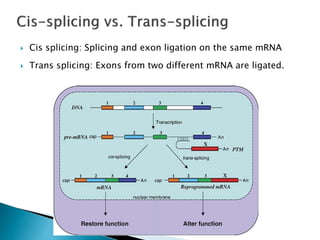
 Cis splicing: Splicing and exon ligation on the same mRNA
 Trans splicing: Exons from two different mRNA are ligated.
 Also called spliceosome mediated RNA trans
splicing (SMaRT)
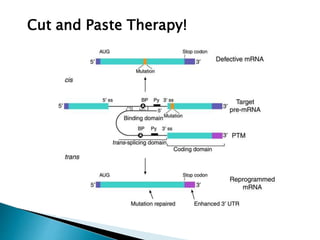
 Repairs the mutated part of target mRNA instead of
whole gene by giving a Pre trans splicing molecule
(PTM) exogenously which has the corrected coding
sequence.
 First reported by Pattaraju et al., in 1999 in cancer
cell lines
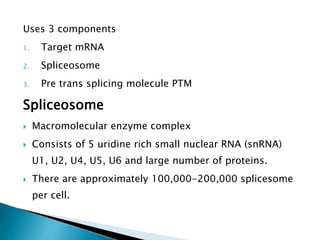
Uses 3 components
1. Target mRNA
2. Spliceosome
3. Pre trans splicing molecule PTM
Spliceosome
 Macromolecular enzyme complex
 Consists of 5 uridine rich small nuclear RNA (snRNA)
U1, U2, U4, U5, U6 and large number of proteins.
 There are approximately 100,000-200,000 splicesome
per cell.
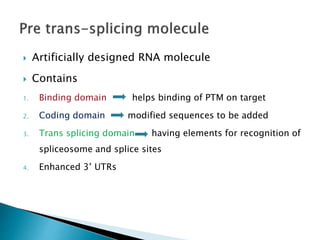
 Artificially designed RNA molecule
 Contains
1. Binding domain helps binding of PTM on target
2. Coding domain modified sequences to be added
3. Trans splicing domain having elements for recognition of
spliceosome and splice sites
4. Enhanced 3’ UTRs
Cut and Paste Therapy!
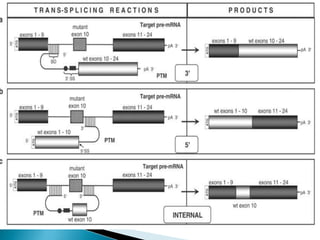
Based on different splice sites in trans splicing
domains
 3’ exons replacement
 5’ exon replacement
 Internal exon replacement
 Injecting the plasmid DNA encoding the PTM
 Viral vectors e.g. AAV, Lentiviral, retroviral
 Trans splicing efficiency increases with high conc. of
PTM.
 A library of PTMs is generated. Bound with GFP and RFP
 Screened for efficient PTM by checking intensity of red
and green fluorescence
 Target pre mRNA expression level
 The type of PTM and its expression level
 Binding strength with target splice sites
 The ease of accessibility of the binding domain
 The route of PTM delivery
 Stem loop structures. Long binding domains
 Still in pre-clinical era
 SMaRT utility has been studied for various genetic diseases
like cystic fibrosis, hemophilia, SCID and cancers in xenograft
models and showed significant level of repair.
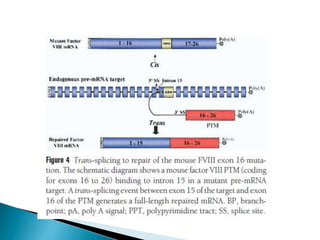
 First In vivo demonstration of SMaRT
 Performed in factor VIII hemophilia knockout mice. 16-26
exon were replaced by 3’ trans splicing. For 8 weeks,
circulating FVIII was detected.
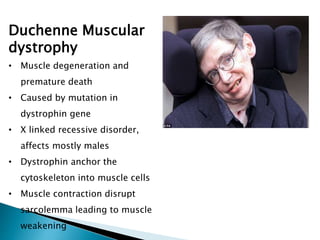
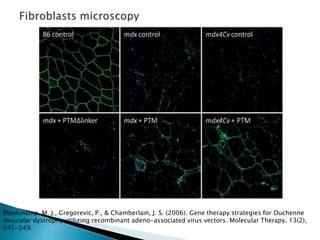
Duchenne Muscular
dystrophy
• Muscle degeneration and
premature death
• Caused by mutation in
dystrophin gene
• X linked recessive disorder,
affects mostly males
• Dystrophin anchor the
cytoskeleton into muscle cells
• Muscle contraction disrupt
sarcolemma leading to muscle
weakening
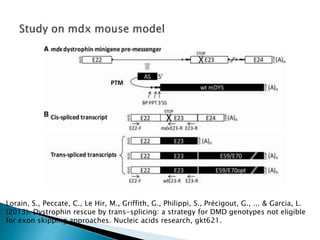
Lorain, S., Peccate, C., Le Hir, M., Griffith, G., Philippi, S., Précigout, G., ... & Garcia, L.
(2013). Dystrophin rescue by trans-splicing: a strategy for DMD genotypes not eligible
for exon skipping approaches. Nucleic acids research, gkt621.
Blankinship, M. J., Gregorevic, P., & Chamberlain, J. S. (2006). Gene therapy strategies for Duchenne
muscular dystrophy utilizing recombinant adeno-associated virus vectors. Molecular Therapy, 13(2),
241-249.
 Can be used in suicide gene therapy by ligating a suicide
gene with the mRNA of potential gene involved in disease.
 Cell death was observed when tried on Epidermolysis bullosa
associated squamous cell carcinoma cells
 Small Trans gene size (corrected exons only)
 PTM targets the mutated gene with high specificity
 Natural regulation of gene
 Eliminating the expression of deleterious protein.
 Less chance of random mutagenesis.
 Undesired gene expression minimized as trans-
splicing only occur in cells expressing the target pre-
mRNA.
 Efficient technique for repairing mutation
 More understanding of PTM designing and
efficiency required
 Studies should extend to higher levels
 Can be used in molecular imaging
 In vivo drug screening
Thank you!

Pre trans splicing gene therapy

  • 1.
    Pre RNA trans-splicing GeneTherapy Presented by: Farah Arooj MS (Biochemistry) 2015-2017 Institute of Biochemistry & Biotechnology University of the Punjab
  • 2.
     RNA splicingin which exons from two different primary RNA transcripts are joined end to end and ligated.  Target Pre mRNA and other is trans splicing molecule  Rare in higher eukaryotes  Emerging technique for RNA repair
  • 3.
     Spliceosome-mediated pre-RNAtrans- splicing  Endonuclease-mediated trans-splicing  Trans splicing ribozyme
  • 4.
     Cis splicing:Splicing and exon ligation on the same mRNA  Trans splicing: Exons from two different mRNA are ligated.
  • 5.
     Also calledspliceosome mediated RNA trans splicing (SMaRT)  Repairs the mutated part of target mRNA instead of whole gene by giving a Pre trans splicing molecule (PTM) exogenously which has the corrected coding sequence.  First reported by Pattaraju et al., in 1999 in cancer cell lines
  • 6.
    Uses 3 components 1.Target mRNA 2. Spliceosome 3. Pre trans splicing molecule PTM Spliceosome  Macromolecular enzyme complex  Consists of 5 uridine rich small nuclear RNA (snRNA) U1, U2, U4, U5, U6 and large number of proteins.  There are approximately 100,000-200,000 splicesome per cell.
  • 7.
     Artificially designedRNA molecule  Contains 1. Binding domain helps binding of PTM on target 2. Coding domain modified sequences to be added 3. Trans splicing domain having elements for recognition of spliceosome and splice sites 4. Enhanced 3’ UTRs
  • 8.
    Cut and PasteTherapy!
  • 9.
    Based on differentsplice sites in trans splicing domains  3’ exons replacement  5’ exon replacement  Internal exon replacement
  • 11.
     Injecting theplasmid DNA encoding the PTM  Viral vectors e.g. AAV, Lentiviral, retroviral  Trans splicing efficiency increases with high conc. of PTM.  A library of PTMs is generated. Bound with GFP and RFP  Screened for efficient PTM by checking intensity of red and green fluorescence
  • 12.
     Target premRNA expression level  The type of PTM and its expression level  Binding strength with target splice sites  The ease of accessibility of the binding domain  The route of PTM delivery  Stem loop structures. Long binding domains
  • 13.
     Still inpre-clinical era  SMaRT utility has been studied for various genetic diseases like cystic fibrosis, hemophilia, SCID and cancers in xenograft models and showed significant level of repair.  First In vivo demonstration of SMaRT  Performed in factor VIII hemophilia knockout mice. 16-26 exon were replaced by 3’ trans splicing. For 8 weeks, circulating FVIII was detected.
  • 15.
    Duchenne Muscular dystrophy • Muscledegeneration and premature death • Caused by mutation in dystrophin gene • X linked recessive disorder, affects mostly males • Dystrophin anchor the cytoskeleton into muscle cells • Muscle contraction disrupt sarcolemma leading to muscle weakening
  • 16.
    Lorain, S., Peccate,C., Le Hir, M., Griffith, G., Philippi, S., Précigout, G., ... & Garcia, L. (2013). Dystrophin rescue by trans-splicing: a strategy for DMD genotypes not eligible for exon skipping approaches. Nucleic acids research, gkt621.
  • 17.
    Blankinship, M. J.,Gregorevic, P., & Chamberlain, J. S. (2006). Gene therapy strategies for Duchenne muscular dystrophy utilizing recombinant adeno-associated virus vectors. Molecular Therapy, 13(2), 241-249.
  • 18.
     Can beused in suicide gene therapy by ligating a suicide gene with the mRNA of potential gene involved in disease.  Cell death was observed when tried on Epidermolysis bullosa associated squamous cell carcinoma cells
  • 19.
     Small Transgene size (corrected exons only)  PTM targets the mutated gene with high specificity  Natural regulation of gene  Eliminating the expression of deleterious protein.  Less chance of random mutagenesis.  Undesired gene expression minimized as trans- splicing only occur in cells expressing the target pre- mRNA.
  • 20.
     Efficient techniquefor repairing mutation  More understanding of PTM designing and efficiency required  Studies should extend to higher levels  Can be used in molecular imaging  In vivo drug screening
  • 21.

Editor's Notes

  • #17 RNA isolation Dystrophin cDNA by RT-PCR PCR amplification Real time PCR Sequencing