R.Priyanka
B.Sc Biochemistry
& Biotechnology
Sericulture is the cultivation of silk through rearing
of silkworm.
It is an agro based industry.
It involves the raising of food plants for silkworm,
rearing of silkworm for production of cocoons, reeling
and spinning of cocoon for production of yarn etc.
For value added benefits such as processing and
weaving.
SILKWORM – Bombyx mori
a. Mulberry silkworm
b. Tasar silkworm
c. Muga silkworm
d. Eri silkworm
e. Oak silkworm
f. Giant silkworm
This was taken as drowry by married princess during olg
age in Tibet.
Slowly it passed on to China and finally to India.
Now India plays a major part in sericulture leading 2nd
position for silk
CATERPILLAR
1. TASAR – Old and Traditional silk ;
Rural areas
2. ERI - Eastern parts of India
3. MULBERRY - Non traditional silk
4. MUGA – Golden yellow silk
MULBERRY LEAVES
COCOON
•High employment potential
•Provides vibrancy to village economies
•Low gestation and high returns
•Women friendly occupation
•Ideal program for weaker sections of society
•Eco-friendly activity
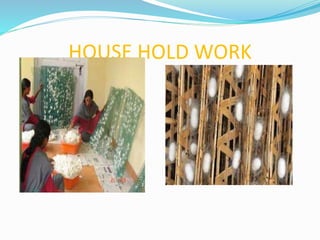
HOUSE HOLD WORK
Mainly in textile industry for
manufacturing garments
Bags, telephone cable insulations, dyeing
& screen printing
•Pebrene – caused by protozoan; larvae become pale
yellow, size reduces & no yield
•Grasserie – skin of larvae rough & saliva becomes
thick
•Flacherie – indigestion occurs & worm becomes thin,
inactive & regenerates
•Muscardine –due to fungi; mortality occurs due to
heavy rain & unhygienic
Leads 2nd position in world
Exporting 1/7th of silk products to foreign
countries
Govt. of India constituted ‘Central Silk Board’
to protect interest of silk industry
Research institutes
i. Central sericulture research
institute, West Bengal
ii. Sericulture research institute,
Mysore
 In vitro culture of embryo
 Tissue culture media- Grace’s
medium
 Cell line production
 Nutrition production
Sericulture

Sericulture

  • 1.
  • 2.
    Sericulture is thecultivation of silk through rearing of silkworm. It is an agro based industry. It involves the raising of food plants for silkworm, rearing of silkworm for production of cocoons, reeling and spinning of cocoon for production of yarn etc. For value added benefits such as processing and weaving.
  • 3.
  • 4.
    a. Mulberry silkworm b.Tasar silkworm c. Muga silkworm d. Eri silkworm e. Oak silkworm f. Giant silkworm
  • 6.
    This was takenas drowry by married princess during olg age in Tibet. Slowly it passed on to China and finally to India. Now India plays a major part in sericulture leading 2nd position for silk
  • 7.
  • 8.
    1. TASAR –Old and Traditional silk ; Rural areas 2. ERI - Eastern parts of India 3. MULBERRY - Non traditional silk 4. MUGA – Golden yellow silk
  • 9.
  • 11.
  • 13.
    •High employment potential •Providesvibrancy to village economies •Low gestation and high returns •Women friendly occupation •Ideal program for weaker sections of society •Eco-friendly activity
  • 14.
  • 15.
    Mainly in textileindustry for manufacturing garments Bags, telephone cable insulations, dyeing & screen printing
  • 16.
    •Pebrene – causedby protozoan; larvae become pale yellow, size reduces & no yield •Grasserie – skin of larvae rough & saliva becomes thick •Flacherie – indigestion occurs & worm becomes thin, inactive & regenerates •Muscardine –due to fungi; mortality occurs due to heavy rain & unhygienic
  • 17.
    Leads 2nd positionin world Exporting 1/7th of silk products to foreign countries Govt. of India constituted ‘Central Silk Board’ to protect interest of silk industry
  • 18.
    Research institutes i. Centralsericulture research institute, West Bengal ii. Sericulture research institute, Mysore
  • 19.
     In vitroculture of embryo  Tissue culture media- Grace’s medium  Cell line production  Nutrition production

Editor's Notes

  • #4 Silk is the queen of fabrics