RNA EDITING
PRESENTED BY:
PRASHANT VC
DEPT OF ZOOLOGY
GUK
RNA Editing
Definition: any process, other than splicing, that
results in a change in the sequence of a RNA
transcript such that it differs from the sequence
of the DNA template
RNA Editing
Discovered in trypanosome mitochondria
RNA editing has been reported in:
►Protozoa, plants and mammals (not yet fungi or
Prokaryotes)
► Nuclear, mitochondrial, chloroplast and viral RNAs
► mRNA, tRNAand rRNA
RNA Editing
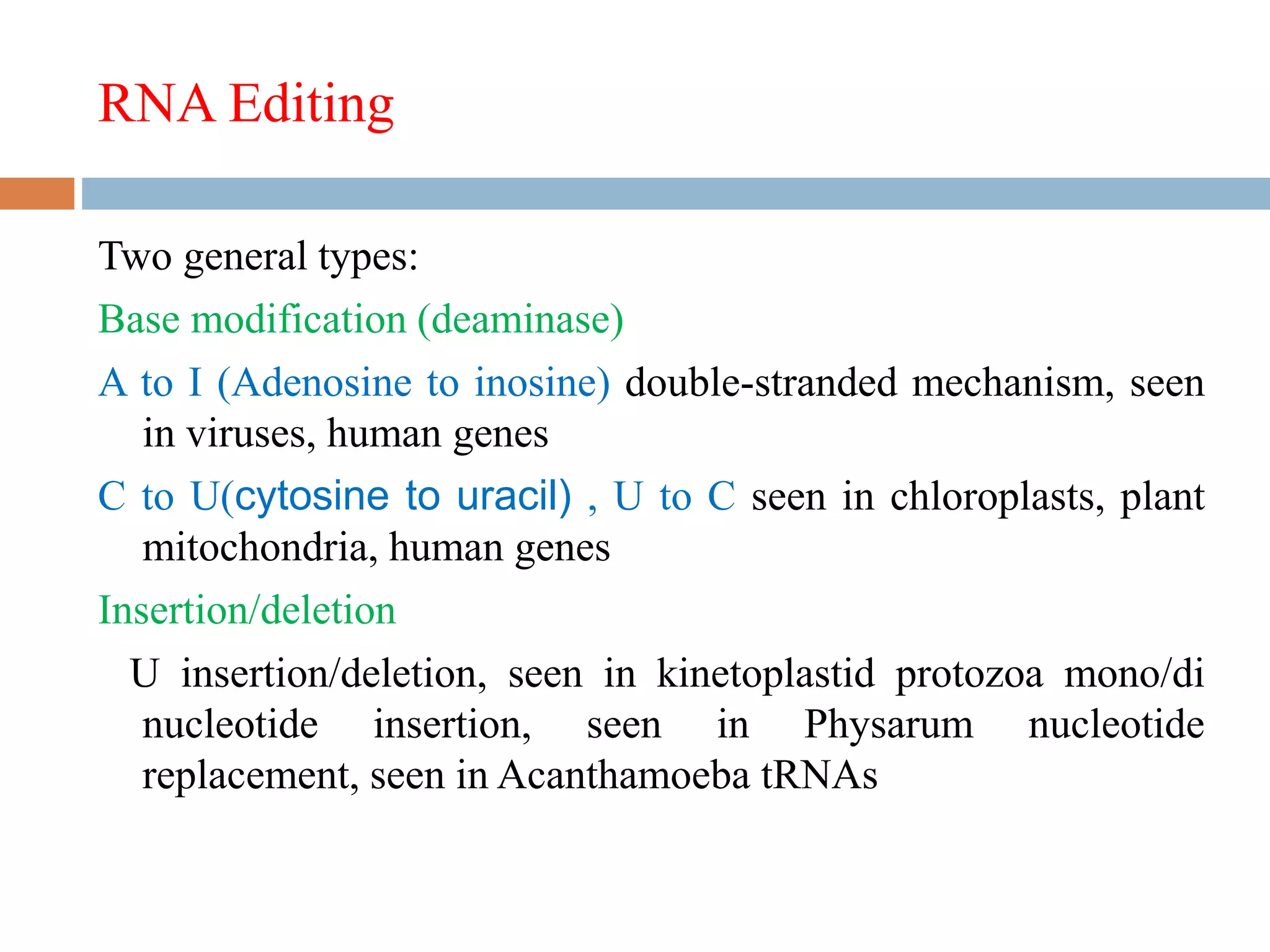
Two general types:
Base modification (deaminase)
A to I (Adenosine to inosine) double-stranded mechanism, seen
in viruses, human genes
C to U(cytosine to uracil) , U to C seen in chloroplasts, plant
mitochondria, human genes
Insertion/deletion
U insertion/deletion, seen in kinetoplastid protozoa mono/di
nucleotide insertion, seen in Physarum nucleotide
replacement, seen in Acanthamoeba tRNAs
Discovery of RNA Editing in Trypanosome Mitochondria
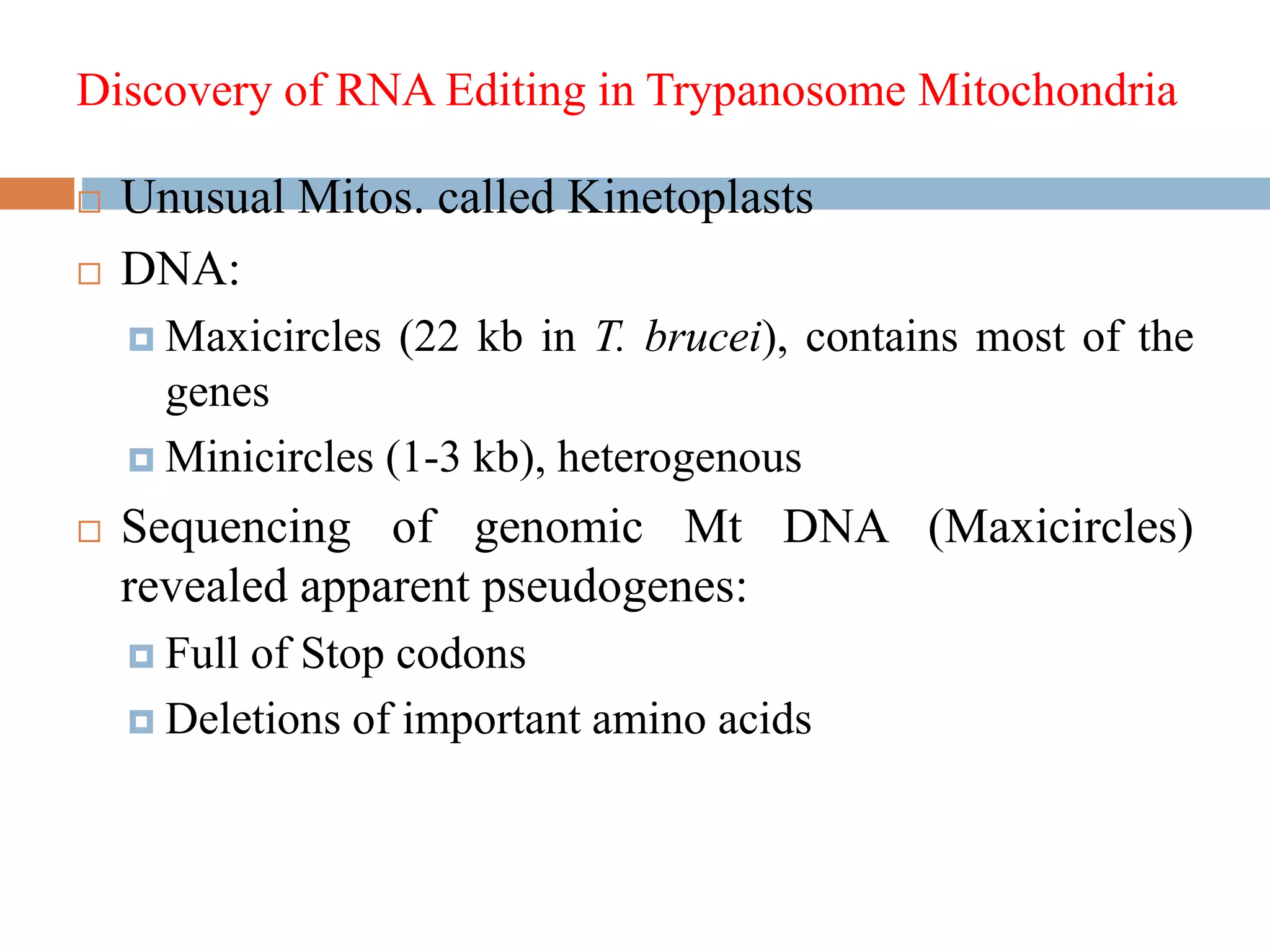
 Unusual Mitos. called Kinetoplasts
 DNA:
 Maxicircles (22 kb in T. brucei), contains most of the
genes
 Minicircles (1-3 kb), heterogenous
 Sequencing of genomic Mt DNA (Maxicircles)
revealed apparent pseudogenes:
 Full of Stop codons
 Deletions of important amino acids
Where were the real functional genes?
 Investigators generated cDNA clones to some of the kinetoplast
mRNAs and sequenced them
 Sequences were partially complementary to pseudogenes on
maxicircle DNA
Cytochrome oxidase
subunit II
 the COXII DNA sequence above is missing 4 Us found in
the mRNA
 Called this “Editing” because it produced functional
mRNAs and proteins from pseudogenes
RNA EDITING IN KINETOPLAST OF TRYPANOSOMES
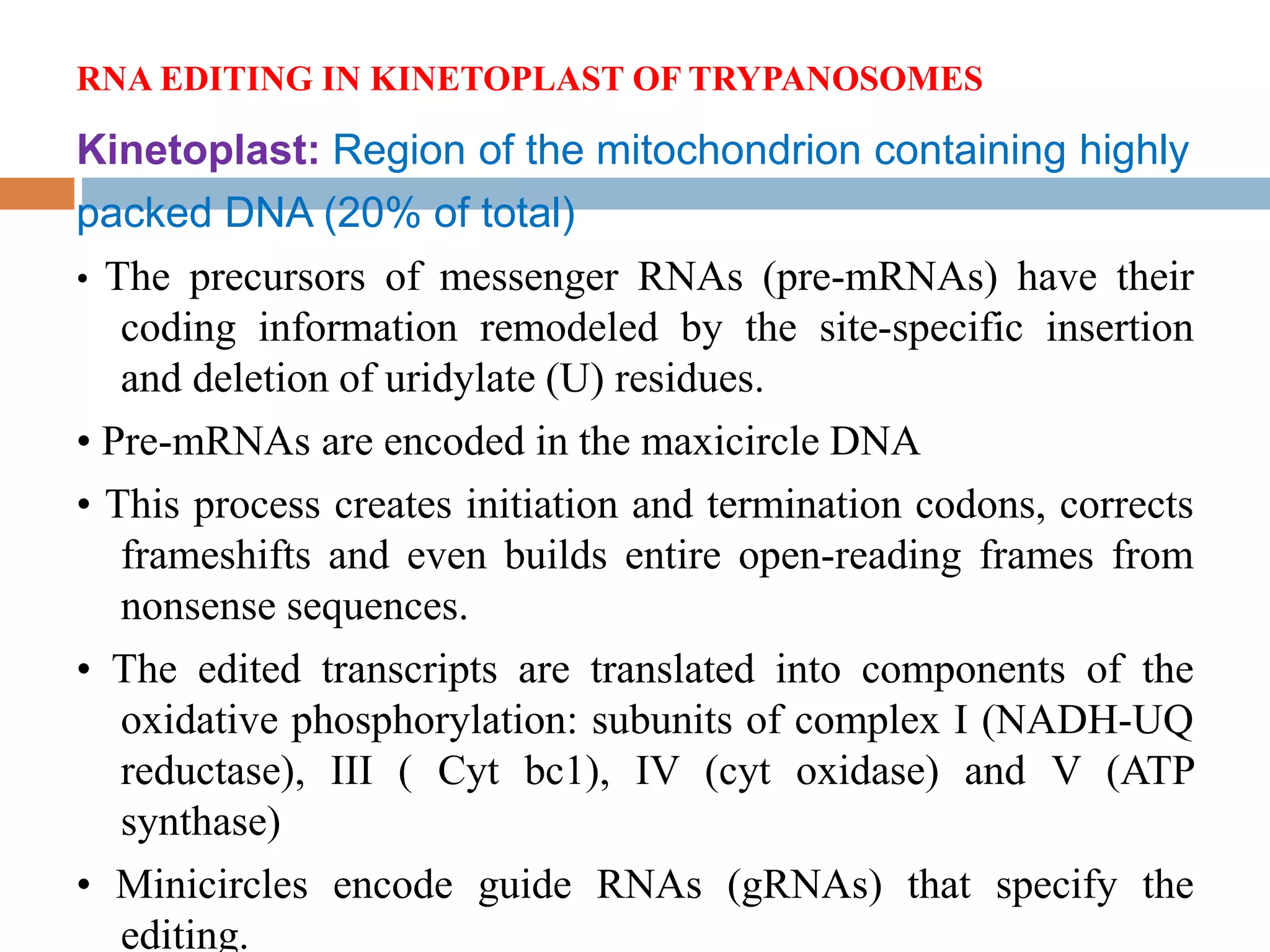
Kinetoplast: Region of the mitochondrion containing highly
packed DNA (20% of total)
• The precursors of messenger RNAs (pre-mRNAs) have their
coding information remodeled by the site-specific insertion
and deletion of uridylate (U) residues.
• Pre-mRNAs are encoded in the maxicircle DNA
• This process creates initiation and termination codons, corrects
frameshifts and even builds entire open-reading frames from
nonsense sequences.
• The edited transcripts are translated into components of the
oxidative phosphorylation: subunits of complex I (NADH-UQ
reductase), III ( Cyt bc1), IV (cyt oxidase) and V (ATP
synthase)
• Minicircles encode guide RNAs (gRNAs) that specify the
editing.
COXIII
Cytochrome oxidase
III
From Trypanosoma
brucei
Fig. 16.15
Lower case Us
were inserted by
editing.
The deleted Ts
(found in the
DNA) are
indicated in
upper case.
Some genes are very heavily edited!
Editing Mechanism
 Post-transcriptional
• Guide RNAs (gRNAs) direct editing
– gRNAs are small and complementary to portions of the edited
mRNA
– Base-pairing of gRNA with unedited RNA gives mismatched
regions, which are recognized by the editing machinery
–Machinery includes an Endonuclease, a Terminal
UridylylTransferase (TUTase), and a RNA ligase
• Editing is directional, from 3’ to 5’
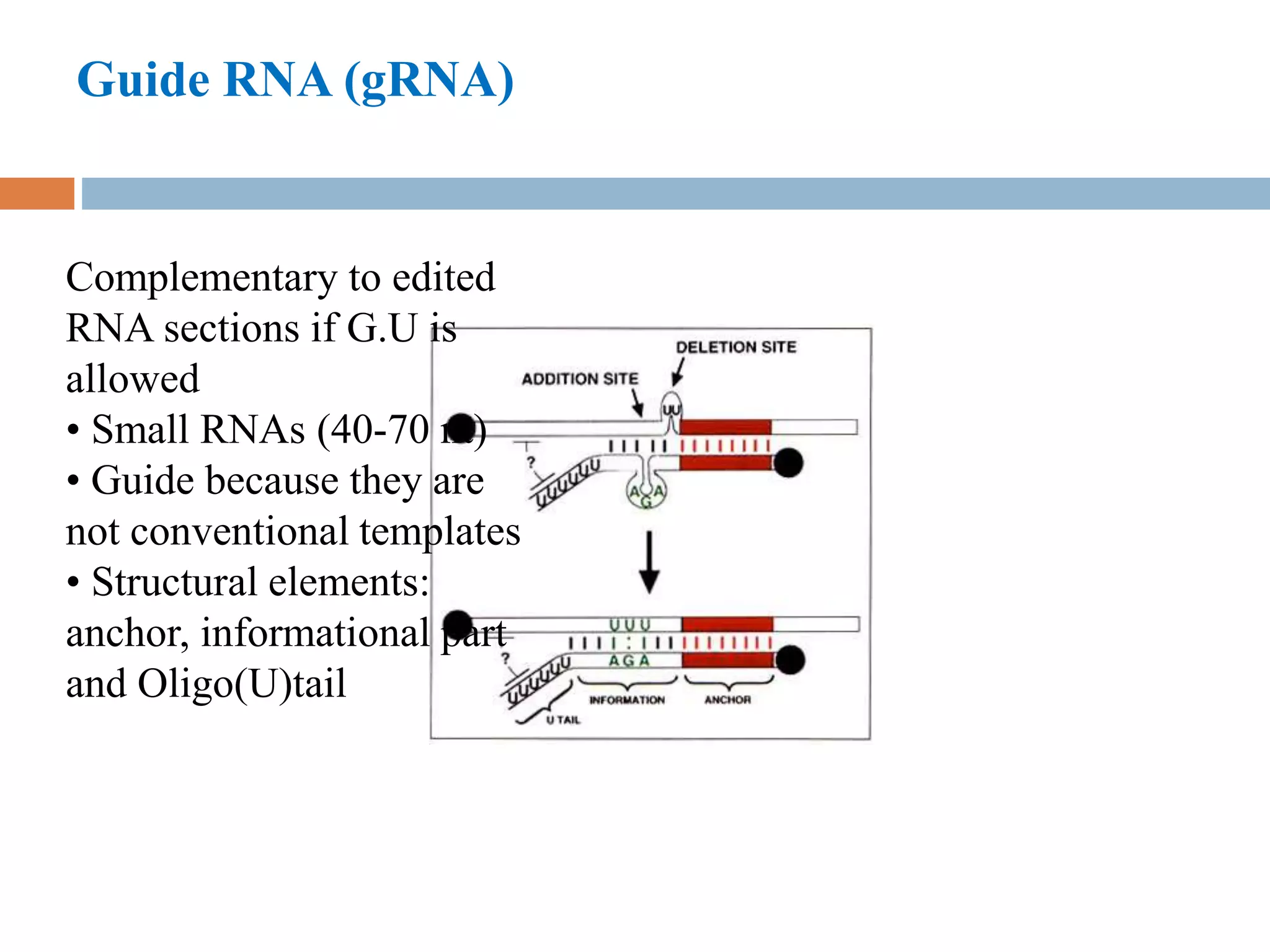
Guide RNA (gRNA)
Complementary to edited
RNA sections if G.U is
allowed
• Small RNAs (40-70 nt)
• Guide because they are
not conventional templates
• Structural elements:
anchor, informational part
and Oligo(U)tail
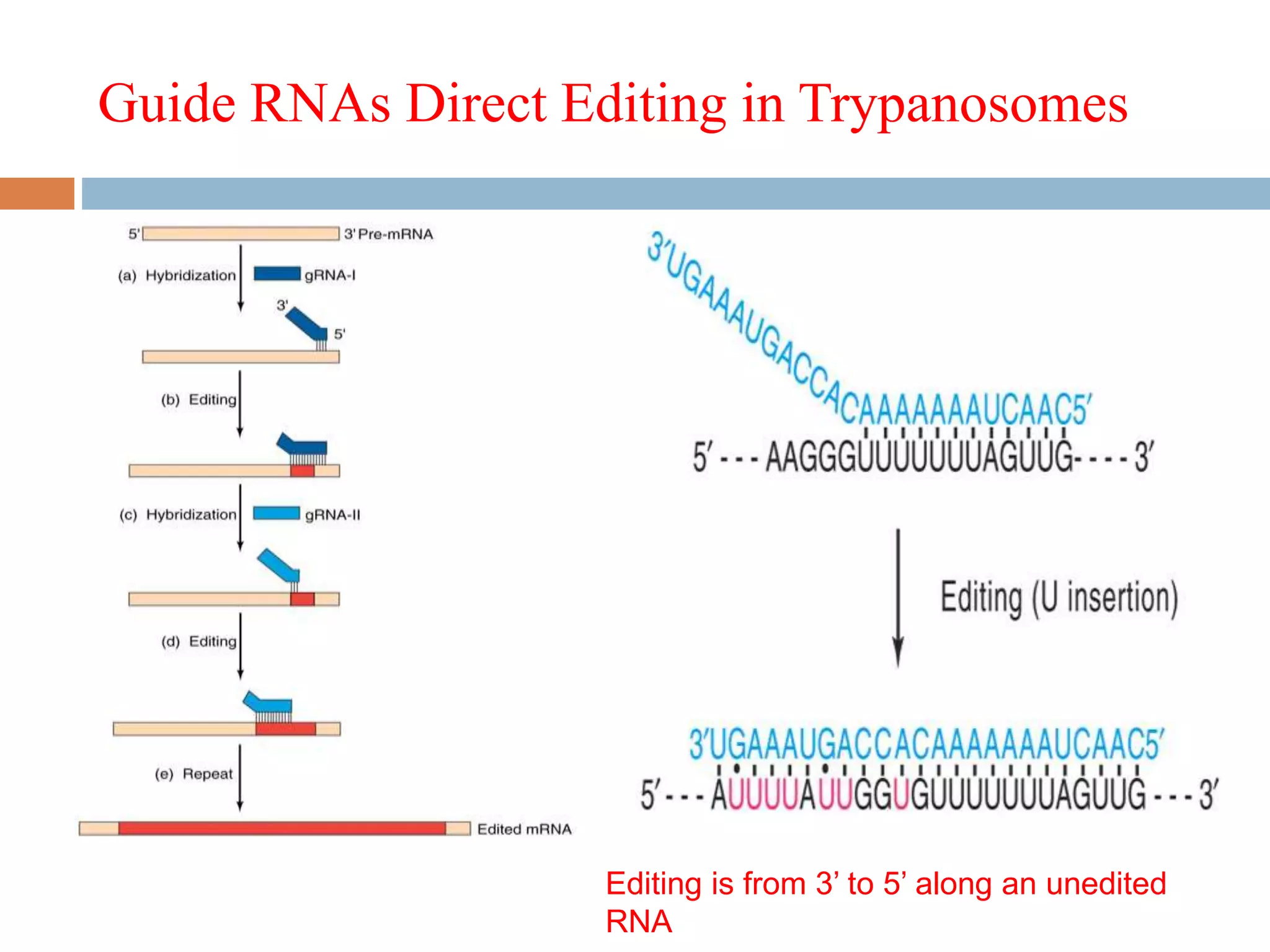
Guide RNAs Direct Editing in Trypanosomes
Editing is from 3’ to 5’ along an unedited
RNA
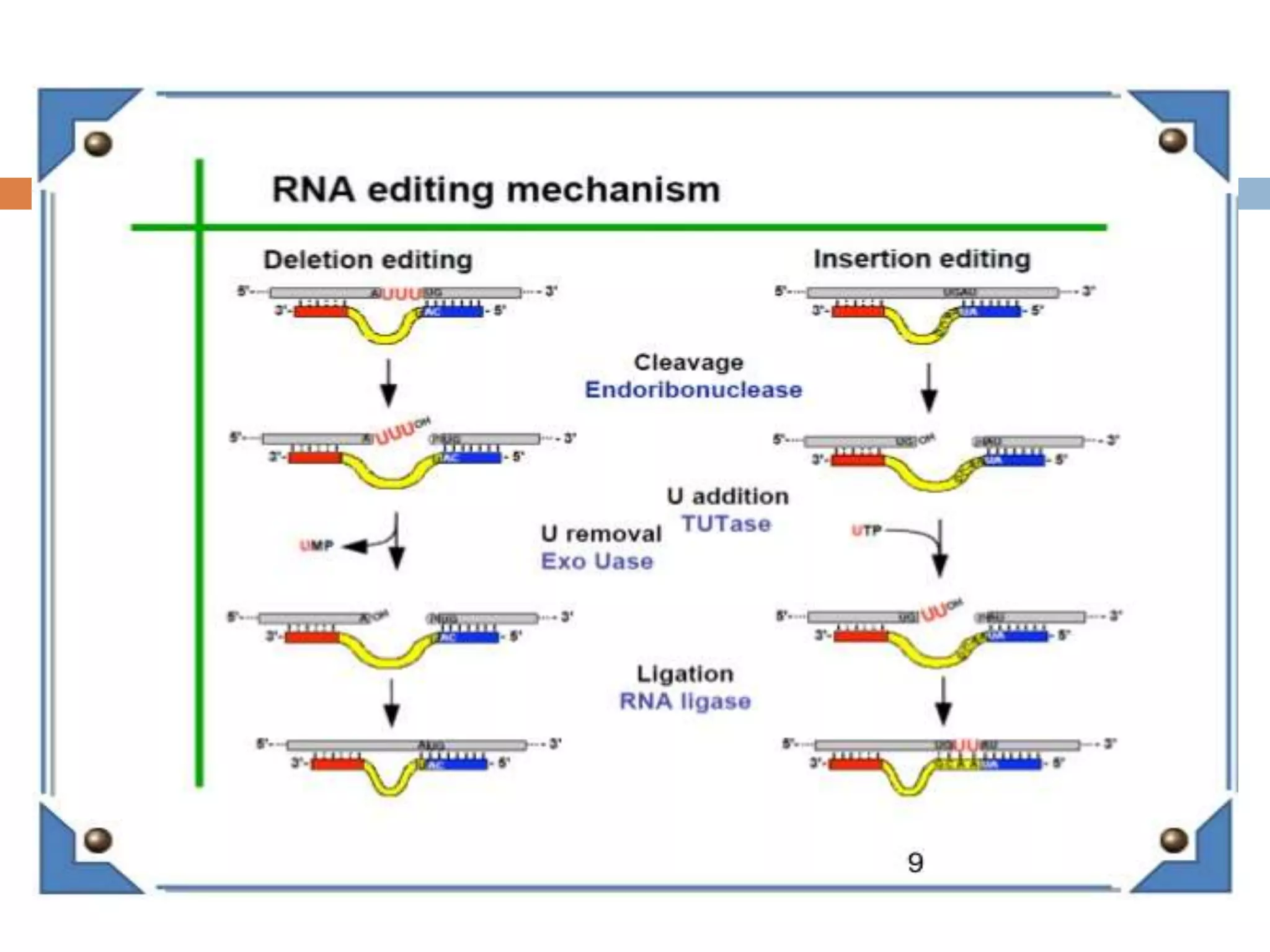
Editing is catalyzed by a multiprotein complex
 Editing is catalyzed by a multiprotein complexes that have not been fully
defined yet. A complex has been purified from glycerol gradients that
contains the four key enzyme activities: 20S editosome
Endonuclease: cleavage in vitro occurs at an unpaired nucleotide immediately
upstream of the gRNA-mRNA anchor duplex.
Exonuclease: exoUase removes non-base-paired U nucleotides after cleavage of
deletion editing sites.
TUTase: In insertion editing, Us are added to the 3’ end of the 5’ pre-mRNA
fragment by a terminal uridyl transferase as specified by the gRNA.
RNA ligase: the natural editing ligase substrates are nicked dsRNAs that are
completely base-paired after the correct addition or removal of U nucleotides
Helicase: each gRNA must be displaced from the sequence that it creates to
enable binding by the subsequent gRNA and also from the mRNA completely
before translation
Other 20S editosome proteins
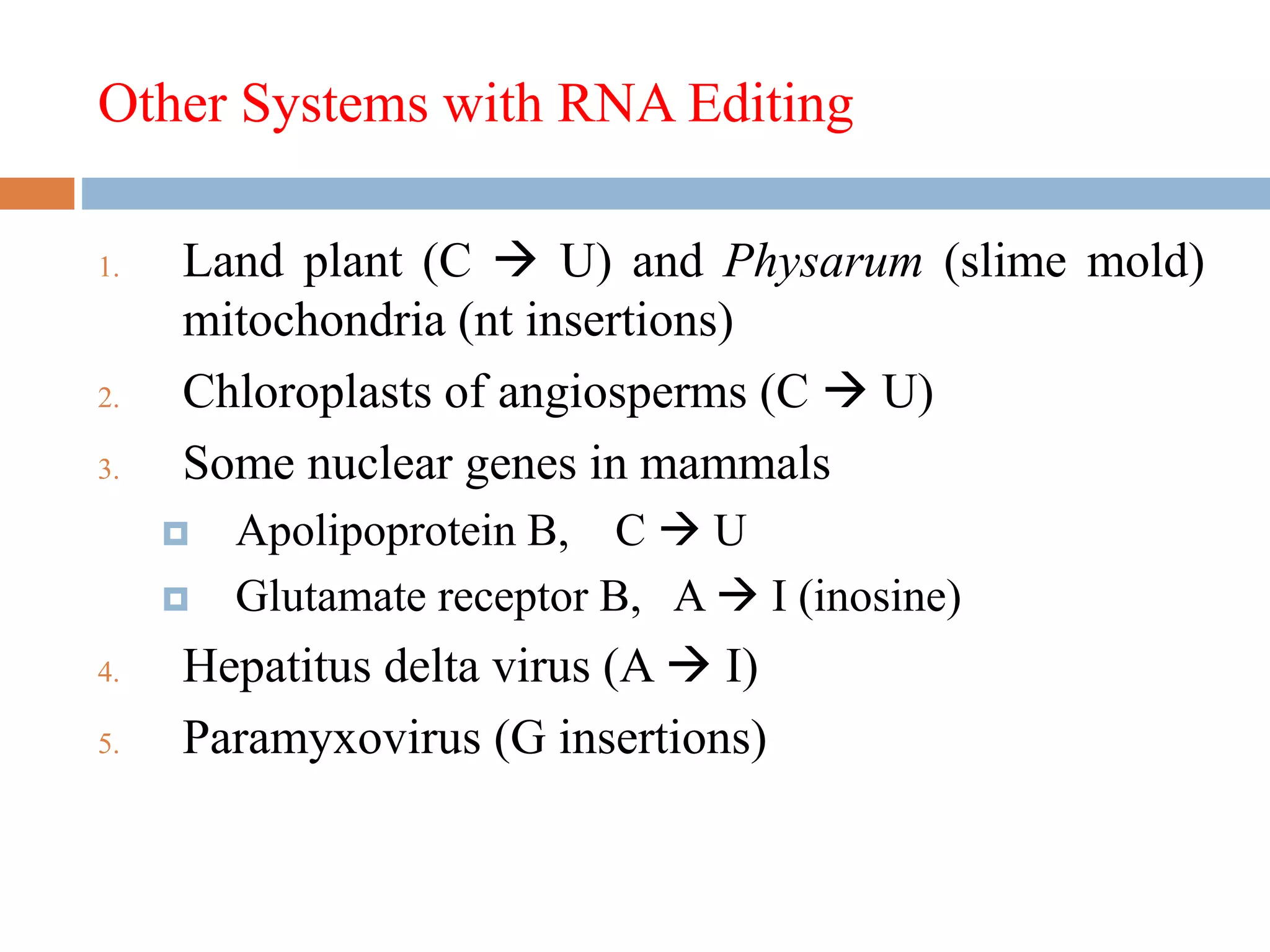
Other Systems with RNA Editing
1. Land plant (C  U) and Physarum (slime mold)
mitochondria (nt insertions)
2. Chloroplasts of angiosperms (C  U)
3. Some nuclear genes in mammals
 Apolipoprotein B, C  U
 Glutamate receptor B, A  I (inosine)
4. Hepatitus delta virus (A  I)
5. Paramyxovirus (G insertions)
THANK YOU

RNA Editing.pptx

  • 1.
    RNA EDITING PRESENTED BY: PRASHANTVC DEPT OF ZOOLOGY GUK
  • 2.
    RNA Editing Definition: anyprocess, other than splicing, that results in a change in the sequence of a RNA transcript such that it differs from the sequence of the DNA template
  • 3.
    RNA Editing Discovered intrypanosome mitochondria RNA editing has been reported in: ►Protozoa, plants and mammals (not yet fungi or Prokaryotes) ► Nuclear, mitochondrial, chloroplast and viral RNAs ► mRNA, tRNAand rRNA
  • 4.
    RNA Editing Two generaltypes: Base modification (deaminase) A to I (Adenosine to inosine) double-stranded mechanism, seen in viruses, human genes C to U(cytosine to uracil) , U to C seen in chloroplasts, plant mitochondria, human genes Insertion/deletion U insertion/deletion, seen in kinetoplastid protozoa mono/di nucleotide insertion, seen in Physarum nucleotide replacement, seen in Acanthamoeba tRNAs
  • 5.
    Discovery of RNAEditing in Trypanosome Mitochondria  Unusual Mitos. called Kinetoplasts  DNA:  Maxicircles (22 kb in T. brucei), contains most of the genes  Minicircles (1-3 kb), heterogenous  Sequencing of genomic Mt DNA (Maxicircles) revealed apparent pseudogenes:  Full of Stop codons  Deletions of important amino acids
  • 6.
    Where were thereal functional genes?  Investigators generated cDNA clones to some of the kinetoplast mRNAs and sequenced them  Sequences were partially complementary to pseudogenes on maxicircle DNA Cytochrome oxidase subunit II  the COXII DNA sequence above is missing 4 Us found in the mRNA  Called this “Editing” because it produced functional mRNAs and proteins from pseudogenes
  • 7.
    RNA EDITING INKINETOPLAST OF TRYPANOSOMES Kinetoplast: Region of the mitochondrion containing highly packed DNA (20% of total) • The precursors of messenger RNAs (pre-mRNAs) have their coding information remodeled by the site-specific insertion and deletion of uridylate (U) residues. • Pre-mRNAs are encoded in the maxicircle DNA • This process creates initiation and termination codons, corrects frameshifts and even builds entire open-reading frames from nonsense sequences. • The edited transcripts are translated into components of the oxidative phosphorylation: subunits of complex I (NADH-UQ reductase), III ( Cyt bc1), IV (cyt oxidase) and V (ATP synthase) • Minicircles encode guide RNAs (gRNAs) that specify the editing.
  • 8.
    COXIII Cytochrome oxidase III From Trypanosoma brucei Fig.16.15 Lower case Us were inserted by editing. The deleted Ts (found in the DNA) are indicated in upper case. Some genes are very heavily edited!
  • 9.
    Editing Mechanism  Post-transcriptional •Guide RNAs (gRNAs) direct editing – gRNAs are small and complementary to portions of the edited mRNA – Base-pairing of gRNA with unedited RNA gives mismatched regions, which are recognized by the editing machinery –Machinery includes an Endonuclease, a Terminal UridylylTransferase (TUTase), and a RNA ligase • Editing is directional, from 3’ to 5’
  • 10.
    Guide RNA (gRNA) Complementaryto edited RNA sections if G.U is allowed • Small RNAs (40-70 nt) • Guide because they are not conventional templates • Structural elements: anchor, informational part and Oligo(U)tail
  • 11.
    Guide RNAs DirectEditing in Trypanosomes Editing is from 3’ to 5’ along an unedited RNA
  • 13.
    Editing is catalyzedby a multiprotein complex  Editing is catalyzed by a multiprotein complexes that have not been fully defined yet. A complex has been purified from glycerol gradients that contains the four key enzyme activities: 20S editosome Endonuclease: cleavage in vitro occurs at an unpaired nucleotide immediately upstream of the gRNA-mRNA anchor duplex. Exonuclease: exoUase removes non-base-paired U nucleotides after cleavage of deletion editing sites. TUTase: In insertion editing, Us are added to the 3’ end of the 5’ pre-mRNA fragment by a terminal uridyl transferase as specified by the gRNA. RNA ligase: the natural editing ligase substrates are nicked dsRNAs that are completely base-paired after the correct addition or removal of U nucleotides Helicase: each gRNA must be displaced from the sequence that it creates to enable binding by the subsequent gRNA and also from the mRNA completely before translation Other 20S editosome proteins
  • 14.
    Other Systems withRNA Editing 1. Land plant (C  U) and Physarum (slime mold) mitochondria (nt insertions) 2. Chloroplasts of angiosperms (C  U) 3. Some nuclear genes in mammals  Apolipoprotein B, C  U  Glutamate receptor B, A  I (inosine) 4. Hepatitus delta virus (A  I) 5. Paramyxovirus (G insertions)
  • 15.