RNA PROCESSING
D.INDRAJA
Introduction
• In eukaryotes transcription and translation take place in different
cellular compartments
• In prokaryotes transcription of mRNA and translation occur
simultaneously.
• Thus mRNA molecule undergo little or no modification after
synthesis by RNA polymerase in prokaryotes. In contrast pre-tRNA,
pre-rRNA undergo processing like cleavage, addition of nucleotides
and chemical modifications after synthesis
• Although both prokaryotes and eukaryotes modify pre-tRNA and
pre-rRNA, eukaryotes very extensively process pre mRNA destined
to become mRNA
Types of processing in mRNA
5’capping
3’cleavage/polyadenylation
Splicing
RNA Editing
5’Capping
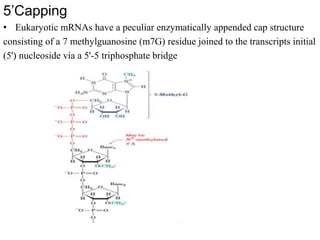
• Eukaryotic mRNAs have a peculiar enzymatically appended cap structure
consisting of a 7 methylguanosine (m7G) residue joined to the transcripts initial
(5') nucleoside via a 5'-5 triphosphate bridge
Process
• Phosphorylation by TFIIH at serine 5 residue (CTD of RNA pol II) recruits
the capping machinery.
• This m cap, which is added to the growing transcript before it is -30
nucleotides long, defines the eukaryotic translational start site.
• Capping marks the completion of RNAP II switch from transcription
initiation to elongation
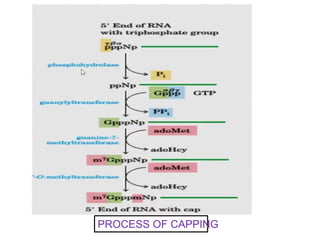
• Enzymes involved - nucleotide phosphohydrolase (RNA triphosphatase),
guanylyl transferase, methyltransferase
• First, an RNA triphosphatase removes the terminal phosphate from a pre-
mRNA
• Next, a guanylyl transferase adds the capping GMP (from GTP).
• Next, methyltransferases methylate the N7 position of guanine at the 5’ end
of nascent RNA.
PROCESS OF CAPPING
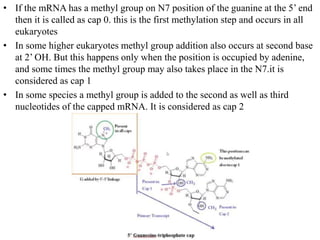
• If the mRNA has a methyl group on N7 position of the guanine at the 5’ end
then it is called as cap 0. this is the first methylation step and occurs in all
eukaryotes
• In some higher eukaryotes methyl group addition also occurs at second base
at 2’ OH. But this happens only when the position is occupied by adenine,
and some times the methyl group may also takes place in the N7.it is
considered as cap 1
• In some species a methyl group is added to the second as well as third
nucleotides of the capped mRNA. It is considered as cap 2
Functions
• Caps appear to serve at least four functions:
• They protect mRNA from degradation.
• They enhance the translatability of mRNAs.
• They enhance the transport of mRNAs from the nucleus into
the cytoplasm.
• They enhance the efficiency of splicing of mRNAs.
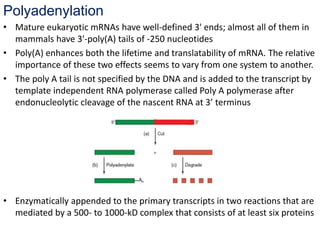
Polyadenylation
• Mature eukaryotic mRNAs have well-defined 3' ends; almost all of them in
mammals have 3'-poly(A) tails of -250 nucleotides
• Poly(A) enhances both the lifetime and translatability of mRNA. The relative
importance of these two effects seems to vary from one system to another.
• The poly A tail is not specified by the DNA and is added to the transcript by
template independent RNA polymerase called Poly A polymerase after
endonucleolytic cleavage of the nascent RNA at 3’ terminus
• Enzymatically appended to the primary transcripts in two reactions that are
mediated by a 500- to 1000-kD complex that consists of at least six proteins
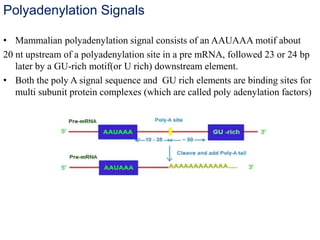
Polyadenylation Signals
• Mammalian polyadenylation signal consists of an AAUAAA motif about
20 nt upstream of a polyadenylation site in a pre mRNA, followed 23 or 24 bp
later by a GU-rich motif(or U rich) downstream element.
• Both the poly A signal sequence and GU rich elements are binding sites for
multi subunit protein complexes (which are called poly adenylation factors)
Polyadenylation Factors
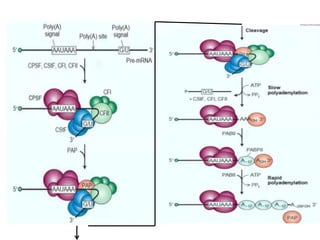
• Cleavage and polyadenylation specificity factor (CPSF) - 360 kDa,
having four different polypeptides, first forms an unstable complex
with the upstream AAUAAA poly(A) signal
• Cleavage stimulatory factor (CS1F) - a 200-kDa heterotrimer,
interacts with the GU-rich sequence
• Cleavage factor I (CFI) - a 150-kDa heterotrimer
• Cleavage factor II (CFII)
• Poly(A) polymerase (PAP) -links cleavage and polyadenylation in
template independent manner and substrate is ATP
• Poly(A)-binding protein (PABPII) - binds to the short A tail initially
added by PAP
Process
Identification of signals and binding
• Both the poly A signal sequence and GU rich elements are binding sites for
multi subunit protein complexes which are Cleavage and polyadenylation
specificity factor (CPSF) and Cleavage stimulatory factor (CS1F)
• Generation of poly A tail at 3’terminus first requires cleavage factors CFI
and CFII which act as endonucleases to cleave the RNA at polyadenylation
site.it is followed by polyadenylation
Polyadenylation
• The reaction passes through two stages:
• First a short oligo A sequence (~10residues)is added at the 3’ end
• In second phase the oligo A tail is extended to the full ~200 residue
length.this reaction requires another stimulatory factor that
recognizes the oligo A tail. This additional factor includes poly
Adenylation binding protein (PABP) which helps to polymerase to
add the adenosines possibly influences the length of the poly A tail
that is synthesized and appears to play a role in the maintenance of
the tail after synthesis
Termination of Transcription
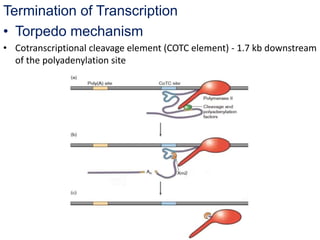
• Torpedo mechanism
• Cotranscriptional cleavage element (COTC element) - 1.7 kb downstream
of the polyadenylation site
Polyadenlytaion in bacteria
• Polyadenylation also occurs in some mRNA in bacteria. In E.coli
polyadenylation in some mRNA results in the formation of poly A tail of 10
to 40 nucleotides. It is catalyzed by poly A polymerase associated with
ribosomes
• Here poly A tail acts as a binding site for the nucleases (PNPase and Rnase)
responsible for degradation of mRNA
Alternative polyadenylation
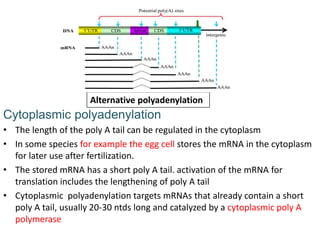
• In mRNAs of some protein coding genes have more than one poly
adenylation site.
• So a gene can code for several mRNAs that differ in the position of poly A
tail .This process is termed as alternative polyadenylation .this causes more
than one transcript from a single gene
Example: development of B lymphocytes  during development the synthesis
of antibody molecules switches from membrane bound forms to secreted
forms
Cytoplasmic polyadenylation
• The length of the poly A tail can be regulated in the cytoplasm
• In some species for example the egg cell stores the mRNA in the cytoplasm
for later use after fertilization.
• The stored mRNA has a short poly A tail. activation of the mRNA for
translation includes the lengthening of poly A tail
• Cytoplasmic polyadenylation targets mRNAs that already contain a short
poly A tail, usually 20-30 ntds long and catalyzed by a cytoplasmic poly A
polymerase
Alternative polyadenylation
Splicing
• Formation of a mature, functional mRNA, the introns are removed and
exons are spliced together is known as RNA splicing
• Most striking aspect of gene splicing is its precision
• Exons are never shuffled; their order in the mature mRNA is exactly the
same as that in the gene from which it is transcribed
• group III introns are present in eukaryotic nucleus, need spliceosomes to
splice out
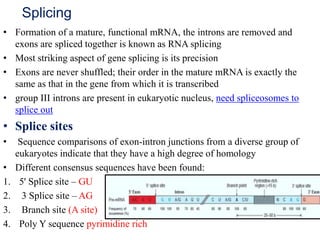
• Splice sites
• Sequence comparisons of exon-intron junctions from a diverse group of
eukaryotes indicate that they have a high degree of homology
• Different consensus sequences have been found:
1. 5' Splice site – GU
2. 3 Splice site – AG
3. Branch site (A site)
4. Poly Y sequence pyrimidine rich
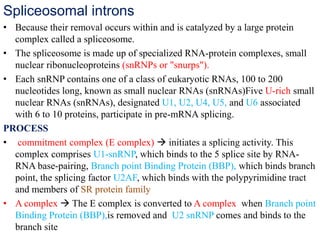
Spliceosomal introns
• Because their removal occurs within and is catalyzed by a large protein
complex called a spliceosome.
• The spliceosome is made up of specialized RNA-protein complexes, small
nuclear ribonucleoproteins (snRNPs or "snurps").
• Each snRNP contains one of a class of eukaryotic RNAs, 100 to 200
nucleotides long, known as small nuclear RNAs (snRNAs)Five U-rich small
nuclear RNAs (snRNAs), designated U1, U2, U4, U5, and U6 associated
with 6 to 10 proteins, participate in pre-mRNA splicing.
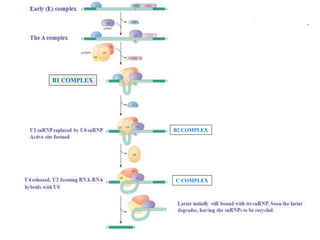
PROCESS
• commitment complex (E complex)  initiates a splicing activity. This
complex comprises U1-snRNP, which binds to the 5 splice site by RNA-
RNA base-pairing, Branch point Binding Protein (BBP), which binds branch
point, the splicing factor U2AF, which binds with the polypyrimidine tract
and members of SR protein family
• A complex  The E complex is converted to A complex when Branch point
Binding Protein (BBP),is removed and U2 snRNP comes and binds to the
branch site
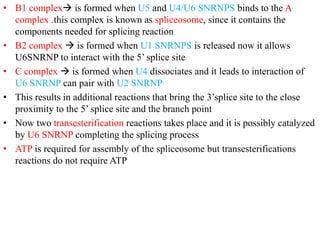
• B1 complex is formed when U5 and U4/U6 SNRNPS binds to the A
complex .this complex is known as spliceosome, since it contains the
components needed for splicing reaction
• B2 complex  is formed when U1 SNRNPS is released now it allows
U6SNRNP to interact with the 5’ splice site
• C complex  is formed when U4 dissociates and it leads to interaction of
U6 SNRNP can pair with U2 SNRNP
• This results in additional reactions that bring the 3’splice site to the close
proximity to the 5’ splice site and the branch point
• Now two transesterification reactions takes place and it is possibly catalyzed
by U6 SNRNP completing the splicing process
• ATP is required for assembly of the spliceosome but transesterifications
reactions do not require ATP
B2 COMPLEX
C COMPLEX
B1 COMPLEX
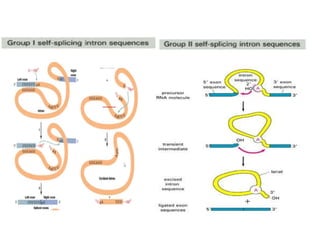
Self-splicing Introns
• The group I and group II introns are Self-splicing Introns
• The group I and group II introns, differ in the details of their splicing mechanisms
but share one surprising characteristic: they are self-splicing-no protein enzymes are
involved!
• Group I: Found in some nuclear, mitochondrial, and chloroplast genes that code for
rRNAs, mRNAs, and tRNAS
• Group II introns : Found in the primary transcripts of mitochondrial or chloroplast
mRNAs in fungi, algae, and plants
Group I Introns
• Three-step reaction sequence:
1. The first step in group I intron involves a nucleophilic attack at the 5’ splice site by
the 3’ OH of an exogenous (free) guanosine or guanine nucleotide
(GMP,GDP,GTP). This aadds the G nucleotide or nucleoside on to the 5’ end of the
intron and releases the 5’ exon
2. The 3'-terminal OH group of the newly liberated 5' exon forms a phosphodiester
bond with the 5'-terminal phosphate of the 3 exon, thereby splicing together the
two exons and releasing the intron.
3. The 3'-terminal OH group of the intron forms a phosphodiester bond with the
phosphate of the nucleotide 15 residues from the intron's 5' end, yielding the 5'-
terminal fragment with the remainder of the intron in cyclic form.
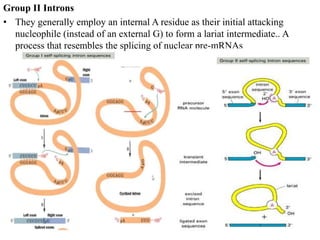
Group II Introns
• They generally employ an internal A residue as their initial attacking
nucleophile (instead of an external G) to form a lariat intermediate.. A
process that resembles the splicing of nuclear pre-mRNAs
The significance of gene splicing:
• It is an agent for rapid protein evolution
• And through alternative splicing, it permits a single gene to encode several
(sometimes many) proteins that may have significantly different functions.
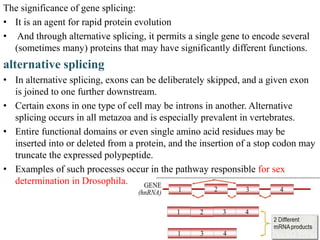
alternative splicing
• In alternative splicing, exons can be deliberately skipped, and a given exon
is joined to one further downstream.
• Certain exons in one type of cell may be introns in another. Alternative
splicing occurs in all metazoa and is especially prevalent in vertebrates.
• Entire functional domains or even single amino acid residues may be
inserted into or deleted from a protein, and the insertion of a stop codon may
truncate the expressed polypeptide.
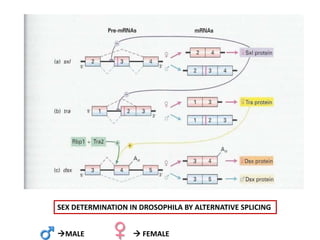
• Examples of such processes occur in the pathway responsible for sex
determination in Drosophila.
SEX DETERMINATION IN DROSOPHILA BY ALTERNATIVE SPLICING
MALE  FEMALE
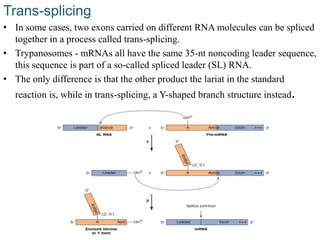
Trans-splicing
• In some cases, two exons carried on different RNA molecules can be spliced
together in a process called trans-splicing.
• Trypanosomes - mRNAs all have the same 35-nt noncoding leader sequence,
this sequence is part of a so-called spliced leader (SL) RNA.
• The only difference is that the other product the lariat in the standard
reaction is, while in trans-splicing, a Y-shaped branch structure instead.
RNA Editing
• It is the process used to modify the proteins made based on the conditions in
the cell. It helps create diversity in protein products from a limited number
of genes
• It can be best defined as changing the nucleotide sequence of RNA, so that
mature RNA differs from that encoded by the genomic sequence
• In eukaryotes RNA editing is widespread occurring in organisms as diverse
as yeast and humans
There are two mechanisms that mediate editing:
1. Site-specific deamination of adenine or cytosine
2. Guide RNA-directed uridine insertion or deletion
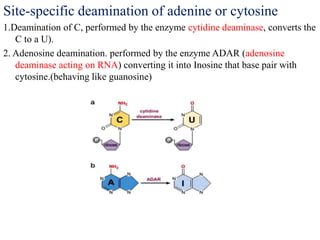
Site-specific deamination of adenine or cytosine
1.Deamination of C, performed by the enzyme cytidine deaminase, converts the
C to a U).
2. Adenosine deamination. performed by the enzyme ADAR (adenosine
deaminase acting on RNA) converting it into Inosine that base pair with
cytosine.(behaving like guanosine)
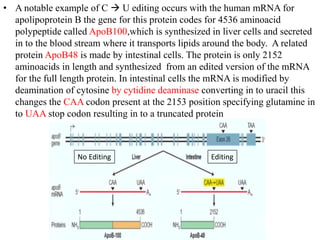
• A notable example of C  U editing occurs with the human mRNA for
apolipoprotein B the gene for this protein codes for 4536 aminoacid
polypeptide called ApoB100,which is synthesized in liver cells and secreted
in to the blood stream where it transports lipids around the body. A related
protein ApoB48 is made by intestinal cells. The protein is only 2152
aminoacids in length and synthesized from an edited version of the mRNA
for the full length protein. In intestinal cells the mRNA is modified by
deamination of cytosine by cytidine deaminase converting in to uracil this
changes the CAA codon present at the 2153 position specifying glutamine in
to UAA stop codon resulting in to a truncated protein
EditingNo Editing
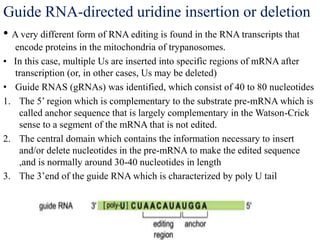
Guide RNA-directed uridine insertion or deletion
• A very different form of RNA editing is found in the RNA transcripts that
encode proteins in the mitochondria of trypanosomes.
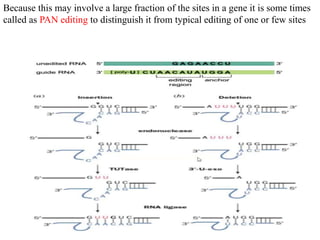
• In this case, multiple Us are inserted into specific regions of mRNA after
transcription (or, in other cases, Us may be deleted)
• Guide RNAS (gRNAs) was identified, which consist of 40 to 80 nucleotides
1. The 5’ region which is complementary to the substrate pre-mRNA which is
called anchor sequence that is largely complementary in the Watson-Crick
sense to a segment of the mRNA that is not edited.
2. The central domain which contains the information necessary to insert
and/or delete nucleotides in the pre-mRNA to make the edited sequence
,and is normally around 30-40 nucleotides in length
3. The 3’end of the guide RNA which is characterized by poly U tail
Because this may involve a large fraction of the sites in a gene it is some times
called as PAN editing to distinguish it from typical editing of one or few sites
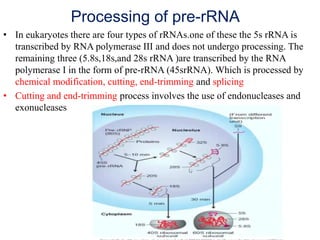
Processing of pre-rRNA
• In eukaryotes there are four types of rRNAs.one of these the 5s rRNA is
transcribed by RNA polymerase III and does not undergo processing. The
remaining three (5.8s,18s,and 28s rRNA )are transcribed by the RNA
polymerase I in the form of pre-rRNA (45srRNA). Which is processed by
chemical modification, cutting, end-trimming and splicing
• Cutting and end-trimming process involves the use of endonucleases and
exonucleases
• Chemical modification of rRNA requires a class of small RNAS, 60 to 300
nucleotides long, called snoRNAs (small nucleolar RNAS).
• snoRNAS primarily guide chemical modifications or other RNAs, mainly
rRNAS, tRNAs and smallnuclear RNAs
• There are two main classes of snoRNA, the C/D box snoRNAS, which are
associated with methylation, and the H/ACA box snoRNAS, which are
associated with pseudouridylation. It base pairs with the RNA to create the
double stranded region that is recognized as a substrate for methylation and
pseudouridylation.
• Chemical modification occurs within the region of complementarity. Each
chemical modification event is specified by a different snoRNA.
• Few eukaryotic nuclear and organelles genes contain self-splicing introns.
Group I and group II introns are self splicing introns (perform splicing
without help of proteinaceous enzymes) and act as ribozymes Group 1
introns are found in the primary transcripts of some nuclear pre-rRNA
forming genes and some organelle's genes. Group genes.Il introns are
generally found in the primary transcripts of some organelles gene
• Group I and Group II introns are also found in few prokaryotic genes
• Both group 1 and group II introns are metallic enzymes, which require
divalent metal cations for activity. Although the metal specificity varies
substantially among the group 1 introns, it is usually satisfied by Mg+2 or
Mn+2.
• Manygroup I and group II introns in organelle genes contain open reading
frame (ORF) which codes for a protein called a maturase that appears to
play a role in splicing. Apart from maturase activity, protein also has
endonuclease activity.
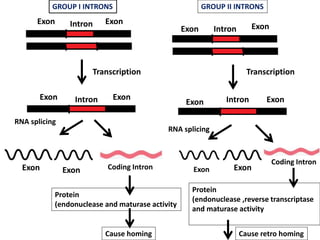
• Endonuclease allows the introns to be mobile, Group I introns migrate by
DNA-mediated mechanism which is termed as homing.
• A homing intron contains a single gene for an endonuclease. This enzyme
cleaves a very specific target site, which is only found in a copy of the target
gene not containing the homing intron. This situation only occurs when two
copies of the target gene are present in a cell, one with the homing intron
and one without The group 1 intron is replicated and then inserted into the
site of double strand break
Exon Exon
Exon Exon
Exon Exon
Exon Exon
Exon Exon Exon Exon
Intron
Intron
Intron
Intron
Coding Intron
Coding Intron
Transcription Transcription
RNA splicing
RNA splicing
Protein
(endonuclease and maturase activity
Cause homing
Protein
(endonuclease ,reverse transcriptase
and maturase activity
Cause retro homing
GROUP I INTRONS GROUP II INTRONS
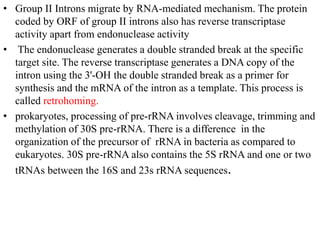
• Group II Introns migrate by RNA-mediated mechanism. The protein
coded by ORF of group II introns also has reverse transcriptase
activity apart from endonuclease activity
• The endonuclease generates a double stranded break at the specific
target site. The reverse transcriptase generates a DNA copy of the
intron using the 3'-OH the double stranded break as a primer for
synthesis and the mRNA of the intron as a template. This process is
called retrohoming.
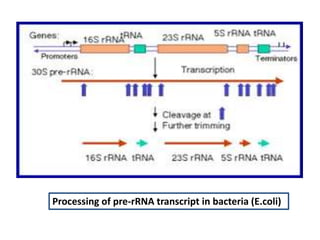
• prokaryotes, processing of pre-rRNA involves cleavage, trimming and
methylation of 30S pre-rRNA. There is a difference in the
organization of the precursor of rRNA in bacteria as compared to
eukaryotes. 30S pre-rRNA also contains the 5S rRNA and one or two
tRNAs between the 16S and 23s rRNA sequences.
Processing of pre-rRNA transcript in bacteria (E.coli)
Processing of pre-tRNA
• Mature cytosolic tRNAs, which average 75-80 nucleotides in length, are
produced from larger precursors (pre-tRNAs) synthesized by RNA
polymerase III in the nucleoplasm.
• Cleavage and base modification occur during processing of all pre-tRNAs;
some pre-tRNAs also are spliced during processing extra 5' nucleotides are
removed by ribonuclease P (RNase P), a ribonucleoprotein endonuclease
serves as a ribozyme
• Generation of 3’ end in e.coli involves endonuclease RNase E/F and
exonuclease RNase D/.RNaseE makes cut at 3’ and then RNase D trims
seven nucleotides from the 3’ end
• Three classes of base modifications occur: replacement of U residues at the
3'end of pre-tRNA with a CCA sequence with tRNA nucleotidyl transferase
• Several modifications such as addition of methyl and isopentenyl groups to
the heterocyclic ring of purine bases ,methylation of the 2- OH group in the
ribose of any residue conversion of specific uridines to dihydrouridine,
pseudouridine, or ribothymidine residues
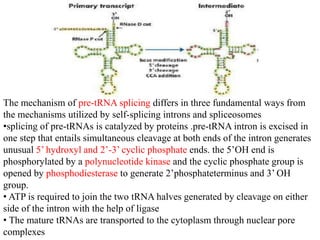
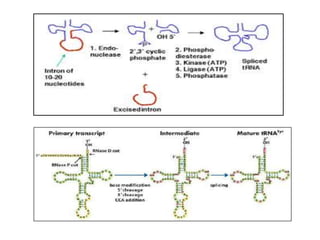
The mechanism of pre-tRNA splicing differs in three fundamental ways from
the mechanisms utilized by self-splicing introns and spliceosomes
•splicing of pre-tRNAs is catalyzed by proteins .pre-tRNA intron is excised in
one step that entails simultaneous cleavage at both ends of the intron generates
unusual 5’ hydroxyl and 2’-3’ cyclic phosphate ends. the 5’OH end is
phosphorylated by a polynucleotide kinase and the cyclic phosphate group is
opened by phosphodiesterase to generate 2’phosphateterminus and 3’ OH
group.
• ATP is required to join the two tRNA halves generated by cleavage on either
side of the intron with the help of ligase
• The mature tRNAs are transported to the cytoplasm through nuclear pore
complexes
Rna processing
Rna processing
Rna processing
Rna processing
Rna processing
Rna processing
Rna processing
Rna processing

Rna processing

  • 1.
  • 2.
    Introduction • In eukaryotestranscription and translation take place in different cellular compartments • In prokaryotes transcription of mRNA and translation occur simultaneously. • Thus mRNA molecule undergo little or no modification after synthesis by RNA polymerase in prokaryotes. In contrast pre-tRNA, pre-rRNA undergo processing like cleavage, addition of nucleotides and chemical modifications after synthesis • Although both prokaryotes and eukaryotes modify pre-tRNA and pre-rRNA, eukaryotes very extensively process pre mRNA destined to become mRNA
  • 3.
    Types of processingin mRNA 5’capping 3’cleavage/polyadenylation Splicing RNA Editing
  • 4.
    5’Capping • Eukaryotic mRNAshave a peculiar enzymatically appended cap structure consisting of a 7 methylguanosine (m7G) residue joined to the transcripts initial (5') nucleoside via a 5'-5 triphosphate bridge
  • 5.
    Process • Phosphorylation byTFIIH at serine 5 residue (CTD of RNA pol II) recruits the capping machinery. • This m cap, which is added to the growing transcript before it is -30 nucleotides long, defines the eukaryotic translational start site. • Capping marks the completion of RNAP II switch from transcription initiation to elongation • Enzymes involved - nucleotide phosphohydrolase (RNA triphosphatase), guanylyl transferase, methyltransferase • First, an RNA triphosphatase removes the terminal phosphate from a pre- mRNA • Next, a guanylyl transferase adds the capping GMP (from GTP). • Next, methyltransferases methylate the N7 position of guanine at the 5’ end of nascent RNA.
  • 6.
  • 7.
    • If themRNA has a methyl group on N7 position of the guanine at the 5’ end then it is called as cap 0. this is the first methylation step and occurs in all eukaryotes • In some higher eukaryotes methyl group addition also occurs at second base at 2’ OH. But this happens only when the position is occupied by adenine, and some times the methyl group may also takes place in the N7.it is considered as cap 1 • In some species a methyl group is added to the second as well as third nucleotides of the capped mRNA. It is considered as cap 2
  • 8.
    Functions • Caps appearto serve at least four functions: • They protect mRNA from degradation. • They enhance the translatability of mRNAs. • They enhance the transport of mRNAs from the nucleus into the cytoplasm. • They enhance the efficiency of splicing of mRNAs.
  • 9.
    Polyadenylation • Mature eukaryoticmRNAs have well-defined 3' ends; almost all of them in mammals have 3'-poly(A) tails of -250 nucleotides • Poly(A) enhances both the lifetime and translatability of mRNA. The relative importance of these two effects seems to vary from one system to another. • The poly A tail is not specified by the DNA and is added to the transcript by template independent RNA polymerase called Poly A polymerase after endonucleolytic cleavage of the nascent RNA at 3’ terminus • Enzymatically appended to the primary transcripts in two reactions that are mediated by a 500- to 1000-kD complex that consists of at least six proteins
  • 10.
    Polyadenylation Signals • Mammalianpolyadenylation signal consists of an AAUAAA motif about 20 nt upstream of a polyadenylation site in a pre mRNA, followed 23 or 24 bp later by a GU-rich motif(or U rich) downstream element. • Both the poly A signal sequence and GU rich elements are binding sites for multi subunit protein complexes (which are called poly adenylation factors)
  • 11.
    Polyadenylation Factors • Cleavageand polyadenylation specificity factor (CPSF) - 360 kDa, having four different polypeptides, first forms an unstable complex with the upstream AAUAAA poly(A) signal • Cleavage stimulatory factor (CS1F) - a 200-kDa heterotrimer, interacts with the GU-rich sequence • Cleavage factor I (CFI) - a 150-kDa heterotrimer • Cleavage factor II (CFII) • Poly(A) polymerase (PAP) -links cleavage and polyadenylation in template independent manner and substrate is ATP • Poly(A)-binding protein (PABPII) - binds to the short A tail initially added by PAP
  • 12.
    Process Identification of signalsand binding • Both the poly A signal sequence and GU rich elements are binding sites for multi subunit protein complexes which are Cleavage and polyadenylation specificity factor (CPSF) and Cleavage stimulatory factor (CS1F) • Generation of poly A tail at 3’terminus first requires cleavage factors CFI and CFII which act as endonucleases to cleave the RNA at polyadenylation site.it is followed by polyadenylation Polyadenylation • The reaction passes through two stages: • First a short oligo A sequence (~10residues)is added at the 3’ end • In second phase the oligo A tail is extended to the full ~200 residue length.this reaction requires another stimulatory factor that recognizes the oligo A tail. This additional factor includes poly Adenylation binding protein (PABP) which helps to polymerase to add the adenosines possibly influences the length of the poly A tail that is synthesized and appears to play a role in the maintenance of the tail after synthesis
  • 14.
    Termination of Transcription •Torpedo mechanism • Cotranscriptional cleavage element (COTC element) - 1.7 kb downstream of the polyadenylation site
  • 15.
    Polyadenlytaion in bacteria •Polyadenylation also occurs in some mRNA in bacteria. In E.coli polyadenylation in some mRNA results in the formation of poly A tail of 10 to 40 nucleotides. It is catalyzed by poly A polymerase associated with ribosomes • Here poly A tail acts as a binding site for the nucleases (PNPase and Rnase) responsible for degradation of mRNA Alternative polyadenylation • In mRNAs of some protein coding genes have more than one poly adenylation site. • So a gene can code for several mRNAs that differ in the position of poly A tail .This process is termed as alternative polyadenylation .this causes more than one transcript from a single gene Example: development of B lymphocytes  during development the synthesis of antibody molecules switches from membrane bound forms to secreted forms
  • 16.
    Cytoplasmic polyadenylation • Thelength of the poly A tail can be regulated in the cytoplasm • In some species for example the egg cell stores the mRNA in the cytoplasm for later use after fertilization. • The stored mRNA has a short poly A tail. activation of the mRNA for translation includes the lengthening of poly A tail • Cytoplasmic polyadenylation targets mRNAs that already contain a short poly A tail, usually 20-30 ntds long and catalyzed by a cytoplasmic poly A polymerase Alternative polyadenylation
  • 17.
    Splicing • Formation ofa mature, functional mRNA, the introns are removed and exons are spliced together is known as RNA splicing • Most striking aspect of gene splicing is its precision • Exons are never shuffled; their order in the mature mRNA is exactly the same as that in the gene from which it is transcribed • group III introns are present in eukaryotic nucleus, need spliceosomes to splice out • Splice sites • Sequence comparisons of exon-intron junctions from a diverse group of eukaryotes indicate that they have a high degree of homology • Different consensus sequences have been found: 1. 5' Splice site – GU 2. 3 Splice site – AG 3. Branch site (A site) 4. Poly Y sequence pyrimidine rich
  • 18.
    Spliceosomal introns • Becausetheir removal occurs within and is catalyzed by a large protein complex called a spliceosome. • The spliceosome is made up of specialized RNA-protein complexes, small nuclear ribonucleoproteins (snRNPs or "snurps"). • Each snRNP contains one of a class of eukaryotic RNAs, 100 to 200 nucleotides long, known as small nuclear RNAs (snRNAs)Five U-rich small nuclear RNAs (snRNAs), designated U1, U2, U4, U5, and U6 associated with 6 to 10 proteins, participate in pre-mRNA splicing. PROCESS • commitment complex (E complex)  initiates a splicing activity. This complex comprises U1-snRNP, which binds to the 5 splice site by RNA- RNA base-pairing, Branch point Binding Protein (BBP), which binds branch point, the splicing factor U2AF, which binds with the polypyrimidine tract and members of SR protein family • A complex  The E complex is converted to A complex when Branch point Binding Protein (BBP),is removed and U2 snRNP comes and binds to the branch site
  • 19.
    • B1 complexis formed when U5 and U4/U6 SNRNPS binds to the A complex .this complex is known as spliceosome, since it contains the components needed for splicing reaction • B2 complex  is formed when U1 SNRNPS is released now it allows U6SNRNP to interact with the 5’ splice site • C complex  is formed when U4 dissociates and it leads to interaction of U6 SNRNP can pair with U2 SNRNP • This results in additional reactions that bring the 3’splice site to the close proximity to the 5’ splice site and the branch point • Now two transesterification reactions takes place and it is possibly catalyzed by U6 SNRNP completing the splicing process • ATP is required for assembly of the spliceosome but transesterifications reactions do not require ATP
  • 20.
  • 21.
    Self-splicing Introns • Thegroup I and group II introns are Self-splicing Introns • The group I and group II introns, differ in the details of their splicing mechanisms but share one surprising characteristic: they are self-splicing-no protein enzymes are involved! • Group I: Found in some nuclear, mitochondrial, and chloroplast genes that code for rRNAs, mRNAs, and tRNAS • Group II introns : Found in the primary transcripts of mitochondrial or chloroplast mRNAs in fungi, algae, and plants Group I Introns • Three-step reaction sequence: 1. The first step in group I intron involves a nucleophilic attack at the 5’ splice site by the 3’ OH of an exogenous (free) guanosine or guanine nucleotide (GMP,GDP,GTP). This aadds the G nucleotide or nucleoside on to the 5’ end of the intron and releases the 5’ exon 2. The 3'-terminal OH group of the newly liberated 5' exon forms a phosphodiester bond with the 5'-terminal phosphate of the 3 exon, thereby splicing together the two exons and releasing the intron. 3. The 3'-terminal OH group of the intron forms a phosphodiester bond with the phosphate of the nucleotide 15 residues from the intron's 5' end, yielding the 5'- terminal fragment with the remainder of the intron in cyclic form.
  • 22.
    Group II Introns •They generally employ an internal A residue as their initial attacking nucleophile (instead of an external G) to form a lariat intermediate.. A process that resembles the splicing of nuclear pre-mRNAs
  • 23.
    The significance ofgene splicing: • It is an agent for rapid protein evolution • And through alternative splicing, it permits a single gene to encode several (sometimes many) proteins that may have significantly different functions. alternative splicing • In alternative splicing, exons can be deliberately skipped, and a given exon is joined to one further downstream. • Certain exons in one type of cell may be introns in another. Alternative splicing occurs in all metazoa and is especially prevalent in vertebrates. • Entire functional domains or even single amino acid residues may be inserted into or deleted from a protein, and the insertion of a stop codon may truncate the expressed polypeptide. • Examples of such processes occur in the pathway responsible for sex determination in Drosophila.
  • 24.
    SEX DETERMINATION INDROSOPHILA BY ALTERNATIVE SPLICING MALE  FEMALE
  • 25.
    Trans-splicing • In somecases, two exons carried on different RNA molecules can be spliced together in a process called trans-splicing. • Trypanosomes - mRNAs all have the same 35-nt noncoding leader sequence, this sequence is part of a so-called spliced leader (SL) RNA. • The only difference is that the other product the lariat in the standard reaction is, while in trans-splicing, a Y-shaped branch structure instead.
  • 26.
    RNA Editing • Itis the process used to modify the proteins made based on the conditions in the cell. It helps create diversity in protein products from a limited number of genes • It can be best defined as changing the nucleotide sequence of RNA, so that mature RNA differs from that encoded by the genomic sequence • In eukaryotes RNA editing is widespread occurring in organisms as diverse as yeast and humans There are two mechanisms that mediate editing: 1. Site-specific deamination of adenine or cytosine 2. Guide RNA-directed uridine insertion or deletion
  • 27.
    Site-specific deamination ofadenine or cytosine 1.Deamination of C, performed by the enzyme cytidine deaminase, converts the C to a U). 2. Adenosine deamination. performed by the enzyme ADAR (adenosine deaminase acting on RNA) converting it into Inosine that base pair with cytosine.(behaving like guanosine)
  • 28.
    • A notableexample of C  U editing occurs with the human mRNA for apolipoprotein B the gene for this protein codes for 4536 aminoacid polypeptide called ApoB100,which is synthesized in liver cells and secreted in to the blood stream where it transports lipids around the body. A related protein ApoB48 is made by intestinal cells. The protein is only 2152 aminoacids in length and synthesized from an edited version of the mRNA for the full length protein. In intestinal cells the mRNA is modified by deamination of cytosine by cytidine deaminase converting in to uracil this changes the CAA codon present at the 2153 position specifying glutamine in to UAA stop codon resulting in to a truncated protein EditingNo Editing
  • 29.
    Guide RNA-directed uridineinsertion or deletion • A very different form of RNA editing is found in the RNA transcripts that encode proteins in the mitochondria of trypanosomes. • In this case, multiple Us are inserted into specific regions of mRNA after transcription (or, in other cases, Us may be deleted) • Guide RNAS (gRNAs) was identified, which consist of 40 to 80 nucleotides 1. The 5’ region which is complementary to the substrate pre-mRNA which is called anchor sequence that is largely complementary in the Watson-Crick sense to a segment of the mRNA that is not edited. 2. The central domain which contains the information necessary to insert and/or delete nucleotides in the pre-mRNA to make the edited sequence ,and is normally around 30-40 nucleotides in length 3. The 3’end of the guide RNA which is characterized by poly U tail
  • 30.
    Because this mayinvolve a large fraction of the sites in a gene it is some times called as PAN editing to distinguish it from typical editing of one or few sites
  • 31.
    Processing of pre-rRNA •In eukaryotes there are four types of rRNAs.one of these the 5s rRNA is transcribed by RNA polymerase III and does not undergo processing. The remaining three (5.8s,18s,and 28s rRNA )are transcribed by the RNA polymerase I in the form of pre-rRNA (45srRNA). Which is processed by chemical modification, cutting, end-trimming and splicing • Cutting and end-trimming process involves the use of endonucleases and exonucleases
  • 32.
    • Chemical modificationof rRNA requires a class of small RNAS, 60 to 300 nucleotides long, called snoRNAs (small nucleolar RNAS). • snoRNAS primarily guide chemical modifications or other RNAs, mainly rRNAS, tRNAs and smallnuclear RNAs • There are two main classes of snoRNA, the C/D box snoRNAS, which are associated with methylation, and the H/ACA box snoRNAS, which are associated with pseudouridylation. It base pairs with the RNA to create the double stranded region that is recognized as a substrate for methylation and pseudouridylation. • Chemical modification occurs within the region of complementarity. Each chemical modification event is specified by a different snoRNA. • Few eukaryotic nuclear and organelles genes contain self-splicing introns. Group I and group II introns are self splicing introns (perform splicing without help of proteinaceous enzymes) and act as ribozymes Group 1 introns are found in the primary transcripts of some nuclear pre-rRNA forming genes and some organelle's genes. Group genes.Il introns are generally found in the primary transcripts of some organelles gene • Group I and Group II introns are also found in few prokaryotic genes
  • 34.
    • Both group1 and group II introns are metallic enzymes, which require divalent metal cations for activity. Although the metal specificity varies substantially among the group 1 introns, it is usually satisfied by Mg+2 or Mn+2. • Manygroup I and group II introns in organelle genes contain open reading frame (ORF) which codes for a protein called a maturase that appears to play a role in splicing. Apart from maturase activity, protein also has endonuclease activity. • Endonuclease allows the introns to be mobile, Group I introns migrate by DNA-mediated mechanism which is termed as homing. • A homing intron contains a single gene for an endonuclease. This enzyme cleaves a very specific target site, which is only found in a copy of the target gene not containing the homing intron. This situation only occurs when two copies of the target gene are present in a cell, one with the homing intron and one without The group 1 intron is replicated and then inserted into the site of double strand break
  • 35.
    Exon Exon Exon Exon ExonExon Exon Exon Exon Exon Exon Exon Intron Intron Intron Intron Coding Intron Coding Intron Transcription Transcription RNA splicing RNA splicing Protein (endonuclease and maturase activity Cause homing Protein (endonuclease ,reverse transcriptase and maturase activity Cause retro homing GROUP I INTRONS GROUP II INTRONS
  • 36.
    • Group IIIntrons migrate by RNA-mediated mechanism. The protein coded by ORF of group II introns also has reverse transcriptase activity apart from endonuclease activity • The endonuclease generates a double stranded break at the specific target site. The reverse transcriptase generates a DNA copy of the intron using the 3'-OH the double stranded break as a primer for synthesis and the mRNA of the intron as a template. This process is called retrohoming. • prokaryotes, processing of pre-rRNA involves cleavage, trimming and methylation of 30S pre-rRNA. There is a difference in the organization of the precursor of rRNA in bacteria as compared to eukaryotes. 30S pre-rRNA also contains the 5S rRNA and one or two tRNAs between the 16S and 23s rRNA sequences.
  • 37.
    Processing of pre-rRNAtranscript in bacteria (E.coli)
  • 38.
    Processing of pre-tRNA •Mature cytosolic tRNAs, which average 75-80 nucleotides in length, are produced from larger precursors (pre-tRNAs) synthesized by RNA polymerase III in the nucleoplasm. • Cleavage and base modification occur during processing of all pre-tRNAs; some pre-tRNAs also are spliced during processing extra 5' nucleotides are removed by ribonuclease P (RNase P), a ribonucleoprotein endonuclease serves as a ribozyme • Generation of 3’ end in e.coli involves endonuclease RNase E/F and exonuclease RNase D/.RNaseE makes cut at 3’ and then RNase D trims seven nucleotides from the 3’ end • Three classes of base modifications occur: replacement of U residues at the 3'end of pre-tRNA with a CCA sequence with tRNA nucleotidyl transferase • Several modifications such as addition of methyl and isopentenyl groups to the heterocyclic ring of purine bases ,methylation of the 2- OH group in the ribose of any residue conversion of specific uridines to dihydrouridine, pseudouridine, or ribothymidine residues
  • 39.
    The mechanism ofpre-tRNA splicing differs in three fundamental ways from the mechanisms utilized by self-splicing introns and spliceosomes •splicing of pre-tRNAs is catalyzed by proteins .pre-tRNA intron is excised in one step that entails simultaneous cleavage at both ends of the intron generates unusual 5’ hydroxyl and 2’-3’ cyclic phosphate ends. the 5’OH end is phosphorylated by a polynucleotide kinase and the cyclic phosphate group is opened by phosphodiesterase to generate 2’phosphateterminus and 3’ OH group. • ATP is required to join the two tRNA halves generated by cleavage on either side of the intron with the help of ligase • The mature tRNAs are transported to the cytoplasm through nuclear pore complexes