Spectrofluorometry
PRESENTED BY:
PRASHANT V C
DEPT OF ZOOLOGY
GUK
Spectrofluorometry
Theory
what cause fluorescence
energy level diagram
Quantification
Instrumentation
Effect of Solvent, Temperature and pH.
Application
An excited molecules can lose its
excess energy via several
processes
-Process B - Releasing E [energy] as heat
when changing within the same state
-The remaining energy can be release by
one of following Processes (C, D & E)
-Process C - Transfer its remaining E to
other chemical species by collision
-Process D - Emitting photons when
falling back to the ground state -
Fluorescence
-Process E1 - Undergoing internal
transition within the same mode of the
excited state
-Process E2 - Undergoing intersystem
crossing to a triplet sublevel of the
excited state
-Process F - Radiating E from triplet to
ground state (triplet quenching) -
Phosphorescence
S0
T1
S2
S1
v1
v2
v3
v4
v1
v2
v3
v4
v1
v2
v3
v4
v1
v2
v3
v4
Inter-
system
crossing
Internal
transition
B
B
E1
E2
C
F
A
B
Fluorescence
D
Fluorescence
Jablonsky diagram
Phosphorescence
Review: Fate of Excited State
When the molecule absorb a photon, it will be excited to
an upper electronic and upper vibrational state. Three
things can happen while it is in this excited state:
1- It may undergo a radiation less loss [vibrational relaxation]
of electronic energy through collision & other
interactions. Most molecules do not fluoresce because
of this deactivation process.
2-It can emit a photon & Fluoresce
3-It can undergo a transition to a metastable state [triplet]
and phosphoresce
Fluorescence
1- Fluorescence is and Emission phenomenon: the energy
transition from a higher to lower state within the molecule
that is being measured by the detection of emitted radiation.
[not the absorption as in Spectrophotometry]
2-It includes:
a] Excitation
[due to input of energy by absorption of EMR-higher energy/Shorter λ]
b] Emission
[ resulted into fluorescence with lower energy/Longer λ]
3-The difference between these two λ is known as the
“STOKES SHIFT” [Larger the shift better the results]
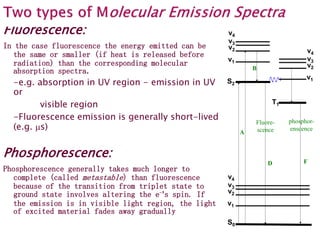
Fluorescence:
In the case fluorescence the energy emitted can be
the same or smaller (if heat is released before
radiation) than the corresponding molecular
absorption spectra.
-e.g. absorption in UV region - emission in UV
or
visible region
-Fluorescence emission is generally short-lived
(e.g. ms)
Phosphorescence:
Phosphorescence generally takes much longer to
complete (called metastable) than fluorescence
because of the transition from triplet state to
ground state involves altering the e-’s spin. If
the emission is in visible light region, the light
of excited material fades away gradually
S0
S2
v1
v2
v3
v4
v1
v2
v3
v4
B
A
phosphor-
enscence
D
Fluore-
scence
T1
v1
v2
v3
v4
F
Intensity of Fluoresecnce
-Intensity is proportional to the:
1-Ground-state population of Fluorophore
2-The rate of absorption
3-The volume of sample illuminated
4-The two λ [excitation & emission]
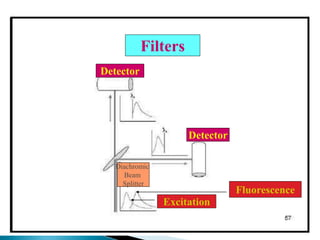
Detector
Detector
Diachromic
Beam
Splitter
Filters
Fluorescence
Excitation
Instrumentation
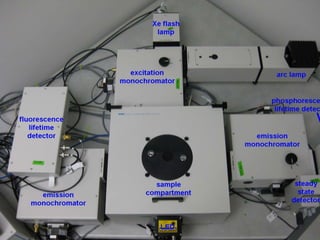
--Sources:
LASER, Deuterium, Halogen,
Xenon Lamp [150W, 300-1300nm]
--Dispersing
Filter, Monochromator, Prism
--Detectors:
Photomultiplier,
Charge Coupled Device
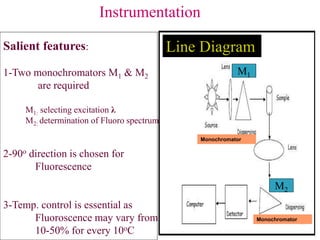
Instrumentation
Monochromator
Monochromator
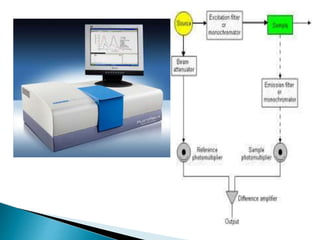
Line Diagram
Salient features:
1-Two monochromators M1 & M2
are required
M1: selecting excitation λ
M2: determination of Fluoro spectrum
2-90o direction is chosen for
Fluorescence
3-Temp. control is essential as
Fluoroscence may vary from
10-50% for every 10oC
M1
M2
Rules for Fluorescence
1-Not observed from saturated hydrocarbons as there are no or n electrons.
Weak fluorescence observed sometimes in the vacuum UV.
2-Rarely observed from non-aromatic hydrocarbons that have some
double bonds.
3-Phopsphorescence is often favourable in aromatic molecules containing
corbonyl groups.
4-Substituents attached to aromatic rings influence Fluorescence. These groups
change the nature of lowest-lying excited state [S1]
5-Addition of rings increases the Fluorescence yield
6-Aliphatic molecules tend to photodissocate rather than fluoresce
SOLVENT EFECT
Fluorescence intensity and wavelength often vary with the
solvent. Solvent capable of exhibiting strong van-der-waals
binding forces with the excited state species prolong the lifetime
of a collision encounter and favor deactivation.
The Viscosity, Polarity and Hydrogen bonding characteristic of
of solvent can significantly affect fluorescence.
There is a rapid (10-11- 10-12 s) reorientation of solvent molecule
around the excited state species causes a shift in excitation
wavelength.
Increase fluor with increase in solvent viscosity due to reduced
rate of bimolecular collision and rate of dynamic quenching.
ENVIRONMENTAL EFFECT
Temperature: Increasing temperature will decrease the
fluorescence.
pH:
pH of solution on protic solvent can be critical for aromatic
molecule with acidic or basic functional group ( Phenols,
Amines).
In some cases only protonated or unprotonated form of acid or
base may be fluorescent. For example, many phenols are
fluorescent only in non-ionized form.
Protic solvent: that has a H atom bound to an O2 (as in OH) or a N (as in an NH3)
APPLICATIONS
-The LASER [Light Amplification by Stimulated Emission of Radiation]
induced fluorescence (LIF) is very sensitive for scanning single
molecule.
-The detection of Non-Fluorecence compounds may be achieved by
coupling Flour Probe [extrinsic Fluorescence].
E.g.: Amino acids:Dansyl chloride Peptides: 0-pthaladehyde
Nucleotide strands by Acridinne [difference in Stokes Shift]
Single strand-Red colour Double strand-Green colour
-Major use for quantitative determination of materials present in
concentrations too low such as Vitamin in food stuffs, NADH,
Hormones, Carcinogenes, Cholestrol, Porphyrins etc.
THANKS

Spectrofluorometry.ppt

  • 1.
  • 2.
    Spectrofluorometry Theory what cause fluorescence energylevel diagram Quantification Instrumentation Effect of Solvent, Temperature and pH. Application
  • 3.
    An excited moleculescan lose its excess energy via several processes -Process B - Releasing E [energy] as heat when changing within the same state -The remaining energy can be release by one of following Processes (C, D & E) -Process C - Transfer its remaining E to other chemical species by collision -Process D - Emitting photons when falling back to the ground state - Fluorescence -Process E1 - Undergoing internal transition within the same mode of the excited state -Process E2 - Undergoing intersystem crossing to a triplet sublevel of the excited state -Process F - Radiating E from triplet to ground state (triplet quenching) - Phosphorescence S0 T1 S2 S1 v1 v2 v3 v4 v1 v2 v3 v4 v1 v2 v3 v4 v1 v2 v3 v4 Inter- system crossing Internal transition B B E1 E2 C F A B Fluorescence D Fluorescence Jablonsky diagram Phosphorescence
  • 4.
    Review: Fate ofExcited State When the molecule absorb a photon, it will be excited to an upper electronic and upper vibrational state. Three things can happen while it is in this excited state: 1- It may undergo a radiation less loss [vibrational relaxation] of electronic energy through collision & other interactions. Most molecules do not fluoresce because of this deactivation process. 2-It can emit a photon & Fluoresce 3-It can undergo a transition to a metastable state [triplet] and phosphoresce
  • 5.
    Fluorescence 1- Fluorescence isand Emission phenomenon: the energy transition from a higher to lower state within the molecule that is being measured by the detection of emitted radiation. [not the absorption as in Spectrophotometry] 2-It includes: a] Excitation [due to input of energy by absorption of EMR-higher energy/Shorter λ] b] Emission [ resulted into fluorescence with lower energy/Longer λ] 3-The difference between these two λ is known as the “STOKES SHIFT” [Larger the shift better the results]
  • 6.
    Fluorescence: In the casefluorescence the energy emitted can be the same or smaller (if heat is released before radiation) than the corresponding molecular absorption spectra. -e.g. absorption in UV region - emission in UV or visible region -Fluorescence emission is generally short-lived (e.g. ms) Phosphorescence: Phosphorescence generally takes much longer to complete (called metastable) than fluorescence because of the transition from triplet state to ground state involves altering the e-’s spin. If the emission is in visible light region, the light of excited material fades away gradually S0 S2 v1 v2 v3 v4 v1 v2 v3 v4 B A phosphor- enscence D Fluore- scence T1 v1 v2 v3 v4 F
  • 7.
    Intensity of Fluoresecnce -Intensityis proportional to the: 1-Ground-state population of Fluorophore 2-The rate of absorption 3-The volume of sample illuminated 4-The two λ [excitation & emission]
  • 8.
  • 9.
    Instrumentation --Sources: LASER, Deuterium, Halogen, XenonLamp [150W, 300-1300nm] --Dispersing Filter, Monochromator, Prism --Detectors: Photomultiplier, Charge Coupled Device
  • 10.
    Instrumentation Monochromator Monochromator Line Diagram Salient features: 1-Twomonochromators M1 & M2 are required M1: selecting excitation λ M2: determination of Fluoro spectrum 2-90o direction is chosen for Fluorescence 3-Temp. control is essential as Fluoroscence may vary from 10-50% for every 10oC M1 M2
  • 11.
    Rules for Fluorescence 1-Notobserved from saturated hydrocarbons as there are no or n electrons. Weak fluorescence observed sometimes in the vacuum UV. 2-Rarely observed from non-aromatic hydrocarbons that have some double bonds. 3-Phopsphorescence is often favourable in aromatic molecules containing corbonyl groups. 4-Substituents attached to aromatic rings influence Fluorescence. These groups change the nature of lowest-lying excited state [S1] 5-Addition of rings increases the Fluorescence yield 6-Aliphatic molecules tend to photodissocate rather than fluoresce
  • 12.
    SOLVENT EFECT Fluorescence intensityand wavelength often vary with the solvent. Solvent capable of exhibiting strong van-der-waals binding forces with the excited state species prolong the lifetime of a collision encounter and favor deactivation. The Viscosity, Polarity and Hydrogen bonding characteristic of of solvent can significantly affect fluorescence. There is a rapid (10-11- 10-12 s) reorientation of solvent molecule around the excited state species causes a shift in excitation wavelength. Increase fluor with increase in solvent viscosity due to reduced rate of bimolecular collision and rate of dynamic quenching.
  • 13.
    ENVIRONMENTAL EFFECT Temperature: Increasingtemperature will decrease the fluorescence. pH: pH of solution on protic solvent can be critical for aromatic molecule with acidic or basic functional group ( Phenols, Amines). In some cases only protonated or unprotonated form of acid or base may be fluorescent. For example, many phenols are fluorescent only in non-ionized form. Protic solvent: that has a H atom bound to an O2 (as in OH) or a N (as in an NH3)
  • 14.
    APPLICATIONS -The LASER [LightAmplification by Stimulated Emission of Radiation] induced fluorescence (LIF) is very sensitive for scanning single molecule. -The detection of Non-Fluorecence compounds may be achieved by coupling Flour Probe [extrinsic Fluorescence]. E.g.: Amino acids:Dansyl chloride Peptides: 0-pthaladehyde Nucleotide strands by Acridinne [difference in Stokes Shift] Single strand-Red colour Double strand-Green colour -Major use for quantitative determination of materials present in concentrations too low such as Vitamin in food stuffs, NADH, Hormones, Carcinogenes, Cholestrol, Porphyrins etc.
  • 17.