Mentor; prof, S. M. PRASAD
MADE BY: DEEPAK YADAV
M.Sc-IV SEM.
RNA EDITING AND RNA TRANSPORT
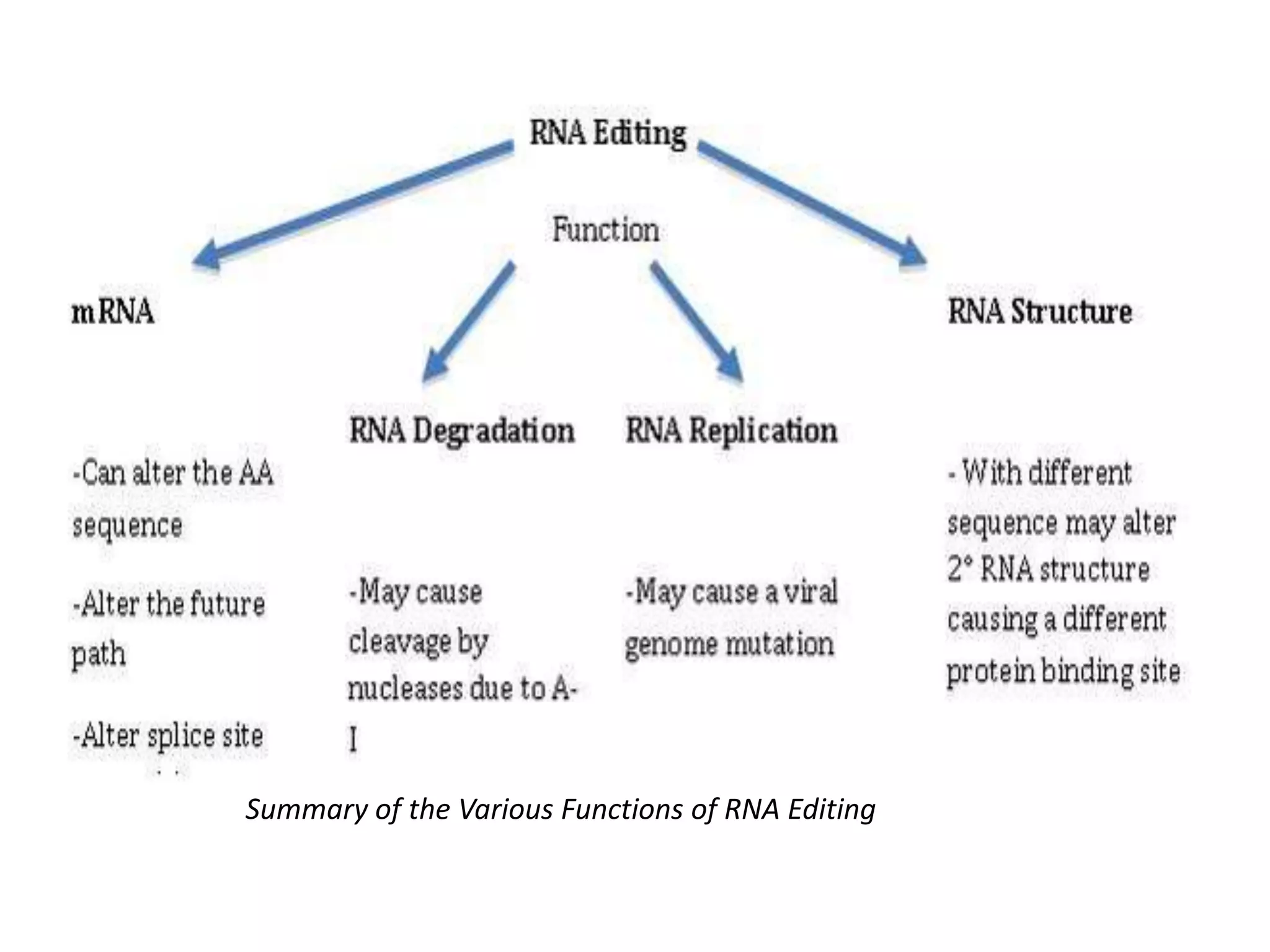
Summary of the Various Functions of RNA Editing
• RNA editing is a process in which information change at
the level of mRNA. It is revealed by situations in which
the coding sequence in an RNA differs from the
sequence of DNA from which it was transcribed.
• Editing events may include the insertion, deletion, and
base substitution of nucleotides within the edited RNA
molecule.
• RNA editing has been observed in
some tRNA, rRNA, mRNA molecules of eukaryotes and
their viruses, archaea and prokaryotes.
• RNA editing occurs in the cell nucleus and cytosol, as
well as within mitochondria and plastids.
• The diversity of RNA editing phenomena
includes nucleobase modifications such as
cytidine (C) to uridine (U) and adenosine (A) to
inosine (I) deaminations, as well as non-
templated nucleotide additions and insertions.
• RNA editing in mRNAs effectively alters the
amino acid sequence of the encoded protein so
that it differs from that predicted by the genomic
DNA sequence.
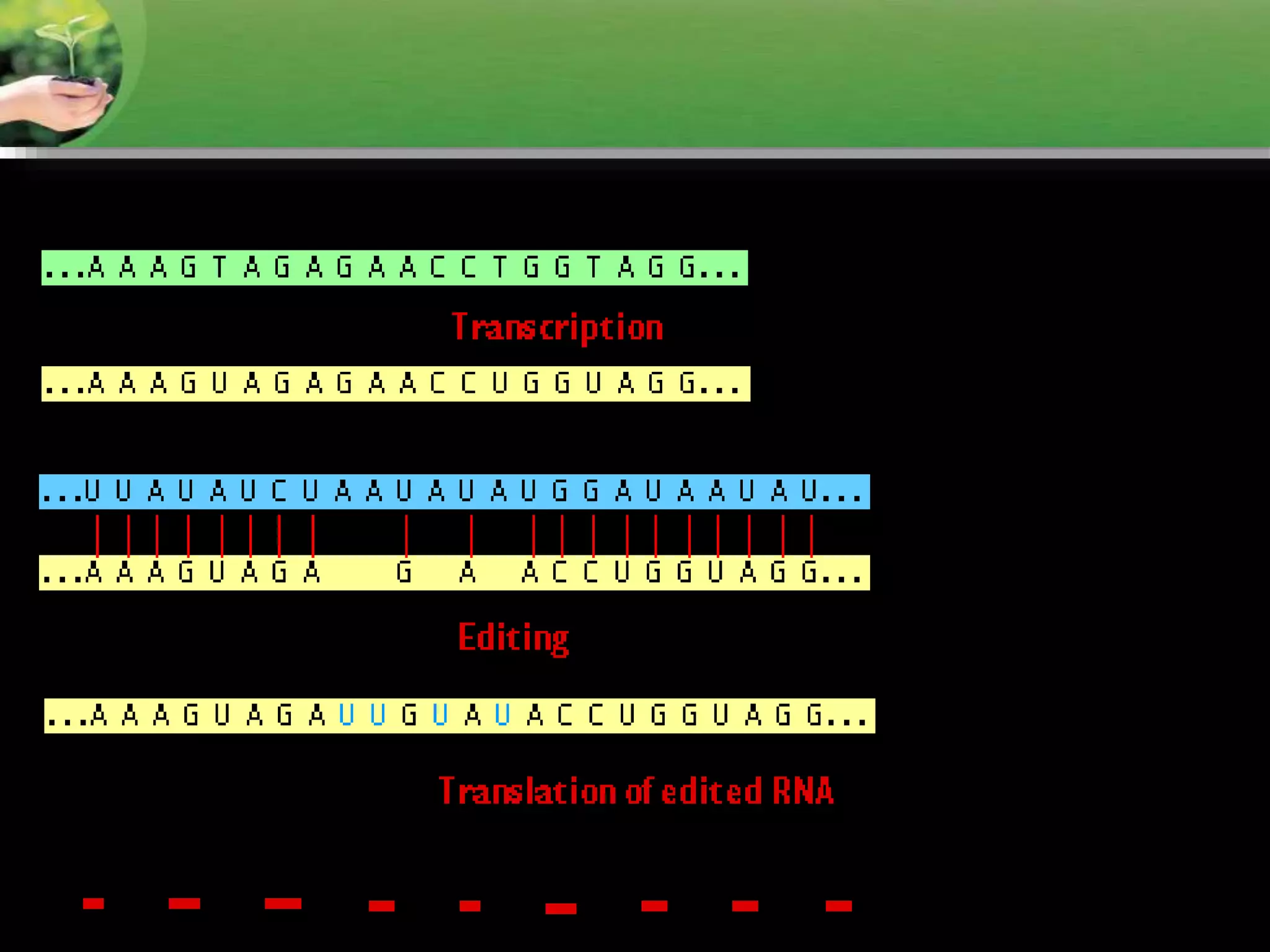
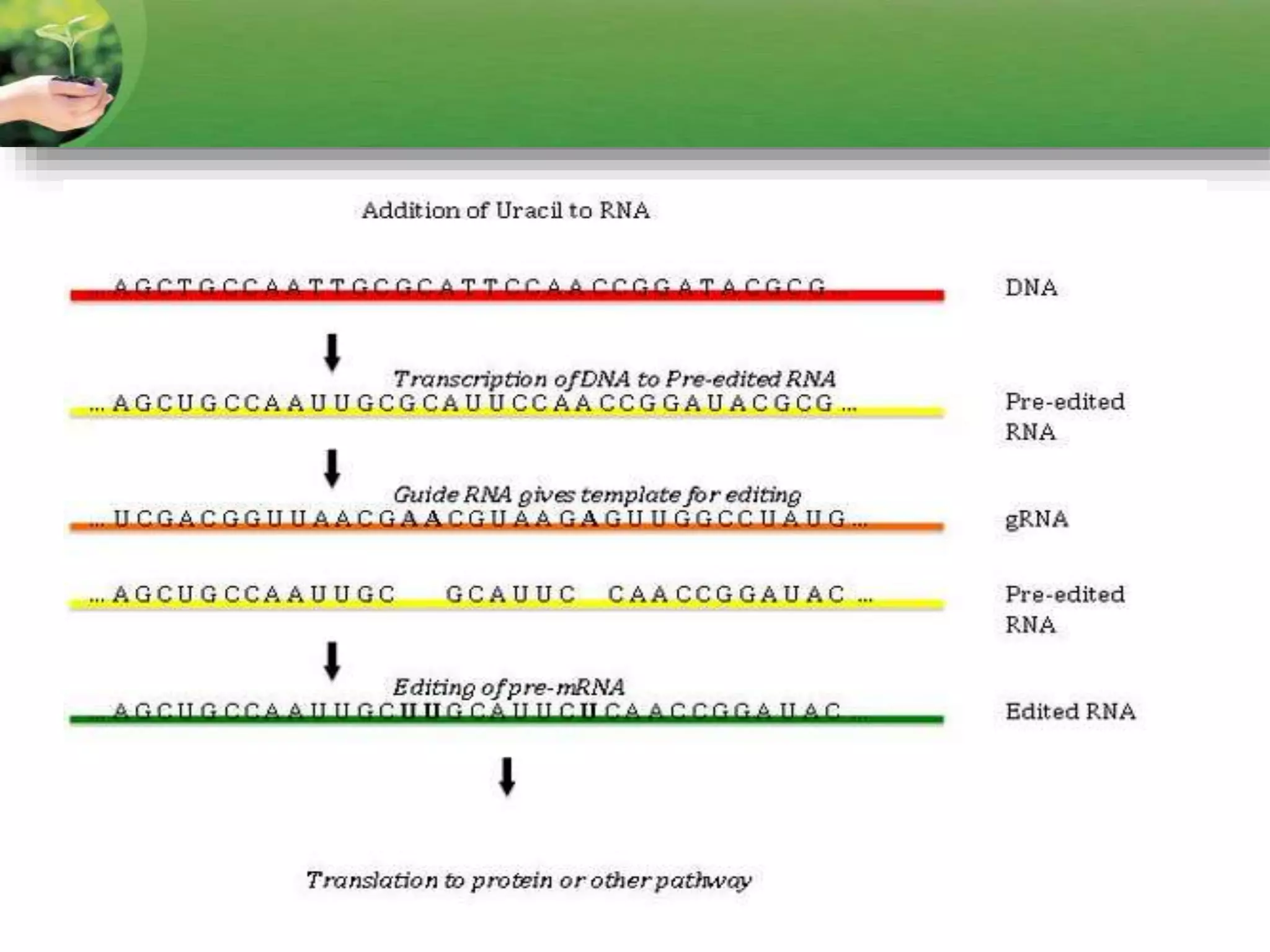
• RNA editing through the addition and deletion
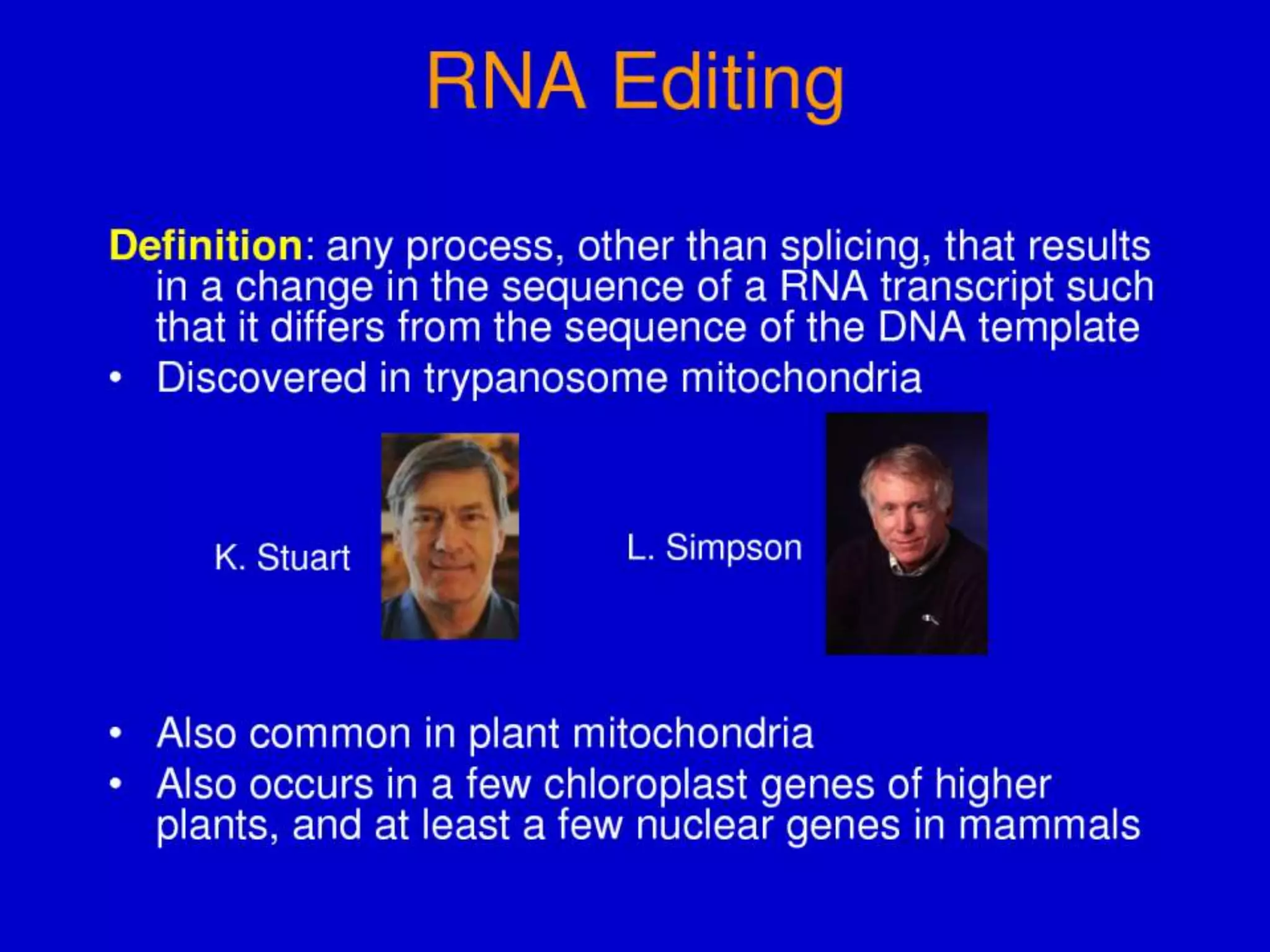
of uracil has been found in kinetoplasts from the
mitochondria of Trypanosoma bruceiBecause this
may involve a large fraction of the sites in a gene, it
is sometimes called "pan-editing" to distinguish it
from typical editing of one or a few sites.
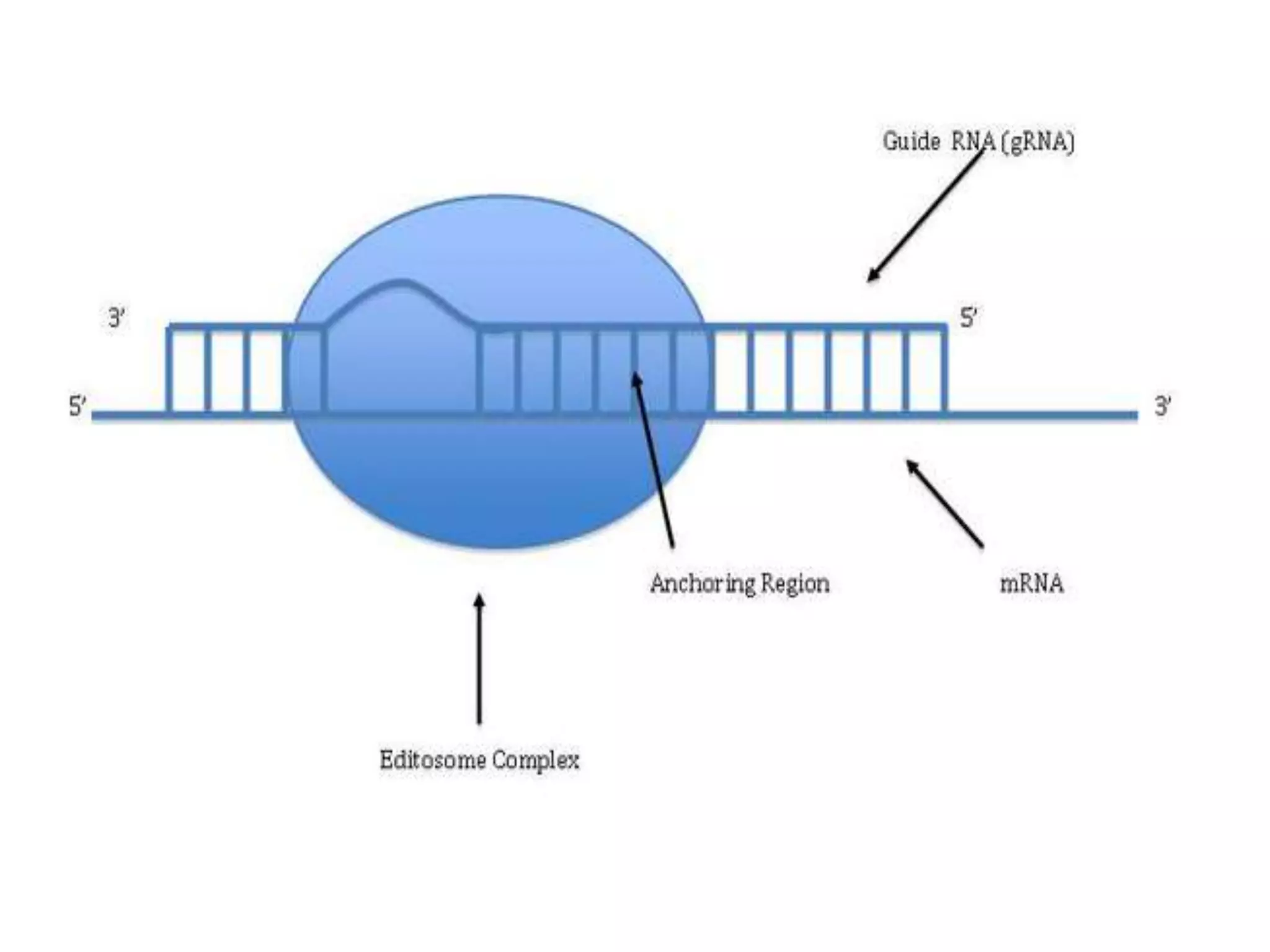
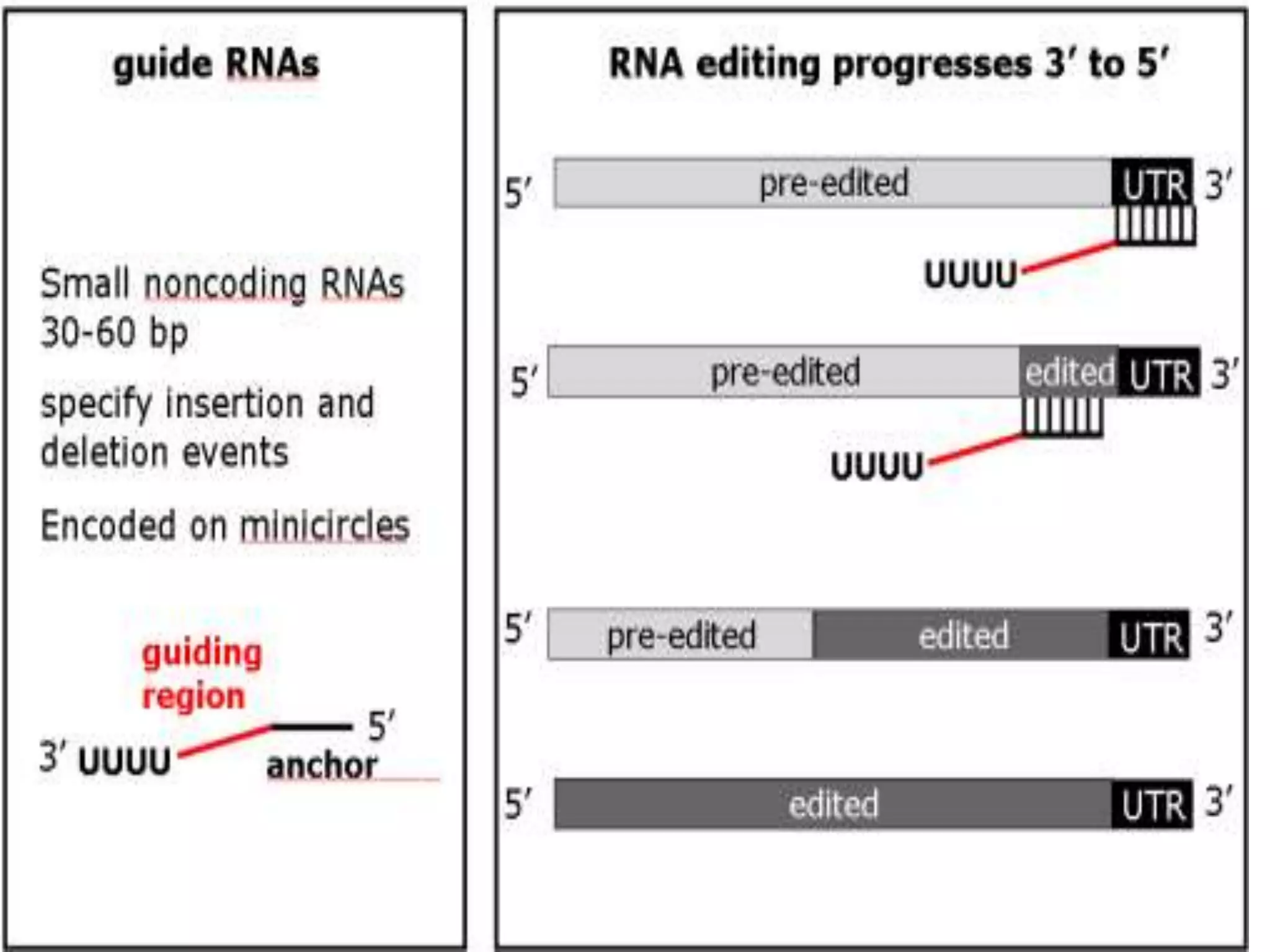
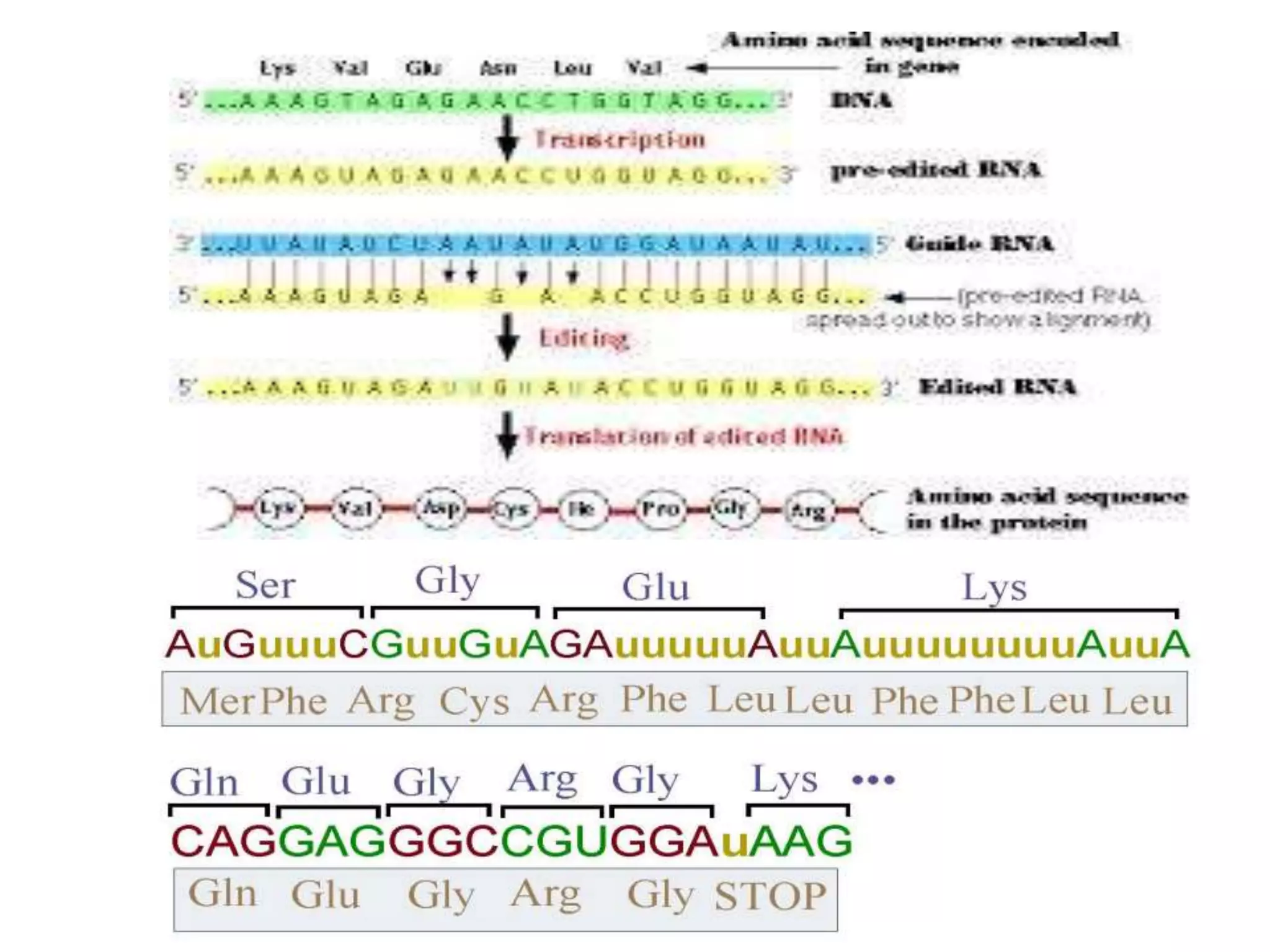
• Pan-editing starts with the base-pairing of the
unedited primary transcript with a guide
RNA (gRNA), which contains complementary
sequences to the regions around the
insertion/deletion points.
• The newly formed double-stranded region is then
enveloped by an editosome, a large multi-protein
complex that catalyzes the editing.
• The editosome opens the transcript at the first mismatched
nucleotide and starts inserting uridines.
• The inserted uridines will base-pair with the guide RNA, and
insertion will continue as long as A or G is present in the guide
RNA and will stop when a C or U is encountered.
• The inserted nucleotides cause a frameshift and result in a
translated protein that differs from its gene.
• The mechanism of the editosome involves an endonucleolytic
cut at the mismatch point between the guide RNA and the
unedited transcript.
• The next step is catalyzed by one of the enzymes in the complex,
a terminal U-transferase, which adds Us from UTP at the 3’ end
of the mRNA.
• Another enzyme, a U-specific exoribonuclease, removes the
unpaired Us.
• After editing has made mRNA complementary to gRNA, an RNA
ligase rejoins the ends of the edited mRNA transcript.
• As a consequence, the editosome can edit only in a 3’ to 5’
direction along the primary RNA transcript.
• The complex can act on only a single guide RNA at a time.
Therefore, a RNA transcript requiring extensive editing will need
more than one guide RNA and editosome complex.
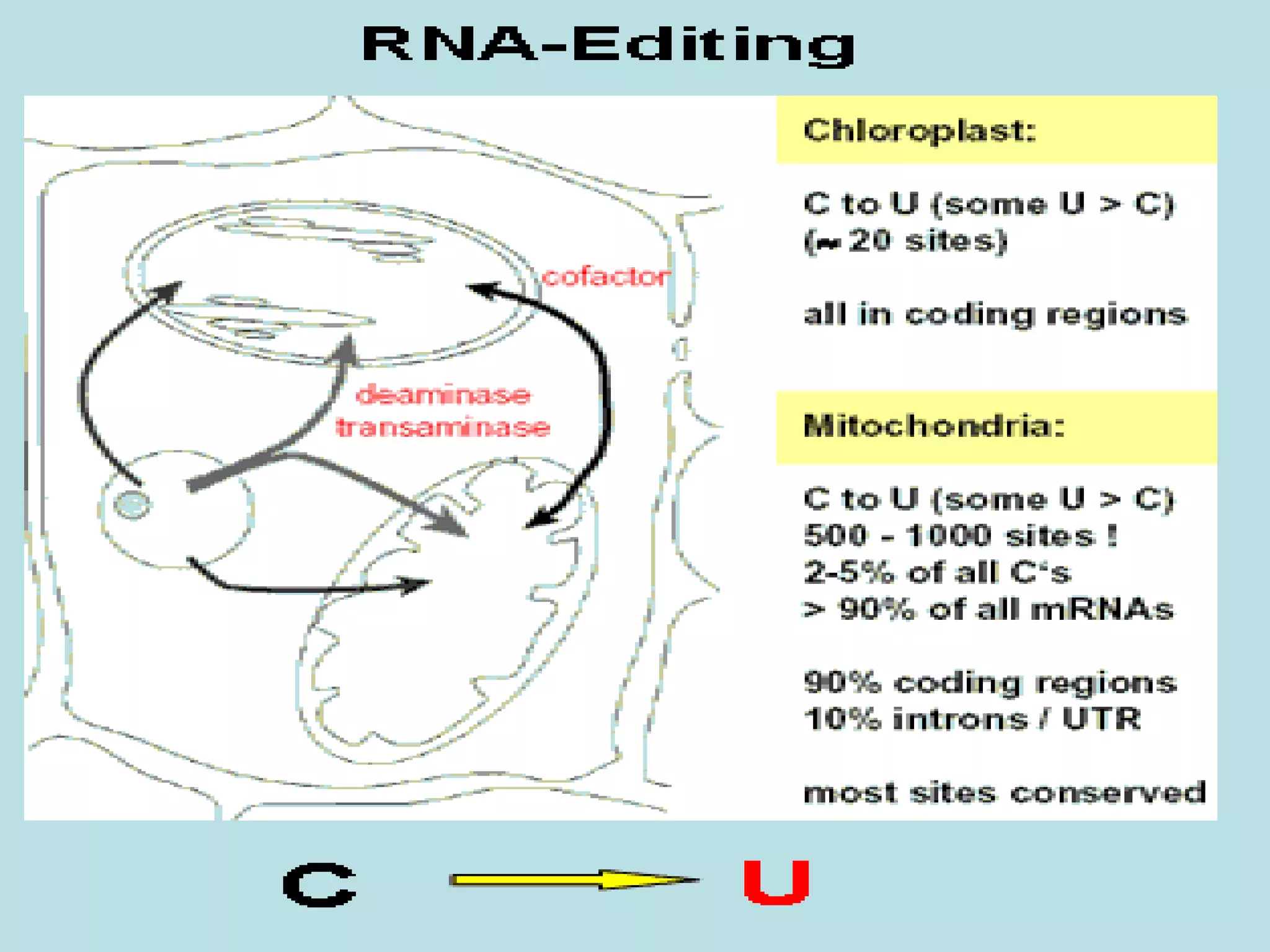
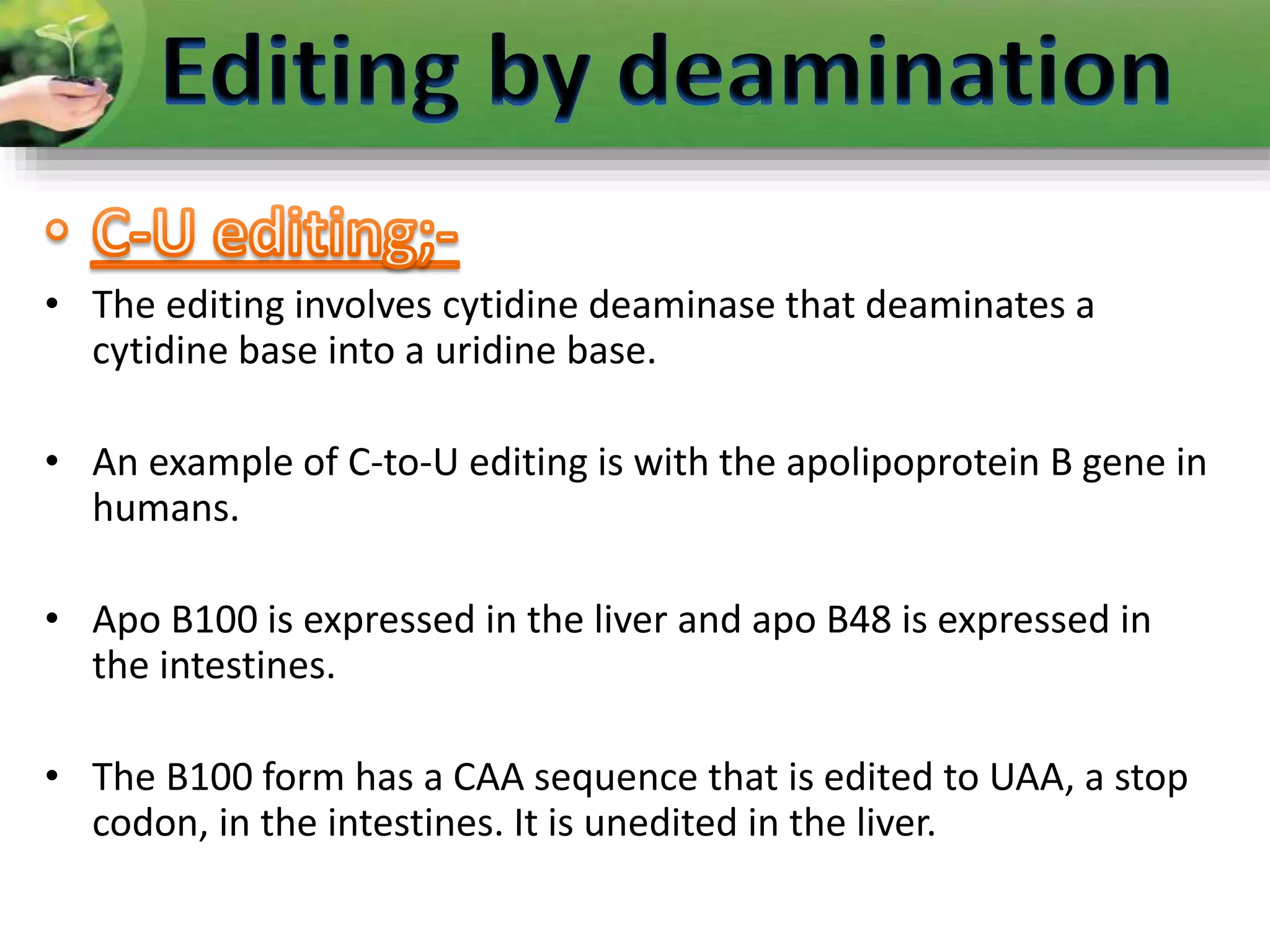
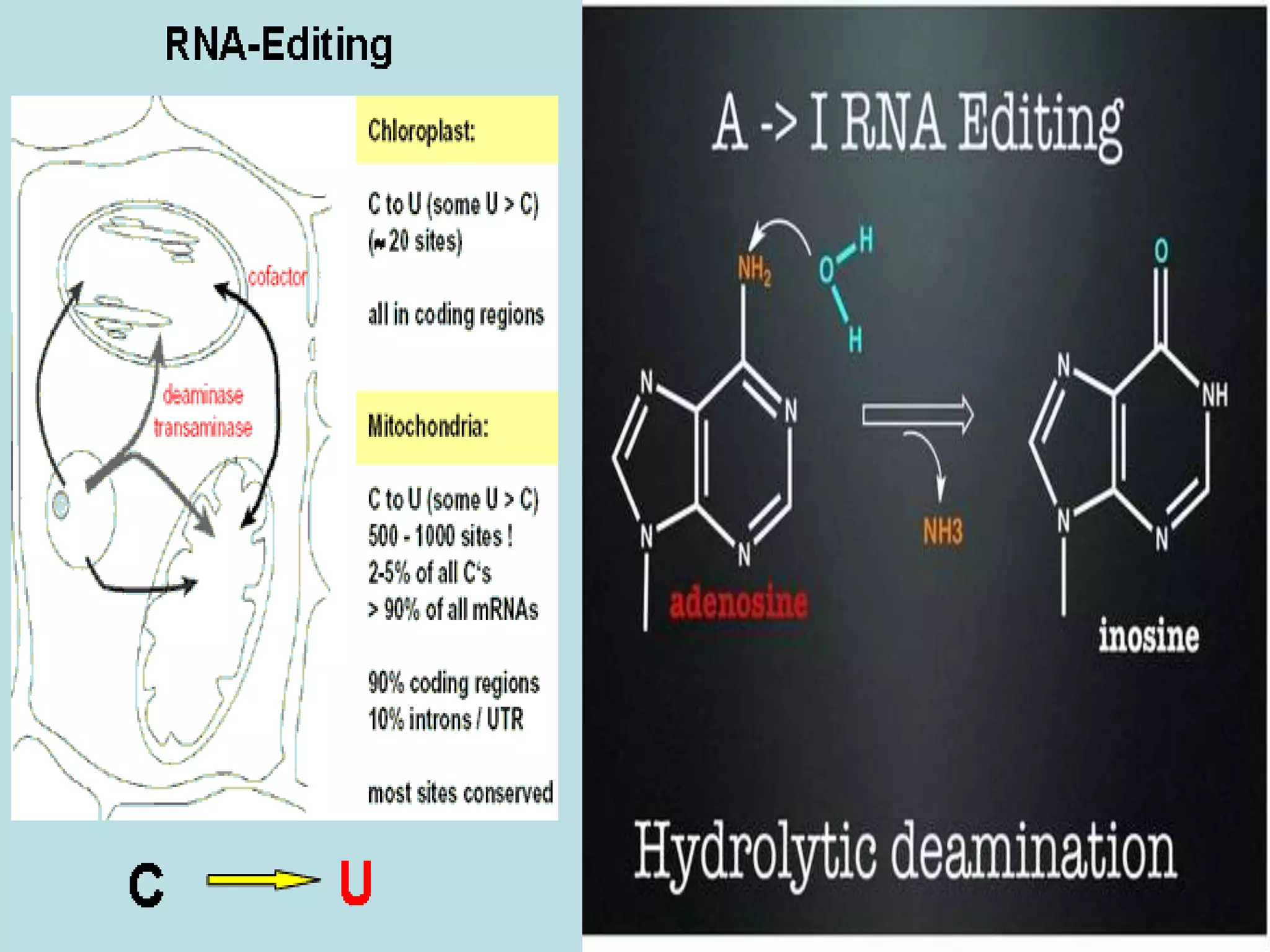
• The editing involves cytidine deaminase that deaminates a
cytidine base into a uridine base.
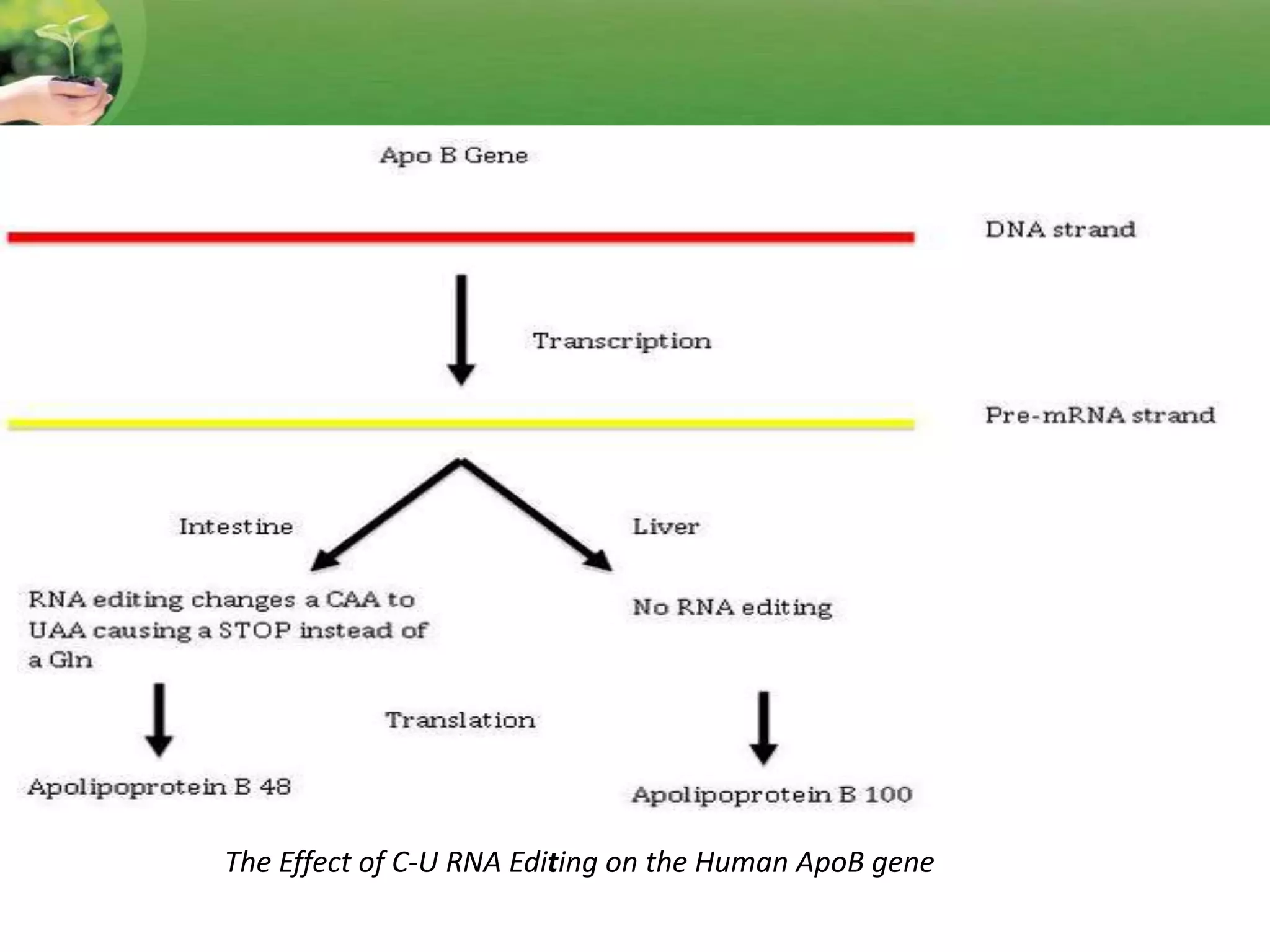
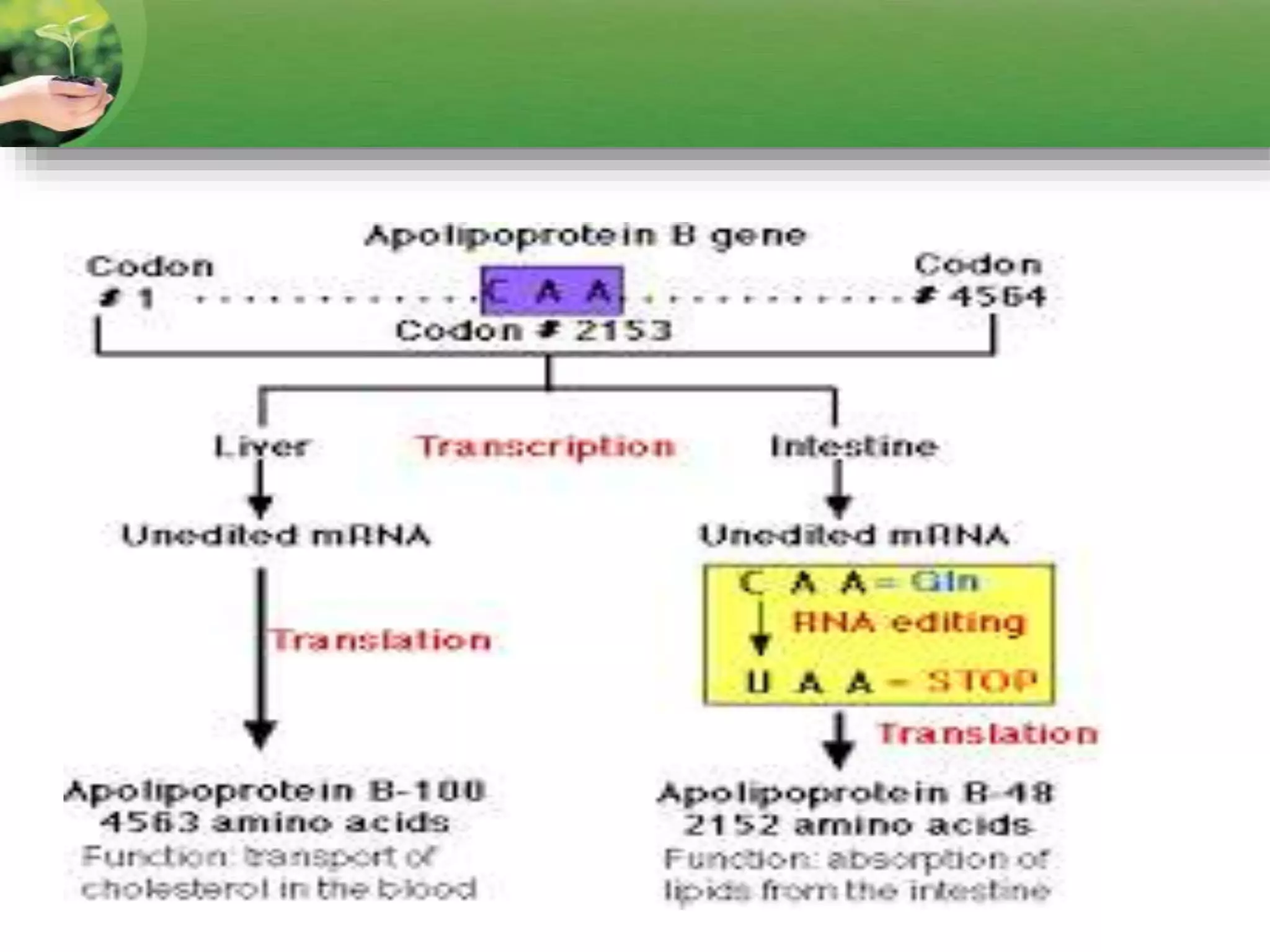
• An example of C-to-U editing is with the apolipoprotein B gene in
humans.
• Apo B100 is expressed in the liver and apo B48 is expressed in
the intestines.
• The B100 form has a CAA sequence that is edited to UAA, a stop
codon, in the intestines. It is unedited in the liver.
The Effect of C-U RNA Editing on the Human ApoB gene
• A-to-I editing is the main form of RNA editing in mammals and
occurs in regions of double-stranded RNA (dsRNA).
• Adenosine deaminases acting on RNA are the RNA-editing
enzymes involved in the hydrolytic deamination of Adenosine to
Inosine (A-to-I editing).
• A-to-I editing can be specific (a single adenosine is edited within
the stretch of dsRNA) or promiscuous (up to 50% of the
adenosines are edited).
• Specific editing occurs within short duplexes, while promiscuous
editing occurs within longer regions of duplex .
Systemic transport of RNA in plants
Plant vasculature was once thought to function
as a mere conduit for nutrients and hormones.
However, recent evidence indicates
that this transport system can participate in the
dissemination of various signal molecules
throughout the plant. Interestingly, these
signals include not only traditional signaling
factors, such as proteins and growth-regulating
small molecules, but also RNA.
Once RNA was thought to be an information
carrier, functioning as a passive template for
protein synthesis. It is now also thought
to act as an active signal molecule, regulating
gene expression and development in plants.
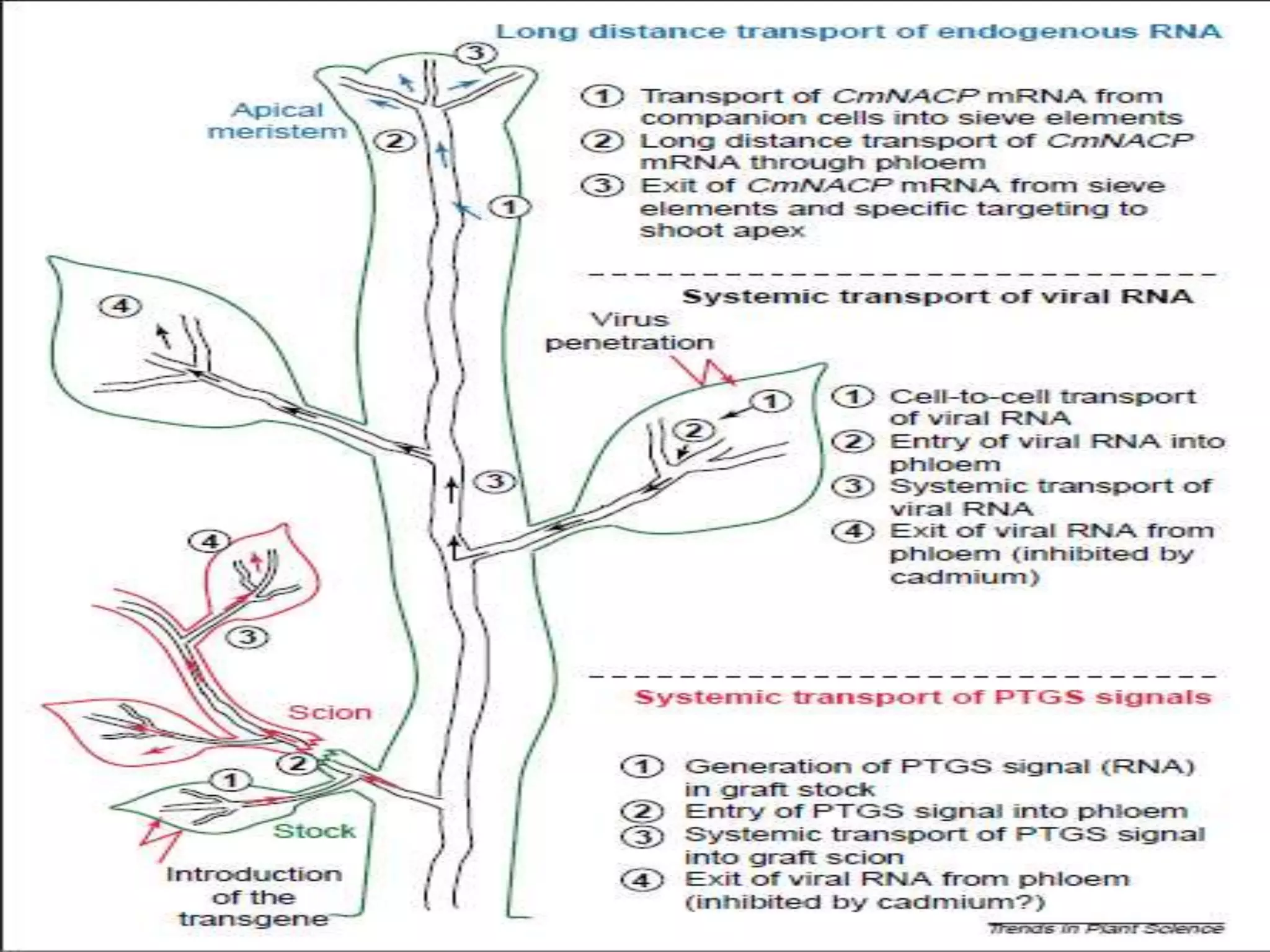
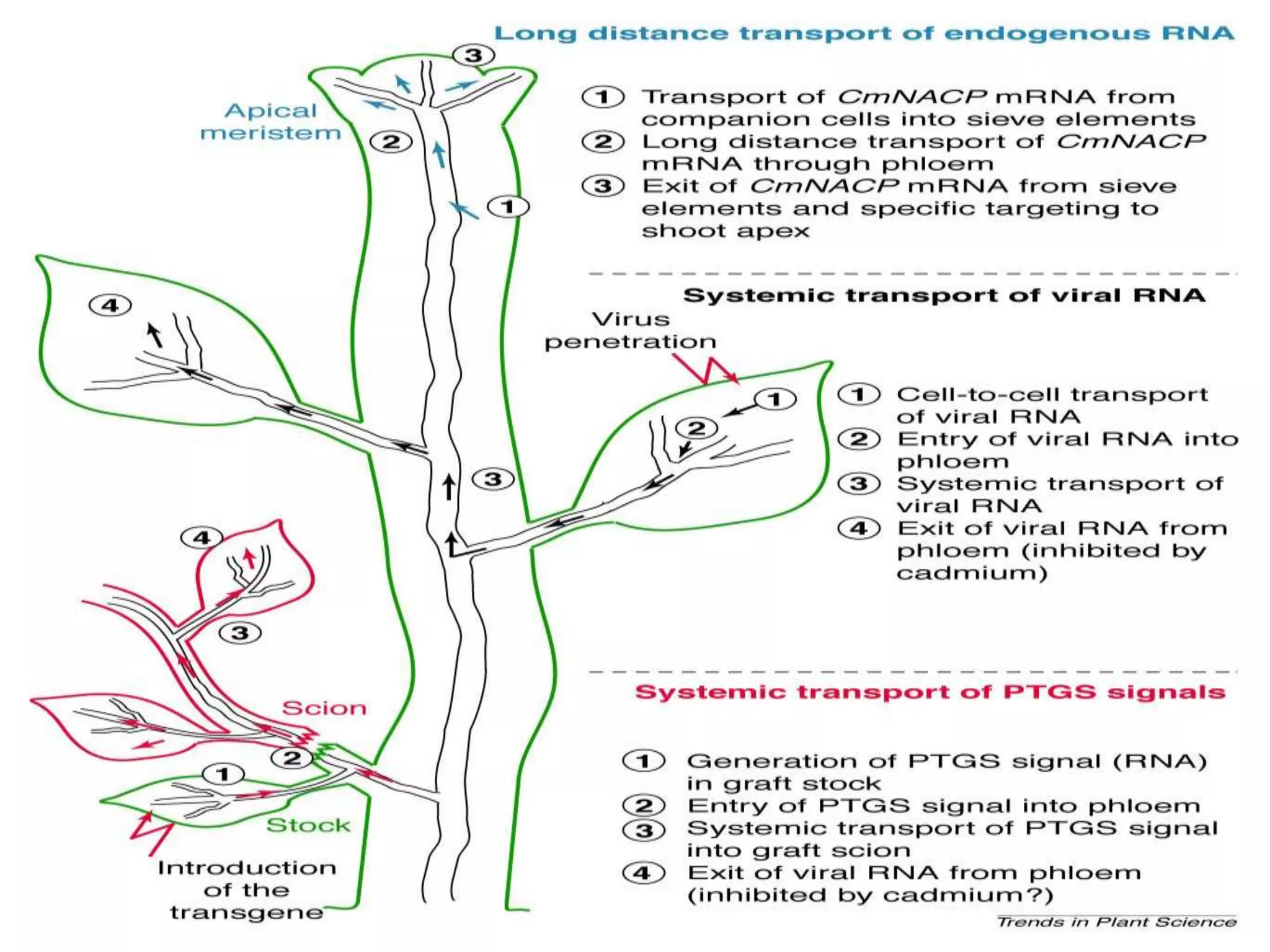
Various types of RNA molecules travel long
distances from their site of synthesis to different
parts of the plant. This systemic movement
occurs through plant vasculature by as yet
unknown mechanisms. Here, three major types
of RNA systemic transport are summarized
(Fig. 1):
• Long distance movement of plant virus
genomic RNA.
• Systemic transport of RNA elicitors of
post-transcriptional gene silencing (PTGS).
• Long distance transport of specific
endogenous RNA molecules.
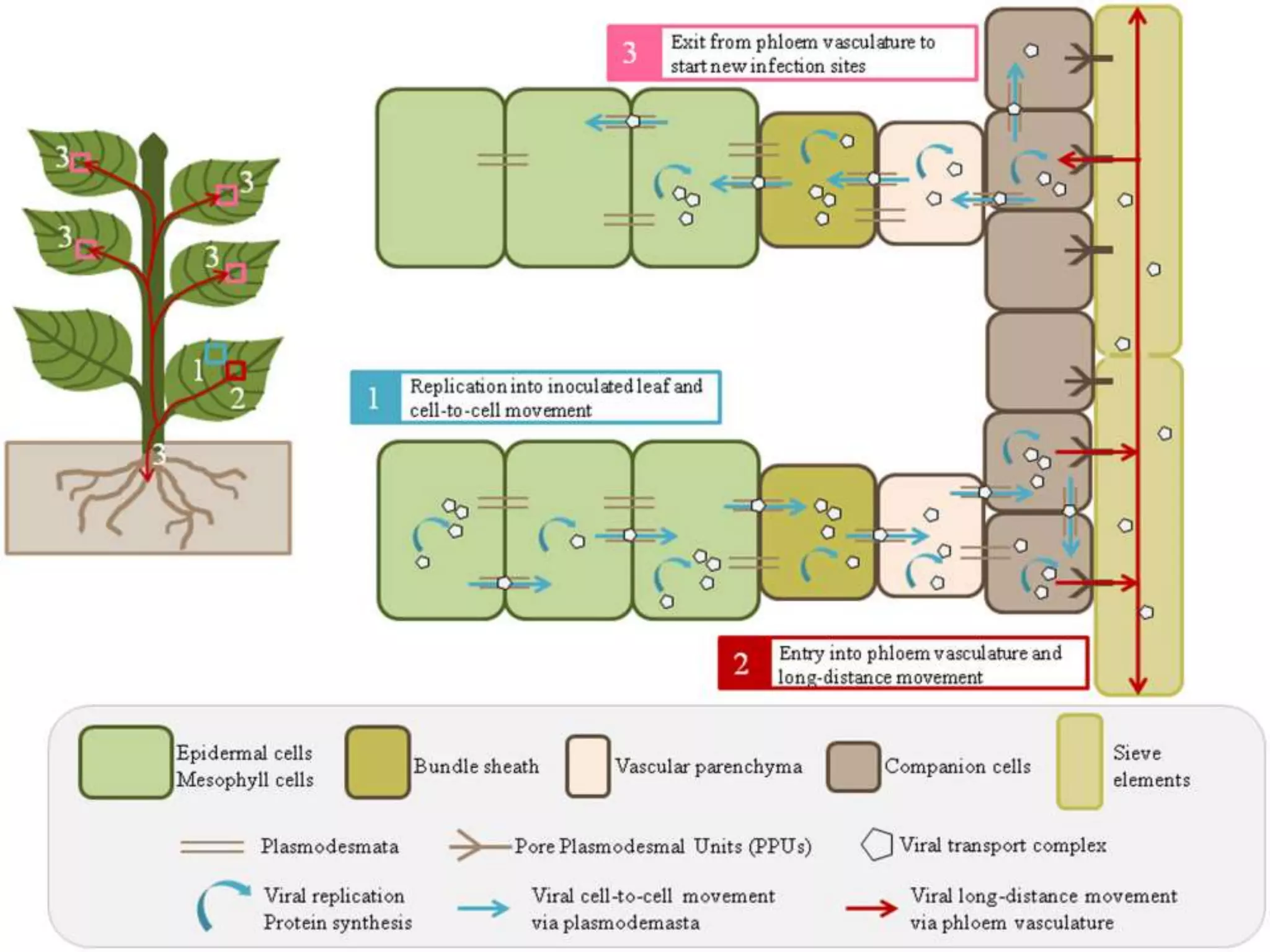
Following initial infection, usually by mechanical
inoculation, plant RNA viruses spread from cell to cell
through plasmodesmata until they reach the vascular
system; the virus is then transported systemically through
the vasculatureVirus-encoded nonstructural movement
proteins mediate the cellto-cell spread of infection
Systemic transport of RNA signals for
post-transcriptional gene silencing
Because viruses often adapt existing cellular
machinery for their own needs, they probably
employ an endogenous pathway for the systemic
transport of RNA. Indeed, recent evidence
indicates that numerous RNA species
travel through plant vasculature, revealing a
novel type of systemic signaling. Specifically,
PTGS, an innate plant defense mechanism,
is probably elicited by such systemic RNA
signals
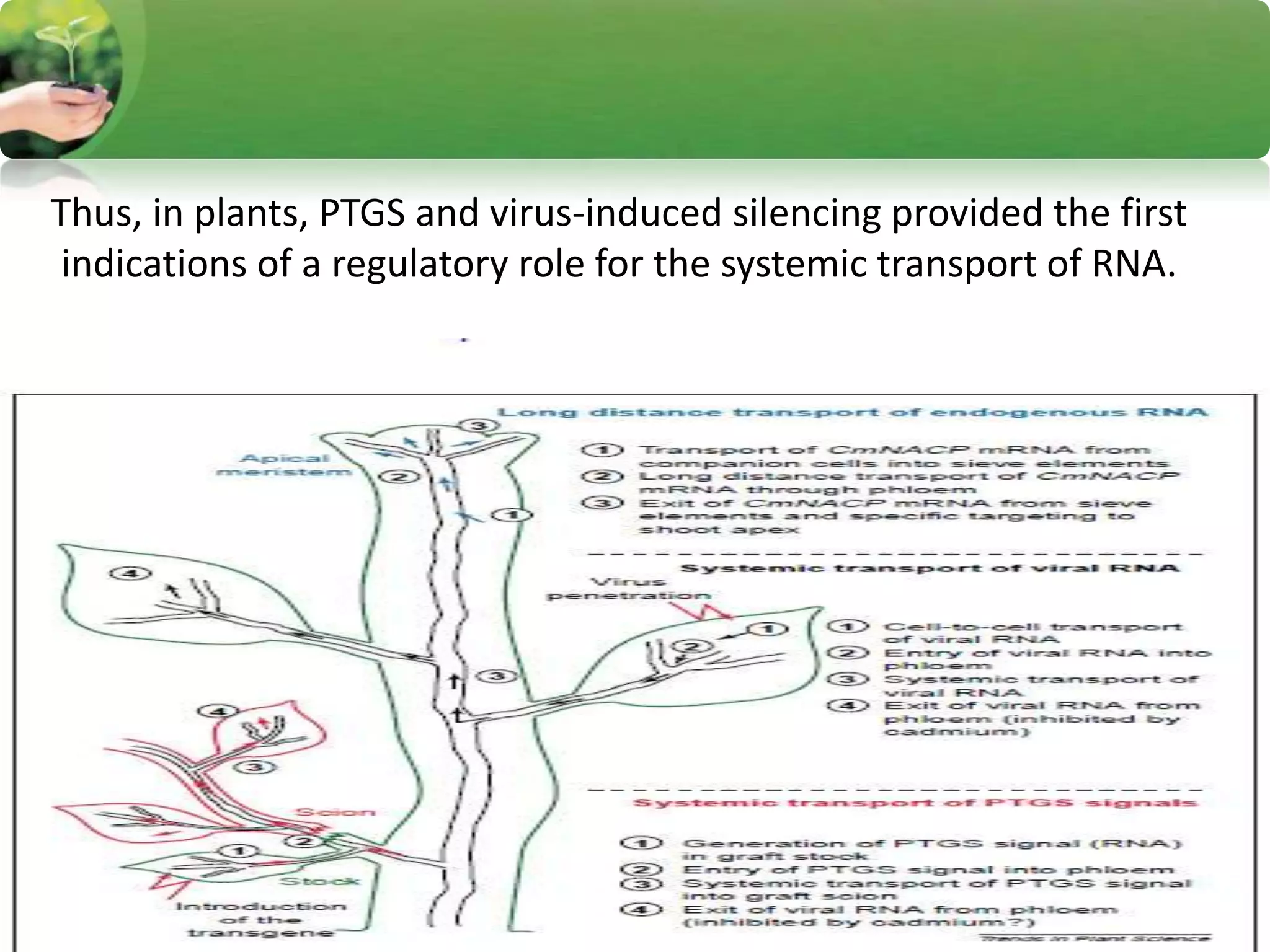
Thus, in plants, PTGS and virus-induced silencing provided the first
indications of a regulatory role for the systemic transport of RNA.
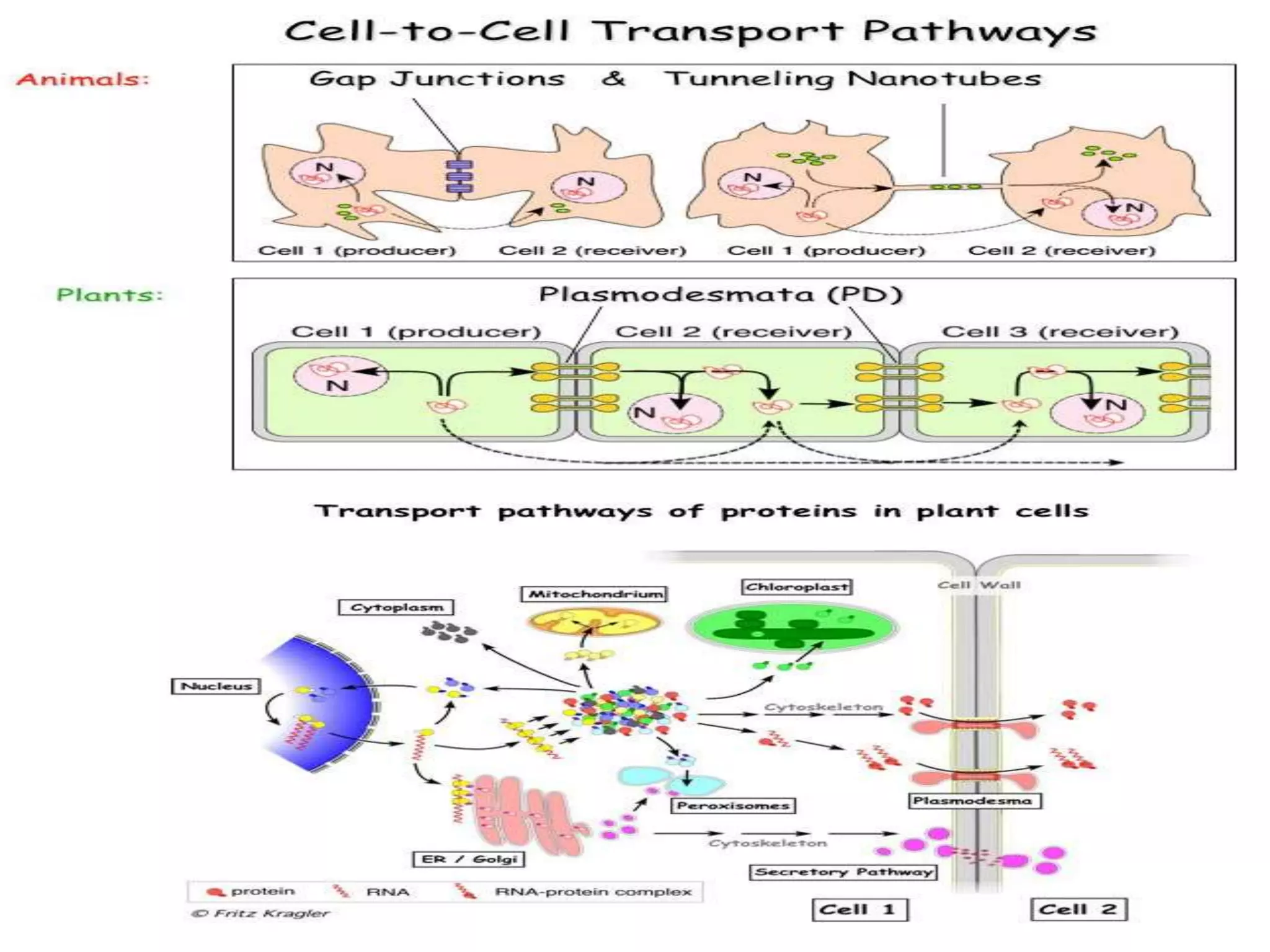
First, signal transduction between adjacent cell
layers, as in Knotted transportation, is fast,
whereas systemic signaling can occur at slower
rates.
Second, cell-to-cell transport minimizes signal
degradation or mistargeting, whereas movement
through the entire phloem poses a higher risk of
signal decay or delivery to the Wrong tissues.
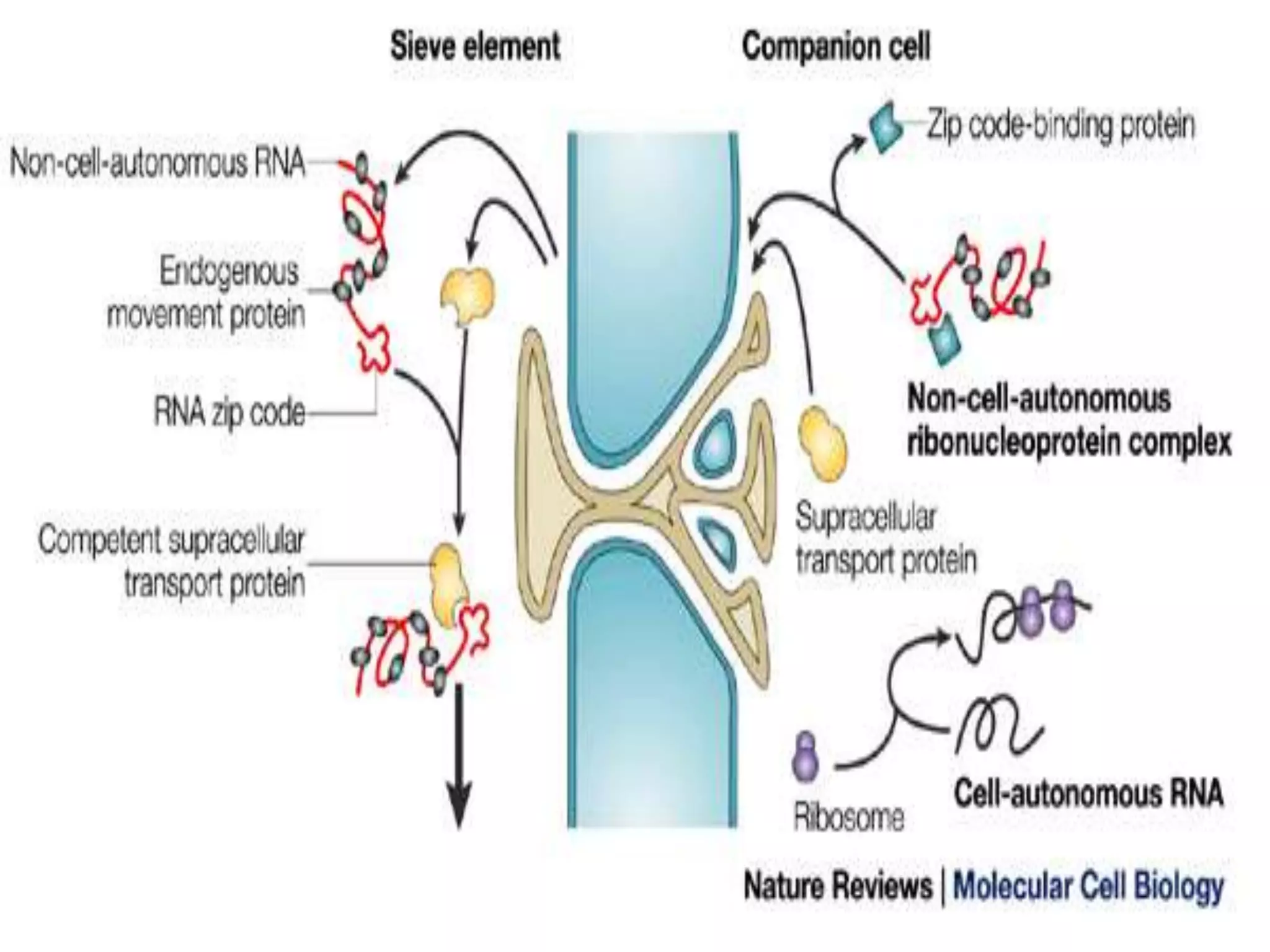
Long distance transport of specific endogenous RNA molecules.
THANK YOU

Rna editing1

  • 1.
    Mentor; prof, S.M. PRASAD MADE BY: DEEPAK YADAV M.Sc-IV SEM. RNA EDITING AND RNA TRANSPORT
  • 4.
    Summary of theVarious Functions of RNA Editing
  • 5.
    • RNA editingis a process in which information change at the level of mRNA. It is revealed by situations in which the coding sequence in an RNA differs from the sequence of DNA from which it was transcribed. • Editing events may include the insertion, deletion, and base substitution of nucleotides within the edited RNA molecule. • RNA editing has been observed in some tRNA, rRNA, mRNA molecules of eukaryotes and their viruses, archaea and prokaryotes. • RNA editing occurs in the cell nucleus and cytosol, as well as within mitochondria and plastids.
  • 7.
    • The diversityof RNA editing phenomena includes nucleobase modifications such as cytidine (C) to uridine (U) and adenosine (A) to inosine (I) deaminations, as well as non- templated nucleotide additions and insertions. • RNA editing in mRNAs effectively alters the amino acid sequence of the encoded protein so that it differs from that predicted by the genomic DNA sequence.
  • 10.
    • RNA editingthrough the addition and deletion of uracil has been found in kinetoplasts from the mitochondria of Trypanosoma bruceiBecause this may involve a large fraction of the sites in a gene, it is sometimes called "pan-editing" to distinguish it from typical editing of one or a few sites. • Pan-editing starts with the base-pairing of the unedited primary transcript with a guide RNA (gRNA), which contains complementary sequences to the regions around the insertion/deletion points. • The newly formed double-stranded region is then enveloped by an editosome, a large multi-protein complex that catalyzes the editing.
  • 11.
    • The editosomeopens the transcript at the first mismatched nucleotide and starts inserting uridines. • The inserted uridines will base-pair with the guide RNA, and insertion will continue as long as A or G is present in the guide RNA and will stop when a C or U is encountered. • The inserted nucleotides cause a frameshift and result in a translated protein that differs from its gene. • The mechanism of the editosome involves an endonucleolytic cut at the mismatch point between the guide RNA and the unedited transcript. • The next step is catalyzed by one of the enzymes in the complex, a terminal U-transferase, which adds Us from UTP at the 3’ end of the mRNA.
  • 12.
    • Another enzyme,a U-specific exoribonuclease, removes the unpaired Us. • After editing has made mRNA complementary to gRNA, an RNA ligase rejoins the ends of the edited mRNA transcript. • As a consequence, the editosome can edit only in a 3’ to 5’ direction along the primary RNA transcript. • The complex can act on only a single guide RNA at a time. Therefore, a RNA transcript requiring extensive editing will need more than one guide RNA and editosome complex.
  • 15.
    • The editinginvolves cytidine deaminase that deaminates a cytidine base into a uridine base. • An example of C-to-U editing is with the apolipoprotein B gene in humans. • Apo B100 is expressed in the liver and apo B48 is expressed in the intestines. • The B100 form has a CAA sequence that is edited to UAA, a stop codon, in the intestines. It is unedited in the liver.
  • 16.
    The Effect ofC-U RNA Editing on the Human ApoB gene
  • 18.
    • A-to-I editingis the main form of RNA editing in mammals and occurs in regions of double-stranded RNA (dsRNA). • Adenosine deaminases acting on RNA are the RNA-editing enzymes involved in the hydrolytic deamination of Adenosine to Inosine (A-to-I editing). • A-to-I editing can be specific (a single adenosine is edited within the stretch of dsRNA) or promiscuous (up to 50% of the adenosines are edited). • Specific editing occurs within short duplexes, while promiscuous editing occurs within longer regions of duplex .
  • 21.
    Systemic transport ofRNA in plants
  • 22.
    Plant vasculature wasonce thought to function as a mere conduit for nutrients and hormones. However, recent evidence indicates that this transport system can participate in the dissemination of various signal molecules throughout the plant. Interestingly, these signals include not only traditional signaling factors, such as proteins and growth-regulating small molecules, but also RNA.
  • 23.
    Once RNA wasthought to be an information carrier, functioning as a passive template for protein synthesis. It is now also thought to act as an active signal molecule, regulating gene expression and development in plants. Various types of RNA molecules travel long distances from their site of synthesis to different parts of the plant. This systemic movement occurs through plant vasculature by as yet unknown mechanisms. Here, three major types of RNA systemic transport are summarized (Fig. 1):
  • 24.
    • Long distancemovement of plant virus genomic RNA. • Systemic transport of RNA elicitors of post-transcriptional gene silencing (PTGS). • Long distance transport of specific endogenous RNA molecules.
  • 26.
    Following initial infection,usually by mechanical inoculation, plant RNA viruses spread from cell to cell through plasmodesmata until they reach the vascular system; the virus is then transported systemically through the vasculatureVirus-encoded nonstructural movement proteins mediate the cellto-cell spread of infection
  • 28.
    Systemic transport ofRNA signals for post-transcriptional gene silencing Because viruses often adapt existing cellular machinery for their own needs, they probably employ an endogenous pathway for the systemic transport of RNA. Indeed, recent evidence indicates that numerous RNA species travel through plant vasculature, revealing a novel type of systemic signaling. Specifically, PTGS, an innate plant defense mechanism, is probably elicited by such systemic RNA signals
  • 30.
    Thus, in plants,PTGS and virus-induced silencing provided the first indications of a regulatory role for the systemic transport of RNA.
  • 31.
    First, signal transductionbetween adjacent cell layers, as in Knotted transportation, is fast, whereas systemic signaling can occur at slower rates. Second, cell-to-cell transport minimizes signal degradation or mistargeting, whereas movement through the entire phloem poses a higher risk of signal decay or delivery to the Wrong tissues. Long distance transport of specific endogenous RNA molecules.
  • 34.