RNA EDITING
DONE BY,
SHALINISAKTHIVEL,
3RD YEAR INTEGRATED M.SC BMS,
BHARATHIDASAN UNIVERSITY,
TRICHY-24.
RNA EDITING
DEFINITION
•The term RNA editing describes those
molecular process in which the information
content is altered in an RNA molecule.
•RNA editing occurs in nucleus as well as in
mitochondria and plastids.
WHEN RNA EDITING OCCURS
• RNA editing: the alteration of the sequence of
nucleotides in the RNA after it has
been transcribed from DNA but
• before it is translated into protein.
TYPES OF EDITING
•RNA editing occurs by two distinct mechanism:
1.Substitution editing
2.Insertion/deletion editing
SUBSTITUTION EDITING
• Chemical alteration of individual nucleotides (the equivalent
of point mutation).
• These alterations are catalysed by enzymes that recognize a
specific target sequence of nucleotides (much like restriction
enzymes)
1. Cytidine deaminases that convert a cytosine (C) in the
RNA to uracil (U);
2. Adenosine deaminases that convert an adenosine (A) to
inosine (I), which the ribosome translates as a guanosine (G). Thus
a CAG codon (for Gln) can be converted to a CGG codon (for Arg).
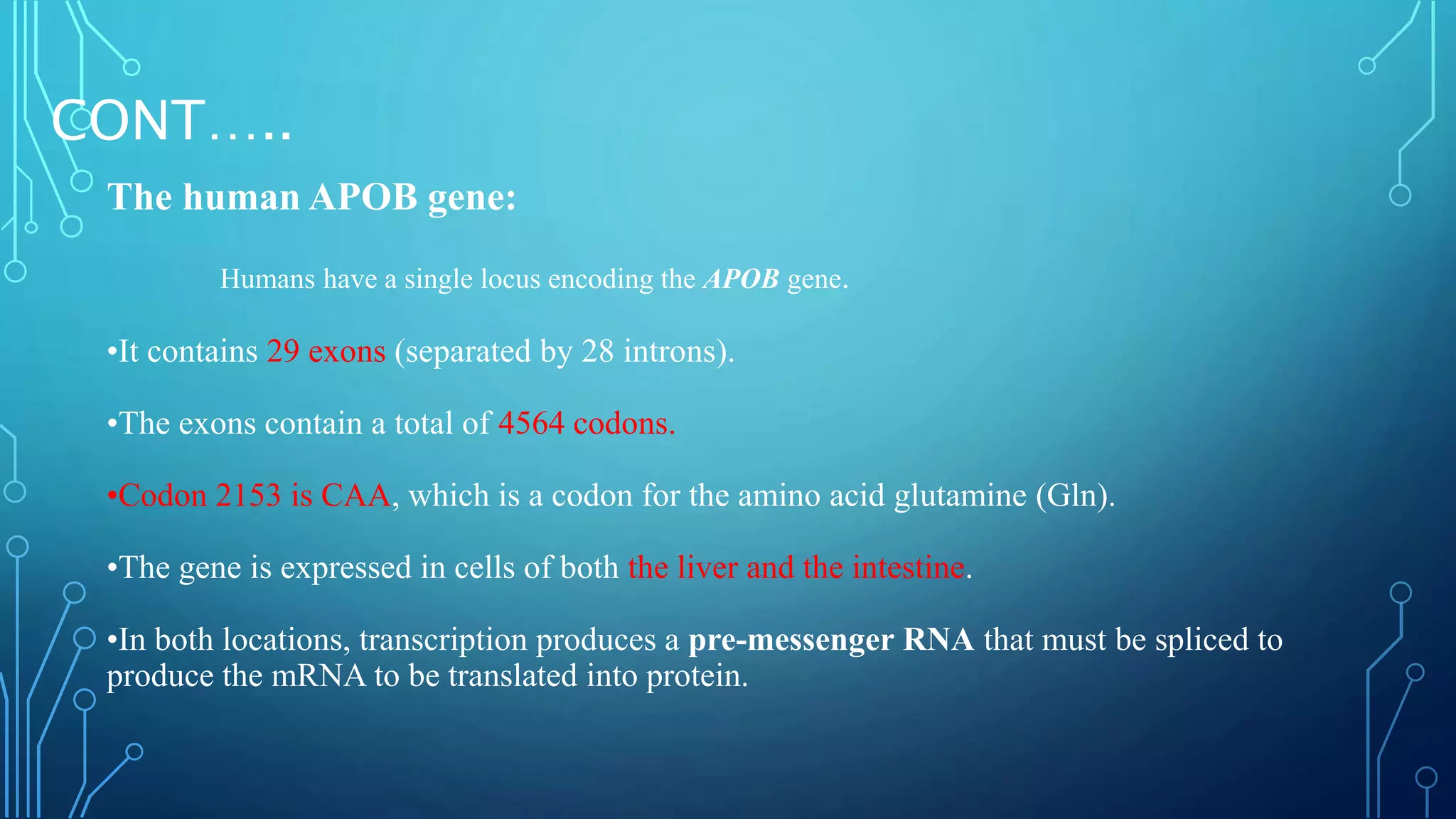
EXAMPLE - THE HUMAN APOB GENE
CONT…..
The human APOB gene:
Humans have a single locus encoding the APOB gene.
•It contains 29 exons (separated by 28 introns).
•The exons contain a total of 4564 codons.
•Codon 2153 is CAA, which is a codon for the amino acid glutamine (Gln).
•The gene is expressed in cells of both the liver and the intestine.
•In both locations, transcription produces a pre-messenger RNA that must be spliced to
produce the mRNA to be translated into protein.
CONT……
• In the Liver. Here the process occurs normally producing apolipoprotein B-100 — a
protein containing 4,563 amino acids — that is essential for the transport of cholesterol
and other lipids in the blood.
• In the Intestine. In the cells of the intestine, an additional step of pre-mRNA processing
occurs: the chemical modification of the C nucleotide in Codon 2153 (CAA) into a U.
This RNA editing changes the codon from one encoding the amino acid glutamine
(Gln) to a STOP codon (UAA)
The modification is catalysed by the enzyme cytidine deaminase that
• Recognizes the sequence of the RNA at that one place in the molecule and
• Catalyses the deamination of C thus forming U.
Translation of the mRNA stops at codon #2153 forming apolipoprotein B-
48 — a protein containing 2152 amino acids — that aids in the absorption of dietary
lipids from the contents of the intestine.
INSERTION/DELETION EDITING
• INSERTION OR DELETION of nucleotides in the RNA. These
alterations are mediated by guide RNA molecules.
– gRNAs are small and complementary to portions of the
edited mRNA
– Base-pairing of gRNA with unedited RNA gives
mismatched regions, which are recognized by the editing
machinery.
– Machinery includes an Endonuclease, a Terminal Uridylyl
Transferase (TUTase), and a RNA ligase.
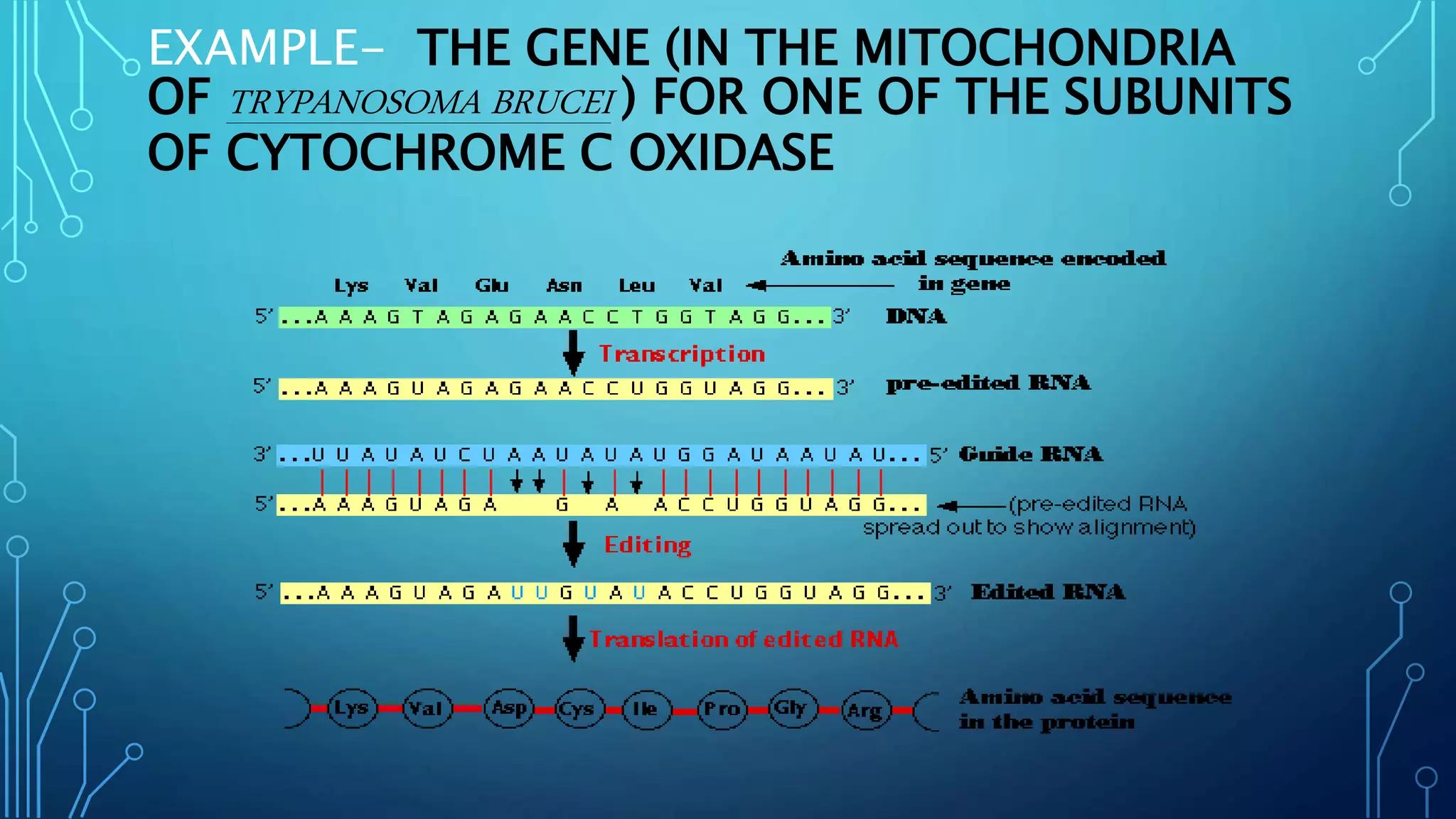
EXAMPLE- THE GENE (IN THE MITOCHONDRIA
OF TRYPANOSOMA BRUCEI ) FOR ONE OF THE SUBUNITS
OF CYTOCHROME C OXIDASE
CONT…..
Editing requires a special class of RNA molecules called guide RNA (gRNA)
In the guide RNA where, usually, there are As not found in
the transcript to be edited.
• The bulges are eliminated by cutting the backbone of the shorter
molecule and inserting complementary bases.
• Note that in the example, the insertion of 4 nucleotides has created
a frameshift so that the amino acids encoded downstream (after Val) in
the edited RNA are entirely different from those specified by the gene
itself.
SIGNIFICANCE OF EDITING
• It is essential in regulating gene expression of organism.
• RNA editing mutant was reported with strong defects in
organelle development.
• It is a mechanism to increase the number of different proteins
available with the not need to increase the number of gene in
genome.
• May helps protect the genome against some viruses.
RNA Editing.

RNA Editing.

  • 1.
    RNA EDITING DONE BY, SHALINISAKTHIVEL, 3RDYEAR INTEGRATED M.SC BMS, BHARATHIDASAN UNIVERSITY, TRICHY-24.
  • 2.
  • 3.
    DEFINITION •The term RNAediting describes those molecular process in which the information content is altered in an RNA molecule. •RNA editing occurs in nucleus as well as in mitochondria and plastids.
  • 4.
    WHEN RNA EDITINGOCCURS • RNA editing: the alteration of the sequence of nucleotides in the RNA after it has been transcribed from DNA but • before it is translated into protein.
  • 5.
    TYPES OF EDITING •RNAediting occurs by two distinct mechanism: 1.Substitution editing 2.Insertion/deletion editing
  • 6.
    SUBSTITUTION EDITING • Chemicalalteration of individual nucleotides (the equivalent of point mutation). • These alterations are catalysed by enzymes that recognize a specific target sequence of nucleotides (much like restriction enzymes) 1. Cytidine deaminases that convert a cytosine (C) in the RNA to uracil (U); 2. Adenosine deaminases that convert an adenosine (A) to inosine (I), which the ribosome translates as a guanosine (G). Thus a CAG codon (for Gln) can be converted to a CGG codon (for Arg).
  • 7.
    EXAMPLE - THEHUMAN APOB GENE
  • 8.
    CONT….. The human APOBgene: Humans have a single locus encoding the APOB gene. •It contains 29 exons (separated by 28 introns). •The exons contain a total of 4564 codons. •Codon 2153 is CAA, which is a codon for the amino acid glutamine (Gln). •The gene is expressed in cells of both the liver and the intestine. •In both locations, transcription produces a pre-messenger RNA that must be spliced to produce the mRNA to be translated into protein.
  • 9.
    CONT…… • In theLiver. Here the process occurs normally producing apolipoprotein B-100 — a protein containing 4,563 amino acids — that is essential for the transport of cholesterol and other lipids in the blood. • In the Intestine. In the cells of the intestine, an additional step of pre-mRNA processing occurs: the chemical modification of the C nucleotide in Codon 2153 (CAA) into a U. This RNA editing changes the codon from one encoding the amino acid glutamine (Gln) to a STOP codon (UAA) The modification is catalysed by the enzyme cytidine deaminase that • Recognizes the sequence of the RNA at that one place in the molecule and • Catalyses the deamination of C thus forming U. Translation of the mRNA stops at codon #2153 forming apolipoprotein B- 48 — a protein containing 2152 amino acids — that aids in the absorption of dietary lipids from the contents of the intestine.
  • 10.
    INSERTION/DELETION EDITING • INSERTIONOR DELETION of nucleotides in the RNA. These alterations are mediated by guide RNA molecules. – gRNAs are small and complementary to portions of the edited mRNA – Base-pairing of gRNA with unedited RNA gives mismatched regions, which are recognized by the editing machinery. – Machinery includes an Endonuclease, a Terminal Uridylyl Transferase (TUTase), and a RNA ligase.
  • 11.
    EXAMPLE- THE GENE(IN THE MITOCHONDRIA OF TRYPANOSOMA BRUCEI ) FOR ONE OF THE SUBUNITS OF CYTOCHROME C OXIDASE
  • 12.
    CONT….. Editing requires aspecial class of RNA molecules called guide RNA (gRNA) In the guide RNA where, usually, there are As not found in the transcript to be edited. • The bulges are eliminated by cutting the backbone of the shorter molecule and inserting complementary bases. • Note that in the example, the insertion of 4 nucleotides has created a frameshift so that the amino acids encoded downstream (after Val) in the edited RNA are entirely different from those specified by the gene itself.
  • 13.
    SIGNIFICANCE OF EDITING •It is essential in regulating gene expression of organism. • RNA editing mutant was reported with strong defects in organelle development. • It is a mechanism to increase the number of different proteins available with the not need to increase the number of gene in genome. • May helps protect the genome against some viruses.