PROKARYOTIC
TRANSCRIPTION
Prepared By:
Dr. Asit Prasad Dash
Assistant Professor
DEPARTMENT OF PLANT BREEDING AND GENETICS
INSTITUTE OF AGRICULTURAL SCIENCES
SIKSHA ‘O’ ANUSANDHAN (DEEMED TO BE UNIVERSITY), BHUBANESWAR,
751029
vThe process of production of RNA copy of a DNA sequence is
called transcription;
vthis reaction is catalyzed by DNA-directed RNA polymerase
(RNA polymerase).
THE CENTRAL DOGMA(Crick, 1958)
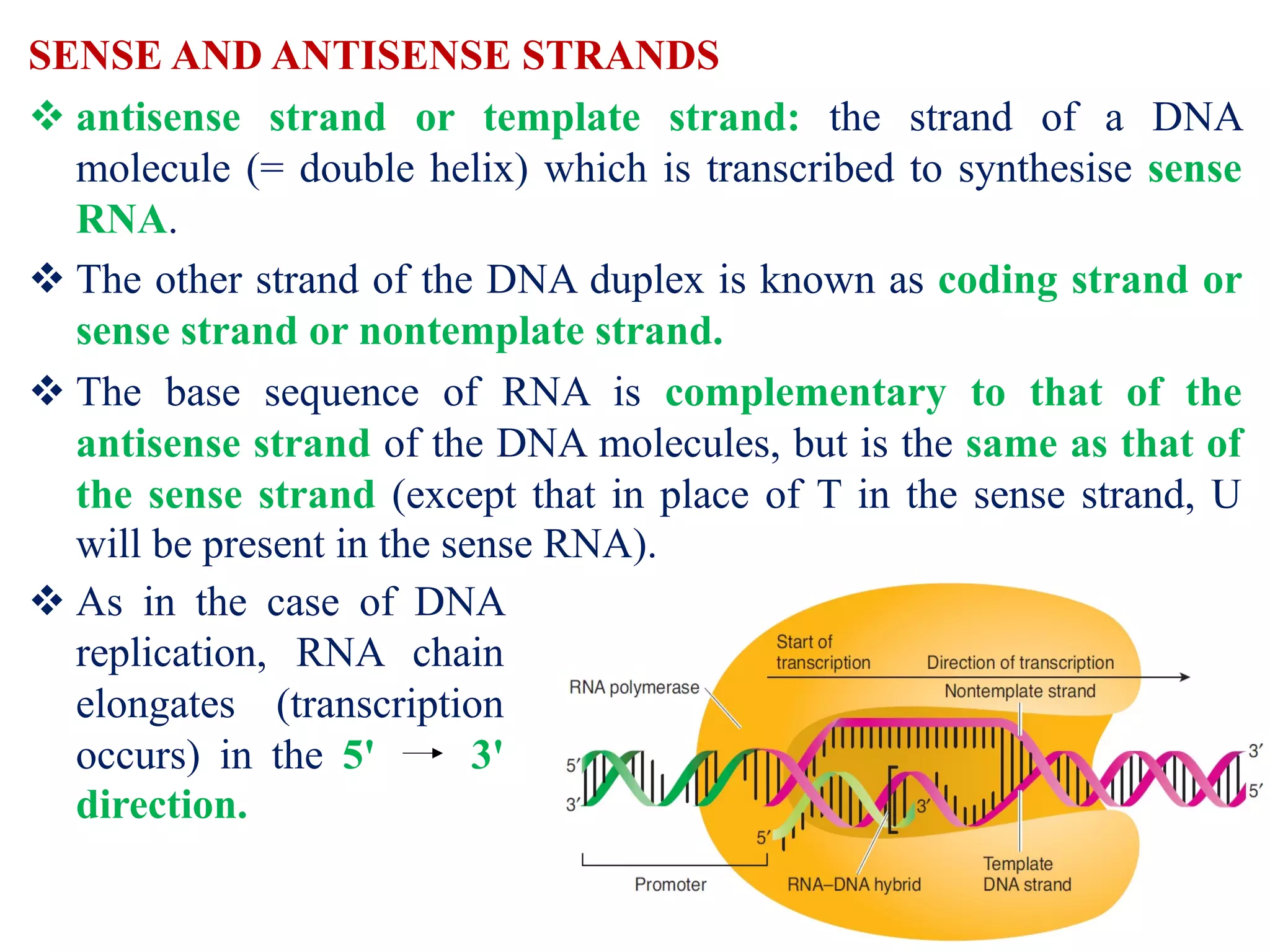
v As in the case of DNA
replication, RNA chain
elongates (transcription
occurs) in the 5' 3'
direction.
SENSE AND ANTISENSE STRANDS
v antisense strand or template strand: the strand of a DNA
molecule (= double helix) which is transcribed to synthesise sense
RNA.
v The other strand of the DNA duplex is known as coding strand or
sense strand or nontemplate strand.
v The base sequence of RNA is complementary to that of the
antisense strand of the DNA molecules, but is the same as that of
the sense strand (except that in place of T in the sense strand, U
will be present in the sense RNA).
TRANSCRIPTION UNIT
v A transcription unit is that stretch or sequence of DNA that is
transcribed into a single RNA molecule. A transcription unit has
Ø Promoter at its beginning (at the 3'-end of its antisense strand),
Ø Start point
Ø Coding region and
Ø Terminator sequence at its end.
v RNA polymerase binds to the promoter, and transcription begins
at the start point; it progresses through the coding sequence and
ends around the terminator site.
v In case of eukaryotes, each gene is a distinct transcription unit.
v In case of prokaryotes, genes encoding the enzymes for a single
biosynthetic pathway are usually clustered together into a single
regulatory unit called operon and each operon functions as a
single transcription unit.
Prokaryotic Gene Structure
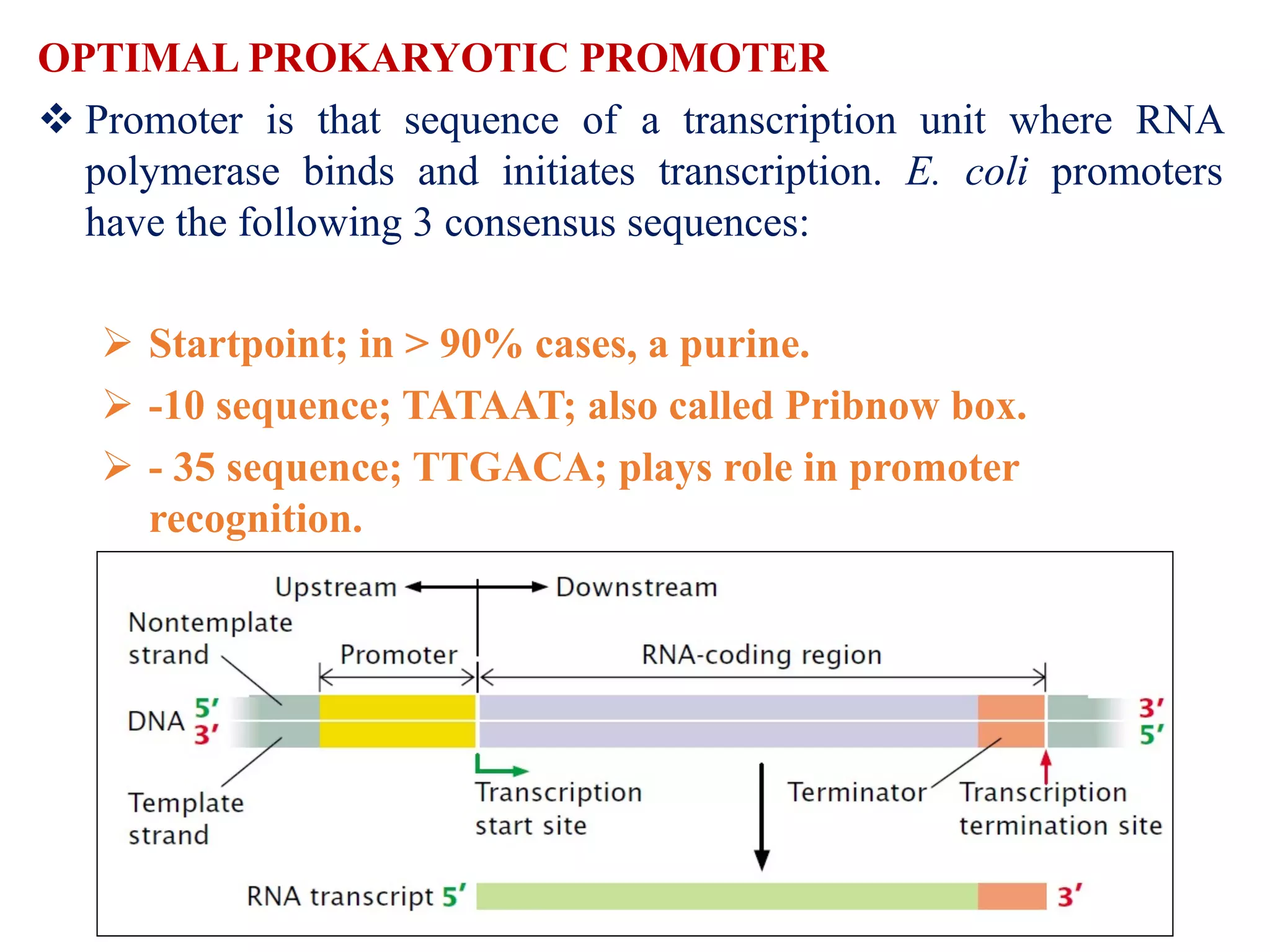
OPTIMAL PROKARYOTIC PROMOTER
v Promoter is that sequence of a transcription unit where RNA
polymerase binds and initiates transcription. E. coli promoters
have the following 3 consensus sequences:
Ø Startpoint; in > 90% cases, a purine.
Ø -10 sequence; TATAAT; also called Pribnow box.
Ø - 35 sequence; TTGACA; plays role in promoter
recognition.
BACTERIAL RNA POLYMERASE
v In most bacteria, a single type of RNA polymerase is found. The
complete RNA polymerase molecule is called holoenzyme; it has
the following components:
1. Core Enzyme
v The core enzyme can transcribe a DNA duplex after transcription
has been initiated, but it cannot initiate transcription at proper
sites.
2. Sigma (σ) Factor
v The sigma factor is involved in
stable binding of RNA
polymerase holoenzyme
specifically to promoter DNA.
v It is released from the core
enzyme when the RNA chain
reaches 8-9 bases following
transcription initiation.
TRANSCRIPTION PROCESS
The transcription process is divided into the following 3 distinct
phases:
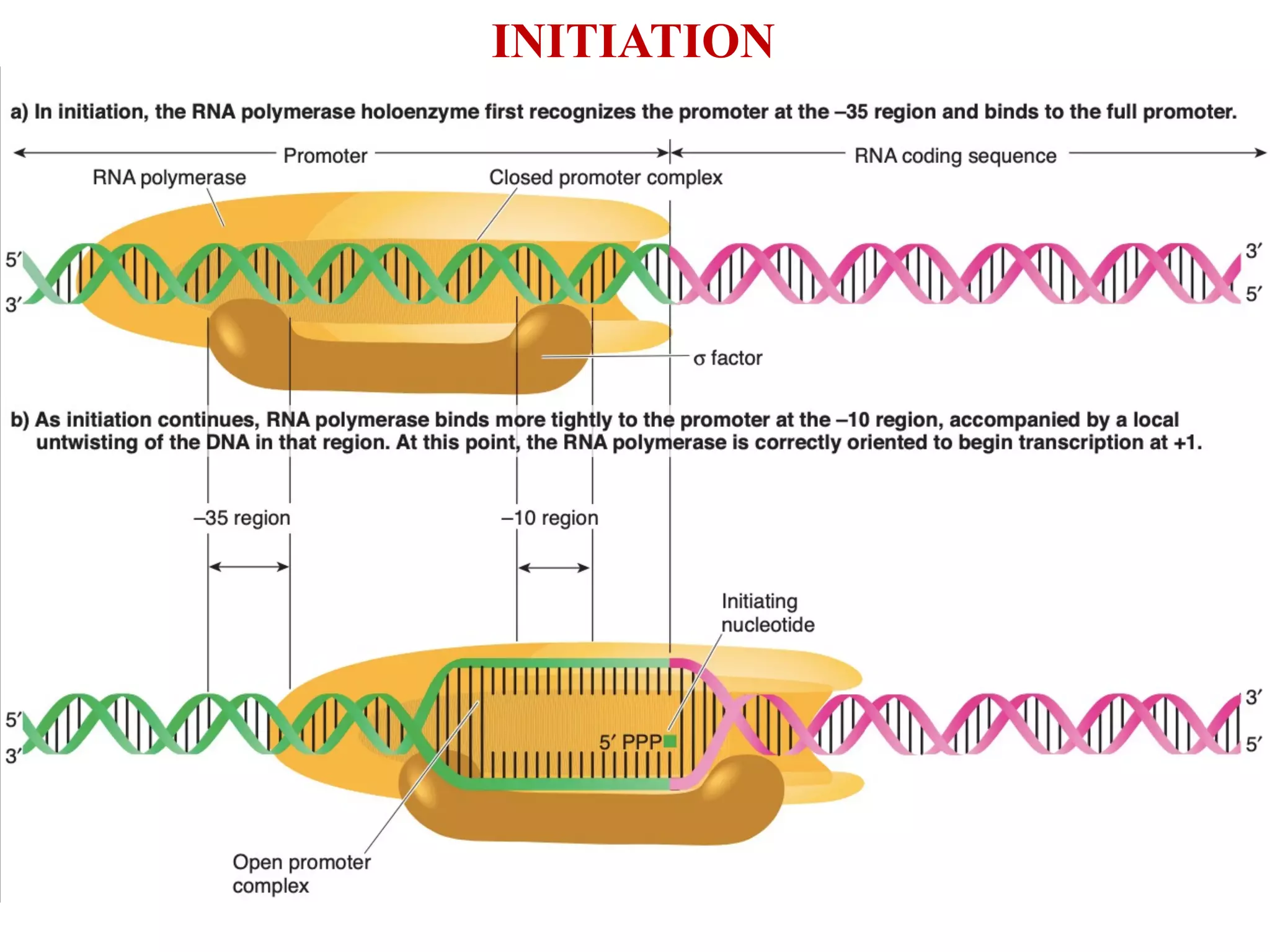
vInitiation: Holoenzyme binds promoter and begins
RNA synthesis.
vElongation: Holoenzyme leaves promoter, and σ
factor dissociates; core enzyme continues RNA
synthesis.
vTermination: At terminator sites; RNA and core
enzyme dissociate from DNA.
INITIATION
ELONGATION
Termination
Ø Core enzyme reaches terminator site,
Ø No further ribotides are added to the RNA chain
Ø RNA chain dissociates from the template strand of DNA.
Ø Transcription bubble disappears
Ø Core enzyme dissociates from DNA.
The termination in prokaryotes have been classified into two groups:
1. Rho-Dependent Terminators
v A polypeptide called rho-factor is required for termination.
v Most likely, rho-factor binds the RNA transcript at a recognition site that is
located upstream of the termination site and interacts with the core enzyme
to cause termination.
2. Rho-independent Terminator
v Termination of transcription does not require rho factor.
v The RNA transcript forms a typical hairpin loop, which is followed by a
run of ~6 U residues.
v The poly-U region probably signals the core enzyme to leave the DNA
duplex causing the transcription termination.
Rho-independent termination
Thank You

Prokaryotic transcription

  • 1.
    PROKARYOTIC TRANSCRIPTION Prepared By: Dr. AsitPrasad Dash Assistant Professor DEPARTMENT OF PLANT BREEDING AND GENETICS INSTITUTE OF AGRICULTURAL SCIENCES SIKSHA ‘O’ ANUSANDHAN (DEEMED TO BE UNIVERSITY), BHUBANESWAR, 751029
  • 2.
    vThe process ofproduction of RNA copy of a DNA sequence is called transcription; vthis reaction is catalyzed by DNA-directed RNA polymerase (RNA polymerase). THE CENTRAL DOGMA(Crick, 1958)
  • 3.
    v As inthe case of DNA replication, RNA chain elongates (transcription occurs) in the 5' 3' direction. SENSE AND ANTISENSE STRANDS v antisense strand or template strand: the strand of a DNA molecule (= double helix) which is transcribed to synthesise sense RNA. v The other strand of the DNA duplex is known as coding strand or sense strand or nontemplate strand. v The base sequence of RNA is complementary to that of the antisense strand of the DNA molecules, but is the same as that of the sense strand (except that in place of T in the sense strand, U will be present in the sense RNA).
  • 5.
    TRANSCRIPTION UNIT v Atranscription unit is that stretch or sequence of DNA that is transcribed into a single RNA molecule. A transcription unit has Ø Promoter at its beginning (at the 3'-end of its antisense strand), Ø Start point Ø Coding region and Ø Terminator sequence at its end. v RNA polymerase binds to the promoter, and transcription begins at the start point; it progresses through the coding sequence and ends around the terminator site. v In case of eukaryotes, each gene is a distinct transcription unit. v In case of prokaryotes, genes encoding the enzymes for a single biosynthetic pathway are usually clustered together into a single regulatory unit called operon and each operon functions as a single transcription unit.
  • 6.
  • 7.
    OPTIMAL PROKARYOTIC PROMOTER vPromoter is that sequence of a transcription unit where RNA polymerase binds and initiates transcription. E. coli promoters have the following 3 consensus sequences: Ø Startpoint; in > 90% cases, a purine. Ø -10 sequence; TATAAT; also called Pribnow box. Ø - 35 sequence; TTGACA; plays role in promoter recognition.
  • 8.
    BACTERIAL RNA POLYMERASE vIn most bacteria, a single type of RNA polymerase is found. The complete RNA polymerase molecule is called holoenzyme; it has the following components: 1. Core Enzyme v The core enzyme can transcribe a DNA duplex after transcription has been initiated, but it cannot initiate transcription at proper sites. 2. Sigma (σ) Factor v The sigma factor is involved in stable binding of RNA polymerase holoenzyme specifically to promoter DNA. v It is released from the core enzyme when the RNA chain reaches 8-9 bases following transcription initiation.
  • 9.
    TRANSCRIPTION PROCESS The transcriptionprocess is divided into the following 3 distinct phases: vInitiation: Holoenzyme binds promoter and begins RNA synthesis. vElongation: Holoenzyme leaves promoter, and σ factor dissociates; core enzyme continues RNA synthesis. vTermination: At terminator sites; RNA and core enzyme dissociate from DNA.
  • 10.
  • 11.
  • 12.
    Termination Ø Core enzymereaches terminator site, Ø No further ribotides are added to the RNA chain Ø RNA chain dissociates from the template strand of DNA. Ø Transcription bubble disappears Ø Core enzyme dissociates from DNA. The termination in prokaryotes have been classified into two groups: 1. Rho-Dependent Terminators v A polypeptide called rho-factor is required for termination. v Most likely, rho-factor binds the RNA transcript at a recognition site that is located upstream of the termination site and interacts with the core enzyme to cause termination. 2. Rho-independent Terminator v Termination of transcription does not require rho factor. v The RNA transcript forms a typical hairpin loop, which is followed by a run of ~6 U residues. v The poly-U region probably signals the core enzyme to leave the DNA duplex causing the transcription termination.
  • 13.
  • 14.