P R E S E N T E D B Y :
P R A S H A N T V C
D E P T O F Z O O L O G Y
G U K
Atomic Absorption
Spectrometer
History
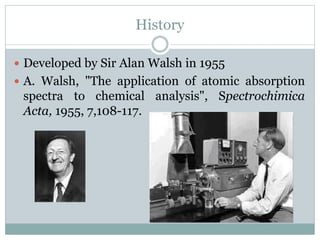
 Developed by Sir Alan Walsh in 1955
 A. Walsh, "The application of atomic absorption
spectra to chemical analysis", Spectrochimica
Acta, 1955, 7,108-117.
Atomic Absorption
 The "ground state" atom absorbs light energy of a
specific wavelength as it enters the "excited state."
 As the number of atoms in the light path increases,
the amount of light absorbed also increases.
 By measuring the amount of light absorbed, a
quantitative determination of the amount of
analyte can be made.
 The use of special light sources and careful
selection of wavelengths allow the specific
determination of
individual elements.
The origin of emission and absorption spectra. An emission spectrum is
produced when a molecule moves from a higher to a lower level. An
absorption spectra shows the radiation absorbed as atoms/molecules move
from a lower to a higher energy level.
Salient features
 AAS is very selective - each element has different set
of energy levels and lines are very narrow
 The elements must be reduced to the elemental
neutral ground state , neutral ground state by the
flame.
 The elements must be in vaporized state.
 The elements must be imposed in the beam of
radiation from the source.
Benefits and limitations
 Benefits :
1. Greater sensitivity and detection limits than other
methods
2. Direct analysis of some types of liquid samples
3. Low spectral interference
4. Very small sample size
 Limitations: Costly, for each element needs a specific
HCL.
Interference
 Absorption of source radiation: an element other than the one
of interest may absorb the wavelength being used.
 Ionization interference: the formation of ions rather than
atoms causes lower absorption of radiation. This problem is
overcome by adding ionization suppressors.
 Self absorption: atoms of the same kind as those that are
absorbing radiation will absorb more at the center of the line
than at the edges, thus resulting in a change of shape and
intensity of the line.
 Background absorption of source radiation: This is caused by
the presence of a particle from incomplete atomization. This
problem is overcome by increasing the flame temperature.
 Rate of aspiration, nebulization, or transport of the sample
(e.g. viscosity, surface tension, vapor pressure , and density) .
AAS instrumentation
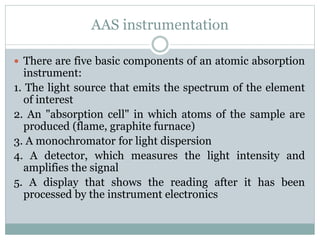
 There are five basic components of an atomic absorption
instrument:
1. The light source that emits the spectrum of the element
of interest
2. An "absorption cell" in which atoms of the sample are
produced (flame, graphite furnace)
3. A monochromator for light dispersion
4. A detector, which measures the light intensity and
amplifies the signal
5. A display that shows the reading after it has been
processed by the instrument electronics
Types
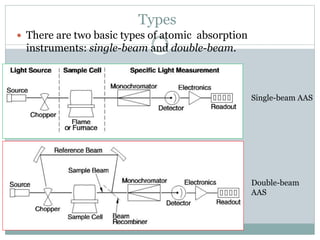
 There are two basic types of atomic absorption
instruments: single-beam and double-beam.
Single-beam AAS
Double-beam
AAS
The Light Source
 The light source, called a hollow cathode tube, is a
lamp that emits exactly the wavelength required for
the analysis (without the use of a monochromator).
 The light is directed at the flame containing the
sample.
 A red glow is observed in lamps filled with neon,
while argon filled lamps have a blue glow.
A Hollow Cathode Lamp
Flame
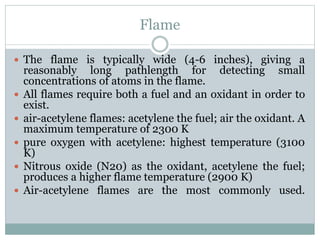
 The flame is typically wide (4-6 inches), giving a
reasonably long pathlength for detecting small
concentrations of atoms in the flame.
 All flames require both a fuel and an oxidant in order to
exist.
 air-acetylene flames: acetylene the fuel; air the oxidant. A
maximum temperature of 2300 K
 pure oxygen with acetylene: highest temperature (3100
K)
 Nitrous oxide (N20) as the oxidant, acetylene the fuel;
produces a higher flame temperature (2900 K)
 Air-acetylene flames are the most commonly used.
Burner (Atomizer)
 There are two designs of burners for the flame atomizer that
are in common use. These are the so-called "total
consumption burner" and the “premix burner."
 The fuel, oxidant, and sample all meet at the base of the
flame. The fuel (usually acetylene) and oxidant (usually air)
are forced, under pressure, into the flame, whereas the
sample is drawn into the flame by aspiration. The rush of
the fuel and oxidant through the burner head creates a
vacuum in the sample line and draws the sample from the
sample container into the flame with a "nebulizing" or
mixing effect.
 Burner heads are all made of solid titanium which is
corrosion resistant and free of most of the elements
commonly determined by atomic absorption.
Premix Burner
Total Consumption
Burner
GFAA
 an electrothermal graphite furnace is used
 The sample is heated stepwise (up to 3000ºC) to dry.
 it accepts solutions, slurries, or solid samples.
 it is a much more efficient atomizer than a flame
furnance and it can directly accept very small absolute
quantities of sample.
 It also provides a reducing environment for easily
oxidized elements.
 Samples are placed directly into the graphite furnace and
the furnace is electrically heated in several steps to dry
the sample, ash organic matter, and vaporize the analyte
atoms.
 The three-step sample preparation for graphite furnaces is
as follows:
1. Dry - evaporation of solvents (10–100 s)
2. Ash - removal of volatile hydroxides, sulfates, carbonates
(10–100 s)
3. Fire/Atomize - atomization of remaining analyte (1 s)
Monochromator
 The function of the monochromator is to isolate a
single atomic resonance line from the spectrum of
lines emitted by the hollow cathode lamp. Essentially
it is an adjustable filter that selects a specific, narrow
region of the spectrum for transmission to the
detector and excludes all wavelengths outside this
region.
 Prism
 Diffraction grating
Diffraction gratings
 Dispersion devices can be prisms but diffraction gratings are
used in AAS as they are:
 cheaper
 easier to make and
 provide superior performance.
 The diffraction grating is a block of glass with one surface
coated with highly reflective aluminium. The Al surface is
scored with fine grooves spaced closely together. Usually 500
- 3000 grooves per mm are used. The grooves must be
straight, evenly spaced, parallel and of identical shape.
 Light striking these grooves is reflected and dispersed at
different angles according to its wavelength. By rotating the
grating, a constituent wavelength is focussed on to the exit slit
via the second mirror.
 The detector measures the light intensity
(amplified by Photomultiplier Tube), which after
adjusting for the blank, is output to the readout.
Water Sample Preparation
1. Add 5 ml conc. HNO3 with 100 ml water
2. Heat on a hotplate in a beaker with watch glass
on top (Do not Boil)
3. Add 5 ml conc HNO3 again when 10-15 ml
solution remains.
4. Heat again then let it cool and makeup the
volume upto 100 ml with dilute HNO3(0.5 M)
5. Filter with whatmann filter paper before analysis.
 flame AAS (F AAS) – intended for determination of
higher concentrations (tenths to tens μg/ml)
 electrothermal AAS (ET AAS) or graphite furnace
AAS (GF AAS) – for determination of trace and
ultratrace concentrations (tens pg/ml to tens ng/ml)
 vapour generation techniques (VG AAS)
 – hydride generation AAS (HG AAS) – trace conc. of
As, Se, Sb, Te, Sn...
 – cold vapour AAS (CV AAS) – trace conc. of Hg.
THANK YOU

Atomic Absorption Spectrometer.pptx

  • 1.
    P R ES E N T E D B Y : P R A S H A N T V C D E P T O F Z O O L O G Y G U K Atomic Absorption Spectrometer
  • 2.
    History  Developed bySir Alan Walsh in 1955  A. Walsh, "The application of atomic absorption spectra to chemical analysis", Spectrochimica Acta, 1955, 7,108-117.
  • 4.
    Atomic Absorption  The"ground state" atom absorbs light energy of a specific wavelength as it enters the "excited state."  As the number of atoms in the light path increases, the amount of light absorbed also increases.  By measuring the amount of light absorbed, a quantitative determination of the amount of analyte can be made.  The use of special light sources and careful selection of wavelengths allow the specific determination of individual elements.
  • 5.
    The origin ofemission and absorption spectra. An emission spectrum is produced when a molecule moves from a higher to a lower level. An absorption spectra shows the radiation absorbed as atoms/molecules move from a lower to a higher energy level.
  • 6.
    Salient features  AASis very selective - each element has different set of energy levels and lines are very narrow  The elements must be reduced to the elemental neutral ground state , neutral ground state by the flame.  The elements must be in vaporized state.  The elements must be imposed in the beam of radiation from the source.
  • 7.
    Benefits and limitations Benefits : 1. Greater sensitivity and detection limits than other methods 2. Direct analysis of some types of liquid samples 3. Low spectral interference 4. Very small sample size  Limitations: Costly, for each element needs a specific HCL.
  • 8.
    Interference  Absorption ofsource radiation: an element other than the one of interest may absorb the wavelength being used.  Ionization interference: the formation of ions rather than atoms causes lower absorption of radiation. This problem is overcome by adding ionization suppressors.  Self absorption: atoms of the same kind as those that are absorbing radiation will absorb more at the center of the line than at the edges, thus resulting in a change of shape and intensity of the line.  Background absorption of source radiation: This is caused by the presence of a particle from incomplete atomization. This problem is overcome by increasing the flame temperature.  Rate of aspiration, nebulization, or transport of the sample (e.g. viscosity, surface tension, vapor pressure , and density) .
  • 9.
    AAS instrumentation  Thereare five basic components of an atomic absorption instrument: 1. The light source that emits the spectrum of the element of interest 2. An "absorption cell" in which atoms of the sample are produced (flame, graphite furnace) 3. A monochromator for light dispersion 4. A detector, which measures the light intensity and amplifies the signal 5. A display that shows the reading after it has been processed by the instrument electronics
  • 10.
    Types  There aretwo basic types of atomic absorption instruments: single-beam and double-beam. Single-beam AAS Double-beam AAS
  • 11.
    The Light Source The light source, called a hollow cathode tube, is a lamp that emits exactly the wavelength required for the analysis (without the use of a monochromator).  The light is directed at the flame containing the sample.  A red glow is observed in lamps filled with neon, while argon filled lamps have a blue glow.
  • 12.
  • 13.
    Flame  The flameis typically wide (4-6 inches), giving a reasonably long pathlength for detecting small concentrations of atoms in the flame.  All flames require both a fuel and an oxidant in order to exist.  air-acetylene flames: acetylene the fuel; air the oxidant. A maximum temperature of 2300 K  pure oxygen with acetylene: highest temperature (3100 K)  Nitrous oxide (N20) as the oxidant, acetylene the fuel; produces a higher flame temperature (2900 K)  Air-acetylene flames are the most commonly used.
  • 15.
    Burner (Atomizer)  Thereare two designs of burners for the flame atomizer that are in common use. These are the so-called "total consumption burner" and the “premix burner."  The fuel, oxidant, and sample all meet at the base of the flame. The fuel (usually acetylene) and oxidant (usually air) are forced, under pressure, into the flame, whereas the sample is drawn into the flame by aspiration. The rush of the fuel and oxidant through the burner head creates a vacuum in the sample line and draws the sample from the sample container into the flame with a "nebulizing" or mixing effect.  Burner heads are all made of solid titanium which is corrosion resistant and free of most of the elements commonly determined by atomic absorption.
  • 16.
  • 17.
    GFAA  an electrothermalgraphite furnace is used  The sample is heated stepwise (up to 3000ºC) to dry.  it accepts solutions, slurries, or solid samples.  it is a much more efficient atomizer than a flame furnance and it can directly accept very small absolute quantities of sample.  It also provides a reducing environment for easily oxidized elements.  Samples are placed directly into the graphite furnace and the furnace is electrically heated in several steps to dry the sample, ash organic matter, and vaporize the analyte atoms.
  • 18.
     The three-stepsample preparation for graphite furnaces is as follows: 1. Dry - evaporation of solvents (10–100 s) 2. Ash - removal of volatile hydroxides, sulfates, carbonates (10–100 s) 3. Fire/Atomize - atomization of remaining analyte (1 s)
  • 20.
    Monochromator  The functionof the monochromator is to isolate a single atomic resonance line from the spectrum of lines emitted by the hollow cathode lamp. Essentially it is an adjustable filter that selects a specific, narrow region of the spectrum for transmission to the detector and excludes all wavelengths outside this region.  Prism  Diffraction grating
  • 21.
    Diffraction gratings  Dispersiondevices can be prisms but diffraction gratings are used in AAS as they are:  cheaper  easier to make and  provide superior performance.  The diffraction grating is a block of glass with one surface coated with highly reflective aluminium. The Al surface is scored with fine grooves spaced closely together. Usually 500 - 3000 grooves per mm are used. The grooves must be straight, evenly spaced, parallel and of identical shape.  Light striking these grooves is reflected and dispersed at different angles according to its wavelength. By rotating the grating, a constituent wavelength is focussed on to the exit slit via the second mirror.
  • 23.
     The detectormeasures the light intensity (amplified by Photomultiplier Tube), which after adjusting for the blank, is output to the readout.
  • 24.
    Water Sample Preparation 1.Add 5 ml conc. HNO3 with 100 ml water 2. Heat on a hotplate in a beaker with watch glass on top (Do not Boil) 3. Add 5 ml conc HNO3 again when 10-15 ml solution remains. 4. Heat again then let it cool and makeup the volume upto 100 ml with dilute HNO3(0.5 M) 5. Filter with whatmann filter paper before analysis.
  • 25.
     flame AAS(F AAS) – intended for determination of higher concentrations (tenths to tens μg/ml)  electrothermal AAS (ET AAS) or graphite furnace AAS (GF AAS) – for determination of trace and ultratrace concentrations (tens pg/ml to tens ng/ml)  vapour generation techniques (VG AAS)  – hydride generation AAS (HG AAS) – trace conc. of As, Se, Sb, Te, Sn...  – cold vapour AAS (CV AAS) – trace conc. of Hg.
  • 26.