‘RIBOZYMES’
By
KAUSHAL KUMAR SAHU
Assistant Professor (Ad Hoc)
Department of Biotechnology
Govt. Digvijay Autonomous P. G. College
Raj-Nandgaon ( C. G. )
Synopsis
Introduction
History
Definition
Types of RNA catalytic activity
1.Intermolecular catalysis
2.Intramolecular catalysis
RNA splicing
Types of ribozymes
1. Group 1 introns
2. Group 2 introns
3. Spliceosomes
4. Hammerhead ribozymes
5. RNase P ribozyme
6. Ribosomes
Clinical application of ribozyme
Conclusion
Reference
INTRODUCTION
 Ribozyme is derived from the word ‘RNA’ and
‘enzyme’.
 Term ribozyme is used to describe an RNA with
catalytic activity.
 Ribozyme activity is based on transesterification
and phosphodiester bond hydrolysis.
 Ribozymes are inactivated by heating above
their melting temperature and if essential
nucleotides are changed.
HISTORY
 In 1967, Carl Woese, Francis Crick & Leslic
Orgel were the first to suggest that RNA
could act as catalyst.
 In 1880, Sidney Altman discovered first
ribozyme.
 The term ribozyme were first introduced by
Kelly Krugger et al in 1982.
DEFINITION
A ribozyme is RNA molecules that is
capable of catalyzing RNA cleavage in a
sequence specific way and they may
catalyze self cleavage as well as
cleavage of external substrates.
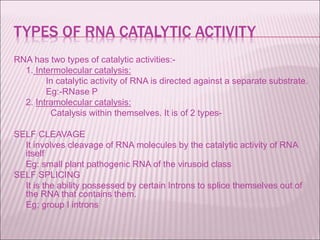
TYPES OF RNA CATALYTIC ACTIVITY
RNA has two types of catalytic activities:-
1. Intermolecular catalysis:
In catalytic activity of RNA is directed against a separate substrate.
Eg:-RNase P
2. Intramolecular catalysis:
Catalysis within themselves. It is of 2 types-
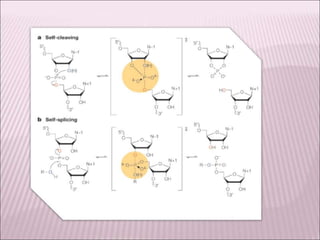
SELF CLEAVAGE
It involves cleavage of RNA molecules by the catalytic activity of RNA
itself
Eg: small plant pathogenic RNA of the virusoid class
SELF SPLICING
It is the ability possessed by certain Introns to splice themselves out of
the RNA that contains them.
Eg: group I introns
RNA SPLICING
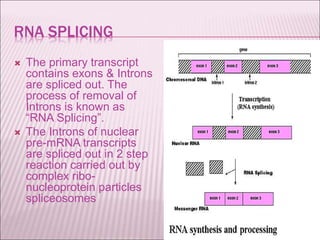
 The primary transcript
contains exons & Introns
are spliced out. The
process of removal of
Introns is known as
“RNA Splicing”.
 The Introns of nuclear
pre-mRNA transcripts
are spliced out in 2 step
reaction carried out by
complex ribo-
nucleoprotein particles
spliceosomes
Types of ribozymes:
1) Group I Introns (Autocatalytic splicing)
2) Group II introns
3) RNAase P Ribozyme (tRNA precursor splicing)
4) Spliceosomes (pre mRNAsplicing)
5) Hammerhead ribozyme (self cleavage)
6) Hairpin ribozymes
7) Ribosomes
RIBOSOMES
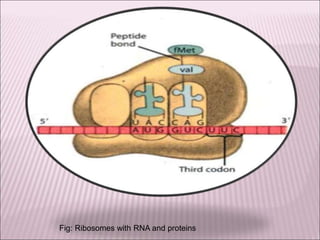
Ribosomes are complex RNA particles made up of two dissimilar subunits
each of which contains RNA & many proteins. Ribosomes play role as a
ribozyme.
In prokaryotes the active site of ribosome is on the 50S subunit. There are
no protein functional groups to catalyze peptide bond formation. Instead,
residues within 23SrRNA helps transfer a H+ during peptide bond
synthesis.
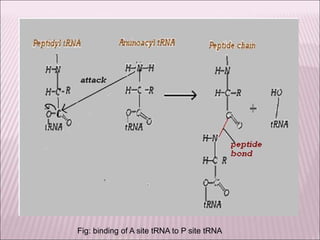
Large subunit is a complex ribozyme in which peptide bond formation is
an RNA catalyzed reaction.
rRNA are more highly conserved throughout evolution than are ribosomal
proteins.
Most mutations that confer resistance to antibiotics that inhibit protein
synthesis occurs in genes encoding rRNAs rather than ribosomal proteins
Fig: binding of A site tRNA to P site tRNA
Fig: Ribosomes with RNA and proteins
GROUP I INTRONS
 Group I Introns are found in diverse location they occur in genes
coding for rRNA in the nuclei of the lower eukaryotes-
Tetrahymena thermophila (a ciliate) and Physarum polycephalum
(a slime mould).
 They have intrinsic ability to splice themselves. This is called as
“SELF SPLICING” or “AUTOCATALYTIC SPLICING”.
 REQUIREMENTS:-
Cofactor –
A guanine nucleoside or nucleotide with free 3’OH
group (GTP,GDP, GMP) as a cofactor.
Cation –
A divalent cation & a monovalent cation.
MECHANISM
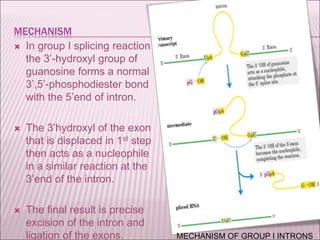
 In group I splicing reaction
the 3’-hydroxyl group of
guanosine forms a normal
3’,5’-phosphodiester bond
with the 5’end of intron.
 The 3’hydroxyl of the exon
that is displaced in 1st step
then acts as a nucleophile
in a similar reaction at the
3’end of the intron.
 The final result is precise
excision of the intron and
ligation of the exons. MECHANISM OF GROUP I INTRONS
GROUP II INTRONS
 Group II introns are generally found in the
primary transcripts of mitochondrial or
chloroplast mRNAs in fungi, algae, and
plants.
MECHANISM
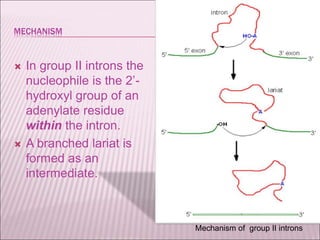
 In group II introns the
nucleophile is the 2’-
hydroxyl group of an
adenylate residue
within the intron.
 A branched lariat is
formed as an
intermediate.
Mechanism of group II introns
RNASE P RIBOZYMES
Ribonuclease P (RNase P) is a type of
ribonuclease which cleaves RNA. RNase P is
unique from other RNases in that it is a ribozyme –
a ribonucleic acid that acts as a catalyst in the
same way that a protein based enzyme would.
Its function is to cleave off an extra, or precursor,
sequence of RNA on tRNA molecules
Splicing mechanism of Rnase P ribozyme
SPLICEOSOMES
A spliceosome is a complex of specialized RNA and
protein subunits that removes introns from a
transcribed pre-mRNA segment. This process is
generally referred to as splicing.
Each spliceosome is composed of five small nuclear
RNA proteins, called snRNPs, (pronounced "snurps")
and a range of non-snRNP associated protein
factors.
The snRNPs that make up the nuclear spliceosome
are named U1, U2, U4, U5, and U6, and participate in
several RNA-RNA and RNA-protein interactions. The
RNA component of the snRNP is rich in uridine (the
MECHANISM
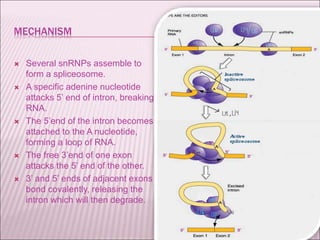
 Several snRNPs assemble to
form a spliceosome.
 A specific adenine nucleotide
attacks 5’ end of intron, breaking
RNA.
 The 5’end of the intron becomes
attached to the A nucleotide,
forming a loop of RNA.
 The free 3’end of one exon
attacks the 5’ end of the other.
 3’ and 5’ ends of adjacent exons
bond covalently, releasing the
intron which will then degrade.
HAMMERHEAD RIBOZYMES
 Another example of the ability of
RNA to function as an
endonuclease is provided by
some small plant RNAs that
undertake a self cleavage
reaction.
 These small plant RNAs falls
into two general groups:
Viroids
Virusoids
 Certain virus like elements
called “virusoids” has small RNA
genomes & usually requires
another virus to assist in their
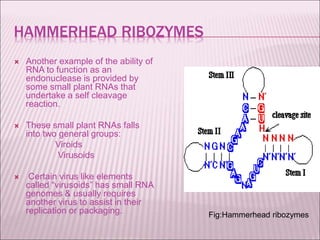
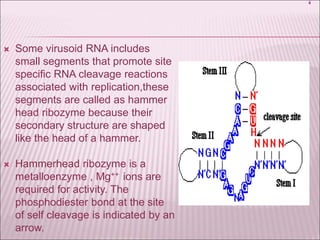
replication or packaging. Fig:Hammerhead ribozymes
.
 Some virusoid RNA includes
small segments that promote site
specific RNA cleavage reactions
associated with replication,these
segments are called as hammer
head ribozyme because their
secondary structure are shaped
like the head of a hammer.
 Hammerhead ribozyme is a
metalloenzyme , Mg++ ions are
required for activity. The
phosphodiester bond at the site
of self cleavage is indicated by an
arrow.
HAIRPIN RIBOZYMES
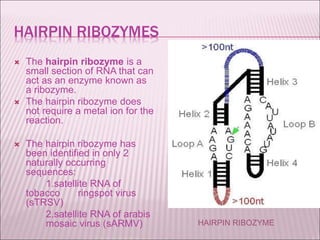
 The hairpin ribozyme is a
small section of RNA that can
act as an enzyme known as
a ribozyme.
 The hairpin ribozyme does
not require a metal ion for the
reaction.
 The hairpin ribozyme has
been identified in only 2
naturally occurring
sequences:
1.satellite RNA of
tobacco ringspot virus
(sTRSV)
2.satellite RNA of arabis
mosaic virus (sARMV) HAIRPIN RIBOZYME
APPLICATIONS OF RIBOZYME
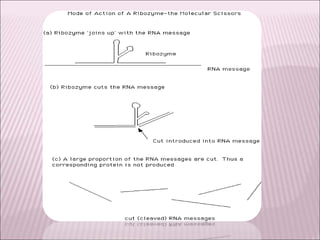
 The ribozyme binds to an RNA (substrate)
having complementary nucleotide sequences
& catalyze the reaction that cleaves the
backbone of the substrate RNA.
 Ribozyme binds to mRNA and inhibits its
expression, thus helps in many diseases
therapy eg: genetical diseases. Mechanism
is as follows:
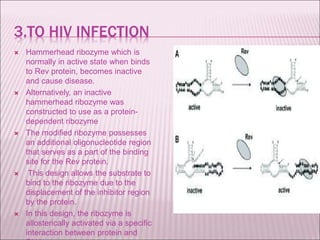
3.TO HIV INFECTION
 Hammerhead ribozyme which is
normally in active state when binds
to Rev protein, becomes inactive
and cause disease.
 Alternatively, an inactive
hammerhead ribozyme was
constructed to use as a protein-
dependent ribozyme
 The modified ribozyme possesses
an additional oligonucleotide region
that serves as a part of the binding
site for the Rev protein.
 This design allows the substrate to
bind to the ribozyme due to the
displacement of the inhibitor region
by the protein.
 In this design, the ribozyme is
allosterically activated via a specific
interaction between protein and
Books Author
Gene 8 Benjamin Lewin
Cell and molecular biology Gerald Karp
Principle of genetics Simmons, Snustad &
Gardener
Biochemistry (III edition) Nelson & Cox
Reference
Websites:
www.wikipedia.com

Ribozyme by KK Sahu sir

  • 1.
    ‘RIBOZYMES’ By KAUSHAL KUMAR SAHU AssistantProfessor (Ad Hoc) Department of Biotechnology Govt. Digvijay Autonomous P. G. College Raj-Nandgaon ( C. G. )
  • 2.
    Synopsis Introduction History Definition Types of RNAcatalytic activity 1.Intermolecular catalysis 2.Intramolecular catalysis RNA splicing Types of ribozymes 1. Group 1 introns 2. Group 2 introns 3. Spliceosomes 4. Hammerhead ribozymes 5. RNase P ribozyme 6. Ribosomes Clinical application of ribozyme Conclusion Reference
  • 3.
    INTRODUCTION  Ribozyme isderived from the word ‘RNA’ and ‘enzyme’.  Term ribozyme is used to describe an RNA with catalytic activity.  Ribozyme activity is based on transesterification and phosphodiester bond hydrolysis.  Ribozymes are inactivated by heating above their melting temperature and if essential nucleotides are changed.
  • 4.
    HISTORY  In 1967,Carl Woese, Francis Crick & Leslic Orgel were the first to suggest that RNA could act as catalyst.  In 1880, Sidney Altman discovered first ribozyme.  The term ribozyme were first introduced by Kelly Krugger et al in 1982.
  • 5.
    DEFINITION A ribozyme isRNA molecules that is capable of catalyzing RNA cleavage in a sequence specific way and they may catalyze self cleavage as well as cleavage of external substrates.
  • 6.
    TYPES OF RNACATALYTIC ACTIVITY RNA has two types of catalytic activities:- 1. Intermolecular catalysis: In catalytic activity of RNA is directed against a separate substrate. Eg:-RNase P 2. Intramolecular catalysis: Catalysis within themselves. It is of 2 types- SELF CLEAVAGE It involves cleavage of RNA molecules by the catalytic activity of RNA itself Eg: small plant pathogenic RNA of the virusoid class SELF SPLICING It is the ability possessed by certain Introns to splice themselves out of the RNA that contains them. Eg: group I introns
  • 8.
    RNA SPLICING  Theprimary transcript contains exons & Introns are spliced out. The process of removal of Introns is known as “RNA Splicing”.  The Introns of nuclear pre-mRNA transcripts are spliced out in 2 step reaction carried out by complex ribo- nucleoprotein particles spliceosomes
  • 9.
    Types of ribozymes: 1)Group I Introns (Autocatalytic splicing) 2) Group II introns 3) RNAase P Ribozyme (tRNA precursor splicing) 4) Spliceosomes (pre mRNAsplicing) 5) Hammerhead ribozyme (self cleavage) 6) Hairpin ribozymes 7) Ribosomes
  • 10.
    RIBOSOMES Ribosomes are complexRNA particles made up of two dissimilar subunits each of which contains RNA & many proteins. Ribosomes play role as a ribozyme. In prokaryotes the active site of ribosome is on the 50S subunit. There are no protein functional groups to catalyze peptide bond formation. Instead, residues within 23SrRNA helps transfer a H+ during peptide bond synthesis. Large subunit is a complex ribozyme in which peptide bond formation is an RNA catalyzed reaction. rRNA are more highly conserved throughout evolution than are ribosomal proteins. Most mutations that confer resistance to antibiotics that inhibit protein synthesis occurs in genes encoding rRNAs rather than ribosomal proteins
  • 11.
    Fig: binding ofA site tRNA to P site tRNA
  • 12.
    Fig: Ribosomes withRNA and proteins
  • 13.
    GROUP I INTRONS Group I Introns are found in diverse location they occur in genes coding for rRNA in the nuclei of the lower eukaryotes- Tetrahymena thermophila (a ciliate) and Physarum polycephalum (a slime mould).  They have intrinsic ability to splice themselves. This is called as “SELF SPLICING” or “AUTOCATALYTIC SPLICING”.  REQUIREMENTS:- Cofactor – A guanine nucleoside or nucleotide with free 3’OH group (GTP,GDP, GMP) as a cofactor. Cation – A divalent cation & a monovalent cation.
  • 14.
    MECHANISM  In groupI splicing reaction the 3’-hydroxyl group of guanosine forms a normal 3’,5’-phosphodiester bond with the 5’end of intron.  The 3’hydroxyl of the exon that is displaced in 1st step then acts as a nucleophile in a similar reaction at the 3’end of the intron.  The final result is precise excision of the intron and ligation of the exons. MECHANISM OF GROUP I INTRONS
  • 15.
    GROUP II INTRONS Group II introns are generally found in the primary transcripts of mitochondrial or chloroplast mRNAs in fungi, algae, and plants.
  • 16.
    MECHANISM  In groupII introns the nucleophile is the 2’- hydroxyl group of an adenylate residue within the intron.  A branched lariat is formed as an intermediate. Mechanism of group II introns
  • 17.
    RNASE P RIBOZYMES RibonucleaseP (RNase P) is a type of ribonuclease which cleaves RNA. RNase P is unique from other RNases in that it is a ribozyme – a ribonucleic acid that acts as a catalyst in the same way that a protein based enzyme would. Its function is to cleave off an extra, or precursor, sequence of RNA on tRNA molecules
  • 18.
    Splicing mechanism ofRnase P ribozyme
  • 19.
    SPLICEOSOMES A spliceosome isa complex of specialized RNA and protein subunits that removes introns from a transcribed pre-mRNA segment. This process is generally referred to as splicing. Each spliceosome is composed of five small nuclear RNA proteins, called snRNPs, (pronounced "snurps") and a range of non-snRNP associated protein factors. The snRNPs that make up the nuclear spliceosome are named U1, U2, U4, U5, and U6, and participate in several RNA-RNA and RNA-protein interactions. The RNA component of the snRNP is rich in uridine (the
  • 20.
    MECHANISM  Several snRNPsassemble to form a spliceosome.  A specific adenine nucleotide attacks 5’ end of intron, breaking RNA.  The 5’end of the intron becomes attached to the A nucleotide, forming a loop of RNA.  The free 3’end of one exon attacks the 5’ end of the other.  3’ and 5’ ends of adjacent exons bond covalently, releasing the intron which will then degrade.
  • 21.
    HAMMERHEAD RIBOZYMES  Anotherexample of the ability of RNA to function as an endonuclease is provided by some small plant RNAs that undertake a self cleavage reaction.  These small plant RNAs falls into two general groups: Viroids Virusoids  Certain virus like elements called “virusoids” has small RNA genomes & usually requires another virus to assist in their replication or packaging. Fig:Hammerhead ribozymes
  • 22.
    .  Some virusoidRNA includes small segments that promote site specific RNA cleavage reactions associated with replication,these segments are called as hammer head ribozyme because their secondary structure are shaped like the head of a hammer.  Hammerhead ribozyme is a metalloenzyme , Mg++ ions are required for activity. The phosphodiester bond at the site of self cleavage is indicated by an arrow.
  • 23.
    HAIRPIN RIBOZYMES  Thehairpin ribozyme is a small section of RNA that can act as an enzyme known as a ribozyme.  The hairpin ribozyme does not require a metal ion for the reaction.  The hairpin ribozyme has been identified in only 2 naturally occurring sequences: 1.satellite RNA of tobacco ringspot virus (sTRSV) 2.satellite RNA of arabis mosaic virus (sARMV) HAIRPIN RIBOZYME
  • 24.
    APPLICATIONS OF RIBOZYME The ribozyme binds to an RNA (substrate) having complementary nucleotide sequences & catalyze the reaction that cleaves the backbone of the substrate RNA.  Ribozyme binds to mRNA and inhibits its expression, thus helps in many diseases therapy eg: genetical diseases. Mechanism is as follows:
  • 26.
    3.TO HIV INFECTION Hammerhead ribozyme which is normally in active state when binds to Rev protein, becomes inactive and cause disease.  Alternatively, an inactive hammerhead ribozyme was constructed to use as a protein- dependent ribozyme  The modified ribozyme possesses an additional oligonucleotide region that serves as a part of the binding site for the Rev protein.  This design allows the substrate to bind to the ribozyme due to the displacement of the inhibitor region by the protein.  In this design, the ribozyme is allosterically activated via a specific interaction between protein and
  • 28.
    Books Author Gene 8Benjamin Lewin Cell and molecular biology Gerald Karp Principle of genetics Simmons, Snustad & Gardener Biochemistry (III edition) Nelson & Cox Reference Websites: www.wikipedia.com