Revolution in ChinaRevolution in China
Heading towards revolution inHeading towards revolution in
China…China… 1800s1800s
– The Opium WarsThe Opium Wars
– Open Door PolicyOpen Door Policy
– The Boxer RebellionThe Boxer Rebellion
 The Republic of ChinaThe Republic of China
– Formed in Nanjing March 12, 1912Formed in Nanjing March 12, 1912
 Sun Yat-sen is President, Yuan Shikai quicklySun Yat-sen is President, Yuan Shikai quickly
replaced him, but not a smooth transitionreplaced him, but not a smooth transition
 May Fourth Movement, 1919May Fourth Movement, 1919
 Civil War DevelopsCivil War Develops
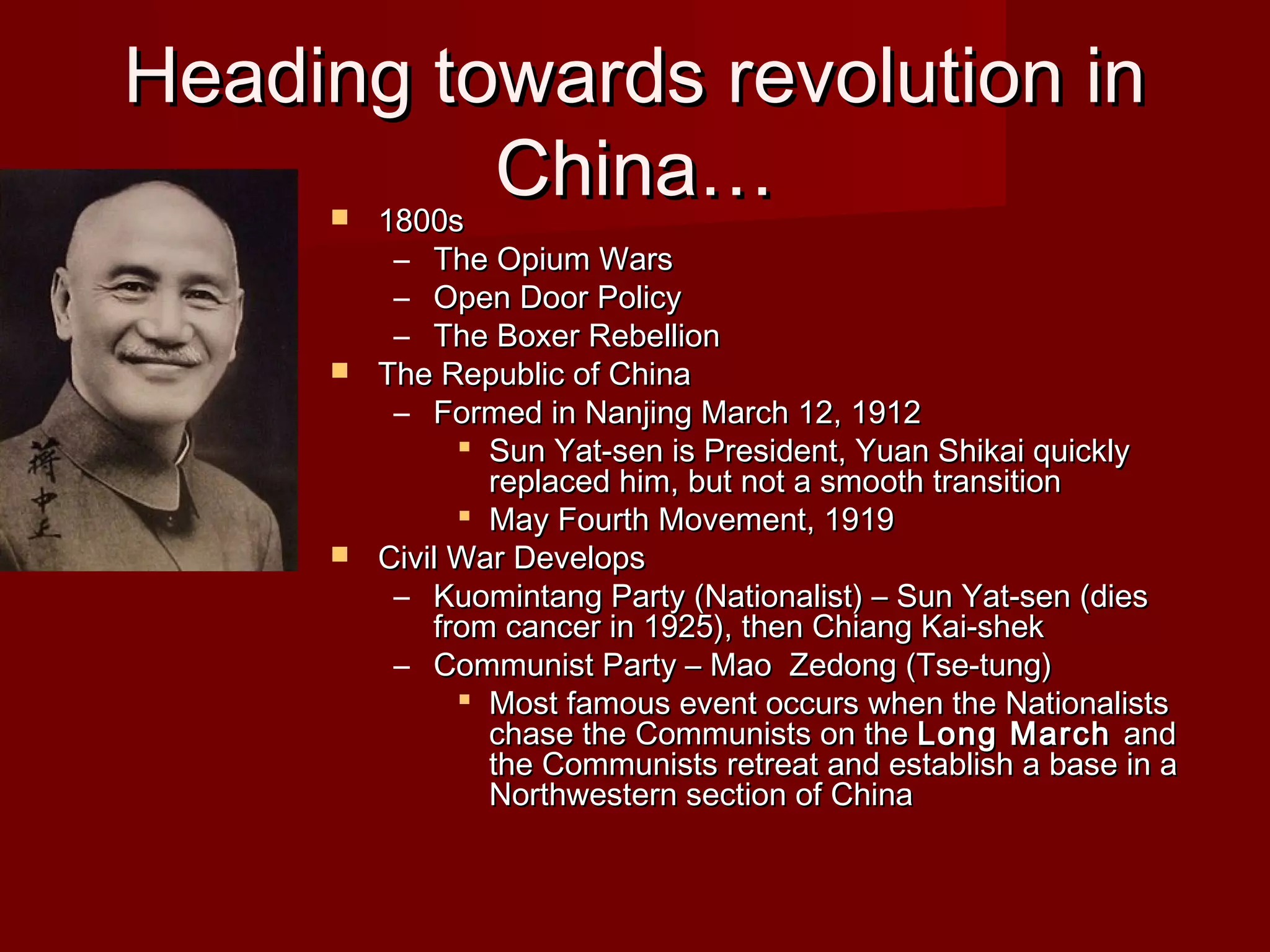
– Kuomintang Party (Nationalist) – Sun Yat-sen (diesKuomintang Party (Nationalist) – Sun Yat-sen (dies
from cancer in 1925), then Chiang Kai-shekfrom cancer in 1925), then Chiang Kai-shek
– Communist Party – Mao Zedong (Tse-tung)Communist Party – Mao Zedong (Tse-tung)
 Most famous event occurs when the NationalistsMost famous event occurs when the Nationalists
chase the Communists on thechase the Communists on the Long MarchLong March andand
the Communists retreat and establish a base in athe Communists retreat and establish a base in a
Northwestern section of ChinaNorthwestern section of China
Japan Invades ChinaJapan Invades China
 The Manchurian Incident – September 1931The Manchurian Incident – September 1931
– Japanese railway is attacked, Japanese claimJapanese railway is attacked, Japanese claim
Chinese dissidents are to blame, use it as an excuseChinese dissidents are to blame, use it as an excuse
to invadeto invade
 Japanese invade Manchuria, name it ManchukuoJapanese invade Manchuria, name it Manchukuo
 1933 – Japanese attack the Great Wall region1933 – Japanese attack the Great Wall region
 July 7, 1937 - full scale invasion of ChinaJuly 7, 1937 - full scale invasion of China
– Beijing, Shanghai, and Nanjing all fallBeijing, Shanghai, and Nanjing all fall
– Rape of NanjingRape of Nanjing
 China will be on the allies side in WW IIChina will be on the allies side in WW II
 Japanese will surrender their Chinese holdings inJapanese will surrender their Chinese holdings in
1945, once they surrender to the US1945, once they surrender to the US
Chinese RevolutionChinese Revolution
 Chiang Kai-Shek (Nationalist) v. MaoChiang Kai-Shek (Nationalist) v. Mao
Zedong (Comm.)Zedong (Comm.)
 China unites to fight Japan (1930s – 1945)China unites to fight Japan (1930s – 1945)
 During WW II, United States pumped $During WW II, United States pumped $
into Guomindang partyinto Guomindang party
 WW II ends, Chinese Civil War for fourWW II ends, Chinese Civil War for four
yearyear
Chinese Civil War EndsChinese Civil War Ends
 By 1949 – Mao Zedong has millions of peasantsBy 1949 – Mao Zedong has millions of peasants
in N. Chinain N. China
 Mao’s forces head South, chasing theMao’s forces head South, chasing the
GuomindangGuomindang
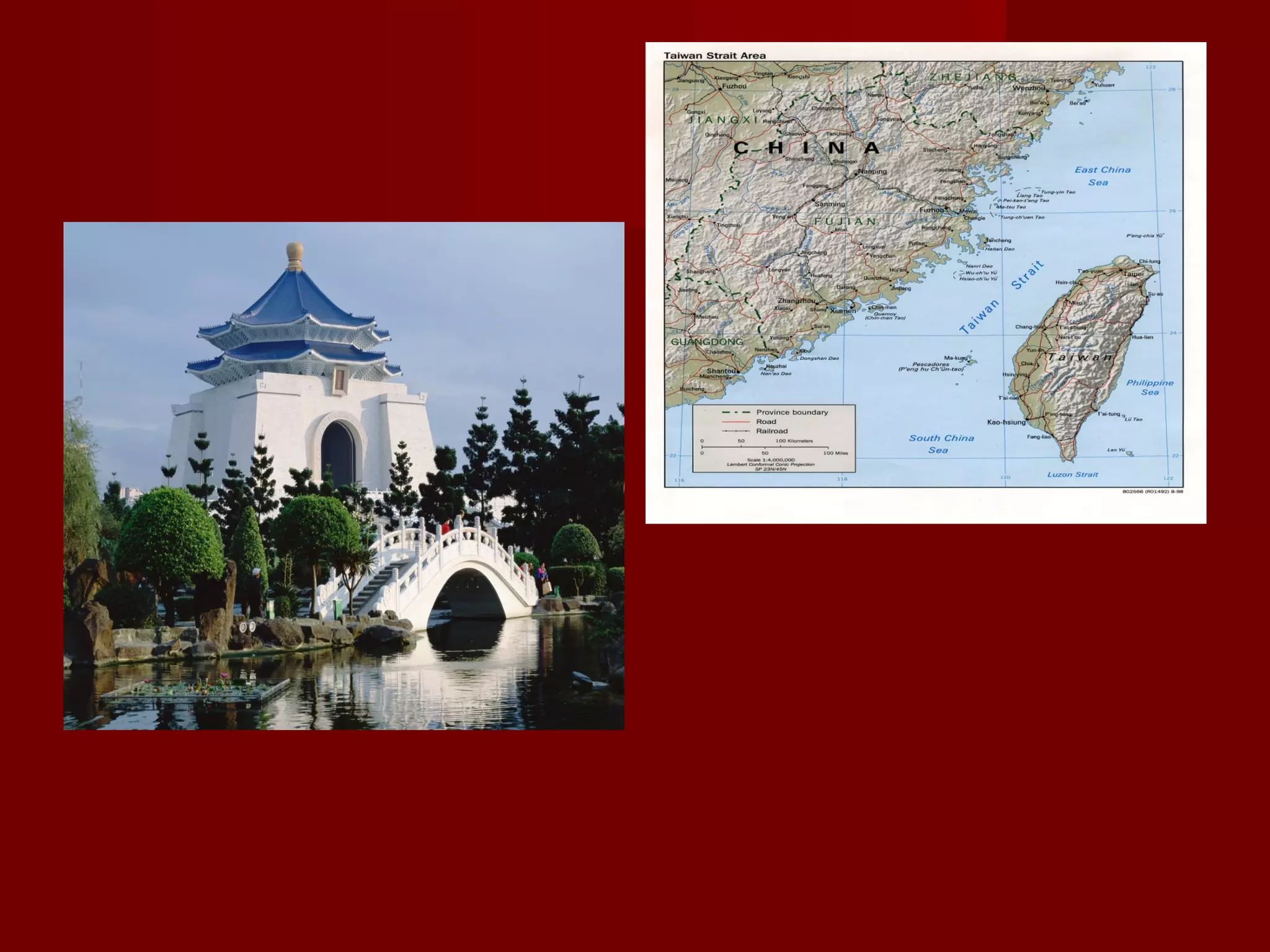
 Guomindang (Nationalists) flees to the island ofGuomindang (Nationalists) flees to the island of
Taiwan and establishes the Republic of ChinaTaiwan and establishes the Republic of China
 Communists and Mao take over mainland ChinaCommunists and Mao take over mainland China
and call it the People’s Republic of Chinaand call it the People’s Republic of China
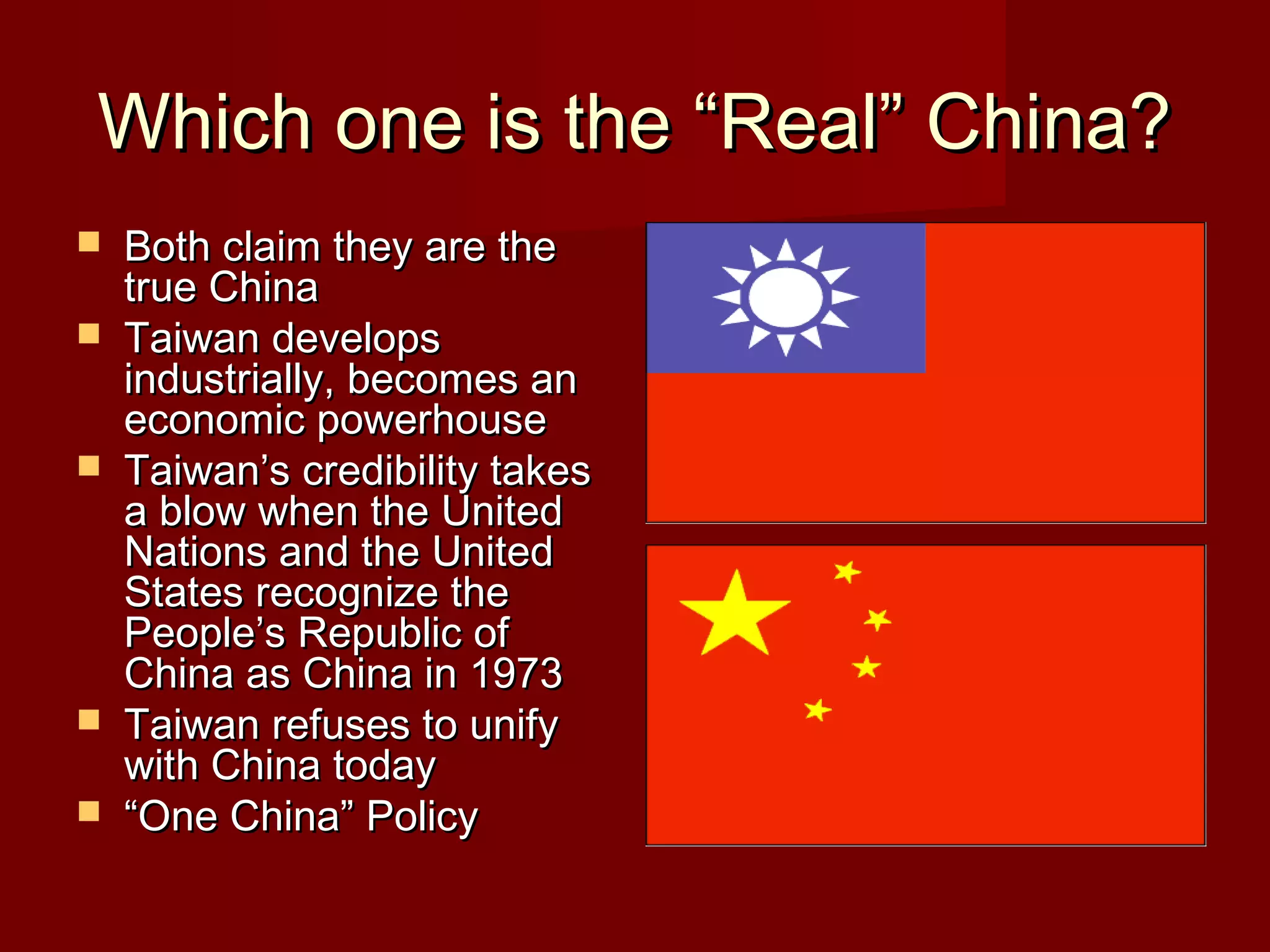
Which one is the “Real” China?Which one is the “Real” China?
 Both claim they are theBoth claim they are the
true Chinatrue China
 Taiwan developsTaiwan develops
industrially, becomes anindustrially, becomes an
economic powerhouseeconomic powerhouse
 Taiwan’s credibility takesTaiwan’s credibility takes
a blow when the Uniteda blow when the United
Nations and the UnitedNations and the United
States recognize theStates recognize the
People’s Republic ofPeople’s Republic of
China as China in 1973China as China in 1973
 Taiwan refuses to unifyTaiwan refuses to unify
with China todaywith China today
 ““One China” PolicyOne China” Policy
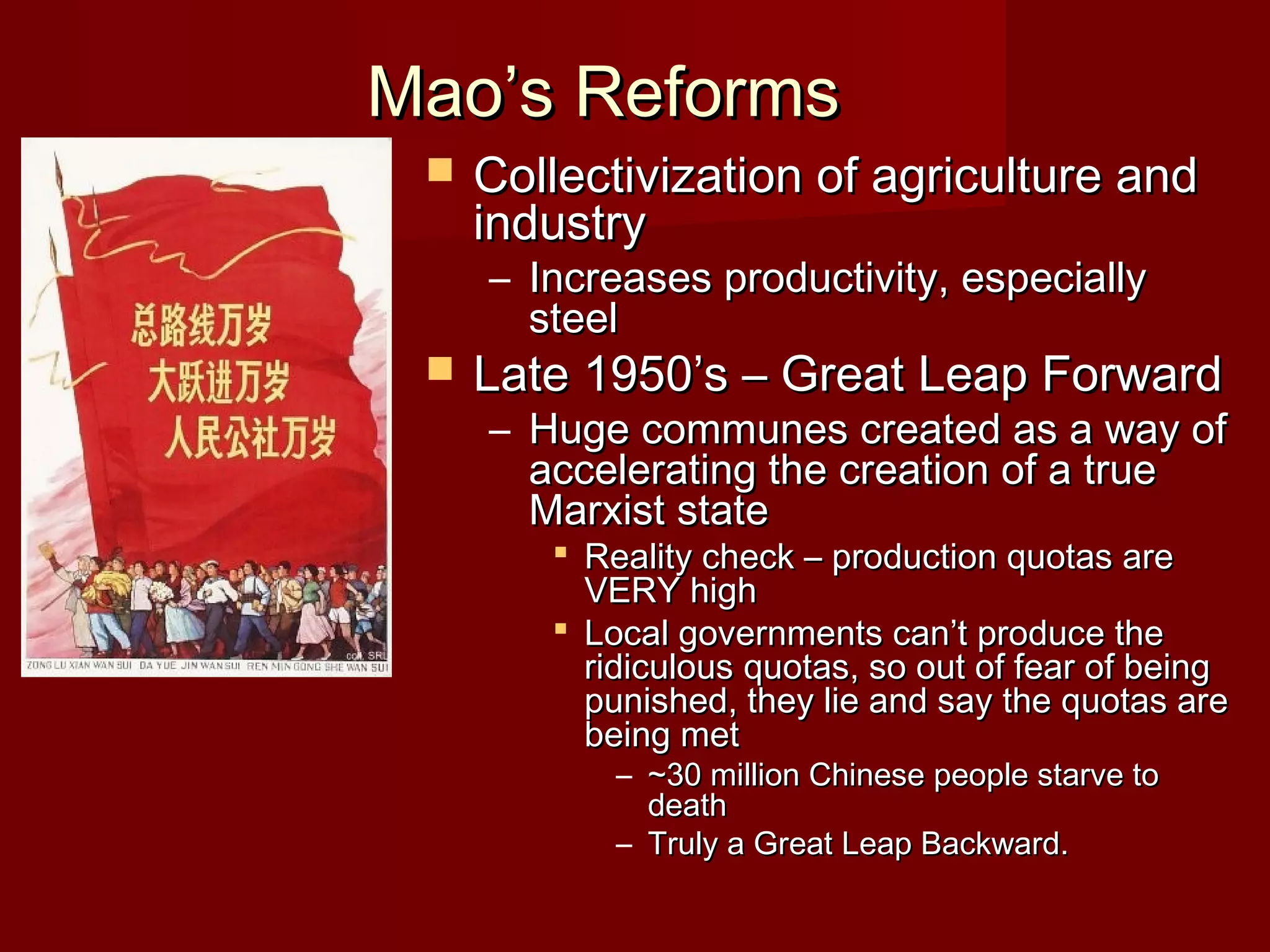
Mao’s ReformsMao’s Reforms
 Collectivization of agriculture andCollectivization of agriculture and
industryindustry
– Increases productivity, especiallyIncreases productivity, especially
steelsteel
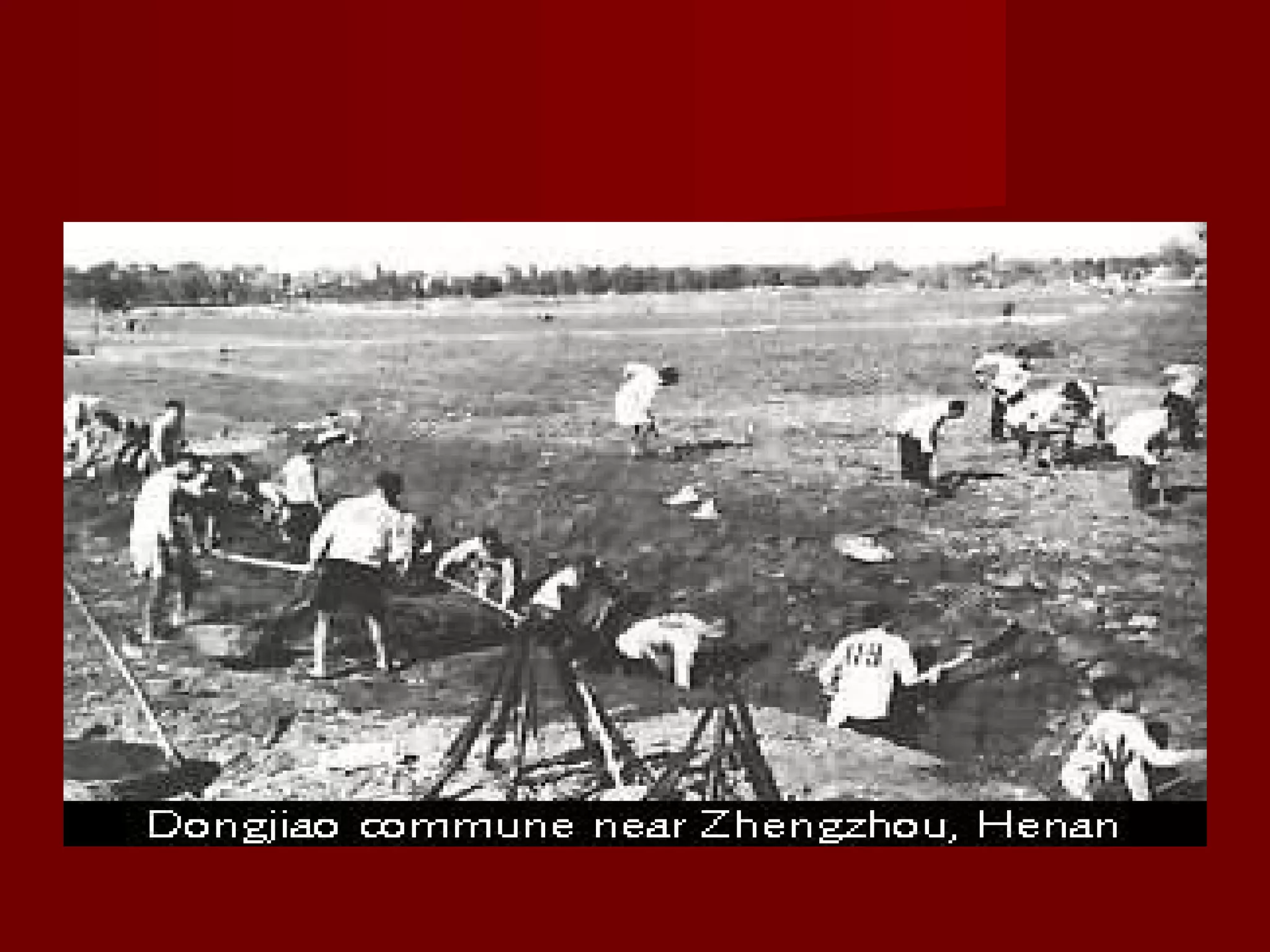
 Late 1950’s – Great Leap ForwardLate 1950’s – Great Leap Forward
– Huge communes created as a way ofHuge communes created as a way of
accelerating the creation of a trueaccelerating the creation of a true
Marxist stateMarxist state
 Reality check – production quotas areReality check – production quotas are
VERY highVERY high
 Local governments can’t produce theLocal governments can’t produce the
ridiculous quotas, so out of fear of beingridiculous quotas, so out of fear of being
punished, they lie and say the quotas arepunished, they lie and say the quotas are
being metbeing met
– ~30 million Chinese people starve to~30 million Chinese people starve to
deathdeath
– Truly a Great Leap Backward.Truly a Great Leap Backward.
Great Leap BackwardGreat Leap Backward
 Mao’s previous success is erasedMao’s previous success is erased
 Soviet Union withdrew supportSoviet Union withdrew support
– Soviets realize China isn’t following orders…Soviets realize China isn’t following orders…
 Mao turns focus to military (If Soviet’sMao turns focus to military (If Soviet’s
aren’t with China, they’re against China)aren’t with China, they’re against China)
– Elements of capitalism introducedElements of capitalism introduced
– 1964 – China tests its first atom bomb1964 – China tests its first atom bomb
Cultural Revolution - 1966Cultural Revolution - 1966
 Mao – purist, upset his country is straying fromMao – purist, upset his country is straying from
communismcommunism
 Revolution discourages development of aRevolution discourages development of a
privileged classprivileged class
– Erases all traces of Western-influenced knowledgeErases all traces of Western-influenced knowledge
– Closes universities for four yearsCloses universities for four years
– Sends students, professors, doctors, lawyers, andSends students, professors, doctors, lawyers, and
classical musicians to collective farms for “culturalclassical musicians to collective farms for “cultural
retraining”retraining”
– Political dissidents imprisoned or killedPolitical dissidents imprisoned or killed
New CurriculumNew Curriculum
 Once reopened, curriculum is adjusted toOnce reopened, curriculum is adjusted to
include only communist studies and vocationalinclude only communist studies and vocational
trainingtraining
 Little Red Book – Mao’s teachings onLittle Red Book – Mao’s teachings on
communism – becomes popular symbol forcommunism – becomes popular symbol for
forced egalitarianismforced egalitarianism
 Cultural Revolution prevents China fromCultural Revolution prevents China from
advancing economically or sociallyadvancing economically or socially
– By early 1970s, China opens back up to WesternBy early 1970s, China opens back up to Western
ideasideas
1976 – Deng Xiaoping1976 – Deng Xiaoping
 Mao dies, Deng Xiaoping steps upMao dies, Deng Xiaoping steps up
 Changes education policyChanges education policy
 Changes Economic policies –Changes Economic policies –
– From strict command economy to including elementsFrom strict command economy to including elements
of free-market capitalismof free-market capitalism
– Allows limited business and property ownership toAllows limited business and property ownership to
encourage hard workencourage hard work
– Chinese gvt enters joint ventures with foreignChinese gvt enters joint ventures with foreign
companiescompanies
– Still strictly communist in political senseStill strictly communist in political sense
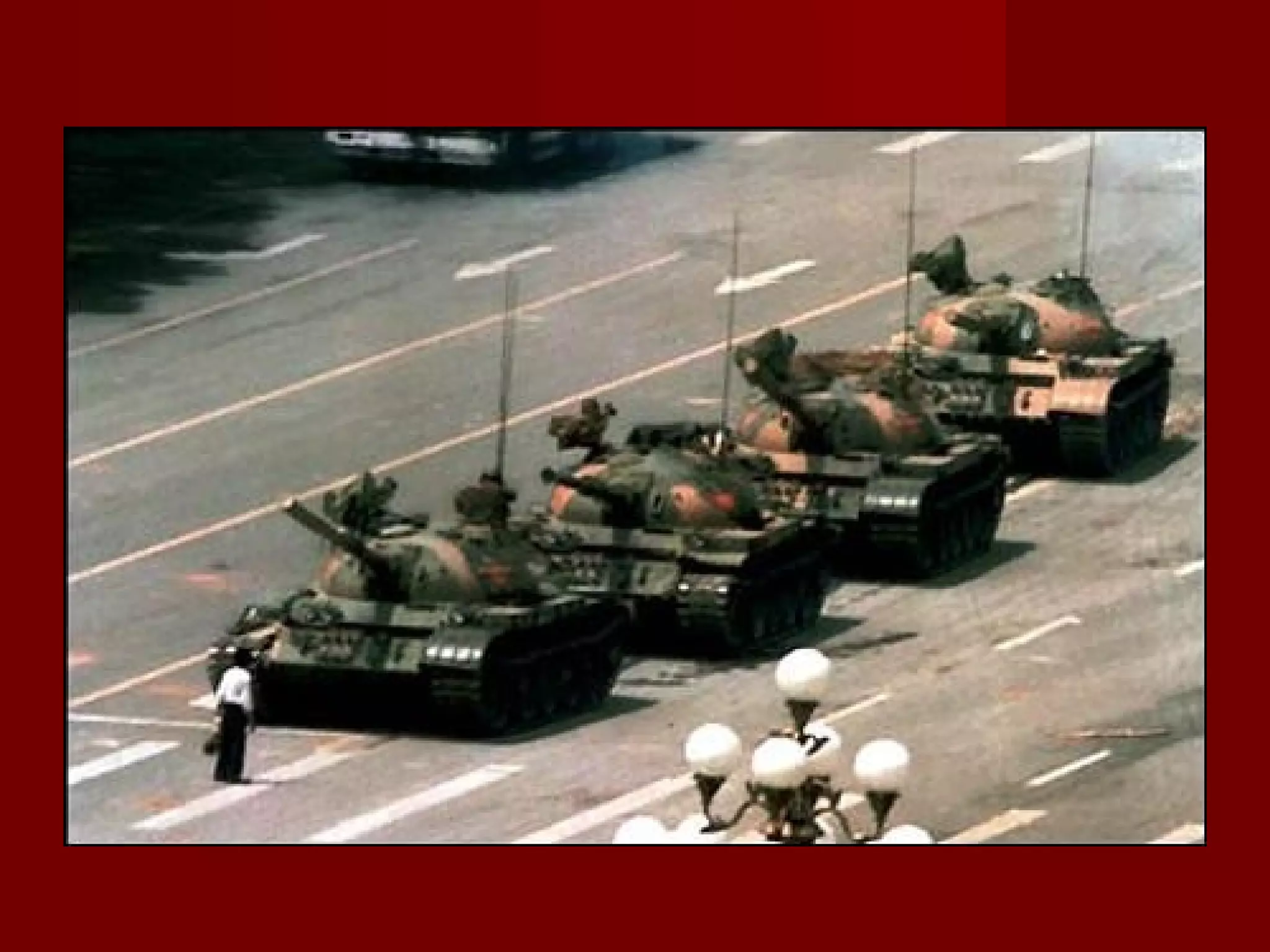
Tiananmen Square MassacreTiananmen Square Massacre
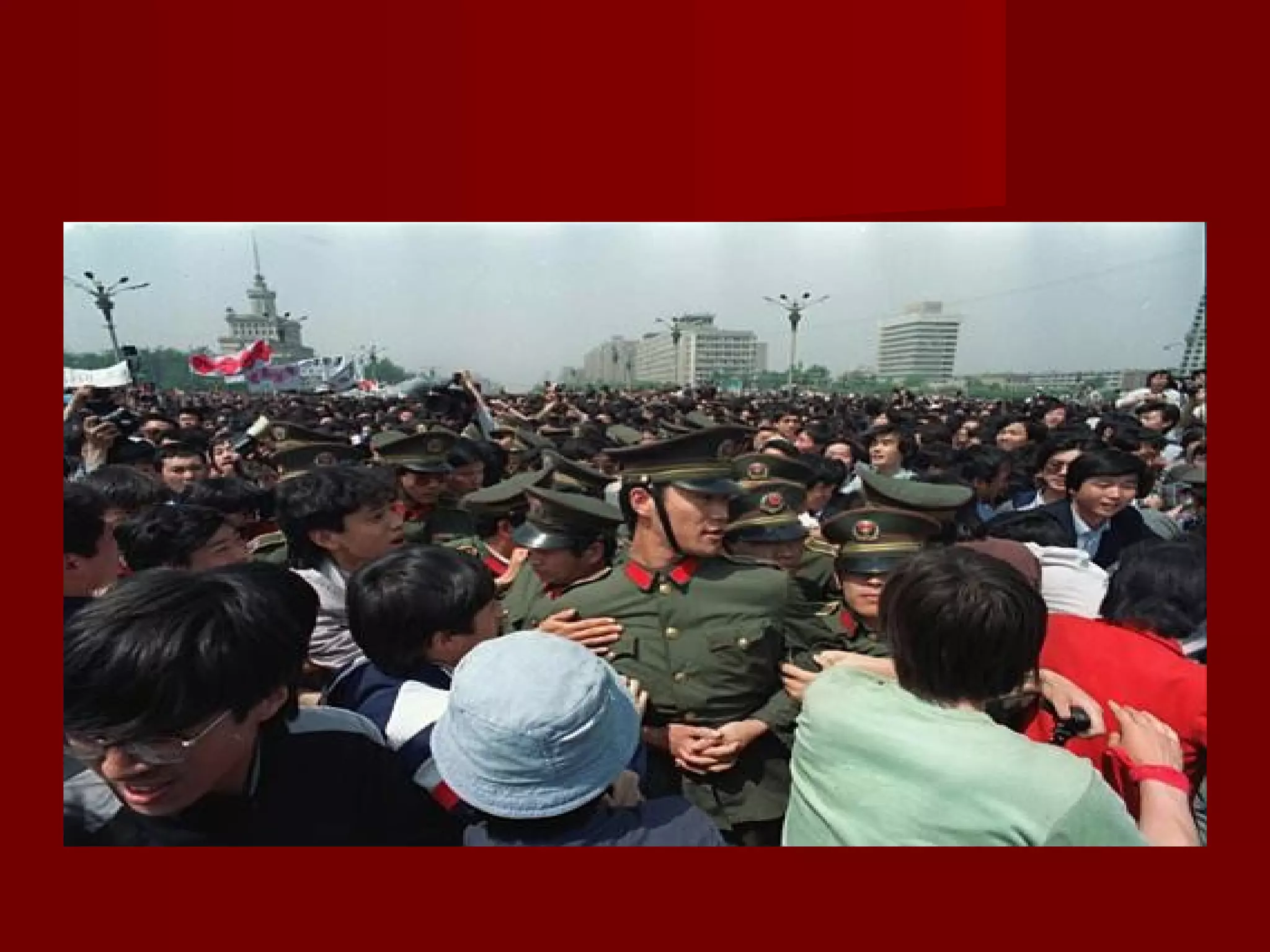
 June 1989 – about 1 million demonstratorsJune 1989 – about 1 million demonstrators
met on Tiananmen Square calling formet on Tiananmen Square calling for
democratic reform, bring in a statue – thedemocratic reform, bring in a statue – the
Goddess of Democracy and FreedomGoddess of Democracy and Freedom
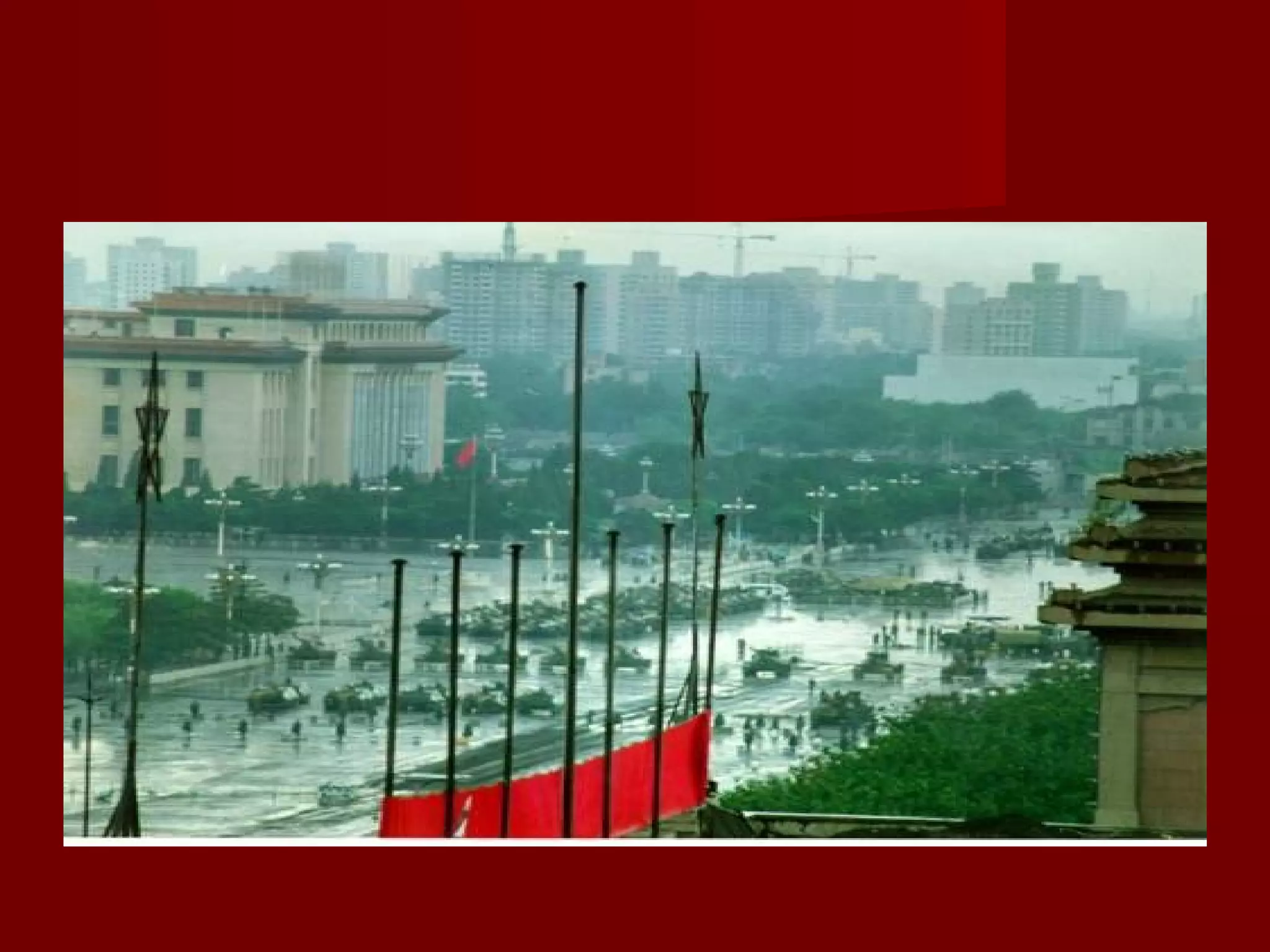
 Chinese government reacts violently –Chinese government reacts violently –
sends troops into open fire, hundreds ofsends troops into open fire, hundreds of
people are killedpeople are killed
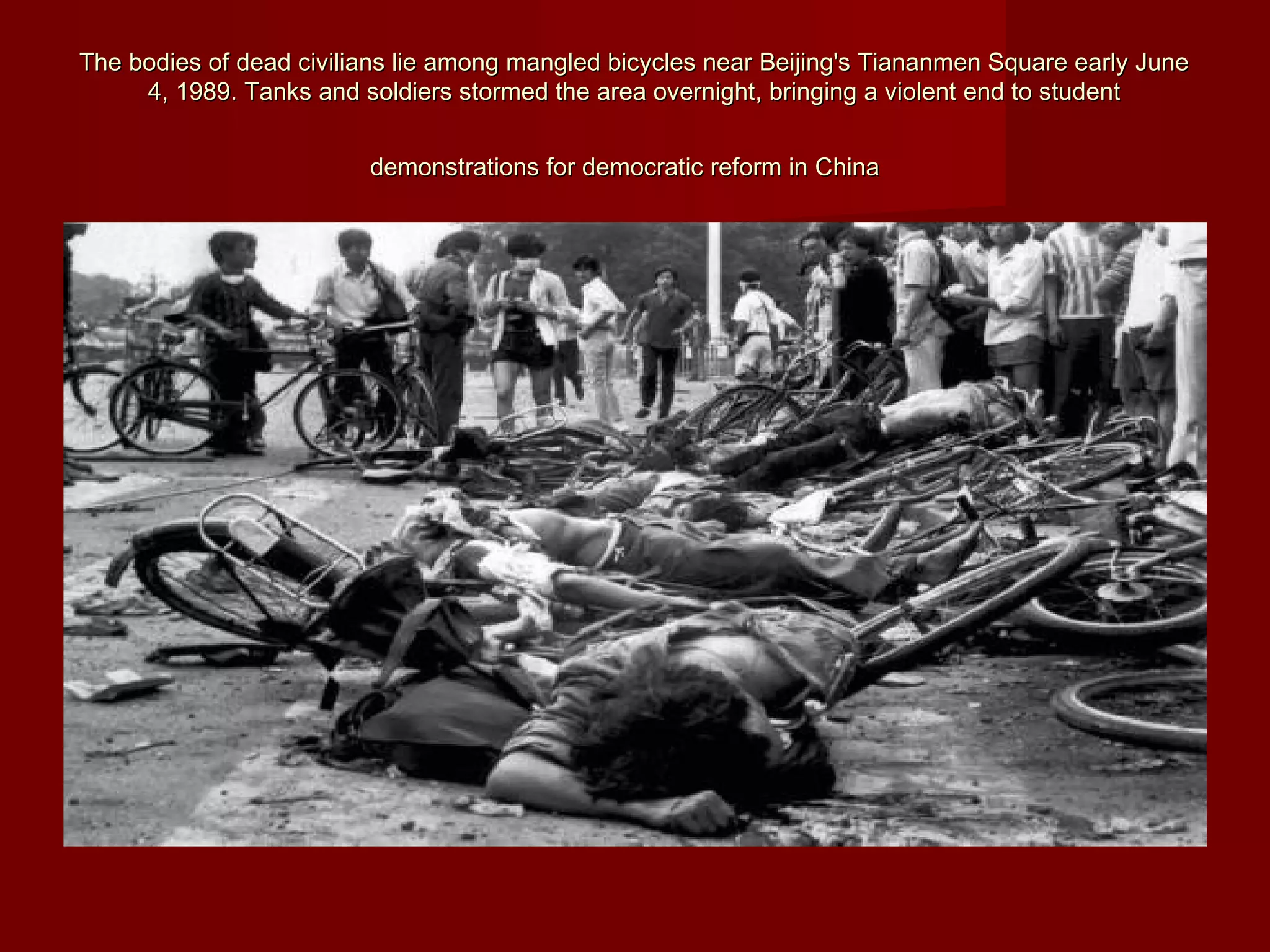
The bodies of dead civilians lie among mangled bicycles near Beijing's Tiananmen Square early JuneThe bodies of dead civilians lie among mangled bicycles near Beijing's Tiananmen Square early June
4, 1989. Tanks and soldiers stormed the area overnight, bringing a violent end to student4, 1989. Tanks and soldiers stormed the area overnight, bringing a violent end to student
demonstrations for democratic reform in Chinademonstrations for democratic reform in China
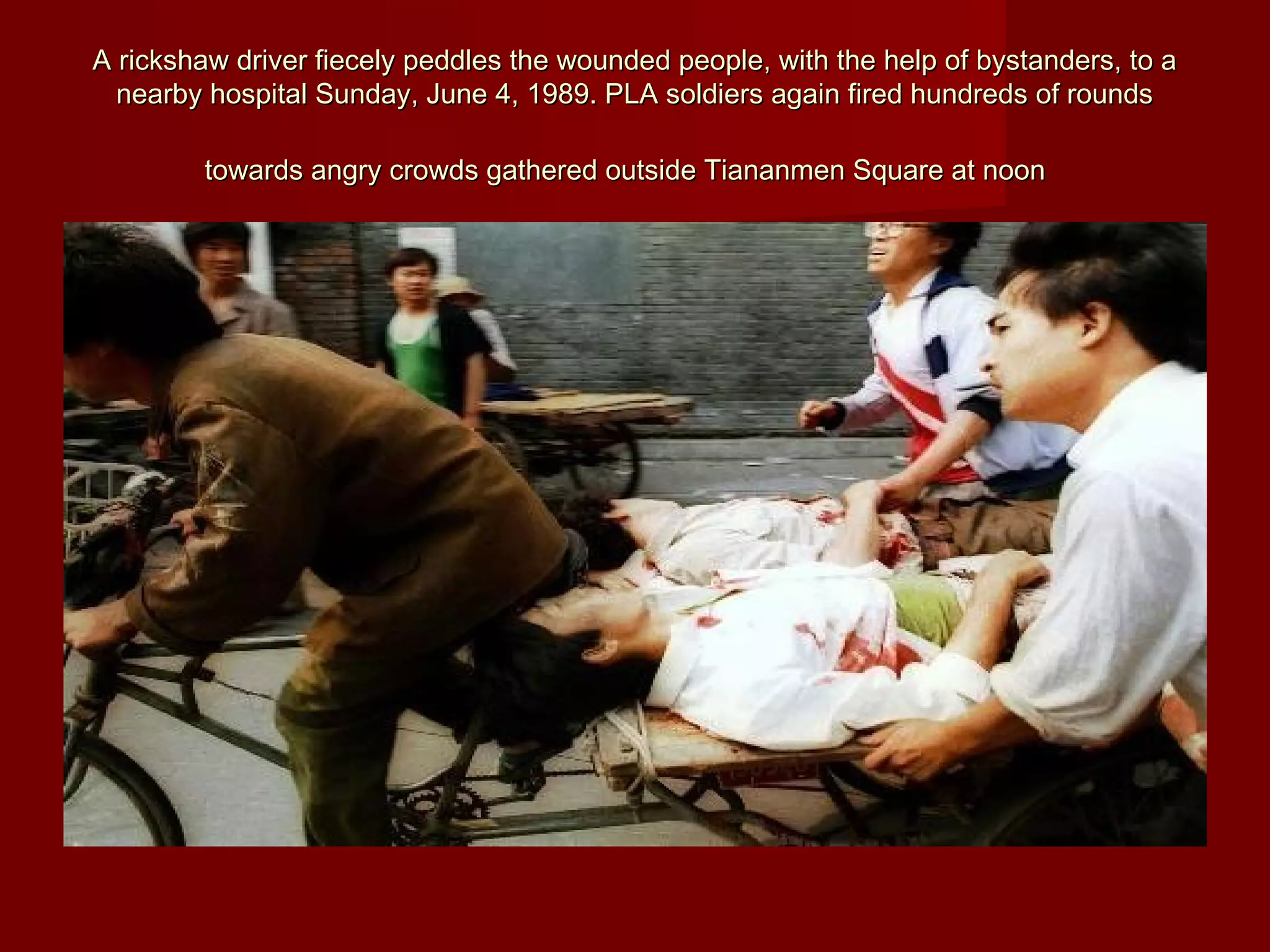
A rickshaw driver fiecely peddles the wounded people, with the help of bystanders, to aA rickshaw driver fiecely peddles the wounded people, with the help of bystanders, to a
nearby hospital Sunday, June 4, 1989. PLA soldiers again fired hundreds of roundsnearby hospital Sunday, June 4, 1989. PLA soldiers again fired hundreds of rounds
towards angry crowds gathered outside Tiananmen Square at noontowards angry crowds gathered outside Tiananmen Square at noon
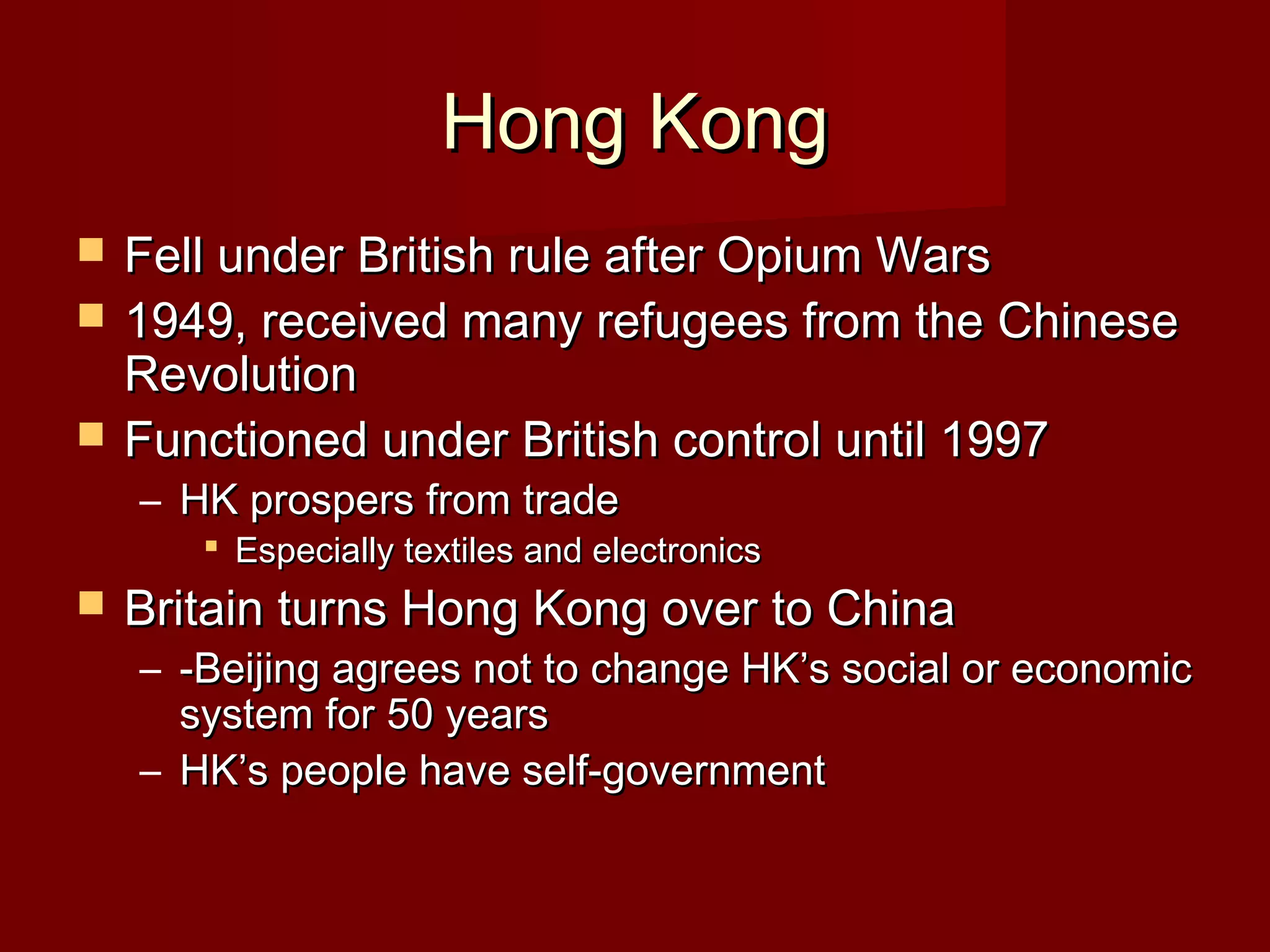
Hong KongHong Kong
 Fell under British rule after Opium WarsFell under British rule after Opium Wars
 1949, received many refugees from the Chinese1949, received many refugees from the Chinese
RevolutionRevolution
 Functioned under British control until 1997Functioned under British control until 1997
– HK prospers from tradeHK prospers from trade
 Especially textiles and electronicsEspecially textiles and electronics
 Britain turns Hong Kong over to ChinaBritain turns Hong Kong over to China
– -Beijing agrees not to change HK’s social or economic-Beijing agrees not to change HK’s social or economic
system for 50 yearssystem for 50 years
– HK’s people have self-governmentHK’s people have self-government

Revolution in China

  • 1.
  • 2.
    Heading towards revolutioninHeading towards revolution in China…China… 1800s1800s – The Opium WarsThe Opium Wars – Open Door PolicyOpen Door Policy – The Boxer RebellionThe Boxer Rebellion  The Republic of ChinaThe Republic of China – Formed in Nanjing March 12, 1912Formed in Nanjing March 12, 1912  Sun Yat-sen is President, Yuan Shikai quicklySun Yat-sen is President, Yuan Shikai quickly replaced him, but not a smooth transitionreplaced him, but not a smooth transition  May Fourth Movement, 1919May Fourth Movement, 1919  Civil War DevelopsCivil War Develops – Kuomintang Party (Nationalist) – Sun Yat-sen (diesKuomintang Party (Nationalist) – Sun Yat-sen (dies from cancer in 1925), then Chiang Kai-shekfrom cancer in 1925), then Chiang Kai-shek – Communist Party – Mao Zedong (Tse-tung)Communist Party – Mao Zedong (Tse-tung)  Most famous event occurs when the NationalistsMost famous event occurs when the Nationalists chase the Communists on thechase the Communists on the Long MarchLong March andand the Communists retreat and establish a base in athe Communists retreat and establish a base in a Northwestern section of ChinaNorthwestern section of China
  • 3.
    Japan Invades ChinaJapanInvades China  The Manchurian Incident – September 1931The Manchurian Incident – September 1931 – Japanese railway is attacked, Japanese claimJapanese railway is attacked, Japanese claim Chinese dissidents are to blame, use it as an excuseChinese dissidents are to blame, use it as an excuse to invadeto invade  Japanese invade Manchuria, name it ManchukuoJapanese invade Manchuria, name it Manchukuo  1933 – Japanese attack the Great Wall region1933 – Japanese attack the Great Wall region  July 7, 1937 - full scale invasion of ChinaJuly 7, 1937 - full scale invasion of China – Beijing, Shanghai, and Nanjing all fallBeijing, Shanghai, and Nanjing all fall – Rape of NanjingRape of Nanjing  China will be on the allies side in WW IIChina will be on the allies side in WW II  Japanese will surrender their Chinese holdings inJapanese will surrender their Chinese holdings in 1945, once they surrender to the US1945, once they surrender to the US
  • 4.
    Chinese RevolutionChinese Revolution Chiang Kai-Shek (Nationalist) v. MaoChiang Kai-Shek (Nationalist) v. Mao Zedong (Comm.)Zedong (Comm.)  China unites to fight Japan (1930s – 1945)China unites to fight Japan (1930s – 1945)  During WW II, United States pumped $During WW II, United States pumped $ into Guomindang partyinto Guomindang party  WW II ends, Chinese Civil War for fourWW II ends, Chinese Civil War for four yearyear
  • 5.
    Chinese Civil WarEndsChinese Civil War Ends  By 1949 – Mao Zedong has millions of peasantsBy 1949 – Mao Zedong has millions of peasants in N. Chinain N. China  Mao’s forces head South, chasing theMao’s forces head South, chasing the GuomindangGuomindang  Guomindang (Nationalists) flees to the island ofGuomindang (Nationalists) flees to the island of Taiwan and establishes the Republic of ChinaTaiwan and establishes the Republic of China  Communists and Mao take over mainland ChinaCommunists and Mao take over mainland China and call it the People’s Republic of Chinaand call it the People’s Republic of China
  • 6.
    Which one isthe “Real” China?Which one is the “Real” China?  Both claim they are theBoth claim they are the true Chinatrue China  Taiwan developsTaiwan develops industrially, becomes anindustrially, becomes an economic powerhouseeconomic powerhouse  Taiwan’s credibility takesTaiwan’s credibility takes a blow when the Uniteda blow when the United Nations and the UnitedNations and the United States recognize theStates recognize the People’s Republic ofPeople’s Republic of China as China in 1973China as China in 1973  Taiwan refuses to unifyTaiwan refuses to unify with China todaywith China today  ““One China” PolicyOne China” Policy
  • 9.
    Mao’s ReformsMao’s Reforms Collectivization of agriculture andCollectivization of agriculture and industryindustry – Increases productivity, especiallyIncreases productivity, especially steelsteel  Late 1950’s – Great Leap ForwardLate 1950’s – Great Leap Forward – Huge communes created as a way ofHuge communes created as a way of accelerating the creation of a trueaccelerating the creation of a true Marxist stateMarxist state  Reality check – production quotas areReality check – production quotas are VERY highVERY high  Local governments can’t produce theLocal governments can’t produce the ridiculous quotas, so out of fear of beingridiculous quotas, so out of fear of being punished, they lie and say the quotas arepunished, they lie and say the quotas are being metbeing met – ~30 million Chinese people starve to~30 million Chinese people starve to deathdeath – Truly a Great Leap Backward.Truly a Great Leap Backward.
  • 12.
    Great Leap BackwardGreatLeap Backward  Mao’s previous success is erasedMao’s previous success is erased  Soviet Union withdrew supportSoviet Union withdrew support – Soviets realize China isn’t following orders…Soviets realize China isn’t following orders…  Mao turns focus to military (If Soviet’sMao turns focus to military (If Soviet’s aren’t with China, they’re against China)aren’t with China, they’re against China) – Elements of capitalism introducedElements of capitalism introduced – 1964 – China tests its first atom bomb1964 – China tests its first atom bomb
  • 13.
    Cultural Revolution -1966Cultural Revolution - 1966  Mao – purist, upset his country is straying fromMao – purist, upset his country is straying from communismcommunism  Revolution discourages development of aRevolution discourages development of a privileged classprivileged class – Erases all traces of Western-influenced knowledgeErases all traces of Western-influenced knowledge – Closes universities for four yearsCloses universities for four years – Sends students, professors, doctors, lawyers, andSends students, professors, doctors, lawyers, and classical musicians to collective farms for “culturalclassical musicians to collective farms for “cultural retraining”retraining” – Political dissidents imprisoned or killedPolitical dissidents imprisoned or killed
  • 14.
    New CurriculumNew Curriculum Once reopened, curriculum is adjusted toOnce reopened, curriculum is adjusted to include only communist studies and vocationalinclude only communist studies and vocational trainingtraining  Little Red Book – Mao’s teachings onLittle Red Book – Mao’s teachings on communism – becomes popular symbol forcommunism – becomes popular symbol for forced egalitarianismforced egalitarianism  Cultural Revolution prevents China fromCultural Revolution prevents China from advancing economically or sociallyadvancing economically or socially – By early 1970s, China opens back up to WesternBy early 1970s, China opens back up to Western ideasideas
  • 15.
    1976 – DengXiaoping1976 – Deng Xiaoping  Mao dies, Deng Xiaoping steps upMao dies, Deng Xiaoping steps up  Changes education policyChanges education policy  Changes Economic policies –Changes Economic policies – – From strict command economy to including elementsFrom strict command economy to including elements of free-market capitalismof free-market capitalism – Allows limited business and property ownership toAllows limited business and property ownership to encourage hard workencourage hard work – Chinese gvt enters joint ventures with foreignChinese gvt enters joint ventures with foreign companiescompanies – Still strictly communist in political senseStill strictly communist in political sense
  • 16.
    Tiananmen Square MassacreTiananmenSquare Massacre  June 1989 – about 1 million demonstratorsJune 1989 – about 1 million demonstrators met on Tiananmen Square calling formet on Tiananmen Square calling for democratic reform, bring in a statue – thedemocratic reform, bring in a statue – the Goddess of Democracy and FreedomGoddess of Democracy and Freedom  Chinese government reacts violently –Chinese government reacts violently – sends troops into open fire, hundreds ofsends troops into open fire, hundreds of people are killedpeople are killed
  • 20.
    The bodies ofdead civilians lie among mangled bicycles near Beijing's Tiananmen Square early JuneThe bodies of dead civilians lie among mangled bicycles near Beijing's Tiananmen Square early June 4, 1989. Tanks and soldiers stormed the area overnight, bringing a violent end to student4, 1989. Tanks and soldiers stormed the area overnight, bringing a violent end to student demonstrations for democratic reform in Chinademonstrations for democratic reform in China
  • 21.
    A rickshaw driverfiecely peddles the wounded people, with the help of bystanders, to aA rickshaw driver fiecely peddles the wounded people, with the help of bystanders, to a nearby hospital Sunday, June 4, 1989. PLA soldiers again fired hundreds of roundsnearby hospital Sunday, June 4, 1989. PLA soldiers again fired hundreds of rounds towards angry crowds gathered outside Tiananmen Square at noontowards angry crowds gathered outside Tiananmen Square at noon
  • 22.
    Hong KongHong Kong Fell under British rule after Opium WarsFell under British rule after Opium Wars  1949, received many refugees from the Chinese1949, received many refugees from the Chinese RevolutionRevolution  Functioned under British control until 1997Functioned under British control until 1997 – HK prospers from tradeHK prospers from trade  Especially textiles and electronicsEspecially textiles and electronics  Britain turns Hong Kong over to ChinaBritain turns Hong Kong over to China – -Beijing agrees not to change HK’s social or economic-Beijing agrees not to change HK’s social or economic system for 50 yearssystem for 50 years – HK’s people have self-governmentHK’s people have self-government