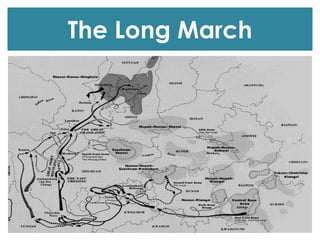
The Long March
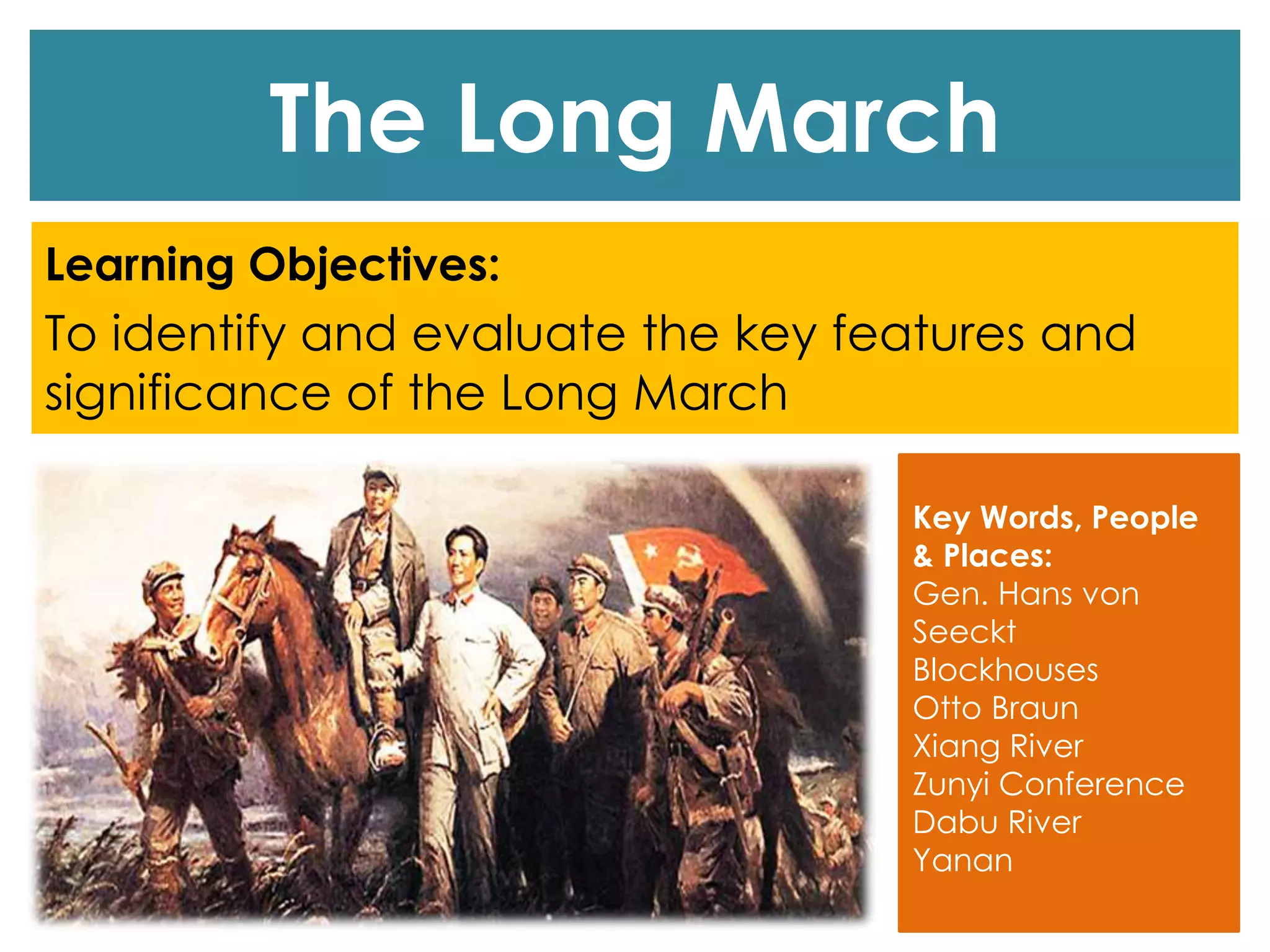
Learning Objectives:
To identify and evaluate the key features and
significance of the Long March
Key Words, People
& Places:
Gen. Hans von
Seeckt
Blockhouses
Otto Braun
Xiang River
Zunyi Conference
Dabu River
Yanan
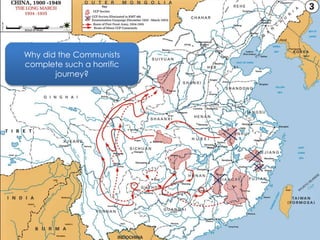
Why did the Communists
complete such a horrific
journey?
The Fifth Extermination
Campaign
LO: To identify and
evaluate the key
features and
significance of the
Long March
• In Summer 1933, Chiang used
new tactics suggested by
General Hans von Seeckt, a
German military advisor.
• Seeckt used ‘blockhouse’
tactics. The KMT surrounded the
Kiangsi Soviet with ½ m troops
and advanced slowly building
blockhouses, digging trenches &
putting up barbed wire fences.
• This prevented food, fuel,
ammunition and weapons
getting in or out.
The Fifth Extermination
Campaign
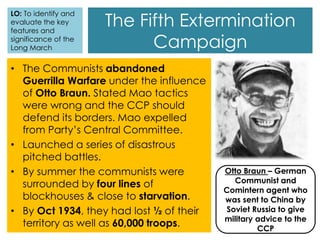
• The Communists abandoned
Guerrilla Warfare under the influence
of Otto Braun. Stated Mao tactics
were wrong and the CCP should
defend its borders. Mao expelled
from Party’s Central Committee.
• Launched a series of disastrous
pitched battles.
• By summer the communists were
surrounded by four lines of
blockhouses & close to starvation.
• By Oct 1934, they had lost ½ of their
territory as well as 60,000 troops.
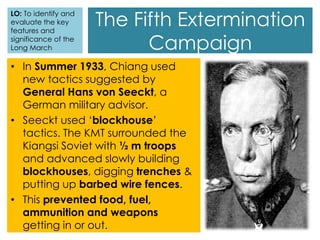
Otto Braun – German
Communist and
Comintern agent who
was sent to China by
Soviet Russia to give
military advice to the
CCP
LO: To identify and
evaluate the key
features and
significance of the
Long March
The Break Out –
October 1934
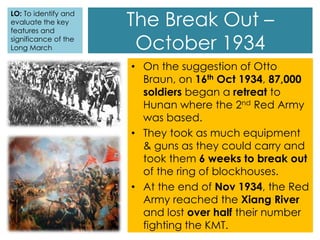
• On the suggestion of Otto
Braun, on 16th Oct 1934, 87,000
soldiers began a retreat to
Hunan where the 2nd Red Army
was based.
• They took as much equipment
& guns as they could carry and
took them 6 weeks to break out
of the ring of blockhouses.
• At the end of Nov 1934, the Red
Army reached the Xiang River
and lost over half their number
fighting the KMT.
LO: To identify and
evaluate the key
features and
significance of the
Long March
Mao Takes Over – January
1935
• In Jan 1935 they reached Zunyi,
where a meeting was held.
Braun was blamed for the
defeat at the Xiang River:
– He had allowed them to
carry to much equipment
which slowed them down.
– The retreat was in a straight
line which helped the KMT
predict where they were
headed.
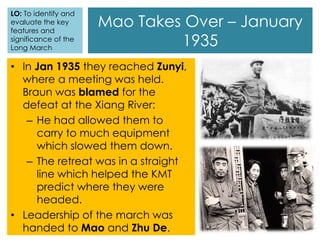
• Leadership of the march was
handed to Mao and Zhu De.
LO: To identify and
evaluate the key
features and
significance of the
Long March
Progress in 1935 – January-
October
• Under their new
leadership, the march
took off in a new
direction, often
changing routes &
splitting forces.
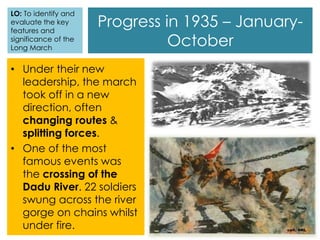
• One of the most
famous events was
the crossing of the
Dadu River. 22 soldiers
swung across the river
gorge on chains whilst
under fire.
LO: To identify and
evaluate the key
features and
significance of the
Long March
The Long March
Progress in 1935 – January-
October
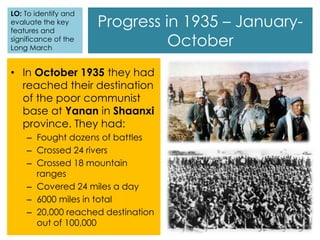
• In October 1935 they had
reached their destination
of the poor communist
base at Yanan in Shaanxi
province. They had:
– Fought dozens of battles
– Crossed 24 rivers
– Crossed 18 mountain
ranges
– Covered 24 miles a day
– 6000 miles in total
– 20,000 reached destination
out of 100,000
LO: To identify and
evaluate the key
features and
significance of the
Long March
Progress in 1935 – January-
October
1. The CCP had survived and
found a new base which was
remote and safe from attack
from the KMT & Japanese
2. Mao was hailed as a great
hero and was re-established as
the unchallenged leader of the
CCP
3. Many Chinese saw the CCP as
heroes & Long March became
part of CCP mythology
4. The good behaviour of the Red
Army impressed peasants
1.) Which is the
most important
consequence of
the march? Why?
2.) How did the
success of the
march help boost
CCP support
across China?
LO: To identify and
evaluate the key
features and
significance of the
Long March
Section C - Exam Question
“For twelve months we were under daily
reconnaissance and bombing from the air. We were
encircled, pursued, obstructed and intercepted on the
ground by a force of several hundred thousand men.
We encountered untold difficulties and obstacles on
the way, but by keeping our two feed going we swept
across a distance of more than 10,000 km…Has there
ever been a long march like ours?”
The Communist Leader Mao Zedong - 1949
• (a) ‘What does this Source tell us about the events of the
Long March?’ (3)
• (b) ‘Describe the key features of EITHER the Long March
OR the Great Leap Forward’ (7)
LO: To identify and
evaluate the key
features and
significance of the
Long March
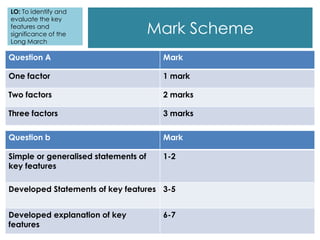
Question A Mark
One factor 1 mark
Two factors 2 marks
Three factors 3 marks
Question b Mark
Simple or generalised statements of
key features
1-2
Developed Statements of key features 3-5
Developed explanation of key
features
6-7
Mark Scheme
LO: To identify and
evaluate the key
features and
significance of the
Long March

The Long March

  • 1.
    The Long March LearningObjectives: To identify and evaluate the key features and significance of the Long March Key Words, People & Places: Gen. Hans von Seeckt Blockhouses Otto Braun Xiang River Zunyi Conference Dabu River Yanan
  • 2.
    Why did theCommunists complete such a horrific journey?
  • 3.
    The Fifth Extermination Campaign LO:To identify and evaluate the key features and significance of the Long March • In Summer 1933, Chiang used new tactics suggested by General Hans von Seeckt, a German military advisor. • Seeckt used ‘blockhouse’ tactics. The KMT surrounded the Kiangsi Soviet with ½ m troops and advanced slowly building blockhouses, digging trenches & putting up barbed wire fences. • This prevented food, fuel, ammunition and weapons getting in or out.
  • 4.
    The Fifth Extermination Campaign •The Communists abandoned Guerrilla Warfare under the influence of Otto Braun. Stated Mao tactics were wrong and the CCP should defend its borders. Mao expelled from Party’s Central Committee. • Launched a series of disastrous pitched battles. • By summer the communists were surrounded by four lines of blockhouses & close to starvation. • By Oct 1934, they had lost ½ of their territory as well as 60,000 troops. Otto Braun – German Communist and Comintern agent who was sent to China by Soviet Russia to give military advice to the CCP LO: To identify and evaluate the key features and significance of the Long March
  • 5.
    The Break Out– October 1934 • On the suggestion of Otto Braun, on 16th Oct 1934, 87,000 soldiers began a retreat to Hunan where the 2nd Red Army was based. • They took as much equipment & guns as they could carry and took them 6 weeks to break out of the ring of blockhouses. • At the end of Nov 1934, the Red Army reached the Xiang River and lost over half their number fighting the KMT. LO: To identify and evaluate the key features and significance of the Long March
  • 6.
    Mao Takes Over– January 1935 • In Jan 1935 they reached Zunyi, where a meeting was held. Braun was blamed for the defeat at the Xiang River: – He had allowed them to carry to much equipment which slowed them down. – The retreat was in a straight line which helped the KMT predict where they were headed. • Leadership of the march was handed to Mao and Zhu De. LO: To identify and evaluate the key features and significance of the Long March
  • 7.
    Progress in 1935– January- October • Under their new leadership, the march took off in a new direction, often changing routes & splitting forces. • One of the most famous events was the crossing of the Dadu River. 22 soldiers swung across the river gorge on chains whilst under fire. LO: To identify and evaluate the key features and significance of the Long March
  • 8.
  • 9.
    Progress in 1935– January- October • In October 1935 they had reached their destination of the poor communist base at Yanan in Shaanxi province. They had: – Fought dozens of battles – Crossed 24 rivers – Crossed 18 mountain ranges – Covered 24 miles a day – 6000 miles in total – 20,000 reached destination out of 100,000 LO: To identify and evaluate the key features and significance of the Long March
  • 10.
    Progress in 1935– January- October 1. The CCP had survived and found a new base which was remote and safe from attack from the KMT & Japanese 2. Mao was hailed as a great hero and was re-established as the unchallenged leader of the CCP 3. Many Chinese saw the CCP as heroes & Long March became part of CCP mythology 4. The good behaviour of the Red Army impressed peasants 1.) Which is the most important consequence of the march? Why? 2.) How did the success of the march help boost CCP support across China? LO: To identify and evaluate the key features and significance of the Long March
  • 11.
    Section C -Exam Question “For twelve months we were under daily reconnaissance and bombing from the air. We were encircled, pursued, obstructed and intercepted on the ground by a force of several hundred thousand men. We encountered untold difficulties and obstacles on the way, but by keeping our two feed going we swept across a distance of more than 10,000 km…Has there ever been a long march like ours?” The Communist Leader Mao Zedong - 1949 • (a) ‘What does this Source tell us about the events of the Long March?’ (3) • (b) ‘Describe the key features of EITHER the Long March OR the Great Leap Forward’ (7) LO: To identify and evaluate the key features and significance of the Long March
  • 12.
    Question A Mark Onefactor 1 mark Two factors 2 marks Three factors 3 marks Question b Mark Simple or generalised statements of key features 1-2 Developed Statements of key features 3-5 Developed explanation of key features 6-7 Mark Scheme LO: To identify and evaluate the key features and significance of the Long March