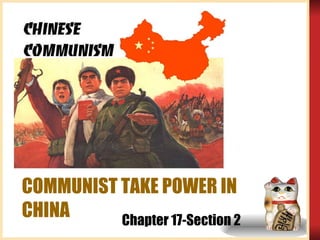
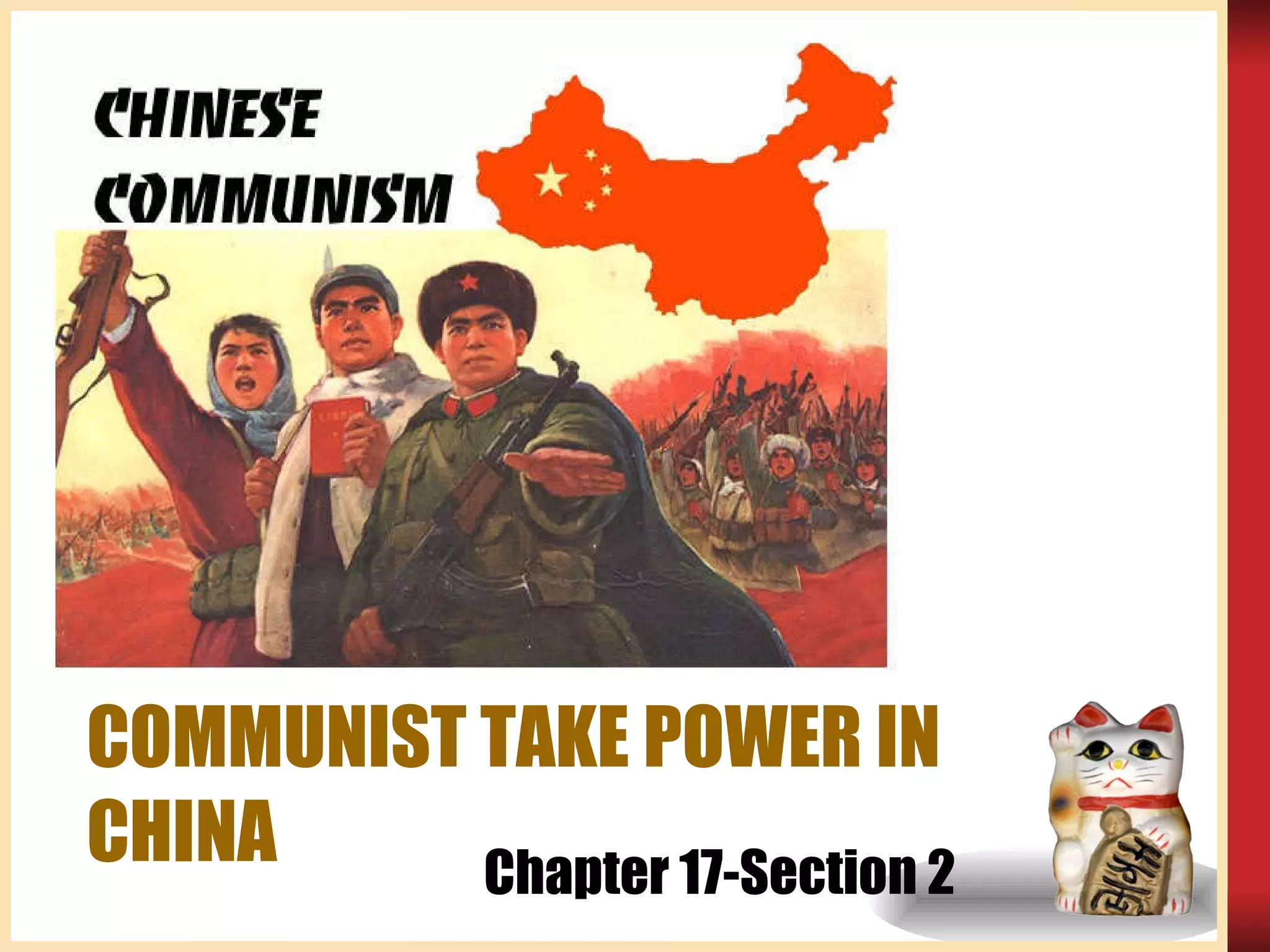
COMMUNIST TAKE POWER IN CHINA Chapter 17-Section 2
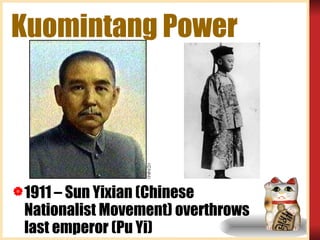
Kuomintang Power 1911 – Sun Yixian (Chinese Nationalist Movement) overthrows last emperor (Pu Yi)
“Three Principles of the People” 1. Nationalism- an end to foreign control 2. people’s rights- democracy 3. people’s livelyhood- economic security for al Chinese “ The Chinese people…do not have national spirit. Therefore, even though we have 4 million people gathered together in one China, in reality, they  are just a heap of sand.” –Sun Yixian
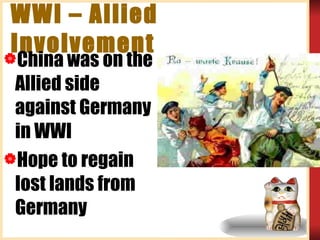
WWI – Allied Involvement China was on the Allied side against Germany in WWI Hope to regain lost lands from Germany
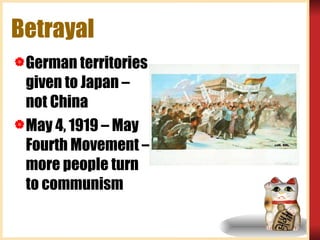
Betrayal German territories given to Japan – not China May 4, 1919 – May Fourth Movement – more people turn to communism
Developing…  While the Chinese Communist Party was forming Sun Yixian and his nationalist party set up a government in South China Yixian grew tired of the West’s empty promises to support his government
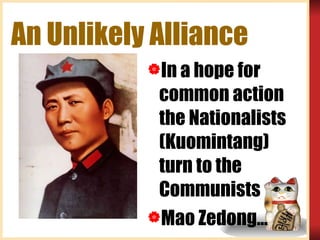
An Unlikely Alliance In a hope for common action the Nationalists (Kuomintang) turn to the Communists Mao Zedong…
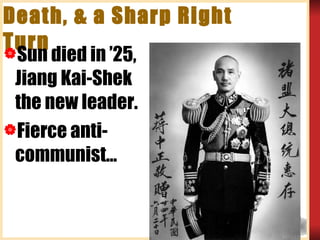
Death, & a Sharp Right Turn Sun died in ’25, Jiang Kai-Shek the new leader. Fierce anti-communist…
Jiang Kai-Shek Had promised democracy and political rights to all Chinese  Yet his government became steadily less democratic and more corrupt Peasants believed that Jiang was doing little to help them So the begin to support communism  …and Mao
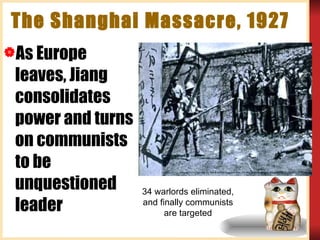
The Shanghai Massacre, 1927 As Europe leaves, Jiang consolidates power and turns on communists to be unquestioned leader 34 warlords eliminated, and finally communists are targeted
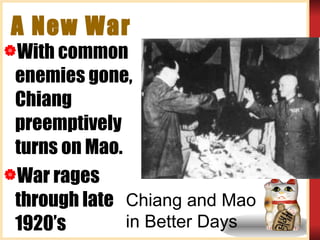
A New War With common enemies gone, Chiang preemptively turns on Mao. War rages through late 1920’s Chiang and Mao in Better Days
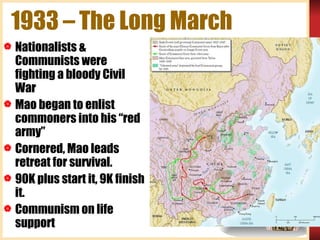
1933 – The Long March Nationalists & Communists were fighting a bloody Civil War Mao began to enlist commoners into his “red army” Cornered, Mao leads retreat for survival. 90K plus start it, 9K finish it. Communism on life support
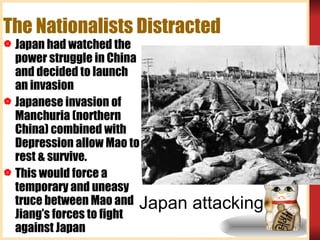
The Nationalists Distracted  Japan had watched the power struggle in China and decided to launch an invasion Japanese invasion of Manchuria (northern China) combined with Depression allow Mao to rest & survive. This would force a temporary and uneasy truce between Mao and Jiang’s forces to fight against Japan Japan attacking
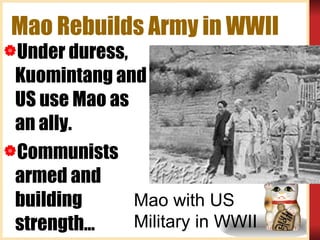
Mao Rebuilds Army in WWII Under duress, Kuomintang and US use Mao as an ally. Communists armed and building strength… Mao with US Military in WWII
Setting  the Stage - Again had China fought for the Allies now in WWII -During WWII, Japan’s armies occupied most of China -China’s civilian death toll = 10-22 million -1945 opposing armies were at conflict again VS.
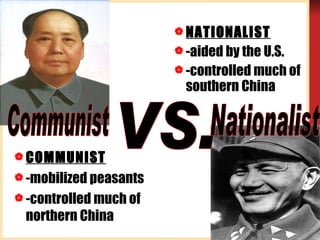
NATIONALIST -aided by the U.S. -controlled much of southern China VS.  COMMUNIST -mobilized peasants  -controlled much of northern China Nationalist Communist
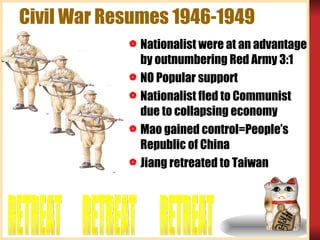
Civil War Resumes 1946-1949 Nationalist were at an advantage by outnumbering Red Army 3:1 NO Popular support Nationalist fled to Communist due to collapsing economy Mao gained control=People’s Republic of China Jiang retreated to Taiwan RETREAT RETREAT RETREAT
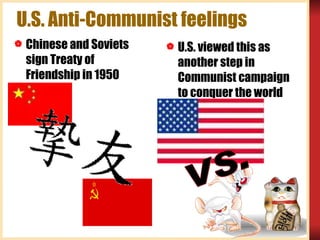
U.S. Anti-Communist feelings Chinese and Soviets sign Treaty of Friendship in 1950 U.S. viewed this as another step in Communist campaign to conquer the world VS.
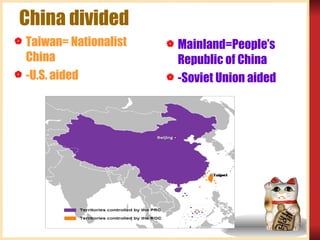
China divided Taiwan= Nationalist China  -U.S. aided Mainland=People’s Republic of China -Soviet Union aided
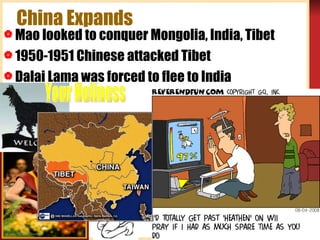
China Expands Mao looked to conquer Mongolia, India, Tibet 1950-1951 Chinese attacked Tibet Dalai Lama was forced to flee to India  Your Holiness
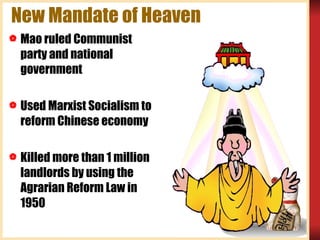
New Mandate of Heaven Mao ruled Communist party and national government  Used Marxist Socialism to reform Chinese economy Killed more than 1 million landlords by using the Agrarian Reform Law in 1950
Marxist Socialism Created collective farms Private companies became nationalized 5 year plan=production goals for industry
Laogai “Re-Education” through labor Live the life of peasant Work People to death
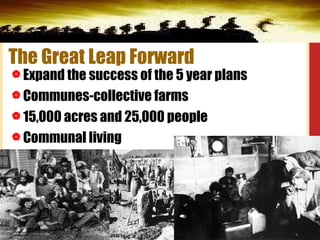
The Great Leap Forward Expand the success of the 5 year plans Communes-collective farms 15,000 acres and 25,000 people Communal living
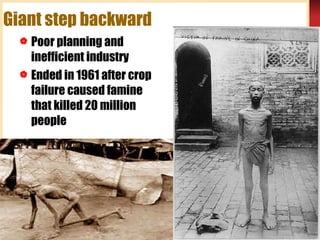
Giant step backward Poor planning and inefficient industry Ended in 1961 after crop failure caused famine that killed 20 million people
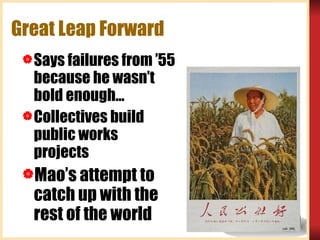
Great Leap Forward Says failures from ’55 because he wasn’t bold enough… Collectives build public works projects Mao’s attempt to catch up with the rest of the world
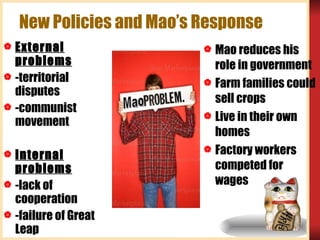
New Policies and Mao’s Response External problems -territorial disputes -communist movement Internal problems -lack of cooperation -failure of Great Leap Mao reduces his role in government Farm families could sell crops Live in their own homes Factory workers competed for wages Mao
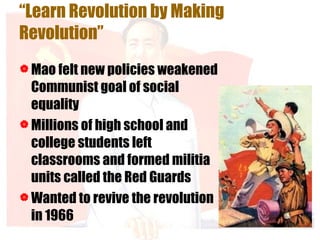
“ Learn Revolution by Making Revolution” Mao felt new policies weakened Communist goal of social equality Millions of high school and college students left classrooms and formed militia units called the Red Guards Wanted to revive the revolution in 1966
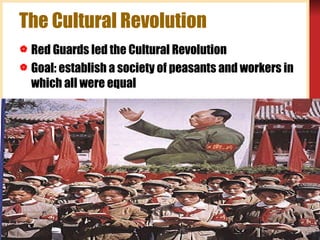
The Cultural Revolution Red Guards led the Cultural Revolution Goal: establish a society of peasants and workers in which all were equal
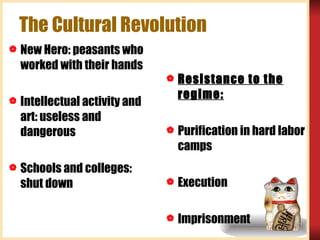
The Cultural Revolution New Hero: peasants who worked with their hands Intellectual activity and art: useless and dangerous Schools and colleges: shut down Resistance to the regime: Purification in hard labor camps Execution Imprisonment
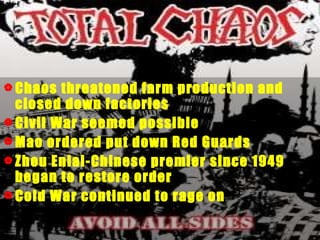
Chaos threatened farm production and closed down factories Civil War seemed possible Mao ordered put down Red Guards Zhou Enlai-Chinese premier since 1949 began to restore order Cold War continued to rage on
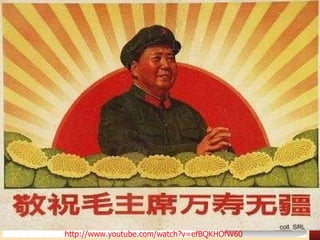
http:// www.youtube.com/watch?v =efBQKHOfW60
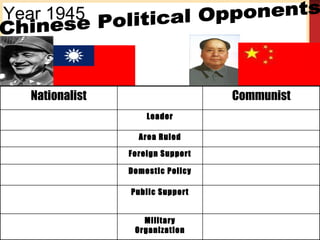
Chinese Political Opponents Year 1945 Military Organization Public Support Domestic Policy Foreign Support Area Ruled Leader Communist Nationalist
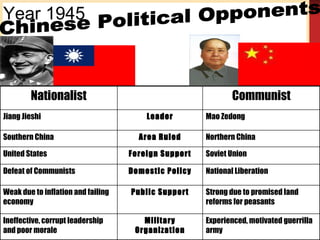
Chinese Political Opponents Year 1945 Experienced, motivated guerrilla army Military Organization Ineffective, corrupt leadership and poor morale Strong due to promised land reforms for peasants Public Support Weak due to inflation and failing economy National Liberation Domestic Policy Defeat of Communists Soviet Union Foreign Support United States Northern China Area Ruled Southern China Mao Zedong Leader Jiang Jieshi Communist Nationalist
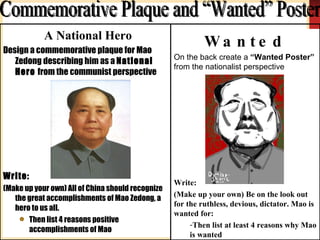
A National Hero Design a commemorative plaque for Mao Zedong describing him as a  National Hero  from the communist perspective Write: (Make up your own) All of China should recognize the great accomplishments of Mao Zedong, a hero to us all. Then list 4 reasons positive accomplishments of Mao Wanted On the back create a  “Wanted Poster”  from the nationalist perspective Write: (Make up your own) Be on the look out for the ruthless, devious, dictator. Mao is wanted for: Then list at least 4 reasons why Mao is wanted Commemorative Plaque and “Wanted” Poster

Communist take power in china

  • 1.
    COMMUNIST TAKE POWERIN CHINA Chapter 17-Section 2
  • 2.
    Kuomintang Power 1911– Sun Yixian (Chinese Nationalist Movement) overthrows last emperor (Pu Yi)
  • 3.
    “Three Principles ofthe People” 1. Nationalism- an end to foreign control 2. people’s rights- democracy 3. people’s livelyhood- economic security for al Chinese “ The Chinese people…do not have national spirit. Therefore, even though we have 4 million people gathered together in one China, in reality, they are just a heap of sand.” –Sun Yixian
  • 4.
    WWI – AlliedInvolvement China was on the Allied side against Germany in WWI Hope to regain lost lands from Germany
  • 5.
    Betrayal German territoriesgiven to Japan – not China May 4, 1919 – May Fourth Movement – more people turn to communism
  • 6.
    Developing… Whilethe Chinese Communist Party was forming Sun Yixian and his nationalist party set up a government in South China Yixian grew tired of the West’s empty promises to support his government
  • 7.
    An Unlikely AllianceIn a hope for common action the Nationalists (Kuomintang) turn to the Communists Mao Zedong…
  • 8.
    Death, & aSharp Right Turn Sun died in ’25, Jiang Kai-Shek the new leader. Fierce anti-communist…
  • 9.
    Jiang Kai-Shek Hadpromised democracy and political rights to all Chinese Yet his government became steadily less democratic and more corrupt Peasants believed that Jiang was doing little to help them So the begin to support communism …and Mao
  • 10.
    The Shanghai Massacre,1927 As Europe leaves, Jiang consolidates power and turns on communists to be unquestioned leader 34 warlords eliminated, and finally communists are targeted
  • 11.
    A New WarWith common enemies gone, Chiang preemptively turns on Mao. War rages through late 1920’s Chiang and Mao in Better Days
  • 12.
    1933 – TheLong March Nationalists & Communists were fighting a bloody Civil War Mao began to enlist commoners into his “red army” Cornered, Mao leads retreat for survival. 90K plus start it, 9K finish it. Communism on life support
  • 13.
    The Nationalists Distracted Japan had watched the power struggle in China and decided to launch an invasion Japanese invasion of Manchuria (northern China) combined with Depression allow Mao to rest & survive. This would force a temporary and uneasy truce between Mao and Jiang’s forces to fight against Japan Japan attacking
  • 14.
    Mao Rebuilds Armyin WWII Under duress, Kuomintang and US use Mao as an ally. Communists armed and building strength… Mao with US Military in WWII
  • 15.
    Setting theStage - Again had China fought for the Allies now in WWII -During WWII, Japan’s armies occupied most of China -China’s civilian death toll = 10-22 million -1945 opposing armies were at conflict again VS.
  • 16.
    NATIONALIST -aided bythe U.S. -controlled much of southern China VS. COMMUNIST -mobilized peasants -controlled much of northern China Nationalist Communist
  • 17.
    Civil War Resumes1946-1949 Nationalist were at an advantage by outnumbering Red Army 3:1 NO Popular support Nationalist fled to Communist due to collapsing economy Mao gained control=People’s Republic of China Jiang retreated to Taiwan RETREAT RETREAT RETREAT
  • 18.
    U.S. Anti-Communist feelingsChinese and Soviets sign Treaty of Friendship in 1950 U.S. viewed this as another step in Communist campaign to conquer the world VS.
  • 19.
    China divided Taiwan=Nationalist China -U.S. aided Mainland=People’s Republic of China -Soviet Union aided
  • 20.
    China Expands Maolooked to conquer Mongolia, India, Tibet 1950-1951 Chinese attacked Tibet Dalai Lama was forced to flee to India Your Holiness
  • 21.
    New Mandate ofHeaven Mao ruled Communist party and national government Used Marxist Socialism to reform Chinese economy Killed more than 1 million landlords by using the Agrarian Reform Law in 1950
  • 22.
    Marxist Socialism Createdcollective farms Private companies became nationalized 5 year plan=production goals for industry
  • 23.
    Laogai “Re-Education” throughlabor Live the life of peasant Work People to death
  • 24.
    The Great LeapForward Expand the success of the 5 year plans Communes-collective farms 15,000 acres and 25,000 people Communal living
  • 25.
    Giant step backwardPoor planning and inefficient industry Ended in 1961 after crop failure caused famine that killed 20 million people
  • 26.
    Great Leap ForwardSays failures from ’55 because he wasn’t bold enough… Collectives build public works projects Mao’s attempt to catch up with the rest of the world
  • 27.
    New Policies andMao’s Response External problems -territorial disputes -communist movement Internal problems -lack of cooperation -failure of Great Leap Mao reduces his role in government Farm families could sell crops Live in their own homes Factory workers competed for wages Mao
  • 28.
    “ Learn Revolutionby Making Revolution” Mao felt new policies weakened Communist goal of social equality Millions of high school and college students left classrooms and formed militia units called the Red Guards Wanted to revive the revolution in 1966
  • 29.
    The Cultural RevolutionRed Guards led the Cultural Revolution Goal: establish a society of peasants and workers in which all were equal
  • 30.
    The Cultural RevolutionNew Hero: peasants who worked with their hands Intellectual activity and art: useless and dangerous Schools and colleges: shut down Resistance to the regime: Purification in hard labor camps Execution Imprisonment
  • 31.
    Chaos threatened farmproduction and closed down factories Civil War seemed possible Mao ordered put down Red Guards Zhou Enlai-Chinese premier since 1949 began to restore order Cold War continued to rage on
  • 32.
  • 33.
    Chinese Political OpponentsYear 1945 Military Organization Public Support Domestic Policy Foreign Support Area Ruled Leader Communist Nationalist
  • 34.
    Chinese Political OpponentsYear 1945 Experienced, motivated guerrilla army Military Organization Ineffective, corrupt leadership and poor morale Strong due to promised land reforms for peasants Public Support Weak due to inflation and failing economy National Liberation Domestic Policy Defeat of Communists Soviet Union Foreign Support United States Northern China Area Ruled Southern China Mao Zedong Leader Jiang Jieshi Communist Nationalist
  • 35.
    A National HeroDesign a commemorative plaque for Mao Zedong describing him as a National Hero from the communist perspective Write: (Make up your own) All of China should recognize the great accomplishments of Mao Zedong, a hero to us all. Then list 4 reasons positive accomplishments of Mao Wanted On the back create a “Wanted Poster” from the nationalist perspective Write: (Make up your own) Be on the look out for the ruthless, devious, dictator. Mao is wanted for: Then list at least 4 reasons why Mao is wanted Commemorative Plaque and “Wanted” Poster

Editor's Notes

  • #3 Pu Yi ascended the throne at 2 years 10 months
  • #9 Middle class background. Allied with bankers and businessmen (feared communism). Does not inspire support among peasants.
  • #11 Chiang Kai-Shek recognized as Chinese leader by Britain and the U.S. (not Soviet Union) In Jiangxi, Mao's authoritative domination, especially that of the military force, was challenged by the Jiangxi branch of the CPC and military officers. Mao's opponents, among whom the most prominent was Li Wenlin , the founder of the CPC's branch and Red Army in Jiangxi, were against Mao's land policies and proposals to reform the local party branch and army leadership. Mao reacted first by accusing the opponents of opportunism and kulakism and then set off a series of systematic suppressions of them. Later the suppressions were turned into bloody physical elimination. It is reported that horrible forms of torture and killing took place. Jung Chang and Jon Halliday claim that victims were subjected to a red-hot gun-rod being rammed into the anus, and that there were many cases of cutting open the stomach and scooping out the heart. [6] The estimated number of the victims amounted to several thousands and could be as high as 186,000. [7] Through the so-called revolutionary terrorism , or red terrorism , Mao's authority and domination in Jiangxi was secured and reassured. However, this had left unforgettable scars on Mao's mind. Will cause a 22 year civil war against the communists
  • #13 Marches through peasant areas to gain support and keep one step ahead of pursuing Nationalists Roundtrip from NY to SF over mountains and rivers Need to get north to meet up with help from the Soviet Union
  • #15 More fighting and war preparation between the Communists and Nationalists than against the Japanese
  • #27 In January 1958, Mao launched the second Five Year Plan known as the Great Leap Forward , a plan intended as an alternative model for economic growth to the Soviet model focusing on heavy industry that was advocated by others in the party. Under this economic program, the relatively small agricultural collectives which had been formed to date were rapidly merged into far larger people's communes , and many of the peasants ordered to work on massive infrastructure projects and the small-scale production of iron and steel. All private food production was banned; livestock and farm implements were brought under collective ownership. Under the Great Leap Forward, Mao and other party leaders ordered the implementation of a variety of unproven and unscientific new agricultural techniques by the new communes. Combined with the diversion of labour to steel production and infrastructure projects and the reduced personal incentives under a commune system this led to an approximately 15% drop in grain production in 1959 followed by further 10% reduction in 1960 and no recovery in 1961. In an effort to win favour with their superiors and avoid being purged, each layer in the party hierarchy exaggerated the amount of grain produced under them and based on the fabricated success, party cadres were ordered to requisition a disproportionately high amount of the true harvest for state use primarily in the cities and urban areas but also for export. The net result, which was compounded in some areas by drought and in others by floods, was that the rural peasants were not left enough to eat and many millions starved to death in what is thought to be the largest famine in human history. This famine was a direct cause of the death of tens of millions of Chinese peasants between 1959 and 1962. Further, many children who became emaciated and malnourished during years of hardship and struggle for survival, died shortly after the Great Leap Forward came to an end in 1962 (Spence, 553). At LEAST 20 million die in the greatest famine in recorded history