Chapter 9
  Civilization in
  Eastern Europe
Byzantium and Orthodox Europe
Constantinople
   Originally Byzantion, a market town/fishing
    village on the Bosporus Strait
   Constantine named it Constantinople and
    made it the capital of the E. Roman Empire
       City kept its name from 340 CE – 1453 CE
   Crossroads – access to Anatolia, SW Asia,
    SE Europe, etc.
The Byzantine Court
   Caesaropapism – emperor rules not only as
    a secular lord, but also plays prominent role
    in ecclesiastical affairs
   Heavily jeweled crowns, silk robes of dark,
    rich purple (the color reserved for imperial
    use)
   Latin = language of the court; Greek =
    language of the people
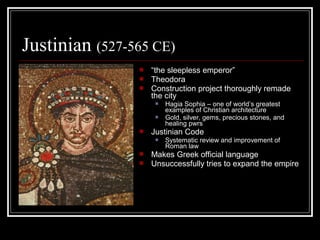
Justinian (527-565 CE)
                   “the sleepless emperor”
                   Theodora
                   Construction project thoroughly remade
                    the city
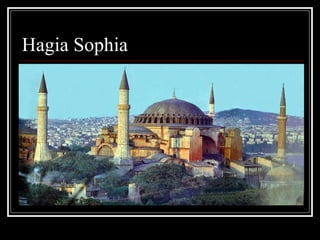
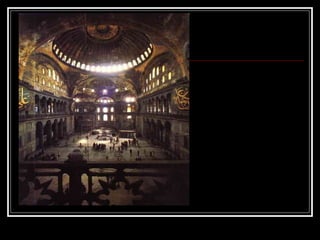
                        Hagia Sophia – one of world’s greatest
                         examples of Christian architecture
                        Gold, silver, gems, precious stones, and
                         healing pwrs
                   Justinian Code
                        Systematic review and improvement of
                         Roman law
                   Makes Greek official language
                   Unsuccessfully tries to expand the empire
Hagia Sophia
Belisarius
   General employed by Justinian to recapture
    the Roman Empire
       Gains N Africa and parts of Italy
            Want N Africa b/c of its grain production
       Can’t maintain Rome against Germanics
       Ravenna – home of gorgeous Christian mosaics
       Will lose what they gained pretty quickly
New external pressures
   Focus on defending the eastern empire
   What group is about to debut?
       They attack 717-718 CE and the Byzantines
        have a secret weapon…
So cool…
   When Muslims tried to invade Byzantium, the Byzantine
    forces used a weapon called “Greek fire” – basically
    ancient napalm – against the fleets and ground forces
   Greek fire even burns as it floats on water – very
    hazardous to wooden ships
   Byzantine empire loses some
    landholdings, but still maintains
                                            Managing the

    Anatolia, Greece, and Balkans
    “Theme” system – imperial province           Empire
    (theme) under jurisdiction of a
    general
       Assumes responsibility for
        military defense and civil admin.
       Enabled quick mobilization
       Byzantine empire expands as
        each theme’s military can
        gradually spread outward
       Basil the Bulgar Slayer – blinded
        15,000
           The blind leading the

             blind….ha ha….
           Supposed sight of the

             massacre causes the
             Bulgarian king’s death
           Helps gain control of the

             fiesty Bulgarian kingdom
Trade
   Crossroads for Eurasia
   Commercial links between manufacturers and merchants between
    central Asia, Russia, Scandinavia, northern Europe, and lands of
    the Black Sea and Mediterranean basin
   Bezant – Byzantine gold coin
   Very wealthy from control of trade and levying of custom duties
       China
       India
       Persia
       Western Europe
       Russia and Scandinavia – timber, furs, honey, amber, and slaves
   Banks, business partnerships, loans for business ventures
       Pool resources and limit risks
Iconoclasm
   Icons – particularly popular in Byzantine churches
      Inspired the popular imagination and encouraged

       reverence for holy personages
      Emperor Leo believed veneration of religious images

       was sinful
      726 orders iconoclasm – breaking of icons

   Also disagree over
      Sacrament of communion

      Whether priests should be allowed to marry

      Use of local languages in church
1054 – Great Schism
Thesis Practice
   On your own paper respond to the following
    prompt:
   Compare and contrast the rise and roles of
    Constantinople and Mecca
   Compare and contrast the split in the
    Christian Church and Islam
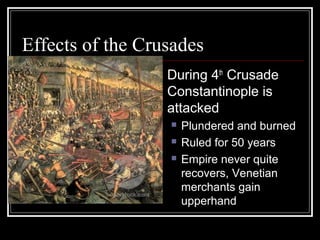
Effects of the Crusades
                   During 4th Crusade
                    Constantinople is
                    attacked
                       Plundered and burned
                       Ruled for 50 years
                       Empire never quite
                        recovers, Venetian
                        merchants gain
                        upperhand
Istanbul v. Constantinople
   1453 – Ottoman forces          http://www.youtube.com/wat
                                   ch?v=Mv-
    take over                      KcF3Rkv8&feature=related
   Ancient Christian city is
    overturned
       Istanbul becomes capital
        of Ottoman Empire
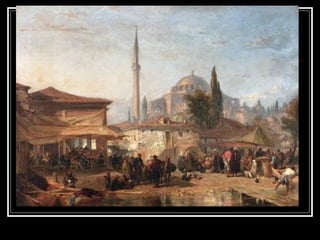
       Hagia Sophia is turned
        into a mosque and turets
        are added
Arts
   Mosaics
   Icons
   Greek, Roman, Persian, and other Middle
    Eastern styles blend together
The Rise of Russia
   HUGE
   Borders both Europe and China, touches the
    Baltic Sea and the Pacific Ocean
   Is Russia part of Europe or Asia?
   Northern forests – poor soil, cold, snowy climate
   South – band of fertile land, attracted farmers
    (modern day Ukraine)
   Southern steppe – open, treeless grassland,
    nomadic people, herds and horses
   Dnieper and Volga River – major trade routes
Kievan Rus’
   Slavs expand into southern Russia
   Varangians (Russian word for Vikings) – trade
    with Slavs, Kiev becomes a midpoint between
    Scandinavia and Constantinople
   Cyril and Methodius
       Missionaries from Constantinople, adapt Greek alphabet
        to Slavic language – develops Cyrillic (still used in Ukraine
        and Russia)
   Byzantine Christianity
   Onion domes from Byzantium
Kievan Rus’
   First ruler – prince Rurik
   Russia is coined by the Scandinavians,
    could be from Greek word for “red”
   Vladimir I (r. 980-1015)– converts to
    Christianity on behalf of all his people
       Organizes mass baptisms for his subjects, forced
        conversions
       Russian Orthodox Church soon develops
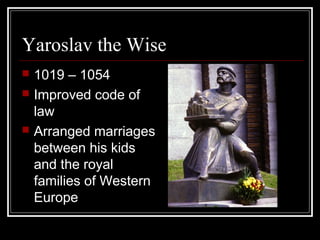
Yaroslav the Wise
   1019 – 1054
   Improved code of
    law
   Arranged marriages
    between his kids
    and the royal
    families of Western
    Europe
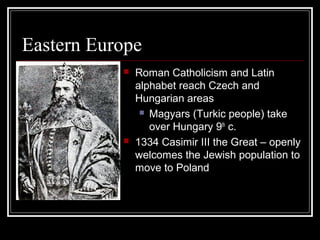
Eastern Europe
              Roman Catholicism and Latin
               alphabet reach Czech and
               Hungarian areas
                 Magyars (Turkic people) take

                  over Hungary 9th c.
              1334 Casimir III the Great – openly
               welcomes the Jewish population to
               move to Poland
Mongol Conquest
   A young leader
    united the nomadic
    Mongols of central
    Asia
   Overrun lands from
    China to Eastern
    Europe – dubs
    himself “Genghis
    Khan” – “world
    emperor”
The Golden Horde
   1236-1241 – Batu, Genghiz’s grandson leads
    Mongol armies into Russia
   “Golden Horde” because of the color of their tents
   Also called Tatars in the Russian tradition
   Loot and burn Kiev and many other Russian
    towns
   “no eye remained to weep for the dead”
   Rule from a capital on the Volga for the next 240
    years
       ***This is Russia’s dormant/stagnant period***
240 Years of Mongol Rule
    Women become especially subservient to their
     husbands. (Husbands can even sell their wives
     into slavery to pay family debts)
    Absolute power Mongols have will serve as an
     inspiration for Russian rulers later on
    Mongols severed Russian ties to Western
     Europe at a time when Europeans were making
     rapid advances in the arts and sciences
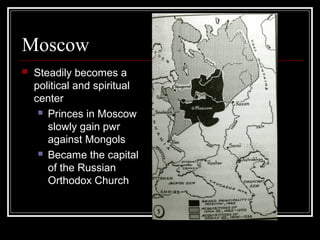
Moscow
   Steadily becomes a
    political and spiritual
    center
      Princes in Moscow

       slowly gain pwr
       against Mongols
      Became the capital

       of the Russian
       Orthodox Church
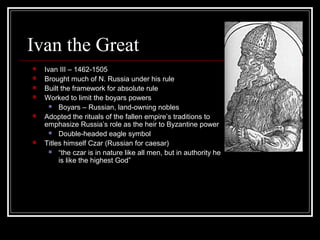
Ivan the Great
   Ivan III – 1462-1505
   Brought much of N. Russia under his rule
   Built the framework for absolute rule
   Worked to limit the boyars powers
       Boyars – Russian, land-owning nobles

   Adopted the rituals of the fallen empire’s traditions to
    emphasize Russia’s role as the heir to Byzantine power
       Double-headed eagle symbol

   Titles himself Czar (Russian for caesar)
       “the czar is in nature like all men, but in authority he
         is like the highest God”

Chapter 9 Civilizations in Eastern Europe

  • 1.
    Chapter 9 Civilization in Eastern Europe Byzantium and Orthodox Europe
  • 2.
    Constantinople  Originally Byzantion, a market town/fishing village on the Bosporus Strait  Constantine named it Constantinople and made it the capital of the E. Roman Empire  City kept its name from 340 CE – 1453 CE  Crossroads – access to Anatolia, SW Asia, SE Europe, etc.
  • 3.
    The Byzantine Court  Caesaropapism – emperor rules not only as a secular lord, but also plays prominent role in ecclesiastical affairs  Heavily jeweled crowns, silk robes of dark, rich purple (the color reserved for imperial use)  Latin = language of the court; Greek = language of the people
  • 4.
    Justinian (527-565 CE)  “the sleepless emperor”  Theodora  Construction project thoroughly remade the city  Hagia Sophia – one of world’s greatest examples of Christian architecture  Gold, silver, gems, precious stones, and healing pwrs  Justinian Code  Systematic review and improvement of Roman law  Makes Greek official language  Unsuccessfully tries to expand the empire
  • 5.
  • 9.
    Belisarius  General employed by Justinian to recapture the Roman Empire  Gains N Africa and parts of Italy  Want N Africa b/c of its grain production  Can’t maintain Rome against Germanics  Ravenna – home of gorgeous Christian mosaics  Will lose what they gained pretty quickly
  • 10.
    New external pressures  Focus on defending the eastern empire  What group is about to debut?  They attack 717-718 CE and the Byzantines have a secret weapon…
  • 11.
    So cool…  When Muslims tried to invade Byzantium, the Byzantine forces used a weapon called “Greek fire” – basically ancient napalm – against the fleets and ground forces  Greek fire even burns as it floats on water – very hazardous to wooden ships
  • 12.
    Byzantine empire loses some landholdings, but still maintains Managing the  Anatolia, Greece, and Balkans “Theme” system – imperial province Empire (theme) under jurisdiction of a general  Assumes responsibility for military defense and civil admin.  Enabled quick mobilization  Byzantine empire expands as each theme’s military can gradually spread outward  Basil the Bulgar Slayer – blinded 15,000  The blind leading the blind….ha ha….  Supposed sight of the massacre causes the Bulgarian king’s death  Helps gain control of the fiesty Bulgarian kingdom
  • 13.
    Trade  Crossroads for Eurasia  Commercial links between manufacturers and merchants between central Asia, Russia, Scandinavia, northern Europe, and lands of the Black Sea and Mediterranean basin  Bezant – Byzantine gold coin  Very wealthy from control of trade and levying of custom duties  China  India  Persia  Western Europe  Russia and Scandinavia – timber, furs, honey, amber, and slaves  Banks, business partnerships, loans for business ventures  Pool resources and limit risks
  • 14.
    Iconoclasm  Icons – particularly popular in Byzantine churches  Inspired the popular imagination and encouraged reverence for holy personages  Emperor Leo believed veneration of religious images was sinful  726 orders iconoclasm – breaking of icons  Also disagree over  Sacrament of communion  Whether priests should be allowed to marry  Use of local languages in church
  • 15.
  • 16.
    Thesis Practice  On your own paper respond to the following prompt:  Compare and contrast the rise and roles of Constantinople and Mecca  Compare and contrast the split in the Christian Church and Islam
  • 17.
    Effects of theCrusades  During 4th Crusade Constantinople is attacked  Plundered and burned  Ruled for 50 years  Empire never quite recovers, Venetian merchants gain upperhand
  • 18.
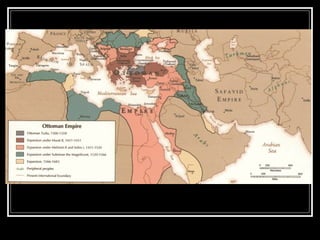
    Istanbul v. Constantinople  1453 – Ottoman forces http://www.youtube.com/wat ch?v=Mv- take over KcF3Rkv8&feature=related  Ancient Christian city is overturned  Istanbul becomes capital of Ottoman Empire  Hagia Sophia is turned into a mosque and turets are added
  • 20.
    Arts  Mosaics  Icons  Greek, Roman, Persian, and other Middle Eastern styles blend together
  • 21.
    The Rise ofRussia  HUGE  Borders both Europe and China, touches the Baltic Sea and the Pacific Ocean  Is Russia part of Europe or Asia?  Northern forests – poor soil, cold, snowy climate  South – band of fertile land, attracted farmers (modern day Ukraine)  Southern steppe – open, treeless grassland, nomadic people, herds and horses  Dnieper and Volga River – major trade routes
  • 22.
    Kievan Rus’  Slavs expand into southern Russia  Varangians (Russian word for Vikings) – trade with Slavs, Kiev becomes a midpoint between Scandinavia and Constantinople  Cyril and Methodius  Missionaries from Constantinople, adapt Greek alphabet to Slavic language – develops Cyrillic (still used in Ukraine and Russia)  Byzantine Christianity  Onion domes from Byzantium
  • 23.
    Kievan Rus’  First ruler – prince Rurik  Russia is coined by the Scandinavians, could be from Greek word for “red”  Vladimir I (r. 980-1015)– converts to Christianity on behalf of all his people  Organizes mass baptisms for his subjects, forced conversions  Russian Orthodox Church soon develops
  • 24.
    Yaroslav the Wise  1019 – 1054  Improved code of law  Arranged marriages between his kids and the royal families of Western Europe
  • 25.
    Eastern Europe  Roman Catholicism and Latin alphabet reach Czech and Hungarian areas  Magyars (Turkic people) take over Hungary 9th c.  1334 Casimir III the Great – openly welcomes the Jewish population to move to Poland
  • 26.
    Mongol Conquest  A young leader united the nomadic Mongols of central Asia  Overrun lands from China to Eastern Europe – dubs himself “Genghis Khan” – “world emperor”
  • 28.
    The Golden Horde  1236-1241 – Batu, Genghiz’s grandson leads Mongol armies into Russia  “Golden Horde” because of the color of their tents  Also called Tatars in the Russian tradition  Loot and burn Kiev and many other Russian towns  “no eye remained to weep for the dead”  Rule from a capital on the Volga for the next 240 years  ***This is Russia’s dormant/stagnant period***
  • 29.
    240 Years ofMongol Rule  Women become especially subservient to their husbands. (Husbands can even sell their wives into slavery to pay family debts)  Absolute power Mongols have will serve as an inspiration for Russian rulers later on  Mongols severed Russian ties to Western Europe at a time when Europeans were making rapid advances in the arts and sciences
  • 30.
    Moscow  Steadily becomes a political and spiritual center  Princes in Moscow slowly gain pwr against Mongols  Became the capital of the Russian Orthodox Church
  • 31.
    Ivan the Great  Ivan III – 1462-1505  Brought much of N. Russia under his rule  Built the framework for absolute rule  Worked to limit the boyars powers  Boyars – Russian, land-owning nobles  Adopted the rituals of the fallen empire’s traditions to emphasize Russia’s role as the heir to Byzantine power  Double-headed eagle symbol  Titles himself Czar (Russian for caesar)  “the czar is in nature like all men, but in authority he is like the highest God”

Editor's Notes

  • #5 Theodora – circus trainer’s daughter – actress and prostitute. Strong willed and intelligent, gave Justinian much guidance, convinced him to squash a revolt against him and then encouraged him to campaign to recapture the West.