Imperialism


 1800-1914
A Western Dominated World
New Imperialism and Its
Causes
– Domination by one country
  of the political, economic,
  or cultural life of another
  country or region.
– Economic interests
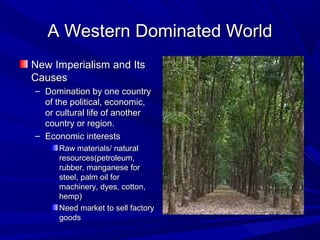
     Raw materials/ natural
     resources(petroleum,
     rubber, manganese for
     steel, palm oil for
     machinery, dyes, cotton,
     hemp)
     Need market to sell factory
     goods
Political and military interests
– Rise of nationalism – “we’re SO better than YOU” –
  land = prestige
Humanitarian Goals
– Westerners feel concern for “little bros” beyond the
  seas
– Missionaries, doctors, colonial officials, etc, obliged to
  spread blessings of Western civilization; including
  medicine, law, and Christian religion
Social Darwinism
– Racial superiority; European races are superior;
  imperial conquest and destruction of weaker races
  were nature’s way of improving the human species
Initially Europeans had limited interest in
controlling regions (very expensive)
Communication realities prevented
centralized control (had to rely on local
admin)
Dutch = Prototype
Dutch paid tribute to Mataram sultans
– Dutch East India Company worked within the
  system
Later backed Mataram sultans in
intertribal conflicts
– Every time the Dutch helped they demanded
  more land
    Dutch backing was needed due to their
    organization, weapons, etc
    By the 1750s they had given everything up
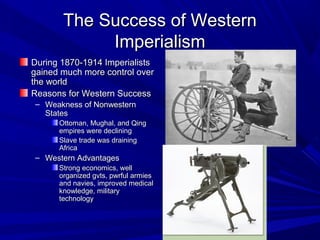
The Success of Western
            Imperialism
During 1870-1914 Imperialists
gained much more control over
the world
Reasons for Western Success
– Weakness of Nonwestern
  States
      Ottoman, Mughal, and Qing
      empires were declining
      Slave trade was draining
      Africa
– Western Advantages
      Strong economics, well
      organized gvts, pwrful armies
      and navies, improved medical
      knowledge, military
      technology
Resistance
– Asians and Africans often resisted domination
  and fought back
Criticism at Home
– Imperialism immoral?
– Imperialism hypocritical?
    Democracy v. imposition of power
Forms of Imperial Rule
Colonies
– France – use direct rule
    Sends officials and soldiers from France to
    administer
    Goal? Impose French culture on colonies and
    then into French provinces
– Britain – use indirect rule
    Use sultans, chiefs/local rulers, etc
    Encourage children of Western rulers to get
    education in Britain (to groom a new Westernized
    generation of leaders)
Protectorates
– Local rulers were left in place, but were
  expected to follow the advice of European
  advisers (Puppet and satellite relationship)
Spheres of Influence
– Outside power claims exclusive
  investment/trading privileges with an area (US
  claims Latin Am.)
New Economic Patterns –
       Global Economy
Money Economy
– Barter system replaced by money economy
Economic Dependency (depend on industrial
nations products)
– Could be considered economic subjugation
Modernization
– Modern banking system
– Transportation and communication networks
    Railroads!
    Canals!
    Telegraph!
Cultural Impact
Westernization – gvt, ideas, technology, and
culture
– Resented or embraced?
Schools and Hospitals –
–   Built by missionaries
–   Taught literacy
–   Introduced vaccines and hygiene
Religion
– Missionaries and Christian faith
Impact on Western Culture
– New foods, art, architecture, sculptors, etc
Political Effects
World Wars
Early 1900’s – Africa and Asia – Western
educated elites begin organizing
nationalist movements to end colonial rule
Competition between industrial
nations=extra tension
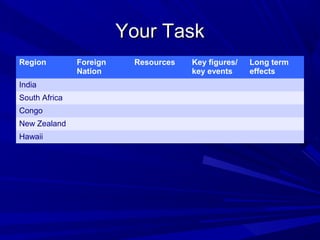
Your Task
Region         Foreign    Resources   Key figures/   Long term
               Nation                 key events     effects
India
South Africa
Congo
New Zealand
Hawaii
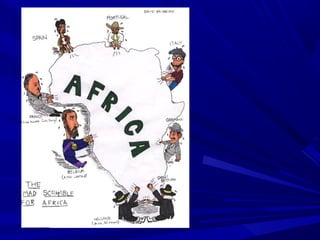
Scramble for Africa
Berlin Conference – 1884
 – Called by Portugal
 – Organized by Bismark
 – Formalizes the “Scramble for Africa”
        US was invited but did not participate
        European powers recognize that
          – Congo=Leopold’s
          – Niger River and Congo River = open for ships to traverse
          – International prohibition of the slave trade is signed
          – Did not officially “carve up” Africa…but did determine what land
            was currently in the hands of Africans and was thus, fair game…
          – European powers only held a colony if
                 They had treaties with local leaders
                 Their flags flew there
                 They established an admin there
India
Nawabs – Mughal empire’s Muslim princes – regional rulers…often
made independent agreements with the British, Dutch, and French
Sepoys – hired and trained Indian troops
1763 – Seven Years War Ends
1818 – British Raj (reign) begins (hold the majority of India)
Sepoy Rebellion – 1857
 – Stage a mutiny, proclaim allegiance to the Mughals, elites and
   peasants join in…
 – British send in forces to “contain the trouble”
 – By 1858 – direct imperial rule is imposed
British Imperial Rule in India
Madras, Bombay, Calcutta
 – Admin centers
 – Local leaders of princely states had to report to British
   admins
Reasons for British takeover
 – Muslims/Hindus don’t unite under national identity
 – Some Indians liked fighting for British
      Received uniforms, weapons, pay,
      5 to 1 Indians serving the British to the actual # of
      British soldiers
India has lots of raw materials, large population
Social Reforms
South Africa
Dutch colony – halfway to India post 1652
Boers (farmers) started moving inland
– Descendents of the Dutch speaking settlers
– Subjugated local Khoikhoi peoples;
  miscegenation ensued creating a “colored”
  population
British take over in the 1800s
– Boers had not benefited from the Scientific,
  Industrial, or Urban revolutions
– Had slaves
Boers move even further inland…
Boer War
Come into contact with established Bantus – the Zulus and Xhosa
British forced at times to come in on the side of the Boers
Boers try to create the Boer Republics in the 1850s
 – Orange Free State and Transvaal
 – Diamonds were discovered in 1867. Uhoh.
      Cecil Rhodes moves in and founds De Beers Consolidated
– Boers win first war in 1871
– Gold discovered in 1885
– Boer War from 1899-1902
– British win, but feel bad about treating Boers horribly, tend to
  allow then to rule themselves
– 1910 – Union of South Africa is founded, generally led by
  Afrikaners
The Congo
Heart of Darkness
King Leopold II
New Zealand
Poor Maoris
Hawaii
Claimed by British in 1843
US in 1898
Originally Discovered by Captain James
Cook
Population declines by half
Turned to commercial crops
American planters/naval base encourage
the US to annex
Suez Canal – 1869
Panama Canal – 1904-1914

Chapter 24 - Imperialism

  • 1.
  • 2.
    A Western DominatedWorld New Imperialism and Its Causes – Domination by one country of the political, economic, or cultural life of another country or region. – Economic interests Raw materials/ natural resources(petroleum, rubber, manganese for steel, palm oil for machinery, dyes, cotton, hemp) Need market to sell factory goods
  • 3.
    Political and militaryinterests – Rise of nationalism – “we’re SO better than YOU” – land = prestige Humanitarian Goals – Westerners feel concern for “little bros” beyond the seas – Missionaries, doctors, colonial officials, etc, obliged to spread blessings of Western civilization; including medicine, law, and Christian religion Social Darwinism – Racial superiority; European races are superior; imperial conquest and destruction of weaker races were nature’s way of improving the human species
  • 4.
    Initially Europeans hadlimited interest in controlling regions (very expensive) Communication realities prevented centralized control (had to rely on local admin)
  • 5.
    Dutch = Prototype Dutchpaid tribute to Mataram sultans – Dutch East India Company worked within the system Later backed Mataram sultans in intertribal conflicts – Every time the Dutch helped they demanded more land Dutch backing was needed due to their organization, weapons, etc By the 1750s they had given everything up
  • 6.
    The Success ofWestern Imperialism During 1870-1914 Imperialists gained much more control over the world Reasons for Western Success – Weakness of Nonwestern States Ottoman, Mughal, and Qing empires were declining Slave trade was draining Africa – Western Advantages Strong economics, well organized gvts, pwrful armies and navies, improved medical knowledge, military technology
  • 7.
    Resistance – Asians andAfricans often resisted domination and fought back Criticism at Home – Imperialism immoral? – Imperialism hypocritical? Democracy v. imposition of power
  • 8.
    Forms of ImperialRule Colonies – France – use direct rule Sends officials and soldiers from France to administer Goal? Impose French culture on colonies and then into French provinces – Britain – use indirect rule Use sultans, chiefs/local rulers, etc Encourage children of Western rulers to get education in Britain (to groom a new Westernized generation of leaders)
  • 9.
    Protectorates – Local rulerswere left in place, but were expected to follow the advice of European advisers (Puppet and satellite relationship) Spheres of Influence – Outside power claims exclusive investment/trading privileges with an area (US claims Latin Am.)
  • 10.
    New Economic Patterns– Global Economy Money Economy – Barter system replaced by money economy Economic Dependency (depend on industrial nations products) – Could be considered economic subjugation Modernization – Modern banking system – Transportation and communication networks Railroads! Canals! Telegraph!
  • 11.
    Cultural Impact Westernization –gvt, ideas, technology, and culture – Resented or embraced? Schools and Hospitals – – Built by missionaries – Taught literacy – Introduced vaccines and hygiene Religion – Missionaries and Christian faith Impact on Western Culture – New foods, art, architecture, sculptors, etc
  • 12.
    Political Effects World Wars Early1900’s – Africa and Asia – Western educated elites begin organizing nationalist movements to end colonial rule Competition between industrial nations=extra tension
  • 15.
    Your Task Region Foreign Resources Key figures/ Long term Nation key events effects India South Africa Congo New Zealand Hawaii
  • 16.
    Scramble for Africa BerlinConference – 1884 – Called by Portugal – Organized by Bismark – Formalizes the “Scramble for Africa” US was invited but did not participate European powers recognize that – Congo=Leopold’s – Niger River and Congo River = open for ships to traverse – International prohibition of the slave trade is signed – Did not officially “carve up” Africa…but did determine what land was currently in the hands of Africans and was thus, fair game… – European powers only held a colony if They had treaties with local leaders Their flags flew there They established an admin there
  • 17.
    India Nawabs – Mughalempire’s Muslim princes – regional rulers…often made independent agreements with the British, Dutch, and French Sepoys – hired and trained Indian troops 1763 – Seven Years War Ends 1818 – British Raj (reign) begins (hold the majority of India) Sepoy Rebellion – 1857 – Stage a mutiny, proclaim allegiance to the Mughals, elites and peasants join in… – British send in forces to “contain the trouble” – By 1858 – direct imperial rule is imposed
  • 18.
    British Imperial Rulein India Madras, Bombay, Calcutta – Admin centers – Local leaders of princely states had to report to British admins Reasons for British takeover – Muslims/Hindus don’t unite under national identity – Some Indians liked fighting for British Received uniforms, weapons, pay, 5 to 1 Indians serving the British to the actual # of British soldiers India has lots of raw materials, large population Social Reforms
  • 19.
    South Africa Dutch colony– halfway to India post 1652 Boers (farmers) started moving inland – Descendents of the Dutch speaking settlers – Subjugated local Khoikhoi peoples; miscegenation ensued creating a “colored” population British take over in the 1800s – Boers had not benefited from the Scientific, Industrial, or Urban revolutions – Had slaves Boers move even further inland…
  • 20.
    Boer War Come intocontact with established Bantus – the Zulus and Xhosa British forced at times to come in on the side of the Boers Boers try to create the Boer Republics in the 1850s – Orange Free State and Transvaal – Diamonds were discovered in 1867. Uhoh. Cecil Rhodes moves in and founds De Beers Consolidated – Boers win first war in 1871 – Gold discovered in 1885 – Boer War from 1899-1902 – British win, but feel bad about treating Boers horribly, tend to allow then to rule themselves – 1910 – Union of South Africa is founded, generally led by Afrikaners
  • 21.
    The Congo Heart ofDarkness King Leopold II
  • 22.
  • 23.
    Hawaii Claimed by Britishin 1843 US in 1898 Originally Discovered by Captain James Cook Population declines by half Turned to commercial crops American planters/naval base encourage the US to annex
  • 24.
    Suez Canal –1869 Panama Canal – 1904-1914