Chapter 10
The Middle Ages
  500 – 1400s
Technically…
   Early Middle Ages
       500-1000s
   High Middle Ages
       1000-1400s
The Early Middle Ages
   Sparsely populated, dense forests,
    rich soil, etc.
   From 400-700 Germanic tribes
    carved Western Europe into small
    kingdoms
   Franks – strongest kingdom
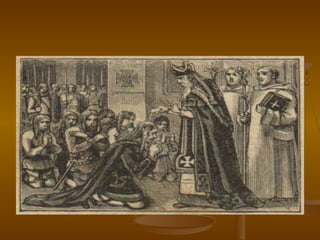
       Clovis, king of the Franks

           Conquers Gaul

           Ruled lands like the
             Franks, but preserves
             Roman legacy
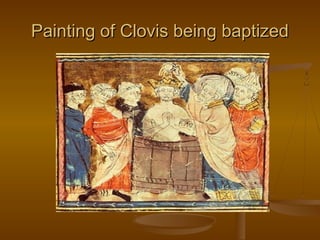
           Converted to Christianity
             (religion of people in Gaul)
                 Earns support AND
                   gains the Christian
                   Church of Rome as an
                   ally
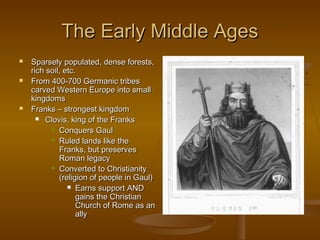
Painting of Clovis being baptized
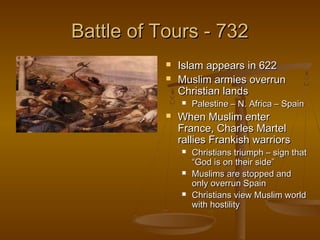
Battle of Tours - 732
              Islam appears in 622
              Muslim armies overrun
               Christian lands
                  Palestine – N. Africa – Spain
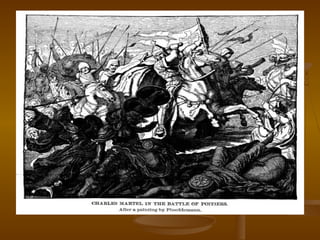
              When Muslim enter
               France, Charles Martel
               rallies Frankish warriors
                  Christians triumph – sign that
                   “God is on their side”
                  Muslims are stopped and
                   only overrun Spain
                  Christians view Muslim world
                   with hostility
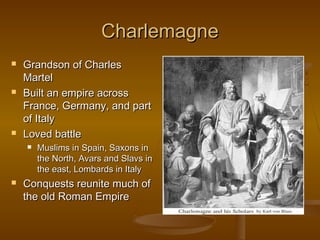
Charlemagne
   Grandson of Charles
    Martel
   Built an empire across
    France, Germany, and part
    of Italy
   Loved battle
       Muslims in Spain, Saxons in
        the North, Avars and Slavs in
        the east, Lombards in Italy
   Conquests reunite much of
    the old Roman Empire
   Pope Leo III asks Charlemagne
    to help against rebellious nobles
    in Rome
   Frankish armies crush the
    rebellion
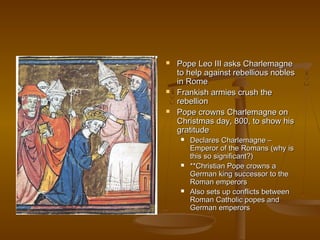
   Pope crowns Charlemagne on
    Christmas day, 800, to show his
    gratitude
        Declares Charlemagne –
         Emperor of the Romans (why is
         this so significant?)
        **Christian Pope crowns a
         German king successor to the
         Roman emperors
        Also sets up conflicts between
         Roman Catholic popes and
         German emperors
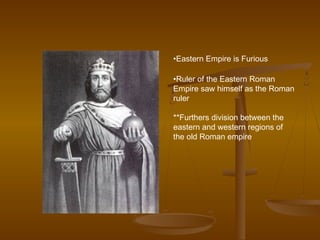
•Eastern Empire is Furious

•Ruler of the Eastern Roman
Empire saw himself as the Roman
ruler

**Furthers division between the
eastern and western regions of
the old Roman empire
   Uses officials to make sure people are
    happy (roads, complaints, justice, etc)
       Missi dominici
   Charlemagne can read, but can’t write
   Alcuin creates curriculum based on Latin
    learning
       becomes the model educational system for
        Medieval Europe
   Extends Christian civilization to Northern
    Europe
Roaming threats
   Muslim forces threaten
    thru 900s
   Magyars
       settle in Hungary and
        plunder Germany, ½
        France, and Italy
        (eventually pushed back to
        Hungary)
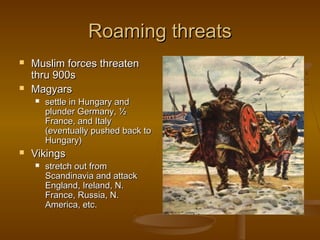
   Vikings
       stretch out from
        Scandinavia and attack
        England, Ireland, N.
        France, Russia, N.
        America, etc.
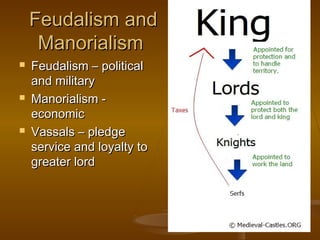
Feudalism and
     Manorialism
   Feudalism – political
    and military
   Manorialism -
    economic
   Vassals – pledge
    service and loyalty to
    greater lord
Happenings in the Kingdom of England
   King Edward (Anglo-Sax) dies
   Harold (weak guy) put in charge
   William of Normandy (strong leader, of Viking
    descent)
       Raises an army and gets pope’s support
       William triumphs and defeats Harold
       William the Conqueror!
       Norman (French) influence
       Battle of Hastings
       Bayeux Tapestry
King William (the Conqueror)
   Required feudal allegiance
   Domesday Book – listed every castle, field
    and pigpen in England
       Helped with efficient tax collection
   Royal exchequer – royal treasury
Unified Legal System
   King Henry II
       1154 – common law – legal system based on
        custom and court rulings and applied to all of
        England
       Created a jury – group of men sworn to speak
        the truth
King Henry and Thomas Becket
   King Henry – claimed the right to try clergy in
    royal courts
   Thomas Becket – Archbishop of Canterbury,
    fiercely disagreed with the king
   “what a pack of fools and cowards I have
    nourished, that not one of them will avenge me
    of this turbulent priest”
   4 knights kill Thomas Becket for King Henry
   Becket’s honored as a martyr and saint,
    pilgrimage destination
King John the Soft
   King John – clever, greedy, cruel,
    untrustworthy
   Not a people person
   War with Philip II – loses French lands
   Gives into Innocent III to avoid kingdom
    wide excommunication, has to recognize
    England as a fief to Rome.
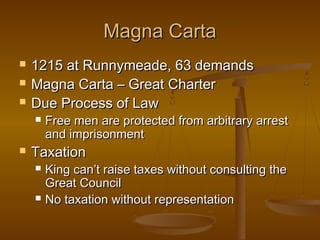
Magna Carta
   1215 at Runnymeade, 63 demands
   Magna Carta – Great Charter
   Due Process of Law
       Free men are protected from arbitrary arrest
        and imprisonment
   Taxation
       King can’t raise taxes without consulting the
        Great Council
       No taxation without representation
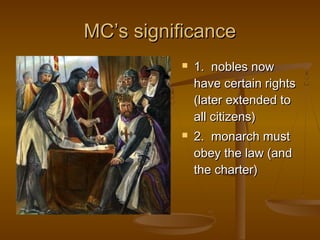
MC’s significance
             1. nobles now
              have certain rights
              (later extended to
              all citizens)
             2. monarch must
              obey the law (and
              the charter)
Great Council
   House of Commons (2 knights from each
    county)
   House of Lords
   King summons this parliament for his own
    purpose
   Serve as a checks and balance
Onto France!
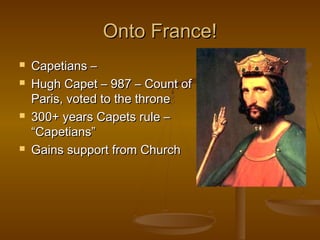
   Capetians –
   Hugh Capet – 987 – Count of
    Paris, voted to the throne
   300+ years Capets rule –
    “Capetians”
   Gains support from Church
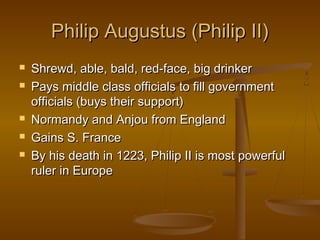
Philip Augustus (Philip II)
   Shrewd, able, bald, red-face, big drinker
   Pays middle class officials to fill government
    officials (buys their support)
   Normandy and Anjou from England
   Gains S. France
   By his death in 1223, Philip II is most powerful
    ruler in Europe
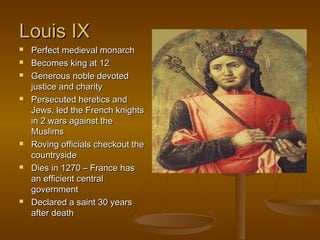
Louis IX
   Perfect medieval monarch
   Becomes king at 12
   Generous noble devoted
    justice and charity
   Persecuted heretics and
    Jews, led the French knights
    in 2 wars against the
    Muslims
   Roving officials checkout the
    countryside
   Dies in 1270 – France has
    an efficient central
    government
   Declared a saint 30 years
    after death
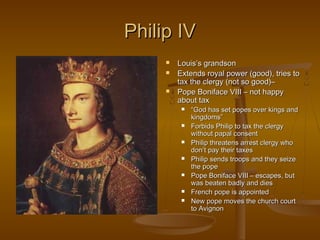
Philip IV
        Louis’s grandson
        Extends royal power (good), tries to
         tax the clergy (not so good)–
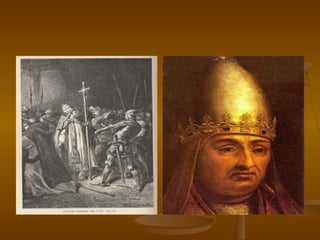
        Pope Boniface VIII – not happy
         about tax
             “God has set popes over kings and
              kingdoms”
             Forbids Philip to tax the clergy
              without papal consent
             Philip threatens arrest clergy who
              don’t pay their taxes
             Philip sends troops and they seize
              the pope
             Pope Boniface VIII – escapes, but
              was beaten badly and dies
             French pope is appointed
             New pope moves the church court
              to Avignon
Estates General
   Created in 1302
   3 parts – clergy, nobles, townspeople
   Body of people that have a say in the
    government
   NOT AS POWERFUL as the English
    Parliament (Great Council) because
    Estates General has no control of taxation
Holy Roman Empire
        Otto I of Saxony – King of Germany
            Helps pope out
            962 – crowned as Holy Roman Emperor
                 Holy – crowned by the pope
                 Roman – heir to the emperors of ancient
                  Rome
        Pope Gregory VII – banned lay
         investiture
            Only Pope can appoint bishops
        HRE Henry IV
            Disagreement with GregoryVII because
             he thinks the HRE should appoint
             bishops to their royal fiefs
        Concordat of Worms – 1122
            Church has sole pwr to elect and invest
             bishops w/spiritual authority; emperor has
             right to invest them with fiefs
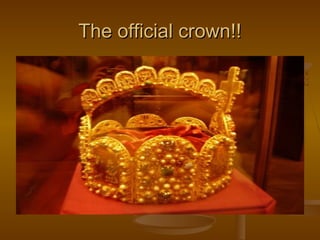
The official crown!!
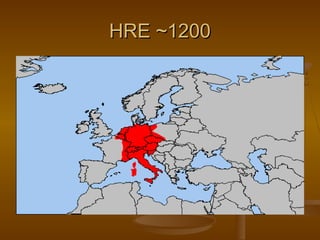
HRE ~1200
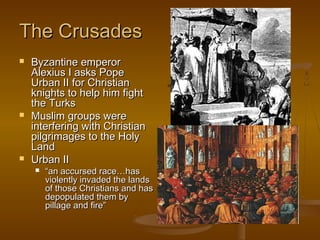
The Crusades
   Byzantine emperor
    Alexius I asks Pope
    Urban II for Christian
    knights to help him fight
    the Turks
   Muslim groups were
    interfering with Christian
    pilgrimages to the Holy
    Land
   Urban II
       “an accursed race…has
        violently invaded the lands
        of those Christians and has
        depopulated them by
        pillage and fire”
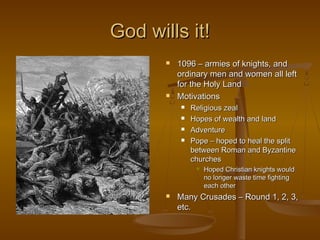
God wills it!
          1096 – armies of knights, and
           ordinary men and women all left
           for the Holy Land
          Motivations
              Religious zeal
              Hopes of wealth and land
              Adventure
              Pope – hoped to heal the split
               between Roman and Byzantine
               churches
                   Hoped Christian knights would
                    no longer waste time fighting
                    each other
          Many Crusades – Round 1, 2, 3,
           etc.
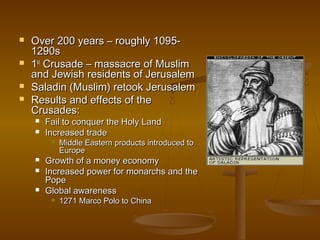
   Over 200 years – roughly 1095-
    1290s
   1st Crusade – massacre of Muslim
    and Jewish residents of Jerusalem
   Saladin (Muslim) retook Jerusalem
   Results and effects of the
    Crusades:
       Fail to conquer the Holy Land
       Increased trade
            Middle Eastern products introduced to
             Europe
       Growth of a money economy
       Increased power for monarchs and the
        Pope
       Global awareness
            1271 Marco Polo to China
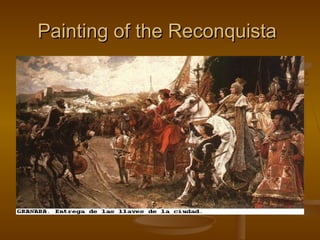
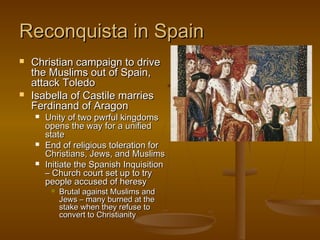
Reconquista in Spain
   Christian campaign to drive
    the Muslims out of Spain,
    attack Toledo
   Isabella of Castile marries
    Ferdinand of Aragon
       Unity of two pwrful kingdoms
        opens the way for a unified
        state
       End of religious toleration for
        Christians, Jews, and Muslims
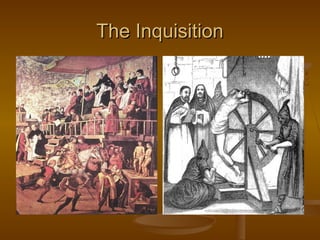
       Initiate the Spanish Inquisition
        – Church court set up to try
        people accused of heresy
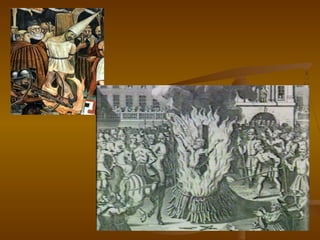
            Brutal against Muslims and
             Jews – many burned at the
             stake when they refuse to
             convert to Christianity
Painting of the Reconquista
The Inquisition
Medieval Architecture
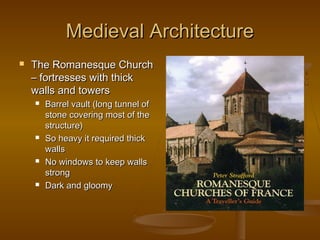
   The Romanesque Church
    – fortresses with thick
    walls and towers
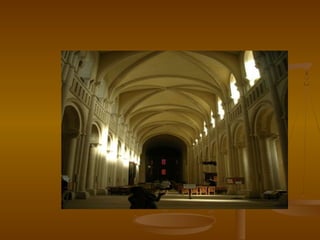
       Barrel vault (long tunnel of
        stone covering most of the
        structure)
       So heavy it required thick
        walls
       No windows to keep walls
        strong
       Dark and gloomy
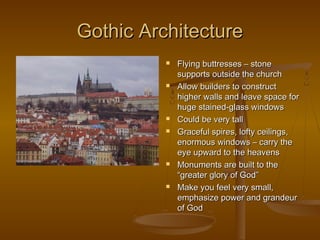
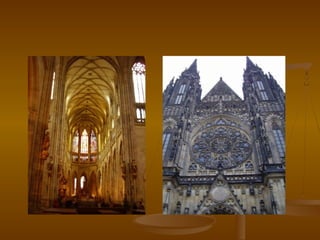
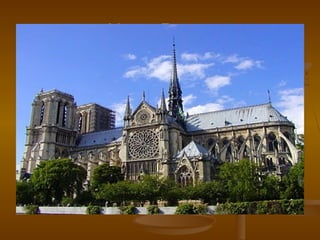
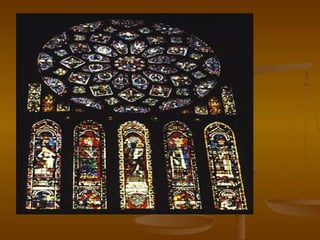
Gothic Architecture
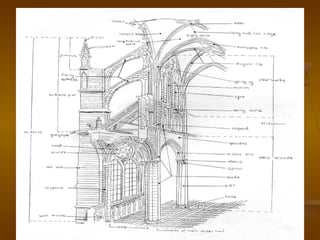
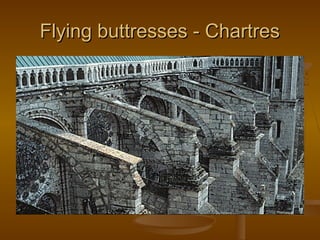
             Flying buttresses – stone
              supports outside the church
             Allow builders to construct
              higher walls and leave space for
              huge stained-glass windows
             Could be very tall
             Graceful spires, lofty ceilings,
              enormous windows – carry the
              eye upward to the heavens
             Monuments are built to the
              “greater glory of God”
             Make you feel very small,
              emphasize power and grandeur
              of God
Notre Dame
Flying buttresses - Chartres
Vernacular
   Vernacular
   Epics
   Dante’s Divine Comedy
       Abandon all hope, ye that enter here
   Beowulf
   Song of Roland
   Canterbury Tales
Growth of Trade and Banking
   Agricultural advancements –
       Cause population increase and surplus of food (allows for
        urbanization to occur)
            Windmills, iron plow, horse replaced oxen, 3 field system
   Urban Growth – more specialized manufacturing and
    commercial activities
       Increases trade
       Creation of Guilds
            Apprentice, journeyman, etc.
            Prevents monopoly
            Quality control
       Development of banking system
            Lending money
            Receipts and regional systems
       Joint business ventures
            Invest in supplies and pool resources, limits risks since land and sea
             travel is dangerous
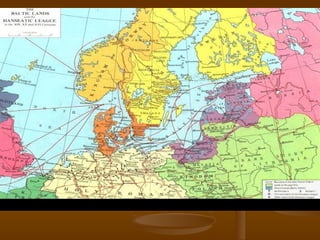
   Created to organize trade between cities in
    Northern Germany and Southern Scandinavia            Hanseatic
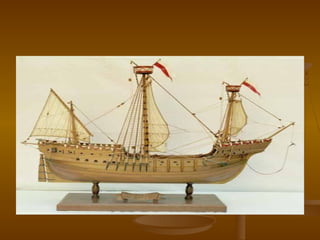
       with no navies to protect their travels, they
        band together for safety and successful
        trade
                                                           League
   1344 Hanseatic League is recognized as a
    loose trade association
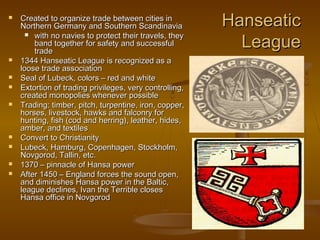
   Seal of Lubeck, colors – red and white
   Extortion of trading privileges, very controlling,
    created monopolies whenever possible
   Trading: timber, pitch, turpentine, iron, copper,
    horses, livestock, hawks and falconry for
    hunting, fish (cod and herring), leather, hides,
    amber, and textiles
   Convert to Christianity
   Lubeck, Hamburg, Copenhagen, Stockholm,
    Novgorod, Tallin, etc.
   1370 – pinnacle of Hansa power
   After 1450 – England forces the sound open,
    and diminishes Hansa power in the Baltic,
    league declines, Ivan the Terrible closes
    Hansa office in Novgorod
 Venetian             Merchants
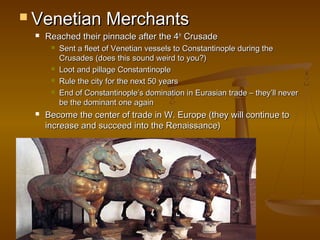
    Reached their pinnacle after the 4th Crusade
         Sent a fleet of Venetian vessels to Constantinople during the
          Crusades (does this sound weird to you?)
         Loot and pillage Constantinople
         Rule the city for the next 50 years
         End of Constantinople’s domination in Eurasian trade – they’ll never
          be the dominant one again
    Become the center of trade in W. Europe (they will continue to
     increase and succeed into the Renaissance)
Troubled 1300’s
   Famine and crop failure already rampant
       Makes everyone more susceptible to the
        plague
PLAGUE!
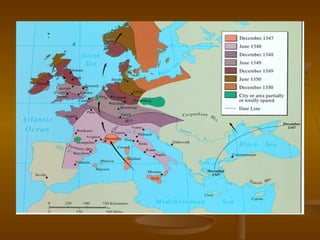
   1347 – a Genoese trading ship brings the
    plague to Messina, Sicily
   Italy to Spain to France and Germany –
    one in three people died
   Originated in Asia and spread to the
    Middle East to Europe
       India depopulated; Mesopotamia, Syria and
        Armenia covered with dead bodies
       Cairo – 7,000 dead bodies a day
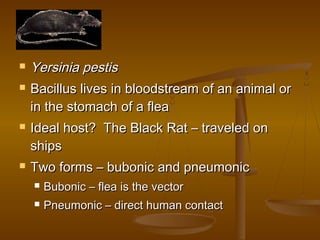
   Yersinia pestis
   Bacillus lives in bloodstream of an animal or
    in the stomach of a flea
   Ideal host? The Black Rat – traveled on
    ships
   Two forms – bubonic and pneumonic
       Bubonic – flea is the vector
       Pneumonic – direct human contact
   Streets were cesspools
   Mud, refuse, human excrement
   Personal hygiene – everyone had fleas
    and body lice so flea bites were perfectly
    normal
   Aristocratic families all slept in one room
    together
   Middle-class or poor households often
    slept in one bed
Symptoms
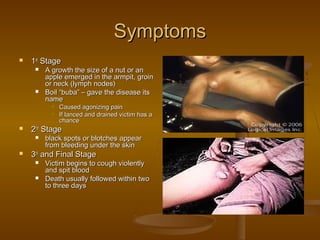
   1st Stage
        A growth the size of a nut or an
         apple emerged in the armpit, groin
         or neck (lymph nodes)
        Boil “buba” – gave the disease its
         name
             Caused agonizing pain
             If lanced and drained victim has a
              chance
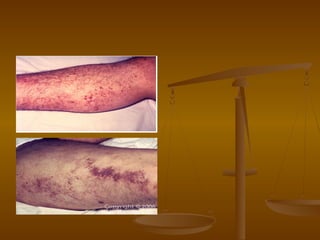
   2nd Stage
        black spots or blotches appear
         from bleeding under the skin
   3rd and Final Stage
        Victim begins to cough violently
         and spit blood
        Death usually followed within two
         to three days
Social Effects
   People didn’t understand the science behind
    how the disease spread…so,
   Terror and bewilderment spread
   Magic and witchcraft
   Profound pessimism
   Wild pleasures – we’ll die soon anyway
   Flagellants – scourged and whipped themselves
    as penance for their and society’s sins
   People fled from city centers
The Decameron
   Giovannia Boccaccio
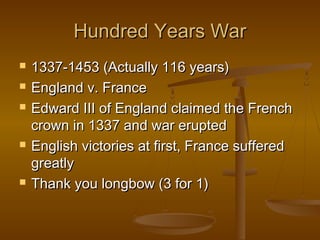
Hundred Years War
   1337-1453 (Actually 116 years)
   England v. France
   Edward III of England claimed the French
    crown in 1337 and war erupted
   English victories at first, France suffered
    greatly
   Thank you longbow (3 for 1)
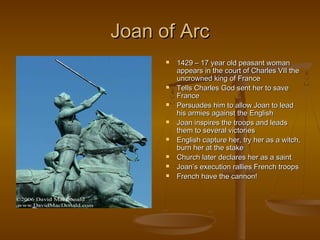
Joan of Arc
         1429 – 17 year old peasant woman
          appears in the court of Charles VII the
          uncrowned king of France
         Tells Charles God sent her to save
          France
         Persuades him to allow Joan to lead
          his armies against the English
         Joan inspires the troops and leads
          them to several victories
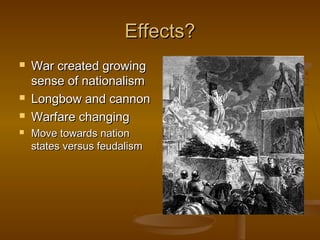
         English capture her, try her as a witch,
          burn her at the stake
         Church later declares her as a saint
         Joan’s execution rallies French troops
         French have the cannon!
Effects?
   War created growing
    sense of nationalism
   Longbow and cannon
   Warfare changing
   Move towards nation
    states versus feudalism

Ch 10 Medieval Europe

  • 1.
    Chapter 10 The MiddleAges 500 – 1400s
  • 2.
    Technically…  Early Middle Ages  500-1000s  High Middle Ages  1000-1400s
  • 3.
    The Early MiddleAges  Sparsely populated, dense forests, rich soil, etc.  From 400-700 Germanic tribes carved Western Europe into small kingdoms  Franks – strongest kingdom  Clovis, king of the Franks  Conquers Gaul  Ruled lands like the Franks, but preserves Roman legacy  Converted to Christianity (religion of people in Gaul)  Earns support AND gains the Christian Church of Rome as an ally
  • 5.
    Painting of Clovisbeing baptized
  • 6.
    Battle of Tours- 732  Islam appears in 622  Muslim armies overrun Christian lands  Palestine – N. Africa – Spain  When Muslim enter France, Charles Martel rallies Frankish warriors  Christians triumph – sign that “God is on their side”  Muslims are stopped and only overrun Spain  Christians view Muslim world with hostility
  • 8.
    Charlemagne  Grandson of Charles Martel  Built an empire across France, Germany, and part of Italy  Loved battle  Muslims in Spain, Saxons in the North, Avars and Slavs in the east, Lombards in Italy  Conquests reunite much of the old Roman Empire
  • 9.
    Pope Leo III asks Charlemagne to help against rebellious nobles in Rome  Frankish armies crush the rebellion  Pope crowns Charlemagne on Christmas day, 800, to show his gratitude  Declares Charlemagne – Emperor of the Romans (why is this so significant?)  **Christian Pope crowns a German king successor to the Roman emperors  Also sets up conflicts between Roman Catholic popes and German emperors
  • 10.
    •Eastern Empire isFurious •Ruler of the Eastern Roman Empire saw himself as the Roman ruler **Furthers division between the eastern and western regions of the old Roman empire
  • 11.
    Uses officials to make sure people are happy (roads, complaints, justice, etc)  Missi dominici  Charlemagne can read, but can’t write  Alcuin creates curriculum based on Latin learning  becomes the model educational system for Medieval Europe  Extends Christian civilization to Northern Europe
  • 12.
    Roaming threats  Muslim forces threaten thru 900s  Magyars  settle in Hungary and plunder Germany, ½ France, and Italy (eventually pushed back to Hungary)  Vikings  stretch out from Scandinavia and attack England, Ireland, N. France, Russia, N. America, etc.
  • 14.
    Feudalism and Manorialism  Feudalism – political and military  Manorialism - economic  Vassals – pledge service and loyalty to greater lord
  • 16.
    Happenings in theKingdom of England  King Edward (Anglo-Sax) dies  Harold (weak guy) put in charge  William of Normandy (strong leader, of Viking descent)  Raises an army and gets pope’s support  William triumphs and defeats Harold  William the Conqueror!  Norman (French) influence  Battle of Hastings  Bayeux Tapestry
  • 17.
    King William (theConqueror)  Required feudal allegiance  Domesday Book – listed every castle, field and pigpen in England  Helped with efficient tax collection  Royal exchequer – royal treasury
  • 18.
    Unified Legal System  King Henry II  1154 – common law – legal system based on custom and court rulings and applied to all of England  Created a jury – group of men sworn to speak the truth
  • 19.
    King Henry andThomas Becket  King Henry – claimed the right to try clergy in royal courts  Thomas Becket – Archbishop of Canterbury, fiercely disagreed with the king  “what a pack of fools and cowards I have nourished, that not one of them will avenge me of this turbulent priest”  4 knights kill Thomas Becket for King Henry  Becket’s honored as a martyr and saint, pilgrimage destination
  • 20.
    King John theSoft  King John – clever, greedy, cruel, untrustworthy  Not a people person  War with Philip II – loses French lands  Gives into Innocent III to avoid kingdom wide excommunication, has to recognize England as a fief to Rome.
  • 21.
    Magna Carta  1215 at Runnymeade, 63 demands  Magna Carta – Great Charter  Due Process of Law  Free men are protected from arbitrary arrest and imprisonment  Taxation  King can’t raise taxes without consulting the Great Council  No taxation without representation
  • 22.
    MC’s significance  1. nobles now have certain rights (later extended to all citizens)  2. monarch must obey the law (and the charter)
  • 23.
    Great Council  House of Commons (2 knights from each county)  House of Lords  King summons this parliament for his own purpose  Serve as a checks and balance
  • 24.
    Onto France!  Capetians –  Hugh Capet – 987 – Count of Paris, voted to the throne  300+ years Capets rule – “Capetians”  Gains support from Church
  • 25.
    Philip Augustus (PhilipII)  Shrewd, able, bald, red-face, big drinker  Pays middle class officials to fill government officials (buys their support)  Normandy and Anjou from England  Gains S. France  By his death in 1223, Philip II is most powerful ruler in Europe
  • 26.
    Louis IX  Perfect medieval monarch  Becomes king at 12  Generous noble devoted justice and charity  Persecuted heretics and Jews, led the French knights in 2 wars against the Muslims  Roving officials checkout the countryside  Dies in 1270 – France has an efficient central government  Declared a saint 30 years after death
  • 27.
    Philip IV  Louis’s grandson  Extends royal power (good), tries to tax the clergy (not so good)–  Pope Boniface VIII – not happy about tax  “God has set popes over kings and kingdoms”  Forbids Philip to tax the clergy without papal consent  Philip threatens arrest clergy who don’t pay their taxes  Philip sends troops and they seize the pope  Pope Boniface VIII – escapes, but was beaten badly and dies  French pope is appointed  New pope moves the church court to Avignon
  • 29.
    Estates General  Created in 1302  3 parts – clergy, nobles, townspeople  Body of people that have a say in the government  NOT AS POWERFUL as the English Parliament (Great Council) because Estates General has no control of taxation
  • 30.
    Holy Roman Empire  Otto I of Saxony – King of Germany  Helps pope out  962 – crowned as Holy Roman Emperor  Holy – crowned by the pope  Roman – heir to the emperors of ancient Rome  Pope Gregory VII – banned lay investiture  Only Pope can appoint bishops  HRE Henry IV  Disagreement with GregoryVII because he thinks the HRE should appoint bishops to their royal fiefs  Concordat of Worms – 1122  Church has sole pwr to elect and invest bishops w/spiritual authority; emperor has right to invest them with fiefs
  • 31.
  • 32.
  • 33.
    The Crusades  Byzantine emperor Alexius I asks Pope Urban II for Christian knights to help him fight the Turks  Muslim groups were interfering with Christian pilgrimages to the Holy Land  Urban II  “an accursed race…has violently invaded the lands of those Christians and has depopulated them by pillage and fire”
  • 34.
    God wills it!  1096 – armies of knights, and ordinary men and women all left for the Holy Land  Motivations  Religious zeal  Hopes of wealth and land  Adventure  Pope – hoped to heal the split between Roman and Byzantine churches  Hoped Christian knights would no longer waste time fighting each other  Many Crusades – Round 1, 2, 3, etc.
  • 37.
    Over 200 years – roughly 1095- 1290s  1st Crusade – massacre of Muslim and Jewish residents of Jerusalem  Saladin (Muslim) retook Jerusalem  Results and effects of the Crusades:  Fail to conquer the Holy Land  Increased trade  Middle Eastern products introduced to Europe  Growth of a money economy  Increased power for monarchs and the Pope  Global awareness  1271 Marco Polo to China
  • 38.
    Reconquista in Spain  Christian campaign to drive the Muslims out of Spain, attack Toledo  Isabella of Castile marries Ferdinand of Aragon  Unity of two pwrful kingdoms opens the way for a unified state  End of religious toleration for Christians, Jews, and Muslims  Initiate the Spanish Inquisition – Church court set up to try people accused of heresy  Brutal against Muslims and Jews – many burned at the stake when they refuse to convert to Christianity
  • 39.
    Painting of theReconquista
  • 40.
  • 42.
    Medieval Architecture  The Romanesque Church – fortresses with thick walls and towers  Barrel vault (long tunnel of stone covering most of the structure)  So heavy it required thick walls  No windows to keep walls strong  Dark and gloomy
  • 44.
    Gothic Architecture  Flying buttresses – stone supports outside the church  Allow builders to construct higher walls and leave space for huge stained-glass windows  Could be very tall  Graceful spires, lofty ceilings, enormous windows – carry the eye upward to the heavens  Monuments are built to the “greater glory of God”  Make you feel very small, emphasize power and grandeur of God
  • 48.
  • 49.
  • 51.
    Vernacular  Vernacular  Epics  Dante’s Divine Comedy  Abandon all hope, ye that enter here  Beowulf  Song of Roland  Canterbury Tales
  • 52.
    Growth of Tradeand Banking  Agricultural advancements –  Cause population increase and surplus of food (allows for urbanization to occur)  Windmills, iron plow, horse replaced oxen, 3 field system  Urban Growth – more specialized manufacturing and commercial activities  Increases trade  Creation of Guilds  Apprentice, journeyman, etc.  Prevents monopoly  Quality control  Development of banking system  Lending money  Receipts and regional systems  Joint business ventures  Invest in supplies and pool resources, limits risks since land and sea travel is dangerous
  • 53.
    Created to organize trade between cities in Northern Germany and Southern Scandinavia Hanseatic  with no navies to protect their travels, they band together for safety and successful trade League  1344 Hanseatic League is recognized as a loose trade association  Seal of Lubeck, colors – red and white  Extortion of trading privileges, very controlling, created monopolies whenever possible  Trading: timber, pitch, turpentine, iron, copper, horses, livestock, hawks and falconry for hunting, fish (cod and herring), leather, hides, amber, and textiles  Convert to Christianity  Lubeck, Hamburg, Copenhagen, Stockholm, Novgorod, Tallin, etc.  1370 – pinnacle of Hansa power  After 1450 – England forces the sound open, and diminishes Hansa power in the Baltic, league declines, Ivan the Terrible closes Hansa office in Novgorod
  • 56.
     Venetian Merchants  Reached their pinnacle after the 4th Crusade  Sent a fleet of Venetian vessels to Constantinople during the Crusades (does this sound weird to you?)  Loot and pillage Constantinople  Rule the city for the next 50 years  End of Constantinople’s domination in Eurasian trade – they’ll never be the dominant one again  Become the center of trade in W. Europe (they will continue to increase and succeed into the Renaissance)
  • 57.
    Troubled 1300’s  Famine and crop failure already rampant  Makes everyone more susceptible to the plague
  • 58.
    PLAGUE!  1347 – a Genoese trading ship brings the plague to Messina, Sicily  Italy to Spain to France and Germany – one in three people died  Originated in Asia and spread to the Middle East to Europe  India depopulated; Mesopotamia, Syria and Armenia covered with dead bodies  Cairo – 7,000 dead bodies a day
  • 59.
    Yersinia pestis  Bacillus lives in bloodstream of an animal or in the stomach of a flea  Ideal host? The Black Rat – traveled on ships  Two forms – bubonic and pneumonic  Bubonic – flea is the vector  Pneumonic – direct human contact
  • 60.
    Streets were cesspools  Mud, refuse, human excrement  Personal hygiene – everyone had fleas and body lice so flea bites were perfectly normal  Aristocratic families all slept in one room together  Middle-class or poor households often slept in one bed
  • 61.
    Symptoms  1st Stage  A growth the size of a nut or an apple emerged in the armpit, groin or neck (lymph nodes)  Boil “buba” – gave the disease its name  Caused agonizing pain  If lanced and drained victim has a chance  2nd Stage  black spots or blotches appear from bleeding under the skin  3rd and Final Stage  Victim begins to cough violently and spit blood  Death usually followed within two to three days
  • 64.
    Social Effects  People didn’t understand the science behind how the disease spread…so,  Terror and bewilderment spread  Magic and witchcraft  Profound pessimism  Wild pleasures – we’ll die soon anyway  Flagellants – scourged and whipped themselves as penance for their and society’s sins  People fled from city centers
  • 65.
    The Decameron  Giovannia Boccaccio
  • 66.
    Hundred Years War  1337-1453 (Actually 116 years)  England v. France  Edward III of England claimed the French crown in 1337 and war erupted  English victories at first, France suffered greatly  Thank you longbow (3 for 1)
  • 67.
    Joan of Arc  1429 – 17 year old peasant woman appears in the court of Charles VII the uncrowned king of France  Tells Charles God sent her to save France  Persuades him to allow Joan to lead his armies against the English  Joan inspires the troops and leads them to several victories  English capture her, try her as a witch, burn her at the stake  Church later declares her as a saint  Joan’s execution rallies French troops  French have the cannon!
  • 68.
    Effects?  War created growing sense of nationalism  Longbow and cannon  Warfare changing  Move towards nation states versus feudalism