Revolution in China
       © Student Handouts, Inc.
Fall of the Qing (Manchu) Dynasty
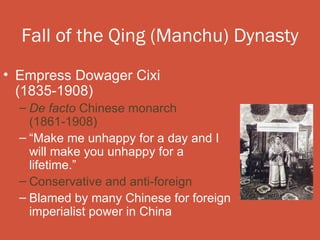
• Empress Dowager Cixi
  (1835-1908)
  – De facto Chinese monarch
    (1861-1908)
  – “Make me unhappy for a day and I
    will make you unhappy for a
    lifetime.”
  – Conservative and anti-foreign
  – Blamed by many Chinese for foreign
    imperialist power in China
Fall of the Qing (Manchu) Dynasty
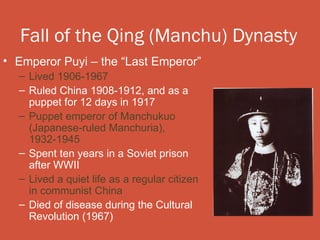
• Emperor Puyi – the “Last Emperor”
  – Lived 1906-1967
  – Ruled China 1908-1912, and as a
    puppet for 12 days in 1917
  – Puppet emperor of Manchukuo
    (Japanese-ruled Manchuria),
    1932-1945
  – Spent ten years in a Soviet prison
    after WWII
  – Lived a quiet life as a regular citizen
    in communist China
  – Died of disease during the Cultural
    Revolution (1967)
Republican Revolution (1912)

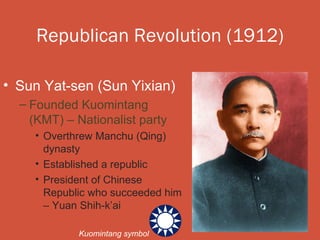
• Sun Yat-sen (Sun Yixian)
  – Founded Kuomintang
    (KMT) – Nationalist party
    • Overthrew Manchu (Qing)
      dynasty
    • Established a republic
    • President of Chinese
      Republic who succeeded him
      – Yuan Shih-k’ai

            Kuomintang symbol
Republic of China: Weaknesses
• Disunity
  – Local warlords fought Kuomintang for control
  – Wars raged between 1912 and 1928
• Foreign imperialists
  – Americans, Europeans, and Japanese
• Poor transportation
  – 1914 – only 6,000 miles of railroad track
     • 225,000 miles in the smaller United States
  – Few decent roads
Foreign Imperialists
• Twenty-One Demands (1915)
  – Japan attempted to make China a Japanese
    protectorate
  – Action condemned and stopped by other leading
    world powers
• World War I and the Treaty of Versailles
  – China attempted to abolish concessions and
    extraterritoriality
     • Attempt failed
  – China did not sign the Treaty of Versailles
  – Japan gained mandate over most of Germany’s
    Asian possessions and rights
Three Principles of the People

• Book published by Sun Yat-sen before his
  death in 1925
  1. Principle of Mínquán
   •   Democracy – the people are sovereign
  2. Principle of Mínzú
   •   Nationalism – an end to foreign imperialism
  3. Principle of Mínshēng
   •   Livelihood – economic development,
       industrialization, land reform, and social welfare –
       elements of progressivism and socialism
Growth of Communism
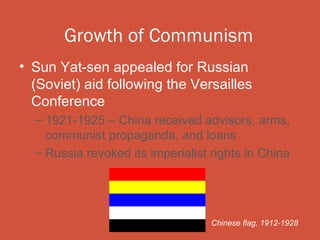
• Sun Yat-sen appealed for Russian
  (Soviet) aid following the Versailles
  Conference
  – 1921-1925 – China received advisors, arms,
    communist propaganda, and loans
  – Russia revoked its imperialist rights in China


                                   Chinese flag, 1912-1928
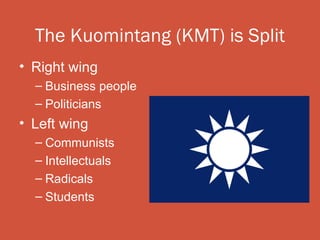
The Kuomintang (KMT) is Split
• Right wing
  – Business people
  – Politicians
• Left wing
  – Communists
  – Intellectuals
  – Radicals
  – Students
Nationalist Revolution
• Sun Yat-sen succeeded by Chiang Kai-
  shek
• Communists expelled by Kuomintang
• 1926-1928 – war to control the warlords
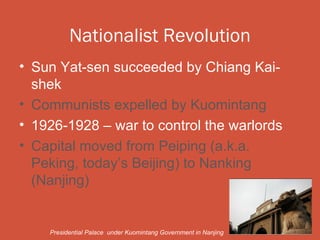
• Capital moved from Peiping (a.k.a.
  Peking, today’s Beijing) to Nanking
  (Nanjing)


    Presidential Palace under Kuomintang Government in Nanjing
Civil War in China
• 1927-1932 and 1933-1937 – war between
  Communists and Nationalists
• Communists – Mao Tse-tung (Mao Zedong)
• Nationalists – Chiang Kai-shek
• War halted 1932-1933 and 1937-1945 to fight
  Japanese aggression
• Communists were victorious in 1949
• Nationalists retreated to Formosa (Taiwan)
• End of imperialism in China
  – Hong Kong returned to China in 1997
Japanese Aggression

• Japan was a threat to China – 1894-1941
• 1937 – Japanese invasion
  – Japanese took control of north and areas
    along the coast
  – Rape of Nanking
  – Chinese Communists and Nationalists
    • Intermittently were at peace as they united to fight
      against the Japanese
    • Guerrilla and scorched earth tactics
    • Received American aid against the Japanese
World War II
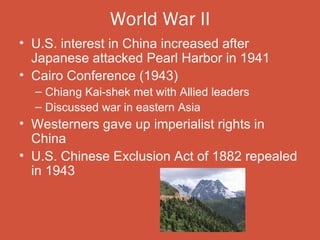
• U.S. interest in China increased after
  Japanese attacked Pearl Harbor in 1941
• Cairo Conference (1943)
  – Chiang Kai-shek met with Allied leaders
  – Discussed war in eastern Asia
• Westerners gave up imperialist rights in
  China
• U.S. Chinese Exclusion Act of 1882 repealed
  in 1943
Communists in Control – 1949
• Communists and Nationalists resumed civil
  war following World War II
• Chiang Kai-shek’s Nationalist government
  wasted foreign economic aid
• Many Kuomintang deserted to Communists
• Manchuria – taken over by Communists in
  1948
• December, 1949 -- Communists in control
• Chiang Kai-shek and Nationalists retreated to
  Formosa (Taiwan)
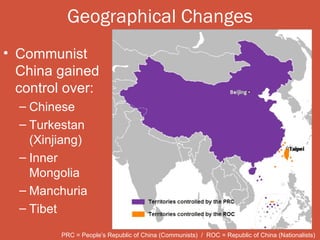
Geographical Changes
• Communist
  China gained
  control over:
  – Chinese
  – Turkestan
    (Xinjiang)
  – Inner
    Mongolia
  – Manchuria
  – Tibet

         PRC = People’s Republic of China (Communists) / ROC = Republic of China (Nationalists)
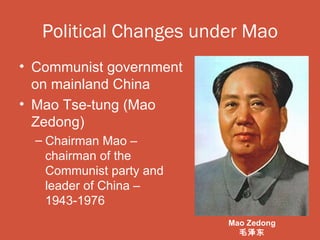
Political Changes under Mao
• Communist government
  on mainland China
• Mao Tse-tung (Mao
  Zedong)
  – Chairman Mao –
    chairman of the
    Communist party and
    leader of China –
    1943-1976
                          Mao Zedong
                            毛泽东
Economic Changes under Mao
• First Five-Year Plan (1953-1957)
  – Advances in agriculture and coal, electricity, iron,
    and steel production
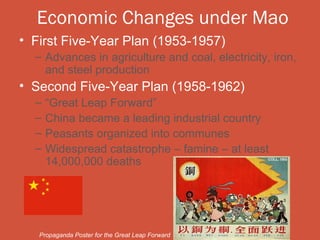
• Second Five-Year Plan (1958-1962)
  –   “Great Leap Forward”
  –   China became a leading industrial country
  –   Peasants organized into communes
  –   Widespread catastrophe – famine – at least
      14,000,000 deaths


   Propaganda Poster for the Great Leap Forward
Foreign Relations
• Russia (Soviet Union)
  – Growing split between USSR and China
     • “Peaceful coexistence” policy of USSR viewed as surrender
  – 1960 – end of Soviet economic aid
• Tibet
  – Seized in 1962
• Korea
  – Aided North Korea in the Korean War (1950-1953)
• Vietnam
  – Supported North Vietnam and aided Viet Cong during
    Vietnam War (1959-1975)
Foreign Relations
• Cold War
  – Economic aid to Africa, Asia, and Latin America
• “Atomic Club” (1964)
  – Fifth overall, and first non-white, country to
    develop nuclear weapons
• United Nations
  – One of five permanent members of U.N. Security
    Council (1971, replacing Taiwan)
• Relations with United States
  – 1972 – U.S. President Richard Nixon opened
    diplomatic relations with China
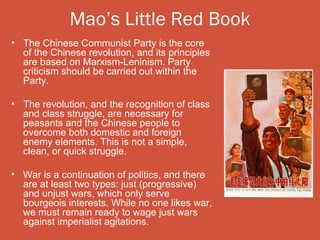
Mao’s Little Red Book
• The Chinese Communist Party is the core
  of the Chinese revolution, and its principles
  are based on Marxism-Leninism. Party
  criticism should be carried out within the
  Party.

• The revolution, and the recognition of class
  and class struggle, are necessary for
  peasants and the Chinese people to
  overcome both domestic and foreign
  enemy elements. This is not a simple,
  clean, or quick struggle.

• War is a continuation of politics, and there
  are at least two types: just (progressive)
  and unjust wars, which only serve
  bourgeois interests. While no one likes war,
  we must remain ready to wage just wars
  against imperialist agitations.
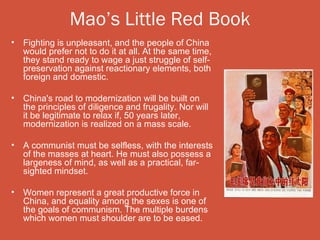
Mao’s Little Red Book
•   Fighting is unpleasant, and the people of China
    would prefer not to do it at all. At the same time,
    they stand ready to wage a just struggle of self-
    preservation against reactionary elements, both
    foreign and domestic.

•   China's road to modernization will be built on
    the principles of diligence and frugality. Nor will
    it be legitimate to relax if, 50 years later,
    modernization is realized on a mass scale.

•   A communist must be selfless, with the interests
    of the masses at heart. He must also possess a
    largeness of mind, as well as a practical, far-
    sighted mindset.

•   Women represent a great productive force in
    China, and equality among the sexes is one of
    the goals of communism. The multiple burdens
    which women must shoulder are to be eased.
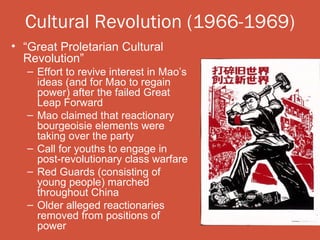
Cultural Revolution (1966-1969)
• “Great Proletarian Cultural
  Revolution”
   – Effort to revive interest in Mao’s
     ideas (and for Mao to regain
     power) after the failed Great
     Leap Forward
   – Mao claimed that reactionary
     bourgeoisie elements were
     taking over the party
   – Call for youths to engage in
     post-revolutionary class warfare
   – Red Guards (consisting of
     young people) marched
     throughout China
   – Older alleged reactionaries
     removed from positions of
     power
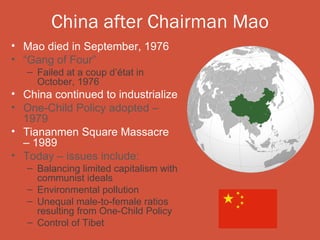
China after Chairman Mao
• Mao died in September, 1976
• “Gang of Four”
   – Failed at a coup d’état in
     October, 1976
• China continued to industrialize
• One-Child Policy adopted –
  1979
• Tiananmen Square Massacre
  – 1989
• Today – issues include:
   – Balancing limited capitalism with
     communist ideals
   – Environmental pollution
   – Unequal male-to-female ratios
     resulting from One-Child Policy
   – Control of Tibet

Chinese Revolution

  • 1.
    Revolution in China © Student Handouts, Inc.
  • 2.
    Fall of theQing (Manchu) Dynasty • Empress Dowager Cixi (1835-1908) – De facto Chinese monarch (1861-1908) – “Make me unhappy for a day and I will make you unhappy for a lifetime.” – Conservative and anti-foreign – Blamed by many Chinese for foreign imperialist power in China
  • 3.
    Fall of theQing (Manchu) Dynasty • Emperor Puyi – the “Last Emperor” – Lived 1906-1967 – Ruled China 1908-1912, and as a puppet for 12 days in 1917 – Puppet emperor of Manchukuo (Japanese-ruled Manchuria), 1932-1945 – Spent ten years in a Soviet prison after WWII – Lived a quiet life as a regular citizen in communist China – Died of disease during the Cultural Revolution (1967)
  • 4.
    Republican Revolution (1912) •Sun Yat-sen (Sun Yixian) – Founded Kuomintang (KMT) – Nationalist party • Overthrew Manchu (Qing) dynasty • Established a republic • President of Chinese Republic who succeeded him – Yuan Shih-k’ai Kuomintang symbol
  • 5.
    Republic of China:Weaknesses • Disunity – Local warlords fought Kuomintang for control – Wars raged between 1912 and 1928 • Foreign imperialists – Americans, Europeans, and Japanese • Poor transportation – 1914 – only 6,000 miles of railroad track • 225,000 miles in the smaller United States – Few decent roads
  • 6.
    Foreign Imperialists • Twenty-OneDemands (1915) – Japan attempted to make China a Japanese protectorate – Action condemned and stopped by other leading world powers • World War I and the Treaty of Versailles – China attempted to abolish concessions and extraterritoriality • Attempt failed – China did not sign the Treaty of Versailles – Japan gained mandate over most of Germany’s Asian possessions and rights
  • 7.
    Three Principles ofthe People • Book published by Sun Yat-sen before his death in 1925 1. Principle of Mínquán • Democracy – the people are sovereign 2. Principle of Mínzú • Nationalism – an end to foreign imperialism 3. Principle of Mínshēng • Livelihood – economic development, industrialization, land reform, and social welfare – elements of progressivism and socialism
  • 8.
    Growth of Communism •Sun Yat-sen appealed for Russian (Soviet) aid following the Versailles Conference – 1921-1925 – China received advisors, arms, communist propaganda, and loans – Russia revoked its imperialist rights in China Chinese flag, 1912-1928
  • 9.
    The Kuomintang (KMT)is Split • Right wing – Business people – Politicians • Left wing – Communists – Intellectuals – Radicals – Students
  • 10.
    Nationalist Revolution • SunYat-sen succeeded by Chiang Kai- shek • Communists expelled by Kuomintang • 1926-1928 – war to control the warlords • Capital moved from Peiping (a.k.a. Peking, today’s Beijing) to Nanking (Nanjing) Presidential Palace under Kuomintang Government in Nanjing
  • 11.
    Civil War inChina • 1927-1932 and 1933-1937 – war between Communists and Nationalists • Communists – Mao Tse-tung (Mao Zedong) • Nationalists – Chiang Kai-shek • War halted 1932-1933 and 1937-1945 to fight Japanese aggression • Communists were victorious in 1949 • Nationalists retreated to Formosa (Taiwan) • End of imperialism in China – Hong Kong returned to China in 1997
  • 12.
    Japanese Aggression • Japanwas a threat to China – 1894-1941 • 1937 – Japanese invasion – Japanese took control of north and areas along the coast – Rape of Nanking – Chinese Communists and Nationalists • Intermittently were at peace as they united to fight against the Japanese • Guerrilla and scorched earth tactics • Received American aid against the Japanese
  • 13.
    World War II •U.S. interest in China increased after Japanese attacked Pearl Harbor in 1941 • Cairo Conference (1943) – Chiang Kai-shek met with Allied leaders – Discussed war in eastern Asia • Westerners gave up imperialist rights in China • U.S. Chinese Exclusion Act of 1882 repealed in 1943
  • 14.
    Communists in Control– 1949 • Communists and Nationalists resumed civil war following World War II • Chiang Kai-shek’s Nationalist government wasted foreign economic aid • Many Kuomintang deserted to Communists • Manchuria – taken over by Communists in 1948 • December, 1949 -- Communists in control • Chiang Kai-shek and Nationalists retreated to Formosa (Taiwan)
  • 15.
    Geographical Changes • Communist China gained control over: – Chinese – Turkestan (Xinjiang) – Inner Mongolia – Manchuria – Tibet PRC = People’s Republic of China (Communists) / ROC = Republic of China (Nationalists)
  • 16.
    Political Changes underMao • Communist government on mainland China • Mao Tse-tung (Mao Zedong) – Chairman Mao – chairman of the Communist party and leader of China – 1943-1976 Mao Zedong 毛泽东
  • 17.
    Economic Changes underMao • First Five-Year Plan (1953-1957) – Advances in agriculture and coal, electricity, iron, and steel production • Second Five-Year Plan (1958-1962) – “Great Leap Forward” – China became a leading industrial country – Peasants organized into communes – Widespread catastrophe – famine – at least 14,000,000 deaths Propaganda Poster for the Great Leap Forward
  • 18.
    Foreign Relations • Russia(Soviet Union) – Growing split between USSR and China • “Peaceful coexistence” policy of USSR viewed as surrender – 1960 – end of Soviet economic aid • Tibet – Seized in 1962 • Korea – Aided North Korea in the Korean War (1950-1953) • Vietnam – Supported North Vietnam and aided Viet Cong during Vietnam War (1959-1975)
  • 19.
    Foreign Relations • ColdWar – Economic aid to Africa, Asia, and Latin America • “Atomic Club” (1964) – Fifth overall, and first non-white, country to develop nuclear weapons • United Nations – One of five permanent members of U.N. Security Council (1971, replacing Taiwan) • Relations with United States – 1972 – U.S. President Richard Nixon opened diplomatic relations with China
  • 20.
    Mao’s Little RedBook • The Chinese Communist Party is the core of the Chinese revolution, and its principles are based on Marxism-Leninism. Party criticism should be carried out within the Party. • The revolution, and the recognition of class and class struggle, are necessary for peasants and the Chinese people to overcome both domestic and foreign enemy elements. This is not a simple, clean, or quick struggle. • War is a continuation of politics, and there are at least two types: just (progressive) and unjust wars, which only serve bourgeois interests. While no one likes war, we must remain ready to wage just wars against imperialist agitations.
  • 21.
    Mao’s Little RedBook • Fighting is unpleasant, and the people of China would prefer not to do it at all. At the same time, they stand ready to wage a just struggle of self- preservation against reactionary elements, both foreign and domestic. • China's road to modernization will be built on the principles of diligence and frugality. Nor will it be legitimate to relax if, 50 years later, modernization is realized on a mass scale. • A communist must be selfless, with the interests of the masses at heart. He must also possess a largeness of mind, as well as a practical, far- sighted mindset. • Women represent a great productive force in China, and equality among the sexes is one of the goals of communism. The multiple burdens which women must shoulder are to be eased.
  • 22.
    Cultural Revolution (1966-1969) •“Great Proletarian Cultural Revolution” – Effort to revive interest in Mao’s ideas (and for Mao to regain power) after the failed Great Leap Forward – Mao claimed that reactionary bourgeoisie elements were taking over the party – Call for youths to engage in post-revolutionary class warfare – Red Guards (consisting of young people) marched throughout China – Older alleged reactionaries removed from positions of power
  • 23.
    China after ChairmanMao • Mao died in September, 1976 • “Gang of Four” – Failed at a coup d’état in October, 1976 • China continued to industrialize • One-Child Policy adopted – 1979 • Tiananmen Square Massacre – 1989 • Today – issues include: – Balancing limited capitalism with communist ideals – Environmental pollution – Unequal male-to-female ratios resulting from One-Child Policy – Control of Tibet

Editor's Notes

  • #11 Possible anecdote: The Kuomintang changed the name of Peking/Beijing to Peiping (or Beiping) in 1928.
  • #17 Possible anecdote: Other men served as chairman of the republic (as opposed to both the party and the republic) as well as premier, but Mao was the de facto leader of China until his death in 1976.
  • #18 Note: Chairman Mao ’s role as China’s leader became less significant following the failure of the Great Leap Forward.
  • #21 Note: Mao ’s Quotations were published by the Chinese government from 1964 to 1976.