Chapter 8:
African Civilizations and the
Spread of Islam
• Stateless Societies
  ▫ Organized around kinship, little centralization of authority
      Gvt rarely a full time occupation
• Common Elements of African Societies
  ▫ Bantu language base
  ▫ Animistic religions
  ▫ Cosmology to explain the universe
  ▫ Superstitious
  ▫ Ancestors were first settlers of their land, therefore they have
    ownership of the land, resources, etc.
      Venerated ancestors, link to the spiritual world
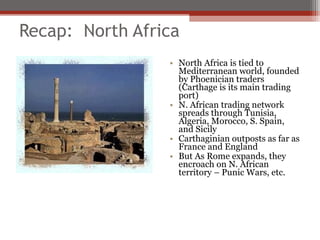
Recap: North Africa
                 • North Africa is tied to
                   Mediterranean world, founded
                   by Phoenician traders
                   (Carthage is its main trading
                   port)
                 • N. African trading network
                   spreads through Tunisia,
                   Algeria, Morocco, S. Spain,
                   and Sicily
                 • Carthaginian outposts as far as
                   France and England
                 • But As Rome expands, they
                   encroach on N. African
                   territory – Punic Wars, etc.
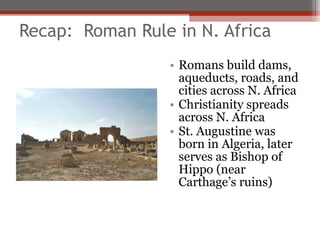
Recap: Roman Rule in N. Africa
                 • Romans build dams,
                   aqueducts, roads, and
                   cities across N. Africa
                 • Christianity spreads
                   across N. Africa
                 • St. Augustine was
                   born in Algeria, later
                   serves as Bishop of
                   Hippo (near
                   Carthage’s ruins)
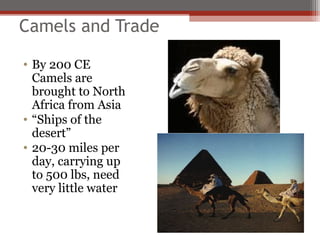
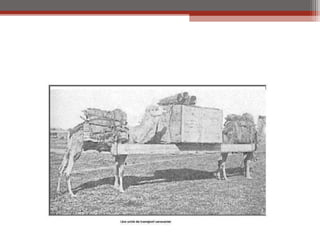
Camels and Trade

• By 200 CE
  Camels are
  brought to North
  Africa from Asia
• “Ships of the
  desert”
• 20-30 miles per
  day, carrying up
  to 500 lbs, need
  very little water
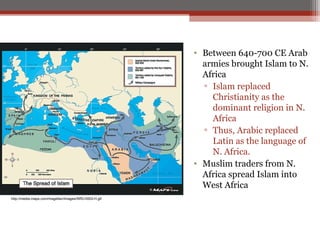
• Between 640-700 CE Arab
    Spread of Islam                                     armies brought Islam to N.
                                                        Africa
                                                        ▫ Islam replaced
                                                          Christianity as the
                                                          dominant religion in N.
                                                          Africa
                                                        ▫ Thus, Arabic replaced
                                                          Latin as the language of
                                                          N. Africa.
                                                      • Muslim traders from N.
                                                        Africa spread Islam into
                                                        West Africa
http://media.maps.com/magellan/Images/WRLH003-H.gif
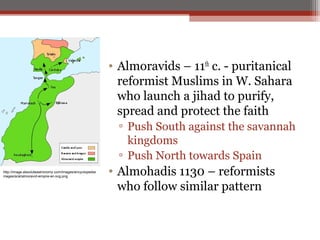
• Almoravids – 11th c. - puritanical
                                                            reformist Muslims in W. Sahara
                                                            who launch a jihad to purify,
                                                            spread and protect the faith
                                                            ▫ Push South against the savannah
                                                              kingdoms
                                                            ▫ Push North towards Spain
http://image.absoluteastronomy.com/images/encyclopediai
mages/a/al/almoravid-empire-en.svg.png
                                                          • Almohadis 1130 – reformists
                                                            who follow similar pattern
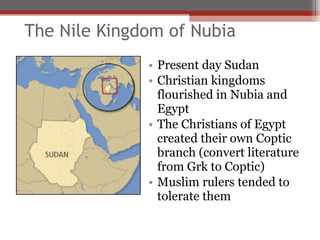
The Nile Kingdom of Nubia
              • Present day Sudan
              • Christian kingdoms
                flourished in Nubia and
                Egypt
              • The Christians of Egypt
                created their own Coptic
                branch (convert literature
                from Grk to Coptic)
              • Muslim rulers tended to
                tolerate them
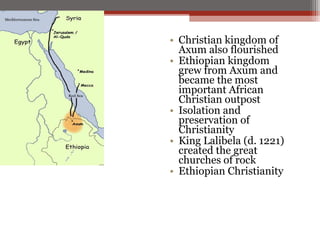
• Christian kingdom of
  Axum also flourished
• Ethiopian kingdom
  grew from Axum and
  became the most
  important African
  Christian outpost
• Isolation and
  preservation of
  Christianity
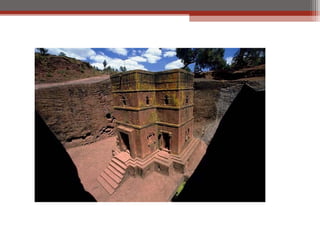
• King Lalibela (d. 1221)
  created the great
  churches of rock
• Ethiopian Christianity
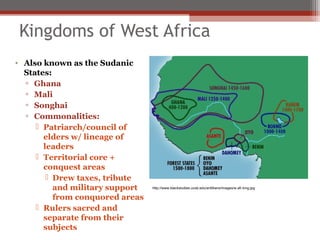
Kingdoms of West Africa
• Also known as the Sudanic
  States:
  ▫ Ghana
  ▫ Mali
  ▫ Songhai
  ▫ Commonalities:
      Patriarch/council of
       elders w/ lineage of
       leaders
      Territorial core +
       conquest areas
         Drew taxes, tribute
          and military support   http://www.blackstudies.ucsb.edu/antillians/images/w.afr.king.jpg

          from conquored areas
      Rulers sacred and
       separate from their
       subjects
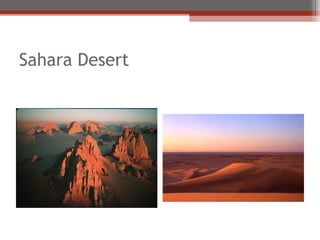
Sahara Desert
Trading Gold and Salt
• Trade network stretches across the Sahara to
  reach civilizations along the Mediterranean and
  Middle East
• Gold is plentiful in Ghana, Nigeria, and Senegal
• Men dig soil up from pits and women wash the
  soil to extract the gold dust and pieces
• Used hollow feather quills to transport gold dust
  safely to N. Africa and Europe
Salt!
• Salt essential aspect of diet to prevent
  dehydration
• Sahara has an abundance of salt
  ▫ in Taghaza people even built houses out of salt
    blocks
• Salt is scarce in the savanna
  ▫ Block of salt easily worth its weight in gold
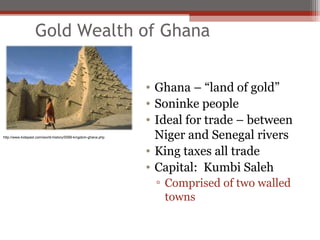
Gold Wealth of Ghana


                                                               • Ghana – “land of gold”
                                                               • Soninke people
                                                               • Ideal for trade – between
http://www.kidspast.com/world-history/0099-kingdom-ghana.php     Niger and Senegal rivers
                                                               • King taxes all trade
                                                               • Capital: Kumbi Saleh
                                                                ▫ Comprised of two walled
                                                                  towns
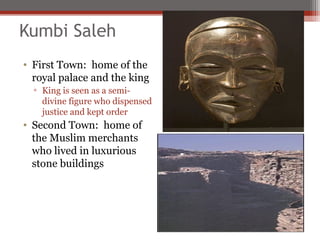
Kumbi Saleh
• First Town: home of the
  royal palace and the king
  ▫ King is seen as a semi-
    divine figure who dispensed
    justice and kept order
• Second Town: home of
  the Muslim merchants
  who lived in luxurious
  stone buildings
Influence of Islam
• Muslim merchants brought the Islamic faith to
  Ghana
• Ghana adopted Muslim counselors, government
  officials, military technology, ideas about
  government, written language, coinage, business
  methods, and styles of architecture.
• Most Soninke people continue to support their
  traditional customs and beliefs
Ghana’s Decline
• c. 1050 AD Almoravids – pious Muslims of N.
  Africa launch a campaign to spread Islam
• Almoravids overwhelm and take Ghana, but
  cannot consistently rule Ghana across the
  Sahara
• Kingdom of Mali expands and takes over Ghana
  instead
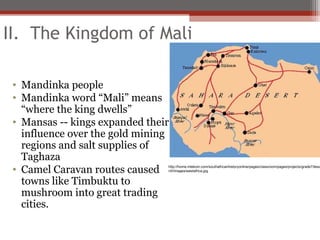
II. The Kingdom of Mali

 • Mandinka people
 • Mandinka word “Mali” means
   “where the king dwells”
 • Mansas -- kings expanded their
   influence over the gold mining
   regions and salt supplies of
   Taghaza
 • Camel Caravan routes caused  http://home.intekom.com/southafricanhistoryonline/pages/classroom/pages/projects/grade7/lesso
                                n5/Images/westafrica.jpg


   towns like Timbuktu to
   mushroom into great trading
   cities.
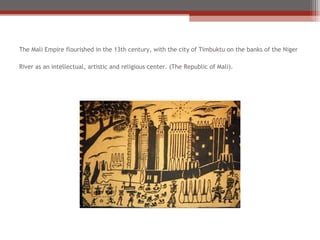
The Mali Empire flourished in the 13th century, with the city of Timbuktu on the banks of the Niger

River as an intellectual, artistic and religious center. (The Republic of Mali).
Sundiata
                                    Ibn Batuta said:
• Brilliant leader                  • Arab traveler
• Celebrated by the griots          • “Of all peoples, the Blacks are
  (professional oral historians)      those who most hate injustice,
• He divided up the world (16         and their emperor pardons
  clans – bear arms and carry         none who is guilty of it”
  the box and arrow; five clans –
  devoted to religious duties;
  four clans – specialists like
  blacksmiths and griots)
• Even though very diverse,
  safety and loyalty were
  emphasized
• Crime was severely punished
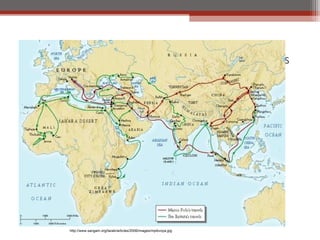
Ibn Batuta & Marco Polo late 1200’s early 1300’s


        http://www.sangam.org/taraki/articles/2006/images/mpibvoya.jpg
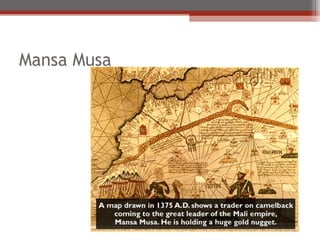
Mansa Musa
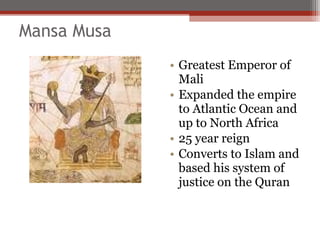
Mansa Musa
             • Greatest Emperor of
               Mali
             • Expanded the empire
               to Atlantic Ocean and
               up to North Africa
             • 25 year reign
             • Converts to Islam and
               based his system of
               justice on the Quran
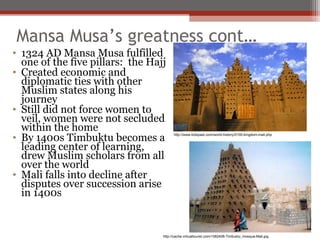
Mansa Musa’s greatness cont…
• 1324 AD Mansa Musa fulfilled
  one of the five pillars: the Hajj
• Created economic and
  diplomatic ties with other
  Muslim states along his
  journey
• Still did not force women to
  veil, women were not secluded
  within the home
• By 1400s Timbuktu becomes a           http://www.kidspast.com/world-history/0100-kingdom-mali.php


  leading center of learning,
  drew Muslim scholars from all
  over the world
• Mali falls into decline after
  disputes over succession arise
  in 1400s


                                  http://cache.virtualtourist.com/1582406-Timbuktu_mosque-Mali.jpg
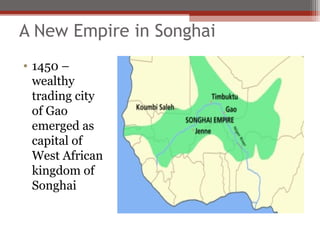
A New Empire in Songhai
• 1450 –
  wealthy
  trading city
  of Gao
  emerged as
  capital of
  West African
  kingdom of
  Songhai
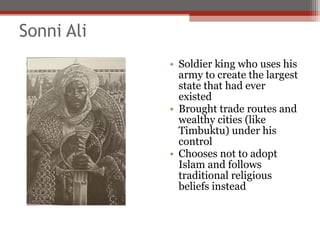
Sonni Ali
            • Soldier king who uses his
              army to create the largest
              state that had ever
              existed
            • Brought trade routes and
              wealthy cities (like
              Timbuktu) under his
              control
            • Chooses not to adopt
              Islam and follows
              traditional religious
              beliefs instead
Aski Muhammad
• Expanded the territory of Songhai
• Improved government beauracracy
• As a Muslim, he made his hajj and met with
  different Islamic states along the way to increase
  his ties to the Muslim world.
• Built temples and schools to study the Quran
• Scholars and poets flock to Gao
Invaders from the North!
• 1586 – succession disputes (surprise, surprise)
  lead to civil war
• Ruler of Morocco uses an army armed with
  gunpowder weapons to seize gold mines
• Morocco is unable to control Songhai across the
  Sahara, the kingdoms of West Africa end up
  splintered and fragmented
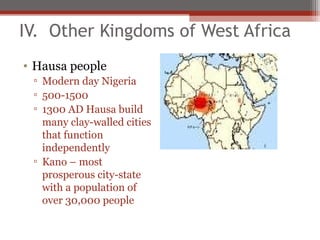
IV. Other Kingdoms of West Africa
• Hausa people
 ▫ Modern day Nigeria
 ▫ 500-1500
 ▫ 1300 AD Hausa build
   many clay-walled cities
   that function
   independently
 ▫ Kano – most
   prosperous city-state
   with a population of
   over 30,000 people
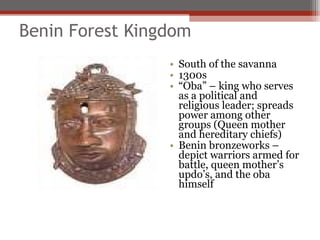
Benin Forest Kingdom
                 • South of the savanna
                 • 1300s
                 • “Oba” – king who serves
                   as a political and
                   religious leader; spreads
                   power among other
                   groups (Queen mother
                   and hereditary chiefs)
                 • Benin bronzeworks –
                   depict warriors armed for
                   battle, queen mother’s
                   updo’s, and the oba
                   himself
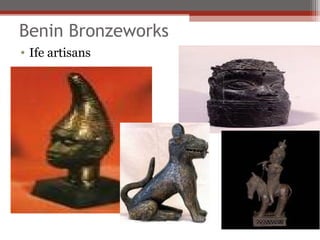
Benin Bronzeworks
• Ife artisans
Great Zimbabwe

Africa and Islam (Ch 8)

  • 1.
    Chapter 8: African Civilizationsand the Spread of Islam
  • 2.
    • Stateless Societies ▫ Organized around kinship, little centralization of authority  Gvt rarely a full time occupation • Common Elements of African Societies ▫ Bantu language base ▫ Animistic religions ▫ Cosmology to explain the universe ▫ Superstitious ▫ Ancestors were first settlers of their land, therefore they have ownership of the land, resources, etc.  Venerated ancestors, link to the spiritual world
  • 3.
    Recap: North Africa • North Africa is tied to Mediterranean world, founded by Phoenician traders (Carthage is its main trading port) • N. African trading network spreads through Tunisia, Algeria, Morocco, S. Spain, and Sicily • Carthaginian outposts as far as France and England • But As Rome expands, they encroach on N. African territory – Punic Wars, etc.
  • 4.
    Recap: Roman Rulein N. Africa • Romans build dams, aqueducts, roads, and cities across N. Africa • Christianity spreads across N. Africa • St. Augustine was born in Algeria, later serves as Bishop of Hippo (near Carthage’s ruins)
  • 5.
    Camels and Trade •By 200 CE Camels are brought to North Africa from Asia • “Ships of the desert” • 20-30 miles per day, carrying up to 500 lbs, need very little water
  • 6.
    • Between 640-700CE Arab Spread of Islam armies brought Islam to N. Africa ▫ Islam replaced Christianity as the dominant religion in N. Africa ▫ Thus, Arabic replaced Latin as the language of N. Africa. • Muslim traders from N. Africa spread Islam into West Africa http://media.maps.com/magellan/Images/WRLH003-H.gif
  • 7.
    • Almoravids –11th c. - puritanical reformist Muslims in W. Sahara who launch a jihad to purify, spread and protect the faith ▫ Push South against the savannah kingdoms ▫ Push North towards Spain http://image.absoluteastronomy.com/images/encyclopediai mages/a/al/almoravid-empire-en.svg.png • Almohadis 1130 – reformists who follow similar pattern
  • 8.
    The Nile Kingdomof Nubia • Present day Sudan • Christian kingdoms flourished in Nubia and Egypt • The Christians of Egypt created their own Coptic branch (convert literature from Grk to Coptic) • Muslim rulers tended to tolerate them
  • 9.
    • Christian kingdomof Axum also flourished • Ethiopian kingdom grew from Axum and became the most important African Christian outpost • Isolation and preservation of Christianity • King Lalibela (d. 1221) created the great churches of rock • Ethiopian Christianity
  • 11.
    Kingdoms of WestAfrica • Also known as the Sudanic States: ▫ Ghana ▫ Mali ▫ Songhai ▫ Commonalities:  Patriarch/council of elders w/ lineage of leaders  Territorial core + conquest areas  Drew taxes, tribute and military support http://www.blackstudies.ucsb.edu/antillians/images/w.afr.king.jpg from conquored areas  Rulers sacred and separate from their subjects
  • 12.
  • 13.
    Trading Gold andSalt • Trade network stretches across the Sahara to reach civilizations along the Mediterranean and Middle East • Gold is plentiful in Ghana, Nigeria, and Senegal • Men dig soil up from pits and women wash the soil to extract the gold dust and pieces • Used hollow feather quills to transport gold dust safely to N. Africa and Europe
  • 14.
    Salt! • Salt essentialaspect of diet to prevent dehydration • Sahara has an abundance of salt ▫ in Taghaza people even built houses out of salt blocks • Salt is scarce in the savanna ▫ Block of salt easily worth its weight in gold
  • 16.
    Gold Wealth ofGhana • Ghana – “land of gold” • Soninke people • Ideal for trade – between http://www.kidspast.com/world-history/0099-kingdom-ghana.php Niger and Senegal rivers • King taxes all trade • Capital: Kumbi Saleh ▫ Comprised of two walled towns
  • 17.
    Kumbi Saleh • FirstTown: home of the royal palace and the king ▫ King is seen as a semi- divine figure who dispensed justice and kept order • Second Town: home of the Muslim merchants who lived in luxurious stone buildings
  • 18.
    Influence of Islam •Muslim merchants brought the Islamic faith to Ghana • Ghana adopted Muslim counselors, government officials, military technology, ideas about government, written language, coinage, business methods, and styles of architecture. • Most Soninke people continue to support their traditional customs and beliefs
  • 19.
    Ghana’s Decline • c.1050 AD Almoravids – pious Muslims of N. Africa launch a campaign to spread Islam • Almoravids overwhelm and take Ghana, but cannot consistently rule Ghana across the Sahara • Kingdom of Mali expands and takes over Ghana instead
  • 20.
    II. The Kingdomof Mali • Mandinka people • Mandinka word “Mali” means “where the king dwells” • Mansas -- kings expanded their influence over the gold mining regions and salt supplies of Taghaza • Camel Caravan routes caused http://home.intekom.com/southafricanhistoryonline/pages/classroom/pages/projects/grade7/lesso n5/Images/westafrica.jpg towns like Timbuktu to mushroom into great trading cities.
  • 21.
    The Mali Empireflourished in the 13th century, with the city of Timbuktu on the banks of the Niger River as an intellectual, artistic and religious center. (The Republic of Mali).
  • 22.
    Sundiata Ibn Batuta said: • Brilliant leader • Arab traveler • Celebrated by the griots • “Of all peoples, the Blacks are (professional oral historians) those who most hate injustice, • He divided up the world (16 and their emperor pardons clans – bear arms and carry none who is guilty of it” the box and arrow; five clans – devoted to religious duties; four clans – specialists like blacksmiths and griots) • Even though very diverse, safety and loyalty were emphasized • Crime was severely punished
  • 23.
    Ibn Batuta &Marco Polo late 1200’s early 1300’s http://www.sangam.org/taraki/articles/2006/images/mpibvoya.jpg
  • 24.
  • 25.
    Mansa Musa • Greatest Emperor of Mali • Expanded the empire to Atlantic Ocean and up to North Africa • 25 year reign • Converts to Islam and based his system of justice on the Quran
  • 26.
    Mansa Musa’s greatnesscont… • 1324 AD Mansa Musa fulfilled one of the five pillars: the Hajj • Created economic and diplomatic ties with other Muslim states along his journey • Still did not force women to veil, women were not secluded within the home • By 1400s Timbuktu becomes a http://www.kidspast.com/world-history/0100-kingdom-mali.php leading center of learning, drew Muslim scholars from all over the world • Mali falls into decline after disputes over succession arise in 1400s http://cache.virtualtourist.com/1582406-Timbuktu_mosque-Mali.jpg
  • 27.
    A New Empirein Songhai • 1450 – wealthy trading city of Gao emerged as capital of West African kingdom of Songhai
  • 28.
    Sonni Ali • Soldier king who uses his army to create the largest state that had ever existed • Brought trade routes and wealthy cities (like Timbuktu) under his control • Chooses not to adopt Islam and follows traditional religious beliefs instead
  • 29.
    Aski Muhammad • Expandedthe territory of Songhai • Improved government beauracracy • As a Muslim, he made his hajj and met with different Islamic states along the way to increase his ties to the Muslim world. • Built temples and schools to study the Quran • Scholars and poets flock to Gao
  • 30.
    Invaders from theNorth! • 1586 – succession disputes (surprise, surprise) lead to civil war • Ruler of Morocco uses an army armed with gunpowder weapons to seize gold mines • Morocco is unable to control Songhai across the Sahara, the kingdoms of West Africa end up splintered and fragmented
  • 31.
    IV. Other Kingdomsof West Africa • Hausa people ▫ Modern day Nigeria ▫ 500-1500 ▫ 1300 AD Hausa build many clay-walled cities that function independently ▫ Kano – most prosperous city-state with a population of over 30,000 people
  • 32.
    Benin Forest Kingdom • South of the savanna • 1300s • “Oba” – king who serves as a political and religious leader; spreads power among other groups (Queen mother and hereditary chiefs) • Benin bronzeworks – depict warriors armed for battle, queen mother’s updo’s, and the oba himself
  • 33.
  • 34.