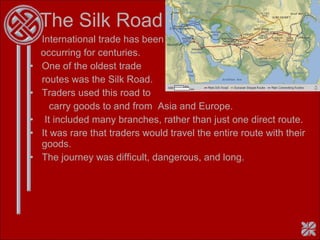
The Silk Road International trade has been occurring for centuries. One of the oldest trade  routes was the Silk Road. Traders used this road to    carry goods to and from  Asia and Europe. It included many branches, rather than just one direct route. It was rare that traders would travel the entire route with their goods. The journey was difficult, dangerous, and long.
. Camel caravans were used to transport goods along the Silk Road. The Silk Road started in Xi’an in China, and traveled to the Mediterranean Sea Traders used the Silk Road until a safe sea route from Europe to  Asia was  possible. Instead of getting goods  from  middlemen of Central Asia,  European traders could  buy spices and other goods from East Asia  directly,  and  then  sell  them in European markets.
After Chengzu’s death in 1424, China’s new emperor decided that foreign trade was too expensive. The rest of the world seemed to demand China’s products more than China sought theirs. The emperor and his advisors agreed that the nation's money should go to strengthening the military rather than to finance commercial voyages. China entered a period of isolation from the rest of the world. While private merchants continued to trade along routes like the Silk Road, China never again financed large voyages like those undertaken by Zheng He.
In the early 1800’s The Qing decided to allow trade on a  limited basis. They created the Canton System. The Canton System only allowed  Europeans to trade in the Chinese  city of Canton (modern day city  of Guangzhou). The Qing intended to limit trade and  protect the Chinese people from  what they viewed as Europe’s negative influence. The Canton System allowed Europeans to bring new products from their colonies in the Western Hemisphere. These products included squash, corn, sweet potatoes and tobacco. Chinese and Indian consumers like the new products. They bought and planted many of the new foods. Meanwhile, luxury items like tobacco became very popular. The system proved profitable. Both Chinese merchants and European trades got very rich.
The Chinese smoked opium for hundreds of years before the Europeans arrived. Opium  us a drug made from poppy plants. It is very strong and addictive. Today, these same opium poppies are used to make drugs like  morphine  (an addictive pain killer) and heroin. Originally, the Chinese used opium predominantly as a medicine. However, as its use increased, many became addicted and used it as a  “ recreational drug ”  When Europeans arrived, they began  shipping increased amounts of opium into the country. More and more people became addicted. Even after the Qing emperor outlaws the product, British smugglers continued  supplying it to Chinese citizens.
In the 1840’s, Great Britain and China went to war over the opium trade. Due to superior weapons, the British defeated the Chinese relatively easily. Britain's victory in the Opium War meant the end of the Canton system. It also resulted in China having to lease the port city of Hong Kong to the British.
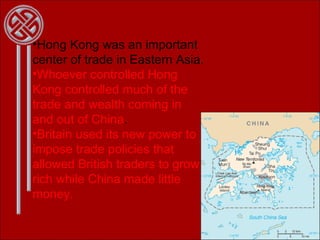
Hong Kong was an important center of trade in Eastern Asia. Whoever controlled Hong Kong controlled much of the trade and wealth coming in and out of China . Britain used its new power to impose trade policies that allowed British traders to grow rich while China made little money.
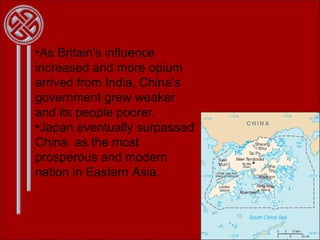
As Britain's influence increased and more opium arrived from India, China’s government grew weaker and its people poorer.  Japan eventually surpassed China  as the most prosperous and modern nation in Eastern Asia.
Effects of Unequal Treaties The Chinese government now only existed on paper, not in reality. The foreigners could do anything they wanted to China as they only had to follow their own laws. Foreign goods were now cheaper than Chinese goods were. China was carved up into  Spheres  of Influence  which is where one foreign nation claims their part of China for their special privileges.
 
Chinese Revolution During the late 19 th  century and into the 20 th  century, China grew very unstable. Poverty and starvation led to unrest among many of China’s peasants.  In 1911, a revolution replaced the emperor with a Chinese republic.
The Ideas of Dr. Sun Yat-sen The Chinese Republic was set up in 1911 when  it got rid of the dynasty type of rule in China. The first ruler was Dr. Sun; “ the Father of the Chinese Revolution” For years Dr. Sun spread the idea that the Chinese people should have a government “of the people, by the people, and for the people” In 1912, he set up the Kuomintang. Kuomintang – The movement founded by Sun Yat-Sen to make China a modern democratic republic.
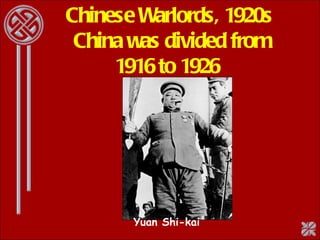
Chinese Warlords, 1920s  China was divided from 1916 to 1926  Yuan Shi-kai
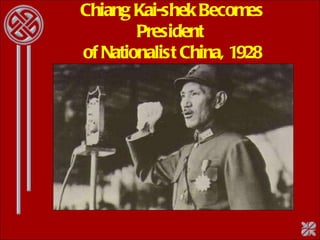
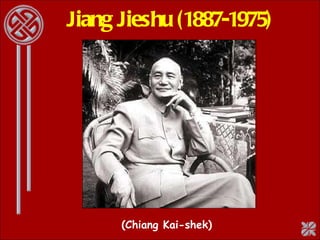
Chiang Kai-shek Rules China In1926 Chiang Kai-shek took over and united most of China. His only nemesis was Mao Zedong and the Communist
20c China: From Republic to  Communist Power
Chiang Kai-shek Becomes President  of Nationalist China, 1928
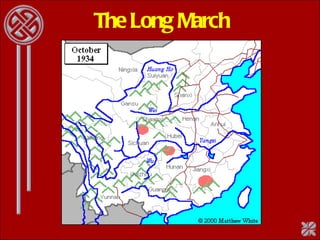
The Long March 1934
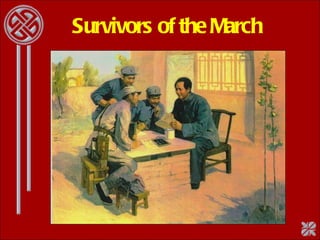
The Long March There was not one Long March, but several, as various Communist armies in the south escaped to the north and west.  The Communists, under the eventual command of Mao Zedong and Zhou Enlai, escaped in a circling retreat to the west and north, which reportedly traversed some 12,500 kilometers (8,000 miles) over 370 days. The Long March began the ascent to power of Mao Zedong , whose leadership during the retreat gained him the support of the members of the party.
The Long March
Mao Zedong As a Young Revolutionary (Mao Tse-tung)
Survivors of the March
Mao With His Children, 1930s
Japan Invades China In 1931 Japan invaded Northern China which was their industrial base. In 1937 Japan attempted to take all of China and during this time the nationalist and the Communist fought with one another.
Tensions soon mounted between the Nationalist and Communist. The Nationalist favored capitalism- They wanted to allow private ownership of businesses, factories, and property. The Communist wanted a command economy- with land, property, and  businesses in the hands of the state. The Communist argued  that only such an  economy would ease the  suffering of China’s  poor rural population.
The Communist Revolution: 1946 - 1949
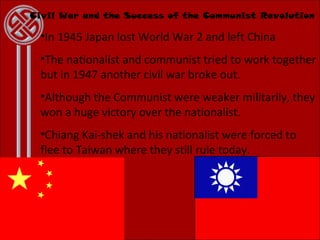
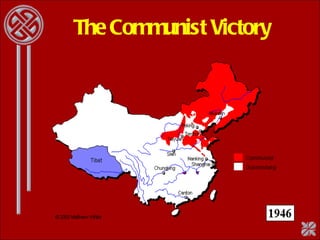
Civil War and the Success of the Communist Revolution In 1945 Japan lost World War 2 and left China The nationalist and communist tried to work together but in 1947 another civil war broke out. Although the Communist were weaker militarily, they won a huge victory over the nationalist. Chiang Kai-shek and his nationalist were forced to flee to Taiwan where they still rule today.
 
The Communist Victory
Reasons for the Communist Victory In 1945 and Communist had one million in their army compared to 3 million in the nationalist military The nationalist received a ton of money from the U.S. The Nationalist government failed to use its power well; it was corrupt and more interested in becoming rich The Nationalist did not pay attention to what the people wanted. The communist lived for may years under very difficult conditions so they became tough and fearless and ready to die for what they believed in. The communist had good generals and they listened to the needs of the common people.
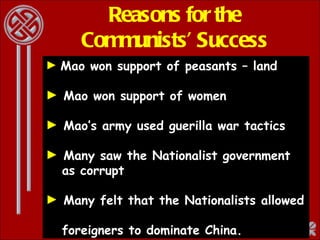
Reasons for the Communists’ Success Mao won support of peasants – land  Mao won support of women Mao’s army used guerilla war tactics Many saw the Nationalist government    as corrupt Many felt that the Nationalists allowed    foreigners to dominate China.
Taiwan:  The Republic of China
Jiang Jieshu (1887-1975) (Chiang Kai-shek)
The People’s Republic of China
The Great Leap Forward (or Backward?) 1958-1961
Once in power, Mao sought to modernize China. He wanted to build industries and strengthen the country after decades of war. In 1958, he launched the  Great Leap Forward . The Great Leap Forward was based on the communist ideal of every citizen working together for the good of the community and the state. It involved thousands of Chinese citizens living together in communes. They shared land for farming, worked together in factories, and tried to care for needs. Unfortunately, the Great Leap Forward was a huge failure. Floods, droughts, bad management, and corruption ruined China and left millions dying of starvation. Eventually, the people returned to their small villages and town to work on government-owned land or in state-owned factories.
Great Leap Forward, 1958 Set up a command economy which is what?   5 year plan to increase agriculture   and industry   Communes Groups of people who live and work   together Property held in common  Had production quotas Failed due to poor quality of    products, poor weather hurt   agriculture Millions of Chinese starved during this period due to improper economic planning.
Communist China Under Mao Industrialized China Increased literacy Class privileges ended Rural Chinese received health    care One-party dictatorship Denied people basic rights and    freedoms --> Inner Mongolia,   Tibet
Mao, Panchen Lama,  Dalai Lama  in Beijing, 1954 Tibet --> an    autonomous   area. Tibet revolts against Chinese Government. Dalai Lama    fled in the    late 1950s to   India.
Communist governments officially do not allow religion for fear of rebellion. Buddism  which believe what?   Daoism  which believe what?   Many times these religions are mixed with _____________  Christianity and Islam  have many followers Confucianism

Theroadtocommunism

  • 1.
    The Silk RoadInternational trade has been occurring for centuries. One of the oldest trade routes was the Silk Road. Traders used this road to carry goods to and from Asia and Europe. It included many branches, rather than just one direct route. It was rare that traders would travel the entire route with their goods. The journey was difficult, dangerous, and long.
  • 2.
    . Camel caravanswere used to transport goods along the Silk Road. The Silk Road started in Xi’an in China, and traveled to the Mediterranean Sea Traders used the Silk Road until a safe sea route from Europe to Asia was possible. Instead of getting goods from middlemen of Central Asia, European traders could buy spices and other goods from East Asia directly, and then sell them in European markets.
  • 3.
    After Chengzu’s deathin 1424, China’s new emperor decided that foreign trade was too expensive. The rest of the world seemed to demand China’s products more than China sought theirs. The emperor and his advisors agreed that the nation's money should go to strengthening the military rather than to finance commercial voyages. China entered a period of isolation from the rest of the world. While private merchants continued to trade along routes like the Silk Road, China never again financed large voyages like those undertaken by Zheng He.
  • 4.
    In the early1800’s The Qing decided to allow trade on a limited basis. They created the Canton System. The Canton System only allowed Europeans to trade in the Chinese city of Canton (modern day city of Guangzhou). The Qing intended to limit trade and protect the Chinese people from what they viewed as Europe’s negative influence. The Canton System allowed Europeans to bring new products from their colonies in the Western Hemisphere. These products included squash, corn, sweet potatoes and tobacco. Chinese and Indian consumers like the new products. They bought and planted many of the new foods. Meanwhile, luxury items like tobacco became very popular. The system proved profitable. Both Chinese merchants and European trades got very rich.
  • 5.
    The Chinese smokedopium for hundreds of years before the Europeans arrived. Opium us a drug made from poppy plants. It is very strong and addictive. Today, these same opium poppies are used to make drugs like morphine (an addictive pain killer) and heroin. Originally, the Chinese used opium predominantly as a medicine. However, as its use increased, many became addicted and used it as a “ recreational drug ” When Europeans arrived, they began shipping increased amounts of opium into the country. More and more people became addicted. Even after the Qing emperor outlaws the product, British smugglers continued supplying it to Chinese citizens.
  • 6.
    In the 1840’s,Great Britain and China went to war over the opium trade. Due to superior weapons, the British defeated the Chinese relatively easily. Britain's victory in the Opium War meant the end of the Canton system. It also resulted in China having to lease the port city of Hong Kong to the British.
  • 7.
    Hong Kong wasan important center of trade in Eastern Asia. Whoever controlled Hong Kong controlled much of the trade and wealth coming in and out of China . Britain used its new power to impose trade policies that allowed British traders to grow rich while China made little money.
  • 8.
    As Britain's influenceincreased and more opium arrived from India, China’s government grew weaker and its people poorer. Japan eventually surpassed China as the most prosperous and modern nation in Eastern Asia.
  • 9.
    Effects of UnequalTreaties The Chinese government now only existed on paper, not in reality. The foreigners could do anything they wanted to China as they only had to follow their own laws. Foreign goods were now cheaper than Chinese goods were. China was carved up into Spheres of Influence which is where one foreign nation claims their part of China for their special privileges.
  • 10.
  • 11.
    Chinese Revolution Duringthe late 19 th century and into the 20 th century, China grew very unstable. Poverty and starvation led to unrest among many of China’s peasants. In 1911, a revolution replaced the emperor with a Chinese republic.
  • 12.
    The Ideas ofDr. Sun Yat-sen The Chinese Republic was set up in 1911 when it got rid of the dynasty type of rule in China. The first ruler was Dr. Sun; “ the Father of the Chinese Revolution” For years Dr. Sun spread the idea that the Chinese people should have a government “of the people, by the people, and for the people” In 1912, he set up the Kuomintang. Kuomintang – The movement founded by Sun Yat-Sen to make China a modern democratic republic.
  • 13.
    Chinese Warlords, 1920s China was divided from 1916 to 1926 Yuan Shi-kai
  • 14.
    Chiang Kai-shek RulesChina In1926 Chiang Kai-shek took over and united most of China. His only nemesis was Mao Zedong and the Communist
  • 15.
    20c China: FromRepublic to Communist Power
  • 16.
    Chiang Kai-shek BecomesPresident of Nationalist China, 1928
  • 17.
  • 18.
    The Long MarchThere was not one Long March, but several, as various Communist armies in the south escaped to the north and west. The Communists, under the eventual command of Mao Zedong and Zhou Enlai, escaped in a circling retreat to the west and north, which reportedly traversed some 12,500 kilometers (8,000 miles) over 370 days. The Long March began the ascent to power of Mao Zedong , whose leadership during the retreat gained him the support of the members of the party.
  • 19.
  • 20.
    Mao Zedong Asa Young Revolutionary (Mao Tse-tung)
  • 21.
  • 22.
    Mao With HisChildren, 1930s
  • 23.
    Japan Invades ChinaIn 1931 Japan invaded Northern China which was their industrial base. In 1937 Japan attempted to take all of China and during this time the nationalist and the Communist fought with one another.
  • 24.
    Tensions soon mountedbetween the Nationalist and Communist. The Nationalist favored capitalism- They wanted to allow private ownership of businesses, factories, and property. The Communist wanted a command economy- with land, property, and businesses in the hands of the state. The Communist argued that only such an economy would ease the suffering of China’s poor rural population.
  • 25.
  • 26.
    Civil War andthe Success of the Communist Revolution In 1945 Japan lost World War 2 and left China The nationalist and communist tried to work together but in 1947 another civil war broke out. Although the Communist were weaker militarily, they won a huge victory over the nationalist. Chiang Kai-shek and his nationalist were forced to flee to Taiwan where they still rule today.
  • 27.
  • 28.
  • 29.
    Reasons for theCommunist Victory In 1945 and Communist had one million in their army compared to 3 million in the nationalist military The nationalist received a ton of money from the U.S. The Nationalist government failed to use its power well; it was corrupt and more interested in becoming rich The Nationalist did not pay attention to what the people wanted. The communist lived for may years under very difficult conditions so they became tough and fearless and ready to die for what they believed in. The communist had good generals and they listened to the needs of the common people.
  • 30.
    Reasons for theCommunists’ Success Mao won support of peasants – land Mao won support of women Mao’s army used guerilla war tactics Many saw the Nationalist government as corrupt Many felt that the Nationalists allowed foreigners to dominate China.
  • 31.
    Taiwan: TheRepublic of China
  • 32.
    Jiang Jieshu (1887-1975)(Chiang Kai-shek)
  • 33.
  • 34.
    The Great LeapForward (or Backward?) 1958-1961
  • 35.
    Once in power,Mao sought to modernize China. He wanted to build industries and strengthen the country after decades of war. In 1958, he launched the Great Leap Forward . The Great Leap Forward was based on the communist ideal of every citizen working together for the good of the community and the state. It involved thousands of Chinese citizens living together in communes. They shared land for farming, worked together in factories, and tried to care for needs. Unfortunately, the Great Leap Forward was a huge failure. Floods, droughts, bad management, and corruption ruined China and left millions dying of starvation. Eventually, the people returned to their small villages and town to work on government-owned land or in state-owned factories.
  • 36.
    Great Leap Forward,1958 Set up a command economy which is what? 5 year plan to increase agriculture and industry Communes Groups of people who live and work together Property held in common Had production quotas Failed due to poor quality of products, poor weather hurt agriculture Millions of Chinese starved during this period due to improper economic planning.
  • 37.
    Communist China UnderMao Industrialized China Increased literacy Class privileges ended Rural Chinese received health care One-party dictatorship Denied people basic rights and freedoms --> Inner Mongolia, Tibet
  • 38.
    Mao, Panchen Lama, Dalai Lama in Beijing, 1954 Tibet --> an autonomous area. Tibet revolts against Chinese Government. Dalai Lama fled in the late 1950s to India.
  • 39.
    Communist governments officiallydo not allow religion for fear of rebellion. Buddism which believe what? Daoism which believe what? Many times these religions are mixed with _____________ Christianity and Islam have many followers Confucianism