Chinese CommunistChinese Communist
RevolutionRevolution
Two ChinasTwo Chinas
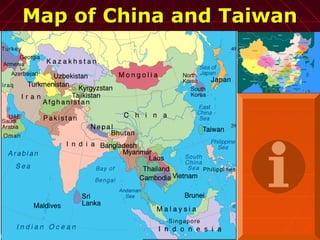
Map of China and TaiwanMap of China and Taiwan
 China is the most populous nation in the world.China is the most populous nation in the world.
 There are technically 2 Chinas:There are technically 2 Chinas:
• TheThe People’s Republic of ChinaPeople’s Republic of China-a-a communist statecommunist state onon
the Asian mainland.the Asian mainland.
• TaiwanTaiwan, aka the, aka the Republic of ChinaRepublic of China-is a small island-is a small island
that today is one of the Asian Tigers. It has athat today is one of the Asian Tigers. It has a non-non-
communist governmentcommunist government..
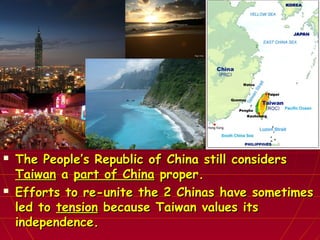
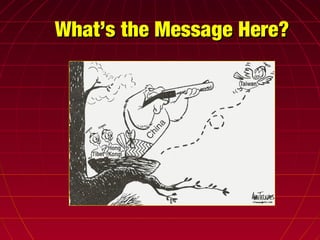
 The People’s Republic of China still considersThe People’s Republic of China still considers
TaiwanTaiwan aa part of Chinapart of China proper.proper.
 Efforts to re-unite the 2 Chinas have sometimesEfforts to re-unite the 2 Chinas have sometimes
led toled to tensiontension because Taiwan values itsbecause Taiwan values its
independence.independence.
CommunistCommunist
Rise To PowerRise To Power
1936-19491936-1949
 Mao ZedongMao Zedong emerged as theemerged as the leader of theleader of the
CommunistsCommunists in the 1930s.in the 1930s.
 Along with 100,000 of his followers, Mao fledAlong with 100,000 of his followers, Mao fled
thethe anti-communist Nationalist Partyanti-communist Nationalist Party, forces in, forces in
1934 in a retreat known as the1934 in a retreat known as the Long MarchLong March..
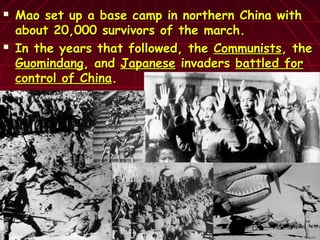
 Mao set up a base camp in northern China withMao set up a base camp in northern China with
about 20,000 survivors of the march.about 20,000 survivors of the march.
 In the years that followed, theIn the years that followed, the CommunistsCommunists, the, the
GuomindangGuomindang, and, and JapaneseJapanese invadersinvaders battled forbattled for
control of Chinacontrol of China..
 After World War II, China’s civil war continued.After World War II, China’s civil war continued.
 Finally, in 1949,Finally, in 1949, Mao’s Communists wereMao’s Communists were
victoriousvictorious in defeating the Guomindang forces.in defeating the Guomindang forces.
 The followers ofThe followers of the Nationalist Party fled tothe Nationalist Party fled to
the island of Taiwanthe island of Taiwan..
Communism UnderCommunism Under
Mao ZedongMao Zedong
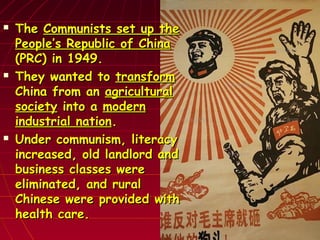
 TheThe Communists set up theCommunists set up the
People’s Republic of ChinaPeople’s Republic of China
(PRC) in 1949.(PRC) in 1949.
 They wanted toThey wanted to transformtransform
China from anChina from an agriculturalagricultural
societysociety into ainto a modernmodern
industrial nationindustrial nation..
 Under communism, literacyUnder communism, literacy
increased, old landlord andincreased, old landlord and
business classes werebusiness classes were
eliminated, and ruraleliminated, and rural
Chinese were provided withChinese were provided with
health care.health care.
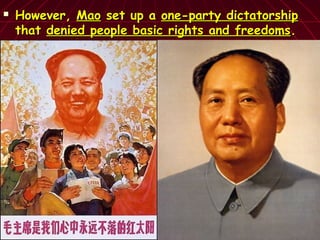
 However,However, MaoMao set up aset up a one-party dictatorshipone-party dictatorship
thatthat denied people basic rights and freedomsdenied people basic rights and freedoms..
The Great LeapThe Great Leap
ForwardForward
 In 1958,In 1958, MaoMao
launched alaunched a programprogram
called thecalled the Great LeapGreat Leap
ForwardForward..
 He called on theHe called on the
people of China topeople of China to
increase agriculturalincrease agricultural
and industrial outputand industrial output..
 To make farms moreTo make farms more
productive, heproductive, he
createdcreated communescommunes,,
groups of people whogroups of people who
live and worklive and work
togethertogether..
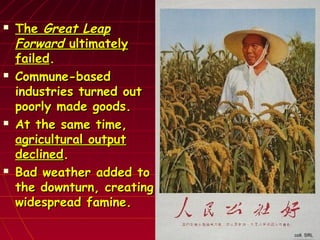
 TheThe Great LeapGreat Leap
ForwardForward ultimatelyultimately
failedfailed..
 Commune-basedCommune-based
industries turned outindustries turned out
poorly made goods.poorly made goods.
 At the same time,At the same time,
agricultural outputagricultural output
declineddeclined..
 Bad weather added toBad weather added to
the downturn, creatingthe downturn, creating
widespread famine.widespread famine.
The CulturalThe Cultural
RevolutionRevolution
&&
The Red GuardThe Red Guard
 In 1966,In 1966, MaoMao launched thelaunched the Cultural RevolutionCultural Revolution toto
renew people’s loyalty to communism andrenew people’s loyalty to communism and
establish a more equitable societyestablish a more equitable society..
 Mao fearedMao feared thatthat revolutionary peasants andrevolutionary peasants and
workersworkers were beingwere being replacedreplaced byby intellectualsintellectuals inin
running the country.running the country.
A Red GuardA Red Guard
Red Guards March toRed Guards March to
CantonCanton
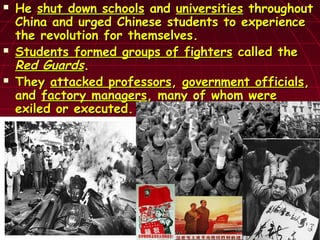
 HeHe shut down schoolsshut down schools andand universitiesuniversities throughoutthroughout
China and urged Chinese students to experienceChina and urged Chinese students to experience
the revolution for themselves.the revolution for themselves.
 Students formed groups of fightersStudents formed groups of fighters called thecalled the
Red GuardsRed Guards..
 TheyThey attacked professorsattacked professors,, government officialsgovernment officials,,
andand factory managersfactory managers, many of whom were, many of whom were
exiled or executed.exiled or executed.
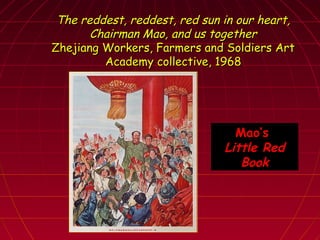
The reddest, reddest, red sun in our heart,The reddest, reddest, red sun in our heart,
Chairman Mao, and us togetherChairman Mao, and us together
Zhejiang Workers, Farmers and Soldiers ArtZhejiang Workers, Farmers and Soldiers Art
Academy collective, 1968Academy collective, 1968
Mao’s
Little Red
Book
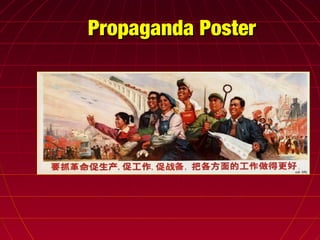
Propaganda PosterPropaganda Poster
Go among the workers, peasants andGo among the workers, peasants and
soldiers, and into the thick of struggle!soldiers, and into the thick of struggle!
1967-19721967-1972
Propaganda PosterPropaganda Poster
United States RecognitionUnited States Recognition
ofof
Communist ChinaCommunist China
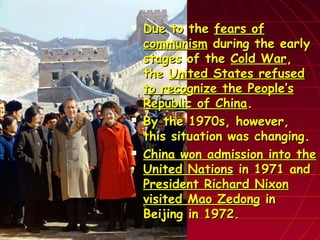
 Due to theDue to the fears offears of
communismcommunism during the earlyduring the early
stages of thestages of the Cold WarCold War,,
thethe United States refusedUnited States refused
to recognize the People’sto recognize the People’s
Republic of ChinaRepublic of China..
 By the 1970s, however,By the 1970s, however,
this situation was changing.this situation was changing.
 China won admission into theChina won admission into the
United NationsUnited Nations in 1971 andin 1971 and
President Richard NixonPresident Richard Nixon
visited Mao Zedongvisited Mao Zedong inin
Beijing in 1972.Beijing in 1972.
 Finally, in 1979,Finally, in 1979, the United States officiallythe United States officially
recognized the People’s Republic of Chinarecognized the People’s Republic of China..
Communism UnderCommunism Under
Deng XiaopingDeng Xiaoping
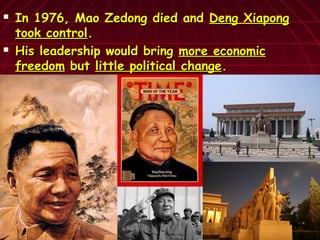
 In 1976, Mao Zedong died andIn 1976, Mao Zedong died and Deng XiapongDeng Xiapong
took controltook control..
 His leadership would bringHis leadership would bring more economicmore economic
freedomfreedom butbut little political changelittle political change..
Economic Reforms:Economic Reforms:
The Four ModernizationsThe Four Modernizations
 To make China a moreTo make China a more modern countrymodern country,, DengDeng
promoted foreign tradepromoted foreign trade and moreand more contact withcontact with
western nationswestern nations..
 He also introduced theHe also introduced the Four ModernizationsFour Modernizations..
 These were concentrated into four areas:These were concentrated into four areas:
1.1. FarmingFarming-methods were modernized and mechanized-methods were modernized and mechanized
2.2. IndustryIndustry-was upgraded and expanded-was upgraded and expanded
3.3. ScienceandTechnologyScienceandTechnology-were promoted and developed-were promoted and developed
4.4. DefenseDefense-systems and military forces were improved-systems and military forces were improved
Limited PrivatizationLimited Privatization
 DengDeng eliminatedeliminated Mao’sMao’s
unpopularunpopular communescommunes..
 He allowedHe allowed land to beland to be
leasedleased to individualto individual
farmers.farmers.
 This systemThis system increasedincreased
agricultural outputagricultural output..
 The government alsoThe government also
allowed some privateallowed some private
businesses to producebusinesses to produce
goods and offer services.goods and offer services.
Foreign InvestmentForeign Investment
 Deng alsoDeng also welcomedwelcomed
foreign technologyforeign technology
and capitaland capital..
 The government setThe government set
up specialup special
enterprise zonesenterprise zones
where foreignerswhere foreigners
could own andcould own and
operate businesses.operate businesses.
Results of Economic ReformsResults of Economic Reforms
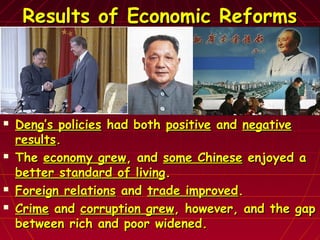
 Deng’s policiesDeng’s policies had bothhad both positivepositive andand negativenegative
resultsresults..
 TheThe economy greweconomy grew, and, and some Chinesesome Chinese enjoyed aenjoyed a
better standard of livingbetter standard of living..
 Foreign relationsForeign relations andand trade improvedtrade improved..
 CrimeCrime andand corruption grewcorruption grew, however, and the gap, however, and the gap
between rich and poor widened.between rich and poor widened.
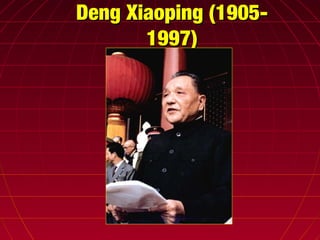
Deng Xiaoping (1905-Deng Xiaoping (1905-
1997)1997)
De-MaoizationDe-Maoization
► Agriculture
► Industry
► Science
► Defense
““The 4 Modernizations”The 4 Modernizations”
Progress in:Progress in:
Class struggle was no longer the central focus!
Gap Between Rich & PoorGap Between Rich & Poor
Deng: If you open a window, some flies
naturally get in!
Tiananmen SquareTiananmen Square
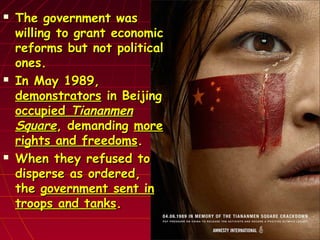
 The government wasThe government was
willing to grant economicwilling to grant economic
reforms but not politicalreforms but not political
ones.ones.
 In May 1989,In May 1989,
demonstratorsdemonstrators in Beijingin Beijing
occupiedoccupied TiananmenTiananmen
SquareSquare, demanding, demanding moremore
rights and freedomsrights and freedoms..
 When they refused toWhen they refused to
disperse as ordered,disperse as ordered,
thethe government sent ingovernment sent in
troops and tankstroops and tanks..
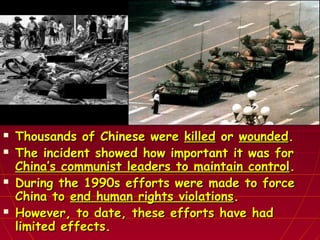
 Thousands of Chinese wereThousands of Chinese were killedkilled oror woundedwounded..
 The incident showed how important it was forThe incident showed how important it was for
China’s communist leaders to maintain controlChina’s communist leaders to maintain control..
 During the 1990s efforts were made to forceDuring the 1990s efforts were made to force
China toChina to end human rights violationsend human rights violations..
 However, to date, these efforts have hadHowever, to date, these efforts have had
limited effects.limited effects.
Tiananmen Square, 1989Tiananmen Square, 1989
More democracy!
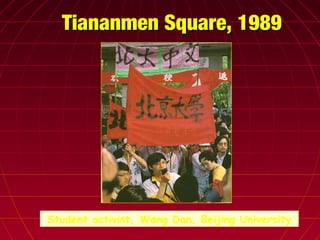
Tiananmen Square, 1989Tiananmen Square, 1989
Student activist, Wang Dan, Beijing University
Tiananmen Square, 1989Tiananmen Square, 1989
Democracy—Our Common Ideal!
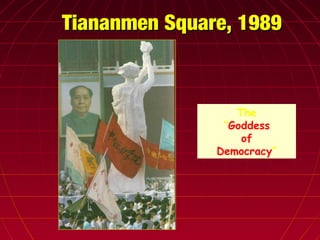
Tiananmen Square, 1989Tiananmen Square, 1989
The
“Goddess
of
Democracy”
Tiananmen Square, 1989Tiananmen Square, 1989
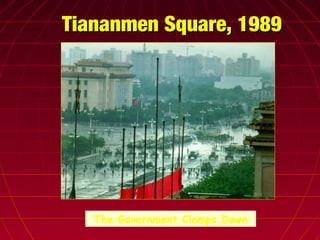
The Government Clamps Down
Tiananmen Square, 1989Tiananmen Square, 1989
One Lone Man’s Protest
Tiananmen Square, 1989Tiananmen Square, 1989
The Massacre: The People’s Army Moves In
Tiananmen Square, 1989Tiananmen Square, 1989
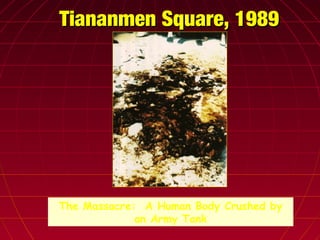
The Massacre: A Human Body Crushed by
an Army Tank
Tiananmen Square, 1989Tiananmen Square, 1989
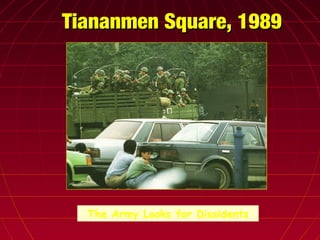
The Army Looks for Dissidents
Tiananmen Square, 1989Tiananmen Square, 1989
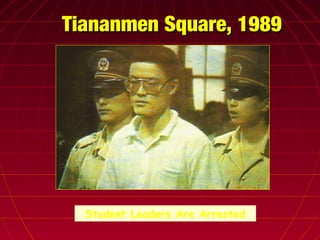
Student Leaders Are Arrested
Tiananmen Square, 1989Tiananmen Square, 1989
Chinese Students Mourn the Dead
Tiananmen Square, 1989Tiananmen Square, 1989
The Reestablishment of Order
What’s the Message Here?What’s the Message Here?
Return ofReturn of
Hong KongHong Kong
 In 1842,In 1842, BritainBritain hadhad
gainedgained thethe island of Hongisland of Hong
KongKong, off the northern, off the northern
coast of China.coast of China.
 In the 1980s, Britain andIn the 1980s, Britain and
China decided thatChina decided that HongHong
Kong would return toKong would return to
Chinese ruleChinese rule in 1997.in 1997.
 China agreed not toChina agreed not to
change Hong Kong’s socialchange Hong Kong’s social
or economic system for 50or economic system for 50
years and to allow theyears and to allow the
island a degree ofisland a degree of self-self-
rulerule..
 The island wasThe island was officially turned overofficially turned over to China onto China on
July 1, 1997.July 1, 1997.
The Role of Women:The Role of Women:
Communist China Compared ToCommunist China Compared To
Dynastic ChinaDynastic China
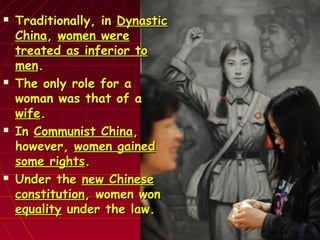
 Traditionally, inTraditionally, in DynasticDynastic
ChinaChina,, women werewomen were
treated as inferior totreated as inferior to
menmen..
 The only role for aThe only role for a
woman was that of awoman was that of a
wifewife..
 InIn Communist ChinaCommunist China,,
however,however, women gainedwomen gained
some rightssome rights..
 Under theUnder the new Chinesenew Chinese
constitutionconstitution, women won, women won
equalityequality under the law.under the law.
 They now were expected toThey now were expected to work alongside menwork alongside men
on farms and in factories.on farms and in factories.
 However, only a fewHowever, only a few womenwomen had top jobs inhad top jobs in
government andgovernment and commonlycommonly werewere not paid thenot paid the
same as men for doing the same worksame as men for doing the same work..
DemographyDemography
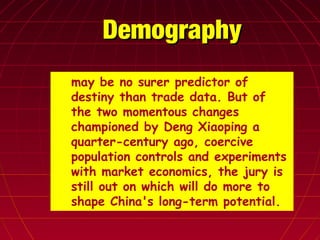
► may be no surer predictor of
destiny than trade data. But of
the two momentous changes
championed by Deng Xiaoping a
quarter-century ago, coercive
population controls and experiments
with market economics, the jury is
still out on which will do more to
shape China's long-term potential.
DemographyDemography
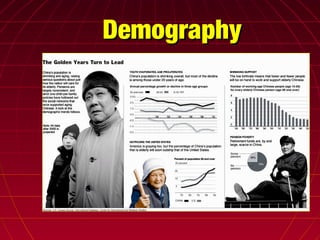
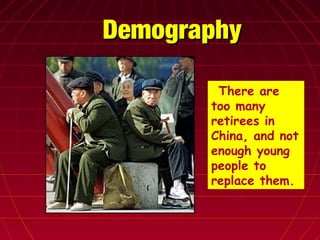
►There are
too many
retirees in
China, and not
enough young
people to
replace them.
DemographyDemography
► "The evidence is overwhelming that a
large population of unmarried adult
males is a risk factor for both crime
and war," Ms. den Boer said in an
interview. "The fact that China is an
authoritarian country is another risk
factor."
SUMMARYSUMMARY
 TheThe CommunistsCommunists, under, under Mao ZedongMao Zedong, rose, rose
to power in China after World War II.to power in China after World War II.
TheirTheir appeal to peasants and to womenappeal to peasants and to women,,
theirtheir superior armysuperior army, and, and lack of supportlack of support
for the Nationalistsfor the Nationalists led to victory for theled to victory for the
Communists. The communist governmentCommunists. The communist government
severelyseverely restricted the rights andrestricted the rights and
freedoms of most Chinesefreedoms of most Chinese. Later leaders,. Later leaders,
such assuch as Deng XiaopingDeng Xiaoping, allowed, allowed freefree
market reformsmarket reforms butbut little political freedomlittle political freedom..
Violations of human rightsViolations of human rights in China havein China have
oftenoften made relationsmade relations withwith ChinaChina and theand the
United StatesUnited States difficult.difficult.

Chinese Mao 2015

  • 1.
  • 2.
  • 3.
    Map of Chinaand TaiwanMap of China and Taiwan
  • 4.
     China isthe most populous nation in the world.China is the most populous nation in the world.  There are technically 2 Chinas:There are technically 2 Chinas: • TheThe People’s Republic of ChinaPeople’s Republic of China-a-a communist statecommunist state onon the Asian mainland.the Asian mainland. • TaiwanTaiwan, aka the, aka the Republic of ChinaRepublic of China-is a small island-is a small island that today is one of the Asian Tigers. It has athat today is one of the Asian Tigers. It has a non-non- communist governmentcommunist government..
  • 5.
     The People’sRepublic of China still considersThe People’s Republic of China still considers TaiwanTaiwan aa part of Chinapart of China proper.proper.  Efforts to re-unite the 2 Chinas have sometimesEfforts to re-unite the 2 Chinas have sometimes led toled to tensiontension because Taiwan values itsbecause Taiwan values its independence.independence.
  • 6.
    CommunistCommunist Rise To PowerRiseTo Power 1936-19491936-1949
  • 7.
     Mao ZedongMaoZedong emerged as theemerged as the leader of theleader of the CommunistsCommunists in the 1930s.in the 1930s.  Along with 100,000 of his followers, Mao fledAlong with 100,000 of his followers, Mao fled thethe anti-communist Nationalist Partyanti-communist Nationalist Party, forces in, forces in 1934 in a retreat known as the1934 in a retreat known as the Long MarchLong March..
  • 8.
     Mao setup a base camp in northern China withMao set up a base camp in northern China with about 20,000 survivors of the march.about 20,000 survivors of the march.  In the years that followed, theIn the years that followed, the CommunistsCommunists, the, the GuomindangGuomindang, and, and JapaneseJapanese invadersinvaders battled forbattled for control of Chinacontrol of China..
  • 9.
     After WorldWar II, China’s civil war continued.After World War II, China’s civil war continued.  Finally, in 1949,Finally, in 1949, Mao’s Communists wereMao’s Communists were victoriousvictorious in defeating the Guomindang forces.in defeating the Guomindang forces.  The followers ofThe followers of the Nationalist Party fled tothe Nationalist Party fled to the island of Taiwanthe island of Taiwan..
  • 10.
  • 11.
     TheThe Communistsset up theCommunists set up the People’s Republic of ChinaPeople’s Republic of China (PRC) in 1949.(PRC) in 1949.  They wanted toThey wanted to transformtransform China from anChina from an agriculturalagricultural societysociety into ainto a modernmodern industrial nationindustrial nation..  Under communism, literacyUnder communism, literacy increased, old landlord andincreased, old landlord and business classes werebusiness classes were eliminated, and ruraleliminated, and rural Chinese were provided withChinese were provided with health care.health care.
  • 12.
     However,However, MaoMaoset up aset up a one-party dictatorshipone-party dictatorship thatthat denied people basic rights and freedomsdenied people basic rights and freedoms..
  • 13.
    The Great LeapTheGreat Leap ForwardForward
  • 14.
     In 1958,In1958, MaoMao launched alaunched a programprogram called thecalled the Great LeapGreat Leap ForwardForward..  He called on theHe called on the people of China topeople of China to increase agriculturalincrease agricultural and industrial outputand industrial output..  To make farms moreTo make farms more productive, heproductive, he createdcreated communescommunes,, groups of people whogroups of people who live and worklive and work togethertogether..
  • 15.
     TheThe GreatLeapGreat Leap ForwardForward ultimatelyultimately failedfailed..  Commune-basedCommune-based industries turned outindustries turned out poorly made goods.poorly made goods.  At the same time,At the same time, agricultural outputagricultural output declineddeclined..  Bad weather added toBad weather added to the downturn, creatingthe downturn, creating widespread famine.widespread famine.
  • 16.
  • 17.
     In 1966,In1966, MaoMao launched thelaunched the Cultural RevolutionCultural Revolution toto renew people’s loyalty to communism andrenew people’s loyalty to communism and establish a more equitable societyestablish a more equitable society..  Mao fearedMao feared thatthat revolutionary peasants andrevolutionary peasants and workersworkers were beingwere being replacedreplaced byby intellectualsintellectuals inin running the country.running the country.
  • 18.
    A Red GuardARed Guard
  • 19.
    Red Guards MarchtoRed Guards March to CantonCanton
  • 20.
     HeHe shutdown schoolsshut down schools andand universitiesuniversities throughoutthroughout China and urged Chinese students to experienceChina and urged Chinese students to experience the revolution for themselves.the revolution for themselves.  Students formed groups of fightersStudents formed groups of fighters called thecalled the Red GuardsRed Guards..  TheyThey attacked professorsattacked professors,, government officialsgovernment officials,, andand factory managersfactory managers, many of whom were, many of whom were exiled or executed.exiled or executed.
  • 21.
    The reddest, reddest,red sun in our heart,The reddest, reddest, red sun in our heart, Chairman Mao, and us togetherChairman Mao, and us together Zhejiang Workers, Farmers and Soldiers ArtZhejiang Workers, Farmers and Soldiers Art Academy collective, 1968Academy collective, 1968 Mao’s Little Red Book
  • 22.
  • 23.
    Go among theworkers, peasants andGo among the workers, peasants and soldiers, and into the thick of struggle!soldiers, and into the thick of struggle! 1967-19721967-1972
  • 24.
  • 25.
  • 26.
  • 27.
    United States RecognitionUnitedStates Recognition ofof Communist ChinaCommunist China
  • 28.
     Due totheDue to the fears offears of communismcommunism during the earlyduring the early stages of thestages of the Cold WarCold War,, thethe United States refusedUnited States refused to recognize the People’sto recognize the People’s Republic of ChinaRepublic of China..  By the 1970s, however,By the 1970s, however, this situation was changing.this situation was changing.  China won admission into theChina won admission into the United NationsUnited Nations in 1971 andin 1971 and President Richard NixonPresident Richard Nixon visited Mao Zedongvisited Mao Zedong inin Beijing in 1972.Beijing in 1972.
  • 29.
     Finally, in1979,Finally, in 1979, the United States officiallythe United States officially recognized the People’s Republic of Chinarecognized the People’s Republic of China..
  • 30.
  • 31.
     In 1976,Mao Zedong died andIn 1976, Mao Zedong died and Deng XiapongDeng Xiapong took controltook control..  His leadership would bringHis leadership would bring more economicmore economic freedomfreedom butbut little political changelittle political change..
  • 32.
    Economic Reforms:Economic Reforms: TheFour ModernizationsThe Four Modernizations
  • 33.
     To makeChina a moreTo make China a more modern countrymodern country,, DengDeng promoted foreign tradepromoted foreign trade and moreand more contact withcontact with western nationswestern nations..  He also introduced theHe also introduced the Four ModernizationsFour Modernizations..  These were concentrated into four areas:These were concentrated into four areas: 1.1. FarmingFarming-methods were modernized and mechanized-methods were modernized and mechanized 2.2. IndustryIndustry-was upgraded and expanded-was upgraded and expanded 3.3. ScienceandTechnologyScienceandTechnology-were promoted and developed-were promoted and developed 4.4. DefenseDefense-systems and military forces were improved-systems and military forces were improved
  • 34.
    Limited PrivatizationLimited Privatization DengDeng eliminatedeliminated Mao’sMao’s unpopularunpopular communescommunes..  He allowedHe allowed land to beland to be leasedleased to individualto individual farmers.farmers.  This systemThis system increasedincreased agricultural outputagricultural output..  The government alsoThe government also allowed some privateallowed some private businesses to producebusinesses to produce goods and offer services.goods and offer services.
  • 35.
    Foreign InvestmentForeign Investment Deng alsoDeng also welcomedwelcomed foreign technologyforeign technology and capitaland capital..  The government setThe government set up specialup special enterprise zonesenterprise zones where foreignerswhere foreigners could own andcould own and operate businesses.operate businesses.
  • 36.
    Results of EconomicReformsResults of Economic Reforms  Deng’s policiesDeng’s policies had bothhad both positivepositive andand negativenegative resultsresults..  TheThe economy greweconomy grew, and, and some Chinesesome Chinese enjoyed aenjoyed a better standard of livingbetter standard of living..  Foreign relationsForeign relations andand trade improvedtrade improved..  CrimeCrime andand corruption grewcorruption grew, however, and the gap, however, and the gap between rich and poor widened.between rich and poor widened.
  • 38.
    Deng Xiaoping (1905-DengXiaoping (1905- 1997)1997)
  • 39.
    De-MaoizationDe-Maoization ► Agriculture ► Industry ►Science ► Defense ““The 4 Modernizations”The 4 Modernizations” Progress in:Progress in: Class struggle was no longer the central focus!
  • 40.
    Gap Between Rich& PoorGap Between Rich & Poor Deng: If you open a window, some flies naturally get in!
  • 41.
  • 42.
     The governmentwasThe government was willing to grant economicwilling to grant economic reforms but not politicalreforms but not political ones.ones.  In May 1989,In May 1989, demonstratorsdemonstrators in Beijingin Beijing occupiedoccupied TiananmenTiananmen SquareSquare, demanding, demanding moremore rights and freedomsrights and freedoms..  When they refused toWhen they refused to disperse as ordered,disperse as ordered, thethe government sent ingovernment sent in troops and tankstroops and tanks..
  • 43.
     Thousands ofChinese wereThousands of Chinese were killedkilled oror woundedwounded..  The incident showed how important it was forThe incident showed how important it was for China’s communist leaders to maintain controlChina’s communist leaders to maintain control..  During the 1990s efforts were made to forceDuring the 1990s efforts were made to force China toChina to end human rights violationsend human rights violations..  However, to date, these efforts have hadHowever, to date, these efforts have had limited effects.limited effects.
  • 44.
    Tiananmen Square, 1989TiananmenSquare, 1989 More democracy!
  • 45.
    Tiananmen Square, 1989TiananmenSquare, 1989 Student activist, Wang Dan, Beijing University
  • 46.
    Tiananmen Square, 1989TiananmenSquare, 1989 Democracy—Our Common Ideal!
  • 47.
    Tiananmen Square, 1989TiananmenSquare, 1989 The “Goddess of Democracy”
  • 48.
    Tiananmen Square, 1989TiananmenSquare, 1989 The Government Clamps Down
  • 49.
    Tiananmen Square, 1989TiananmenSquare, 1989 One Lone Man’s Protest
  • 50.
    Tiananmen Square, 1989TiananmenSquare, 1989 The Massacre: The People’s Army Moves In
  • 51.
    Tiananmen Square, 1989TiananmenSquare, 1989 The Massacre: A Human Body Crushed by an Army Tank
  • 52.
    Tiananmen Square, 1989TiananmenSquare, 1989 The Army Looks for Dissidents
  • 53.
    Tiananmen Square, 1989TiananmenSquare, 1989 Student Leaders Are Arrested
  • 54.
    Tiananmen Square, 1989TiananmenSquare, 1989 Chinese Students Mourn the Dead
  • 55.
    Tiananmen Square, 1989TiananmenSquare, 1989 The Reestablishment of Order
  • 56.
    What’s the MessageHere?What’s the Message Here?
  • 57.
  • 58.
     In 1842,In1842, BritainBritain hadhad gainedgained thethe island of Hongisland of Hong KongKong, off the northern, off the northern coast of China.coast of China.  In the 1980s, Britain andIn the 1980s, Britain and China decided thatChina decided that HongHong Kong would return toKong would return to Chinese ruleChinese rule in 1997.in 1997.  China agreed not toChina agreed not to change Hong Kong’s socialchange Hong Kong’s social or economic system for 50or economic system for 50 years and to allow theyears and to allow the island a degree ofisland a degree of self-self- rulerule..
  • 59.
     The islandwasThe island was officially turned overofficially turned over to China onto China on July 1, 1997.July 1, 1997.
  • 60.
    The Role ofWomen:The Role of Women: Communist China Compared ToCommunist China Compared To Dynastic ChinaDynastic China
  • 61.
     Traditionally, inTraditionally,in DynasticDynastic ChinaChina,, women werewomen were treated as inferior totreated as inferior to menmen..  The only role for aThe only role for a woman was that of awoman was that of a wifewife..  InIn Communist ChinaCommunist China,, however,however, women gainedwomen gained some rightssome rights..  Under theUnder the new Chinesenew Chinese constitutionconstitution, women won, women won equalityequality under the law.under the law.
  • 62.
     They nowwere expected toThey now were expected to work alongside menwork alongside men on farms and in factories.on farms and in factories.  However, only a fewHowever, only a few womenwomen had top jobs inhad top jobs in government andgovernment and commonlycommonly werewere not paid thenot paid the same as men for doing the same worksame as men for doing the same work..
  • 63.
    DemographyDemography ► may beno surer predictor of destiny than trade data. But of the two momentous changes championed by Deng Xiaoping a quarter-century ago, coercive population controls and experiments with market economics, the jury is still out on which will do more to shape China's long-term potential.
  • 64.
  • 65.
    DemographyDemography ►There are too many retireesin China, and not enough young people to replace them.
  • 66.
    DemographyDemography ► "The evidenceis overwhelming that a large population of unmarried adult males is a risk factor for both crime and war," Ms. den Boer said in an interview. "The fact that China is an authoritarian country is another risk factor."
  • 67.
    SUMMARYSUMMARY  TheThe CommunistsCommunists,under, under Mao ZedongMao Zedong, rose, rose to power in China after World War II.to power in China after World War II. TheirTheir appeal to peasants and to womenappeal to peasants and to women,, theirtheir superior armysuperior army, and, and lack of supportlack of support for the Nationalistsfor the Nationalists led to victory for theled to victory for the Communists. The communist governmentCommunists. The communist government severelyseverely restricted the rights andrestricted the rights and freedoms of most Chinesefreedoms of most Chinese. Later leaders,. Later leaders, such assuch as Deng XiaopingDeng Xiaoping, allowed, allowed freefree market reformsmarket reforms butbut little political freedomlittle political freedom.. Violations of human rightsViolations of human rights in China havein China have oftenoften made relationsmade relations withwith ChinaChina and theand the United StatesUnited States difficult.difficult.