Chapter 17
The Transformation of the West

            1450 - 1750
Italian Renaissance

Challenge of medieval values and styles
Boccaccio and Petrarch promote values in their
 writing that is contrary to medieval logic and
 theology
Niccolo Machiavelli – The Prince – political theory,
 discussed realistic ways to seize and maintain power.

Humanism – focus on human kind as the center of
 intellectual and artistic endeavor
    Religion isn’t attacked, but is no longer the dominant focus
Niccolo Machiavelli

The Prince
Published in 1513
Combined personal experience of politics with his
 knowledge of the past to offer a guide to rulers on
 how to gain and maintain power
“The end justifies the means” (do what you gotta
 do)
Ruthless power politics, use whatever methods
 necessary to achieve goals
Controversy? - some see this as an excuse to be
 corrupt and deceitful politicians
Influence?

Commerce – merchants improve banking
 techniques, b/m more openly profit-seeking
Political – leaders rule with emphasis on what they
 could do to advance the well-being and glory of their
 city
    Develop professional armies
    Sponsored cultural activities
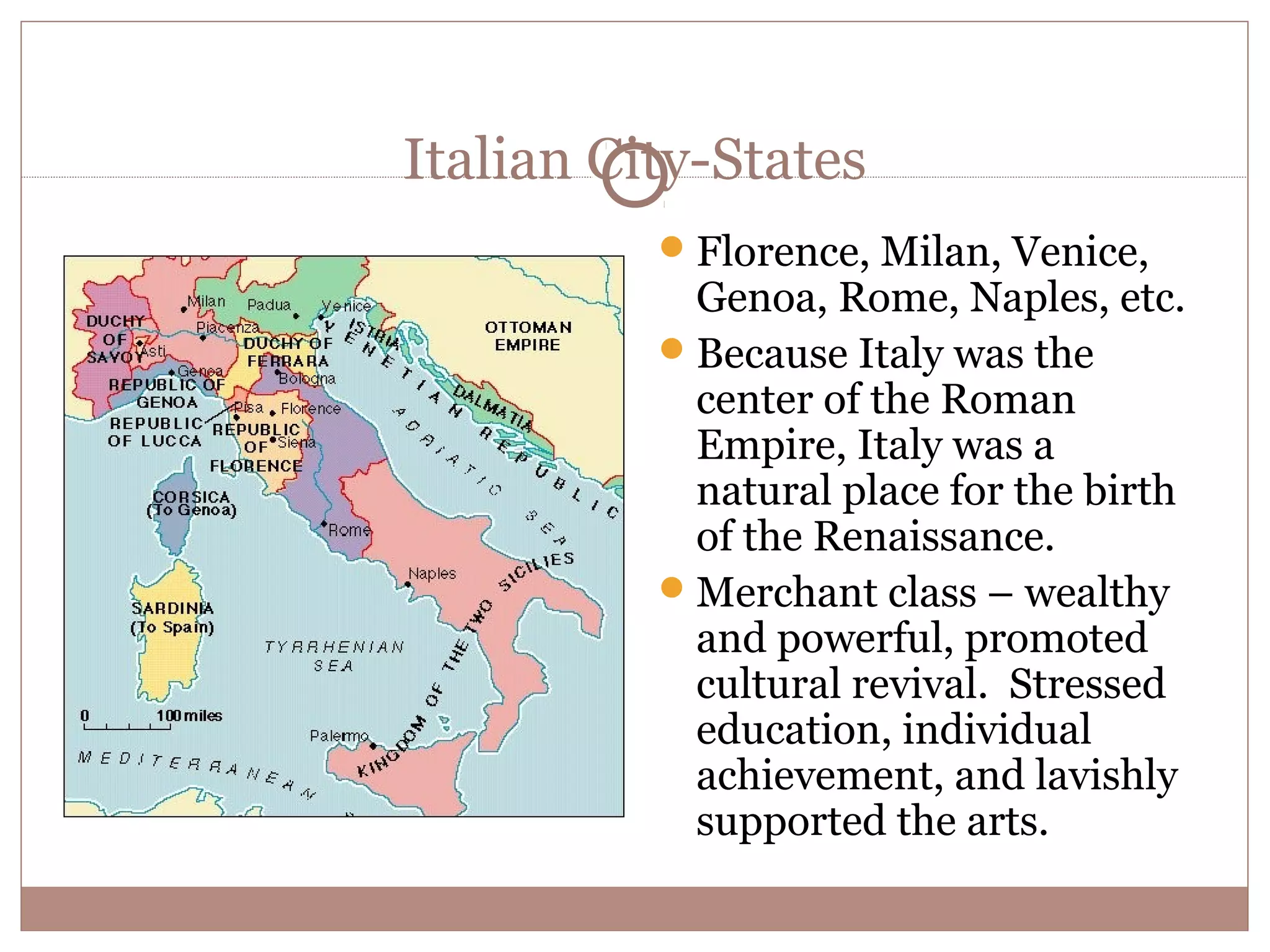
Italian City-States
           Florence, Milan, Venice,
            Genoa, Rome, Naples, etc.
           Because Italy was the
            center of the Roman
            Empire, Italy was a
            natural place for the birth
            of the Renaissance.
           Merchant class – wealthy
            and powerful, promoted
            cultural revival. Stressed
            education, individual
            achievement, and lavishly
            supported the arts.
Patrons
Merchant class -
Northern Renaissance

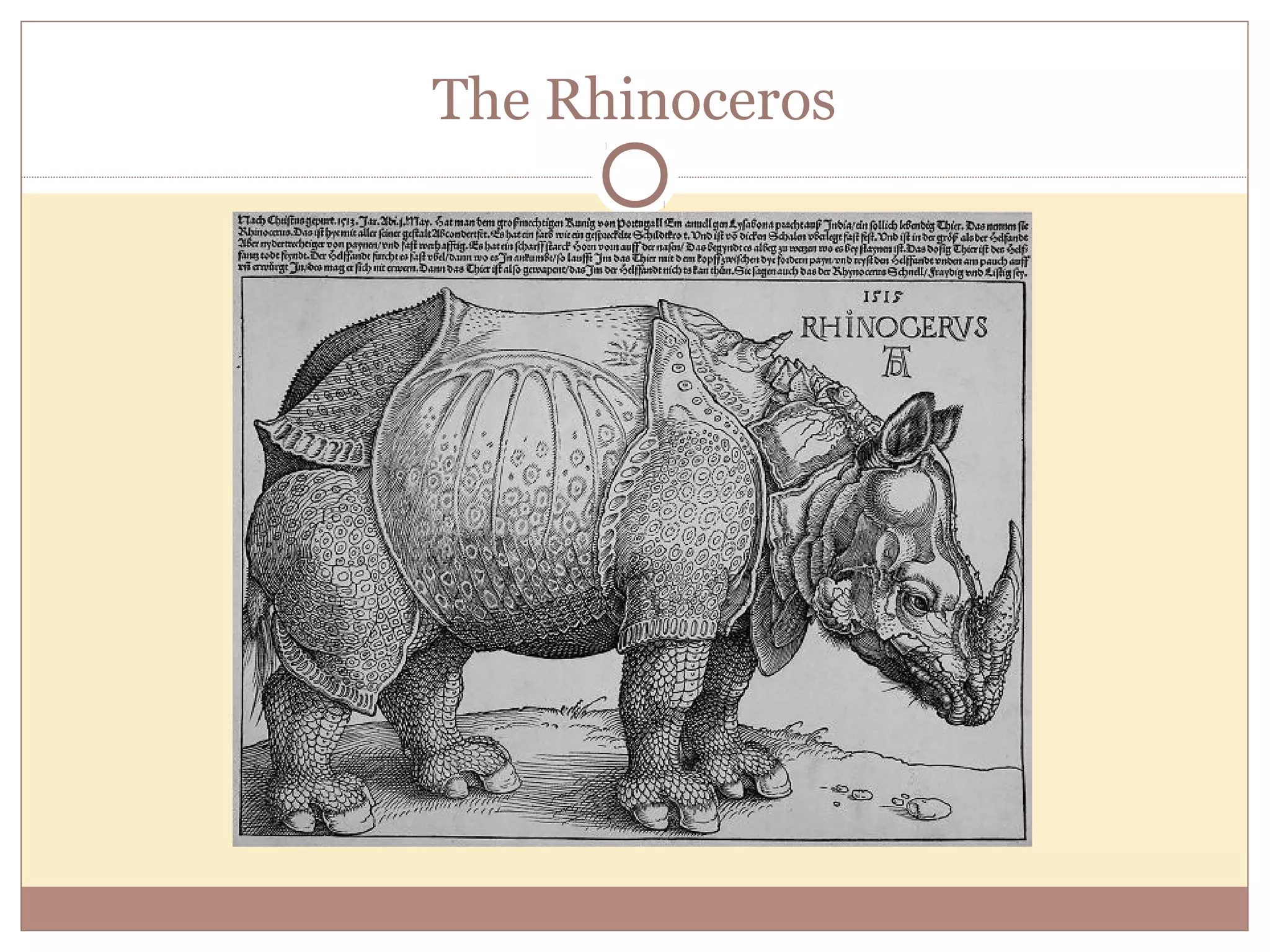
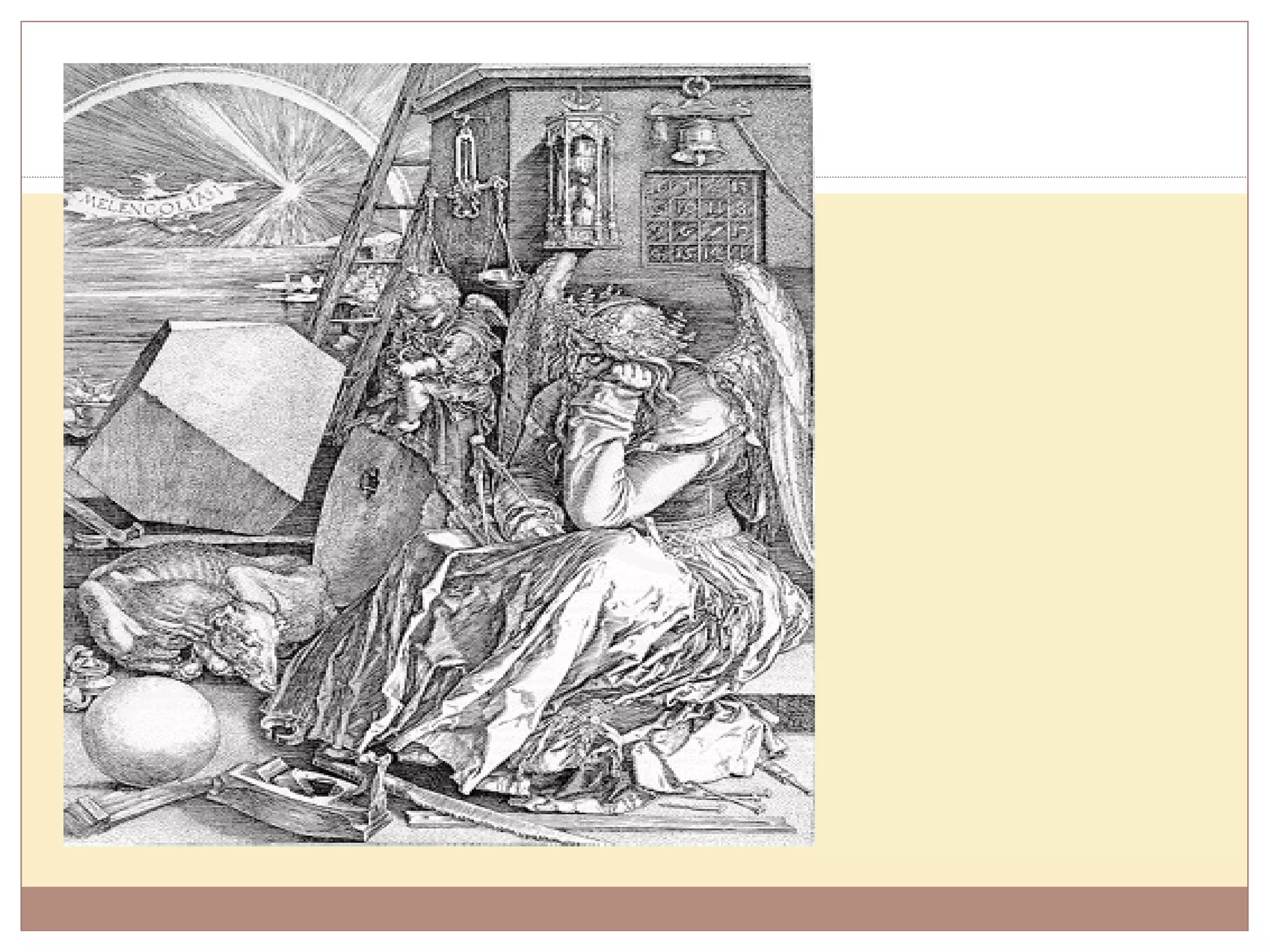
 Albrecht Durer – “German Leonardo”
     Studied in Italy
     Wide-range of interests, painted and created engravings
         Engravings – artists etches a design on a metal plate with acid and uses the plate to
          make prints
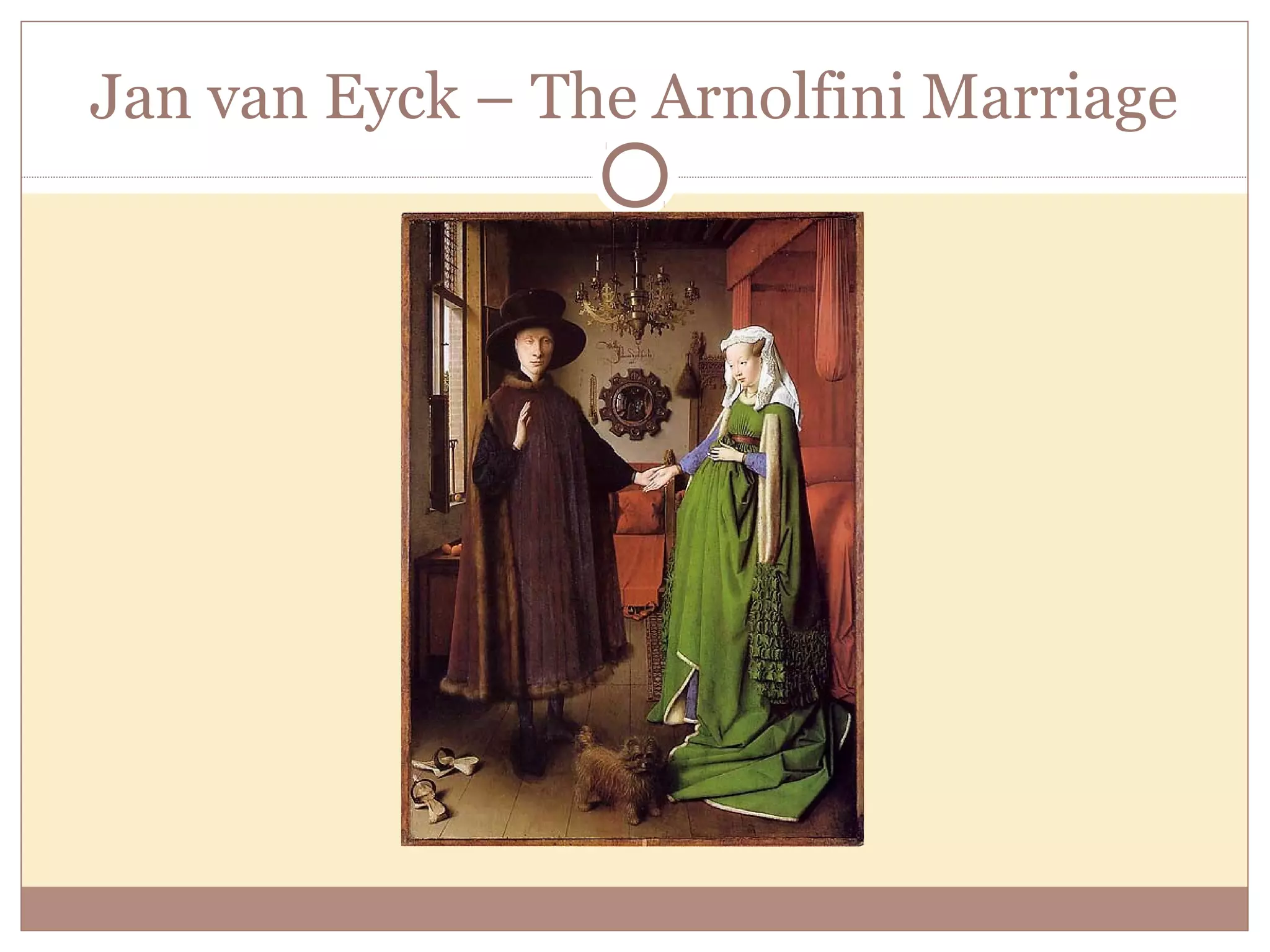
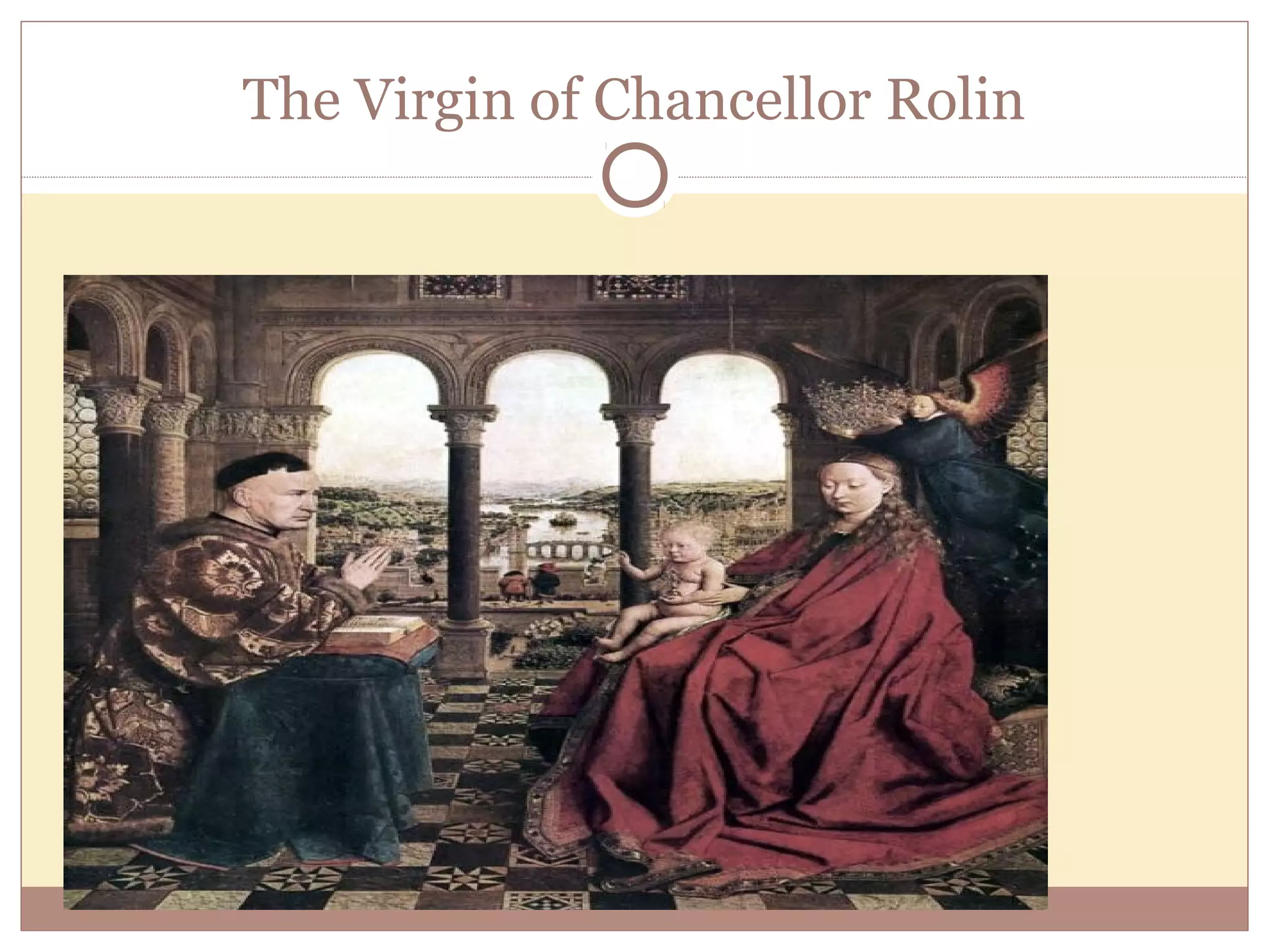
 Flemish painters – develop oil paint, which survives time more
  successfully
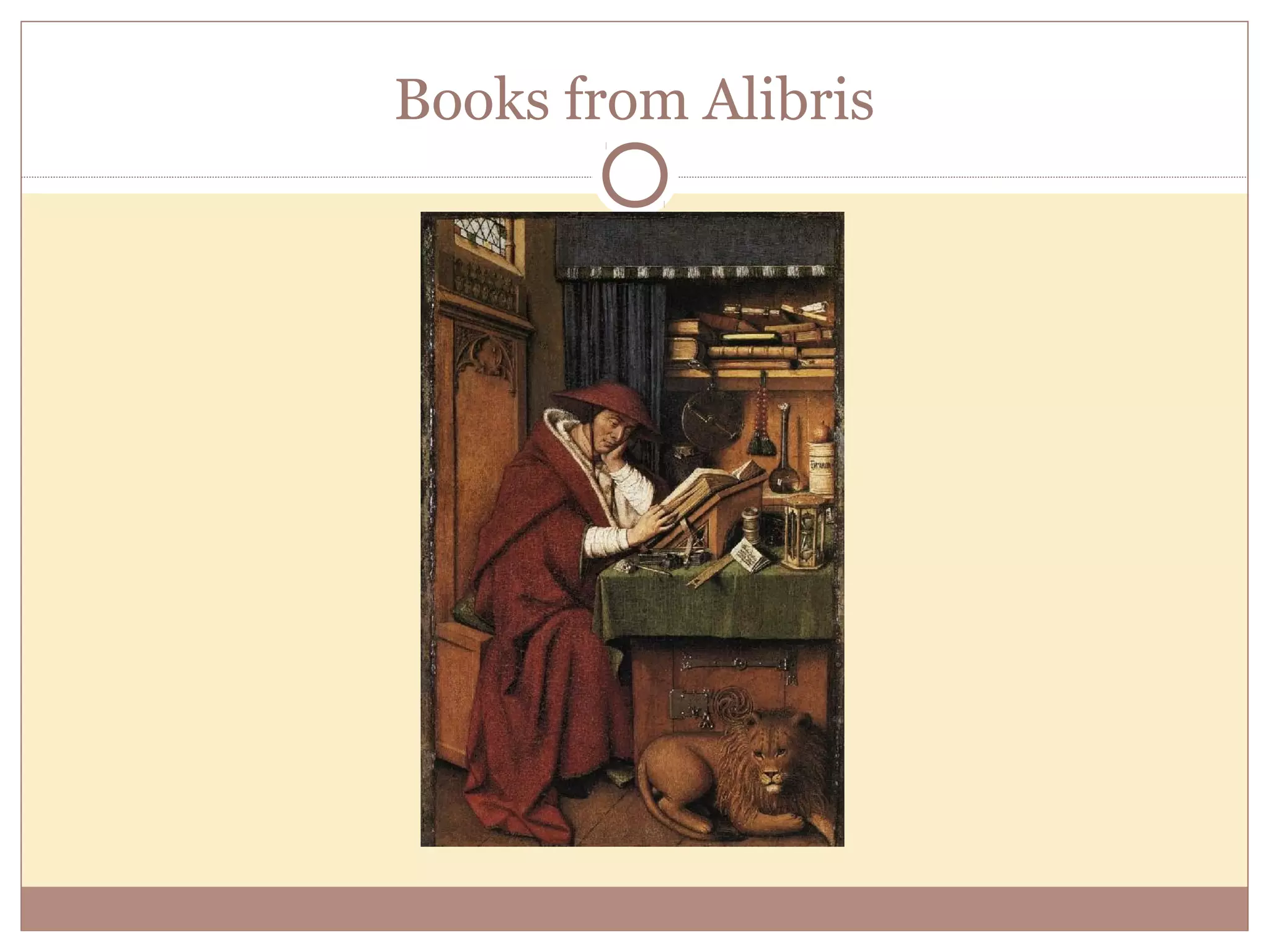
 Hubert van Eyck
     Paintings of townspeople and religious scenes, realistic details
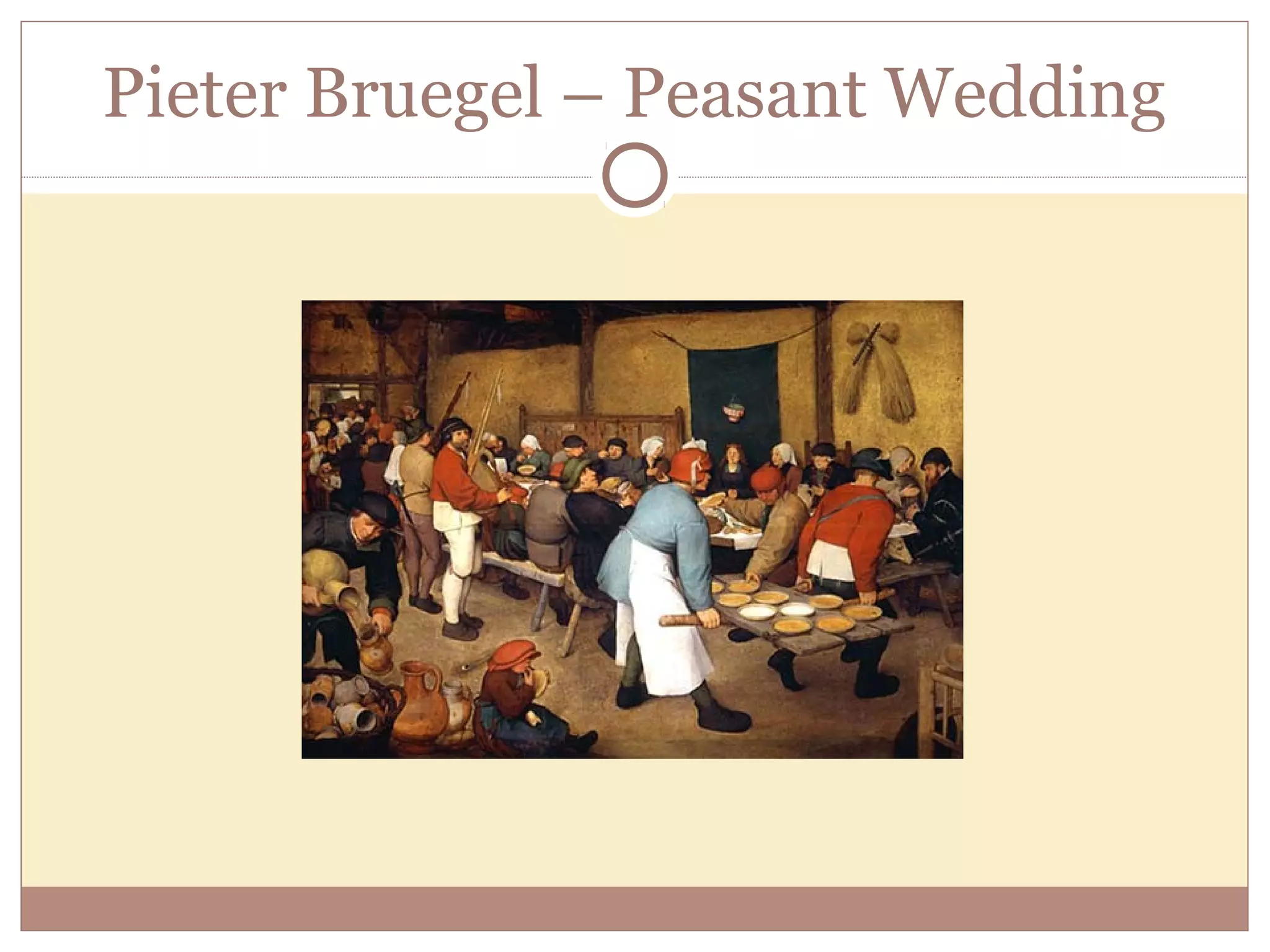
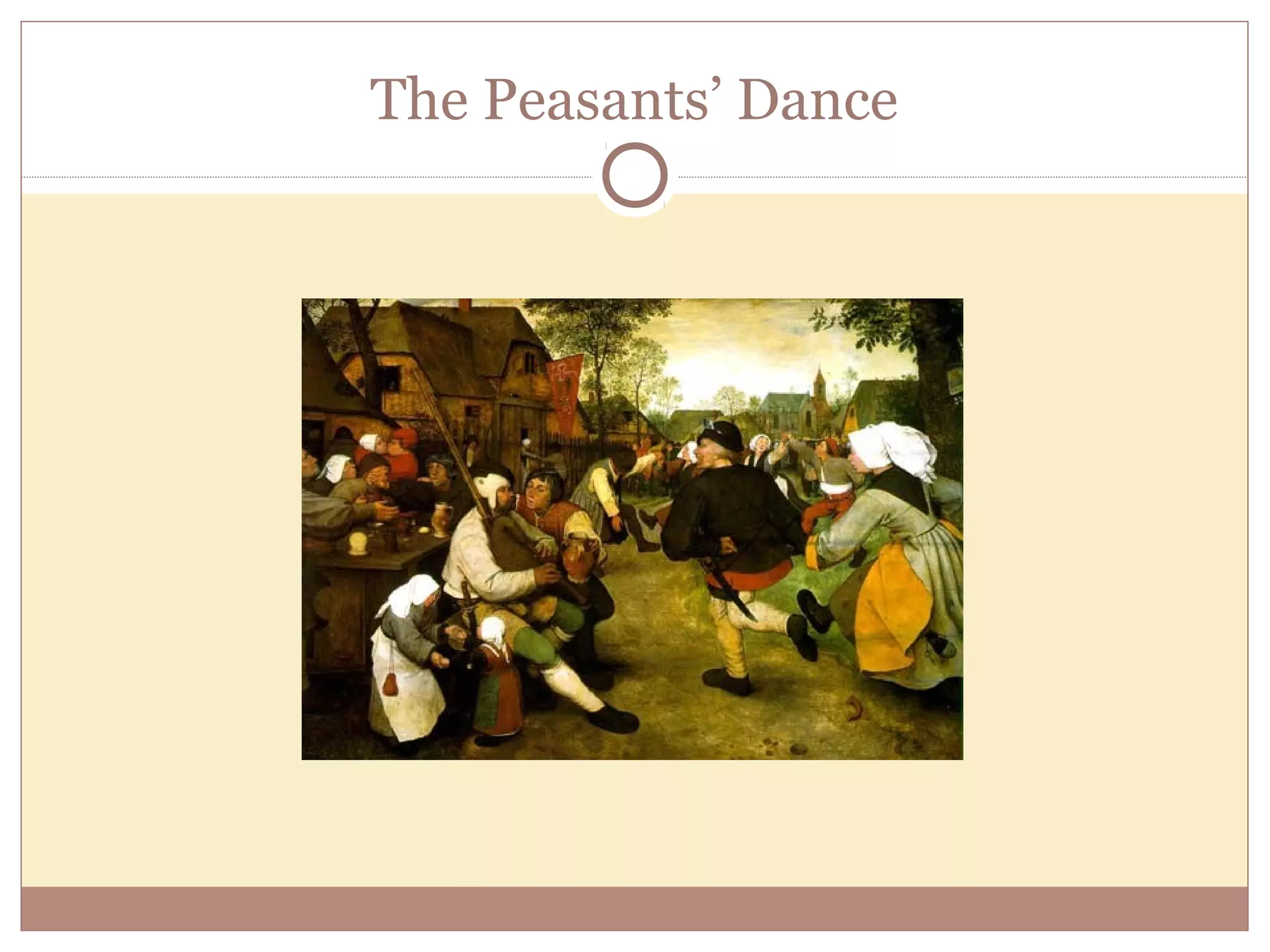
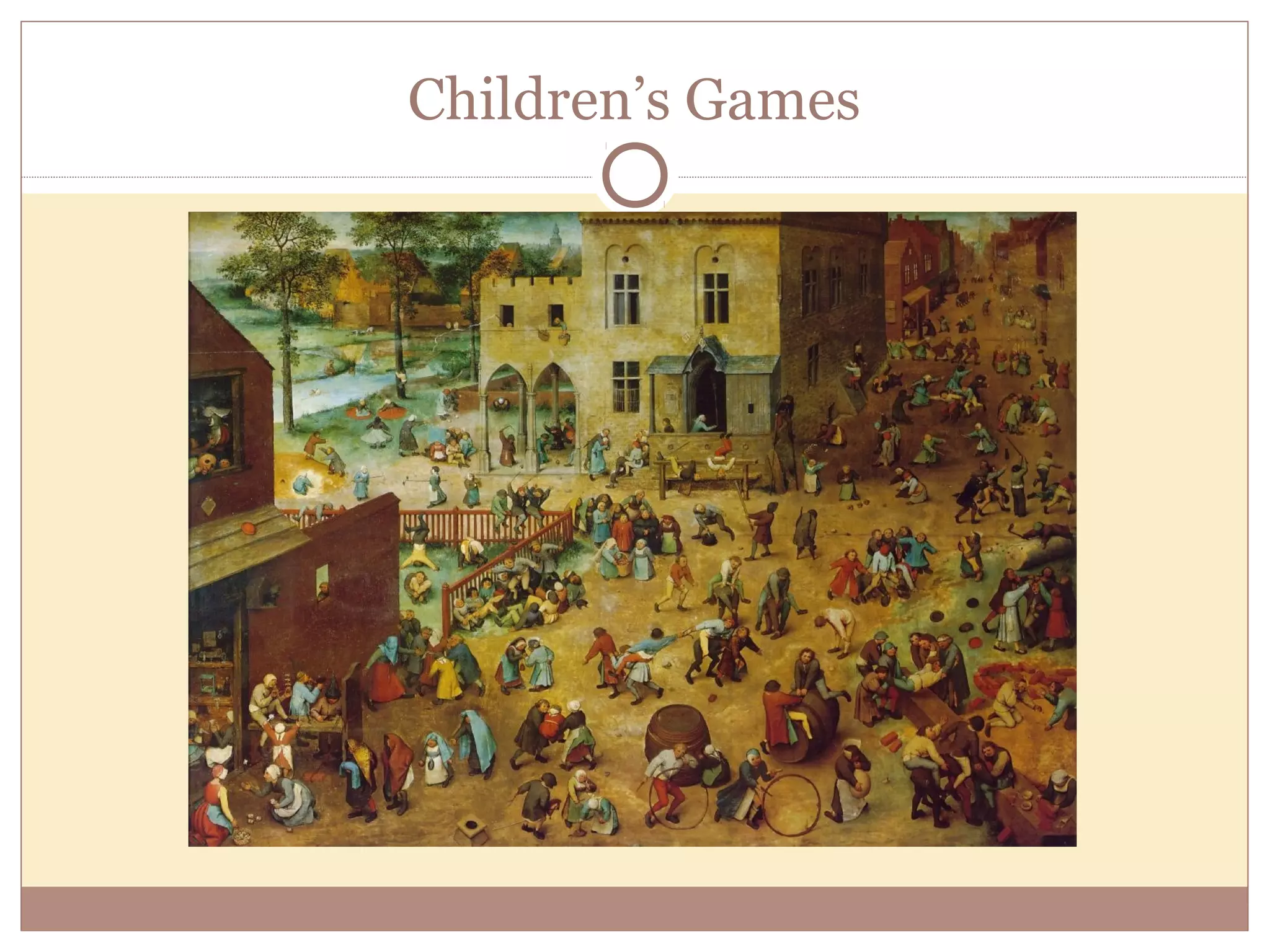
 Pieter Bruegel
     Vibrant colors to portrayal lively scenes of peasant life
 Peter Paul Rubens
     Enormous paintings of pagan figures from the classical past
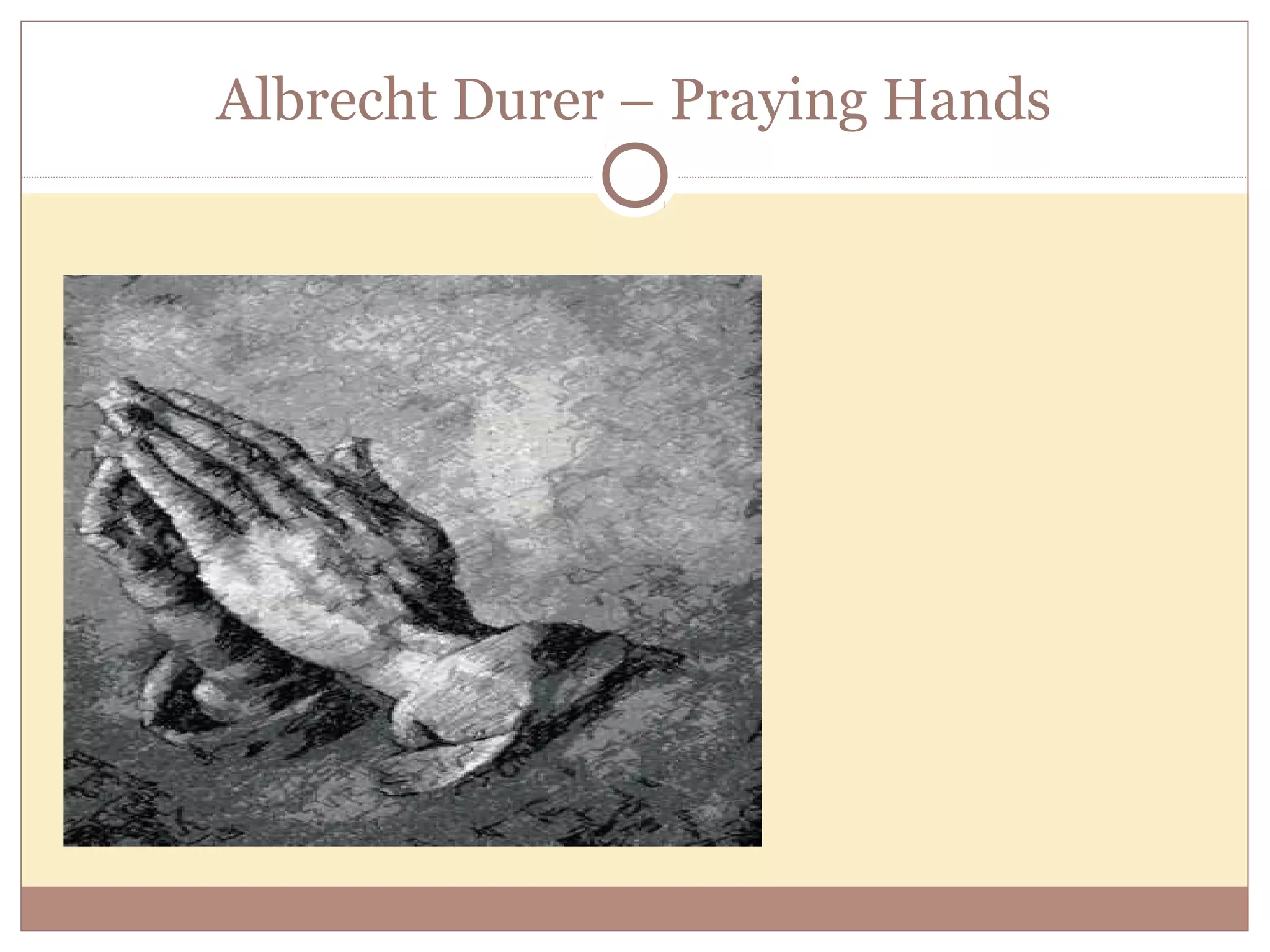
Albrecht Durer – Praying Hands
The Rhinoceros
Jan van Eyck – The Arnolfini Marriage
The Virgin of Chancellor Rolin
Books from Alibris
Pieter Bruegel – Peasant Wedding
The Peasants’ Dance
Children’s Games
Northern
  Humanists


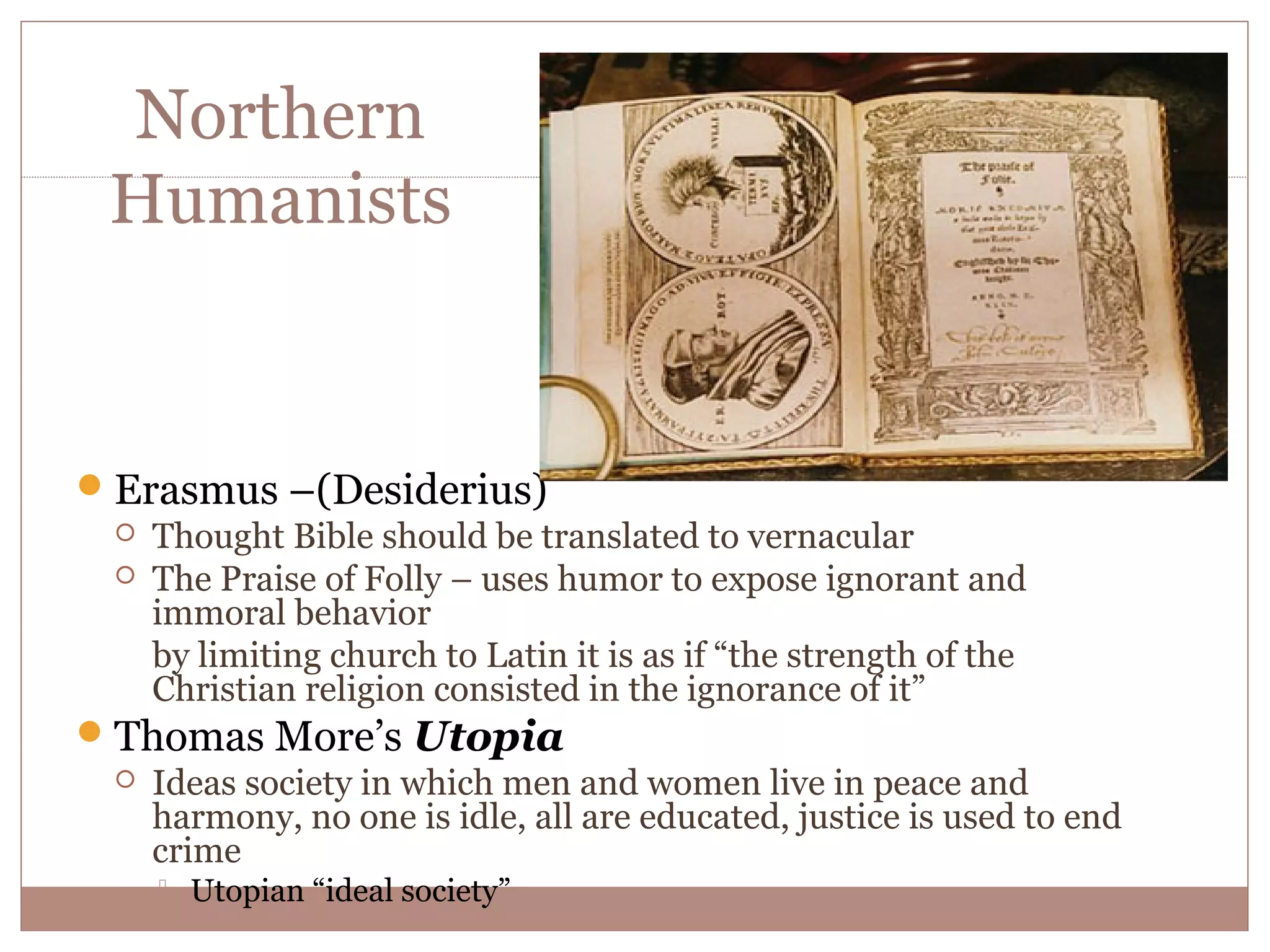
 Erasmus –(Desiderius)
   Thought Bible should be translated to vernacular
   The Praise of Folly – uses humor to expose ignorant and
    immoral behavior
    by limiting church to Latin it is as if “the strength of the
    Christian religion consisted in the ignorance of it”
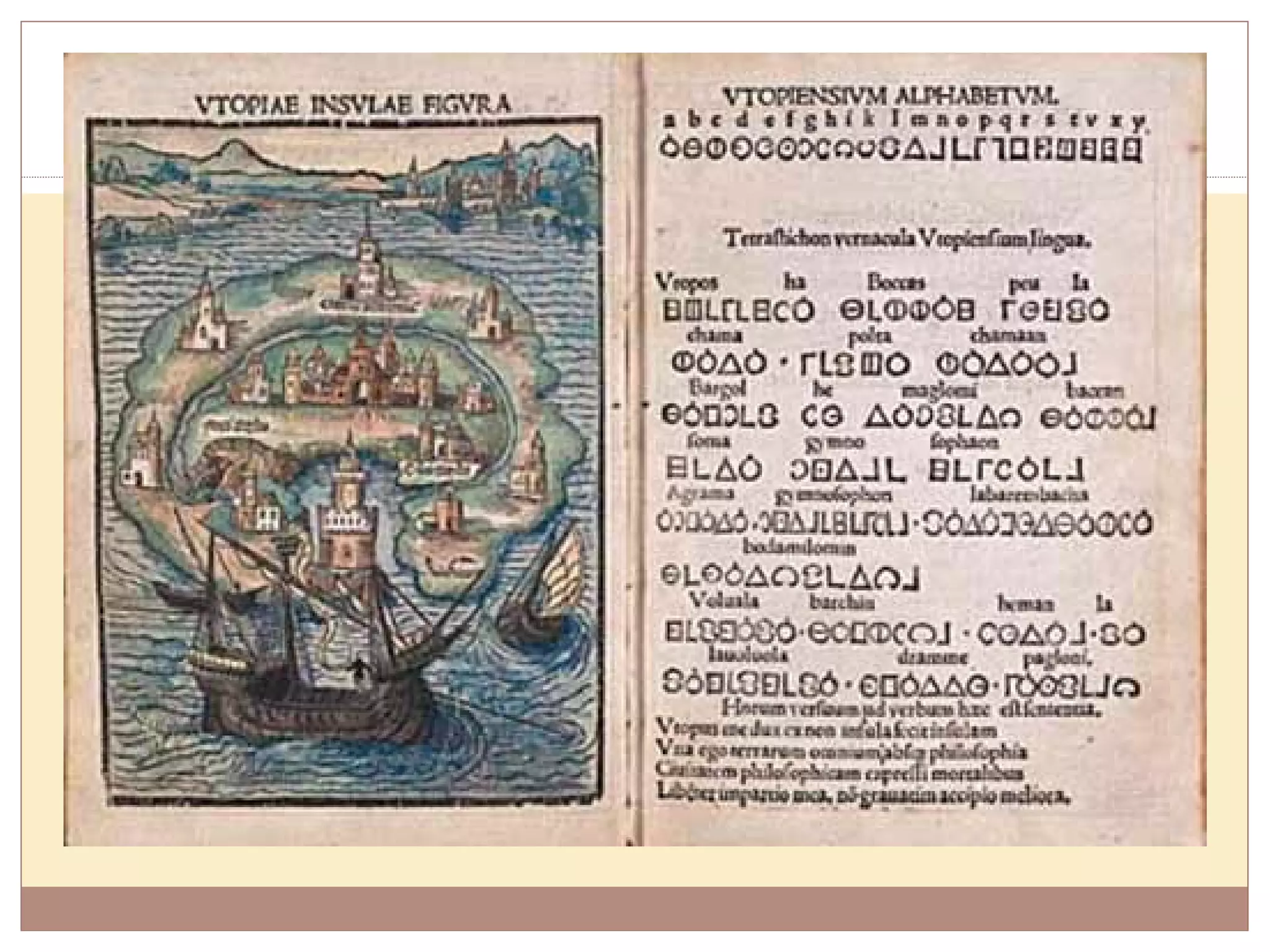
 Thomas More’s Utopia
   Ideas society in which men and women live in peace and
    harmony, no one is idle, all are educated, justice is used to end
    crime
        Utopian “ideal society”
Writers for a New Audience

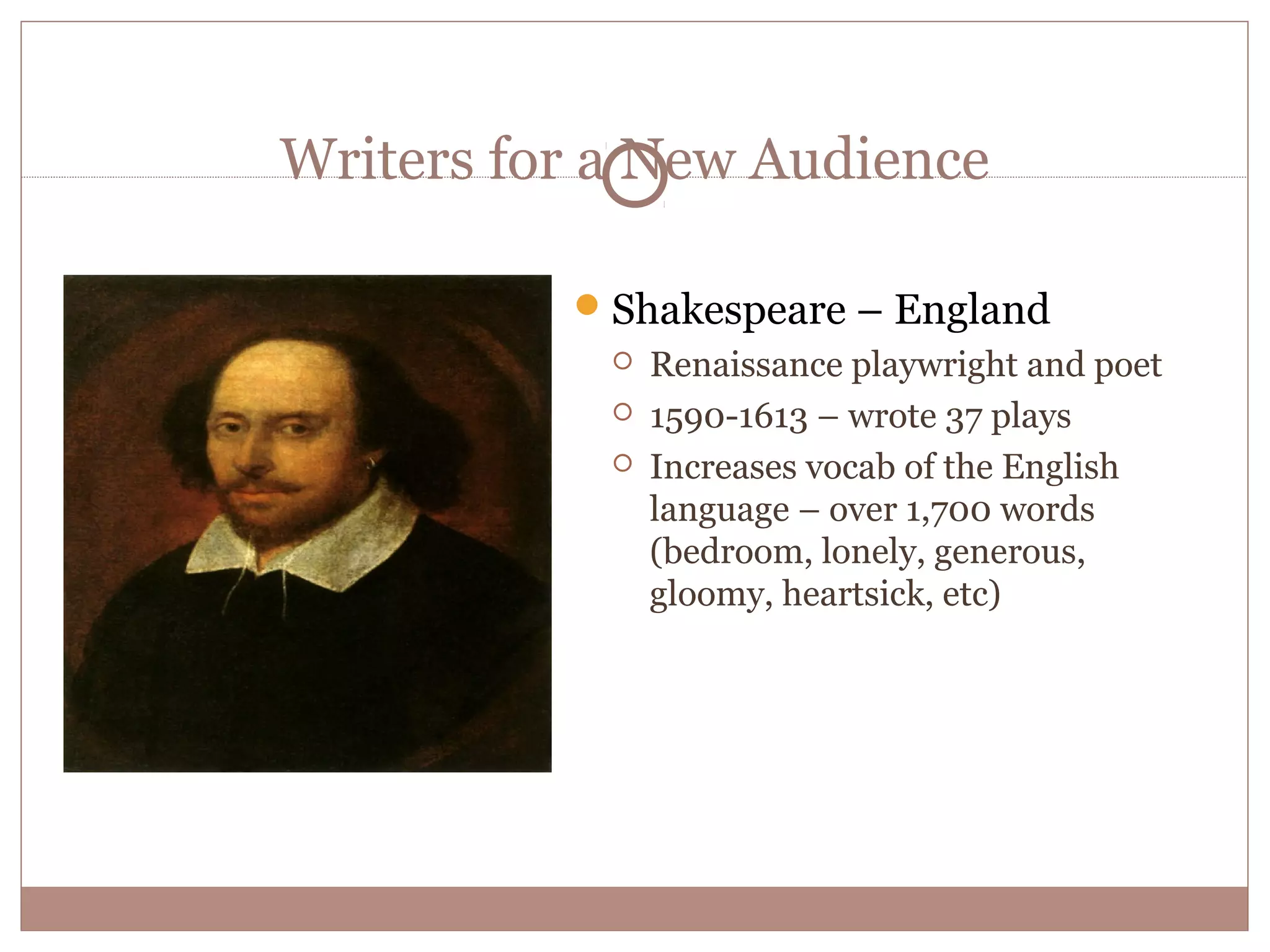
           Shakespeare – England
               Renaissance playwright and poet
               1590-1613 – wrote 37 plays
               Increases vocab of the English
                language – over 1,700 words
                (bedroom, lonely, generous,
                gloomy, heartsick, etc)
Printing
         Revolution
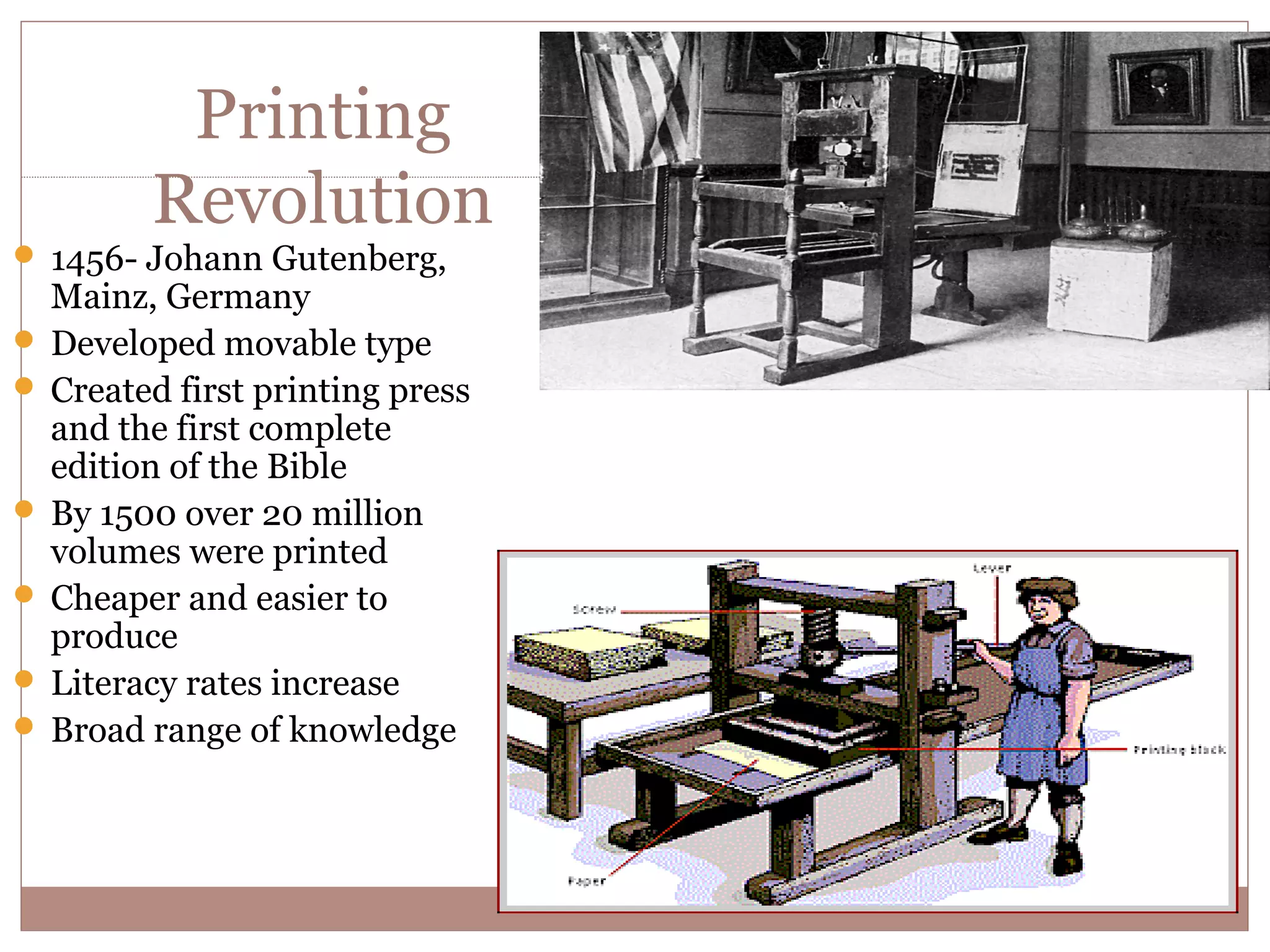
 1456- Johann Gutenberg,
  Mainz, Germany
 Developed movable type
 Created first printing press
  and the first complete
  edition of the Bible
 By 1500 over 20 million
  volumes were printed
 Cheaper and easier to
  produce
 Literacy rates increase
 Broad range of knowledge
Martin Luther
 Was a devout Catholic, served as a monk, tried to
  continually bring himself closer to God
 Nails his Ninety-five Theses to the door of the Castle
  Church in Wittenberg, Germany on All Hallows Eve,
  1517
     Protests sale of indulgences (“Heaven Insurance” for you and
      your loved ones – dead or alive!)
     Salvation by faith alone; he opposed the Catholic Church’s beliefs
      in penance and good works
     Bible is the only authority for Christian life; Pope is a false
      authority
     Priesthood of all believers – each person should have an
      individual relationship with God and should read/interpret the
      Bible for him/herself
     All people are equal in the eyes of God
Wrote many books, essays, and letters – which are
 quickly printed and spread throughout
Luther was not easily silenced – he ideas shake
 Europe
Pope Leo X issues a Papal Bull June 15,1520 and
 threatens to excommunicate Luther unless he
 recanted
Luther and his students at the University of
 Witten berg burned the Papal Bull in a bonfire
Pope excommunicates Luther
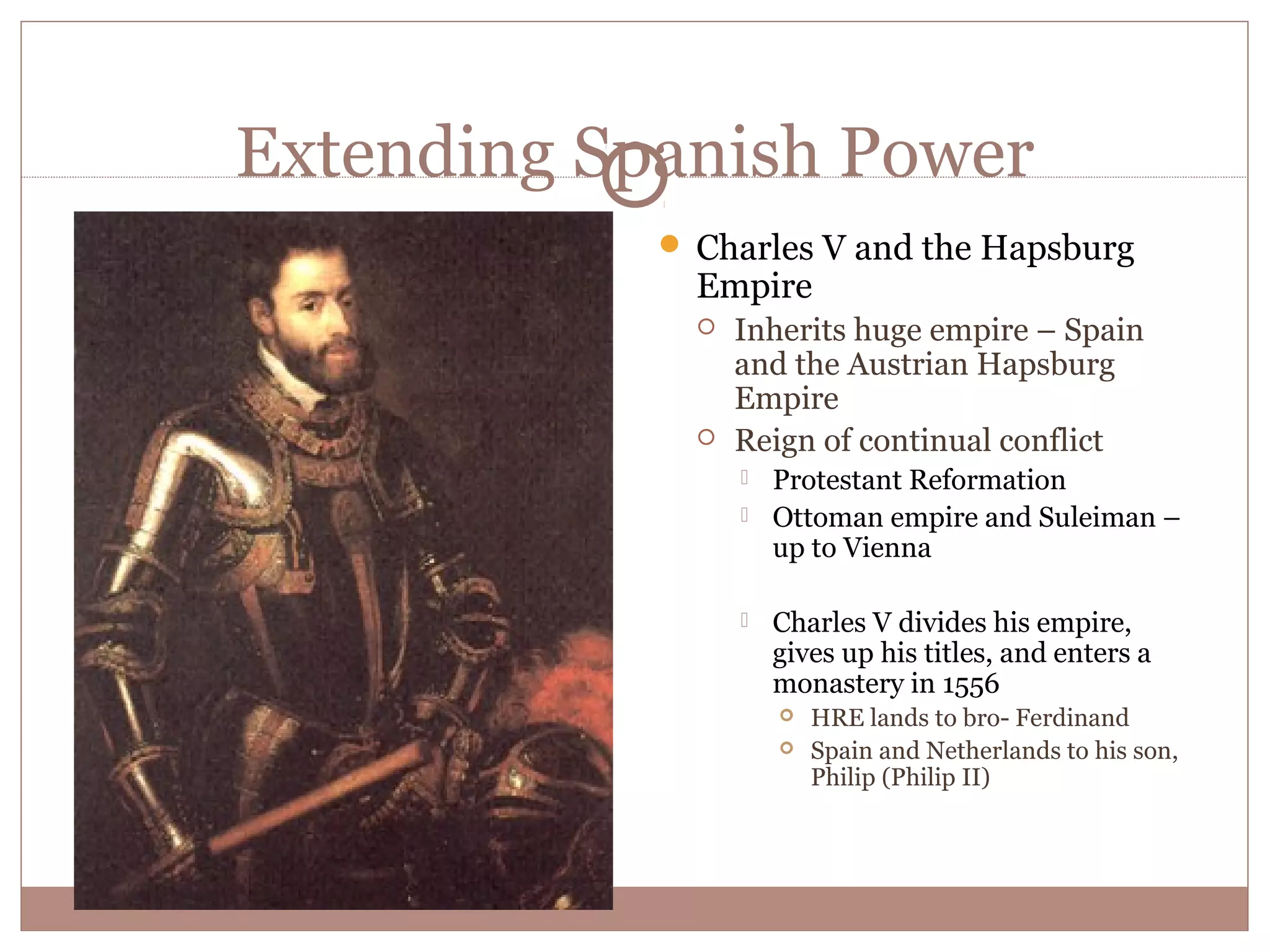
 Charles V – HRE
 1521 – summons Luther to the Imperial Diet at Worms to
  stand trial
 Refuses to recant his ideas,
      “Unless I am convinced by Scripture and plain reason…my
       conscience is captive to the Word of God. I cannot and I will not
       recant anything, for to go against conscience is neither right nor safe.
        Here I stand. I cannot do otherwise. Amen.”
 Charles V replies –
   “A single friar who goes counter to all Christianity for a thousand
    years must be wrong…I will proceed against him as a notorious
    heretic”
 Charles V issues Edict of Worms – declaring Luther an
   outlaw and heretic
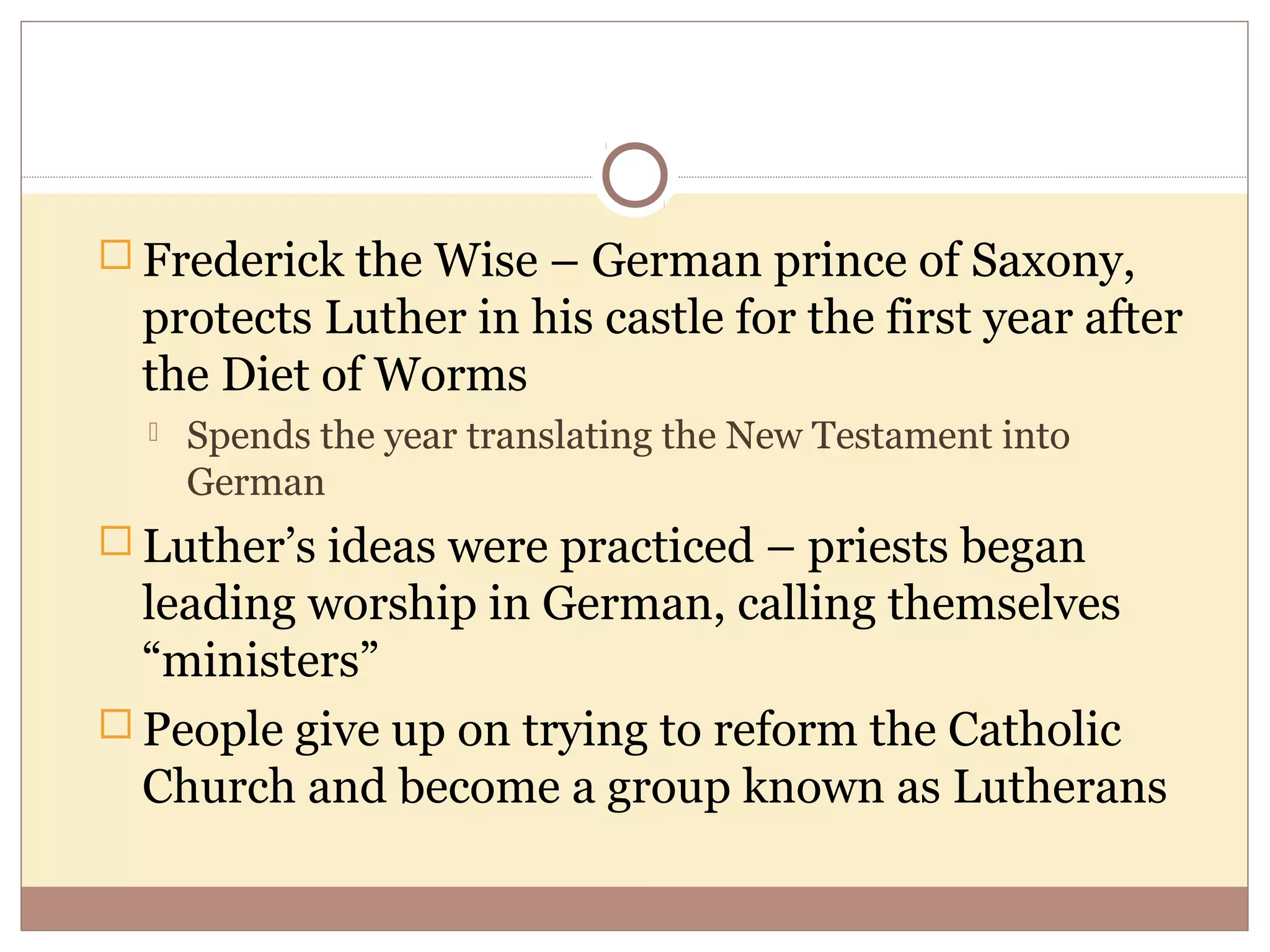
 Frederick the Wise – German prince of Saxony,
  protects Luther in his castle for the first year after
  the Diet of Worms
     Spends the year translating the New Testament into
      German
 Luther’s ideas were practiced – priests began
  leading worship in German, calling themselves
  “ministers”
 People give up on trying to reform the Catholic
  Church and become a group known as Lutherans
Changing Views of the Universe
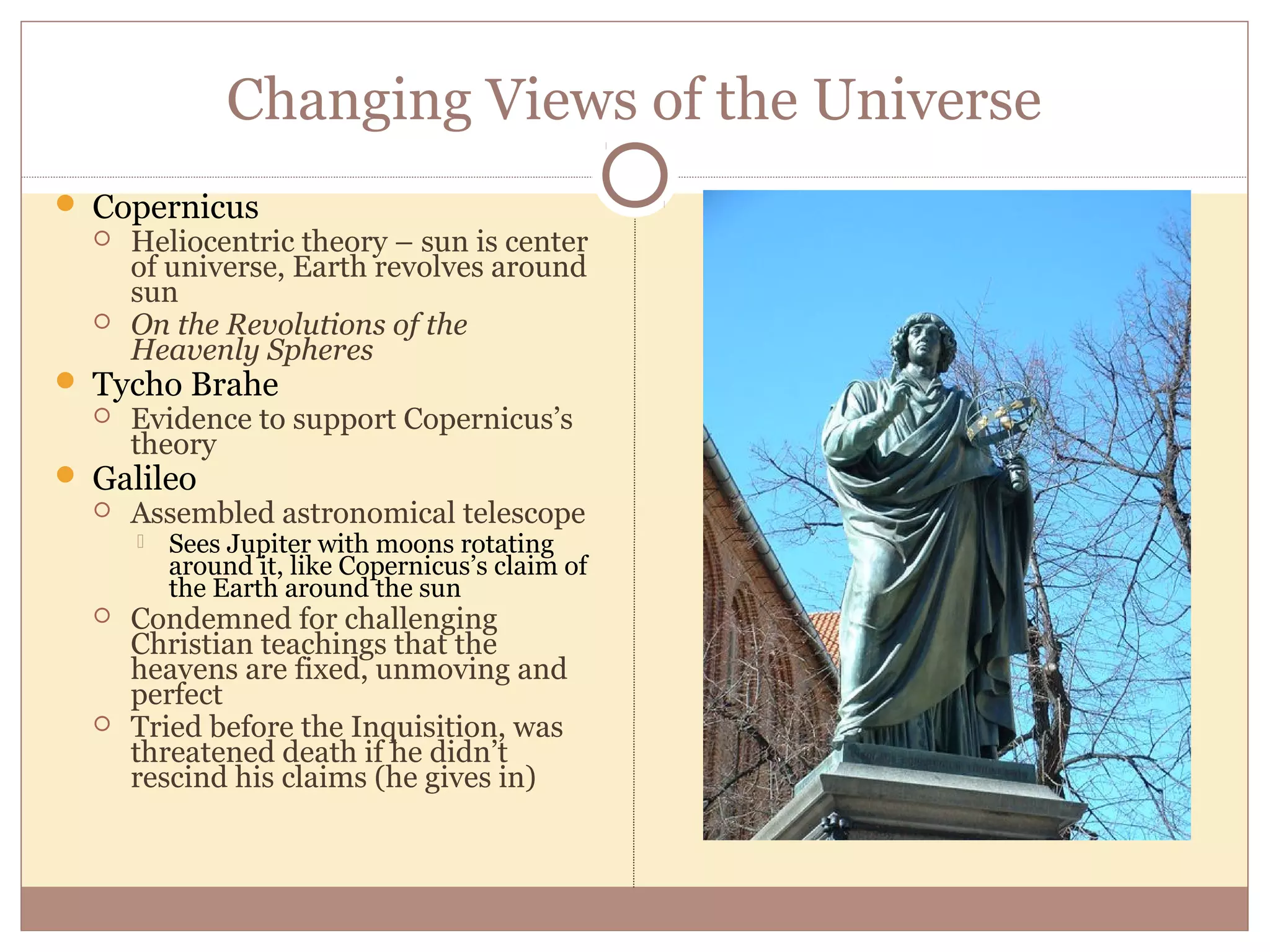
 Copernicus
     Heliocentric theory – sun is center
      of universe, Earth revolves around
      sun
     On the Revolutions of the
      Heavenly Spheres
 Tycho Brahe
     Evidence to support Copernicus’s
      theory
 Galileo
     Assembled astronomical telescope
         Sees Jupiter with moons rotating
          around it, like Copernicus’s claim of
          the Earth around the sun
     Condemned for challenging
      Christian teachings that the
      heavens are fixed, unmoving and
      perfect
     Tried before the Inquisition, was
      threatened death if he didn’t
      rescind his claims (he gives in)
Absolute monarchies
“Reality checkers” –
 Parliament/Estates
 General
Extending Spanish Power
             Charles V and the Hapsburg
              Empire
                 Inherits huge empire – Spain
                  and the Austrian Hapsburg
                  Empire
                 Reign of continual conflict
                     Protestant Reformation
                     Ottoman empire and Suleiman –
                      up to Vienna

                     Charles V divides his empire,
                      gives up his titles, and enters a
                      monastery in 1556
                         HRE lands to bro- Ferdinand
                         Spain and Netherlands to his son,
                          Philip (Philip II)
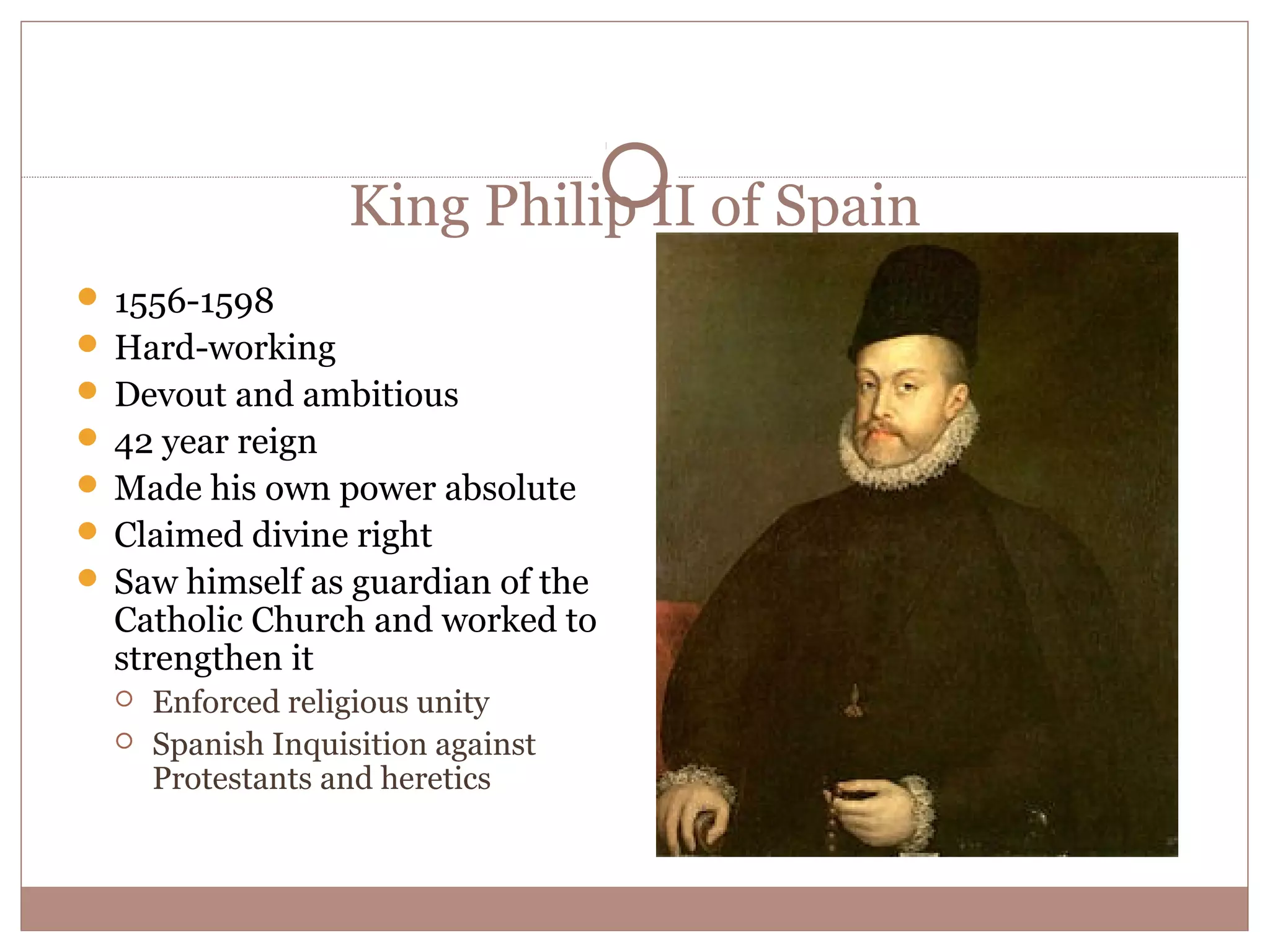
King Philip II of Spain
 1556-1598
 Hard-working
 Devout and ambitious
 42 year reign
 Made his own power absolute
 Claimed divine right
 Saw himself as guardian of the
  Catholic Church and worked to
  strengthen it
     Enforced religious unity
     Spanish Inquisition against
      Protestants and heretics
Netherlands viciously revolted for freedom from
 Spain’s reign
    Revolts in the 1560’s, 1581 – Dutch Netherlands (they’re
     Protestant btw), not official til 1648
Queen Elizabeth I of England is the archenemy
 (she and England are Protestant)
  Queen Elizabeth secretly, then openly supported the
   Netherlands efforts for freedom
  Encouraged Sea Dogs (English privateers) to plunder
   Spanish treasure ships
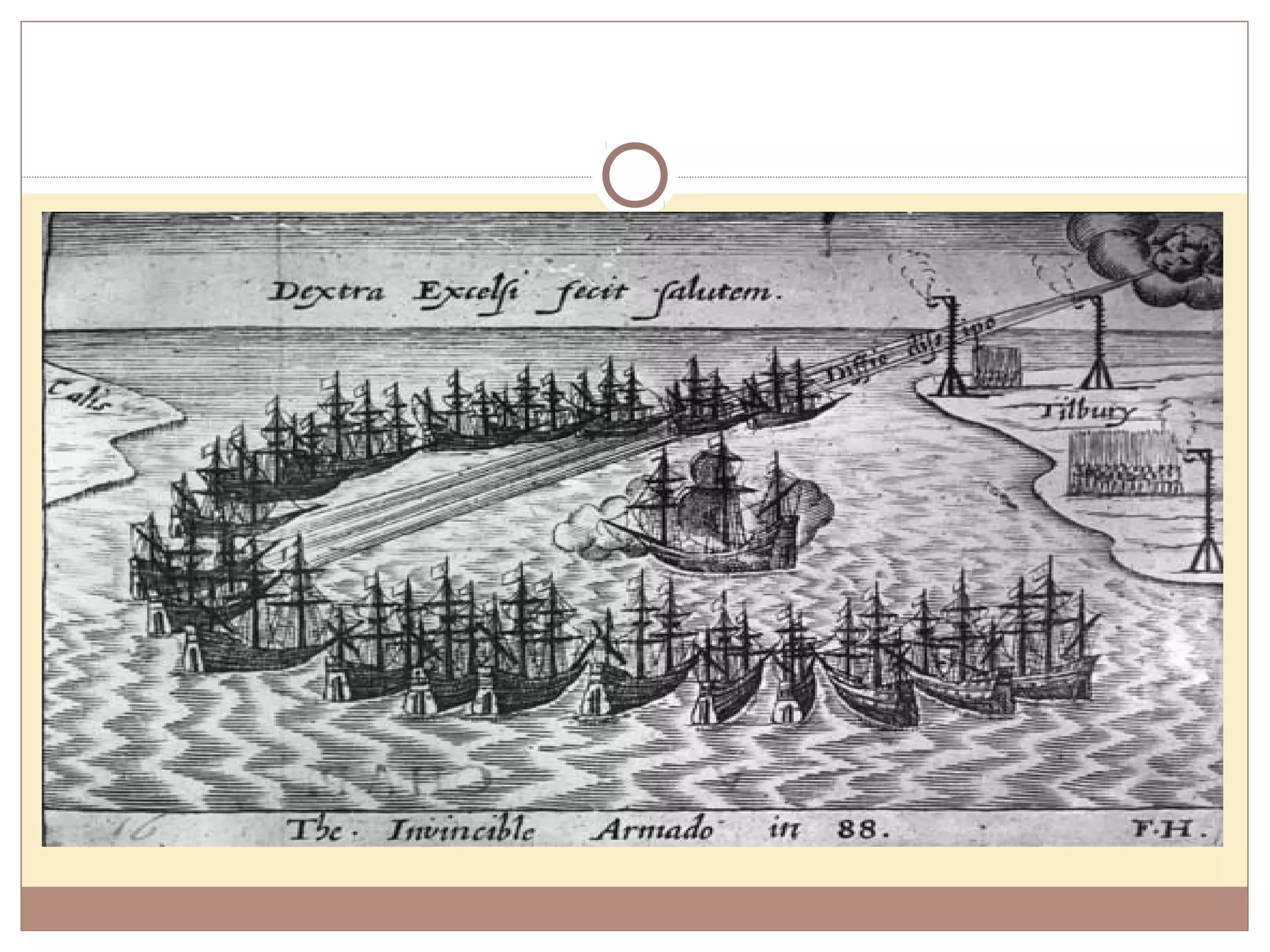
  British navy defeats the Spanish Armada
        Spanish had 130 ships 20,000 men and 2,400 artillery
        Long term effects of this event!!!
1600s Spain’s power and prosperity begin to
 decline
Lack of strong leadership
Economic issues
  Overseas wars drain wealth
  Treasure from the Americas caused imbalance – Spain
   neglected their agriculture and commerce
  Expulsion of Muslims and Jews caused a deficit of skilled
   artisans and merchants
  American gold and silver caused soaring inflation
France under Louis XIV
 Huguenots – French Protestants
     Catholicism is majority in France
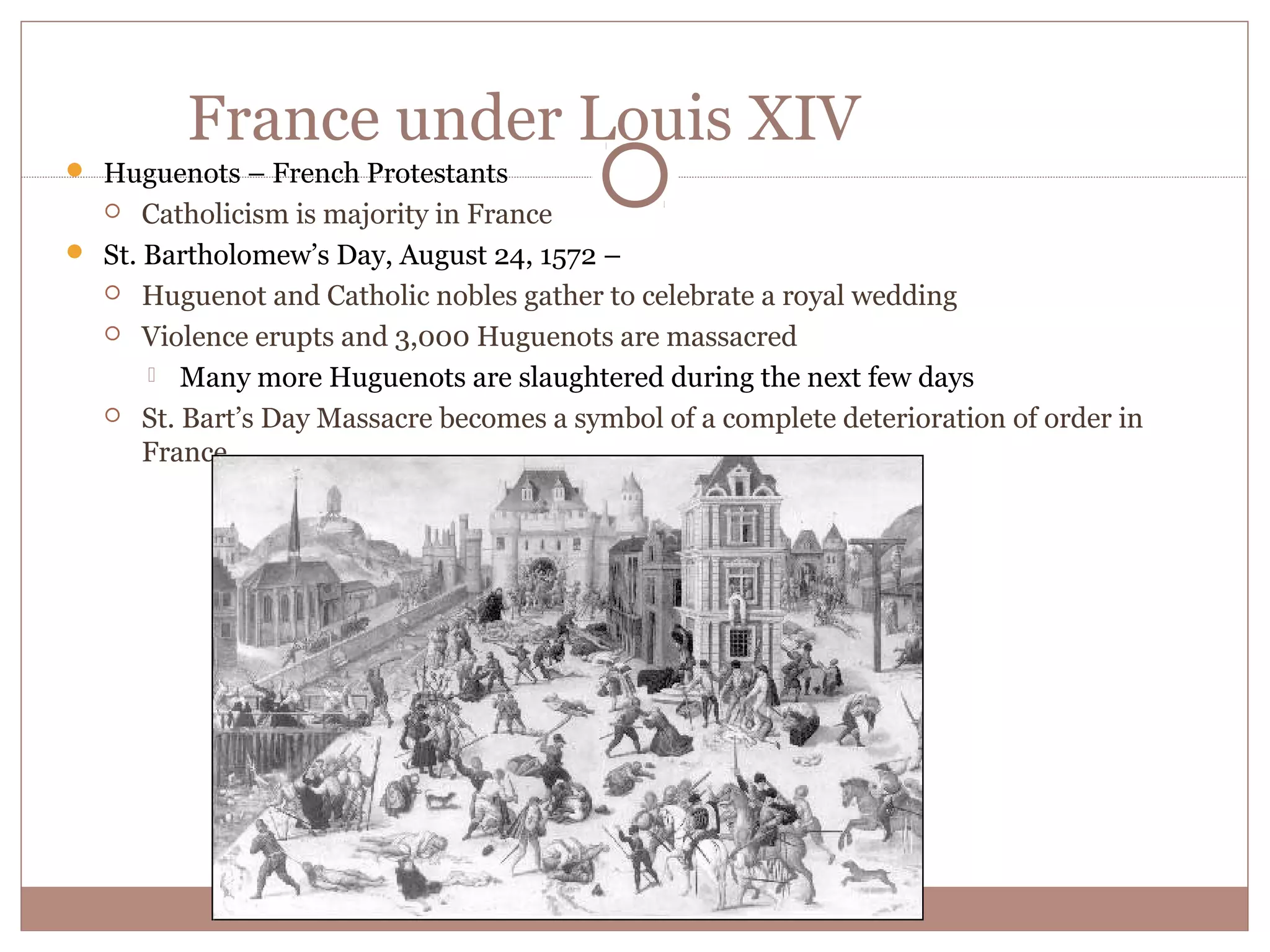
 St. Bartholomew’s Day, August 24, 1572 –
   Huguenot and Catholic nobles gather to celebrate a royal wedding

   Violence erupts and 3,000 Huguenots are massacred

       Many more Huguenots are slaughtered during the next few days
   St. Bart’s Day Massacre becomes a symbol of a complete deterioration of order in
      France
Henry IV
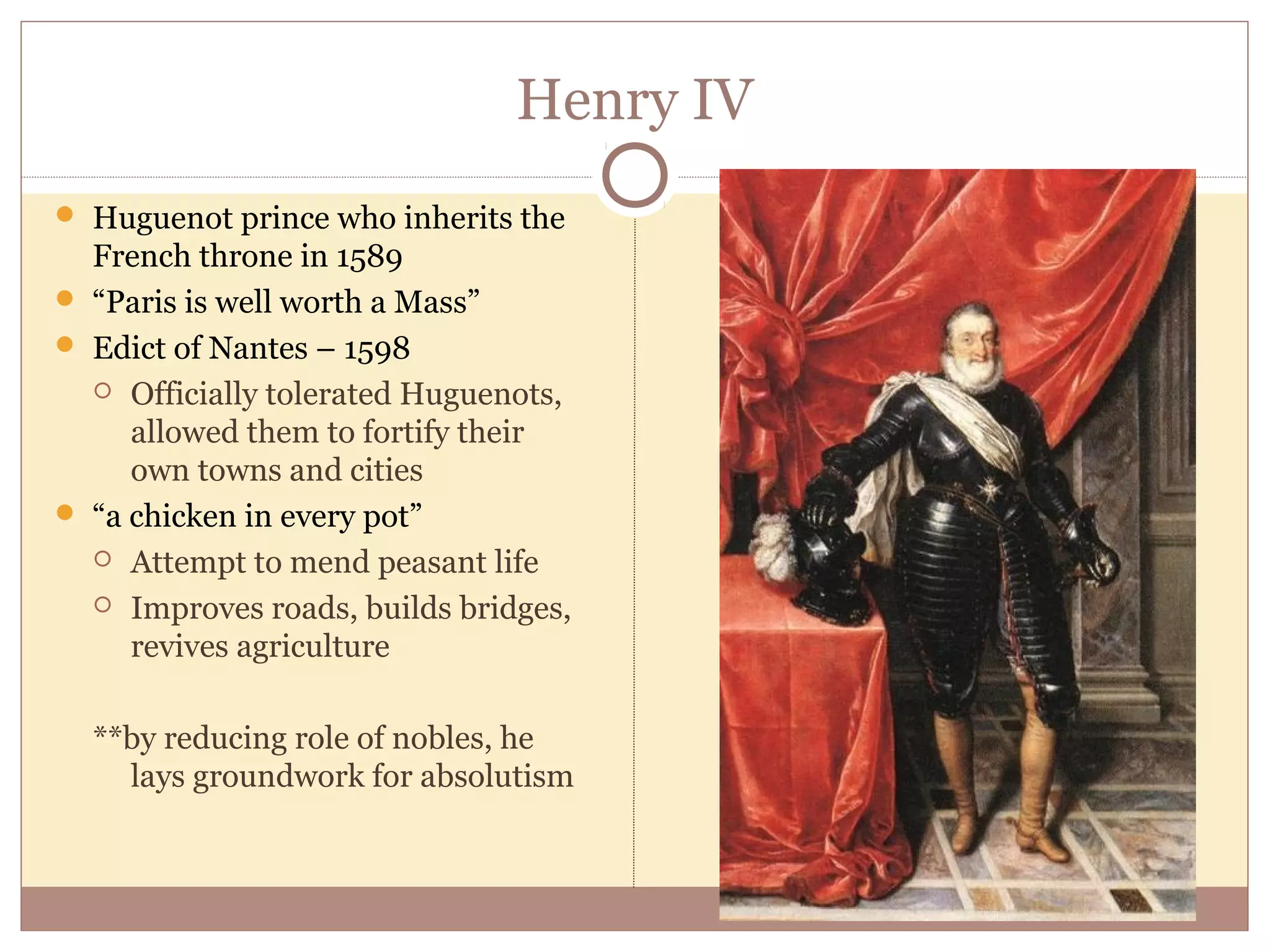
 Huguenot prince who inherits the
  French throne in 1589
 “Paris is well worth a Mass”
 Edict of Nantes – 1598
   Officially tolerated Huguenots,
     allowed them to fortify their
     own towns and cities
 “a chicken in every pot”
   Attempt to mend peasant life

   Improves roads, builds bridges,
     revives agriculture

  **by reducing role of nobles, he
    lays groundwork for absolutism
Richelieu
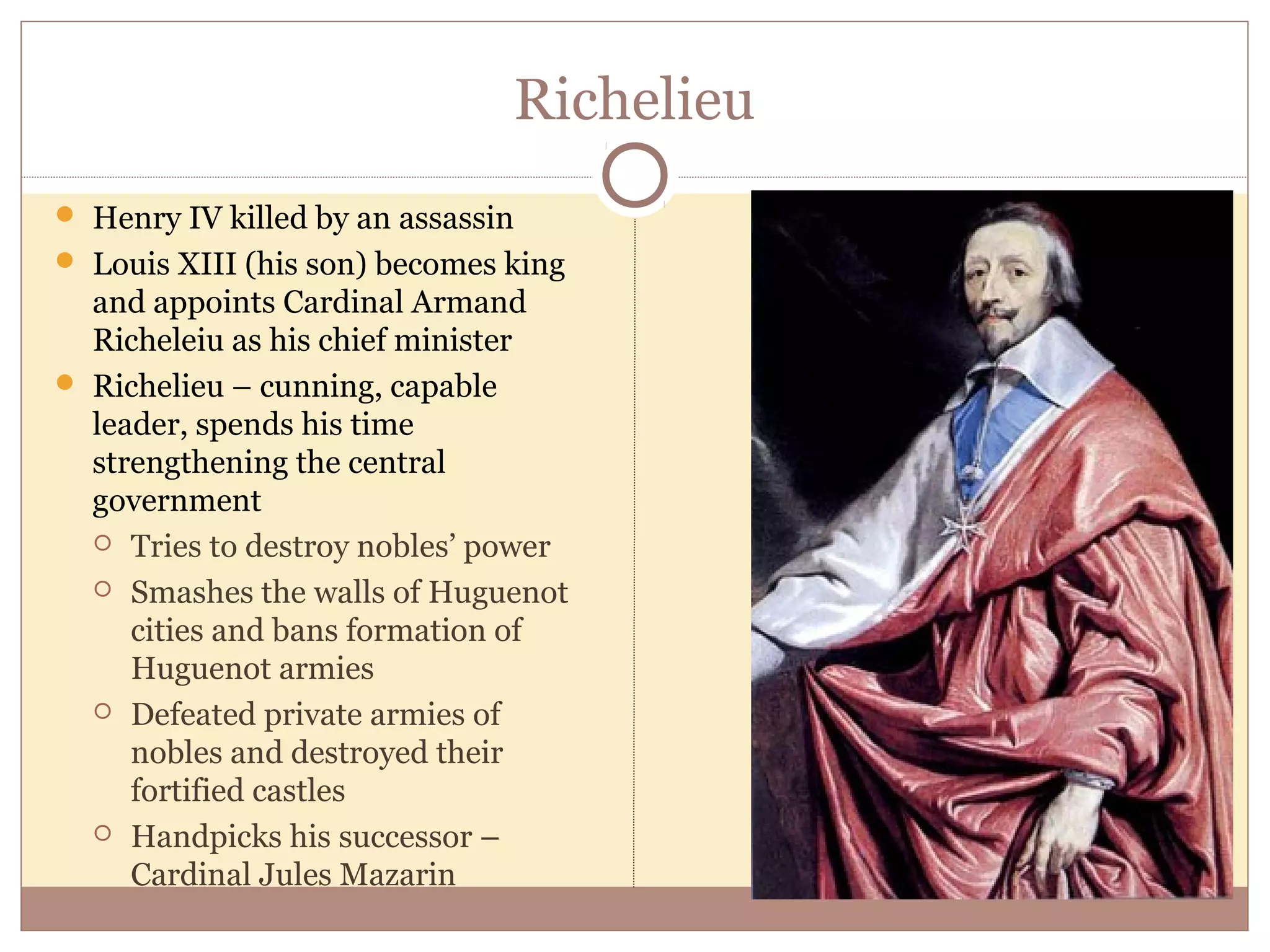
 Henry IV killed by an assassin
 Louis XIII (his son) becomes king
  and appoints Cardinal Armand
  Richeleiu as his chief minister
 Richelieu – cunning, capable
  leader, spends his time
  strengthening the central
  government
   Tries to destroy nobles’ power

   Smashes the walls of Huguenot
     cities and bans formation of
     Huguenot armies
   Defeated private armies of
     nobles and destroyed their
     fortified castles
   Handpicks his successor –
     Cardinal Jules Mazarin
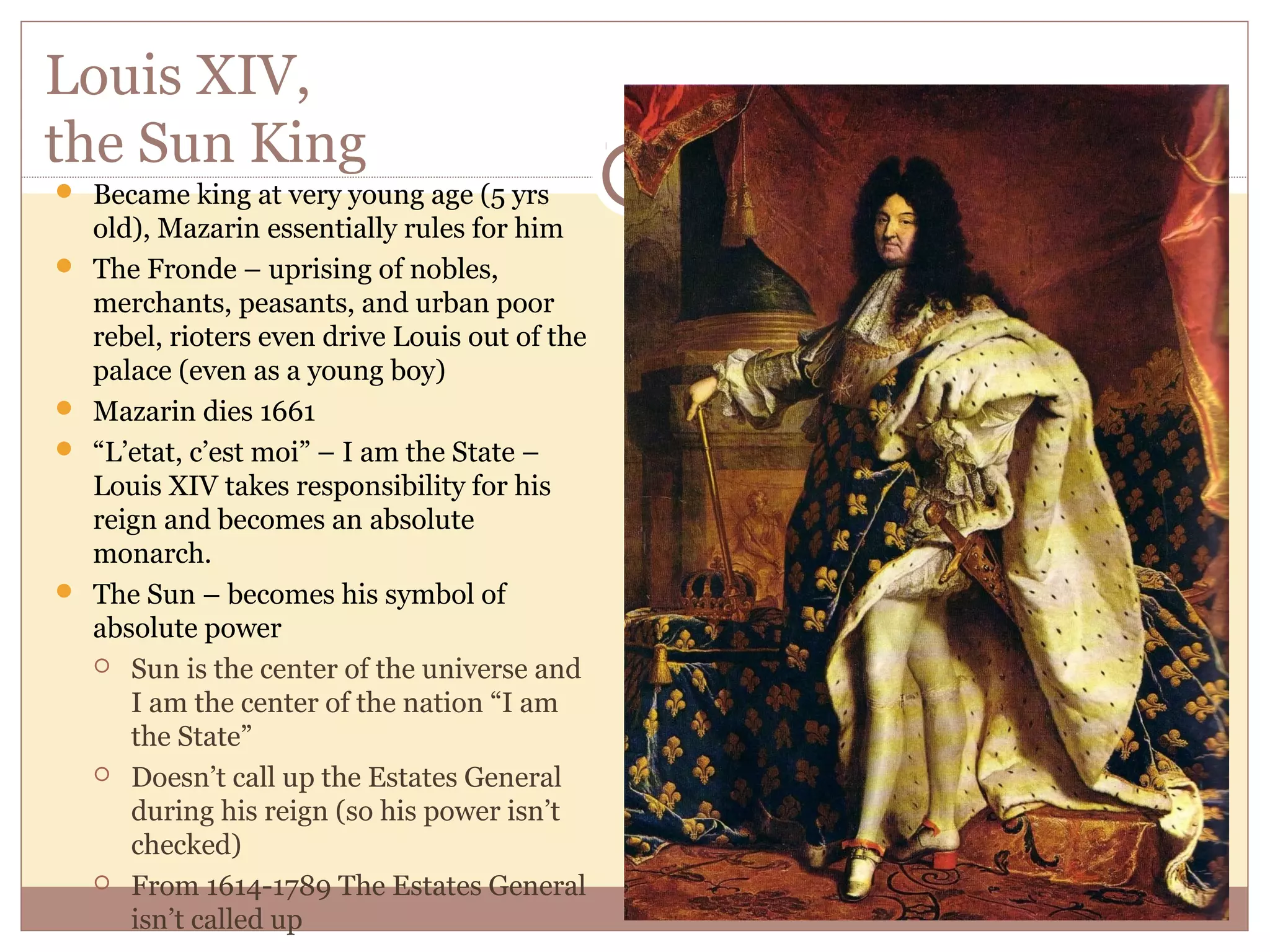
Louis XIV,
the Sun King
 Became king at very young age (5 yrs
    old), Mazarin essentially rules for him
   The Fronde – uprising of nobles,
    merchants, peasants, and urban poor
    rebel, rioters even drive Louis out of the
    palace (even as a young boy)
   Mazarin dies 1661
   “L’etat, c’est moi” – I am the State –
    Louis XIV takes responsibility for his
    reign and becomes an absolute
    monarch.
   The Sun – becomes his symbol of
    absolute power
     Sun is the center of the universe and
       I am the center of the nation “I am
       the State”
     Doesn’t call up the Estates General
       during his reign (so his power isn’t
       checked)
     From 1614-1789 The Estates General
       isn’t called up
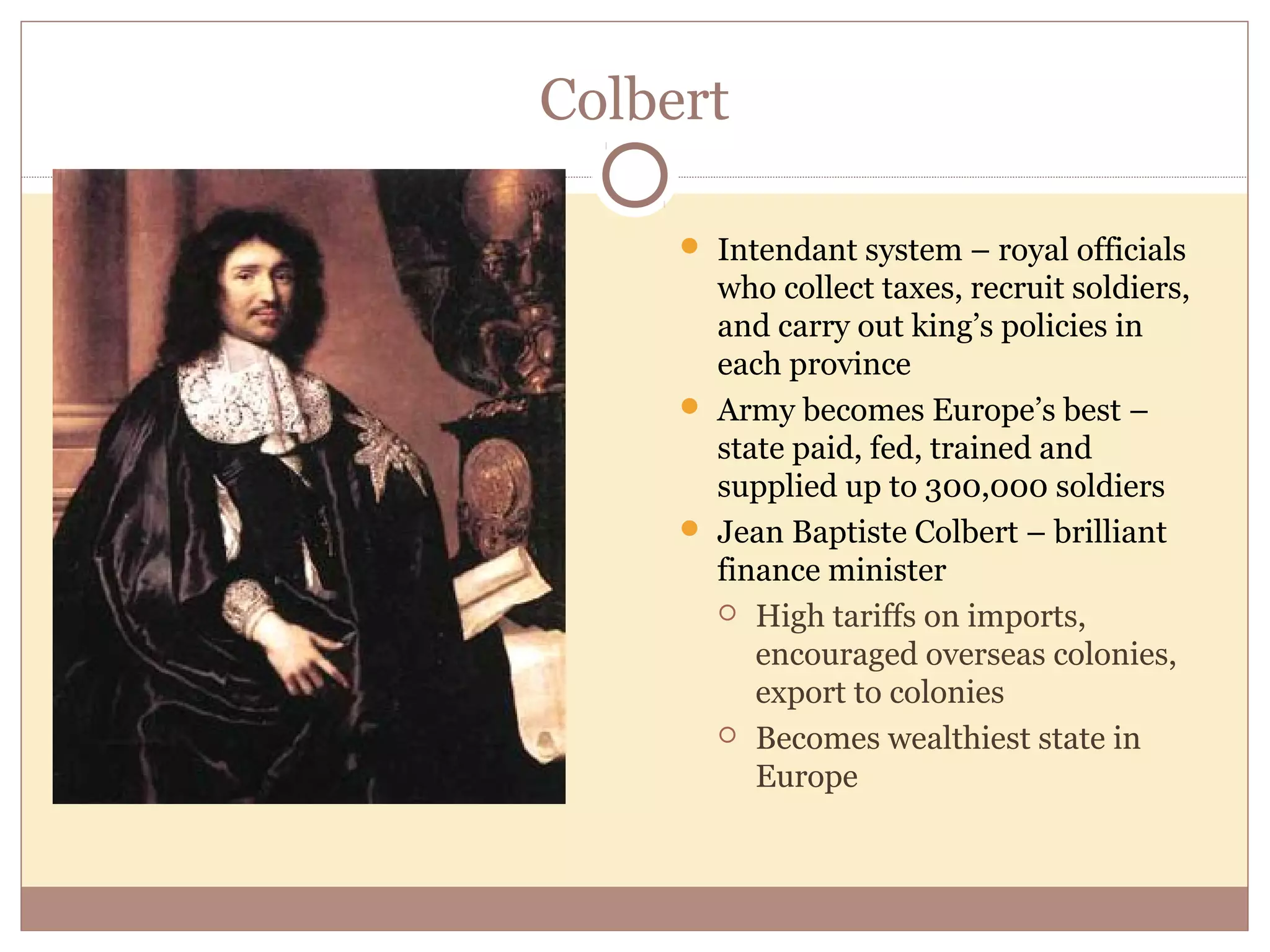
Colbert

      Intendant system – royal officials
       who collect taxes, recruit soldiers,
       and carry out king’s policies in
       each province
      Army becomes Europe’s best –
       state paid, fed, trained and
       supplied up to 300,000 soldiers
      Jean Baptiste Colbert – brilliant
       finance minister
        High tariffs on imports,
          encouraged overseas colonies,
          export to colonies
        Becomes wealthiest state in
          Europe
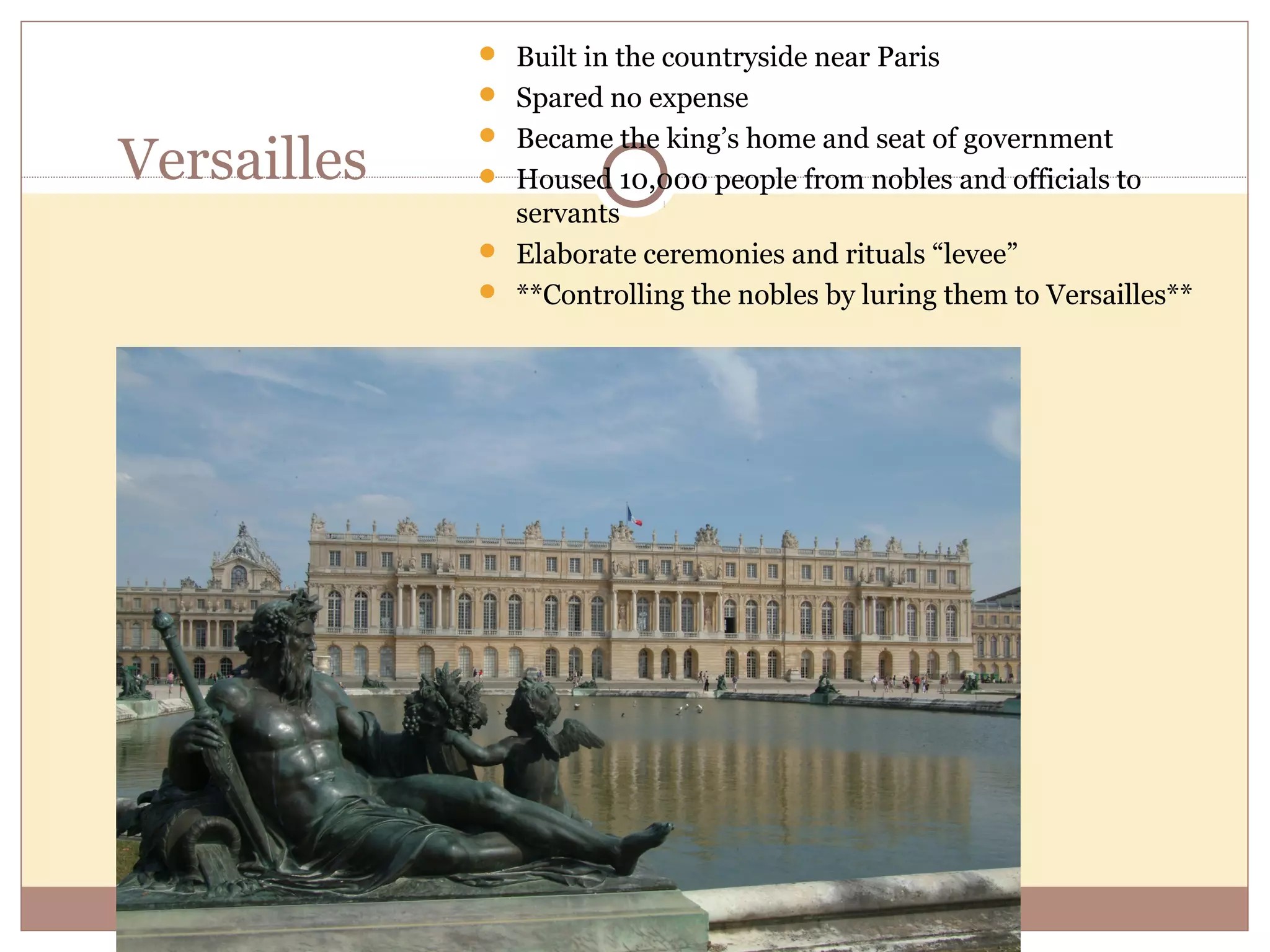
 Built in the countryside near Paris
              Spared no expense
              Became the king’s home and seat of government
Versailles    Housed 10,000 people from nobles and officials to
               servants
              Elaborate ceremonies and rituals “levee”
              **Controlling the nobles by luring them to Versailles**
Triumph of Parliament in England

 Tudors Line of Successors –
   While the Tudor rulers believe in divine right, they also gave
    Parliament consideration
 King Henry VIII
   Asked Parliament to pass the Act of Supremacy – when they do, the
    monarch of England becomes the head of the Church of England
   Parliament becomes used to being consulted

 Edward VI
 Mary I
 Queen Elizabeth I – 1559-1603
   Consulted Parliament when needed, made her a very popular ruler

   Forbade Parliament to meddle with the concept of her marriage (or
    lack of)
 When Elizabeth dies in 1603, no direct heir
 Stuarts – ruling family of Scotland, closest
  relative
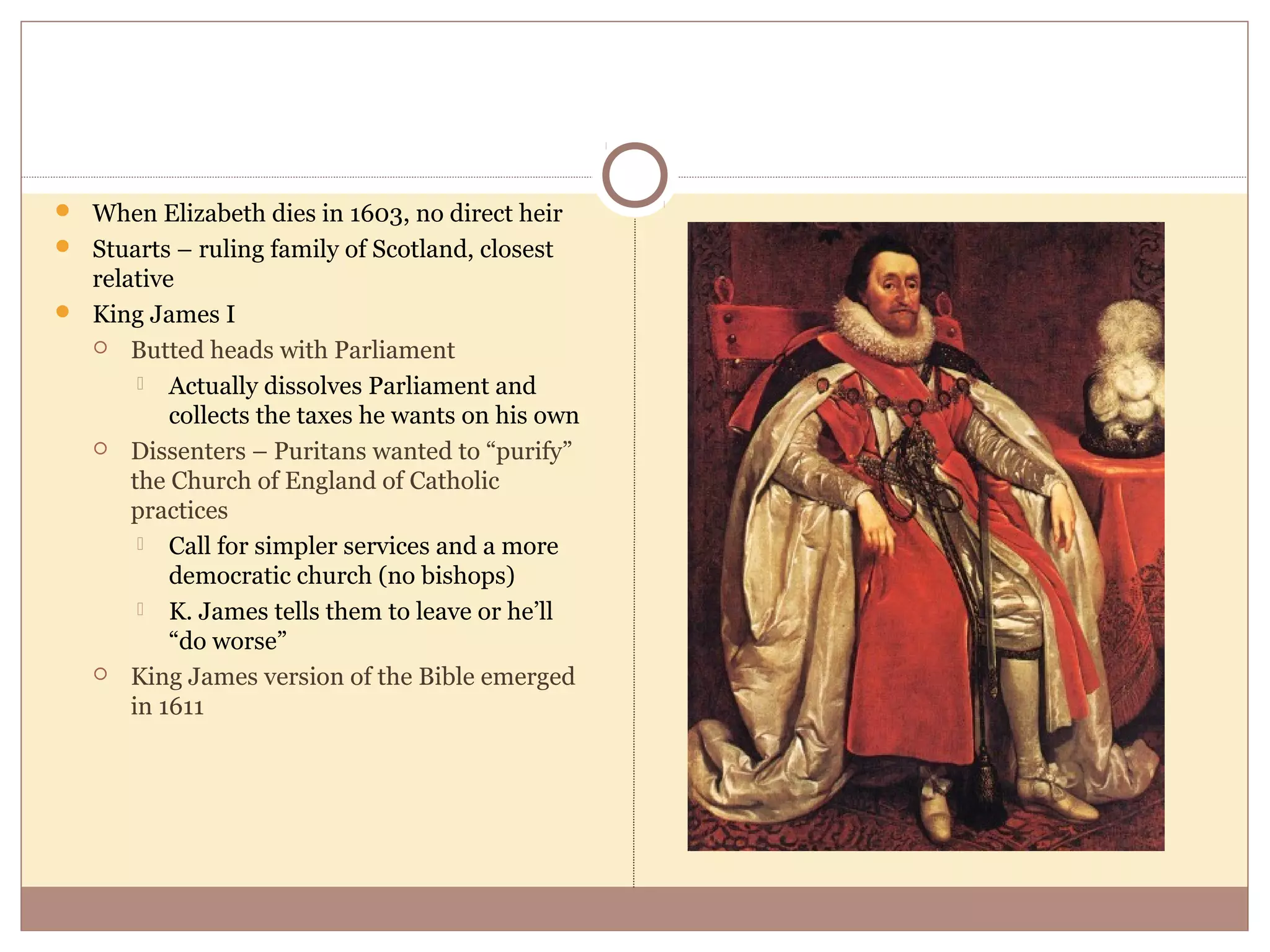
 King James I
   Butted heads with Parliament

        Actually dissolves Parliament and
          collects the taxes he wants on his own
   Dissenters – Puritans wanted to “purify”
      the Church of England of Catholic
      practices
        Call for simpler services and a more
          democratic church (no bishops)
        K. James tells them to leave or he’ll
          “do worse”
   King James version of the Bible emerged
      in 1611
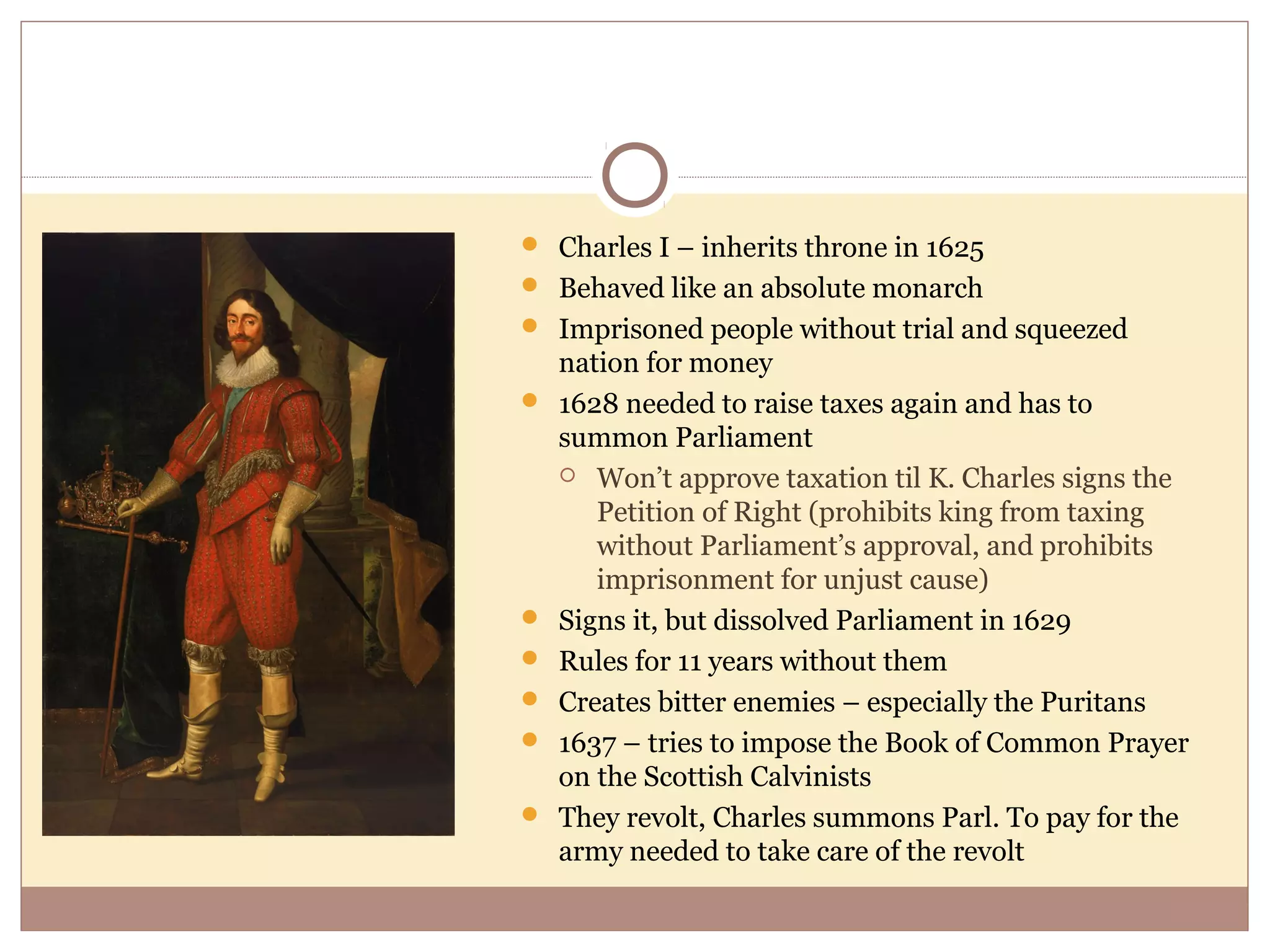
 Charles I – inherits throne in 1625
 Behaved like an absolute monarch
 Imprisoned people without trial and squeezed
    nation for money
   1628 needed to raise taxes again and has to
    summon Parliament
     Won’t approve taxation til K. Charles signs the
       Petition of Right (prohibits king from taxing
       without Parliament’s approval, and prohibits
       imprisonment for unjust cause)
   Signs it, but dissolved Parliament in 1629
   Rules for 11 years without them
   Creates bitter enemies – especially the Puritans
   1637 – tries to impose the Book of Common Prayer
    on the Scottish Calvinists
   They revolt, Charles summons Parl. To pay for the
    army needed to take care of the revolt
The Long Parliament
Met on and off from 1640-1653
Parliament tried and executed the King’s chief
 ministers
Declare Parliament can’t be dissolved without their
 own consent
Charles I lashes back
Leads troops into the House of Commons to arrest
 its most radical leaders
    They escape through the back door and flee to form their
     own armies
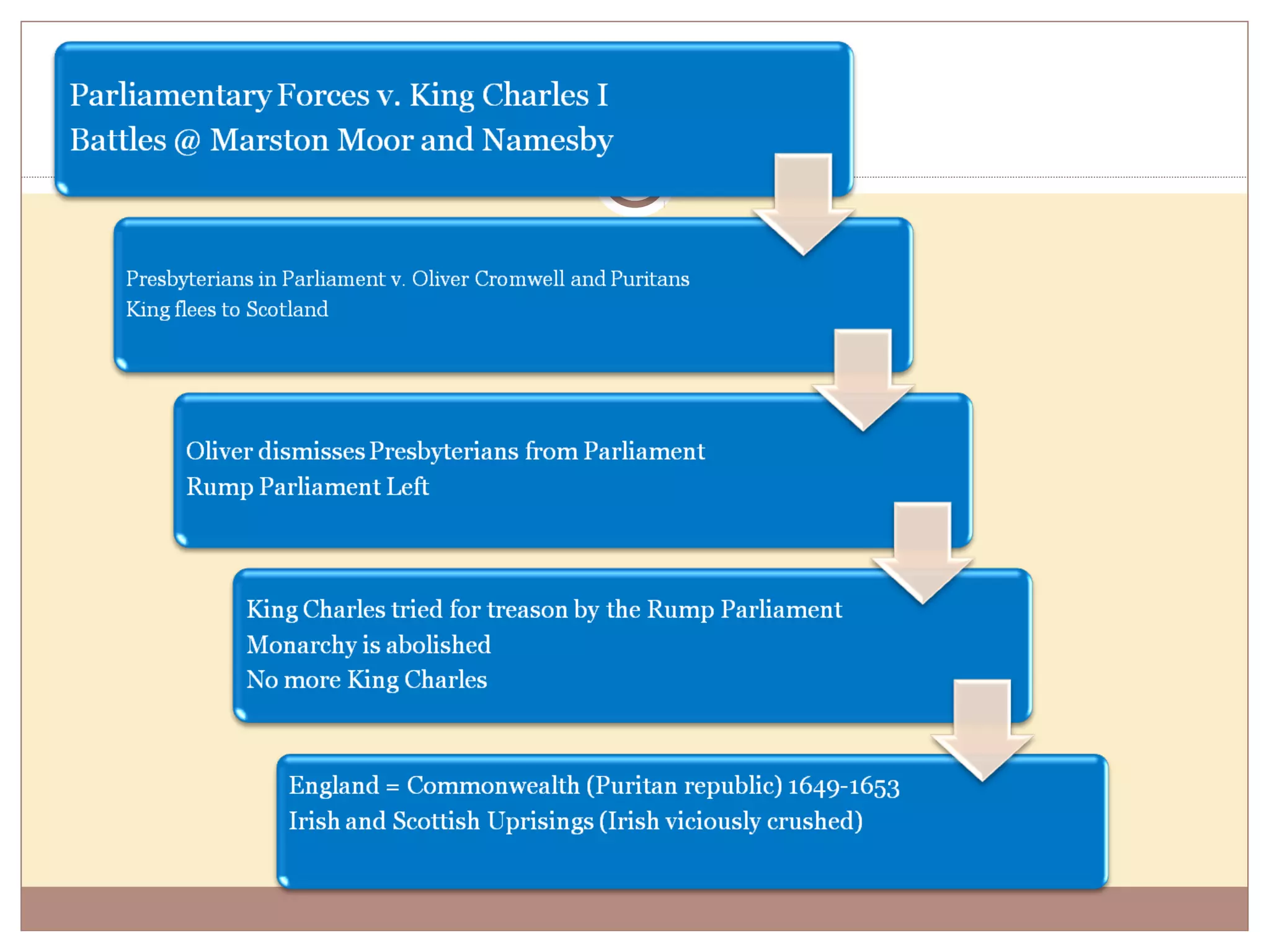
English Civil War

 1642-1649
 Cavaliers v. Roundheads
 Charles I and supporters v.
  Parliament and supporters –
  country gentry, town-dwelling
  manufacturers, and Puritan clergy
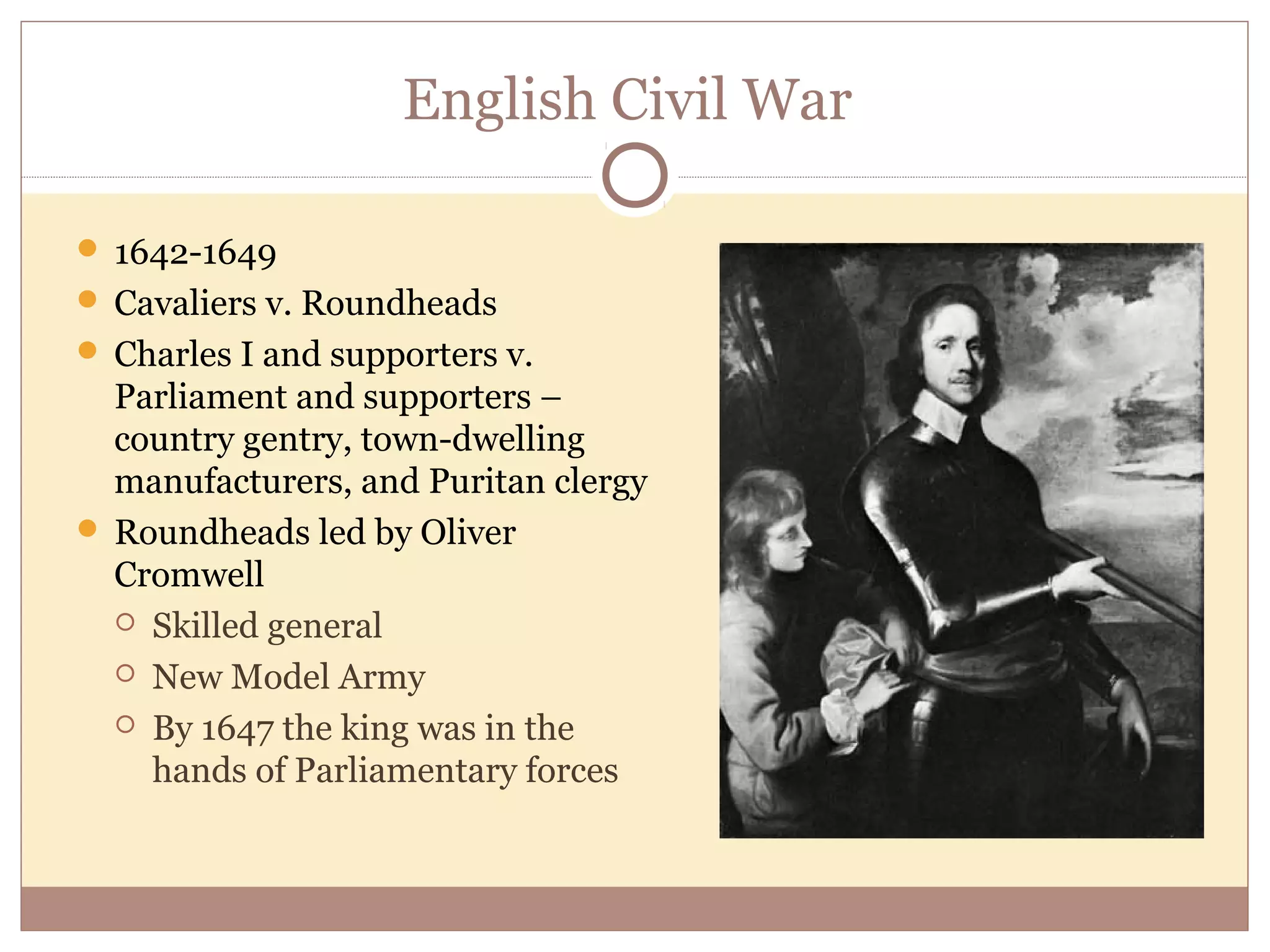
 Roundheads led by Oliver
  Cromwell
   Skilled general

   New Model Army

   By 1647 the king was in the
    hands of Parliamentary forces
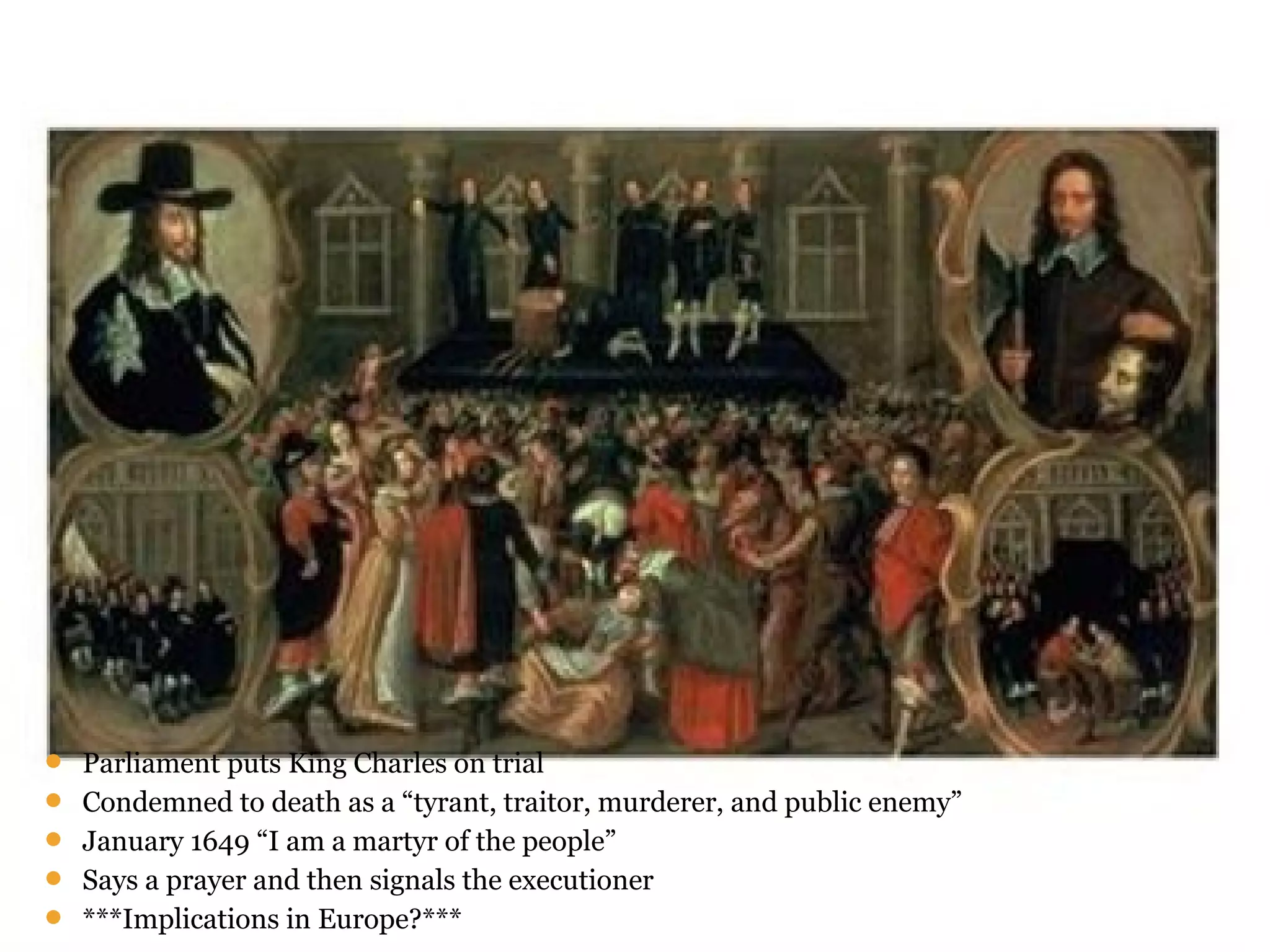
 Parliament puts King Charles on trial
 Condemned to death as a “tyrant, traitor, murderer, and public enemy”
 January 1649 “I am a martyr of the people”
 Says a prayer and then signals the executioner
 ***Implications in Europe?***
Shockwave through Europe
Kings had been assassinated or killed in battle but
 never tried and executed by their own people
In England – no ruler can claim absolute power and
 ignore the rule of law
The Commonwealth

The House of Commons abolishes the monarchy, the
 House of Lords, and the Church of England
Declares England a republic, called the
 Commonwealth
Oliver Cromwell will serve as their leader
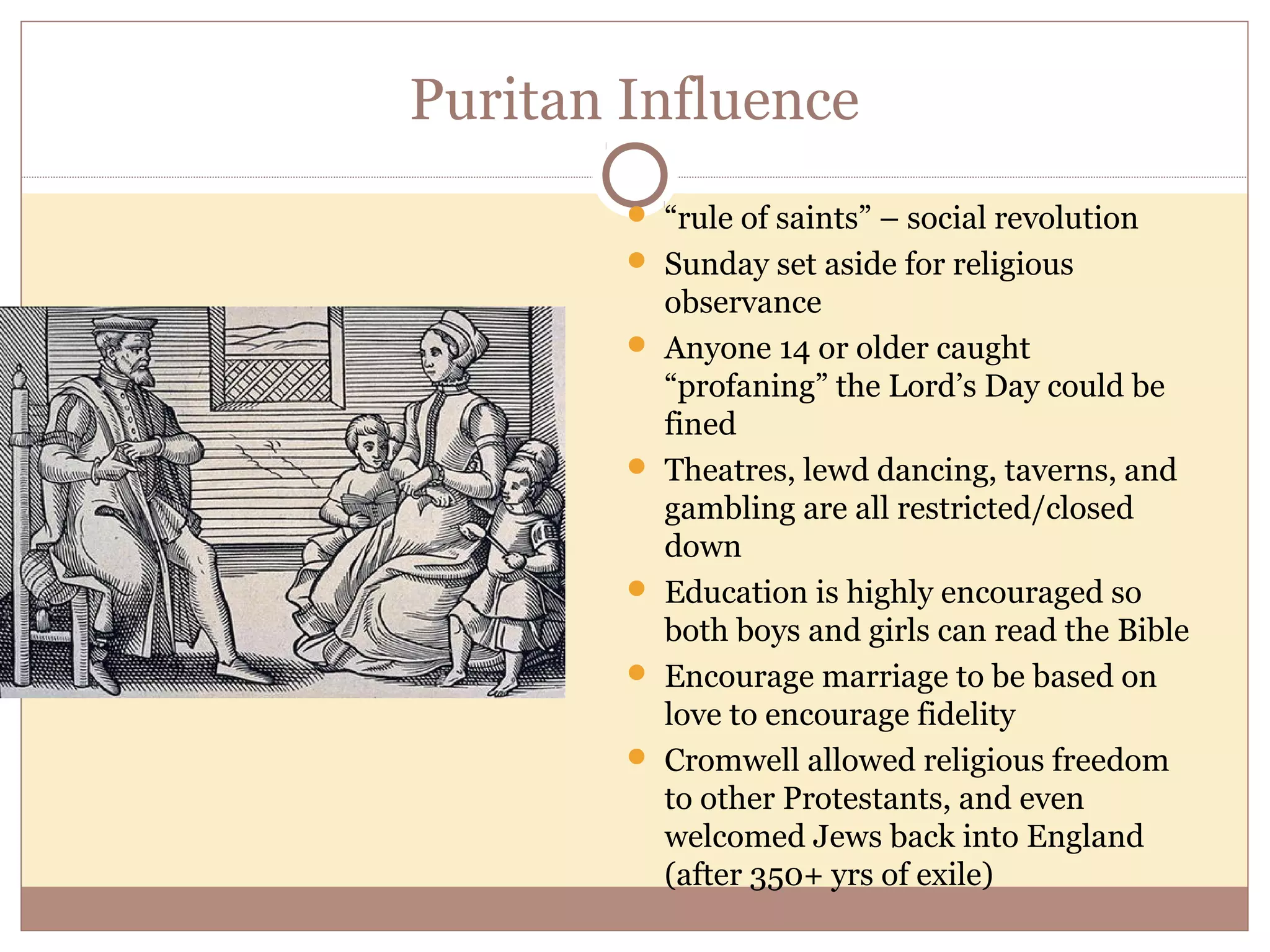
Puritan Influence
         “rule of saints” – social revolution
         Sunday set aside for religious
            observance
           Anyone 14 or older caught
            “profaning” the Lord’s Day could be
            fined
           Theatres, lewd dancing, taverns, and
            gambling are all restricted/closed
            down
           Education is highly encouraged so
            both boys and girls can read the Bible
           Encourage marriage to be based on
            love to encourage fidelity
           Cromwell allowed religious freedom
            to other Protestants, and even
            welcomed Jews back into England
            (after 350+ yrs of exile)
Lord protector

Oliver can’t get along with the Rump
 Parliament either
    House of Commons wants to disband Cromwell’s
     50,000 man army
    So he disbands Parliament
1653 – Declares himself Lord Protector
    Imposes Puritan prohibitions
    Creates the first written constitution for his
     “republic”…de facto dictatorship
    Dies 1658, son Richard succeeds him, but England has
     had enough
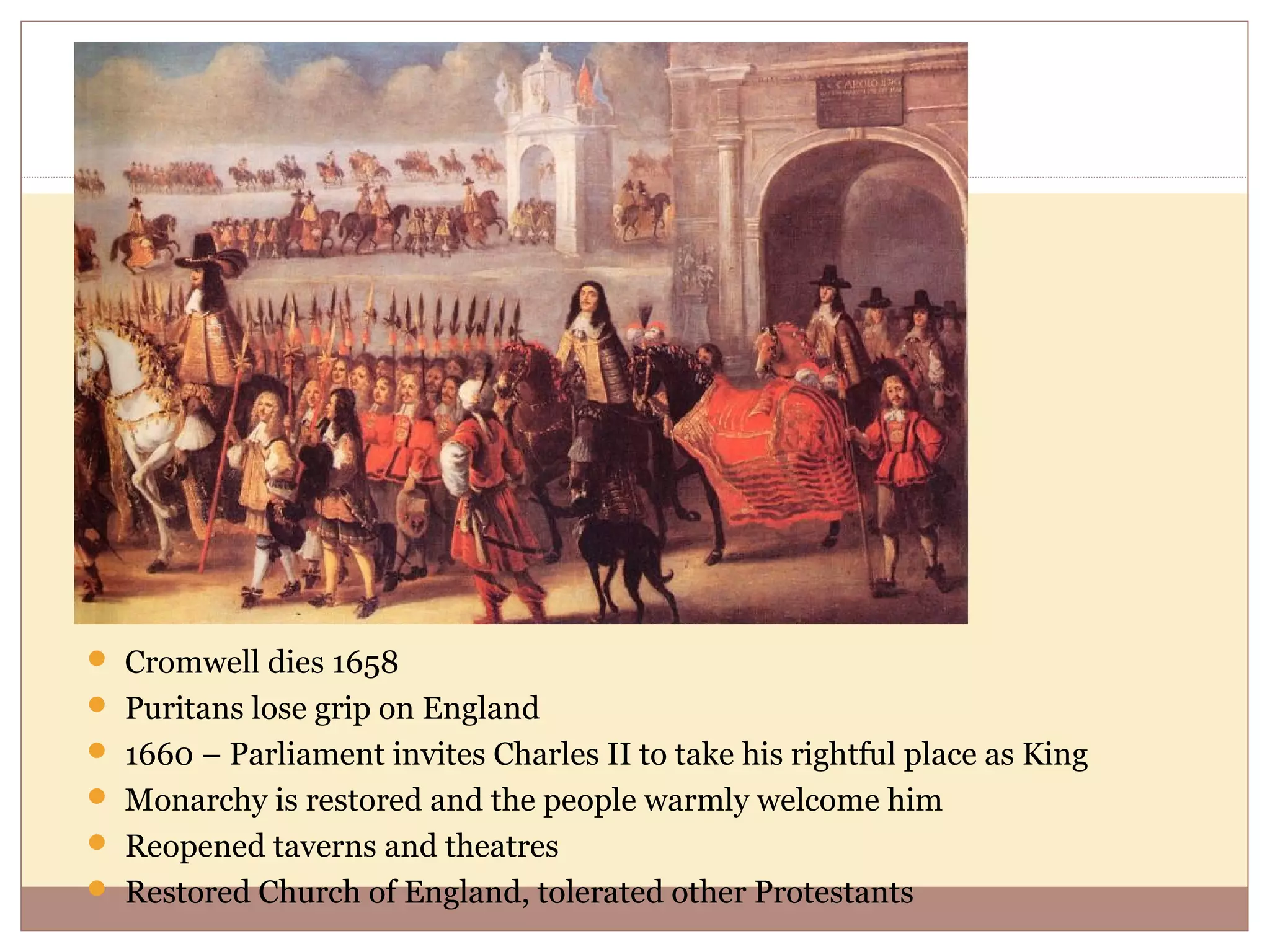
 Cromwell dies 1658
 Puritans lose grip on England
 1660 – Parliament invites Charles II to take his rightful place as King
 Monarchy is restored and the people warmly welcome him
 Reopened taverns and theatres
 Restored Church of England, tolerated other Protestants
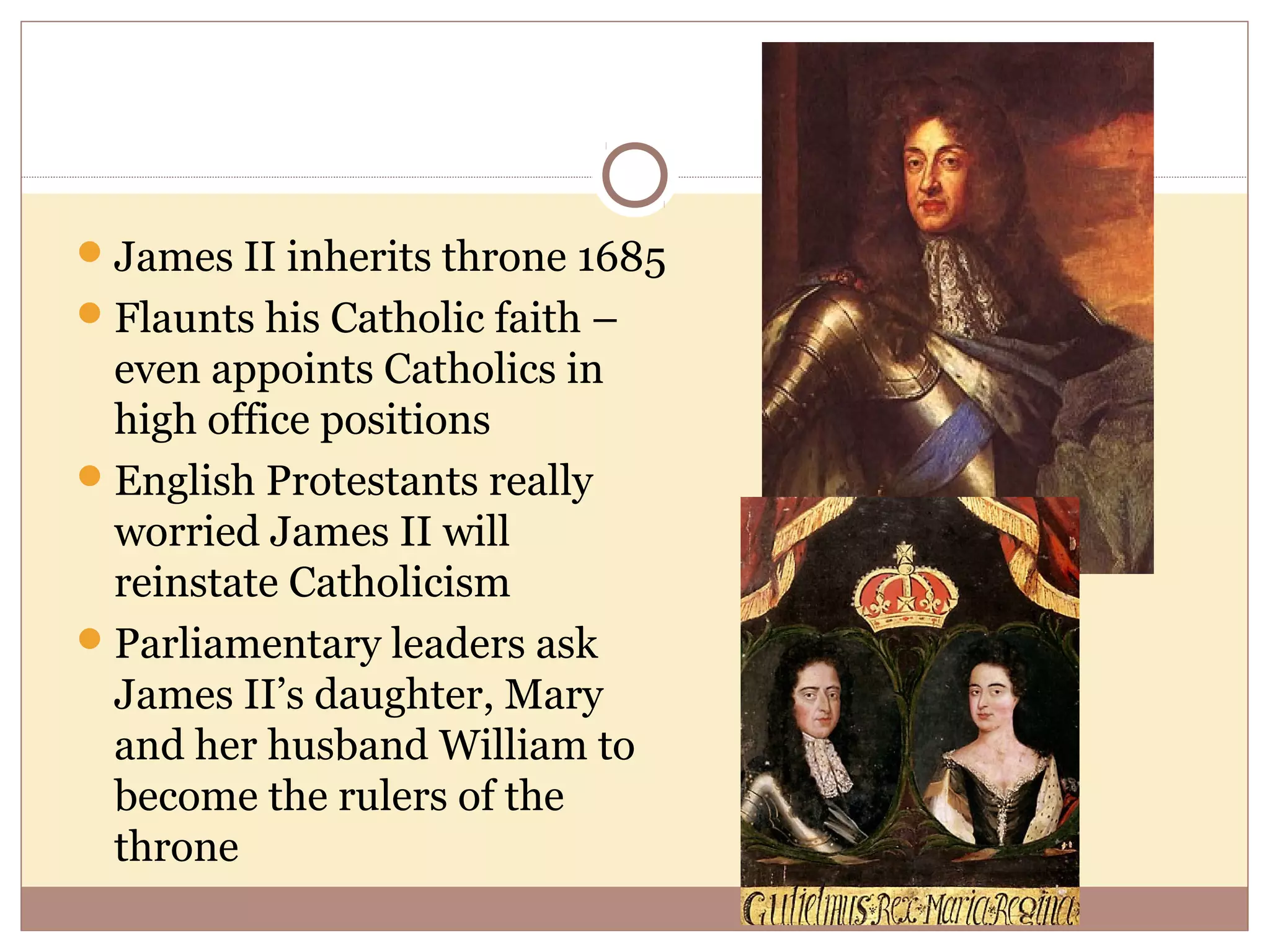
 James II inherits throne 1685
 Flaunts his Catholic faith –
  even appoints Catholics in
  high office positions
 English Protestants really
  worried James II will
  reinstate Catholicism
 Parliamentary leaders ask
  James II’s daughter, Mary
  and her husband William to
  become the rulers of the
  throne
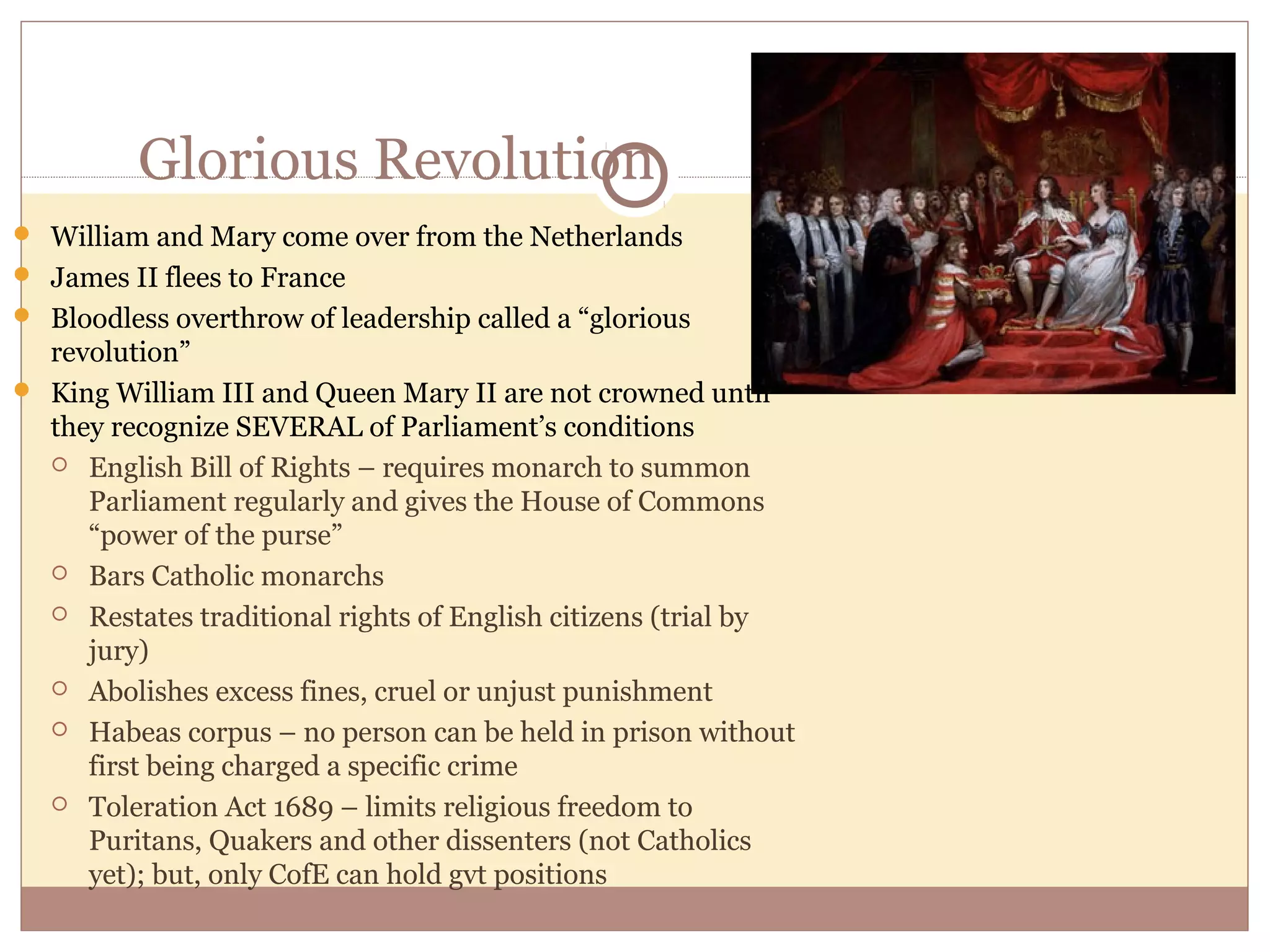
Glorious Revolution
 William and Mary come over from the Netherlands
 James II flees to France
 Bloodless overthrow of leadership called a “glorious
  revolution”
 King William III and Queen Mary II are not crowned until
  they recognize SEVERAL of Parliament’s conditions
   English Bill of Rights – requires monarch to summon
     Parliament regularly and gives the House of Commons
     “power of the purse”
   Bars Catholic monarchs

   Restates traditional rights of English citizens (trial by
     jury)
   Abolishes excess fines, cruel or unjust punishment

   Habeas corpus – no person can be held in prison without
     first being charged a specific crime
   Toleration Act 1689 – limits religious freedom to
     Puritans, Quakers and other dissenters (not Catholics
     yet); but, only CofE can hold gvt positions
Enlightenment

Early Philosopher –
Thomas Hobbes
    Humans are flawed and need strong, harsh leadership
John Locke
    Natural rights
    Tabula rasa
    Social contract
Enlightenment Philosophers
    Rousseau – “Social Contract”
    Montesquieu – checks and balances
Status Check

Spain
France
England
HRE
Italy
The Church
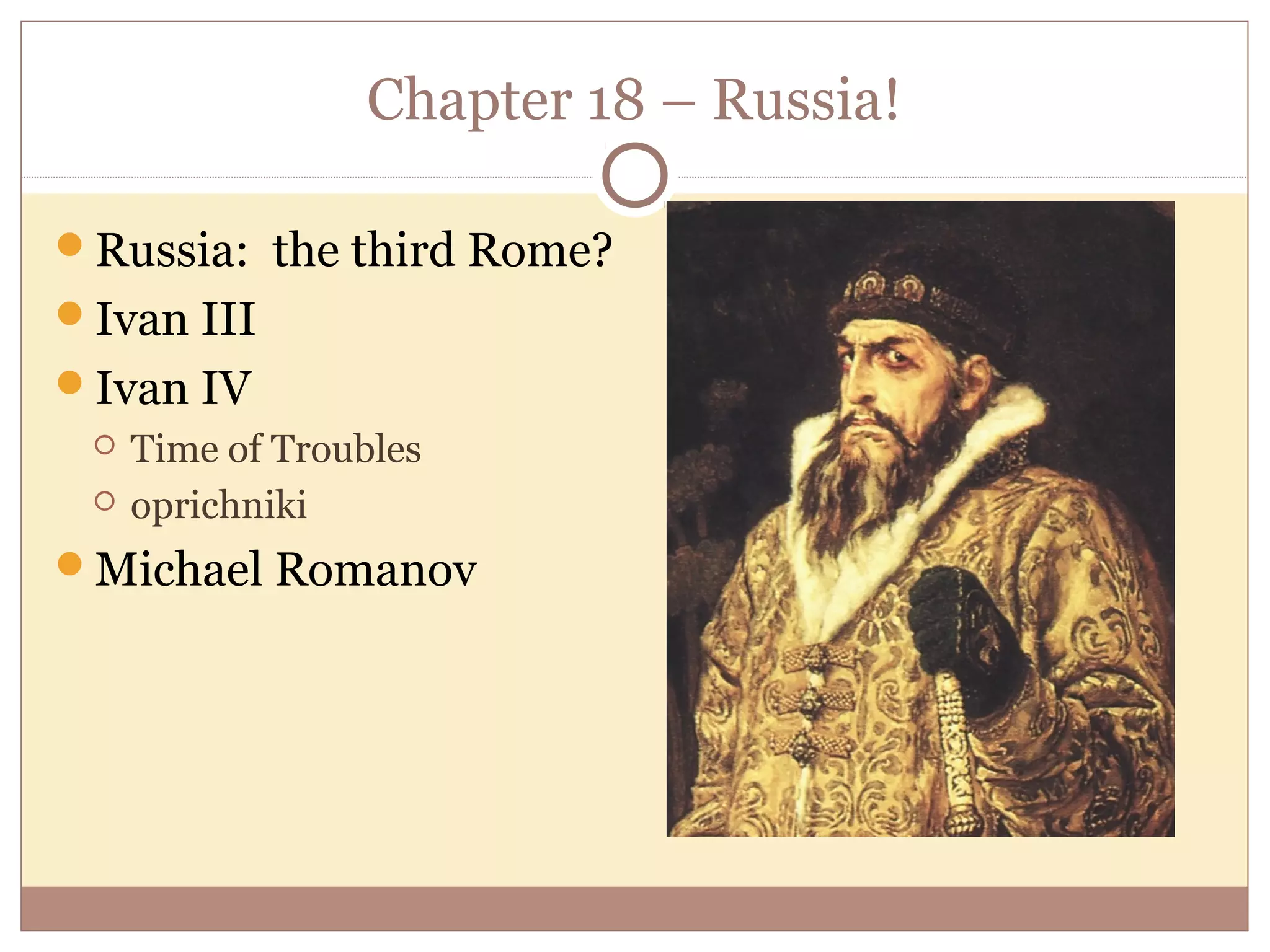
Chapter 18 – Russia!

Russia: the third Rome?
Ivan III
Ivan IV
    Time of Troubles
    oprichniki
Michael Romanov
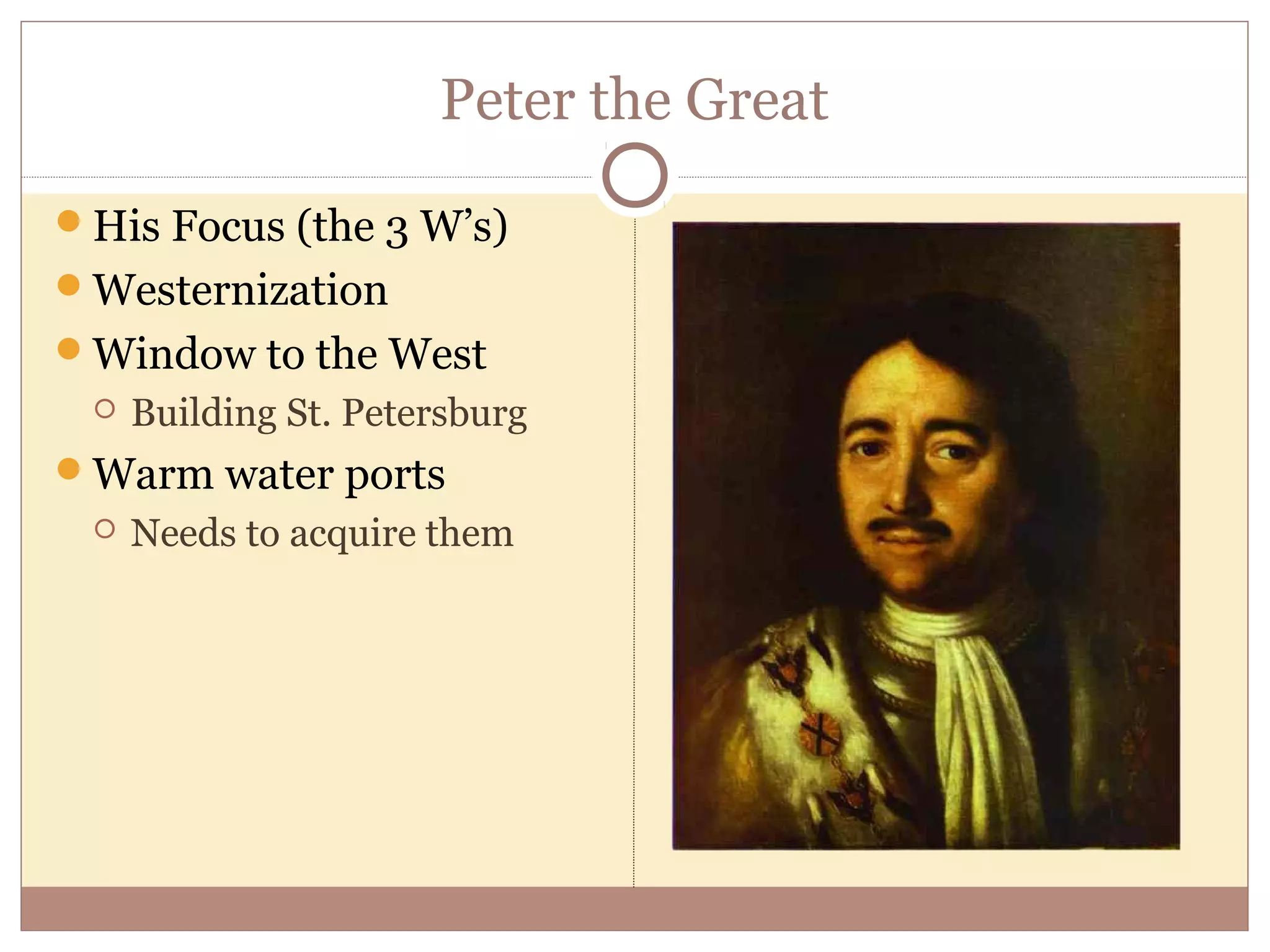
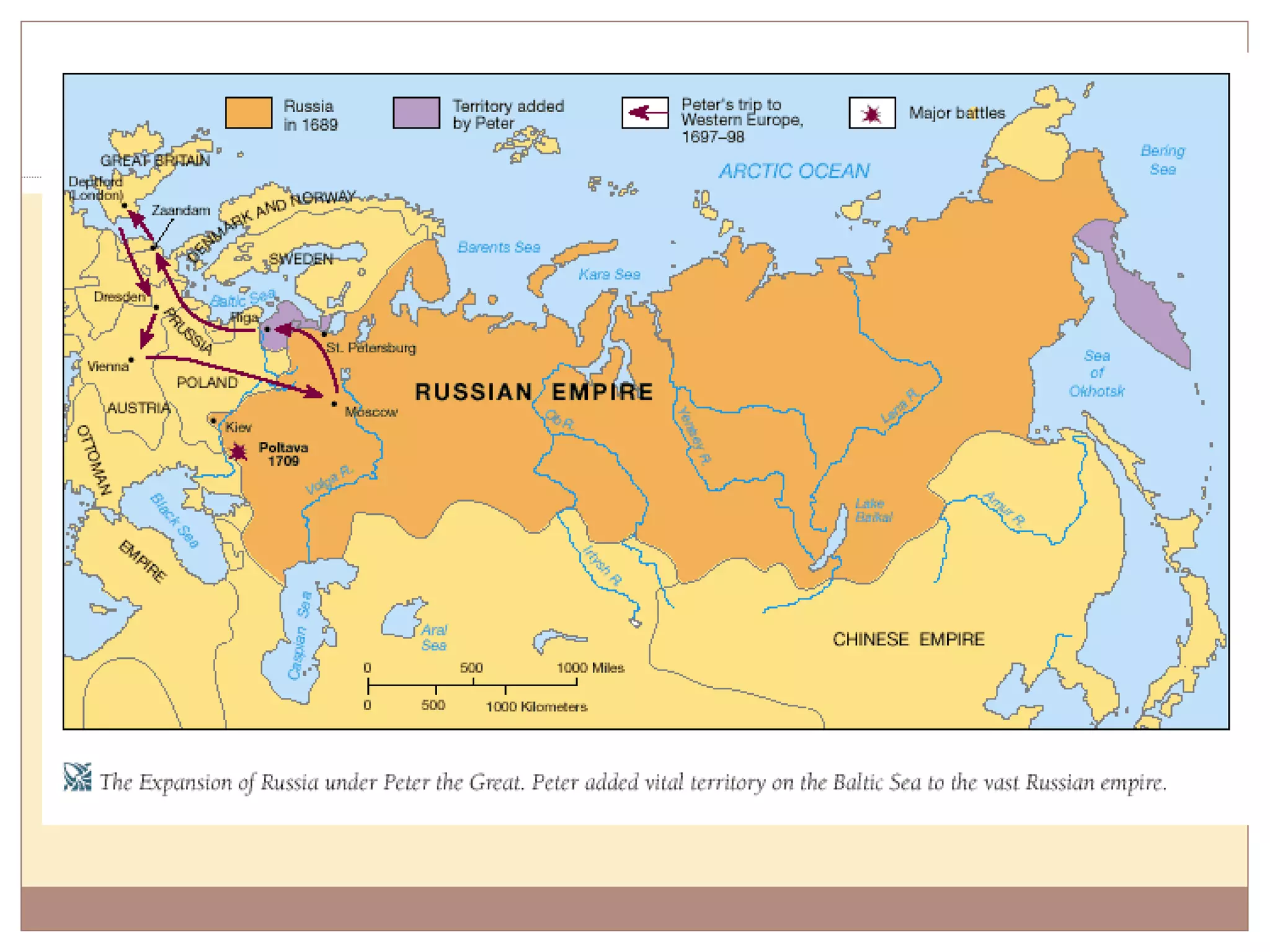
Peter the Great
His Focus (the 3 W’s)
Westernization
Window to the West
    Building St. Petersburg
Warm water ports
    Needs to acquire them
Selective Borrowing

Toured all over Europe incognito
Shipbuilding from Holland
Ballet from France
Christmas trees from Germany
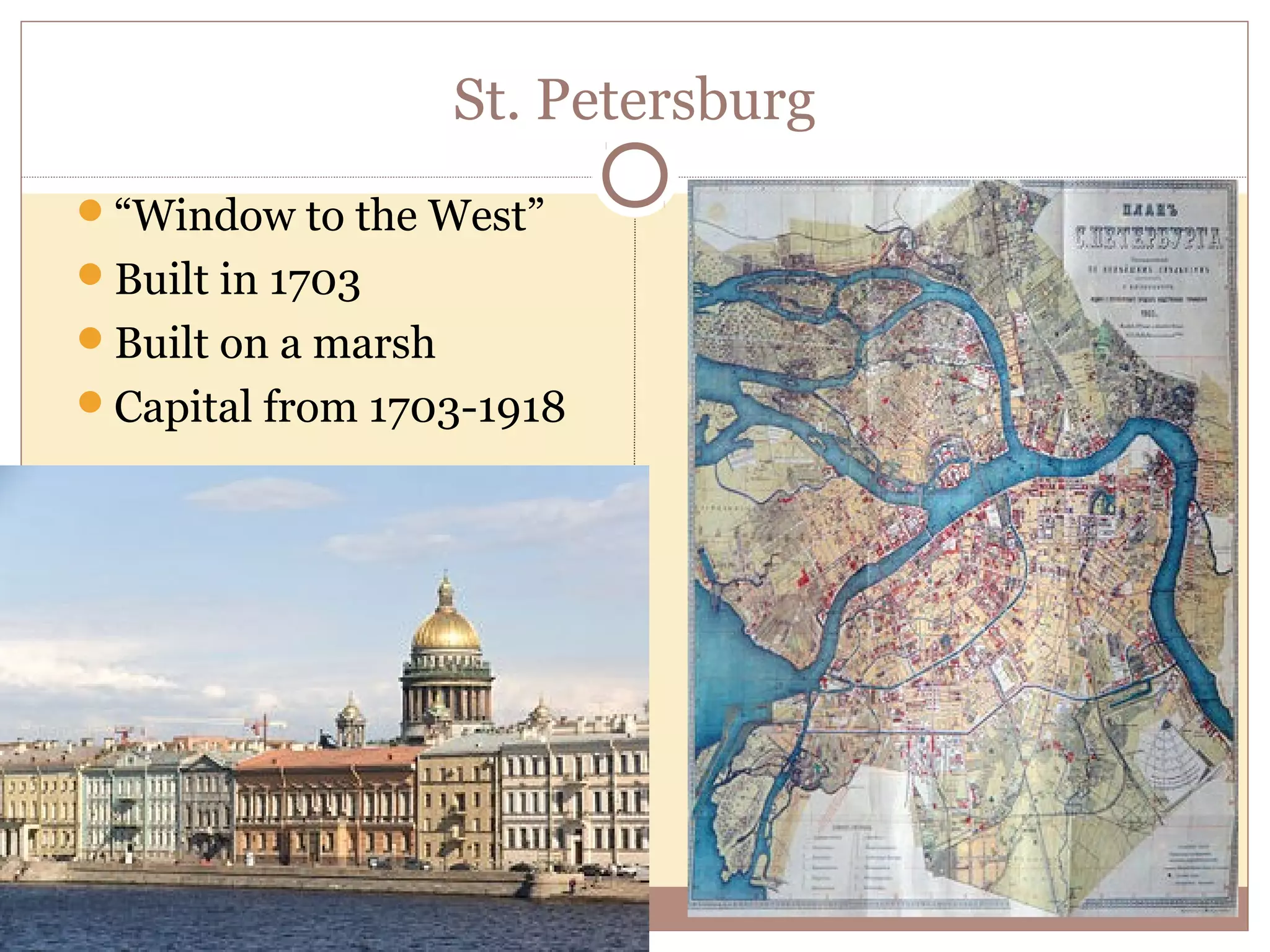
St. Petersburg
“Window to the West”
Built in 1703
Built on a marsh
Capital from 1703-1918
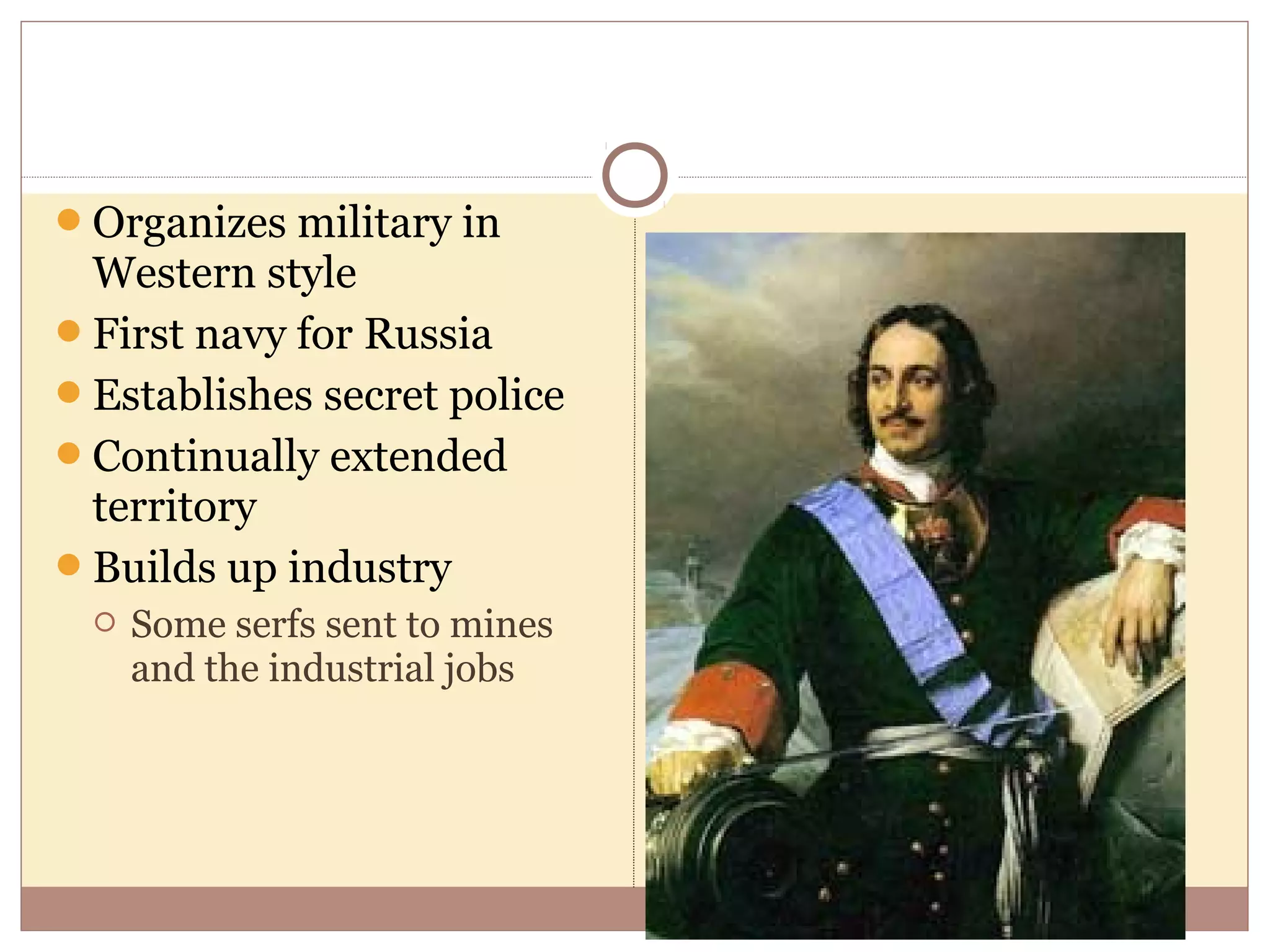
Organizes military in
 Western style
First navy for Russia
Establishes secret police
Continually extended
 territory
Builds up industry
    Some serfs sent to mines
     and the industrial jobs
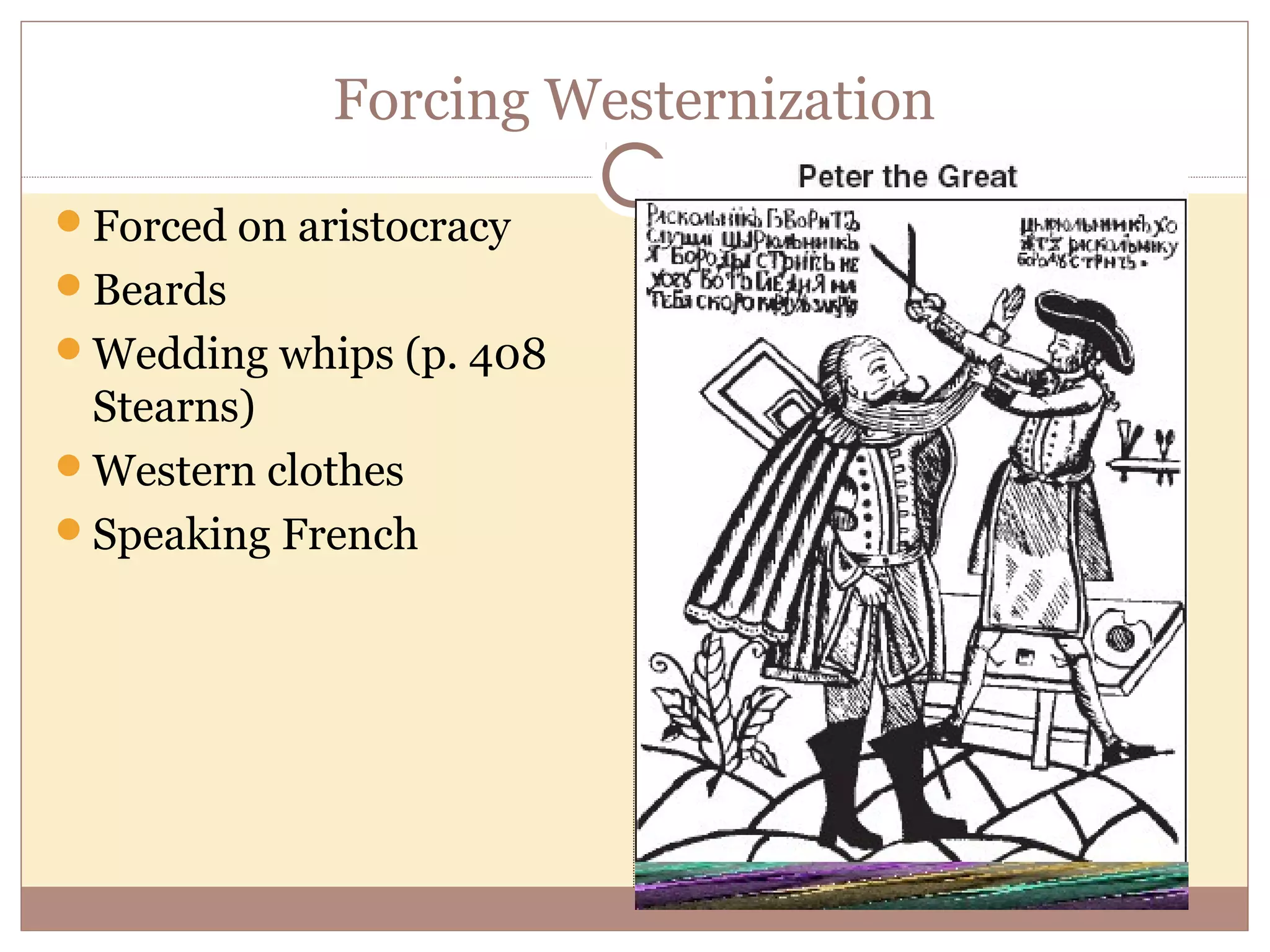
Forcing Westernization
Forced on aristocracy
Beards
Wedding whips (p. 408
 Stearns)
Western clothes
Speaking French
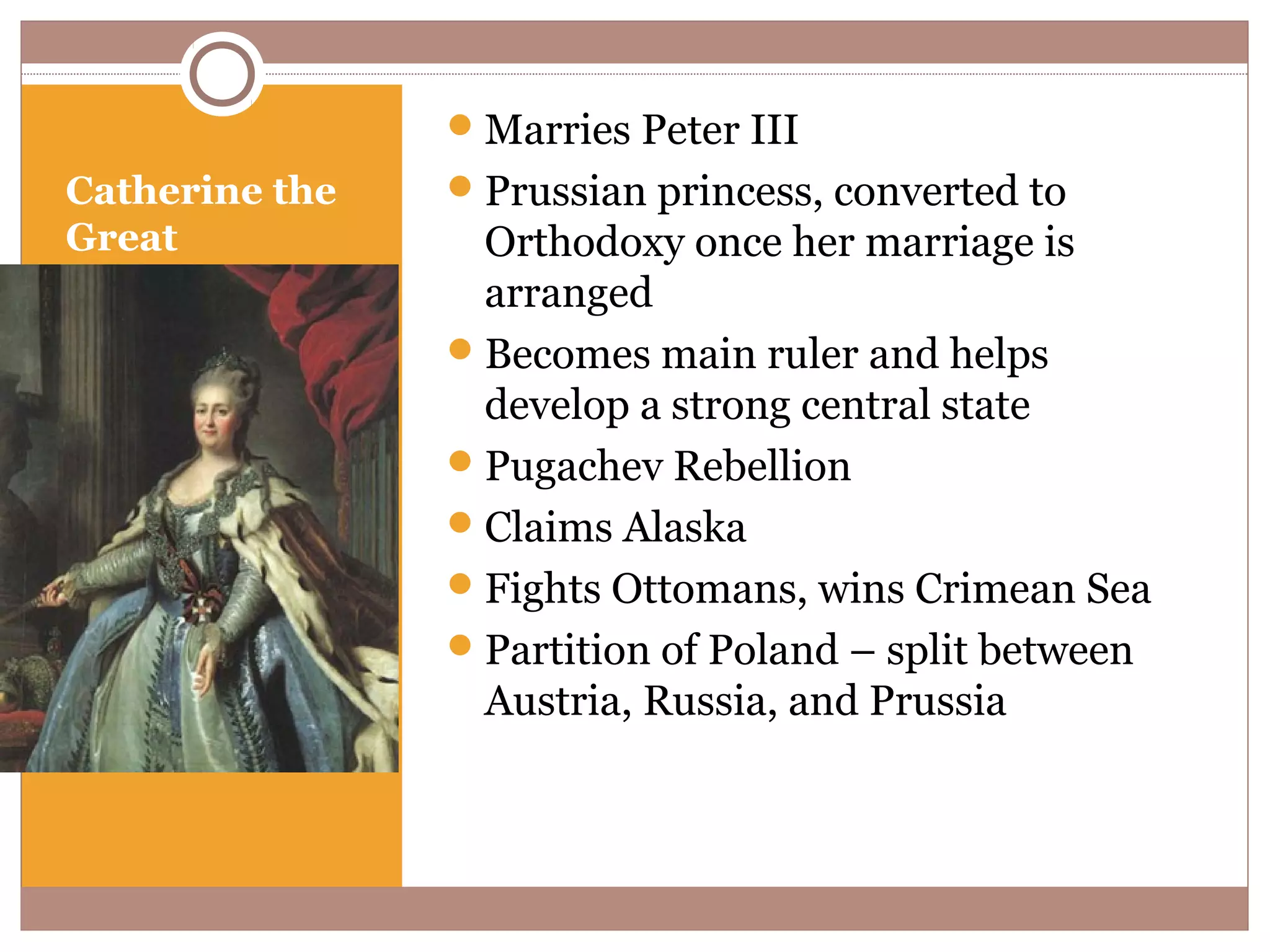
 Marries Peter III
Catherine the    Prussian princess, converted to
Great             Orthodoxy once her marriage is
                  arranged
                 Becomes main ruler and helps
                  develop a strong central state
                 Pugachev Rebellion
                 Claims Alaska
                 Fights Ottomans, wins Crimean Sea
                 Partition of Poland – split between
                  Austria, Russia, and Prussia

Chapter 17- The Development of the West

  • 1.
    Chapter 17 The Transformationof the West 1450 - 1750
  • 2.
    Italian Renaissance Challenge ofmedieval values and styles Boccaccio and Petrarch promote values in their writing that is contrary to medieval logic and theology Niccolo Machiavelli – The Prince – political theory, discussed realistic ways to seize and maintain power. Humanism – focus on human kind as the center of intellectual and artistic endeavor  Religion isn’t attacked, but is no longer the dominant focus
  • 3.
    Niccolo Machiavelli The Prince Publishedin 1513 Combined personal experience of politics with his knowledge of the past to offer a guide to rulers on how to gain and maintain power “The end justifies the means” (do what you gotta do) Ruthless power politics, use whatever methods necessary to achieve goals Controversy? - some see this as an excuse to be corrupt and deceitful politicians
  • 4.
    Influence? Commerce – merchantsimprove banking techniques, b/m more openly profit-seeking Political – leaders rule with emphasis on what they could do to advance the well-being and glory of their city  Develop professional armies  Sponsored cultural activities
  • 5.
    Italian City-States  Florence, Milan, Venice, Genoa, Rome, Naples, etc.  Because Italy was the center of the Roman Empire, Italy was a natural place for the birth of the Renaissance.  Merchant class – wealthy and powerful, promoted cultural revival. Stressed education, individual achievement, and lavishly supported the arts.
  • 6.
  • 7.
    Northern Renaissance  AlbrechtDurer – “German Leonardo”  Studied in Italy  Wide-range of interests, painted and created engravings  Engravings – artists etches a design on a metal plate with acid and uses the plate to make prints  Flemish painters – develop oil paint, which survives time more successfully  Hubert van Eyck  Paintings of townspeople and religious scenes, realistic details  Pieter Bruegel  Vibrant colors to portrayal lively scenes of peasant life  Peter Paul Rubens  Enormous paintings of pagan figures from the classical past
  • 8.
    Albrecht Durer –Praying Hands
  • 9.
  • 11.
    Jan van Eyck– The Arnolfini Marriage
  • 12.
    The Virgin ofChancellor Rolin
  • 13.
  • 14.
    Pieter Bruegel –Peasant Wedding
  • 15.
  • 16.
  • 17.
    Northern Humanists Erasmus –(Desiderius)  Thought Bible should be translated to vernacular  The Praise of Folly – uses humor to expose ignorant and immoral behavior by limiting church to Latin it is as if “the strength of the Christian religion consisted in the ignorance of it”  Thomas More’s Utopia  Ideas society in which men and women live in peace and harmony, no one is idle, all are educated, justice is used to end crime  Utopian “ideal society”
  • 19.
    Writers for aNew Audience  Shakespeare – England  Renaissance playwright and poet  1590-1613 – wrote 37 plays  Increases vocab of the English language – over 1,700 words (bedroom, lonely, generous, gloomy, heartsick, etc)
  • 20.
    Printing Revolution  1456- Johann Gutenberg, Mainz, Germany  Developed movable type  Created first printing press and the first complete edition of the Bible  By 1500 over 20 million volumes were printed  Cheaper and easier to produce  Literacy rates increase  Broad range of knowledge
  • 21.
    Martin Luther  Wasa devout Catholic, served as a monk, tried to continually bring himself closer to God  Nails his Ninety-five Theses to the door of the Castle Church in Wittenberg, Germany on All Hallows Eve, 1517  Protests sale of indulgences (“Heaven Insurance” for you and your loved ones – dead or alive!)  Salvation by faith alone; he opposed the Catholic Church’s beliefs in penance and good works  Bible is the only authority for Christian life; Pope is a false authority  Priesthood of all believers – each person should have an individual relationship with God and should read/interpret the Bible for him/herself  All people are equal in the eyes of God
  • 22.
    Wrote many books,essays, and letters – which are quickly printed and spread throughout Luther was not easily silenced – he ideas shake Europe
  • 23.
    Pope Leo Xissues a Papal Bull June 15,1520 and threatens to excommunicate Luther unless he recanted Luther and his students at the University of Witten berg burned the Papal Bull in a bonfire Pope excommunicates Luther
  • 24.
     Charles V– HRE  1521 – summons Luther to the Imperial Diet at Worms to stand trial  Refuses to recant his ideas,  “Unless I am convinced by Scripture and plain reason…my conscience is captive to the Word of God. I cannot and I will not recant anything, for to go against conscience is neither right nor safe. Here I stand. I cannot do otherwise. Amen.”  Charles V replies –  “A single friar who goes counter to all Christianity for a thousand years must be wrong…I will proceed against him as a notorious heretic”  Charles V issues Edict of Worms – declaring Luther an outlaw and heretic
  • 25.
     Frederick theWise – German prince of Saxony, protects Luther in his castle for the first year after the Diet of Worms  Spends the year translating the New Testament into German  Luther’s ideas were practiced – priests began leading worship in German, calling themselves “ministers”  People give up on trying to reform the Catholic Church and become a group known as Lutherans
  • 26.
    Changing Views ofthe Universe  Copernicus  Heliocentric theory – sun is center of universe, Earth revolves around sun  On the Revolutions of the Heavenly Spheres  Tycho Brahe  Evidence to support Copernicus’s theory  Galileo  Assembled astronomical telescope  Sees Jupiter with moons rotating around it, like Copernicus’s claim of the Earth around the sun  Condemned for challenging Christian teachings that the heavens are fixed, unmoving and perfect  Tried before the Inquisition, was threatened death if he didn’t rescind his claims (he gives in)
  • 27.
  • 28.
    Extending Spanish Power  Charles V and the Hapsburg Empire  Inherits huge empire – Spain and the Austrian Hapsburg Empire  Reign of continual conflict  Protestant Reformation  Ottoman empire and Suleiman – up to Vienna  Charles V divides his empire, gives up his titles, and enters a monastery in 1556  HRE lands to bro- Ferdinand  Spain and Netherlands to his son, Philip (Philip II)
  • 29.
    King Philip IIof Spain  1556-1598  Hard-working  Devout and ambitious  42 year reign  Made his own power absolute  Claimed divine right  Saw himself as guardian of the Catholic Church and worked to strengthen it  Enforced religious unity  Spanish Inquisition against Protestants and heretics
  • 30.
    Netherlands viciously revoltedfor freedom from Spain’s reign  Revolts in the 1560’s, 1581 – Dutch Netherlands (they’re Protestant btw), not official til 1648 Queen Elizabeth I of England is the archenemy (she and England are Protestant)  Queen Elizabeth secretly, then openly supported the Netherlands efforts for freedom  Encouraged Sea Dogs (English privateers) to plunder Spanish treasure ships  British navy defeats the Spanish Armada  Spanish had 130 ships 20,000 men and 2,400 artillery  Long term effects of this event!!!
  • 32.
    1600s Spain’s powerand prosperity begin to decline Lack of strong leadership Economic issues  Overseas wars drain wealth  Treasure from the Americas caused imbalance – Spain neglected their agriculture and commerce  Expulsion of Muslims and Jews caused a deficit of skilled artisans and merchants  American gold and silver caused soaring inflation
  • 33.
    France under LouisXIV  Huguenots – French Protestants  Catholicism is majority in France  St. Bartholomew’s Day, August 24, 1572 –  Huguenot and Catholic nobles gather to celebrate a royal wedding  Violence erupts and 3,000 Huguenots are massacred  Many more Huguenots are slaughtered during the next few days  St. Bart’s Day Massacre becomes a symbol of a complete deterioration of order in France
  • 34.
    Henry IV  Huguenotprince who inherits the French throne in 1589  “Paris is well worth a Mass”  Edict of Nantes – 1598  Officially tolerated Huguenots, allowed them to fortify their own towns and cities  “a chicken in every pot”  Attempt to mend peasant life  Improves roads, builds bridges, revives agriculture **by reducing role of nobles, he lays groundwork for absolutism
  • 35.
    Richelieu  Henry IVkilled by an assassin  Louis XIII (his son) becomes king and appoints Cardinal Armand Richeleiu as his chief minister  Richelieu – cunning, capable leader, spends his time strengthening the central government  Tries to destroy nobles’ power  Smashes the walls of Huguenot cities and bans formation of Huguenot armies  Defeated private armies of nobles and destroyed their fortified castles  Handpicks his successor – Cardinal Jules Mazarin
  • 36.
    Louis XIV, the SunKing  Became king at very young age (5 yrs old), Mazarin essentially rules for him  The Fronde – uprising of nobles, merchants, peasants, and urban poor rebel, rioters even drive Louis out of the palace (even as a young boy)  Mazarin dies 1661  “L’etat, c’est moi” – I am the State – Louis XIV takes responsibility for his reign and becomes an absolute monarch.  The Sun – becomes his symbol of absolute power  Sun is the center of the universe and I am the center of the nation “I am the State”  Doesn’t call up the Estates General during his reign (so his power isn’t checked)  From 1614-1789 The Estates General isn’t called up
  • 37.
    Colbert  Intendant system – royal officials who collect taxes, recruit soldiers, and carry out king’s policies in each province  Army becomes Europe’s best – state paid, fed, trained and supplied up to 300,000 soldiers  Jean Baptiste Colbert – brilliant finance minister  High tariffs on imports, encouraged overseas colonies, export to colonies  Becomes wealthiest state in Europe
  • 38.
     Built inthe countryside near Paris  Spared no expense  Became the king’s home and seat of government Versailles  Housed 10,000 people from nobles and officials to servants  Elaborate ceremonies and rituals “levee”  **Controlling the nobles by luring them to Versailles**
  • 39.
    Triumph of Parliamentin England  Tudors Line of Successors –  While the Tudor rulers believe in divine right, they also gave Parliament consideration  King Henry VIII  Asked Parliament to pass the Act of Supremacy – when they do, the monarch of England becomes the head of the Church of England  Parliament becomes used to being consulted  Edward VI  Mary I  Queen Elizabeth I – 1559-1603  Consulted Parliament when needed, made her a very popular ruler  Forbade Parliament to meddle with the concept of her marriage (or lack of)
  • 40.
     When Elizabethdies in 1603, no direct heir  Stuarts – ruling family of Scotland, closest relative  King James I  Butted heads with Parliament  Actually dissolves Parliament and collects the taxes he wants on his own  Dissenters – Puritans wanted to “purify” the Church of England of Catholic practices  Call for simpler services and a more democratic church (no bishops)  K. James tells them to leave or he’ll “do worse”  King James version of the Bible emerged in 1611
  • 41.
     Charles I– inherits throne in 1625  Behaved like an absolute monarch  Imprisoned people without trial and squeezed nation for money  1628 needed to raise taxes again and has to summon Parliament  Won’t approve taxation til K. Charles signs the Petition of Right (prohibits king from taxing without Parliament’s approval, and prohibits imprisonment for unjust cause)  Signs it, but dissolved Parliament in 1629  Rules for 11 years without them  Creates bitter enemies – especially the Puritans  1637 – tries to impose the Book of Common Prayer on the Scottish Calvinists  They revolt, Charles summons Parl. To pay for the army needed to take care of the revolt
  • 42.
    The Long Parliament Meton and off from 1640-1653 Parliament tried and executed the King’s chief ministers Declare Parliament can’t be dissolved without their own consent Charles I lashes back Leads troops into the House of Commons to arrest its most radical leaders  They escape through the back door and flee to form their own armies
  • 43.
    English Civil War 1642-1649  Cavaliers v. Roundheads  Charles I and supporters v. Parliament and supporters – country gentry, town-dwelling manufacturers, and Puritan clergy  Roundheads led by Oliver Cromwell  Skilled general  New Model Army  By 1647 the king was in the hands of Parliamentary forces
  • 44.
     Parliament putsKing Charles on trial  Condemned to death as a “tyrant, traitor, murderer, and public enemy”  January 1649 “I am a martyr of the people”  Says a prayer and then signals the executioner  ***Implications in Europe?***
  • 45.
    Shockwave through Europe Kingshad been assassinated or killed in battle but never tried and executed by their own people In England – no ruler can claim absolute power and ignore the rule of law
  • 46.
    The Commonwealth The Houseof Commons abolishes the monarchy, the House of Lords, and the Church of England Declares England a republic, called the Commonwealth Oliver Cromwell will serve as their leader
  • 48.
    Puritan Influence  “rule of saints” – social revolution  Sunday set aside for religious observance  Anyone 14 or older caught “profaning” the Lord’s Day could be fined  Theatres, lewd dancing, taverns, and gambling are all restricted/closed down  Education is highly encouraged so both boys and girls can read the Bible  Encourage marriage to be based on love to encourage fidelity  Cromwell allowed religious freedom to other Protestants, and even welcomed Jews back into England (after 350+ yrs of exile)
  • 49.
    Lord protector Oliver can’tget along with the Rump Parliament either  House of Commons wants to disband Cromwell’s 50,000 man army  So he disbands Parliament 1653 – Declares himself Lord Protector  Imposes Puritan prohibitions  Creates the first written constitution for his “republic”…de facto dictatorship  Dies 1658, son Richard succeeds him, but England has had enough
  • 50.
     Cromwell dies1658  Puritans lose grip on England  1660 – Parliament invites Charles II to take his rightful place as King  Monarchy is restored and the people warmly welcome him  Reopened taverns and theatres  Restored Church of England, tolerated other Protestants
  • 51.
     James IIinherits throne 1685  Flaunts his Catholic faith – even appoints Catholics in high office positions  English Protestants really worried James II will reinstate Catholicism  Parliamentary leaders ask James II’s daughter, Mary and her husband William to become the rulers of the throne
  • 52.
    Glorious Revolution  Williamand Mary come over from the Netherlands  James II flees to France  Bloodless overthrow of leadership called a “glorious revolution”  King William III and Queen Mary II are not crowned until they recognize SEVERAL of Parliament’s conditions  English Bill of Rights – requires monarch to summon Parliament regularly and gives the House of Commons “power of the purse”  Bars Catholic monarchs  Restates traditional rights of English citizens (trial by jury)  Abolishes excess fines, cruel or unjust punishment  Habeas corpus – no person can be held in prison without first being charged a specific crime  Toleration Act 1689 – limits religious freedom to Puritans, Quakers and other dissenters (not Catholics yet); but, only CofE can hold gvt positions
  • 53.
    Enlightenment Early Philosopher – ThomasHobbes  Humans are flawed and need strong, harsh leadership John Locke  Natural rights  Tabula rasa  Social contract Enlightenment Philosophers  Rousseau – “Social Contract”  Montesquieu – checks and balances
  • 54.
  • 55.
    Chapter 18 –Russia! Russia: the third Rome? Ivan III Ivan IV  Time of Troubles  oprichniki Michael Romanov
  • 56.
    Peter the Great HisFocus (the 3 W’s) Westernization Window to the West  Building St. Petersburg Warm water ports  Needs to acquire them
  • 57.
    Selective Borrowing Toured allover Europe incognito Shipbuilding from Holland Ballet from France Christmas trees from Germany
  • 58.
    St. Petersburg “Window tothe West” Built in 1703 Built on a marsh Capital from 1703-1918
  • 59.
    Organizes military in Western style First navy for Russia Establishes secret police Continually extended territory Builds up industry  Some serfs sent to mines and the industrial jobs
  • 61.
    Forcing Westernization Forced onaristocracy Beards Wedding whips (p. 408 Stearns) Western clothes Speaking French
  • 62.
     Marries PeterIII Catherine the  Prussian princess, converted to Great Orthodoxy once her marriage is arranged  Becomes main ruler and helps develop a strong central state  Pugachev Rebellion  Claims Alaska  Fights Ottomans, wins Crimean Sea  Partition of Poland – split between Austria, Russia, and Prussia