Chapter 16
The World Economy
New Toys
• Deep-draft, round-hulled sailing ships,
  loaded with heavy armaments
• Compass (China-ME-Europe)
• Gunpowder related toys – same chain
  – European metalwork allows for first guns and
    cannons
  – HUGE advantage
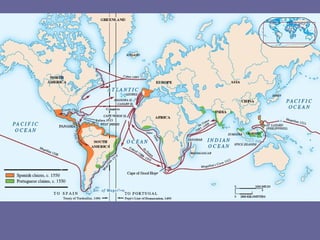
The pioneering explorers
•   Portugal – excitement of discovery, potential harm to Muslim world,
    and craving for wealth “potent mix”
• Henry the Navigator
• Dias
 -- Cape of Good Hope (1488) – will become a filling station
• Columbus’s voyage in 1492 causes Portugal to up their efforts
• Vasco da Gama reaches India in 1498
    –   Annual visits to India
    –   Sometimes use ship’s guns to intimidate
    –   Blown off course to Brazil – establish colony
    –   Set up Mozambique in E. Africa and Gao in India
    –   Islands of Indonesia
    –   China
    –   By 1542 even Japan
Spanish Explorers
• Christopher Columbus – origin?
   – Sponsored by King Ferdinand and Queen Isabella (Spain,
     pushed out Muslims, reclaimed kingdom, Castille and Aragon)
   – West Indies (Caribbean)
• Amerigo Vespucci (Italian) – “New World” and the
  Americas
   – Spain wins papal approval for control of land (Portugal will get
     Brazil)
• Ferdinand Magellan – set sail in 1519
   – Pass Southern tip of S. America
   – Discover and name Pacific Ocean for Europe for “peaceful”
     ocean
   – Reached Indonesian islands in 1521
   – Claims the Philippines and names them after King Philip II (will
     remain a Spanish holding until 1898)
Spanish Conquistadors
•   God, gold, and glory!
•   Hernan Cortes – Tenochtitlan to Mexico City
•   Francisco Pizarro – Inca Empire – Equador to Chile
•   Soon all but Brazil of S. America all the way up to
    California
•   St. Augustine 1519
•   Catholic Church and the Jesuits – chance to convert and
    gain Catholic souls
•   Silver and gold, silver and gold….FLOODS the European
    Economy
•   Glory! – Well, it’s obvious.
• Easily conquer the Americas
  – Gunpowder
  – Diseases
  – Civil Unrest in the Americas
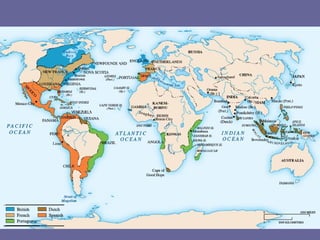
British, French, Dutch, Spanish
• Spanish Armada 1588
• French in Canada – 1534, Samuel de
  Champlain – Quebec 1608, Great Lakes region,
  Mississippi Valley
  – Restrict protestants
• English – Jamestown 1607, Plymouth, 1622 (but
  this one wasn’t economic)
  – Restrict Catholics
• Dutch East India Company – 1602
  – Taiwan
• British East India Company
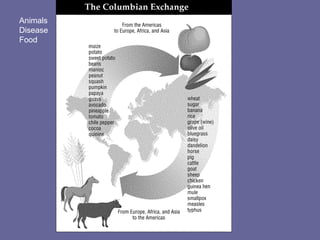
Animals
Disease
Food
Mercantilism
• Economic concept –
• Import only from empire
  – Import raw materials, manufacture at home,
    export manufactured goods out
• Export as much as possible to as many as
  possible
  – Allow own colonies to only buy from your
    kingdom
• Exploration
• Conquest when necessary
• Colonization
  – Emergence of Coercive labor systems
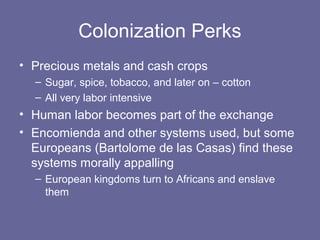
Colonization Perks
• Precious metals and cash crops
  – Sugar, spice, tobacco, and later on – cotton
  – All very labor intensive
• Human labor becomes part of the exchange
• Encomienda and other systems used, but some
  Europeans (Bartolome de las Casas) find these
  systems morally appalling
  – European kingdoms turn to Africans and enslave
    them
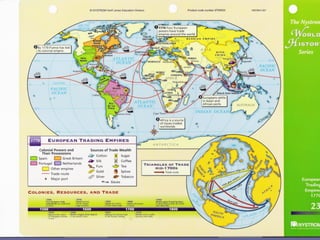
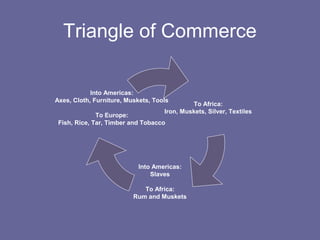
Triangle of Commerce

            Into Americas:
Axes, Cloth, Furniture, Muskets, Tools
                                             To Africa:
                                    Iron, Muskets, Silver, Textiles
              To Europe:
 Fish, Rice, Tar, Timber and Tobacco


                           Into Americas:
                               Slaves

                             To Africa:
                          Rum and Muskets
Ottoman Empire
• Established 1453
• Continues trading Arab trading
  connections with E. Africa, India, and
  China
• Loses B. of Lepanto in 1571 – setback
  against Spanish navy in the E.
  Mediterranean
China
• Participated less actively than Europe
• Benefits from world economy – excess of
  American money a positive for China
• Avoid entering involvement of international trade
  on anyone’s terms – limits trade to a trickle
  – This just keeps China’s stuff in the “rare” category,
    Europeans anxious to open China up
• Strong export pattern
• British government tries to get China to open up
  – Effort turned down
  – Haughtily inform Europeans that the Chinese have no
    need for outside goods
Japan and Korea
• Japan – initially attracted by Western
  expeditions in the 16th century
  – Pulls back
  – Show some openness to Christian missions
  – Fascinated by Western gunnery and shipping
  – Once they develop the ability to mimic W. weapons
    they cut off contact
  – Forbidden to travel or trade abroad
  – Enter a period of near complete isolation from 17th-19th
    century
      • Exceptions? – Chinese contact (only a little) and Dutch
        enclave in Nagasaki
• Korea – pulls back as well
India
• Mughal India – Persian for “Mongol India”
    – Proceeded Dehli Sultanate
•   Sold goods for New World silver
•   British East India Company
•   France
•   Britain wins control after 7 years war
Russia
• Isolated by Mongols
• Open back up slowly – Ivan the III –
  capital in Moscow
• Ivan the Terrible (IV)
• Time of Troubles early 1600s
• Michael Romanov appointed – establishes
  Romanov line
Africa
• West Africa – become victims of the slave
  trade
• East Africa – still trading with India, China,
  and ME
• North Africa – still trading

Chapter 16 world economy

  • 1.
  • 2.
    New Toys • Deep-draft,round-hulled sailing ships, loaded with heavy armaments • Compass (China-ME-Europe) • Gunpowder related toys – same chain – European metalwork allows for first guns and cannons – HUGE advantage
  • 3.
    The pioneering explorers • Portugal – excitement of discovery, potential harm to Muslim world, and craving for wealth “potent mix” • Henry the Navigator • Dias -- Cape of Good Hope (1488) – will become a filling station • Columbus’s voyage in 1492 causes Portugal to up their efforts • Vasco da Gama reaches India in 1498 – Annual visits to India – Sometimes use ship’s guns to intimidate – Blown off course to Brazil – establish colony – Set up Mozambique in E. Africa and Gao in India – Islands of Indonesia – China – By 1542 even Japan
  • 4.
    Spanish Explorers • ChristopherColumbus – origin? – Sponsored by King Ferdinand and Queen Isabella (Spain, pushed out Muslims, reclaimed kingdom, Castille and Aragon) – West Indies (Caribbean) • Amerigo Vespucci (Italian) – “New World” and the Americas – Spain wins papal approval for control of land (Portugal will get Brazil) • Ferdinand Magellan – set sail in 1519 – Pass Southern tip of S. America – Discover and name Pacific Ocean for Europe for “peaceful” ocean – Reached Indonesian islands in 1521 – Claims the Philippines and names them after King Philip II (will remain a Spanish holding until 1898)
  • 5.
    Spanish Conquistadors • God, gold, and glory! • Hernan Cortes – Tenochtitlan to Mexico City • Francisco Pizarro – Inca Empire – Equador to Chile • Soon all but Brazil of S. America all the way up to California • St. Augustine 1519 • Catholic Church and the Jesuits – chance to convert and gain Catholic souls • Silver and gold, silver and gold….FLOODS the European Economy • Glory! – Well, it’s obvious.
  • 6.
    • Easily conquerthe Americas – Gunpowder – Diseases – Civil Unrest in the Americas
  • 7.
    British, French, Dutch,Spanish • Spanish Armada 1588 • French in Canada – 1534, Samuel de Champlain – Quebec 1608, Great Lakes region, Mississippi Valley – Restrict protestants • English – Jamestown 1607, Plymouth, 1622 (but this one wasn’t economic) – Restrict Catholics • Dutch East India Company – 1602 – Taiwan • British East India Company
  • 11.
  • 12.
    Mercantilism • Economic concept– • Import only from empire – Import raw materials, manufacture at home, export manufactured goods out • Export as much as possible to as many as possible – Allow own colonies to only buy from your kingdom
  • 13.
    • Exploration • Conquestwhen necessary • Colonization – Emergence of Coercive labor systems
  • 14.
    Colonization Perks • Preciousmetals and cash crops – Sugar, spice, tobacco, and later on – cotton – All very labor intensive • Human labor becomes part of the exchange • Encomienda and other systems used, but some Europeans (Bartolome de las Casas) find these systems morally appalling – European kingdoms turn to Africans and enslave them
  • 15.
    Triangle of Commerce Into Americas: Axes, Cloth, Furniture, Muskets, Tools To Africa: Iron, Muskets, Silver, Textiles To Europe: Fish, Rice, Tar, Timber and Tobacco Into Americas: Slaves To Africa: Rum and Muskets
  • 16.
    Ottoman Empire • Established1453 • Continues trading Arab trading connections with E. Africa, India, and China • Loses B. of Lepanto in 1571 – setback against Spanish navy in the E. Mediterranean
  • 17.
    China • Participated lessactively than Europe • Benefits from world economy – excess of American money a positive for China • Avoid entering involvement of international trade on anyone’s terms – limits trade to a trickle – This just keeps China’s stuff in the “rare” category, Europeans anxious to open China up • Strong export pattern • British government tries to get China to open up – Effort turned down – Haughtily inform Europeans that the Chinese have no need for outside goods
  • 18.
    Japan and Korea •Japan – initially attracted by Western expeditions in the 16th century – Pulls back – Show some openness to Christian missions – Fascinated by Western gunnery and shipping – Once they develop the ability to mimic W. weapons they cut off contact – Forbidden to travel or trade abroad – Enter a period of near complete isolation from 17th-19th century • Exceptions? – Chinese contact (only a little) and Dutch enclave in Nagasaki • Korea – pulls back as well
  • 19.
    India • Mughal India– Persian for “Mongol India” – Proceeded Dehli Sultanate • Sold goods for New World silver • British East India Company • France • Britain wins control after 7 years war
  • 20.
    Russia • Isolated byMongols • Open back up slowly – Ivan the III – capital in Moscow • Ivan the Terrible (IV) • Time of Troubles early 1600s • Michael Romanov appointed – establishes Romanov line
  • 21.
    Africa • West Africa– become victims of the slave trade • East Africa – still trading with India, China, and ME • North Africa – still trading