Revolution in China Modern World History, by Dan McDowell. Teaching Point, ©2003 Class Notes 12:2
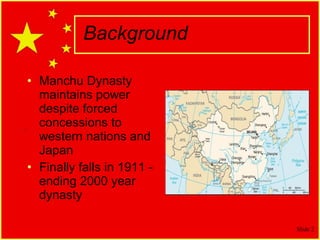
Background Manchu Dynasty maintains power despite forced concessions to western nations and Japan Finally falls in 1911 - ending 2000 year dynasty
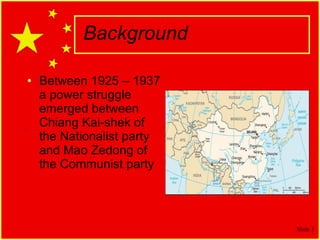
Background Between 1925 – 1937 a power struggle emerged between Chiang Kai-shek of the Nationalist party and Mao Zedong of the Communist party
Chiang Kai-shek Leader of the GMD National Revolutionary Army – fought the warlords, the Japanese starting in 1937, and the communists He promoted Chinese culture, but he was a Christian and he strongly supported western ideas
Chiang Kai-shek Encouraged continued western investment in China Worked closely with foreign investors – enforcing their demands Failed to consolidate power and modernize China
Mao Zedong Not influenced by the west – raised and educated away from foreign influences More concerned with the plight of the Chinese peasant – who had been ignored by the GMD
Mao Zedong Most supporters were peasants, industrialization put aside for land redistribution Created army and developed guerilla war tactics to fight Nationalists and then Japanese
The Long March In 1934 Chiang Kai-shek attacked communist strong-hold in Northern China 80,000 men retreated 6000 miles over 370 days to a new communist base in Northern China This experience of bravery, survival, and comradeship would define first generation of communist leaders
The Long March
Civil War / Japanese Invasion 1931 – Japan invaded Manchuria (Northern China) GMD continued to attack communists after Long March 1937 – Japan invaded China proper Communists and Nationalists fight Japanese separately
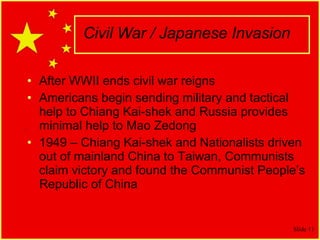
Civil War / Japanese Invasion After WWII ends civil war reigns Americans begin sending military and tactical help to Chiang Kai-shek and Russia provides minimal help to Mao Zedong 1949 – Chiang Kai-shek and Nationalists driven out of mainland China to Taiwan, Communists claim victory and found the Communist People’s Republic of China
Power Base Communist Army already established in the fight against Japanese and GMD Peasant support grew even more with early redistributions of land First years saw massive propaganda movements against “enemies” of the state – many dissidents imprisoned or killed in first years
Economic Development 1949 – Foreign economic influence eliminated – most foreigners kicked out of China 1950 – Soviet style five year plan implemented to encourage collectivization with limited success 1952 – Industrialization five year plan had more success
Great Leap Forward 1958  Mao attempted to reinvent Chinese economy Wished to industrialize outside the western model as quickly as possible Eliminated private enterprise Forced people out of the cities and into communes “ Backyard steel mills” – small industrial centers scattered throughout China Plan failed miserably – famine caused millions to die, program ended early, Mao’s power reduced
The Hundred Flowers Policy 1957  After end of the successful Industrialization five year plan, government loosened control of people People allowed to question government policies Significant rise in anti-government rhetoric causes Mao to end policy and arrest top detractors
Cultural Revolution 1966 Mao wished to regain power lost in the Great Leap Forward Created Red Guard from the Chinese youth Questioned traditional culture, education, and leadership (except Mao) Cult of personality forms around Mao
Cultural Revolution Traditional culture and education destroyed, intellectuals and leaders imprisoned or killed Chaos causes economic decline and Mao stabilizes revolution through the reorganization of party

Communist China

  • 1.
    Revolution in ChinaModern World History, by Dan McDowell. Teaching Point, ©2003 Class Notes 12:2
  • 2.
    Background Manchu Dynastymaintains power despite forced concessions to western nations and Japan Finally falls in 1911 - ending 2000 year dynasty
  • 3.
    Background Between 1925– 1937 a power struggle emerged between Chiang Kai-shek of the Nationalist party and Mao Zedong of the Communist party
  • 4.
    Chiang Kai-shek Leaderof the GMD National Revolutionary Army – fought the warlords, the Japanese starting in 1937, and the communists He promoted Chinese culture, but he was a Christian and he strongly supported western ideas
  • 5.
    Chiang Kai-shek Encouragedcontinued western investment in China Worked closely with foreign investors – enforcing their demands Failed to consolidate power and modernize China
  • 6.
    Mao Zedong Notinfluenced by the west – raised and educated away from foreign influences More concerned with the plight of the Chinese peasant – who had been ignored by the GMD
  • 7.
    Mao Zedong Mostsupporters were peasants, industrialization put aside for land redistribution Created army and developed guerilla war tactics to fight Nationalists and then Japanese
  • 8.
    The Long MarchIn 1934 Chiang Kai-shek attacked communist strong-hold in Northern China 80,000 men retreated 6000 miles over 370 days to a new communist base in Northern China This experience of bravery, survival, and comradeship would define first generation of communist leaders
  • 9.
  • 10.
    Civil War /Japanese Invasion 1931 – Japan invaded Manchuria (Northern China) GMD continued to attack communists after Long March 1937 – Japan invaded China proper Communists and Nationalists fight Japanese separately
  • 11.
    Civil War /Japanese Invasion After WWII ends civil war reigns Americans begin sending military and tactical help to Chiang Kai-shek and Russia provides minimal help to Mao Zedong 1949 – Chiang Kai-shek and Nationalists driven out of mainland China to Taiwan, Communists claim victory and found the Communist People’s Republic of China
  • 12.
    Power Base CommunistArmy already established in the fight against Japanese and GMD Peasant support grew even more with early redistributions of land First years saw massive propaganda movements against “enemies” of the state – many dissidents imprisoned or killed in first years
  • 13.
    Economic Development 1949– Foreign economic influence eliminated – most foreigners kicked out of China 1950 – Soviet style five year plan implemented to encourage collectivization with limited success 1952 – Industrialization five year plan had more success
  • 14.
    Great Leap Forward1958 Mao attempted to reinvent Chinese economy Wished to industrialize outside the western model as quickly as possible Eliminated private enterprise Forced people out of the cities and into communes “ Backyard steel mills” – small industrial centers scattered throughout China Plan failed miserably – famine caused millions to die, program ended early, Mao’s power reduced
  • 15.
    The Hundred FlowersPolicy 1957 After end of the successful Industrialization five year plan, government loosened control of people People allowed to question government policies Significant rise in anti-government rhetoric causes Mao to end policy and arrest top detractors
  • 16.
    Cultural Revolution 1966Mao wished to regain power lost in the Great Leap Forward Created Red Guard from the Chinese youth Questioned traditional culture, education, and leadership (except Mao) Cult of personality forms around Mao
  • 17.
    Cultural Revolution Traditionalculture and education destroyed, intellectuals and leaders imprisoned or killed Chaos causes economic decline and Mao stabilizes revolution through the reorganization of party