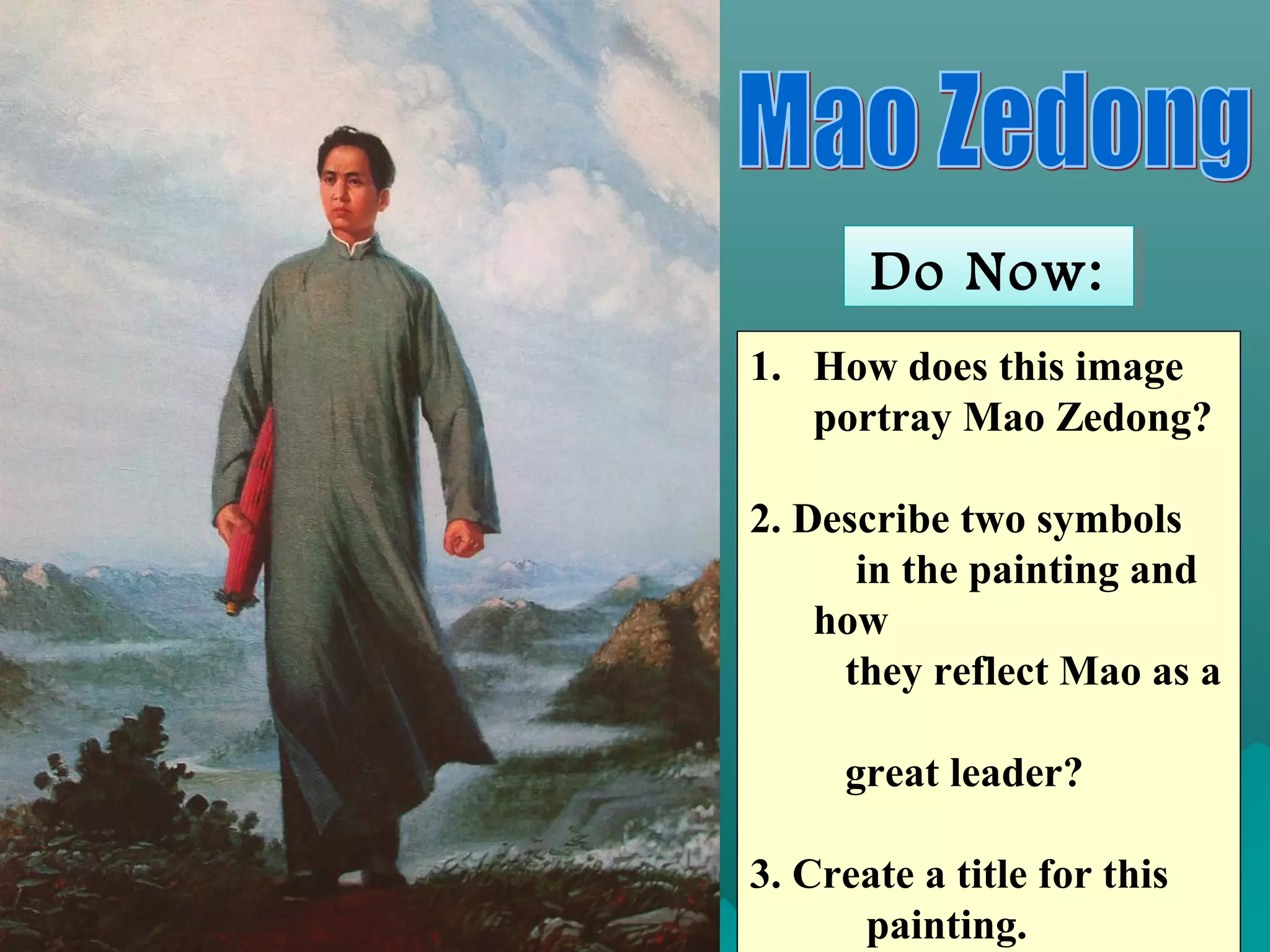
1. How does this image
portray Mao Zedong?
2. Describe two symbols
in the painting and
how
they reflect Mao as a
great leader?
3. Create a title for this
painting.
Do Now:Do Now:
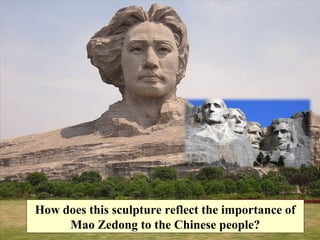
How does this sculpture reflect the importance of
Mao Zedong to the Chinese people?
SlideSlide 33
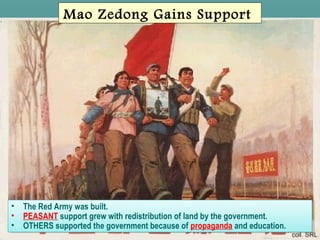
Mao Zedong Gains Support
• The Red Army was built.
• PEASANT support grew with redistribution of land by the government.
• OTHERS supported the government because of propaganda and education.
• The Red Army was built.
• PEASANT support grew with redistribution of land by the government.
• OTHERS supported the government because of propaganda and education.
SlideSlide 44
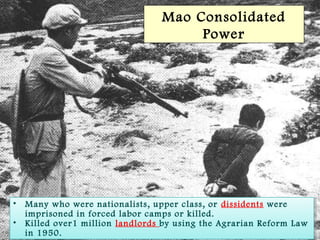
Mao Consolidated
Power
• Many who were nationalists, upper class, or dissidents were
imprisoned in forced labor camps or killed.
• Killed over1 million landlords by using the Agrarian Reform Law
in 1950.
• Many who were nationalists, upper class, or dissidents were
imprisoned in forced labor camps or killed.
• Killed over1 million landlords by using the Agrarian Reform Law
in 1950.
SlideSlide 55
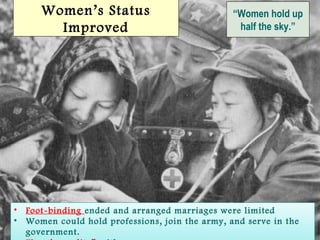
“Women hold up
half the sky.”
Women’s Status
Improved
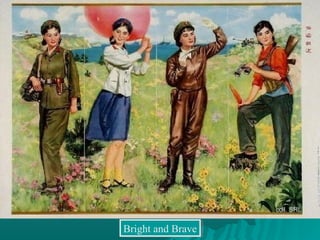
• Foot-binding ended and arranged marriages were limited
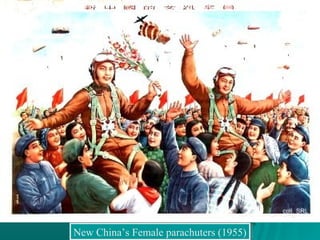
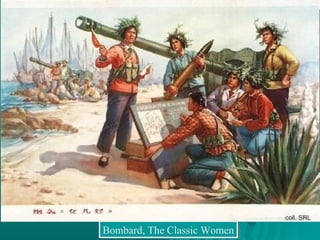
• Women could hold professions, join the army, and serve in the
government.
• Foot-binding ended and arranged marriages were limited
• Women could hold professions, join the army, and serve in the
government.
Bright and BraveBright and Brave
New China’s Female parachuters (1955)New China’s Female parachuters (1955)
Bombard, The Classic WomenBombard, The Classic Women
SlideSlide 99
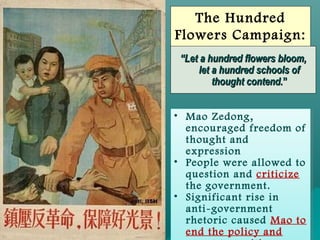
The Hundred
Flowers Campaign:
1957
• Mao Zedong,
encouraged freedom of
thought and
expression
• People were allowed to
question and criticize
the government.
• Significant rise in
anti-government
rhetoric caused Mao to
end the policy and
• Mao Zedong,
encouraged freedom of
thought and
expression
• People were allowed to
question and criticize
the government.
• Significant rise in
anti-government
rhetoric caused Mao to
end the policy and
““Let a hundred flowers bloom,Let a hundred flowers bloom,
let a hundred schools oflet a hundred schools of
thought contend.thought contend.””
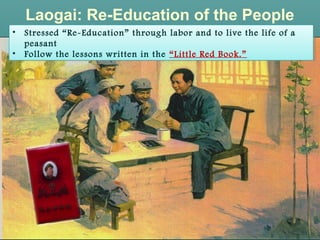
Laogai: Re-Education of the People
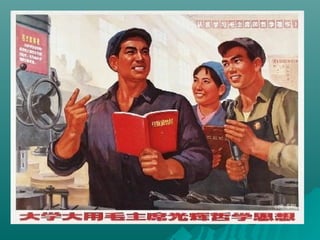
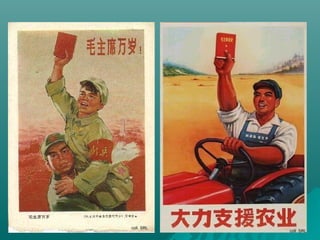
• Stressed “Re-Education” through labor and to live the life of a
peasant
• Follow the lessons written in the “Little Red Book.”
• Stressed “Re-Education” through labor and to live the life of a
peasant
• Follow the lessons written in the “Little Red Book.”
SlideSlide 1111
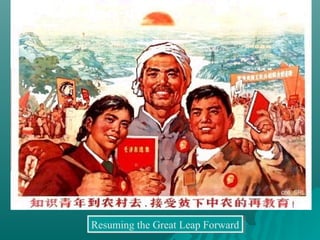
Resuming the Great Leap ForwardResuming the Great Leap Forward
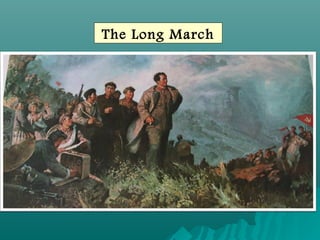
The Long March
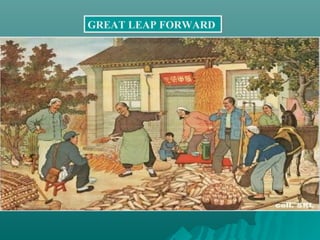
GREAT LEAP FORWARDGREAT LEAP FORWARD
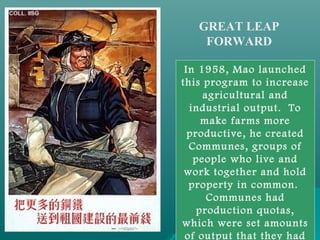
GREAT LEAP
FORWARD
In 1958, Mao launched
this program to increase
agricultural and
industrial output. To
make farms more
productive, he created
Communes, groups of
people who live and
work together and hold
property in common.
Communes had
production quotas,
which were set amounts
of output that they had
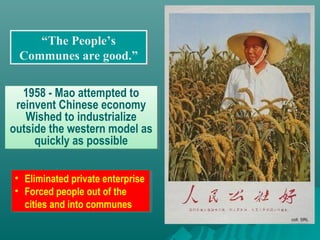
“The People’s
Communes are good.”
“The People’s
Communes are good.”
1958 - Mao attempted to
reinvent Chinese economy
Wished to industrialize
outside the western model as
quickly as possible
1958 - Mao attempted to
reinvent Chinese economy
Wished to industrialize
outside the western model as
quickly as possible
• Eliminated private enterprise
• Forced people out of the
cities and into communes
• Eliminated private enterprise
• Forced people out of the
cities and into communes
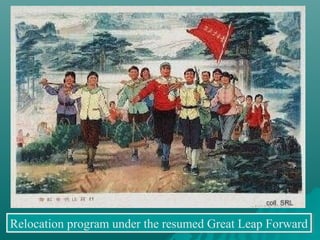
Relocation program under the resumed Great Leap ForwardRelocation program under the resumed Great Leap Forward
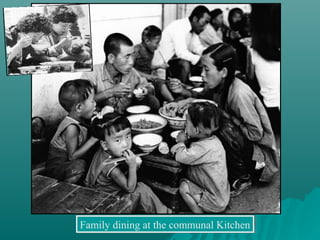
Family dining at the communal KitchenFamily dining at the communal Kitchen
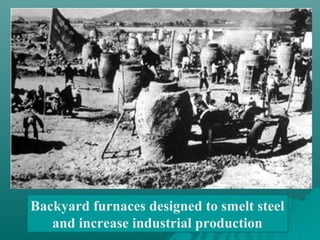
Backyard furnaces designed to smelt steel
and increase industrial production
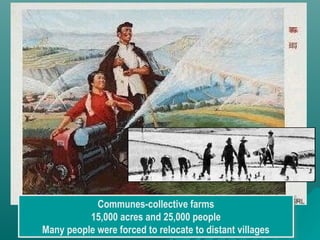
Communes-collective farms
15,000 acres and 25,000 people
Many people were forced to relocate to distant villages
Communes-collective farms
15,000 acres and 25,000 people
Many people were forced to relocate to distant villages
Film Clip
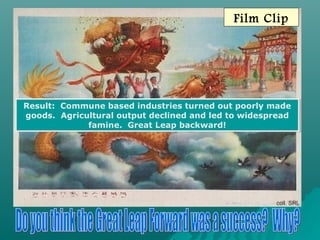
Result: Commune based industries turned out poorly made
goods. Agricultural output declined and led to widespread
famine. Great Leap backward!
Result: Commune based industries turned out poorly made
goods. Agricultural output declined and led to widespread
famine. Great Leap backward!
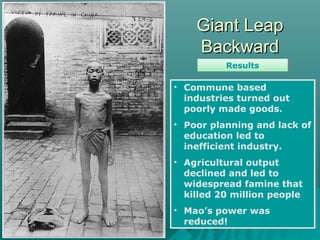
Giant LeapGiant Leap
BackwardBackward
ResultsResults
• Commune based
industries turned out
poorly made goods.
• Poor planning and lack of
education led to
inefficient industry.
• Agricultural output
declined and led to
widespread famine that
killed 20 million people
• Mao’s power was
reduced!
• Commune based
industries turned out
poorly made goods.
• Poor planning and lack of
education led to
inefficient industry.
• Agricultural output
declined and led to
widespread famine that
killed 20 million people
• Mao’s power was
reduced!
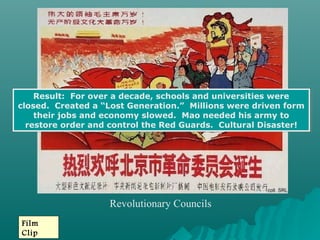
The Cultural Revolution
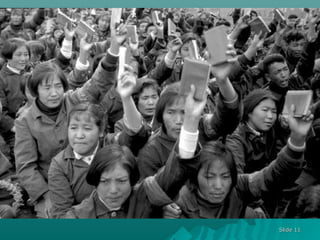
In 1966, Mao launched the Cultural Revolution to renew people’s loyalty to communism
and establish a more equitable society. Mao feared that revolutionary peasants and
workers were being replaced by intellectuals in running the country. He shut down
schools and universities throughout China and urged Chinese students to experience
their own revolution. Students formed groups called Red guards and attacked
professors, government officials, and factory workers who were considered “Counter
Revolutionaries.” Many were killed, imprisoned, or exiled.
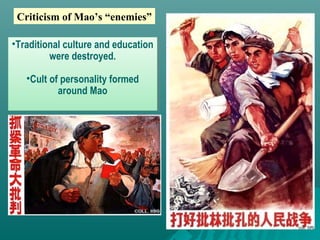
Criticism of Mao’s “enemies”
•Traditional culture and education
were destroyed.
•Cult of personality formed
around Mao
•Traditional culture and education
were destroyed.
•Cult of personality formed
around Mao
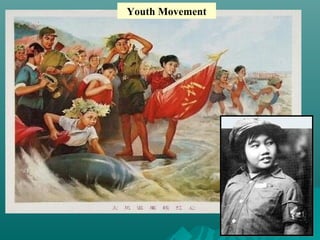
Youth Movement
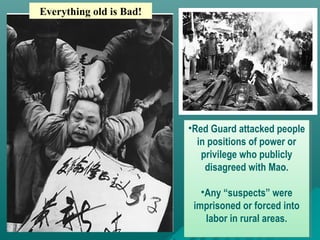
•Red Guard attacked people
in positions of power or
privilege who publicly
disagreed with Mao.
•Any “suspects” were
imprisoned or forced into
labor in rural areas.
•Red Guard attacked people
in positions of power or
privilege who publicly
disagreed with Mao.
•Any “suspects” were
imprisoned or forced into
labor in rural areas.
Everything old is Bad!
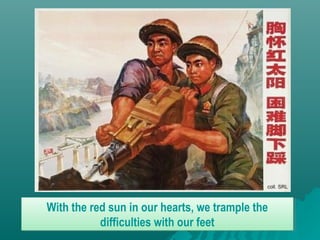
With the red sun in our hearts, we trample the
difficulties with our feet
With the red sun in our hearts, we trample the
difficulties with our feet
Revolutionary Councils
Film
Clip
Result: For over a decade, schools and universities were
closed. Created a “Lost Generation.” Millions were driven form
their jobs and economy slowed. Mao needed his army to
restore order and control the Red Guards. Cultural Disaster!
Result: For over a decade, schools and universities were
closed. Created a “Lost Generation.” Millions were driven form
their jobs and economy slowed. Mao needed his army to
restore order and control the Red Guards. Cultural Disaster!
China Under Mao ZedongChina Under Mao Zedong
 Great Leap ForwardGreat Leap Forward
 Cultural RevolutionCultural Revolution
Result: Commune based industries turned out poorly
made goods. Agricultural output declined and led to
widespread famine. Great Leap backward!
Result: For over a decade, schools and universities were
closed. Created a “Lost Generation.” Millions were driven
form their jobs and economy slowed. Mao needed his
army to restore order and control the Red Guards.
Cultural Disaster!
Result: Commune based industries turned out poorly
made goods. Agricultural output declined and led to
widespread famine. Great Leap backward!
Result: For over a decade, schools and universities were
closed. Created a “Lost Generation.” Millions were driven
form their jobs and economy slowed. Mao needed his
army to restore order and control the Red Guards.
Cultural Disaster!

The Rule of Mao Zedong

  • 1.
    1. How doesthis image portray Mao Zedong? 2. Describe two symbols in the painting and how they reflect Mao as a great leader? 3. Create a title for this painting. Do Now:Do Now:
  • 2.
    How does thissculpture reflect the importance of Mao Zedong to the Chinese people?
  • 3.
    SlideSlide 33 Mao ZedongGains Support • The Red Army was built. • PEASANT support grew with redistribution of land by the government. • OTHERS supported the government because of propaganda and education. • The Red Army was built. • PEASANT support grew with redistribution of land by the government. • OTHERS supported the government because of propaganda and education.
  • 4.
    SlideSlide 44 Mao Consolidated Power •Many who were nationalists, upper class, or dissidents were imprisoned in forced labor camps or killed. • Killed over1 million landlords by using the Agrarian Reform Law in 1950. • Many who were nationalists, upper class, or dissidents were imprisoned in forced labor camps or killed. • Killed over1 million landlords by using the Agrarian Reform Law in 1950.
  • 5.
    SlideSlide 55 “Women holdup half the sky.” Women’s Status Improved • Foot-binding ended and arranged marriages were limited • Women could hold professions, join the army, and serve in the government. • Foot-binding ended and arranged marriages were limited • Women could hold professions, join the army, and serve in the government.
  • 6.
  • 7.
    New China’s Femaleparachuters (1955)New China’s Female parachuters (1955)
  • 8.
    Bombard, The ClassicWomenBombard, The Classic Women
  • 9.
    SlideSlide 99 The Hundred FlowersCampaign: 1957 • Mao Zedong, encouraged freedom of thought and expression • People were allowed to question and criticize the government. • Significant rise in anti-government rhetoric caused Mao to end the policy and • Mao Zedong, encouraged freedom of thought and expression • People were allowed to question and criticize the government. • Significant rise in anti-government rhetoric caused Mao to end the policy and ““Let a hundred flowers bloom,Let a hundred flowers bloom, let a hundred schools oflet a hundred schools of thought contend.thought contend.””
  • 10.
    Laogai: Re-Education ofthe People • Stressed “Re-Education” through labor and to live the life of a peasant • Follow the lessons written in the “Little Red Book.” • Stressed “Re-Education” through labor and to live the life of a peasant • Follow the lessons written in the “Little Red Book.”
  • 11.
  • 12.
    Resuming the GreatLeap ForwardResuming the Great Leap Forward
  • 15.
  • 16.
  • 17.
    GREAT LEAP FORWARD In 1958,Mao launched this program to increase agricultural and industrial output. To make farms more productive, he created Communes, groups of people who live and work together and hold property in common. Communes had production quotas, which were set amounts of output that they had
  • 18.
    “The People’s Communes aregood.” “The People’s Communes are good.” 1958 - Mao attempted to reinvent Chinese economy Wished to industrialize outside the western model as quickly as possible 1958 - Mao attempted to reinvent Chinese economy Wished to industrialize outside the western model as quickly as possible • Eliminated private enterprise • Forced people out of the cities and into communes • Eliminated private enterprise • Forced people out of the cities and into communes
  • 19.
    Relocation program underthe resumed Great Leap ForwardRelocation program under the resumed Great Leap Forward
  • 20.
    Family dining atthe communal KitchenFamily dining at the communal Kitchen
  • 21.
    Backyard furnaces designedto smelt steel and increase industrial production
  • 22.
    Communes-collective farms 15,000 acresand 25,000 people Many people were forced to relocate to distant villages Communes-collective farms 15,000 acres and 25,000 people Many people were forced to relocate to distant villages
  • 23.
    Film Clip Result: Communebased industries turned out poorly made goods. Agricultural output declined and led to widespread famine. Great Leap backward! Result: Commune based industries turned out poorly made goods. Agricultural output declined and led to widespread famine. Great Leap backward!
  • 24.
    Giant LeapGiant Leap BackwardBackward ResultsResults •Commune based industries turned out poorly made goods. • Poor planning and lack of education led to inefficient industry. • Agricultural output declined and led to widespread famine that killed 20 million people • Mao’s power was reduced! • Commune based industries turned out poorly made goods. • Poor planning and lack of education led to inefficient industry. • Agricultural output declined and led to widespread famine that killed 20 million people • Mao’s power was reduced!
  • 25.
    The Cultural Revolution In1966, Mao launched the Cultural Revolution to renew people’s loyalty to communism and establish a more equitable society. Mao feared that revolutionary peasants and workers were being replaced by intellectuals in running the country. He shut down schools and universities throughout China and urged Chinese students to experience their own revolution. Students formed groups called Red guards and attacked professors, government officials, and factory workers who were considered “Counter Revolutionaries.” Many were killed, imprisoned, or exiled.
  • 26.
    Criticism of Mao’s“enemies” •Traditional culture and education were destroyed. •Cult of personality formed around Mao •Traditional culture and education were destroyed. •Cult of personality formed around Mao
  • 27.
  • 28.
    •Red Guard attackedpeople in positions of power or privilege who publicly disagreed with Mao. •Any “suspects” were imprisoned or forced into labor in rural areas. •Red Guard attacked people in positions of power or privilege who publicly disagreed with Mao. •Any “suspects” were imprisoned or forced into labor in rural areas. Everything old is Bad!
  • 29.
    With the redsun in our hearts, we trample the difficulties with our feet With the red sun in our hearts, we trample the difficulties with our feet
  • 30.
    Revolutionary Councils Film Clip Result: Forover a decade, schools and universities were closed. Created a “Lost Generation.” Millions were driven form their jobs and economy slowed. Mao needed his army to restore order and control the Red Guards. Cultural Disaster! Result: For over a decade, schools and universities were closed. Created a “Lost Generation.” Millions were driven form their jobs and economy slowed. Mao needed his army to restore order and control the Red Guards. Cultural Disaster!
  • 31.
    China Under MaoZedongChina Under Mao Zedong  Great Leap ForwardGreat Leap Forward  Cultural RevolutionCultural Revolution Result: Commune based industries turned out poorly made goods. Agricultural output declined and led to widespread famine. Great Leap backward! Result: For over a decade, schools and universities were closed. Created a “Lost Generation.” Millions were driven form their jobs and economy slowed. Mao needed his army to restore order and control the Red Guards. Cultural Disaster! Result: Commune based industries turned out poorly made goods. Agricultural output declined and led to widespread famine. Great Leap backward! Result: For over a decade, schools and universities were closed. Created a “Lost Generation.” Millions were driven form their jobs and economy slowed. Mao needed his army to restore order and control the Red Guards. Cultural Disaster!

Editor's Notes

  • #19 In January 1958, Mao launched the second Five Year Plan known as the Great Leap Forward, a plan intended as an alternative model for economic growth to the Soviet model focusing on heavy industry that was advocated by others in the party. Under this economic program, the relatively small agricultural collectives which had been formed to date were rapidly merged into far larger people's communes, and many of the peasants ordered to work on massive infrastructure projects and the small-scale production of iron and steel. All private food production was banned; livestock and farm implements were brought under collective ownership. Under the Great Leap Forward, Mao and other party leaders ordered the implementation of a variety of unproven and unscientific new agricultural techniques by the new communes. Combined with the diversion of labour to steel production and infrastructure projects and the reduced personal incentives under a commune system this led to an approximately 15% drop in grain production in 1959 followed by further 10% reduction in 1960 and no recovery in 1961. In an effort to win favour with their superiors and avoid being purged, each layer in the party hierarchy exaggerated the amount of grain produced under them and based on the fabricated success, party cadres were ordered to requisition a disproportionately high amount of the true harvest for state use primarily in the cities and urban areas but also for export. The net result, which was compounded in some areas by drought and in others by floods, was that the rural peasants were not left enough to eat and many millions starved to death in what is thought to be the largest famine in human history. This famine was a direct cause of the death of tens of millions of Chinese peasants between 1959 and 1962. Further, many children who became emaciated and malnourished during years of hardship and struggle for survival, died shortly after the Great Leap Forward came to an end in 1962 (Spence, 553). At LEAST 20 million die in the greatest famine in recorded history