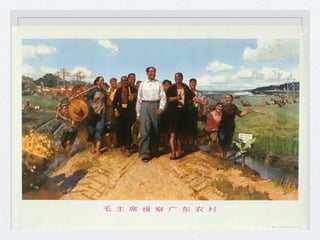
THE CHINESE REVOLUTION
        BY CODY MYERS
THE OPIUM
          WAR(1839-1842)
British East India Company       The war following is an
started to trade opium, and a    embarrassing loss for China,
loss of silver imports forced    and marks the beginning of
action from China(Bentley        foreign intrusion(Bentley and
and Ziegler).                    Ziegler).

Military dumps tons of the
drug, enraging Britain(Bentley
and Ziegler).
SPHERES OF INFLUENCE
The British force the Chinese to sign what was called the
unequal treaty, allowing Britain to trade as they wish, and carve
their own sphere of influence.

Other colonial empires follow Britain’s example

This exploitation leads to numerous rebellions, such as the
Nanjing rebellion, which nearly took down the Qing dynasty.
These were the forerunners to the movement that would take
the dynasty down(Bentley an Ziegler).
THE FIRST REVOLUTION

In 1908, the empress died, placing a young child on the
throne of a crumbling dynasty(“ChineseRevolution”).

The revolt was triggered by drama between foreign railroad
contractors and China, causing riots, and eventually mutiny,
starting in Wuchang(“Chinese Revolution”).

The incompetent regent, in panic, asked Yuan Shikal, a former
viceroy, to come out of retirement to save the
dynasty(“Chinese Revolution”).
THE ESTABLISHMENT OF
        REPUBLIC
Sun Yat-sen: leader of
revolutionaries(“Chinese
Revolution”).

Yuan negotiated w/
revolutionaries, form a
republic, led by Yuan with Li
Yuanhong as vice-
president(“Chinese
Revolution”).
THE FALL OF THE
            REPUBLIC
Yuan abused the system to the
point where he called himself
emperor. Didnt last(“History
of Republic”).

Regional warlords began their
rise to power during this
episode(“History of
Republic”).
WWI DISPUTE

When WWI broke, the vice-president Duan Qirui wanted to
join the allies, but President Li did not. The debating became
so intense, Duan was kicked out of office(“History of
Republic”).

Duan’s warlord allies declared independence(“History of
Republic”).
China in Disarray

Duan defeated Republic’s forces and sent China into war with
Germany(“History of Republic”).

Duan ignored the constitution and dissolved the
parliament(“History of Republic”).

The South revolted by forming a new government, the
Kuomintang, in Guangzhou led by Sun Yat-sen, sparking
Constitutional Protection War(“History of Republic”).
May Fourth Movement
A national movement led by
students from 1917 to1923,
protesting against the many
issues plaguing the nation
including,

    WWI involvement

    Constitutional
    Protection War

    Warlordism
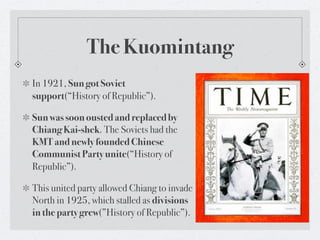
The Kuomintang
In 1921, Sun got Soviet
support(“History of Republic”).

Sun was soon ousted and replaced by
Chiang Kai-shek. The Soviets had the
KMT and newly founded Chinese
Communist Party unite(“History of
Republic”).

This united party allowed Chiang to invade
North in 1925, which stalled as divisions
in the party grew(”History of Republic”).
Chiang’s Rise

The CCP and KMT’s left wing
made a new capital in
Wuhan, and Chiang made a
new capital in
Nanjing(“History of
Republic”).

China now split between three
capitals; Beijing, Wuhan,
Nanjing.
China’s Communist Party
After their capital was established, they
started encouraging insurrections in
rural and urban areas.

Most notably was the Autumn Harvest
Uprising in the Hunan province. It was led
by Mao Zedong(“History of Republic”).

By 1928, Chiang was in control of most of
China, and dominated the CCP. This set
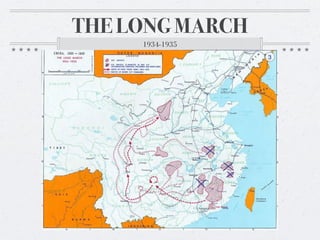
the stage for the Long March, led by Mao
Zedong, which was a Northward 8,000
mile retreat(Szczepanski)
AUTUMN HARVEST UPRISING
THE LONG MARCH
     1934-1935
The Nanjing
       Decade(1928-1937)
A short period of reform dominated by the KMT including

    regaining power to set own tariffs

    modernization of Chinese infrastructure

    Modern Standard Chinese

    women’s rights

    the decade was also marked by the pushing back of warlords
    to China’s limits.
The Second Sino-Japanese War


Chiang was forced to work
with the CCP against the
Japanese, saving the CCP
from annihilation(“History
of Republic”).
Spread of Communism

The Republic of China(KMT) arose from
WWII on the verge of civil war, since there was
no need for cooperation.

The economy collapsed under the weight of
national debt from foreign and internal
strife(“History of Republic”).
Foreign Interest

The United States and Britain
wanted China to be a strong
ally in East Asia, so they
revised the unequal
treaties, and the US threw
out its anti-Chinese
immigration laws(“History
of Republic”).
The Exodus

A three-year civil war(War
of Liberation) quickly
follows end of WW2. Ends
in KMT defeat.

The KMT retreat to Taiwan,
where they remained
THE RULE OF MAO
Mao and the People’s Republic

On October 1 1949, Mao announced establishment of The
People’s Republic of China(Szczepanski). End of the worst,
right?

From 1949 to 1953 mass executions of landowners and
noncommunist commences; estimated death toll:1
million(Szczepanski)

Mao bans all parties but CCP, and becomes
president(Szczepanski).
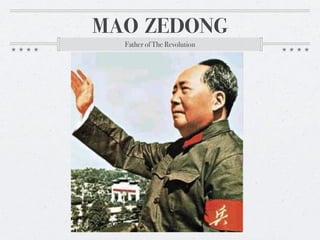
MAO ZEDONG
  Father of The Revolution
More “Reformation”

Implemented First Five Year Plan(1953-58) designed to
encourage industrialization, industry is owned by
public(Szczepanski).

Second Five Year Plan: Great Leap Forward, redistribution
of farm land, ending in catastophe as farmers are
overwhelmed, possibly 20 million starve to
death(Szczepanski).
The Cultural Revolution
Mao replaced as president soon after total failure of ironically named Great
Leap Forward(but still CCP leader, and very powerful)

In 1965, Mao starts the Cultural Revolution to reassert his power in
China by influencing the youth to have them condemn the new upper
classes(“Cultural Revolution”).

     Mao envisioned a China as a single class, and tried to reignite
     revolutionary spirit.

     Led to violence towards foreign embassies and upper classes by
     the Red Guard(bands of youth).

           loss of a generation of educated people for China
Reality
The End of an Era
In 1968, Mao allowed the
turmoil and violence towards
“priveleged” classes to
end(“Cultural Revolution”).

In 9 years Mao would be dead,
and the end of an era with it.
The Revolution finally ended, as
China quickly modernized,
catching up with the rest of the
world.
THE END

Chinese revolution version 2

  • 1.
  • 2.
    THE OPIUM WAR(1839-1842) British East India Company The war following is an started to trade opium, and a embarrassing loss for China, loss of silver imports forced and marks the beginning of action from China(Bentley foreign intrusion(Bentley and and Ziegler). Ziegler). Military dumps tons of the drug, enraging Britain(Bentley and Ziegler).
  • 3.
    SPHERES OF INFLUENCE TheBritish force the Chinese to sign what was called the unequal treaty, allowing Britain to trade as they wish, and carve their own sphere of influence. Other colonial empires follow Britain’s example This exploitation leads to numerous rebellions, such as the Nanjing rebellion, which nearly took down the Qing dynasty. These were the forerunners to the movement that would take the dynasty down(Bentley an Ziegler).
  • 4.
    THE FIRST REVOLUTION In1908, the empress died, placing a young child on the throne of a crumbling dynasty(“ChineseRevolution”). The revolt was triggered by drama between foreign railroad contractors and China, causing riots, and eventually mutiny, starting in Wuchang(“Chinese Revolution”). The incompetent regent, in panic, asked Yuan Shikal, a former viceroy, to come out of retirement to save the dynasty(“Chinese Revolution”).
  • 5.
    THE ESTABLISHMENT OF REPUBLIC Sun Yat-sen: leader of revolutionaries(“Chinese Revolution”). Yuan negotiated w/ revolutionaries, form a republic, led by Yuan with Li Yuanhong as vice- president(“Chinese Revolution”).
  • 6.
    THE FALL OFTHE REPUBLIC Yuan abused the system to the point where he called himself emperor. Didnt last(“History of Republic”). Regional warlords began their rise to power during this episode(“History of Republic”).
  • 7.
    WWI DISPUTE When WWIbroke, the vice-president Duan Qirui wanted to join the allies, but President Li did not. The debating became so intense, Duan was kicked out of office(“History of Republic”). Duan’s warlord allies declared independence(“History of Republic”).
  • 8.
    China in Disarray Duandefeated Republic’s forces and sent China into war with Germany(“History of Republic”). Duan ignored the constitution and dissolved the parliament(“History of Republic”). The South revolted by forming a new government, the Kuomintang, in Guangzhou led by Sun Yat-sen, sparking Constitutional Protection War(“History of Republic”).
  • 9.
    May Fourth Movement Anational movement led by students from 1917 to1923, protesting against the many issues plaguing the nation including, WWI involvement Constitutional Protection War Warlordism
  • 10.
    The Kuomintang In 1921,Sun got Soviet support(“History of Republic”). Sun was soon ousted and replaced by Chiang Kai-shek. The Soviets had the KMT and newly founded Chinese Communist Party unite(“History of Republic”). This united party allowed Chiang to invade North in 1925, which stalled as divisions in the party grew(”History of Republic”).
  • 11.
    Chiang’s Rise The CCPand KMT’s left wing made a new capital in Wuhan, and Chiang made a new capital in Nanjing(“History of Republic”). China now split between three capitals; Beijing, Wuhan, Nanjing.
  • 12.
    China’s Communist Party Aftertheir capital was established, they started encouraging insurrections in rural and urban areas. Most notably was the Autumn Harvest Uprising in the Hunan province. It was led by Mao Zedong(“History of Republic”). By 1928, Chiang was in control of most of China, and dominated the CCP. This set the stage for the Long March, led by Mao Zedong, which was a Northward 8,000 mile retreat(Szczepanski)
  • 13.
  • 14.
    THE LONG MARCH 1934-1935
  • 15.
    The Nanjing Decade(1928-1937) A short period of reform dominated by the KMT including regaining power to set own tariffs modernization of Chinese infrastructure Modern Standard Chinese women’s rights the decade was also marked by the pushing back of warlords to China’s limits.
  • 16.
    The Second Sino-JapaneseWar Chiang was forced to work with the CCP against the Japanese, saving the CCP from annihilation(“History of Republic”).
  • 17.
    Spread of Communism TheRepublic of China(KMT) arose from WWII on the verge of civil war, since there was no need for cooperation. The economy collapsed under the weight of national debt from foreign and internal strife(“History of Republic”).
  • 18.
    Foreign Interest The UnitedStates and Britain wanted China to be a strong ally in East Asia, so they revised the unequal treaties, and the US threw out its anti-Chinese immigration laws(“History of Republic”).
  • 19.
    The Exodus A three-yearcivil war(War of Liberation) quickly follows end of WW2. Ends in KMT defeat. The KMT retreat to Taiwan, where they remained
  • 20.
  • 21.
    Mao and thePeople’s Republic On October 1 1949, Mao announced establishment of The People’s Republic of China(Szczepanski). End of the worst, right? From 1949 to 1953 mass executions of landowners and noncommunist commences; estimated death toll:1 million(Szczepanski) Mao bans all parties but CCP, and becomes president(Szczepanski).
  • 22.
    MAO ZEDONG Father of The Revolution
  • 23.
    More “Reformation” Implemented FirstFive Year Plan(1953-58) designed to encourage industrialization, industry is owned by public(Szczepanski). Second Five Year Plan: Great Leap Forward, redistribution of farm land, ending in catastophe as farmers are overwhelmed, possibly 20 million starve to death(Szczepanski).
  • 24.
    The Cultural Revolution Maoreplaced as president soon after total failure of ironically named Great Leap Forward(but still CCP leader, and very powerful) In 1965, Mao starts the Cultural Revolution to reassert his power in China by influencing the youth to have them condemn the new upper classes(“Cultural Revolution”). Mao envisioned a China as a single class, and tried to reignite revolutionary spirit. Led to violence towards foreign embassies and upper classes by the Red Guard(bands of youth). loss of a generation of educated people for China
  • 27.
  • 28.
    The End ofan Era In 1968, Mao allowed the turmoil and violence towards “priveleged” classes to end(“Cultural Revolution”). In 9 years Mao would be dead, and the end of an era with it. The Revolution finally ended, as China quickly modernized, catching up with the rest of the world.
  • 29.