20c China:
From Republic to
Communist Power
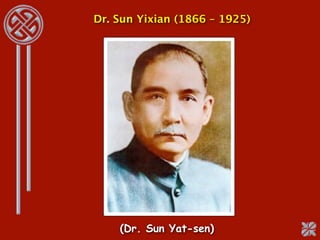
Dr. Sun Yixian (1866 – 1925)


    (Dr. Sun Yat-sen)
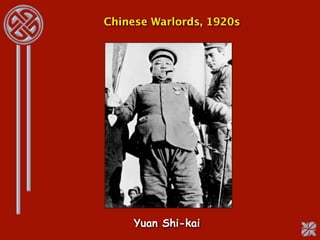
Chinese Warlords, 1920s


     Yuan Shi-kai
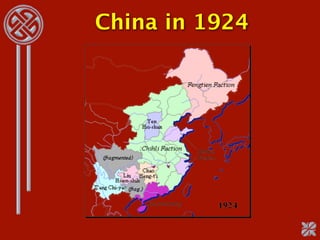
China in 1924
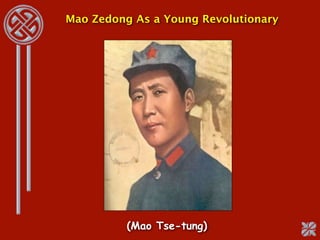
Mao Zedong As a Young Revolutionary


          (Mao Tse-tung)
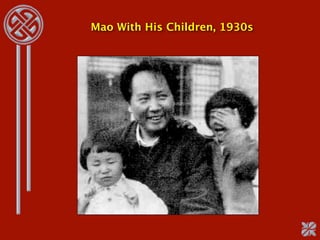
Mao With His Children, 1930s
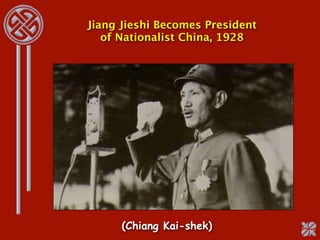
Jiang Jieshi Becomes President
   of Nationalist China, 1928


      (Chiang Kai-shek)
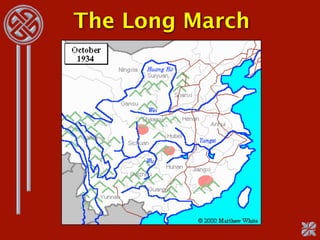
The Long March
     1934
The Long March
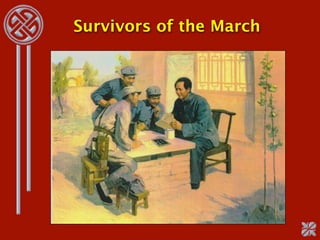
Survivors of the March
Japan Invades China
        1937
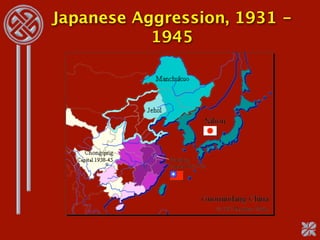
Japanese Aggression, 1931 -
           1945
The Communist
  Revolution:
 1946 - 1949
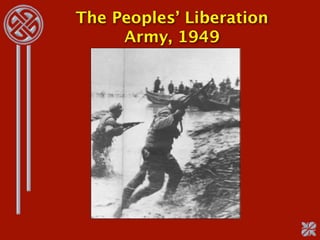
The Peoples’ Liberation
     Army, 1949
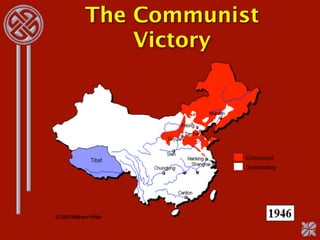
The Communist
    Victory
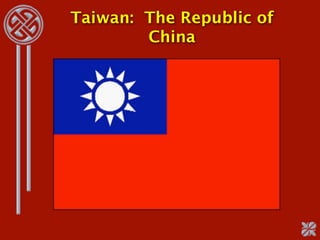
Taiwan: The Republic of
        China
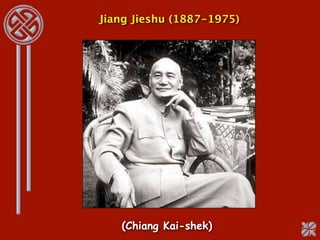
Jiang Jieshu (1887-1975)


   (Chiang Kai-shek)
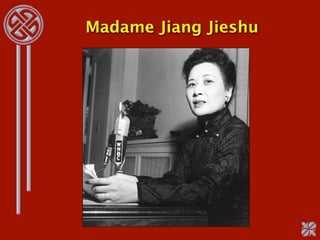
Madame Jiang Jieshu
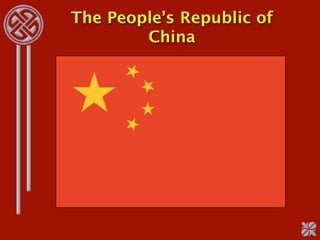
The People’s Republic of
        China
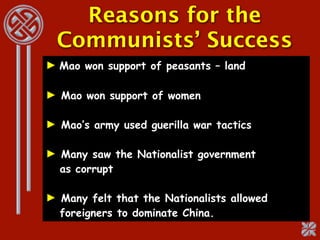
Reasons for the
Communists’ Success
Reasons for the
 Communists’ Success
► Mao won support of peasants – land
Reasons for the
 Communists’ Success
► Mao won support of peasants – land

► Mao won support of women
Reasons for the
  Communists’ Success
► Mao won support of peasants – land

► Mao won support of women

► Mao’s army used guerilla war tactics
Reasons for the
  Communists’ Success
► Mao won support of peasants – land

► Mao won support of women

► Mao’s army used guerilla war tactics

► Many saw the Nationalist government
  as corrupt
Reasons for the
  Communists’ Success
► Mao won support of peasants – land

► Mao won support of women

► Mao’s army used guerilla war tactics

► Many saw the Nationalist government
  as corrupt

► Many felt that the Nationalists allowed
  foreigners to dominate China.
The Great Leap
Forward (or Backward?)
     1958-1961
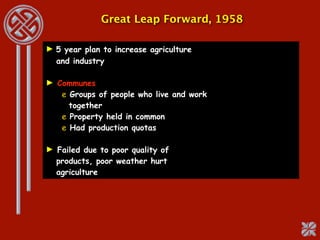
Great Leap Forward, 1958

► 5 year plan to increase agriculture
  and industry
Great Leap Forward, 1958

► 5 year plan to increase agriculture
  and industry

► Communes
Great Leap Forward, 1958

► 5 year plan to increase agriculture
  and industry

► Communes
   e Groups of people who live and work
     together
Great Leap Forward, 1958

► 5 year plan to increase agriculture
  and industry

► Communes
   e Groups of people who live and work
     together
   e Property held in common
Great Leap Forward, 1958

► 5 year plan to increase agriculture
  and industry

► Communes
   e Groups of people who live and work
     together
   e Property held in common
   e Had production quotas
Great Leap Forward, 1958

► 5 year plan to increase agriculture
  and industry

► Communes
   e Groups of people who live and work
     together
   e Property held in common
   e Had production quotas

► Failed due to poor quality of
  products, poor weather hurt
  agriculture
Communist China Under Mao
► Industrialized China
Communist China Under Mao
► Industrialized China
► Increased literacy
Communist China Under Mao
► Industrialized China
► Increased literacy
► Class privileges ended
Communist China Under Mao
►   Industrialized China
►   Increased literacy
►   Class privileges ended
►   Rural Chinese received health
    care
Communist China Under Mao
► Industrialized China
► Increased literacy
► Class privileges ended
► Rural Chinese received health
  care
► One-party dictatorship
Communist China Under Mao
► Industrialized China
► Increased literacy
► Class privileges ended
► Rural Chinese received health
  care
► One-party dictatorship
► Denied people basic rights and
  freedoms --> Inner Mongolia,
  Tibet
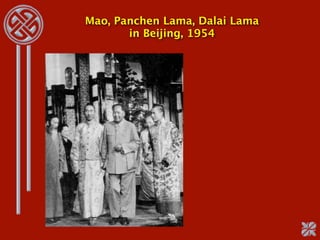
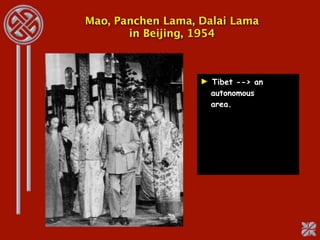
Mao, Panchen Lama, Dalai Lama
       in Beijing, 1954
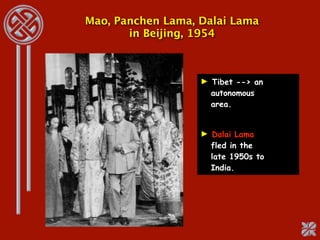
Mao, Panchen Lama, Dalai Lama
       in Beijing, 1954


                   ► Tibet --> an
                     autonomous
                     area.
Mao, Panchen Lama, Dalai Lama
       in Beijing, 1954


                   ► Tibet --> an
                     autonomous
                     area.


                   ► Dalai Lama
                     fled in the
                     late 1950s to
                     India.
The Great
    Proletarian
Cultural Revolution
   1966 - 1976
A Campaign Against the
    “FOUR OLDS”
A Campaign Against the
    “FOUR OLDS”
  ► Old Thoughts
A Campaign Against the
    “FOUR OLDS”
  ► Old Thoughts

  ► Old Culture
A Campaign Against the
    “FOUR OLDS”
  ► Old Thoughts

  ► Old Culture

  ► Old Customs
A Campaign Against the
    “FOUR OLDS”
  ► Old Thoughts

  ► Old Culture

  ► Old Customs

  ► Old Habits
A Campaign Against the
    “FOUR OLDS”
  ► Old Thoughts

  ► Old Culture

  ► Old Customs

  ► Old Habits


     To Rebel Is Good!
Communist China Under Mao

► Designed to renew revolutionary
  spirit and establish a more
  equitable society
Communist China Under Mao

► Designed to renew revolutionary
  spirit and establish a more
  equitable society
► Mao wanted to put “intellectuals”
  in their place
Communist China Under Mao

► Designed to renew revolutionary
  spirit and establish a more
  equitable society
► Mao wanted to put “intellectuals”
  in their place
► Schools shut down – students
  revolted
Communist China Under Mao

► Designed to renew revolutionary
  spirit and establish a more
  equitable society
► Mao wanted to put “intellectuals”
  in their place
► Schools shut down – students
  revolted
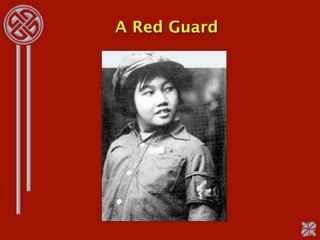
► Red Guards – students who
  attacked professors, government
  officials, factory managers
A Red Guard
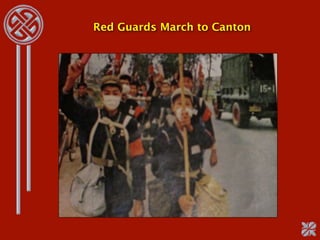
Red Guards March to Canton
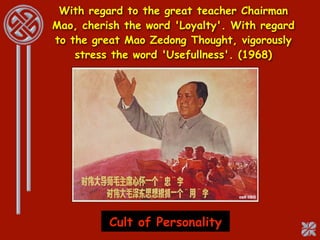
With regard to the great teacher Chairman
Mao, cherish the word 'Loyalty'. With regard
to the great Mao Zedong Thought, vigorously
    stress the word 'Usefullness'. (1968)


          Cult of Personality
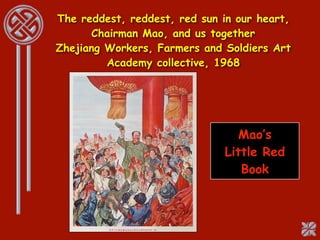
The reddest, reddest, red sun in our heart,
      Chairman Mao, and us together
Zhejiang Workers, Farmers and Soldiers Art
         Academy collective, 1968


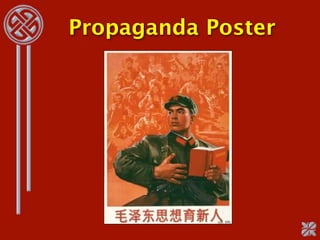
                                 Mao’s
                              Little Red
                                 Book
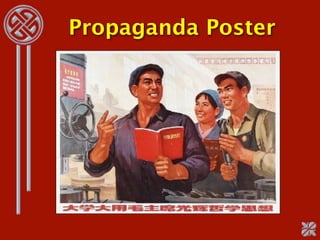
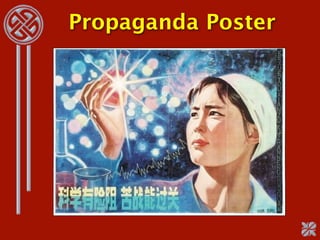
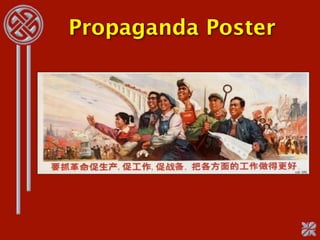
Propaganda Poster
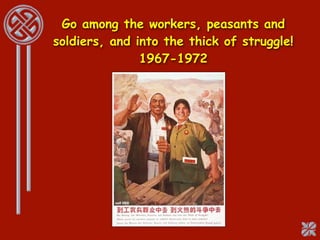
Go among the workers, peasants and
soldiers, and into the thick of struggle!
               1967-1972
Propaganda Poster
Propaganda Poster
Propaganda Poster
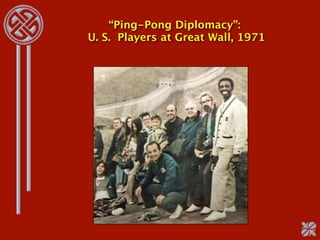
“Ping-Pong Diplomacy”:
U. S. Players at Great Wall, 1971
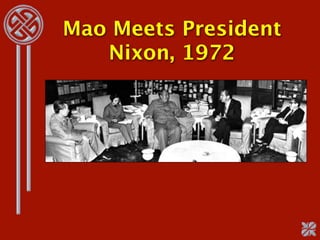
Mao Meets President
   Nixon, 1972
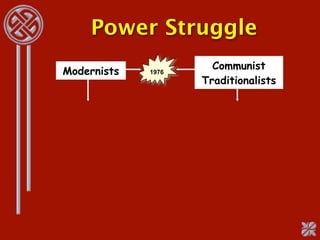
Power Struggle
                      Communist
Modernists   1976
                    Traditionalists
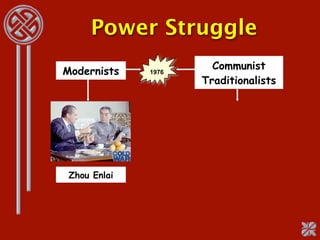
Power Struggle
                       Communist
Modernists    1976
                     Traditionalists


 Zhou Enlai
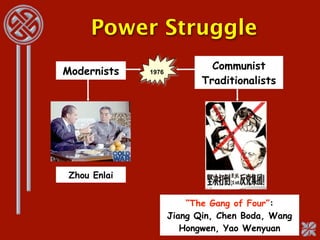
Power Struggle
                              Communist
Modernists    1976
                            Traditionalists


 Zhou Enlai


                         “The Gang of Four”:
                     Jiang Qin, Chen Boda, Wang
                        Hongwen, Yao Wenyuan
Communist Government
         and a
  Capitalist Economy
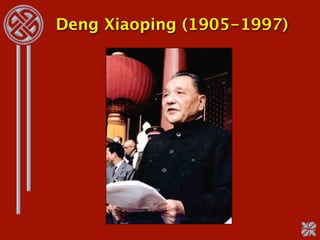
Deng Xiaoping (1905-1997)
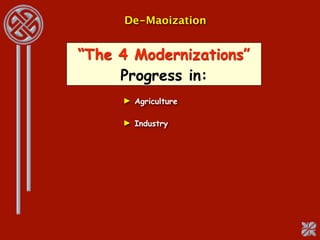
De-Maoization


“The 4 Modernizations”
     Progress in:
De-Maoization


“The 4 Modernizations”
     Progress in:
     ► Agriculture
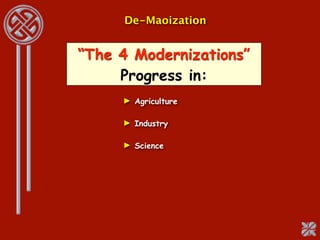
De-Maoization


“The 4 Modernizations”
     Progress in:
     ► Agriculture

     ► Industry
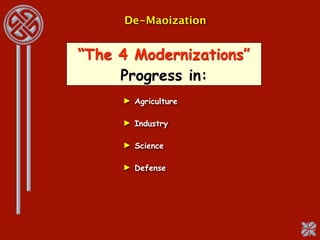
De-Maoization


“The 4 Modernizations”
     Progress in:
     ► Agriculture

     ► Industry

     ► Science
De-Maoization


“The 4 Modernizations”
     Progress in:
     ► Agriculture

     ► Industry

     ► Science

     ► Defense
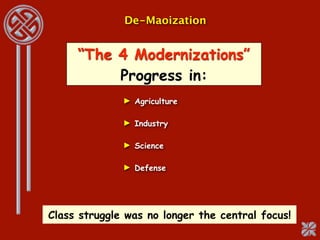
De-Maoization


     “The 4 Modernizations”
          Progress in:
              ► Agriculture

              ► Industry

              ► Science

              ► Defense


Class struggle was no longer the central focus!
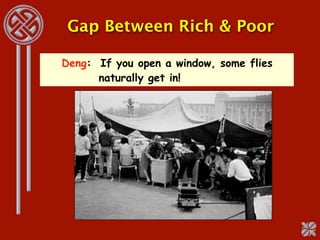
Gap Between Rich & Poor

Deng: If you open a window, some flies
      naturally get in!
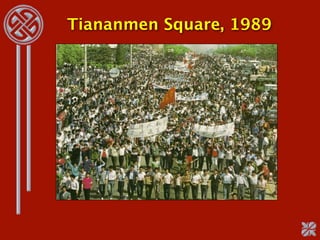
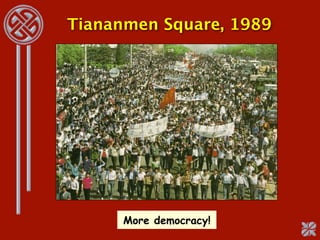
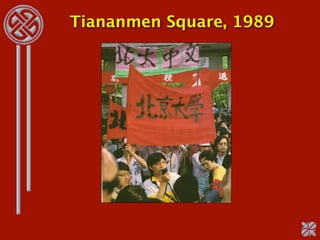
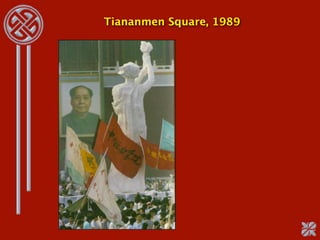
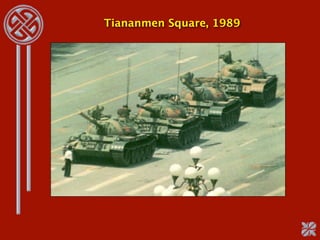
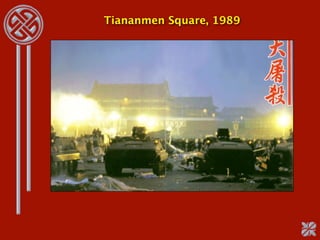
Tiananmen Square, 1989


      More democracy!
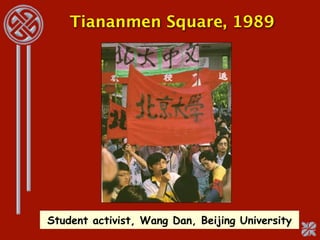
Tiananmen Square, 1989


Student activist, Wang Dan, Beijing University
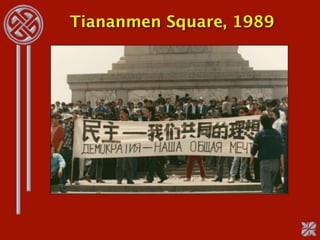
Tiananmen Square, 1989


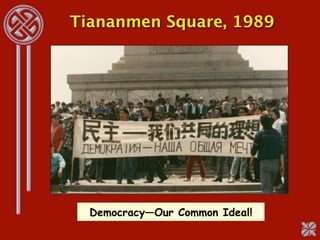
  Democracy—Our Common Ideal!
Tiananmen Square, 1989


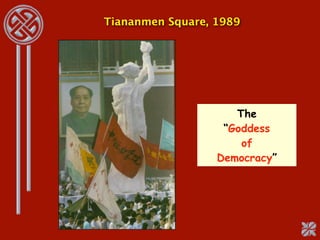
                     The
                   “Goddess
                      of
                  Democracy”
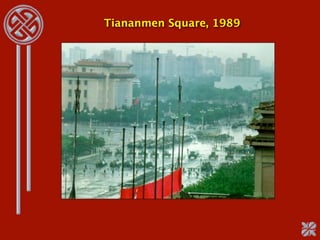
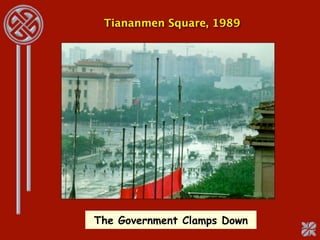
Tiananmen Square, 1989


The Government Clamps Down
Tiananmen Square, 1989


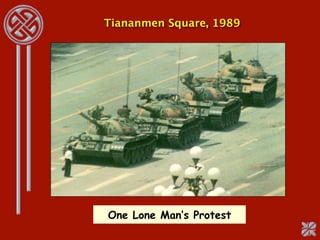
One Lone Man’s Protest
Tiananmen Square, 1989


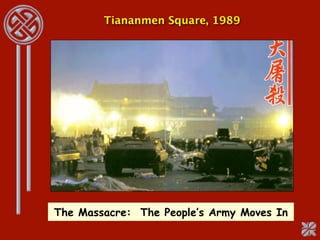
The Massacre: The People’s Army Moves In
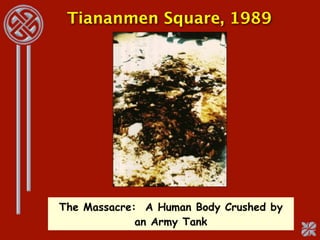
Tiananmen Square, 1989


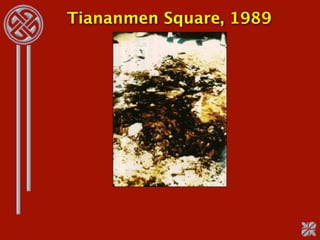
The Massacre: A Human Body Crushed by
             an Army Tank
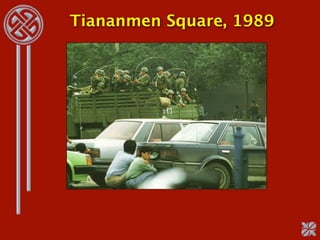
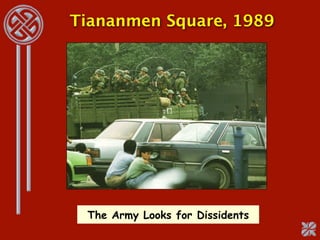
Tiananmen Square, 1989


 The Army Looks for Dissidents
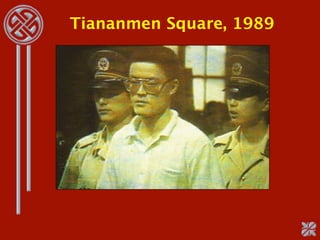
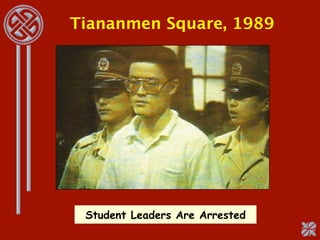
Tiananmen Square, 1989


 Student Leaders Are Arrested
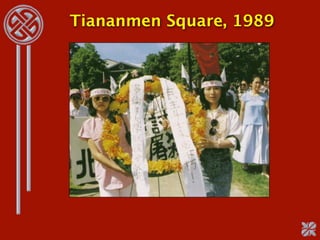
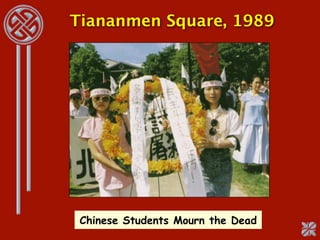
Tiananmen Square, 1989


 Chinese Students Mourn the Dead
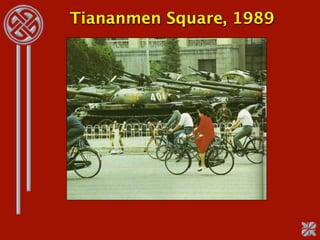
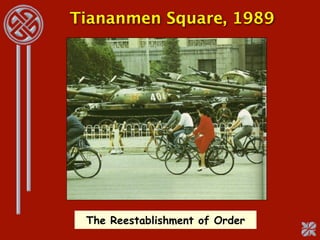
Tiananmen Square, 1989


 The Reestablishment of Order
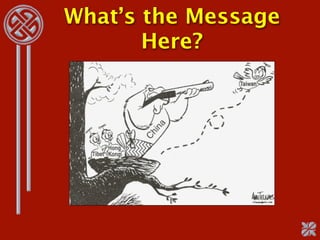
What’s the Message
       Here?
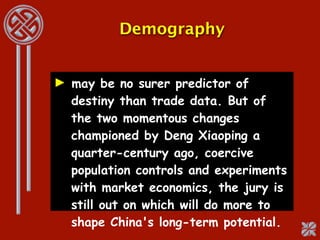
Demography


► may be no surer predictor of
  destiny than trade data. But of
  the two momentous changes
  championed by Deng Xiaoping a
  quarter-century ago, coercive
  population controls and experiments
  with market economics, the jury is
  still out on which will do more to
  shape China's long-term potential.
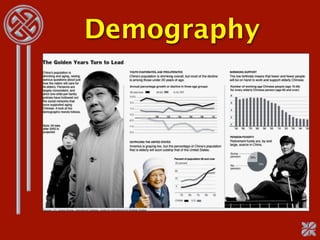
Demography
Demography

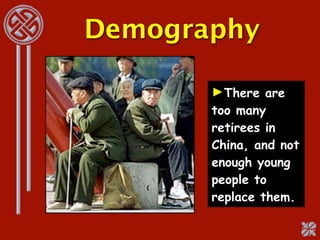
       ►There are
       too many
       retirees in
       China, and not
       enough young
       people to
       replace them.
Demography

► "The evidence is overwhelming that a
  large population of unmarried adult
  males is a risk factor for both crime
  and war," Ms. den Boer said in an
  interview. "The fact that China is an
  authoritarian country is another risk
  factor."

The roadtocommunism