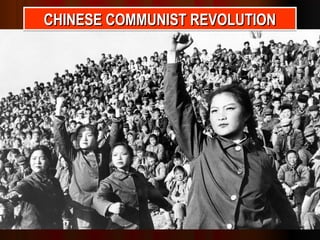
CHINESE COMMUNIST REVOLUTIONCHINESE COMMUNIST REVOLUTIONCHINESE COMMUNIST REVOLUTIONCHINESE COMMUNIST REVOLUTION
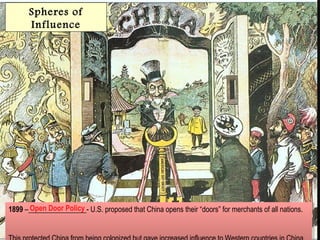
1899 –________________- U.S. proposed that China opens their “doors” for merchants of all nations.1899 –________________- U.S. proposed that China opens their “doors” for merchants of all nations.Open Door Policy
Spheres of
Influence
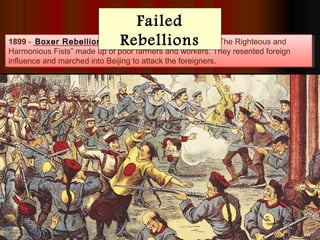
1899 - _______________ - Powerful secret society called “The Righteous and
Harmonious Fists” made up of poor farmers and workers. They resented foreign
influence and marched into Beijing to attack the foreigners.
1899 - _______________ - Powerful secret society called “The Righteous and
Harmonious Fists” made up of poor farmers and workers. They resented foreign
influence and marched into Beijing to attack the foreigners.
Boxer Rebellion
The rebellion failed due to the strength of the
European military but ignited a sense of
nationalism in China. People wanted change.
Failed
Rebellions
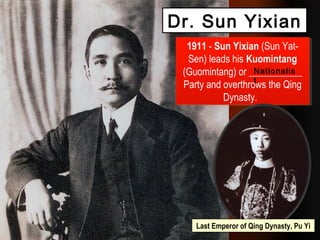
1911 - Sun Yixian (Sun Yat-
Sen) leads his Kuomintang
(Guomintang) or ___________
Party and overthrows the Qing
Dynasty.
1911 - Sun Yixian (Sun Yat-
Sen) leads his Kuomintang
(Guomintang) or ___________
Party and overthrows the Qing
Dynasty.
Nationalis
t
Dr. Sun Yixian
Last Emperor of Qing Dynasty, Pu Yi
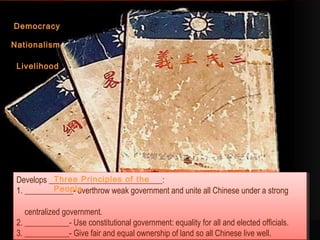
Develops ____________________________:
1. ____________- overthrow weak government and unite all Chinese under a strong
centralized government.
2. ___________- Use constitutional government: equality for all and elected officials.
3. ___________- Give fair and equal ownership of land so all Chinese live well.
Develops ____________________________:
1. ____________- overthrow weak government and unite all Chinese under a strong
centralized government.
2. ___________- Use constitutional government: equality for all and elected officials.
3. ___________- Give fair and equal ownership of land so all Chinese live well.
Three Principles of the
People
Nationalism
Democracy
Livelihood
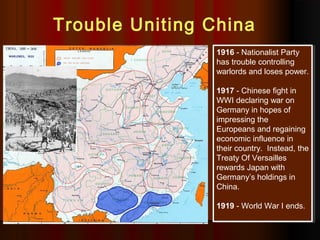
1916 - Nationalist Party
has trouble controlling
warlords and loses power.
1917 - Chinese fight in
WWI declaring war on
Germany in hopes of
impressing the
Europeans and regaining
economic influence in
their country. Instead, the
Treaty Of Versailles
rewards Japan with
Germany’s holdings in
China.
1919 - World War I ends.
1916 - Nationalist Party
has trouble controlling
warlords and loses power.
1917 - Chinese fight in
WWI declaring war on
Germany in hopes of
impressing the
Europeans and regaining
economic influence in
their country. Instead, the
Treaty Of Versailles
rewards Japan with
Germany’s holdings in
China.
1919 - World War I ends.
Trouble Uniting China
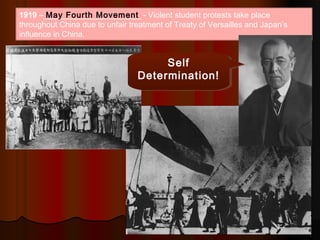
1919 –______________________ - Violent student protests take place
throughout China due to unfair treatment of Treaty of Versailles and Japan’s
influence in China.
May Fourth Movement
Self
Determination!
Self
Determination!
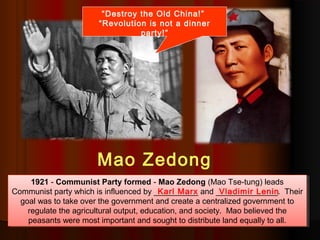
1921 - Communist Party formed - Mao Zedong (Mao Tse-tung) leads
Communist party which is influenced by __________ and ______________. Their
goal was to take over the government and create a centralized government to
regulate the agricultural output, education, and society. Mao believed the
peasants were most important and sought to distribute land equally to all.
1921 - Communist Party formed - Mao Zedong (Mao Tse-tung) leads
Communist party which is influenced by __________ and ______________. Their
goal was to take over the government and create a centralized government to
regulate the agricultural output, education, and society. Mao believed the
peasants were most important and sought to distribute land equally to all.
Karl Marx Vladimir Lenin
“Destroy the Old China!”
“Revolution is not a dinner
party!”
Mao Zedong
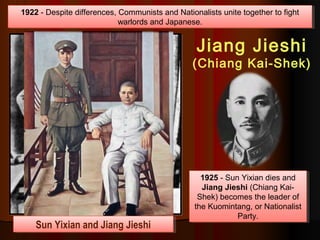
1922 - Despite differences, Communists and Nationalists unite together to fight
warlords and Japanese.
1922 - Despite differences, Communists and Nationalists unite together to fight
warlords and Japanese.
1925 - Sun Yixian dies and
Jiang Jieshi (Chiang Kai-
Shek) becomes the leader of
the Kuomintang, or Nationalist
Party.
1925 - Sun Yixian dies and
Jiang Jieshi (Chiang Kai-
Shek) becomes the leader of
the Kuomintang, or Nationalist
Party.
Jiang Jieshi
(Chiang Kai-Shek)
Sun Yixian and Jiang JieshiSun Yixian and Jiang Jieshi
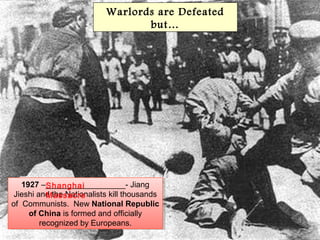
1927 –__________________- Jiang
Jieshi and the Nationalists kill thousands
of Communists. New National Republic
of China is formed and officially
recognized by Europeans.
1927 –__________________- Jiang
Jieshi and the Nationalists kill thousands
of Communists. New National Republic
of China is formed and officially
recognized by Europeans.
Shanghai
Massacre
Warlords are Defeated
but…
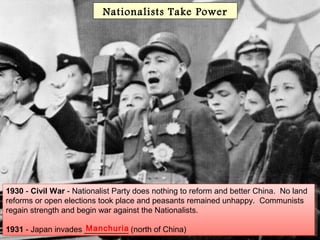
1930 - Civil War - Nationalist Party does nothing to reform and better China. No land
reforms or open elections took place and peasants remained unhappy. Communists
regain strength and begin war against the Nationalists.
1931 - Japan invades __________ (north of China)
1930 - Civil War - Nationalist Party does nothing to reform and better China. No land
reforms or open elections took place and peasants remained unhappy. Communists
regain strength and begin war against the Nationalists.
1931 - Japan invades __________ (north of China)Manchuria
Nationalists Take Power
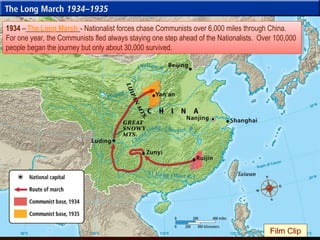
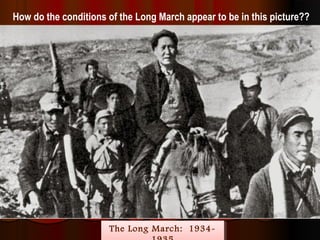
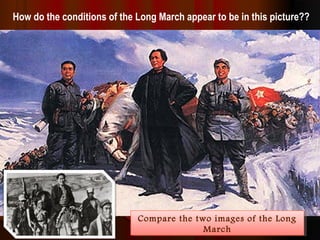
1934 –_______________- Nationalist forces chase Communists over 6,000 miles through China.
For one year, the Communists fled always staying one step ahead of the Nationalists. Over 100,000
people began the journey but only about 30,000 survived.
1934 –_______________- Nationalist forces chase Communists over 6,000 miles through China.
For one year, the Communists fled always staying one step ahead of the Nationalists. Over 100,000
people began the journey but only about 30,000 survived.
The Long March
Film Clip
How do the conditions of the Long March appear to be in this picture??
The Long March: 1934-The Long March: 1934-
How do the conditions of the Long March appear to be in this picture??
Compare the two images of the Long
March
Compare the two images of the Long
March
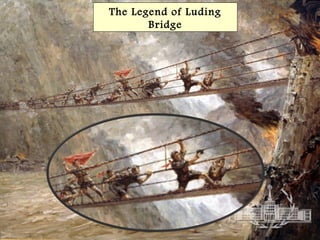
The Legend of Luding
Bridge
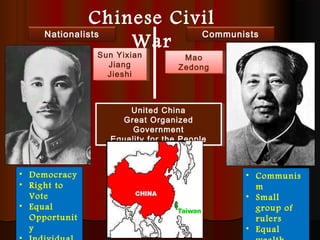
Nationalists Communists
Sun Yixian
Jiang
Jieshi
Sun Yixian
Jiang
Jieshi
Mao
Zedong
Mao
Zedong
United China
Great Organized
Government
Equality for the People
United China
Great Organized
Government
Equality for the People
Chinese Civil
War
• Democracy
• Right to
Vote
• Equal
Opportunit
y
• Communis
m
• Small
group of
rulers
• Equal
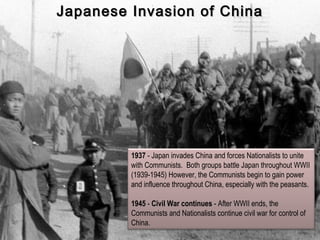
1937 - Japan invades China and forces Nationalists to unite
with Communists. Both groups battle Japan throughout WWII
(1939-1945) However, the Communists begin to gain power
and influence throughout China, especially with the peasants.
1945 - Civil War continues - After WWII ends, the
Communists and Nationalists continue civil war for control of
China.
Japanese Invasion of ChinaJapanese Invasion of China
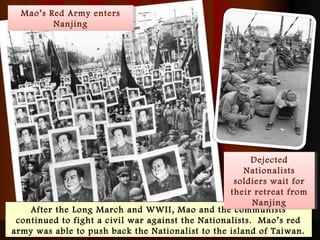
After the Long March and WWII, Mao and the communists
continued to fight a civil war against the Nationalists. Mao’s red
army was able to push back the Nationalist to the island of Taiwan.
Dejected
Nationalists
soldiers wait for
their retreat from
Nanjing
Dejected
Nationalists
soldiers wait for
their retreat from
Nanjing
Mao’s Red Army enters
Nanjing
Mao’s Red Army enters
Nanjing
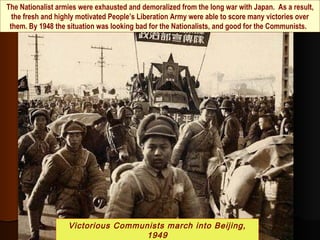
The Nationalist armies were exhausted and demoralized from the long war with Japan. As a result,
the fresh and highly motivated People’s Liberation Army were able to score many victories over
them. By 1948 the situation was looking bad for the Nationalists, and good for the Communists.
Victorious Communists march into Beijing,
1949
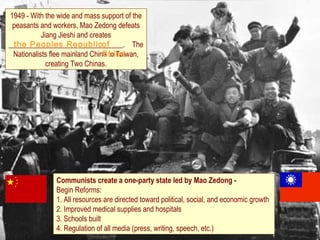
1949 - With the wide and mass support of the
peasants and workers, Mao Zedong defeats
Jiang Jieshi and creates
___________________ ____________. The
Nationalists flee mainland China to Taiwan,
creating Two Chinas.
Communists create a one-party state led by Mao Zedong -
Begin Reforms:
1. All resources are directed toward political, social, and economic growth
2. Improved medical supplies and hospitals
3. Schools built
4. Regulation of all media (press, writing, speech, etc.)
the Peoples Republicof
China
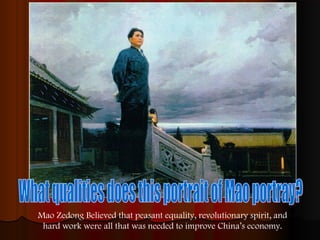
Mao Zedong Believed that peasant equality, revolutionary spirit, and
hard work were all that was needed to improve China’s economy.
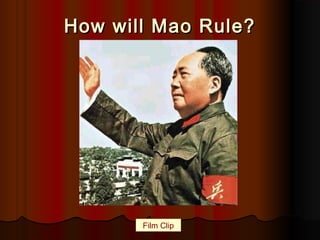
How will Mao Rule?How will Mao Rule?
Film Clip
QUESTIONS:QUESTIONS:
1. How and why did Nationalism develop in China in the early
1900s?
2. Why did Sun Yixian receive vast support for overthrowing
the Qing Empire which had existed for almost 300 years?
3. How did WWI and WWII affect China?
4. How did Mao Zedong and the Communists win the Civil
War?
5. During this 100 year period, which event do you think was
the most important in determining China’s future? Why?

Chinese Communist Revolution Timeline

  • 1.
    CHINESE COMMUNIST REVOLUTIONCHINESECOMMUNIST REVOLUTIONCHINESE COMMUNIST REVOLUTIONCHINESE COMMUNIST REVOLUTION
  • 2.
    1899 –________________- U.S.proposed that China opens their “doors” for merchants of all nations.1899 –________________- U.S. proposed that China opens their “doors” for merchants of all nations.Open Door Policy Spheres of Influence
  • 3.
    1899 - _______________- Powerful secret society called “The Righteous and Harmonious Fists” made up of poor farmers and workers. They resented foreign influence and marched into Beijing to attack the foreigners. 1899 - _______________ - Powerful secret society called “The Righteous and Harmonious Fists” made up of poor farmers and workers. They resented foreign influence and marched into Beijing to attack the foreigners. Boxer Rebellion The rebellion failed due to the strength of the European military but ignited a sense of nationalism in China. People wanted change. Failed Rebellions
  • 4.
    1911 - SunYixian (Sun Yat- Sen) leads his Kuomintang (Guomintang) or ___________ Party and overthrows the Qing Dynasty. 1911 - Sun Yixian (Sun Yat- Sen) leads his Kuomintang (Guomintang) or ___________ Party and overthrows the Qing Dynasty. Nationalis t Dr. Sun Yixian Last Emperor of Qing Dynasty, Pu Yi
  • 5.
    Develops ____________________________: 1. ____________-overthrow weak government and unite all Chinese under a strong centralized government. 2. ___________- Use constitutional government: equality for all and elected officials. 3. ___________- Give fair and equal ownership of land so all Chinese live well. Develops ____________________________: 1. ____________- overthrow weak government and unite all Chinese under a strong centralized government. 2. ___________- Use constitutional government: equality for all and elected officials. 3. ___________- Give fair and equal ownership of land so all Chinese live well. Three Principles of the People Nationalism Democracy Livelihood
  • 6.
    1916 - NationalistParty has trouble controlling warlords and loses power. 1917 - Chinese fight in WWI declaring war on Germany in hopes of impressing the Europeans and regaining economic influence in their country. Instead, the Treaty Of Versailles rewards Japan with Germany’s holdings in China. 1919 - World War I ends. 1916 - Nationalist Party has trouble controlling warlords and loses power. 1917 - Chinese fight in WWI declaring war on Germany in hopes of impressing the Europeans and regaining economic influence in their country. Instead, the Treaty Of Versailles rewards Japan with Germany’s holdings in China. 1919 - World War I ends. Trouble Uniting China
  • 7.
    1919 –______________________ -Violent student protests take place throughout China due to unfair treatment of Treaty of Versailles and Japan’s influence in China. May Fourth Movement Self Determination! Self Determination!
  • 8.
    1921 - CommunistParty formed - Mao Zedong (Mao Tse-tung) leads Communist party which is influenced by __________ and ______________. Their goal was to take over the government and create a centralized government to regulate the agricultural output, education, and society. Mao believed the peasants were most important and sought to distribute land equally to all. 1921 - Communist Party formed - Mao Zedong (Mao Tse-tung) leads Communist party which is influenced by __________ and ______________. Their goal was to take over the government and create a centralized government to regulate the agricultural output, education, and society. Mao believed the peasants were most important and sought to distribute land equally to all. Karl Marx Vladimir Lenin “Destroy the Old China!” “Revolution is not a dinner party!” Mao Zedong
  • 9.
    1922 - Despitedifferences, Communists and Nationalists unite together to fight warlords and Japanese. 1922 - Despite differences, Communists and Nationalists unite together to fight warlords and Japanese. 1925 - Sun Yixian dies and Jiang Jieshi (Chiang Kai- Shek) becomes the leader of the Kuomintang, or Nationalist Party. 1925 - Sun Yixian dies and Jiang Jieshi (Chiang Kai- Shek) becomes the leader of the Kuomintang, or Nationalist Party. Jiang Jieshi (Chiang Kai-Shek) Sun Yixian and Jiang JieshiSun Yixian and Jiang Jieshi
  • 10.
    1927 –__________________- Jiang Jieshiand the Nationalists kill thousands of Communists. New National Republic of China is formed and officially recognized by Europeans. 1927 –__________________- Jiang Jieshi and the Nationalists kill thousands of Communists. New National Republic of China is formed and officially recognized by Europeans. Shanghai Massacre Warlords are Defeated but…
  • 11.
    1930 - CivilWar - Nationalist Party does nothing to reform and better China. No land reforms or open elections took place and peasants remained unhappy. Communists regain strength and begin war against the Nationalists. 1931 - Japan invades __________ (north of China) 1930 - Civil War - Nationalist Party does nothing to reform and better China. No land reforms or open elections took place and peasants remained unhappy. Communists regain strength and begin war against the Nationalists. 1931 - Japan invades __________ (north of China)Manchuria Nationalists Take Power
  • 12.
    1934 –_______________- Nationalistforces chase Communists over 6,000 miles through China. For one year, the Communists fled always staying one step ahead of the Nationalists. Over 100,000 people began the journey but only about 30,000 survived. 1934 –_______________- Nationalist forces chase Communists over 6,000 miles through China. For one year, the Communists fled always staying one step ahead of the Nationalists. Over 100,000 people began the journey but only about 30,000 survived. The Long March Film Clip
  • 13.
    How do theconditions of the Long March appear to be in this picture?? The Long March: 1934-The Long March: 1934-
  • 14.
    How do theconditions of the Long March appear to be in this picture?? Compare the two images of the Long March Compare the two images of the Long March
  • 15.
    The Legend ofLuding Bridge
  • 16.
    Nationalists Communists Sun Yixian Jiang Jieshi SunYixian Jiang Jieshi Mao Zedong Mao Zedong United China Great Organized Government Equality for the People United China Great Organized Government Equality for the People Chinese Civil War • Democracy • Right to Vote • Equal Opportunit y • Communis m • Small group of rulers • Equal
  • 17.
    1937 - Japaninvades China and forces Nationalists to unite with Communists. Both groups battle Japan throughout WWII (1939-1945) However, the Communists begin to gain power and influence throughout China, especially with the peasants. 1945 - Civil War continues - After WWII ends, the Communists and Nationalists continue civil war for control of China. Japanese Invasion of ChinaJapanese Invasion of China
  • 18.
    After the LongMarch and WWII, Mao and the communists continued to fight a civil war against the Nationalists. Mao’s red army was able to push back the Nationalist to the island of Taiwan. Dejected Nationalists soldiers wait for their retreat from Nanjing Dejected Nationalists soldiers wait for their retreat from Nanjing Mao’s Red Army enters Nanjing Mao’s Red Army enters Nanjing
  • 19.
    The Nationalist armieswere exhausted and demoralized from the long war with Japan. As a result, the fresh and highly motivated People’s Liberation Army were able to score many victories over them. By 1948 the situation was looking bad for the Nationalists, and good for the Communists. Victorious Communists march into Beijing, 1949
  • 20.
    1949 - Withthe wide and mass support of the peasants and workers, Mao Zedong defeats Jiang Jieshi and creates ___________________ ____________. The Nationalists flee mainland China to Taiwan, creating Two Chinas. Communists create a one-party state led by Mao Zedong - Begin Reforms: 1. All resources are directed toward political, social, and economic growth 2. Improved medical supplies and hospitals 3. Schools built 4. Regulation of all media (press, writing, speech, etc.) the Peoples Republicof China
  • 21.
    Mao Zedong Believedthat peasant equality, revolutionary spirit, and hard work were all that was needed to improve China’s economy.
  • 22.
    How will MaoRule?How will Mao Rule? Film Clip
  • 23.
    QUESTIONS:QUESTIONS: 1. How andwhy did Nationalism develop in China in the early 1900s? 2. Why did Sun Yixian receive vast support for overthrowing the Qing Empire which had existed for almost 300 years? 3. How did WWI and WWII affect China? 4. How did Mao Zedong and the Communists win the Civil War? 5. During this 100 year period, which event do you think was the most important in determining China’s future? Why?

Editor's Notes

  • #16 In 1935, the communists reached the Luding Bridge. The Nationalists were there first, removed the planks of the bridge and set up machine guns on the other side. At night 22 communist soldiers went across the bridge--in some places hanging from the chains and pulling themselves forward hand over hand with grenades in their teeth--and captured the bridge. 20,000 soldiers made it across Luding Bridge.