Retinoscopy
By
Dr. Alshymaa Moustafa
Ophthalmology Specialist
What is retinoscopy
 Retinoscopy (skiascopy) is a technique to objectively determine the refractive error of
the eye (farsighted, nearsighted, astigmatism ) and the need for glasses.
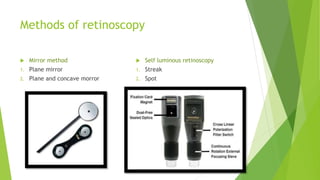
Methods of retinoscopy
 Mirror method
1. Plane mirror
2. Plane and concave morror
 Self luminous retinoscopy
1. Streak
2. Spot
Optical principle
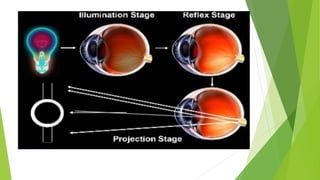
 A beam of light is projected into the eye .
 When the light is moved vertically and horizontally across the eye, the examiner
observes the movement of the reflected light from the back of the eye.
 This reflection is called the red reflex.
 The examiner then introduces lenses in front of the eye and as the power of the
lenses changes, there is a corresponding change in the direction and pattern of
the reflection.
 The examiner keeps changing the lenses until reaching a lens power that
indicates the refractive error of the patient.
Effects of retinoscopy
In (Welch Allyn) Retino
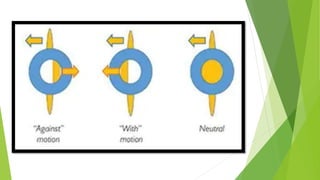
 Plane mirror effect:
(Most used)
1. “ Against ” movement of red reflax
 myopic add (-) lens.
2. “ With ” movement of red reflex
Hyperopic  add (+) lens.
3. Can obtain when the light can’t be
focused on your hand or wall.
4. Set the sleeve to its lowest
position.
 Convergent : (the opposite to other
effect)
1. “ with ” movement of red reflax 
myopic add (-) lens.
2. “ against ” movement of red reflex
Hyperopic  add (+) lens.
3. Set the sleeve up.
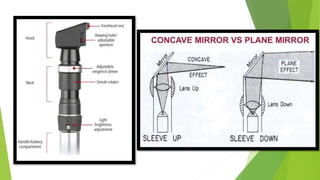
 Not all retinoscopes employ the same sleeve position for the plane mirror
setting.
 For example, the original Copeland retinoscope is in plane position with the
sleeve up; the Welch Allyn (or Heine) instrument is in plane position with
the sleeve down.
 The axis of the streak is rotated with the sleeve.
Types of retinoscopy
 Static retinoscopy
1. Relax accommodation
2. Fixation at 6 meter
3. Determine punctum remotum
 Dynamic retinoscopy
1. Using accommodation of the
patient.
2. Fixation at near object after
correcting far sight errors.
3. Determine punctum proximum.
Retinoscopy technique
(Streak, static retino)
 Dark room .
 Set the sleeve up ( plane effect).
 Ditence between doctor and patient:
1. If 1 m = myope 1D
2. 2/3 m = myope 1.5 D
3. 1/2 m = myope 2 D
 Movement of the retinoscope :
1. Vertical first then horizontal.
2. Neither quick nor slow.
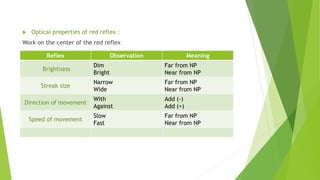
 Optical properties of red reflex :
Work on the center of the red reflex
Reflex Observation Meaning
Brightness
Dim
Bright
Far from NP
Near from NP
Streak size
Narrow
Wide
Far from NP
Near from NP
Direction of movement
With
Against
Add (-)
Add (+)
Speed of movement
Slow
Fast
Far from NP
Near from NP
 Detection of Neutral Point (NP):
1. Brightest
2. Broadest
3. Infinity spead
4. All pupil is lightened
5. If the lenses in trial frame increased by 0.5 D ,the red reflex will move .
6. If the doctor move close to patient , the red reflex will move with.
7. If doctor head moves back , the red reflex will move against .
8. 1st meridian (vertical)is neutralized , then the streak is turned 90° to neutralize
the 2 nd meridian ( horizontal).
9. If all meridians are simillary neutralized  no astigmatism.
10. If two meridians are neutralized at different points  astigmatism .
Recording retinoscope results
 Cruciate lines , vertical and horizontal are the same values in spherical
errors.
 In astigmatism:
1. With rule : vertical is more curved.
2. Against rule : horizontal is more curved.
Calculation of final refraction
 Subtract :
1. Working distance : If WD=2/3 m  subtract 1.5D.
2. Effect of cilliary muscle : if cyclopejic was used  subtract 0.5 or 1.00 D
Examples for streak retinoscopy
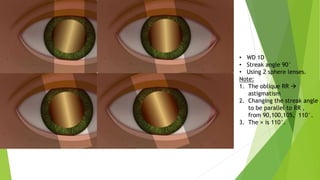
• WD 1D
• Streak angle 90°
• Using 2 sphere lenses.
Note:
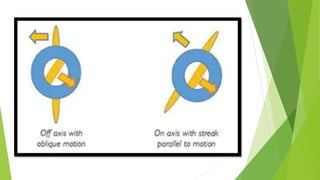
1. The oblique RR 
astigmatism
2. Changing the streak angle
to be parallel to RR ,
from 90,100,105, 110°.
3. The × is 110°.
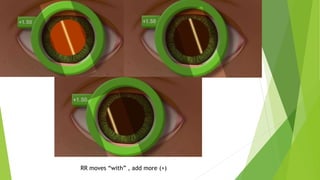
RR moves “with” , add more (+)
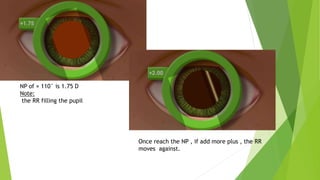
NP of × 110° is 1.75 D
Note:
the RR filling the pupil
Once reach the NP , if add more plus , the RR
moves against.
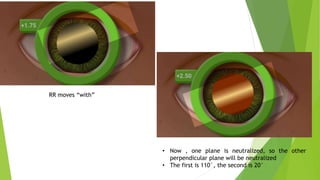
• Now , one plane is neutralized, so the other
perpendicular plane will be neutralized
• The first is 110°, the second is 20°
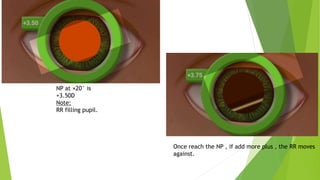
RR moves “with”
NP at ×20° is
+3.50D
Note:
RR filling pupil.
Once reach the NP , if add more plus , the RR moves
against.
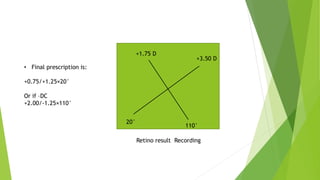
+1.75 D
+3.50 D
110°
20°
Retino result Recording
• Final prescription is:
+0.75/+1.25×20°
Or if –DC
+2.00/-1.25×110°
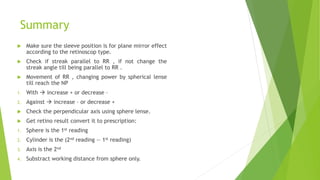
Summary
 Make sure the sleeve position is for plane mirror effect
according to the retinoscop type.
 Check if streak parallel to RR , if not change the
streak angle till being parallel to RR .
 Movement of RR , changing power by spherical lense
till reach the NP
1. With  increase + or decrease –
2. Against  increase – or decrease +
 Check the perpendicular axis using sphere lense.
 Get retino result convert it to prescription:
1. Sphere is the 1st reading
2. Cylinder is the (2nd reading — 1st reading)
3. Axis is the 2nd
4. Substract working distance from sphere only.
Thanks

Retinoscopy

  • 1.
  • 2.
    What is retinoscopy Retinoscopy (skiascopy) is a technique to objectively determine the refractive error of the eye (farsighted, nearsighted, astigmatism ) and the need for glasses.
  • 3.
    Methods of retinoscopy Mirror method 1. Plane mirror 2. Plane and concave morror  Self luminous retinoscopy 1. Streak 2. Spot
  • 4.
    Optical principle  Abeam of light is projected into the eye .  When the light is moved vertically and horizontally across the eye, the examiner observes the movement of the reflected light from the back of the eye.  This reflection is called the red reflex.  The examiner then introduces lenses in front of the eye and as the power of the lenses changes, there is a corresponding change in the direction and pattern of the reflection.  The examiner keeps changing the lenses until reaching a lens power that indicates the refractive error of the patient.
  • 6.
    Effects of retinoscopy In(Welch Allyn) Retino  Plane mirror effect: (Most used) 1. “ Against ” movement of red reflax  myopic add (-) lens. 2. “ With ” movement of red reflex Hyperopic  add (+) lens. 3. Can obtain when the light can’t be focused on your hand or wall. 4. Set the sleeve to its lowest position.  Convergent : (the opposite to other effect) 1. “ with ” movement of red reflax  myopic add (-) lens. 2. “ against ” movement of red reflex Hyperopic  add (+) lens. 3. Set the sleeve up.
  • 7.
     Not allretinoscopes employ the same sleeve position for the plane mirror setting.  For example, the original Copeland retinoscope is in plane position with the sleeve up; the Welch Allyn (or Heine) instrument is in plane position with the sleeve down.  The axis of the streak is rotated with the sleeve.
  • 9.
    Types of retinoscopy Static retinoscopy 1. Relax accommodation 2. Fixation at 6 meter 3. Determine punctum remotum  Dynamic retinoscopy 1. Using accommodation of the patient. 2. Fixation at near object after correcting far sight errors. 3. Determine punctum proximum.
  • 10.
    Retinoscopy technique (Streak, staticretino)  Dark room .  Set the sleeve up ( plane effect).  Ditence between doctor and patient: 1. If 1 m = myope 1D 2. 2/3 m = myope 1.5 D 3. 1/2 m = myope 2 D  Movement of the retinoscope : 1. Vertical first then horizontal. 2. Neither quick nor slow.
  • 11.
     Optical propertiesof red reflex : Work on the center of the red reflex Reflex Observation Meaning Brightness Dim Bright Far from NP Near from NP Streak size Narrow Wide Far from NP Near from NP Direction of movement With Against Add (-) Add (+) Speed of movement Slow Fast Far from NP Near from NP
  • 14.
     Detection ofNeutral Point (NP): 1. Brightest 2. Broadest 3. Infinity spead 4. All pupil is lightened 5. If the lenses in trial frame increased by 0.5 D ,the red reflex will move . 6. If the doctor move close to patient , the red reflex will move with. 7. If doctor head moves back , the red reflex will move against . 8. 1st meridian (vertical)is neutralized , then the streak is turned 90° to neutralize the 2 nd meridian ( horizontal). 9. If all meridians are simillary neutralized  no astigmatism. 10. If two meridians are neutralized at different points  astigmatism .
  • 15.
    Recording retinoscope results Cruciate lines , vertical and horizontal are the same values in spherical errors.  In astigmatism: 1. With rule : vertical is more curved. 2. Against rule : horizontal is more curved.
  • 16.
    Calculation of finalrefraction  Subtract : 1. Working distance : If WD=2/3 m  subtract 1.5D. 2. Effect of cilliary muscle : if cyclopejic was used  subtract 0.5 or 1.00 D
  • 17.
  • 18.
    • WD 1D •Streak angle 90° • Using 2 sphere lenses. Note: 1. The oblique RR  astigmatism 2. Changing the streak angle to be parallel to RR , from 90,100,105, 110°. 3. The × is 110°.
  • 19.
    RR moves “with”, add more (+)
  • 20.
    NP of ×110° is 1.75 D Note: the RR filling the pupil Once reach the NP , if add more plus , the RR moves against.
  • 21.
    • Now ,one plane is neutralized, so the other perpendicular plane will be neutralized • The first is 110°, the second is 20° RR moves “with”
  • 22.
    NP at ×20°is +3.50D Note: RR filling pupil. Once reach the NP , if add more plus , the RR moves against.
  • 23.
    +1.75 D +3.50 D 110° 20° Retinoresult Recording • Final prescription is: +0.75/+1.25×20° Or if –DC +2.00/-1.25×110°
  • 24.
    Summary  Make surethe sleeve position is for plane mirror effect according to the retinoscop type.  Check if streak parallel to RR , if not change the streak angle till being parallel to RR .  Movement of RR , changing power by spherical lense till reach the NP 1. With  increase + or decrease – 2. Against  increase – or decrease +  Check the perpendicular axis using sphere lense.  Get retino result convert it to prescription: 1. Sphere is the 1st reading 2. Cylinder is the (2nd reading — 1st reading) 3. Axis is the 2nd 4. Substract working distance from sphere only.
  • 25.