Fakhruddin Aliasger
Lecturer
SPIO
Fakhruddin Aliasger 1
 Depth may be perceived in two forms
 1. Binocular Disparity (stereopsis)
 2. Monocular Depth Clues
 Stereopsis is the perception of the relative
depth of objects on the basis of binocular
disparity which reflects the slight difference
in the image presented to each eye
Fakhruddin Aliasger 2
 Stereoacuity is the angular measurement of
the minimal resolvable binocular disparity,
which is necessary for the appreciation of
stereopsis
 The ability to demonstrate stereopsis
indicates the presence of retinal
correspondence
 The normal level of stereopsis being
40seconds of arc
Fakhruddin Aliasger 3
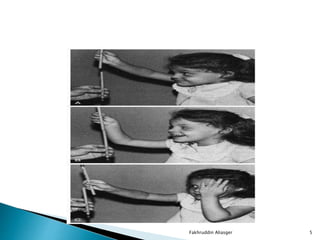
 This is a test for gross stereopsis
 The patient attempts to place a pencil on top
of one held by examiner
 Patient who possess stereopsis will find it
easier to perform the test with both eyes
open than monocularly
Fakhruddin Aliasger 4
Fakhruddin Aliasger 5
Fakhruddin Aliasger 6
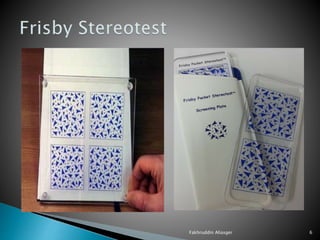
 This uses random shapes with displacement
and consists of three plastic plates of
different thickness of 6mm, 3mm and 1mm
 Each plate consists of four squares produced
by random shapes printed on one side
 Corresponding to one of the squares a
disparity is produced
 This disparity creates a 3D appearance of a
circle
Fakhruddin Aliasger 7
 Frisby plates held at a distance of 40cms of
6mm, 3mm and1mm thick produces
stereopsis of 340”, 170” and 55” respectively
Fakhruddin Aliasger 8
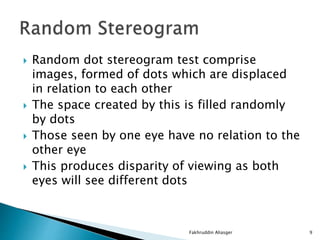
 Random dot stereogram test comprise
images, formed of dots which are displaced
in relation to each other
 The space created by this is filled randomly
by dots
 Those seen by one eye have no relation to the
other eye
 This produces disparity of viewing as both
eyes will see different dots
Fakhruddin Aliasger 9
 There are two types of Random dot test
 1. Lang stereotest
 2. TNO stereotest
Fakhruddin Aliasger 10
 The Lang-stereotest was developed by the
Swiss ophthalmologist Joseph Lang in the
beginning of the eighties
 Two versions are available Lang-stereotest I
and II which only differ in the type of
stereoscopic objects to be recognized
 The Lang-stereotest II additionally contains a
picture that can be recognized with one eye a
star
Fakhruddin Aliasger 11
 The Lang-stereotest for the first time
combines two functional principles of
stereograms the random dots of Julesz and
the grid of cylinders of W.R. Hess
Fakhruddin Aliasger 12
 Position yourself in front of the examinee, so
that you can easily observe his/her eye
movements
 Show the test plate exactly at right angles at
a distance of about 40 cm (16 inches)
 Ask the child if he/she sees something on the
plate and watch the searching movements of
his/her eyes
 When a 3D object has been detected, ask the
child to look for additional objects and also
to describe them
Fakhruddin Aliasger 13
 The examinee may then also point at the
figures and should be able to tell which of
them sticks out most
 Disparities Lang test I
 Car: 550”
 Star: 600”
 Cat: 1200
Fakhruddin Aliasger 14
 Disparities Lang test II
 Moon: 200”
 Truck: 400”
 Elephant: 600”
Fakhruddin Aliasger 15
Fakhruddin Aliasger 16
 Positive
 Correct localization and naming of all hidden
objects, typically jumping eye movements from
one object to the next
 Negative
 No object can be detected, and eye movements
also do not indicate the recognition of the 3D
objects
 Eyes are scanning the test plate and then shift
away from it
 Doubtful
 only one hidden object is localized and named
correctly, eyes are scanning the plate for objects.
Fakhruddin Aliasger 17
 This test was primarily designed for screening
pre-school children for defects of binocular
vision
 It consists of seven plates to be viewed with
red – green spectacles that carry figures that
can be seen only when both eyes cooperate
to give stereoscopic vision
 Three plates (plate I-III) enable the examiner
to quickly establish whether stereoscopic
vision is present at all
Fakhruddin Aliasger 18
 The three plates (V-VII) may be then used for
exact determination of stereoscopic
sensitivity
 When used for screening plate V should be
used as pass fail criterion
 Plate V measures stereoacuity of 480-240 sec
of arc
 Plate VI measures stereoacuity of 120-60 sec
of arc
 Plate VII measures stereoacuity of 30-15 sec
of arc
Fakhruddin Aliasger 19
 When administrating the test plates should be
well illuminated
 The test should be carried out at a distance of
40cms
 The plate should be held squarely and should
not be rotated
 Red green goggles should not be removed
Fakhruddin Aliasger 20
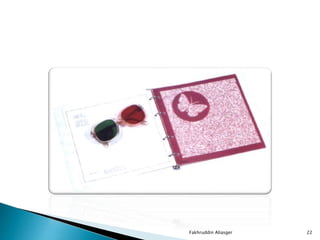
 Plate I
 In this plate two butterflies can be seen, but
one of them is hidden that is visible only
when both eyes are used
 The child is asked to point out at each
butterfly it can see
Fakhruddin Aliasger 21
Fakhruddin Aliasger 22
 Plate II
 Four discs (balls, saucers), that differ in size
are present
 Two of these the largest and second smallest
are visible only stereoscopically
 First ask for the smallest disc which always
visible and then for the largest
Fakhruddin Aliasger 23
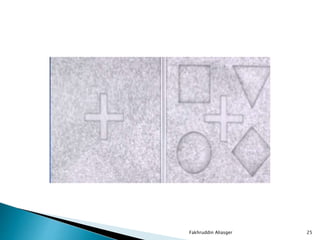
 Plate III
 It consists of four hidden item a disc,
triangle, square and diamond are arranged
around a central cross of different texture
 The child is first asked to look for an example
on the opposite page and then asked to find
for the corresponding plate
Fakhruddin Aliasger 24
Fakhruddin Aliasger 25
 Plate IV
 This is a suppression test
 It consists of a small disc and two large disc
each flanked on sides
 If a child sees only two disc one big and one
small it indicates presence of suppression
 Big disc seen in front of which eye
corresponds to dominant eye
 If the child shows the ability to see small disc
fused with one of the large disc it indicates
presence of fusion
Fakhruddin Aliasger 26
 Plate V-VII
 Here the test figures disc with a sector
missing are presented at six different level
 The corresponding retinal disparity ranges
from 15 to 480 sec of arc
Fakhruddin Aliasger 27
 It is based on the principle of linear
polarisation
 Polaroid filters are worn and a vertical image
of a light source is seen through one filter
and a horizontal image of light is seen
through the other filter
 The target are presented as vectographs
 The disparirty produced by either eye results
in stereopsis
Fakhruddin Aliasger 28
Fakhruddin Aliasger 29
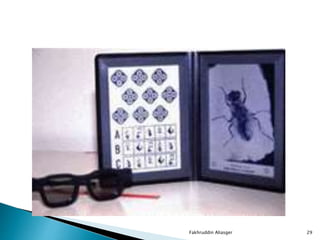
 One plate contains the image of a fly
 The second plate consists of nine boxes each
containing four circles and three rows of
animals
 One circle is displaced to produce disparity
 The image of one animal in each row also
appears to stand out
Fakhruddin Aliasger 30
 The patient wears his/her correction and
wears polaroid lenses over it
 The patient is first shown the fly
 The patient is asked to catch the fly by its
wings
 If the fingers reach above the plates patient
has stereopsis if not the finger will touch the
plate
Fakhruddin Aliasger 31
 In the second part of the test there are three
rows of animals
 The patient is asked to push down the animal
that stands out
 The third part of the test consists of nine
squares with four circle in each of square
 In each square one of the circle appears to
stand out which the patient is asked to push
down
Fakhruddin Aliasger 32
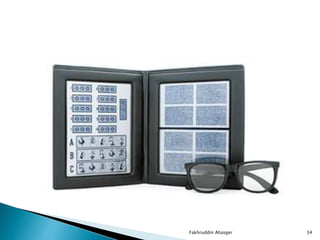
 This test is based on the principle of linear
polarisation
 This test is similar as titmus fly test having
three parts
 On one plate it consists of two groups of four
square
 Three of which it contains geometric shapes
which includes circle square and star
 The shapes appear to stand out distinctly
Fakhruddin Aliasger 33
Fakhruddin Aliasger 34
 The other plate consists of animals and circle
similar to that of titmus fly test
 The perception of random shapes gives
stereoacuity of 500-250 sec of arc
 The perception of circle and animal shapes
gives stereoacuity of 400-20 sec of arc
Fakhruddin Aliasger 35

Test for stereopsis

  • 1.
  • 2.
     Depth maybe perceived in two forms  1. Binocular Disparity (stereopsis)  2. Monocular Depth Clues  Stereopsis is the perception of the relative depth of objects on the basis of binocular disparity which reflects the slight difference in the image presented to each eye Fakhruddin Aliasger 2
  • 3.
     Stereoacuity isthe angular measurement of the minimal resolvable binocular disparity, which is necessary for the appreciation of stereopsis  The ability to demonstrate stereopsis indicates the presence of retinal correspondence  The normal level of stereopsis being 40seconds of arc Fakhruddin Aliasger 3
  • 4.
     This isa test for gross stereopsis  The patient attempts to place a pencil on top of one held by examiner  Patient who possess stereopsis will find it easier to perform the test with both eyes open than monocularly Fakhruddin Aliasger 4
  • 5.
  • 6.
  • 7.
     This usesrandom shapes with displacement and consists of three plastic plates of different thickness of 6mm, 3mm and 1mm  Each plate consists of four squares produced by random shapes printed on one side  Corresponding to one of the squares a disparity is produced  This disparity creates a 3D appearance of a circle Fakhruddin Aliasger 7
  • 8.
     Frisby platesheld at a distance of 40cms of 6mm, 3mm and1mm thick produces stereopsis of 340”, 170” and 55” respectively Fakhruddin Aliasger 8
  • 9.
     Random dotstereogram test comprise images, formed of dots which are displaced in relation to each other  The space created by this is filled randomly by dots  Those seen by one eye have no relation to the other eye  This produces disparity of viewing as both eyes will see different dots Fakhruddin Aliasger 9
  • 10.
     There aretwo types of Random dot test  1. Lang stereotest  2. TNO stereotest Fakhruddin Aliasger 10
  • 11.
     The Lang-stereotestwas developed by the Swiss ophthalmologist Joseph Lang in the beginning of the eighties  Two versions are available Lang-stereotest I and II which only differ in the type of stereoscopic objects to be recognized  The Lang-stereotest II additionally contains a picture that can be recognized with one eye a star Fakhruddin Aliasger 11
  • 12.
     The Lang-stereotestfor the first time combines two functional principles of stereograms the random dots of Julesz and the grid of cylinders of W.R. Hess Fakhruddin Aliasger 12
  • 13.
     Position yourselfin front of the examinee, so that you can easily observe his/her eye movements  Show the test plate exactly at right angles at a distance of about 40 cm (16 inches)  Ask the child if he/she sees something on the plate and watch the searching movements of his/her eyes  When a 3D object has been detected, ask the child to look for additional objects and also to describe them Fakhruddin Aliasger 13
  • 14.
     The examineemay then also point at the figures and should be able to tell which of them sticks out most  Disparities Lang test I  Car: 550”  Star: 600”  Cat: 1200 Fakhruddin Aliasger 14
  • 15.
     Disparities Langtest II  Moon: 200”  Truck: 400”  Elephant: 600” Fakhruddin Aliasger 15
  • 16.
  • 17.
     Positive  Correctlocalization and naming of all hidden objects, typically jumping eye movements from one object to the next  Negative  No object can be detected, and eye movements also do not indicate the recognition of the 3D objects  Eyes are scanning the test plate and then shift away from it  Doubtful  only one hidden object is localized and named correctly, eyes are scanning the plate for objects. Fakhruddin Aliasger 17
  • 18.
     This testwas primarily designed for screening pre-school children for defects of binocular vision  It consists of seven plates to be viewed with red – green spectacles that carry figures that can be seen only when both eyes cooperate to give stereoscopic vision  Three plates (plate I-III) enable the examiner to quickly establish whether stereoscopic vision is present at all Fakhruddin Aliasger 18
  • 19.
     The threeplates (V-VII) may be then used for exact determination of stereoscopic sensitivity  When used for screening plate V should be used as pass fail criterion  Plate V measures stereoacuity of 480-240 sec of arc  Plate VI measures stereoacuity of 120-60 sec of arc  Plate VII measures stereoacuity of 30-15 sec of arc Fakhruddin Aliasger 19
  • 20.
     When administratingthe test plates should be well illuminated  The test should be carried out at a distance of 40cms  The plate should be held squarely and should not be rotated  Red green goggles should not be removed Fakhruddin Aliasger 20
  • 21.
     Plate I In this plate two butterflies can be seen, but one of them is hidden that is visible only when both eyes are used  The child is asked to point out at each butterfly it can see Fakhruddin Aliasger 21
  • 22.
  • 23.
     Plate II Four discs (balls, saucers), that differ in size are present  Two of these the largest and second smallest are visible only stereoscopically  First ask for the smallest disc which always visible and then for the largest Fakhruddin Aliasger 23
  • 24.
     Plate III It consists of four hidden item a disc, triangle, square and diamond are arranged around a central cross of different texture  The child is first asked to look for an example on the opposite page and then asked to find for the corresponding plate Fakhruddin Aliasger 24
  • 25.
  • 26.
     Plate IV This is a suppression test  It consists of a small disc and two large disc each flanked on sides  If a child sees only two disc one big and one small it indicates presence of suppression  Big disc seen in front of which eye corresponds to dominant eye  If the child shows the ability to see small disc fused with one of the large disc it indicates presence of fusion Fakhruddin Aliasger 26
  • 27.
     Plate V-VII Here the test figures disc with a sector missing are presented at six different level  The corresponding retinal disparity ranges from 15 to 480 sec of arc Fakhruddin Aliasger 27
  • 28.
     It isbased on the principle of linear polarisation  Polaroid filters are worn and a vertical image of a light source is seen through one filter and a horizontal image of light is seen through the other filter  The target are presented as vectographs  The disparirty produced by either eye results in stereopsis Fakhruddin Aliasger 28
  • 29.
  • 30.
     One platecontains the image of a fly  The second plate consists of nine boxes each containing four circles and three rows of animals  One circle is displaced to produce disparity  The image of one animal in each row also appears to stand out Fakhruddin Aliasger 30
  • 31.
     The patientwears his/her correction and wears polaroid lenses over it  The patient is first shown the fly  The patient is asked to catch the fly by its wings  If the fingers reach above the plates patient has stereopsis if not the finger will touch the plate Fakhruddin Aliasger 31
  • 32.
     In thesecond part of the test there are three rows of animals  The patient is asked to push down the animal that stands out  The third part of the test consists of nine squares with four circle in each of square  In each square one of the circle appears to stand out which the patient is asked to push down Fakhruddin Aliasger 32
  • 33.
     This testis based on the principle of linear polarisation  This test is similar as titmus fly test having three parts  On one plate it consists of two groups of four square  Three of which it contains geometric shapes which includes circle square and star  The shapes appear to stand out distinctly Fakhruddin Aliasger 33
  • 34.
  • 35.
     The otherplate consists of animals and circle similar to that of titmus fly test  The perception of random shapes gives stereoacuity of 500-250 sec of arc  The perception of circle and animal shapes gives stereoacuity of 400-20 sec of arc Fakhruddin Aliasger 35