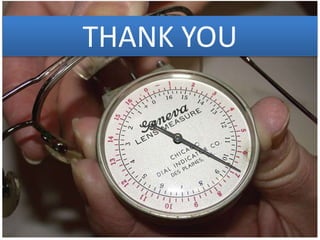
GENEVA LENS MEASURE
Suraj Shil,
B. Optom 1st yr
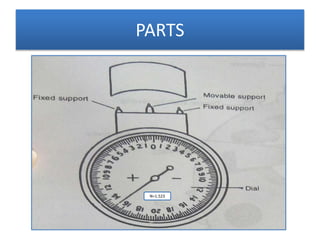
PARTS
N=1.523
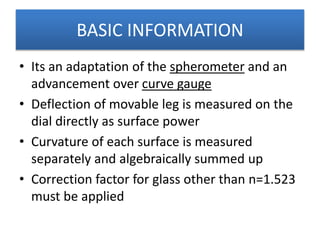
BASIC INFORMATION
• Its an adaptation of the spherometer and an
advancement over curve gauge
• Deflection of movable leg is measured on the
dial directly as surface power
• Curvature of each surface is measured
separately and algebraically summed up
• Correction factor for glass other than n=1.523
must be applied
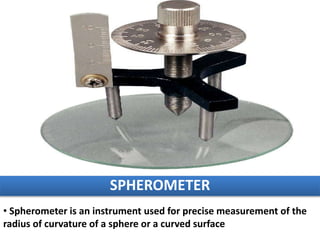
SPHEROMETER
• Spherometer is an instrument used for precise measurement of the
radius of curvature of a sphere or a curved surface
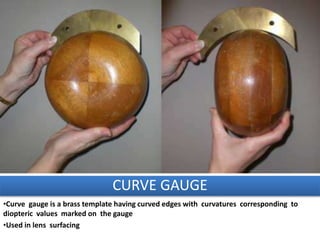
CURVE GAUGE
•Curve gauge is a brass template having curved edges with curvatures corresponding to
diopteric values marked on the gauge
•Used in lens surfacing
WORKING PRINCIPLE of GENEVA LENS
• The device has two fixed pins and a movable pin
in the centre
• When placed on a curved surface the central pin
moves inward or protrudes outward
• A pointer activated by a system of gears indicates
the position of the movable pin in relation to the
fixed pins
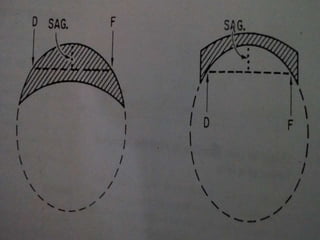
• The central pin indicates the sag of the surface
which provides direct reading of refractive power
WORKING PRINCIPLE
DIGITAL LENS CLOCK
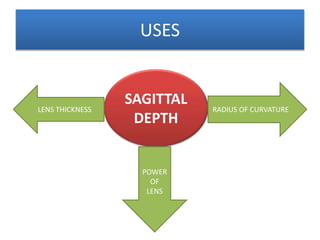
USES
SAGITTAL
DEPTH
RADIUS OF CURVATURE
POWER
OF
LENS
LENS THICKNESS
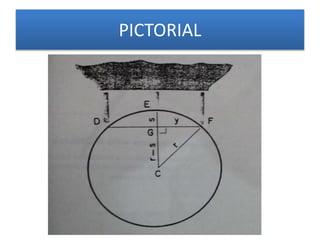
PICTORIAL
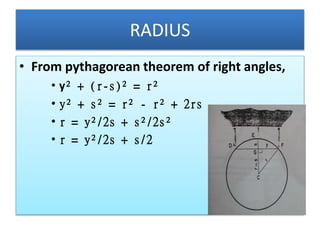
RADIUS
• From pythagorean theorem of right angles,
• y² + (r-s)² = r²
• y² + s² = r² - r² + 2rs
• r = y²/2s + s²/2s²
• r = y²/2s + s/2
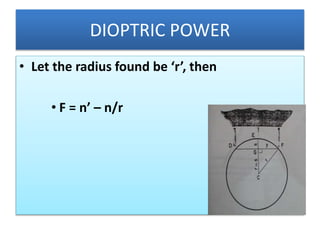
DIOPTRIC POWER
• Let the radius found be ‘r’, then
• F = n’ – n/r
THICKNESS
• Can be used to estimate thickness of a hard or
gas permeable contact lens
• Lens placed concave side up on any hard
surface
• Lens gauge placed on it so that outer prongs
rest on table and centre prong touch lens
• If power and distance between the prongs are
known, thickness of the lens is given by the
sagitta
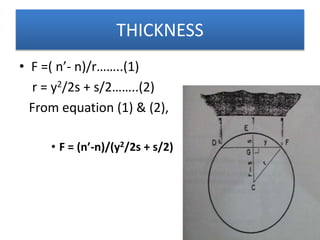
• F =( n’- n)/r……..(1)
r = y2/2s + s/2……..(2)
From equation (1) & (2),
• F = (n’-n)/(y2/2s + s/2)
THICKNESS
FOR CYLINDRICAL LENSES
• Hold the lens measure such that the center
contact point of the lens clock is at optical center
and the lens clock is perpendicular to the lens
surface
• Lens clock is rotated at this point with all three
contact points against the lens
• The indicator will show a changing value, because
the surface has two curves
• The values of these curves are indicated when the
lens clock shows its maximum and minimum
values
FOR BIFOCALS
• For the main lens, none of the three contact
points must touch or rest on the segment
portion
• To measure the near portion accurately, all
three contact points of the lens measure must
fit within the width of the segment
**Using the conventional lens measure,
this is not always possible
SEG CLOCK
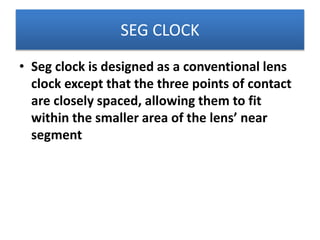
• Seg clock is designed as a conventional lens
clock except that the three points of contact
are closely spaced, allowing them to fit
within the smaller area of the lens’ near
segment
CONVERSION FACTOR
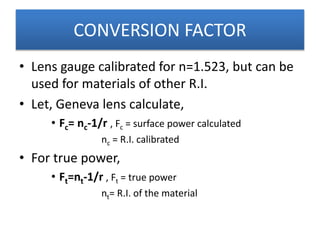
• Lens gauge calibrated for n=1.523, but can be
used for materials of other R.I.
• Let, Geneva lens calculate,
• Fc= nc-1/r , Fc = surface power calculated
nc = R.I. calibrated
• For true power,
• Ft=nt-1/r , Ft = true power
nt= R.I. of the material
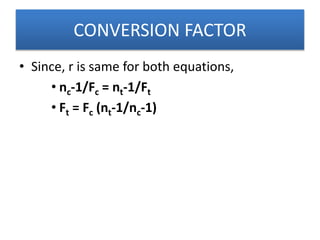
• Since, r is same for both equations,
• nc-1/Fc = nt-1/Ft
• Ft = Fc (nt-1/nc-1)
CONVERSION FACTOR
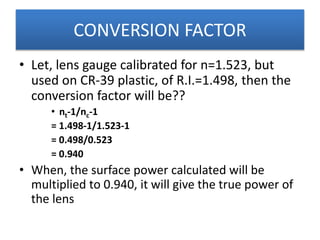
• Let, lens gauge calibrated for n=1.523, but
used on CR-39 plastic, of R.I.=1.498, then the
conversion factor will be??
• nt-1/nc-1
= 1.498-1/1.523-1
= 0.498/0.523
= 0.940
• When, the surface power calculated will be
multiplied to 0.940, it will give the true power of
the lens
CONVERSION FACTOR
CONCLUSIONS
• Important instrument in optics
• Use not confined only for calculation of
surface power
• Can be used for lenses of different R.I.
• Can be used for spherical, sphaerocylinder
and even bifocals
REFERENCES
• SYSTEMS FOR OPHTHALMIC DISPENSING (page:
406, 407, 408, 409)
• CLINICAL OPTICS (page: 27,28)
• OPTICS AND REFRACTION - A.K. Khurana
• REFRACTION AND LENS PRESCRIPTION – Monica
Chaudhary (page: 35,36)
• https://en.m.wikipedia.org/wiki/Lens_clock
• YOUTUBE channel ‘GOODWIN COLLEGE ONLINE
STUDIES’ – “Lens Clock Measurer”
THANK YOU

geneva lens measure/ lens clock

  • 1.
    GENEVA LENS MEASURE SurajShil, B. Optom 1st yr
  • 2.
  • 3.
    BASIC INFORMATION • Itsan adaptation of the spherometer and an advancement over curve gauge • Deflection of movable leg is measured on the dial directly as surface power • Curvature of each surface is measured separately and algebraically summed up • Correction factor for glass other than n=1.523 must be applied
  • 4.
    SPHEROMETER • Spherometer isan instrument used for precise measurement of the radius of curvature of a sphere or a curved surface
  • 5.
    CURVE GAUGE •Curve gaugeis a brass template having curved edges with curvatures corresponding to diopteric values marked on the gauge •Used in lens surfacing
  • 6.
    WORKING PRINCIPLE ofGENEVA LENS • The device has two fixed pins and a movable pin in the centre • When placed on a curved surface the central pin moves inward or protrudes outward • A pointer activated by a system of gears indicates the position of the movable pin in relation to the fixed pins • The central pin indicates the sag of the surface which provides direct reading of refractive power
  • 8.
  • 9.
  • 10.
  • 11.
  • 12.
    RADIUS • From pythagoreantheorem of right angles, • y² + (r-s)² = r² • y² + s² = r² - r² + 2rs • r = y²/2s + s²/2s² • r = y²/2s + s/2
  • 13.
    DIOPTRIC POWER • Letthe radius found be ‘r’, then • F = n’ – n/r
  • 14.
    THICKNESS • Can beused to estimate thickness of a hard or gas permeable contact lens • Lens placed concave side up on any hard surface • Lens gauge placed on it so that outer prongs rest on table and centre prong touch lens • If power and distance between the prongs are known, thickness of the lens is given by the sagitta
  • 15.
    • F =(n’- n)/r……..(1) r = y2/2s + s/2……..(2) From equation (1) & (2), • F = (n’-n)/(y2/2s + s/2) THICKNESS
  • 16.
    FOR CYLINDRICAL LENSES •Hold the lens measure such that the center contact point of the lens clock is at optical center and the lens clock is perpendicular to the lens surface • Lens clock is rotated at this point with all three contact points against the lens • The indicator will show a changing value, because the surface has two curves • The values of these curves are indicated when the lens clock shows its maximum and minimum values
  • 17.
    FOR BIFOCALS • Forthe main lens, none of the three contact points must touch or rest on the segment portion • To measure the near portion accurately, all three contact points of the lens measure must fit within the width of the segment **Using the conventional lens measure, this is not always possible
  • 18.
    SEG CLOCK • Segclock is designed as a conventional lens clock except that the three points of contact are closely spaced, allowing them to fit within the smaller area of the lens’ near segment
  • 19.
    CONVERSION FACTOR • Lensgauge calibrated for n=1.523, but can be used for materials of other R.I. • Let, Geneva lens calculate, • Fc= nc-1/r , Fc = surface power calculated nc = R.I. calibrated • For true power, • Ft=nt-1/r , Ft = true power nt= R.I. of the material
  • 20.
    • Since, ris same for both equations, • nc-1/Fc = nt-1/Ft • Ft = Fc (nt-1/nc-1) CONVERSION FACTOR
  • 21.
    • Let, lensgauge calibrated for n=1.523, but used on CR-39 plastic, of R.I.=1.498, then the conversion factor will be?? • nt-1/nc-1 = 1.498-1/1.523-1 = 0.498/0.523 = 0.940 • When, the surface power calculated will be multiplied to 0.940, it will give the true power of the lens CONVERSION FACTOR
  • 22.
    CONCLUSIONS • Important instrumentin optics • Use not confined only for calculation of surface power • Can be used for lenses of different R.I. • Can be used for spherical, sphaerocylinder and even bifocals
  • 23.
    REFERENCES • SYSTEMS FOROPHTHALMIC DISPENSING (page: 406, 407, 408, 409) • CLINICAL OPTICS (page: 27,28) • OPTICS AND REFRACTION - A.K. Khurana • REFRACTION AND LENS PRESCRIPTION – Monica Chaudhary (page: 35,36) • https://en.m.wikipedia.org/wiki/Lens_clock • YOUTUBE channel ‘GOODWIN COLLEGE ONLINE STUDIES’ – “Lens Clock Measurer”
  • 24.