RETINA AND DIABETIC
RETINOPATHY
Prithwiraj Maiti
R.G.KAR MEDICAL COLLEGE
PART 1: GENERAL RETINAL ANATOMY
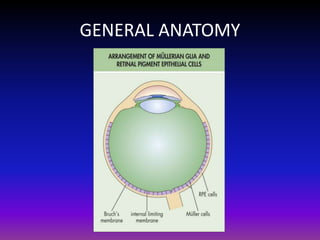
GENERAL ANATOMY
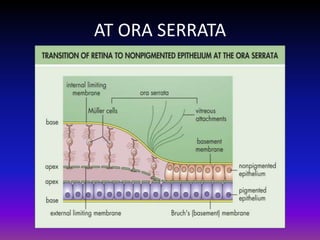
AT ORA SERRATA
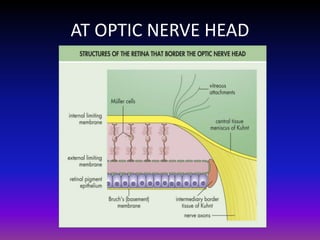
AT OPTIC NERVE HEAD
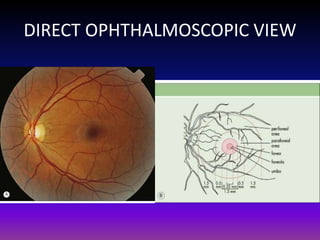
DIRECT OPHTHALMOSCOPIC VIEW
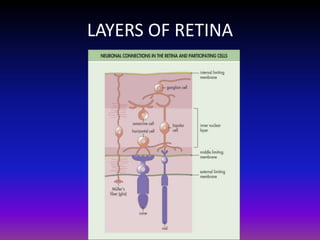
LAYERS OF RETINA
PART 2: DIABETIC RETINOPATHY
PATHOGENESIS
•
•
•
•

ALDOSE REDUCTASE PATHWAY
CENTRAL ROLE OF VEGF
MORPHOLOGICAL CHANGES IN PLATELETS
BLOOD VISCOCITY
ALDOSE REDUCTASE PATHWAY
• ALDOSE REDUCTASE CONVERTS GLUCOSE TO
SORBITOL AND GALACTOSE TO GALACTITOL.
• ALDOSE REDUCTASE IS PRESENT IN HIGH
LEVELS IN:
1. LENS EPITHELIAL CELLS: CATARACT.
2. RETINAL CELLS: RETINOPATHY.
• AN EFFECTIVE ALDOSE REDUCTASE
INHIBITOR HAS NOT BEEN DEVELOPED YET.
CENTRAL ROLE OF VEGF
• VEGF NORMALLY INHIBITS THE GROWTH OF
RETINAL EPITHELIAL CELLS.
• VEGF has a direct role in the proliferative
retinal vascular abnormalities that are found
in diabetes.
• The concentration of VEGF in aqueous and
vitreous directly correlates with the severity
of retinopathy.
MORPHOLOGICAL CHANGES IN
PLATELETS & HIGH BLOOD VISCOCITY
• They cause focal capillary occlusion and focal
areas of ischemia in the retina which, in turn,
contribute to the development of diabetic
retinopathy.
STAGES OF DIABETIC RETINOPATHY
1. Nonproliferative Diabetic Retinopathy
[NPDR]: Early and advanced.
2. Proliferative Diabetic Retinopathy [PDR].
EARLY NPDR
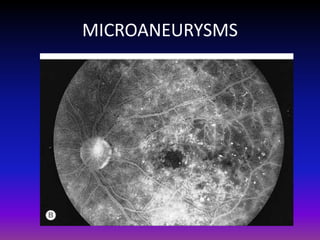
• MICROANEURYSMS:
• SMALL RED DOTS IN THE CENTRAL RETINAL
LAYERS.
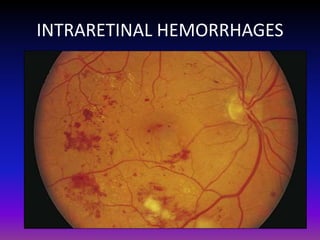
• IF THE WALL OF MICROANEURYSM IS WEAK
ENOUGH, IT MAY LEAD TO INTRARETINAL
HEMORRHAGES.
MICROANEURYSMS
INTRARETINAL HEMORRHAGES
MACULAR EDEMA
• The intercellular edema fluid comes from
leaking microaneurysms/ diffuse capillary
incompetence.
• The edema causes scattering of light by the
multiple interfaces it creates in the retina by
separated retinal cells.
• This decreases the retina’s translucency such
that the normal retinal pigment epithelial and
choroidal background pattern is blurred.
CCIRCINATE RETINOPATHY
• If the leakage of fluid is severe enough, lipid
accumulates in the retina.
• In some cases, lipid is scattered through the
macula.
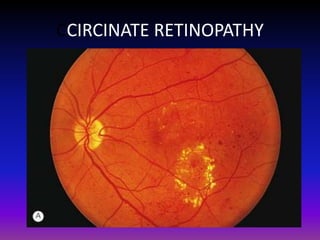
• In others, it accumulates in a ring around a
group of leaking microaneurysms, or around
microaneurysms surrounding an area of
capillary nonperfusion. This pattern is called
circinate retinopathy.
CCIRCINATE RETINOPATHY
ADVANCED NPDR
• Due to increased retinal hypoxia, following changes
are seen in the retina:
1. Intraretinal microvascular abnormalities (IRMA),
2. Cotton-wool spots,
3. Venous beading.
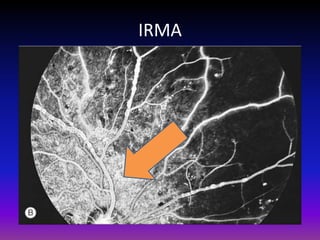
Intraretinal microvascular
abnormalities (IRMA)
• They are dilated capillaries, which seem to
function as collateral channels.
• Capillary hypoperfusion often surrounds
IRMA .
IRMA
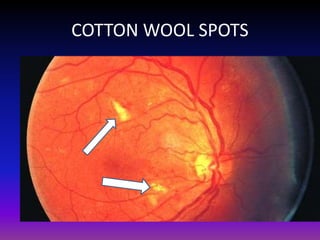
COTTON WOOL SPOTS/
SOFT EXUDATES
• The main cause of this feature is ischemic
changes.
• Local ischemia causes effective obstruction of
axoplasmic flow in the normally transparent
nerve fiber layer AND,
• Subsequent swelling of the nerve fibers gives a
characteristic white fluffy appearance to the
cotton-wool spots.
• Fluorescein angiography shows no capillary
perfusion in the area corresponding to a cottonwool spot.
COTTON WOOL SPOTS
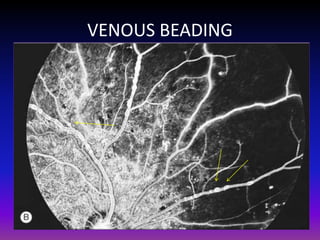
VENOUS BEADING
• Venous beading is an important sign of
sluggish retinal circulation.
• They nearly always are adjacent to large
areas of capillary nonperfusion.
VENOUS BEADING
PDR
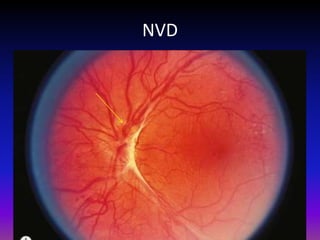
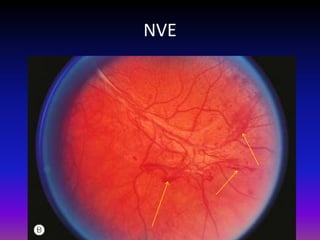
• It is characterized by neovascularization [new
blood vessel formation], which is of 2 types:
1. Neovascularization of the disc [NVD],
2. Neovascularization elsewhere [NVE].
• NVD: New vessels arise within ≤1 disc
diameter of optic nerve.
• NVE: New vessels arise within >1 disc
diameter of optic nerve.
NVD
NVE
VITREOUS TRACTION AND RETINAL
DETACHMENT
• The new vessels usually progress through a stage
of further proliferation, with associated
connective tissue formation.
• As PDR progresses, the fibrous component
becomes more prominent.
• Vitreous traction is transmitted to the retina
along these proliferations and may lead to
traction retinal detachment.
*. [Davis et al. have stressed the role of the
contracting vitreous in the production of vitreous
hemorrhage, retinal breaks, and retinal
detachment.]
Types of diabetic retinal detachments
• Two types of diabetic retinal detachments
occur:
1. Those that are caused by traction alone
(nonrhegmatogenous) and,
2. Those caused by retinal break formation
(rhegmatogenous).
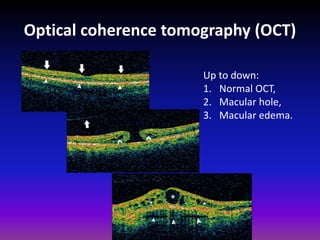
• Optical coherence tomography (OCT) is used
to describe/ determine those detachments.
Optical coherence tomography (OCT)
Up to down:
1. Normal OCT,
2. Macular hole,
3. Macular edema.
DIAGNOSIS
1. Direct ophthalmoscopy,
2. Detection of systemic hyperglycemia:
A. Fasting blood sugar testing,
B. Glucose tolerance test, and
C. Hemoglobin A1c determinations.
3. Optical coherence tomography (OCT), where
available.
TREATMENT
•
•
•
•
•

Antiplatelet therapy.
Antihypertensive drugs.
Anti-VEGF agents.
PRP.
Vitrectomy.
ANTIPLATELET THERAPY
Aspirin 650 mg daily
• It does not influence the progression of
retinopathy/ affect visual acuity/ influence the
incidence of vitreous hemorrhages.
• But it reduces incidence of stroke.
ANTIHYPERTENSIVE DRUGS
• The Hypertension in Diabetes Study group has
demonstrated that with better blood pressure
control, a 37% risk reduction in microvascular
changes can be achieved.
ANTI VEGF AGENTS
• Anti-VEGF drugs are available for the
treatment of macular degeneration.
• Recently, a protein kinase C inhibitor [PKCI]
has been shown to reduce diabetes-induced
hemodynamic abnormalities in patients with
diabetic retinopathy and reduce the risk of
vision loss in patients with macular edema.
PAN RETINAL PHOTOCOAGULATION [PRP]
Eyes with High Risk Characteristics [HRC]
HRC is defined as presence of any of the following:
1. NVD> 1/4th -1/3rd of the disc area,
2. NVD and vitreous hemorrhage.
3. NVE> ½ of the disc area.
4. Vitreous/ Preretinal hemorrhage.
•

The ETDRS found that PRP significantly retards
the development of HRC in eyes with very severe
NPDR and macular edema.
PRP
Mechanism of PRP [Proposed explanations]:
1. PRP decreases the production of vasoproliferative
factors by eliminating some of the hypoxic retina.
2. PRP stimulates the release of antiangiogenic
factors from the retinal pigment epithelium by
thinning the retina.
3. PRP increases oxygenation of the remaining
retina by allowing increased diffusion of oxygen
from the choroid.
4. PRP leads to an increase in vasoinhibitors by
directly stimulating the retinal pigment
epithelium to produce inhibitors of
vasoproliferation.
TREATMENT OF MACULAR EDEMA BY PRP
ETDRS defined clinically significant macular edema as:
1. Retinal thickening involving the center of the macula.
2. Hard exudates within 500μm of the center of the
macula (associated with retinal thickening).
3. An area of macular edema >1 disc area but within one
disc diameter of the center of the macula.
• The treatment strategy is to photocoagulate all leaking
microaneurysms further than 500μm from the center
of the macula and to place a grid of 100–200μm burns
in areas of diffuse capillary leakage and in areas of
capillary nonperfusion.
VITRECTOMY
• The major indications are of vitrectomy in
diabetics are:
1. Nonclearing vitreous hemorrhage.
2. Macular-involving/ macular-threatening
traction retinal detachment, and
3. Combined traction-rhegmatogenous retinal
detachment.
Continued….
• The surgical objectives are:
1. To clear the media,
2. To release all anterior-posterior traction,
3. To release tangential traction via delamination or
segmentation (cutting the fibrotic bridges between
areas of tractional detachment), and
4. To perform endophotocoagulation.
•

A possible cause of failure following an otherwise
successful vitrectomy is NEOVASCULARIZATION OF
IRIS [NVI] resulting in neovascular glaucoma.

Diabetic Retinopathy

  • 1.
    RETINA AND DIABETIC RETINOPATHY PrithwirajMaiti R.G.KAR MEDICAL COLLEGE
  • 2.
    PART 1: GENERALRETINAL ANATOMY
  • 3.
  • 4.
  • 5.
  • 6.
  • 7.
  • 8.
    PART 2: DIABETICRETINOPATHY
  • 9.
    PATHOGENESIS • • • • ALDOSE REDUCTASE PATHWAY CENTRALROLE OF VEGF MORPHOLOGICAL CHANGES IN PLATELETS BLOOD VISCOCITY
  • 10.
    ALDOSE REDUCTASE PATHWAY •ALDOSE REDUCTASE CONVERTS GLUCOSE TO SORBITOL AND GALACTOSE TO GALACTITOL. • ALDOSE REDUCTASE IS PRESENT IN HIGH LEVELS IN: 1. LENS EPITHELIAL CELLS: CATARACT. 2. RETINAL CELLS: RETINOPATHY. • AN EFFECTIVE ALDOSE REDUCTASE INHIBITOR HAS NOT BEEN DEVELOPED YET.
  • 11.
    CENTRAL ROLE OFVEGF • VEGF NORMALLY INHIBITS THE GROWTH OF RETINAL EPITHELIAL CELLS. • VEGF has a direct role in the proliferative retinal vascular abnormalities that are found in diabetes. • The concentration of VEGF in aqueous and vitreous directly correlates with the severity of retinopathy.
  • 12.
    MORPHOLOGICAL CHANGES IN PLATELETS& HIGH BLOOD VISCOCITY • They cause focal capillary occlusion and focal areas of ischemia in the retina which, in turn, contribute to the development of diabetic retinopathy.
  • 13.
    STAGES OF DIABETICRETINOPATHY 1. Nonproliferative Diabetic Retinopathy [NPDR]: Early and advanced. 2. Proliferative Diabetic Retinopathy [PDR].
  • 14.
    EARLY NPDR • MICROANEURYSMS: •SMALL RED DOTS IN THE CENTRAL RETINAL LAYERS. • IF THE WALL OF MICROANEURYSM IS WEAK ENOUGH, IT MAY LEAD TO INTRARETINAL HEMORRHAGES.
  • 15.
  • 16.
  • 17.
    MACULAR EDEMA • Theintercellular edema fluid comes from leaking microaneurysms/ diffuse capillary incompetence. • The edema causes scattering of light by the multiple interfaces it creates in the retina by separated retinal cells. • This decreases the retina’s translucency such that the normal retinal pigment epithelial and choroidal background pattern is blurred.
  • 18.
    CCIRCINATE RETINOPATHY • Ifthe leakage of fluid is severe enough, lipid accumulates in the retina. • In some cases, lipid is scattered through the macula. • In others, it accumulates in a ring around a group of leaking microaneurysms, or around microaneurysms surrounding an area of capillary nonperfusion. This pattern is called circinate retinopathy.
  • 19.
  • 20.
    ADVANCED NPDR • Dueto increased retinal hypoxia, following changes are seen in the retina: 1. Intraretinal microvascular abnormalities (IRMA), 2. Cotton-wool spots, 3. Venous beading.
  • 21.
    Intraretinal microvascular abnormalities (IRMA) •They are dilated capillaries, which seem to function as collateral channels. • Capillary hypoperfusion often surrounds IRMA .
  • 22.
  • 23.
    COTTON WOOL SPOTS/ SOFTEXUDATES • The main cause of this feature is ischemic changes. • Local ischemia causes effective obstruction of axoplasmic flow in the normally transparent nerve fiber layer AND, • Subsequent swelling of the nerve fibers gives a characteristic white fluffy appearance to the cotton-wool spots. • Fluorescein angiography shows no capillary perfusion in the area corresponding to a cottonwool spot.
  • 24.
  • 25.
    VENOUS BEADING • Venousbeading is an important sign of sluggish retinal circulation. • They nearly always are adjacent to large areas of capillary nonperfusion.
  • 26.
  • 27.
    PDR • It ischaracterized by neovascularization [new blood vessel formation], which is of 2 types: 1. Neovascularization of the disc [NVD], 2. Neovascularization elsewhere [NVE]. • NVD: New vessels arise within ≤1 disc diameter of optic nerve. • NVE: New vessels arise within >1 disc diameter of optic nerve.
  • 28.
  • 29.
  • 30.
    VITREOUS TRACTION ANDRETINAL DETACHMENT • The new vessels usually progress through a stage of further proliferation, with associated connective tissue formation. • As PDR progresses, the fibrous component becomes more prominent. • Vitreous traction is transmitted to the retina along these proliferations and may lead to traction retinal detachment. *. [Davis et al. have stressed the role of the contracting vitreous in the production of vitreous hemorrhage, retinal breaks, and retinal detachment.]
  • 31.
    Types of diabeticretinal detachments • Two types of diabetic retinal detachments occur: 1. Those that are caused by traction alone (nonrhegmatogenous) and, 2. Those caused by retinal break formation (rhegmatogenous). • Optical coherence tomography (OCT) is used to describe/ determine those detachments.
  • 32.
    Optical coherence tomography(OCT) Up to down: 1. Normal OCT, 2. Macular hole, 3. Macular edema.
  • 33.
    DIAGNOSIS 1. Direct ophthalmoscopy, 2.Detection of systemic hyperglycemia: A. Fasting blood sugar testing, B. Glucose tolerance test, and C. Hemoglobin A1c determinations. 3. Optical coherence tomography (OCT), where available.
  • 34.
  • 35.
    ANTIPLATELET THERAPY Aspirin 650mg daily • It does not influence the progression of retinopathy/ affect visual acuity/ influence the incidence of vitreous hemorrhages. • But it reduces incidence of stroke.
  • 36.
    ANTIHYPERTENSIVE DRUGS • TheHypertension in Diabetes Study group has demonstrated that with better blood pressure control, a 37% risk reduction in microvascular changes can be achieved.
  • 37.
    ANTI VEGF AGENTS •Anti-VEGF drugs are available for the treatment of macular degeneration. • Recently, a protein kinase C inhibitor [PKCI] has been shown to reduce diabetes-induced hemodynamic abnormalities in patients with diabetic retinopathy and reduce the risk of vision loss in patients with macular edema.
  • 38.
    PAN RETINAL PHOTOCOAGULATION[PRP] Eyes with High Risk Characteristics [HRC] HRC is defined as presence of any of the following: 1. NVD> 1/4th -1/3rd of the disc area, 2. NVD and vitreous hemorrhage. 3. NVE> ½ of the disc area. 4. Vitreous/ Preretinal hemorrhage. • The ETDRS found that PRP significantly retards the development of HRC in eyes with very severe NPDR and macular edema.
  • 39.
    PRP Mechanism of PRP[Proposed explanations]: 1. PRP decreases the production of vasoproliferative factors by eliminating some of the hypoxic retina. 2. PRP stimulates the release of antiangiogenic factors from the retinal pigment epithelium by thinning the retina. 3. PRP increases oxygenation of the remaining retina by allowing increased diffusion of oxygen from the choroid. 4. PRP leads to an increase in vasoinhibitors by directly stimulating the retinal pigment epithelium to produce inhibitors of vasoproliferation.
  • 40.
    TREATMENT OF MACULAREDEMA BY PRP ETDRS defined clinically significant macular edema as: 1. Retinal thickening involving the center of the macula. 2. Hard exudates within 500μm of the center of the macula (associated with retinal thickening). 3. An area of macular edema >1 disc area but within one disc diameter of the center of the macula. • The treatment strategy is to photocoagulate all leaking microaneurysms further than 500μm from the center of the macula and to place a grid of 100–200μm burns in areas of diffuse capillary leakage and in areas of capillary nonperfusion.
  • 41.
    VITRECTOMY • The majorindications are of vitrectomy in diabetics are: 1. Nonclearing vitreous hemorrhage. 2. Macular-involving/ macular-threatening traction retinal detachment, and 3. Combined traction-rhegmatogenous retinal detachment.
  • 42.
    Continued…. • The surgicalobjectives are: 1. To clear the media, 2. To release all anterior-posterior traction, 3. To release tangential traction via delamination or segmentation (cutting the fibrotic bridges between areas of tractional detachment), and 4. To perform endophotocoagulation. • A possible cause of failure following an otherwise successful vitrectomy is NEOVASCULARIZATION OF IRIS [NVI] resulting in neovascular glaucoma.