PRESENTED BY: Dr. Kawshik Nag
MS Resident
Phase A (Ophthalmology)
Chittagong Medical College
Diabetic Retinopathy
 Retinopathy is the most important ocular
complication of diabetes. DR is more
common in type 1 DM than type 2 DM.
 Proliferative Diabetic Retinopathy (PDR)
affects 5-10% of diabetic population. Type 1
Diabetes are at particular risks, with an
incidence of upto 90% after 30 years.
RISK FACTORS of DR
Duration of diabetes
-Most important
• Patient diagnosed before age 30 years
• 50% DR after 10 years
• 90% DR after 30 years
Poor metabolic control
• Less important, but relevant to development and
progression of DR
• Increased HbA1c associated with increased risk.
 Pregnancy
• Associated with rapid progression of DR
• Predicating factors : poor pre-pregnancy control
of DM, too rapid control during the early stages
of pregnancy, pre-eclampsia and fluid imbalance.
 Hypertension
• Very common in patients with DM type 2
• Should strictly control (<140/80 mmHg)
 Nephropathy
• Associated with worsening of DR
• Renal transplantation may be ass with
improvement of DR and better response to
photocoagulation
 Other
• Obesity, increased BMI, high waist-to-hip
ratio
• Hyperlipidemia
• Anemia
Pathogenesis
 Here microangiopathy occurs and it
leads to:
Microvascular occlusion
Microvascular leakage
Hyperglycemia
Intracellular sorbitol accumulation
Free radicals
Glycated end products
Disruption of ion channel function
Protein kinase C activation
Direct effect Microangiopathy Hematological &
on retinal cells (damage to capillary wall) Rheological changes
Intra retinal Edema Microvascular Occlusion causes
Hemorrhages Exudates Ischemia
IRMA
Neovascularization hemorrhage
Fibrosis Traction
SYMPTOMS
Diabetic retinopathy is asymptomatic in early stages of the
disease. As the disease progresses symptoms may include –
• Blurred vision
• Floaters and flashes
• Distorted vision
• Dark areas in the vision
• Poor night vision
• Impaired color vision
• Partial or total loss of vision
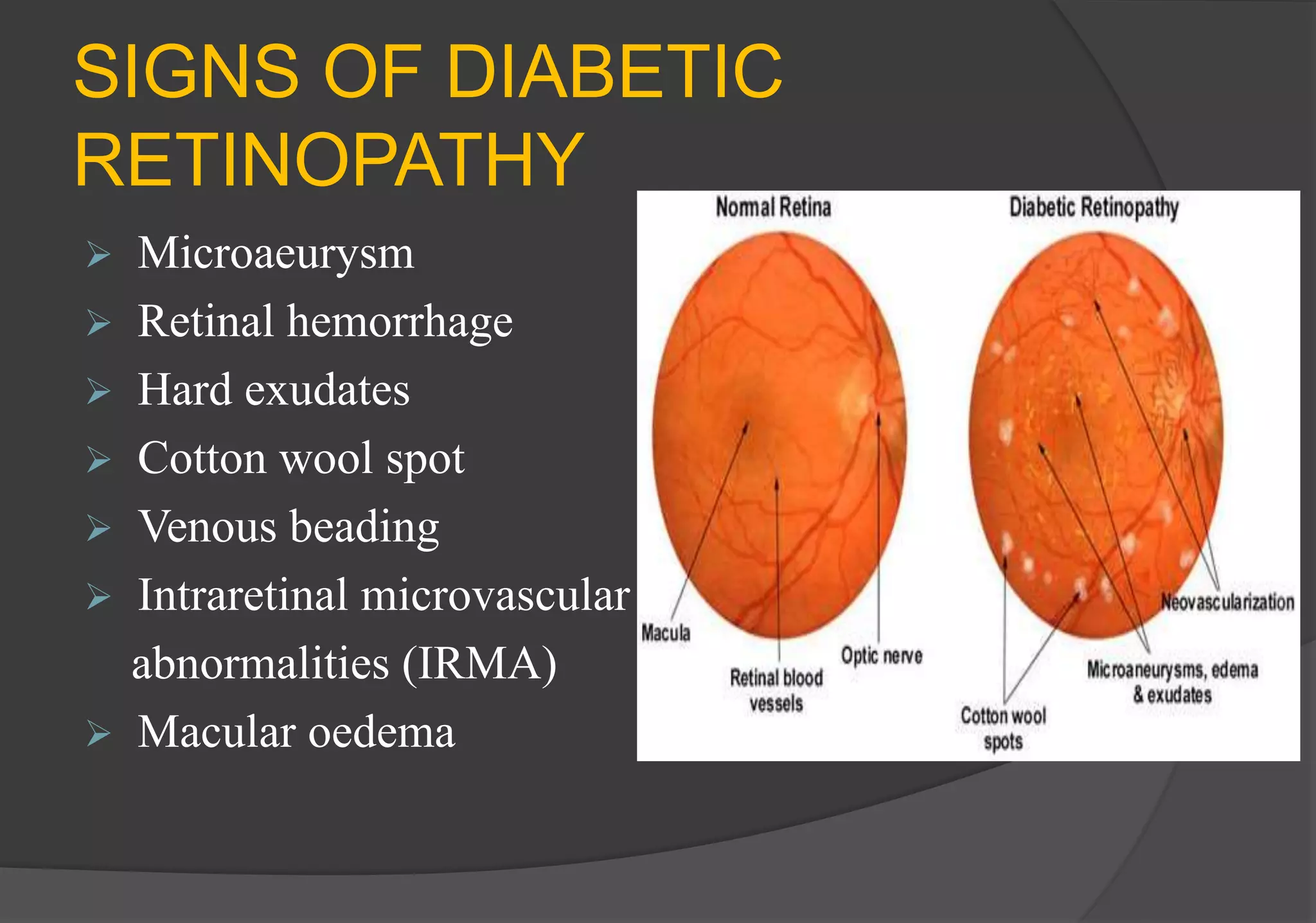
SIGNS OF DIABETIC
RETINOPATHY
 Microaeurysm
 Retinal hemorrhage
 Hard exudates
 Cotton wool spot
 Venous beading
 Intraretinal microvascular
abnormalities (IRMA)
 Macular oedema
Microaneurysm
 Localized saccular outpouchings of capillary wall red dots
• Focal dilatation of capillary wall where pericytes are absent
• Fusion of 2 arms of capillary loop
 Usually seen in relation to areas of capillary non-perfusion
• at the posterior pole in temporal to fovea
 It is the earliest signs of DR
Scattered hyperfluorescent
Microaneurysms may leak plasma
constituents into the retina
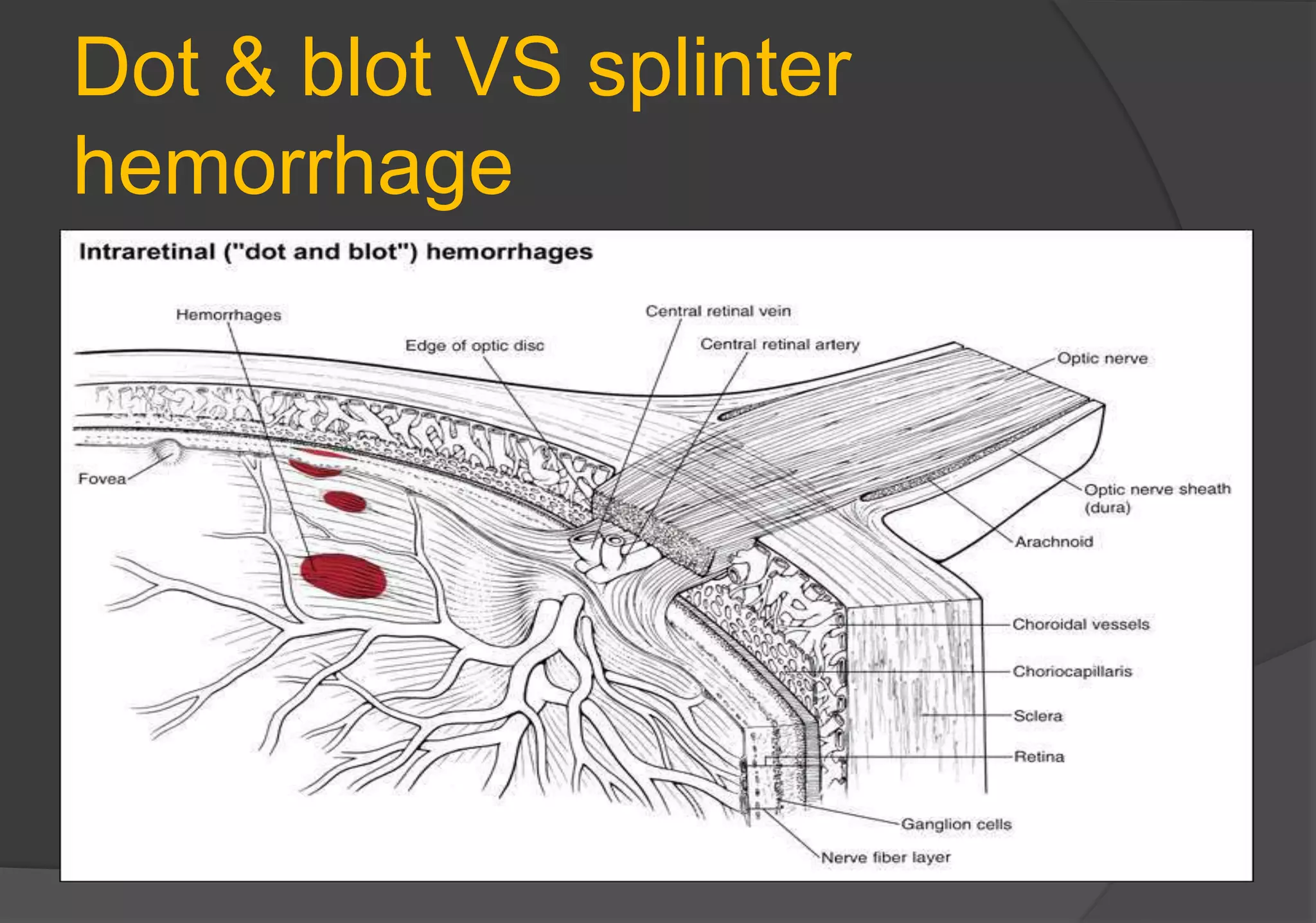
Retinal Hemorrhage
 Capillary or microaneurysm is weakened rupture intraretinal
hemorrhages
 Dot & blot hemorrhages
• Deep hemorrhage - inner nuclear layer or outer plexiform layer
• Usually round or oval
• Dot hemorrhages - bright red dots (same size as large microaneurysms)
• Blot hemorrhages - larger lesions
 Flame-shape or splinter hemorrhages
• More superficial - in nerve fiber layer
• Absorbed slowly after several weeks
• Indistinguishable from hemorrhage in hypertensive retinopathy
• May have co-existence of systemic hypertension BP must be checked
Dot & blot VS splinter
hemorrhage
Hard exudate
 Intra-retinal lipid exudates
 Yellow deposits of lipid and protein within the retina
 Accumulations of lipids leak from surrounding capillaries and
microaneuryisms
 May form a circinate pattern
 Hyperlipidemia may correlate with the development of hard
exudates
Cotton Wool Spot
 White fluffy lesions in nerve fiber layer
 Result from occlusion of retinal pre-capillary arterioles
supplying the nerve fiber layer with concomitant swelling of
local nerve fiber axons
 Also called "soft exudates" or "nerve fiber layer infarctions“
 Fluorescein angiography shows no capillary perfusion in the
area of the soft exudate
 Very common in DR, specially if patient with hypertension.
Hard Exudate VS Cotton Wool
Spot
Venous beading
 Dilatation and beading of retinal vein
 Appearance resembling sausage-shaped dilatation of the
retinal veins
 Sign of severe NPDR
Intraretinal microvascular
abnormalities
(IRMA)
 Abnormal dilated retinal capillaries or may represent
intraretinal neovacularization which has not breached the
internal limiting membrane of the retina.
 Severe NPDR indicate rapidly progress to PDR
Diabetic maculopathy
 Macular ischemia
• Retinal capillary non-perfusion
• Progressive NPDR
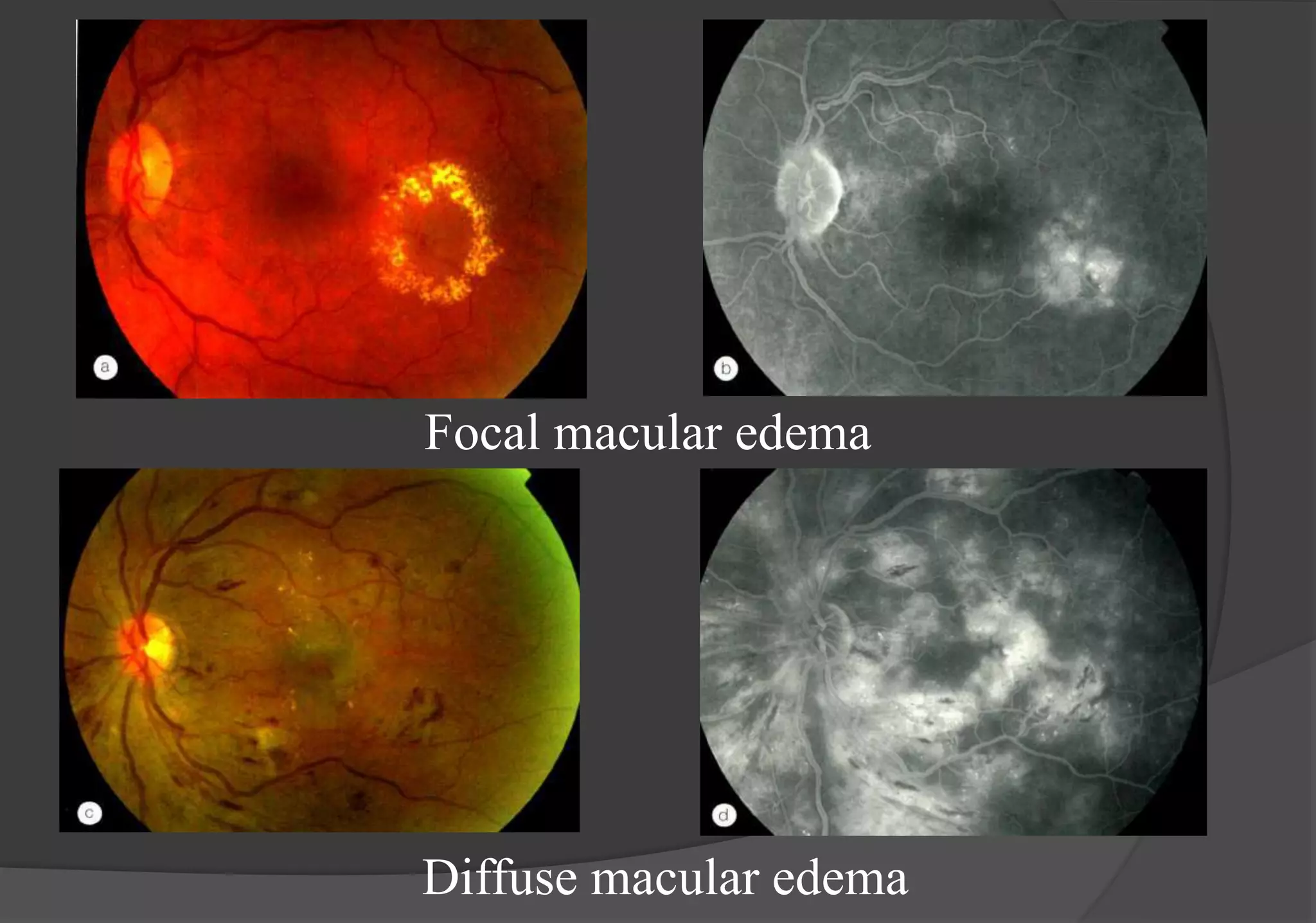
 Macular edema
 Focal or diffuse or mixed
 Increased retinal vascular permeability
 Seen in both NPDR and PDR
 Cause of visual loss in DR
 Important in planning for treatment
Focal macular edema
Diffuse macular edema
Macular ischemia
Clinical Significant Macular
Edema
(CSME)
Retinal edema
within 500 microns
of centre fovea
Hard exudates within
500 microns of fovea
if ass with adjacent
retinal thickening
Retinal edema > 1 disc
diameter, any part is
within 1 disc diameter
of centre of fovea
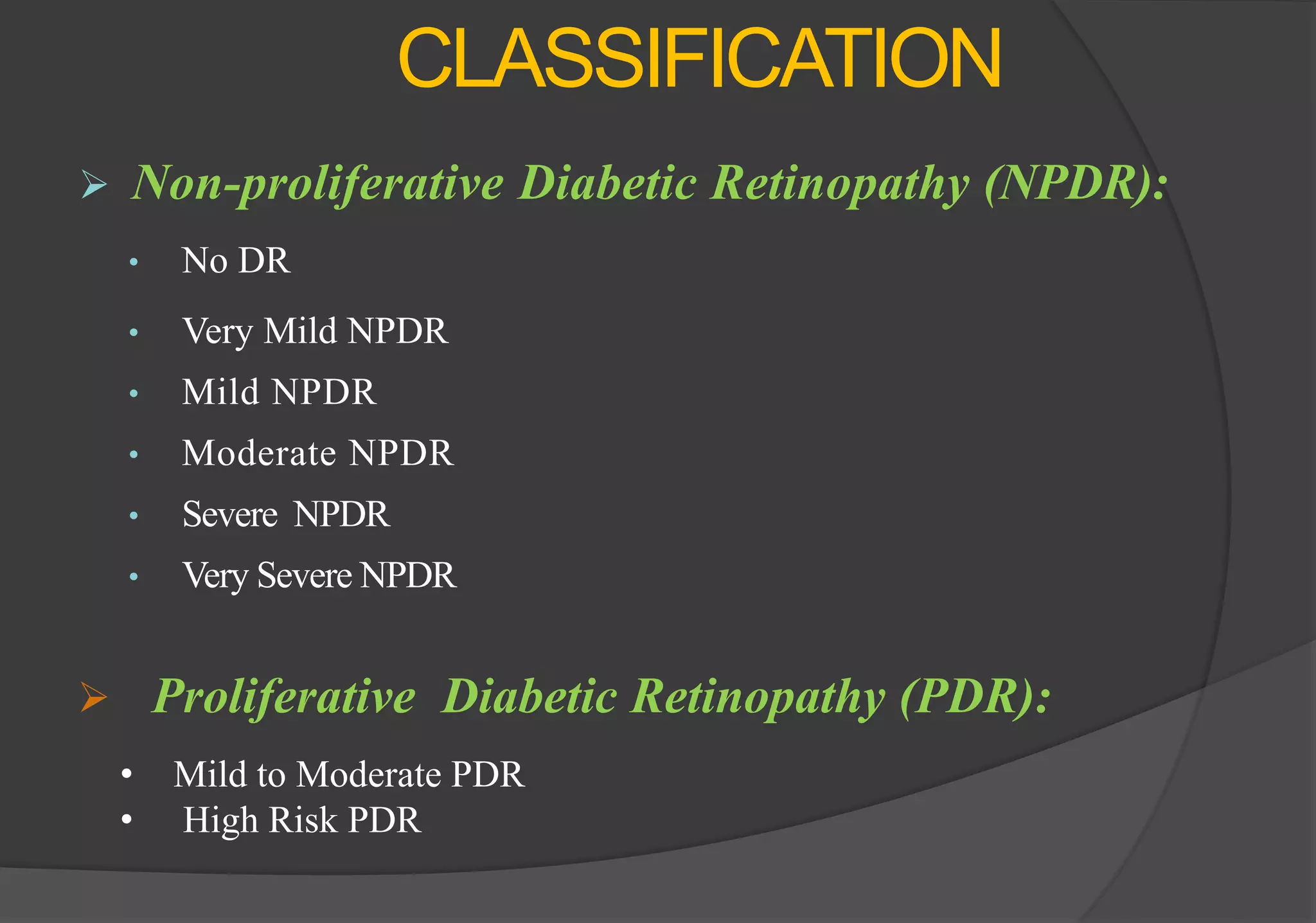
CLASSIFICATION
 Non-proliferative Diabetic Retinopathy (NPDR):
• No DR
• Very Mild NPDR
• Mild NPDR
• Moderate NPDR
• Severe NPDR
• Very Severe NPDR
 Proliferative Diabetic Retinopathy (PDR):
• Mild to Moderate PDR
• High Risk PDR
Nonproliferative diabetic retinopathy
 Very Mild :
Indicated by the presence of at
least 1micro aneurysm.
 Mild :
Microaneurysms, retinal
haemorrhage, exudates, cotton
wool spots.
 Moderate:
• Includes the presence of
hemorrhages(1-3 quadrants), micro -
aneurysms, hardexudates and
Cotton woolspot. Microaneurysm
Exudate
Cotton wool
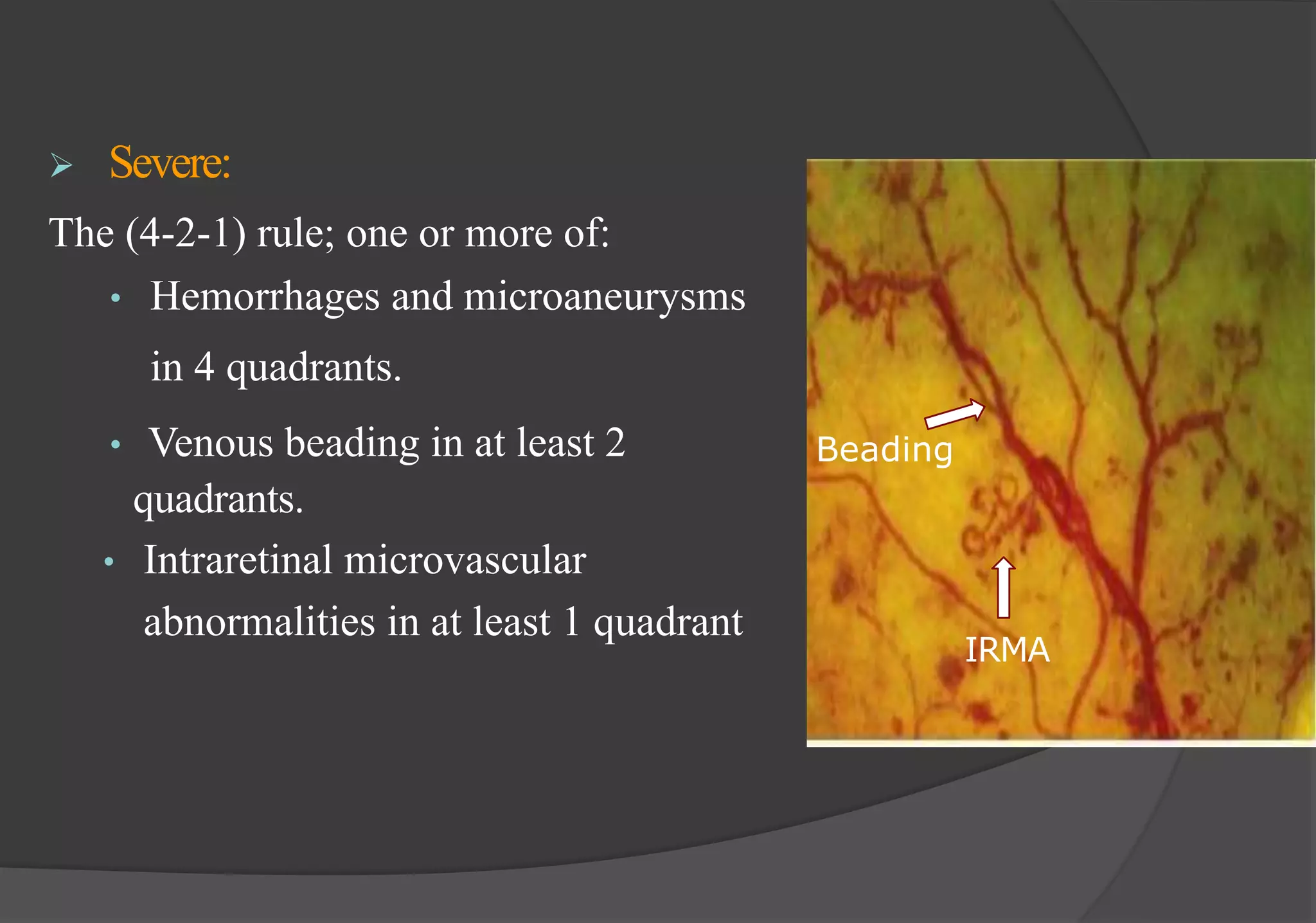
 Severe:
The (4-2-1) rule; one or more of:
• Hemorrhages and microaneurysms
in 4 quadrants.
• Venous beading in at least 2
quadrants.
• Intraretinal microvascular
abnormalities in at least 1 quadrant
IRMA
Beading
Proliferative diabetic
retinopathy
 5% of DM pt.
 Findings-
• Neovascularization : NVD, NVE
• Vitreous changes
 Advanced diabetic eye disease
• Final stage of Uncontrolled PRD
• Glaucoma (neovascularization)
• Blindness from persistent vitreous hemorrhage,tractional
retinal detachment, opaque membrane formation.
Rubeosis iridis
(neovascularisation of
the iris)
Neovascular glaucoma
Diagnostic Testing
 Fundus Fluorescein Angiography:
 To guide treatment of CSME
 To identify Ischemic maculopathy
 Intraretinal microvascular
abnormalities vs Neovascularization
 It can be evaluation in hazy media
 It is not a screening modality
 It is not a routine investigation
 Fundus Photography:
• For documentation purpose
 Optical Coherence Tomography(OCT):
 Non contact
 Non invasive
 Micron resolution
 Cross-sectional study of retina
 Correlates very well with the retinal histology
Optical Coherence Tomography(OCT)
 Qualitative analysis:
 Description by location
 Description of form and structure
 Identification of anomalous structures
 Observation of the reflective qualities of the
retina
 Quantitative analysis:
 Retinal thickness and volume
 Nerve fiber layer thickness.
Retinal Anatomy Compared to OCT
 The vitreous - black space on the top of the image
 Fovea - normal depression
 Umbo- central hyper reflective dot within foveola
 The nerve fiber layer (NFL) and the retinal pigment epithelium (RPE)
• highly reflective than the other layers of the retina ( red – yellow)
 Retinal nerve fiber layer – thicker on nasal side of macula
 Areas of minimal signals ( blue – black)
 Outer nuclear layer – thickest portion
 Ultrasonography ( B- scan) :
• When opaque media preclude retinal examination.
• Useful in ruling out-
• Retinal detachment
• Traction threatening
macular detachment
• Vitreous hemorrhage.
Diabetic retinopathy
Normal
Comparison between Normal Retina & DR
Screening for DR
 Patients withType 1 diabetes should have an
ophthalmologic examination within 5 years
after onset.
 Patients with Type 2 DM should have an
ophthalmologic examination at the time of the
diabetes diagnosis.
 If there is no DR then one annual examination
required.
 If any level of DR, progression and sight
threatening, then examination will be required
more frequently
Screening for DR
 Women with pre existing type 1 or type 2 DM
who are planning pregnancy or pregnant
should be counseled on risk of development &/
or progression of DR.
 Eye examinations should be started from 1st
trimster and monitored every trimster and for 1
year of postpartum period.
Management
 Medical treatment.
 Observation.
 Laser therapy .
 Anti VEGF Agents
 Vitrectomy.
Medical treatment:
 Glucose control :
 controlling diabetes.
 maintaining the HbA1Clevel in the 6-7%range.
 Level of activity :
Maintaining a healthy lifestyle with regular exercise can
help reduce the complication of diabetes and DR.
 Blood pressure control.
 Lipid-lowering therapy.
Laser therapy
 Panretinal photocoagulation (PRP)
 High-risk PDR (3/4)
○ Vitreous or preretinal hemorrhage
○ New vessels on optic disc or within 1,500 microns
from optic disc rim
○ Large new vessels
 Iris or angle neovascularization
 CSME
 Focal or Grid laser
o CSME in both NPDR and PDR
 Inducing involution of new vessels
 Preventing vitreous hemorrhage and preventing visual
loss
 Limitations :
○ Patient must have clear lens and vitreous
○ If cataract treat before laser PRP
○ If vitreous hemorrhage vitrectomy + laser
photocoagulation
(a) before and (b) after focal laser photocoagulation.
(b)
(a)
Focal
laser
Before After
Intravitreal Anti VEGF Agents
 Bevacizumab
 Ranibizumab
 Aflibercept
Surgery
 Pars plana vitrectomy (PPV)
Inications-
○ Severe persistent vitreous hemorrhage
○ Progressive tractional RD (threatening or involving
macula)
○ Combined tractional and rhegmatogenous RD
○ Premacular subhyaloid hemorrhage
○ Recurrent vitreous hemorrhage after laser PRP
 Vitrectomy:
 Removes blood
 Removes Traction
 Allows PRP
Vitrectomy
Aspirin in diabetic
eye
 Aspirin use did not alter progression of diabetic
retinopathy.
 Aspirin use did not increase risk of vitreous
hemorrhage.
 Aspirin use did not affect visual acuity.
 Aspirin reducesriskof cardiovascular morbidity
and mortality.
 Follow up:
Retinal finding Suggested follow-up
Normal Annually
Mild NPDR 1 year
Moderate NPDR 6 months - 1year or refer to
ophthalmologist.
Sever NPDR Every 4 months
DME Every 2-4months
PDR Every 2-3months
Diabetic retinopathy

Diabetic retinopathy

  • 1.
    PRESENTED BY: Dr.Kawshik Nag MS Resident Phase A (Ophthalmology) Chittagong Medical College Diabetic Retinopathy
  • 2.
     Retinopathy isthe most important ocular complication of diabetes. DR is more common in type 1 DM than type 2 DM.  Proliferative Diabetic Retinopathy (PDR) affects 5-10% of diabetic population. Type 1 Diabetes are at particular risks, with an incidence of upto 90% after 30 years.
  • 3.
    RISK FACTORS ofDR Duration of diabetes -Most important • Patient diagnosed before age 30 years • 50% DR after 10 years • 90% DR after 30 years Poor metabolic control • Less important, but relevant to development and progression of DR • Increased HbA1c associated with increased risk.
  • 4.
     Pregnancy • Associatedwith rapid progression of DR • Predicating factors : poor pre-pregnancy control of DM, too rapid control during the early stages of pregnancy, pre-eclampsia and fluid imbalance.  Hypertension • Very common in patients with DM type 2 • Should strictly control (<140/80 mmHg)
  • 5.
     Nephropathy • Associatedwith worsening of DR • Renal transplantation may be ass with improvement of DR and better response to photocoagulation  Other • Obesity, increased BMI, high waist-to-hip ratio • Hyperlipidemia • Anemia
  • 6.
    Pathogenesis  Here microangiopathyoccurs and it leads to: Microvascular occlusion Microvascular leakage
  • 7.
    Hyperglycemia Intracellular sorbitol accumulation Freeradicals Glycated end products Disruption of ion channel function Protein kinase C activation Direct effect Microangiopathy Hematological & on retinal cells (damage to capillary wall) Rheological changes Intra retinal Edema Microvascular Occlusion causes Hemorrhages Exudates Ischemia IRMA Neovascularization hemorrhage Fibrosis Traction
  • 8.
    SYMPTOMS Diabetic retinopathy isasymptomatic in early stages of the disease. As the disease progresses symptoms may include – • Blurred vision • Floaters and flashes • Distorted vision • Dark areas in the vision • Poor night vision • Impaired color vision • Partial or total loss of vision
  • 10.
    SIGNS OF DIABETIC RETINOPATHY Microaeurysm  Retinal hemorrhage  Hard exudates  Cotton wool spot  Venous beading  Intraretinal microvascular abnormalities (IRMA)  Macular oedema
  • 11.
    Microaneurysm  Localized saccularoutpouchings of capillary wall red dots • Focal dilatation of capillary wall where pericytes are absent • Fusion of 2 arms of capillary loop  Usually seen in relation to areas of capillary non-perfusion • at the posterior pole in temporal to fovea  It is the earliest signs of DR
  • 13.
    Scattered hyperfluorescent Microaneurysms mayleak plasma constituents into the retina
  • 14.
    Retinal Hemorrhage  Capillaryor microaneurysm is weakened rupture intraretinal hemorrhages  Dot & blot hemorrhages • Deep hemorrhage - inner nuclear layer or outer plexiform layer • Usually round or oval • Dot hemorrhages - bright red dots (same size as large microaneurysms) • Blot hemorrhages - larger lesions  Flame-shape or splinter hemorrhages • More superficial - in nerve fiber layer • Absorbed slowly after several weeks • Indistinguishable from hemorrhage in hypertensive retinopathy • May have co-existence of systemic hypertension BP must be checked
  • 15.
    Dot & blotVS splinter hemorrhage
  • 18.
    Hard exudate  Intra-retinallipid exudates  Yellow deposits of lipid and protein within the retina  Accumulations of lipids leak from surrounding capillaries and microaneuryisms  May form a circinate pattern  Hyperlipidemia may correlate with the development of hard exudates
  • 20.
    Cotton Wool Spot White fluffy lesions in nerve fiber layer  Result from occlusion of retinal pre-capillary arterioles supplying the nerve fiber layer with concomitant swelling of local nerve fiber axons  Also called "soft exudates" or "nerve fiber layer infarctions“  Fluorescein angiography shows no capillary perfusion in the area of the soft exudate  Very common in DR, specially if patient with hypertension.
  • 22.
    Hard Exudate VSCotton Wool Spot
  • 24.
    Venous beading  Dilatationand beading of retinal vein  Appearance resembling sausage-shaped dilatation of the retinal veins  Sign of severe NPDR
  • 25.
    Intraretinal microvascular abnormalities (IRMA)  Abnormaldilated retinal capillaries or may represent intraretinal neovacularization which has not breached the internal limiting membrane of the retina.  Severe NPDR indicate rapidly progress to PDR
  • 26.
    Diabetic maculopathy  Macularischemia • Retinal capillary non-perfusion • Progressive NPDR  Macular edema  Focal or diffuse or mixed  Increased retinal vascular permeability  Seen in both NPDR and PDR  Cause of visual loss in DR  Important in planning for treatment
  • 28.
  • 29.
  • 30.
    Clinical Significant Macular Edema (CSME) Retinaledema within 500 microns of centre fovea Hard exudates within 500 microns of fovea if ass with adjacent retinal thickening Retinal edema > 1 disc diameter, any part is within 1 disc diameter of centre of fovea
  • 31.
    CLASSIFICATION  Non-proliferative DiabeticRetinopathy (NPDR): • No DR • Very Mild NPDR • Mild NPDR • Moderate NPDR • Severe NPDR • Very Severe NPDR  Proliferative Diabetic Retinopathy (PDR): • Mild to Moderate PDR • High Risk PDR
  • 32.
    Nonproliferative diabetic retinopathy Very Mild : Indicated by the presence of at least 1micro aneurysm.  Mild : Microaneurysms, retinal haemorrhage, exudates, cotton wool spots.
  • 33.
     Moderate: • Includesthe presence of hemorrhages(1-3 quadrants), micro - aneurysms, hardexudates and Cotton woolspot. Microaneurysm Exudate Cotton wool
  • 34.
     Severe: The (4-2-1)rule; one or more of: • Hemorrhages and microaneurysms in 4 quadrants. • Venous beading in at least 2 quadrants. • Intraretinal microvascular abnormalities in at least 1 quadrant IRMA Beading
  • 35.
    Proliferative diabetic retinopathy  5%of DM pt.  Findings- • Neovascularization : NVD, NVE • Vitreous changes  Advanced diabetic eye disease • Final stage of Uncontrolled PRD • Glaucoma (neovascularization) • Blindness from persistent vitreous hemorrhage,tractional retinal detachment, opaque membrane formation.
  • 38.
  • 39.
    Diagnostic Testing  FundusFluorescein Angiography:  To guide treatment of CSME  To identify Ischemic maculopathy  Intraretinal microvascular abnormalities vs Neovascularization  It can be evaluation in hazy media  It is not a screening modality  It is not a routine investigation
  • 41.
     Fundus Photography: •For documentation purpose
  • 42.
     Optical CoherenceTomography(OCT):  Non contact  Non invasive  Micron resolution  Cross-sectional study of retina  Correlates very well with the retinal histology
  • 43.
    Optical Coherence Tomography(OCT) Qualitative analysis:  Description by location  Description of form and structure  Identification of anomalous structures  Observation of the reflective qualities of the retina  Quantitative analysis:  Retinal thickness and volume  Nerve fiber layer thickness.
  • 44.
    Retinal Anatomy Comparedto OCT  The vitreous - black space on the top of the image  Fovea - normal depression  Umbo- central hyper reflective dot within foveola  The nerve fiber layer (NFL) and the retinal pigment epithelium (RPE) • highly reflective than the other layers of the retina ( red – yellow)  Retinal nerve fiber layer – thicker on nasal side of macula  Areas of minimal signals ( blue – black)  Outer nuclear layer – thickest portion
  • 47.
     Ultrasonography (B- scan) : • When opaque media preclude retinal examination. • Useful in ruling out- • Retinal detachment • Traction threatening macular detachment • Vitreous hemorrhage.
  • 48.
  • 49.
    Screening for DR Patients withType 1 diabetes should have an ophthalmologic examination within 5 years after onset.  Patients with Type 2 DM should have an ophthalmologic examination at the time of the diabetes diagnosis.  If there is no DR then one annual examination required.  If any level of DR, progression and sight threatening, then examination will be required more frequently
  • 50.
    Screening for DR Women with pre existing type 1 or type 2 DM who are planning pregnancy or pregnant should be counseled on risk of development &/ or progression of DR.  Eye examinations should be started from 1st trimster and monitored every trimster and for 1 year of postpartum period.
  • 51.
    Management  Medical treatment. Observation.  Laser therapy .  Anti VEGF Agents  Vitrectomy.
  • 52.
    Medical treatment:  Glucosecontrol :  controlling diabetes.  maintaining the HbA1Clevel in the 6-7%range.  Level of activity : Maintaining a healthy lifestyle with regular exercise can help reduce the complication of diabetes and DR.  Blood pressure control.  Lipid-lowering therapy.
  • 53.
    Laser therapy  Panretinalphotocoagulation (PRP)  High-risk PDR (3/4) ○ Vitreous or preretinal hemorrhage ○ New vessels on optic disc or within 1,500 microns from optic disc rim ○ Large new vessels  Iris or angle neovascularization  CSME
  • 54.
     Focal orGrid laser o CSME in both NPDR and PDR  Inducing involution of new vessels  Preventing vitreous hemorrhage and preventing visual loss  Limitations : ○ Patient must have clear lens and vitreous ○ If cataract treat before laser PRP ○ If vitreous hemorrhage vitrectomy + laser photocoagulation
  • 55.
    (a) before and(b) after focal laser photocoagulation. (b) (a)
  • 56.
  • 57.
    Intravitreal Anti VEGFAgents  Bevacizumab  Ranibizumab  Aflibercept
  • 58.
    Surgery  Pars planavitrectomy (PPV) Inications- ○ Severe persistent vitreous hemorrhage ○ Progressive tractional RD (threatening or involving macula) ○ Combined tractional and rhegmatogenous RD ○ Premacular subhyaloid hemorrhage ○ Recurrent vitreous hemorrhage after laser PRP
  • 59.
     Vitrectomy:  Removesblood  Removes Traction  Allows PRP
  • 60.
  • 61.
    Aspirin in diabetic eye Aspirin use did not alter progression of diabetic retinopathy.  Aspirin use did not increase risk of vitreous hemorrhage.  Aspirin use did not affect visual acuity.  Aspirin reducesriskof cardiovascular morbidity and mortality.
  • 62.
     Follow up: Retinalfinding Suggested follow-up Normal Annually Mild NPDR 1 year Moderate NPDR 6 months - 1year or refer to ophthalmologist. Sever NPDR Every 4 months DME Every 2-4months PDR Every 2-3months