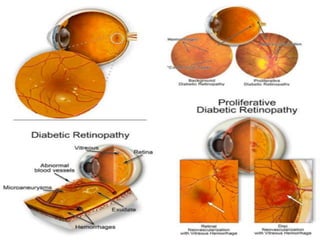
Progressive dysfunction of the 
retinal blood vessels caused by 
chronic hyperglycaemia.
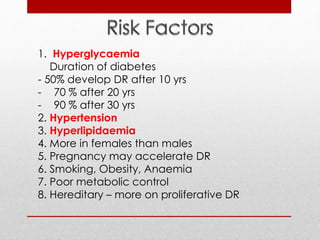
1. Hyperglycaemia 
Duration of diabetes 
- 50% develop DR after 10 yrs 
- 70 % after 20 yrs 
- 90 % after 30 yrs 
2. Hypertension 
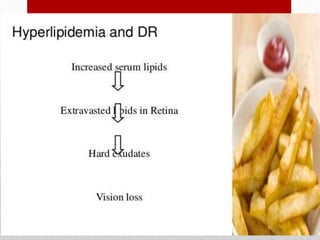
3. Hyperlipidaemia 
4. More in females than males 
5. Pregnancy may accelerate DR 
6. Smoking, Obesity, Anaemia 
7. Poor metabolic control 
8. Hereditary – more on proliferative DR
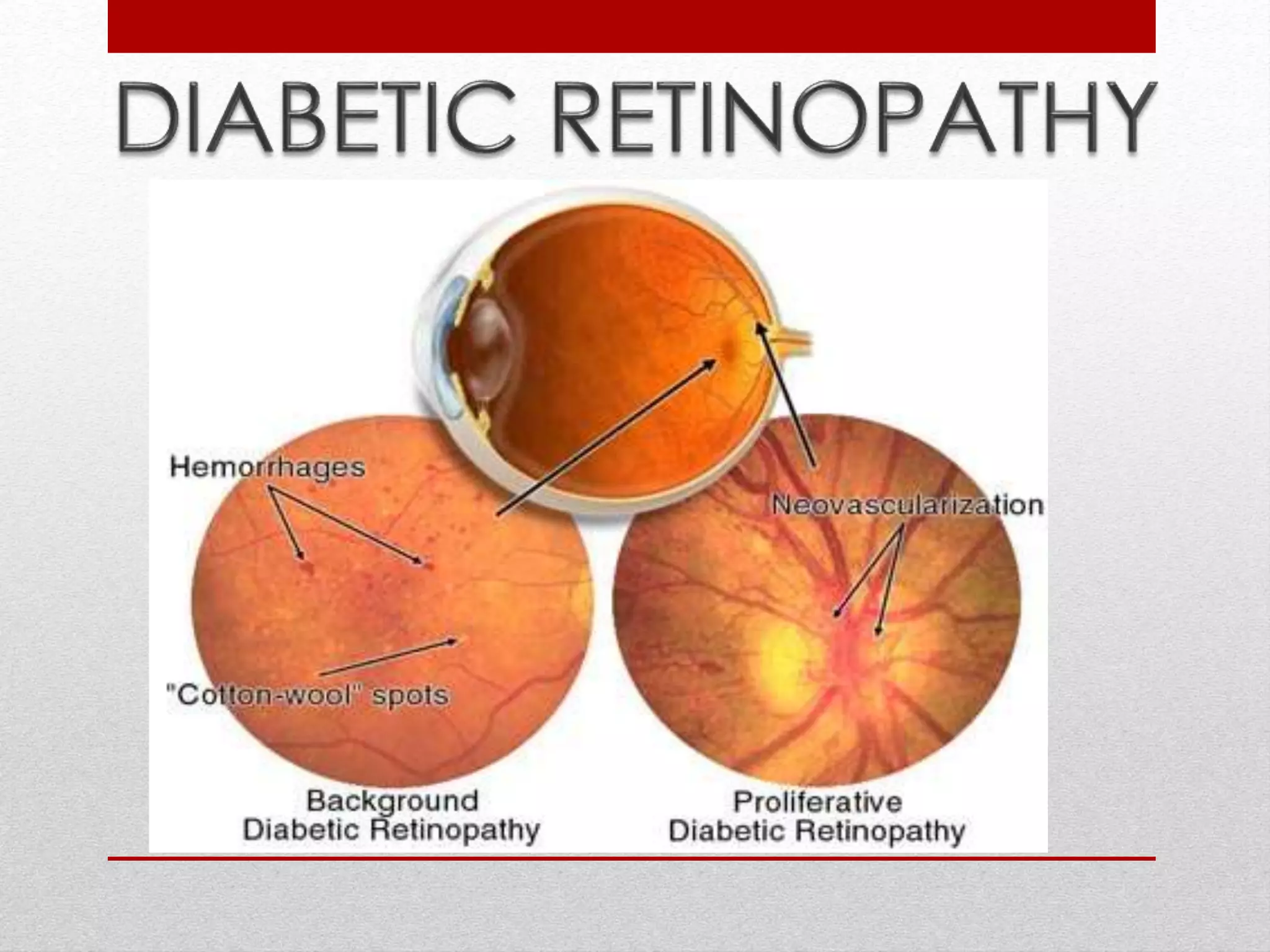
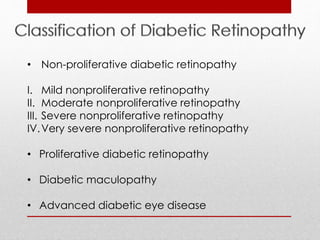
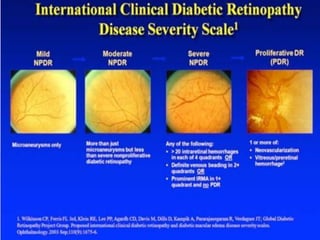
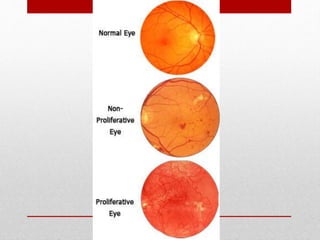
• Non-proliferative diabetic retinopathy 
I. Mild nonproliferative retinopathy 
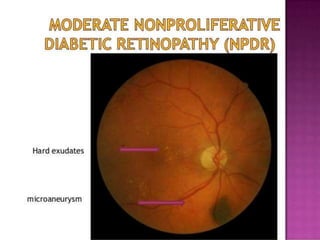
II. Moderate nonproliferative retinopathy 
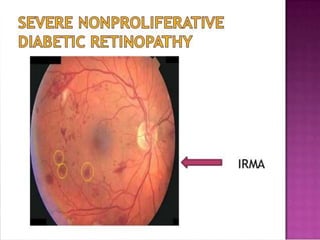
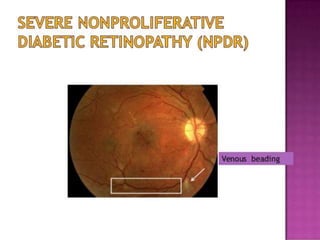
III. Severe nonproliferative retinopathy 
IV.Very severe nonproliferative retinopathy 
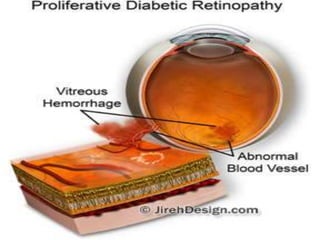
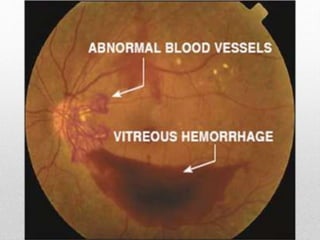
• Proliferative diabetic retinopathy 
• Diabetic maculopathy 
• Advanced diabetic eye disease
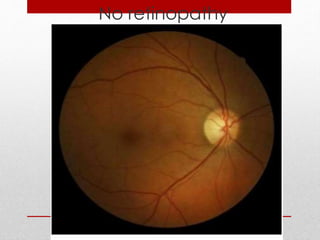
No retinopathy
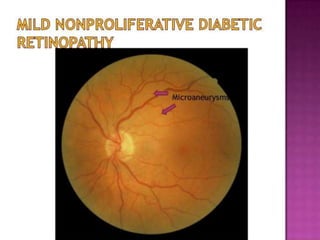
I. Mild nonproliferative retinopathy 
• Atleast one microaneurysm or intraretinal 
haemorrhage 
• Hard/ Soft exduates may or may not be 
present
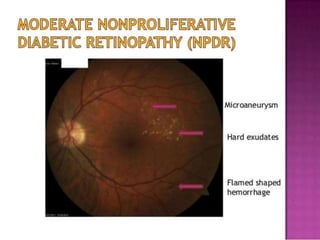
II. Moderate nonproliferative retinopathy 
• Micro aneurysms / intraretinal haemorrhages in 
2 or 3 quadrants 
• Early mild IRMA Intra retinal Microvascular 
abnormalities 
• Hard / Soft exudates may or may not be 
present
III. Severe nonproliferative retinopathy 
Any one of the following : 
• Four quadrants of severe micro aneurysms / 
intraretinal haemorrhages 
• Two quadrants of venous bleeding 
• One quadrant of IRMA changes
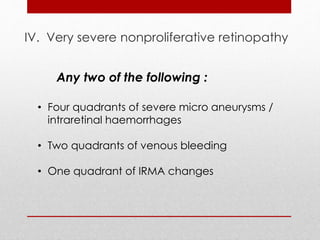
IV. Very severe nonproliferative retinopathy 
Any two of the following : 
• Four quadrants of severe micro aneurysms / 
intraretinal haemorrhages 
• Two quadrants of venous bleeding 
• One quadrant of IRMA changes
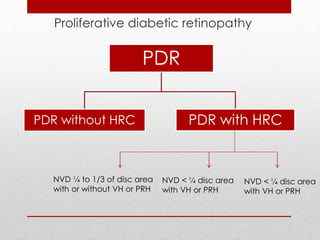
Proliferative diabetic retinopathy 
PDR 
PDR without HRC PDR with HRC 
NVD ¼ to 1/3 of disc area 
with or without VH or PRH 
NVD < ¼ disc area 
with VH or PRH 
NVD < ¼ disc area 
with VH or PRH
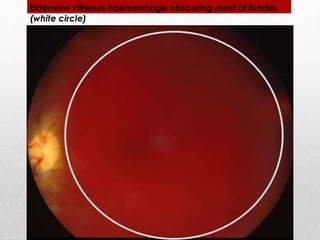
Extensive vitreous haemorrhage obscuring most of fundus 
(white circle)
Diabetic Maculopathy 
On Slit lamp examination with 90D lens : 
1. Thickening of retina at or within 500 micron of the centre of 
fovea 
2. Hard exudates at or within 500 micron of the centre of fovea 
associated with adjacent retinal thickening 
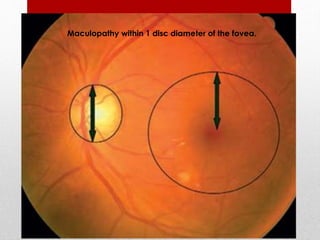
3. Development of a zone of retinal thickening one disc diameter 
or larger in size, at least a part of which is within one disc 
diameter of foveal centre.
Maculopathy within 1 disc diameter of the fovea.
Advanced diabetic eye disease 
1. Persistent vitreous haemorrhage 
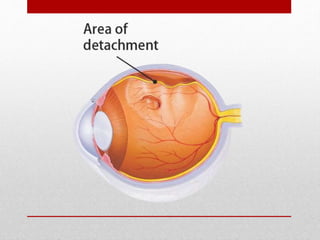
2. Tractional retinal detachment 
3. Neovascular glaucoma
Investigations 
1. Urine examination 
2. Blood sugar estimation 
3. 24 hour urinary protein 
4. Renal function tests 
5. Lipid profile 
6. Haemogram 
7. Glycosylated Haemoglobin (HbA1C) 
8. Fundus Fluorescein angiography – to 
elucidate areas of neovascularisation, 
leakage and capillary nonperfusion 
9. Optical Coherence Tomography to study 
detailed structural changes in diabetic 
maculopathy
Prevention 
1. Primary Prevention – 
Strict glycemic control, 
Blood pressure control, 
correction of dyslipidaemia, 
control of associated anaemia, 
control of hypoproteinemia 
2.Secondary Prevention – Annual eye exams 
3. Tertiary Prevention – Retinal laser 
photocoagulation , 
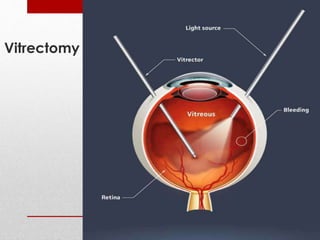
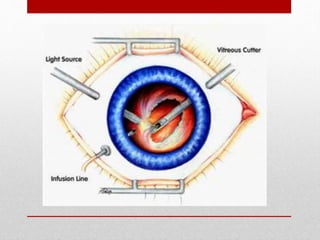
Vitrectomy
Treatment of Diabetic Retinopathy 
1. Anti – vascular endothelial growth factors 
2. Others under evaluation – Protein Kinase C 
inhibitors, Aldose reductase, ACE inhibitors, 
Antioxidants such as vitamin E 
3. Role of intravitreal steroids – Flucinolone 
acetonide intravitreal implant, Inj. 
Triamcinolone intravitreal
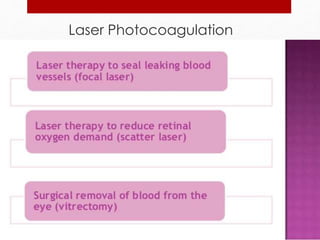
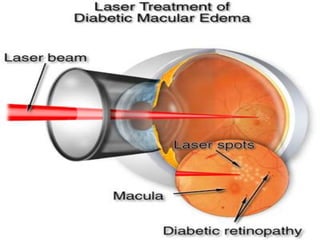
Laser Photocoagulation
Vitrectomy
Latest Treatment modalities for Diabetic Retinopathy 
September 16, 2014 
Eylea Granted Breakthrough Therapy for Diabetic Retinopathy 
Food and Drug Administration (FDA) has granted Eylea (afilbercept) 
Injection Breakthrough Therapy designation for the treatment of 
diabetic retinopathy in patients with diabetic macular edema 
(DME). 
Eylea is a vascular endothelial growth factor (VEGF) inhibitor designed 
to block the growth of new blood vessels and decreases vascular 
permeability in the eye by blocking VEGF-A and placental growth 
factor (PlGF), two growth factors involved in angiogenesis. 
Eylea helps prevent VEGF-A and PlGF from interacting with their natural 
VEGF receptors as shown in preclinical studies. 
Eylea is already approved for the treatment of neovascular (wet) age-related 
macular degeneration (AMD) and macular edema following 
central retinal vein occlusion (CRVO).
Human trials begin for promising diabetic retinopathy 
treatment 
Fri, 05 Sep 2014 
Human trials are set to begin for a new medication, currently called KVD001, 
which treats diabetic macular edema, a form of diabetic retinopathy. 
KVD001 is an intravitreal plasma kallikrein inhibitor drug that is given 
byinjection into the eye. Whilst injections into the eye may sound painful, in 
practice they are not as eye-watering as they sound. 
There is currently only one medication, Lucentis, has been officially licensed for 
treatment of diabetic macular edema. Having another medication such as 
KVD001 would give doctors more choice over which treatment to give and, 
because it works in a different way to Lucentis, it means that it could help save 
thesight of people for whom Lucentis is not effective. 
KVD001 has been developed by KalVista Pharmaceuticals, a company in 
Hampshire. The clinical trials, which will be run across five different centres within 
the United States, are being funded by the type 1 diabetes charity, the JDRF.
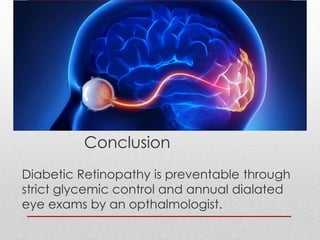
Conclusion 
Diabetic Retinopathy is preventable through 
strict glycemic control and annual dialated 
eye exams by an opthalmologist.

Diabetic retinopathy

  • 4.
    Progressive dysfunction ofthe retinal blood vessels caused by chronic hyperglycaemia.
  • 5.
    1. Hyperglycaemia Durationof diabetes - 50% develop DR after 10 yrs - 70 % after 20 yrs - 90 % after 30 yrs 2. Hypertension 3. Hyperlipidaemia 4. More in females than males 5. Pregnancy may accelerate DR 6. Smoking, Obesity, Anaemia 7. Poor metabolic control 8. Hereditary – more on proliferative DR
  • 11.
    • Non-proliferative diabeticretinopathy I. Mild nonproliferative retinopathy II. Moderate nonproliferative retinopathy III. Severe nonproliferative retinopathy IV.Very severe nonproliferative retinopathy • Proliferative diabetic retinopathy • Diabetic maculopathy • Advanced diabetic eye disease
  • 12.
  • 13.
    I. Mild nonproliferativeretinopathy • Atleast one microaneurysm or intraretinal haemorrhage • Hard/ Soft exduates may or may not be present
  • 15.
    II. Moderate nonproliferativeretinopathy • Micro aneurysms / intraretinal haemorrhages in 2 or 3 quadrants • Early mild IRMA Intra retinal Microvascular abnormalities • Hard / Soft exudates may or may not be present
  • 18.
    III. Severe nonproliferativeretinopathy Any one of the following : • Four quadrants of severe micro aneurysms / intraretinal haemorrhages • Two quadrants of venous bleeding • One quadrant of IRMA changes
  • 21.
    IV. Very severenonproliferative retinopathy Any two of the following : • Four quadrants of severe micro aneurysms / intraretinal haemorrhages • Two quadrants of venous bleeding • One quadrant of IRMA changes
  • 22.
    Proliferative diabetic retinopathy PDR PDR without HRC PDR with HRC NVD ¼ to 1/3 of disc area with or without VH or PRH NVD < ¼ disc area with VH or PRH NVD < ¼ disc area with VH or PRH
  • 24.
    Extensive vitreous haemorrhageobscuring most of fundus (white circle)
  • 29.
    Diabetic Maculopathy OnSlit lamp examination with 90D lens : 1. Thickening of retina at or within 500 micron of the centre of fovea 2. Hard exudates at or within 500 micron of the centre of fovea associated with adjacent retinal thickening 3. Development of a zone of retinal thickening one disc diameter or larger in size, at least a part of which is within one disc diameter of foveal centre.
  • 31.
    Maculopathy within 1disc diameter of the fovea.
  • 32.
    Advanced diabetic eyedisease 1. Persistent vitreous haemorrhage 2. Tractional retinal detachment 3. Neovascular glaucoma
  • 34.
    Investigations 1. Urineexamination 2. Blood sugar estimation 3. 24 hour urinary protein 4. Renal function tests 5. Lipid profile 6. Haemogram 7. Glycosylated Haemoglobin (HbA1C) 8. Fundus Fluorescein angiography – to elucidate areas of neovascularisation, leakage and capillary nonperfusion 9. Optical Coherence Tomography to study detailed structural changes in diabetic maculopathy
  • 35.
    Prevention 1. PrimaryPrevention – Strict glycemic control, Blood pressure control, correction of dyslipidaemia, control of associated anaemia, control of hypoproteinemia 2.Secondary Prevention – Annual eye exams 3. Tertiary Prevention – Retinal laser photocoagulation , Vitrectomy
  • 36.
    Treatment of DiabeticRetinopathy 1. Anti – vascular endothelial growth factors 2. Others under evaluation – Protein Kinase C inhibitors, Aldose reductase, ACE inhibitors, Antioxidants such as vitamin E 3. Role of intravitreal steroids – Flucinolone acetonide intravitreal implant, Inj. Triamcinolone intravitreal
  • 37.
  • 40.
  • 42.
    Latest Treatment modalitiesfor Diabetic Retinopathy September 16, 2014 Eylea Granted Breakthrough Therapy for Diabetic Retinopathy Food and Drug Administration (FDA) has granted Eylea (afilbercept) Injection Breakthrough Therapy designation for the treatment of diabetic retinopathy in patients with diabetic macular edema (DME). Eylea is a vascular endothelial growth factor (VEGF) inhibitor designed to block the growth of new blood vessels and decreases vascular permeability in the eye by blocking VEGF-A and placental growth factor (PlGF), two growth factors involved in angiogenesis. Eylea helps prevent VEGF-A and PlGF from interacting with their natural VEGF receptors as shown in preclinical studies. Eylea is already approved for the treatment of neovascular (wet) age-related macular degeneration (AMD) and macular edema following central retinal vein occlusion (CRVO).
  • 43.
    Human trials beginfor promising diabetic retinopathy treatment Fri, 05 Sep 2014 Human trials are set to begin for a new medication, currently called KVD001, which treats diabetic macular edema, a form of diabetic retinopathy. KVD001 is an intravitreal plasma kallikrein inhibitor drug that is given byinjection into the eye. Whilst injections into the eye may sound painful, in practice they are not as eye-watering as they sound. There is currently only one medication, Lucentis, has been officially licensed for treatment of diabetic macular edema. Having another medication such as KVD001 would give doctors more choice over which treatment to give and, because it works in a different way to Lucentis, it means that it could help save thesight of people for whom Lucentis is not effective. KVD001 has been developed by KalVista Pharmaceuticals, a company in Hampshire. The clinical trials, which will be run across five different centres within the United States, are being funded by the type 1 diabetes charity, the JDRF.
  • 44.
    Conclusion Diabetic Retinopathyis preventable through strict glycemic control and annual dialated eye exams by an opthalmologist.